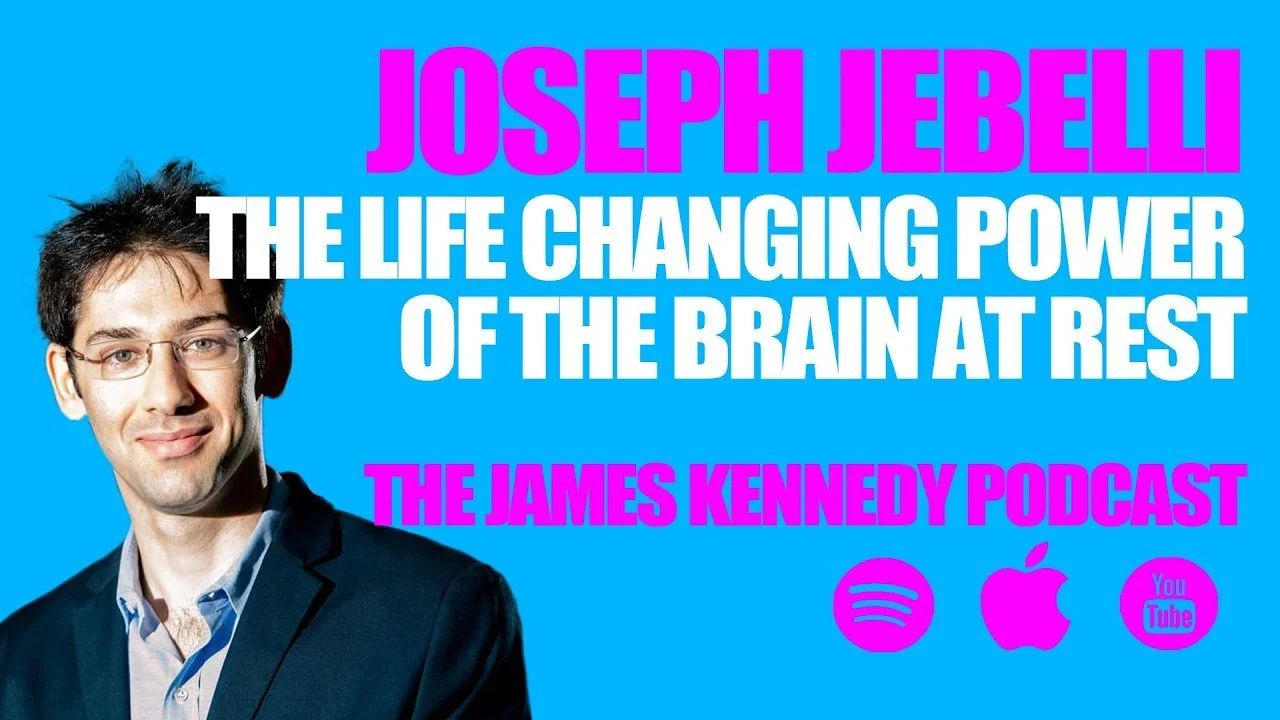
DR JOSEPH JEBELLI - REST YOUR BRAIN, CHANGE YOUR LIFE
James Kennedy speaks with neuroscientist and author Dr. Joseph Jebelli about his book The Brain at Rest. They discuss how overwork and constant digital stimulation harm cognitive health, and explore how activating the brain's default mode network through true rest—such as nature walks, daydreaming, napping, and short breaks—enhances memory, creativity, and long-term productivity
James Kennedy: I personally cannot wait to tuck into this one and welcome onto the show, the brilliant Dr. Joseph Jebelli. How are you doing, man?
Joseph Jebelli: Hi, James. I'm good. Good to be with you.
James Kennedy: Thanks so much for doing this, man. We really appreciate it. And as I said in the intro, I am somebody that definitely needs to be with you. I'm really pleased to hear what you've got to say today because I am a chronic nonstopper. But before we jump into the subject at hand today, could you give the listeners a brief overview of who you are, what you do, and the sort of things that you're involved in?
Joseph Jebelli: Yes. So I'm a neuroscientist by training. So I did my PhD in cell and molecular neuroscience at University College London. And then I worked as a postdoctoral researcher in America at University of Washington in Seattle. And again, it was very cell and molecular, looking at basically brain diseases and looking at a bunch of different brain diseases like ataxia and Parkinson's disease and multiple sclerosis, lots of different things. And I've spent the last couple of years writing quite a lot about neuroscience. And so I wrote my first book about Alzheimer's disease and sort of humanity's hunt for a cure, and I wrote a book about brain evolution as well. And then I started to become really interested in rest and the neuroscience of rest, basically for two reasons: personal and professional, really. So I realized that I was overworking myself. I say in the book that I was going through a phase where I was going into the lab like six or seven in the morning, working on experiments all day long, mentoring students, writing grants. And then I would leave the lab at like seven or eight o'clock at night and I would go straight to a coffee shop and I would work on my first book or a grant or something. And because I was basically in this phase where you just think the faster you run, the more you'll achieve, the harder you work, if you just outwork other people, you'll get what you want, right? And, unsurprisingly, my health started to really take a hit. So my memory started suffering, I was less creative, and I just started to get quite unwell. And so I decided to step back a little bit and not work as hard. Still work hard—I'm still a hardworking, ambitious person—but I just decided to stop overworking myself. And it was also because I'd seen what happened with overwork with my parents as well. So I talk a little bit about my dad and my mom in the book, because they've both worked so hard and have basically worked to the point of burnout. And my father now lives with major depressive disorder as a result. My mom, her blood pressure is so high, the GP asks her for almost daily blood pressure recordings. She's technically in a hypertensive emergency all the time because of her blood pressure. And so it was interesting, because as soon as I started to step back a little bit, I noticed not just that my health returned, but things like my memory and my creativity and my problem-solving returned. And I thought, oh, that's really interesting. What is it about rest that is having these really profound impacts on the brain? And that's when I started to look into what rest is for your brain, true rest, and what it does. And that's when it's just an absolutely extraordinary area of neuroscience, which I explore in the book.
James Kennedy: You've got me fascinated already. I mean, it's such a shame, isn't it? In our society these days, in our culture, the message is that of crushing it. And as you said, outworking the competition and being a winner and all that sort of stuff. Like it's a trophy. You know, working yourself to death, it's almost like a badge of honor. It's such a strange place to have ended up. I'm sure we're going to get into all that and so much more because I've got so many things I want to ask you. So to open that up, what would you say is the central overarching message or main discovery of your book, The Brain at Rest?
Joseph Jebelli: So basically, the book is about the fact that we have our understanding of work and rest completely upside down. So we think that when we rest, our brain is kind of like a muscle and that it's powering down and we're not really doing anything, and that taking time off work and resting too much is kind of lazy, indulgent, unprincipled, or even maybe a bit reckless. But the precise opposite is true. So basically, when you rest, your brain activates a network that we call the default network. And we now know that when you activate your default network with rest, you improve your intelligence, your creativity, your memory, your problem-solving abilities. It even lowers your chances of developing things like depression and dementia. And so it's such an exciting area of neuroscience because it's only really been discovered in the past few years. The default network itself was discovered in 2001, but only in the past few years have we really begun to understand that actually people are succeeding in life not despite their inactivity, but because of their inactivity, right? Because the default network occupies 20% of your brain, whereas your working brain network, what we call the executive network, actually only occupies about 5% of the brain. So there are so many cognitive benefits to be had, and that's what I'm trying to get across in the book. And true rest for the brain is not like looking at your phone or binging on Netflix. Those things feel restful mostly because they're just a distraction from what you were just doing. You're in the office, you're doing your work, and you look at your phone, and it feels restful because you're not looking at your work anymore. But it's a trick; it's masquerading as rest. That's not true rest for the brain. So true rest for the brain is things like staring out of the window and letting your mind wander. It's things like going for a walk, especially in green space. Green space has a whole bunch of really profound benefits on the brain that we can discuss. It's things like taking a 30-minute nap, which we now know actually enlarges your brain by 15 cubic centimeters, which to put into context is the volume of a small plum. So it's really big, you know? And it's things like taking more breaks throughout the day. It's things like engaging in more play, just embracing things like silence, which we know stimulates things like BDNF, a protein that really helps sprout new neurons and helps defend you against things like Alzheimer's. So these are truly restful things to the brain, and they activate this default network. And it's this default network that I really want to encourage people to activate more. There's a reason why you're working on a problem and you can't get it, and you get exhausted and burnt out, and then you think, sod it, I'm just going to go for a walk. And then five or 10 minutes into your walk, the solution just pops into your head. That's your default network busily working on the problem without you even thinking about it. So the book is basically about what rest is for the brain and why it's so beneficial, and that actually rest is the secret to sustained productivity, not work. It's rest that is driving not just your best thinking abilities, but your best long-term productivity and your best work.
James Kennedy: Oh, that's fascinating stuff, man. And the fact that it's actual tangible physical evidence that you can look at on a screen must be pretty mind-blowing. But what about something that's just occurred to me whilst I was listening to you then? What about rumination, though? Because all that happens to me when I start daydreaming or looking out of a window is I start ranting with somebody in my head, start arguing, start going over old things, and getting anxious about future things that haven't happened yet. It's very unrelaxing. So I think that's why I personally tend to keep myself so busy all of the time, to sort of block out that internal asshole. Is that a separate conversation or does that tie in somehow with what we're talking about here?
Joseph Jebelli: No, that's a really good question. So basically, all of the research into mind wandering and daydreaming explores the positive aspects, but there is this side to it, as you said, about rumination. And I get this too, right? I'll stare out the window for a couple of minutes and let my mind wander, but sometimes if I'm doing it for a bit too long or if it's just not the right time of day or if something else is bothering me in the day, I start ruminating and overthinking. And so what I would say about that is if you find that you're mind wandering and you start ruminating, just stop doing it and go and do something else, right? Because I don't want people to avoid the cognitive benefits of daydreaming out of fear of rumination happening. If rumination does start to happen and you start overthinking, getting anxious, then just go and do something else and come back to it at another time. Like, I find that if I'm having a bath, for instance, I mind wander in quite a positive and productive way. So it's just about finding the conditions that you yourself find enjoyable to have a positive daydreaming experience.
James Kennedy: Right, love it. Yeah, well, I totally agree with you about walking as well, because for some reason if I go out walking in nature—I'm lucky I live in South Wales, there's lots of it around—and as a creative person as well, exactly like you said, I can go out for a walk and 10 minutes later the thing that I'm not actively thinking about anymore, the solution will just come. So I totally get that. On the flip side of that, I also do experience what you described as well with the burnout. Now, I'm someone that pushes myself very, very hard. I really never get a day off or any time off ever, really. I won't let myself; I'm always juggling and doing something. I'm self-employed, so there's always that pressure to never take your eye off the ball for a second. And every now and then, every few weeks, I hit a point where I'm just completely and utterly burnt out. My memory starts going, I'm struggling to find the right words, I start getting really gnarky and nasty and depressed, I start hating myself, hating the world. It's pretty grim. And whether I want to or not, a self-imposed kind of lockdown almost happens against my will. I'm just so exhausted that I end up just hiding away for a day or two, just kind of doing nothing. And I'm starting to learn now the pattern that after a day or two of just doing nothing, the fog suddenly starts to lift. I catch up on my sleep, I just watch mindless crap on the telly, and I sit and stare and I daydream. And it's not intentional, but I do know now from habit that after two days of doing that, I'll start to feel so much better. My optimism comes back, my faith in humanity comes back, my sense of possibility comes back. Is all of that, the good and the bad stuff, because of what you're describing?
Joseph Jebelli: Yeah, absolutely. So there are lots of really interesting things there. The thing about doing nothing is it's not really like meditation. Meditation is all focused very much on the present, focused on things like your breathing, and it's a very focused and engaged exercise. This is far more effortless than that, doing nothing. And so the way to think about this is when you actually look at the neuroscience of work as well as the neuroscience of rest. The reason you feel so bad when you're overworking is because overwork does loads of really bad things to the brain. One of the things it does is that it actually thins your frontal cortex in the same way that aging does, so it literally makes your brain older than it is. It also shrinks the hippocampus, the brain region really important for memory, which is why you struggle with things like short-term memory and working memory. It enlarges a region called the amygdala, which is really important for our fight or flight response. That's why overworked people are often very much on edge, very anxious, very tense. And psychologically, overwork is basically broken down into three stages. It starts off with just dissatisfaction, so you're not happy with your work, but that's kind of a manageable feeling, so you just get on with it. But if you ignore that signal, it then moves on to cynicism, and that's where you basically just don't care about your job anymore; it's just something you've been doing for a long time and you've got to do, and I think a lot of people are at that stage. And if you ignore that without taking much more rest, it then moves into the phase of dehumanization, and that's a phase that's very much an emotional hardening, a complete detachment from your colleagues, from your friends and family. It's where you just feel really angry, really grouchy, you have feelings of dread and anxiety, depression, and incompetence. You sort of walk around and it's almost like you wear those feelings like skin, like they've just always been there. And if you ignore that, that then basically leads to all of the neurobiological damage associated with overwork. And it's really interesting—they've done these fascinating longitudinal studies in Scandinavia, and they've shown that once the symptoms of overwork set in, it can actually take your brain up to three years to recover, three years for your brain to return to its baseline ability to solve cognitive problems and tasks. So I would argue that we're all somewhere along that three-year spectrum of overwork. And so when you say, "Okay, enough's enough," and you take time out and you go and sit in the park, not only are you preventing all of that damage from happening and reversing much of it, but you're engaging your resting brain, your default network. And so that's restoring and replenishing your memory and your problem-solving abilities. Being in green space, as an example: we know that when you spend time in nature and green spaces like just a park, your creativity and problem-solving ability goes up by 50 percent. Your memory recall goes up by 20 percent. And part of the reason we think that's true is because when you're in a green space, your brain waves essentially shift from these very busy and anxious beta waves to much more daydreaming, calming, and reflective alpha waves, and even meditative theta waves. And another reason we think that's true as well is because nature abounds with what psychologists call soft fascinations—these are things that just hold your attention in an effortless way. There's a reason why when you sit on a park bench and just watch the rustling of the leaves, or you're at the beach and you look at the lapping of the waves, those things hold your attention in a very effortless way. And when you contrast that to what psychologists call hard fascinations—these are things like your phone, LED billboards, train announcements, bosses, deadlines—all of those things just lead to cognitive fatigue and overwork for your brain. So yeah, exactly when you say, "I've had enough and I'm taking a day off to relax in the park," that's exactly what you're doing: you're activating your resting brain and you're getting all of the cognitive benefits and all of the health benefits of that as well. So many people say to me that they feel guilty, and I just say, "Well, that's productivity guilt. That's the guilt that has come from our society telling you that you should equate your value and worth as a human being with your economic output, right?" That's a hard thing to let go of, but you have to let go of it because it literally is killing you. 745,000 people a year now are dying of overwork. In Japan, they even have a word for it; they call it karoshi. And so you have to let go of that guilt and actually understand that it's not just your body that's resting, your brain is resting, and by resting, it's not powering down, it's powering up and it's doing loads of really important things.
ENJOYING THE CONVERSATION?
GET JAMES KENNEDY'S LATEST INTERVIEWS, WRITING AND LIVE SHOWS STRAIGHT TO YOUR INBOX.
James Kennedy: There is almost like a very interesting irony there then, isn't there? It's like if you want to crush it and be super productive and all that stuff, then actually you need to be resting more.
Joseph Jebelli: Yeah, absolutely. That's one of the key things that I want to get across to people as well, because I think it can be easy to misunderstand the message. When you're doing nothing, your brain's doing a lot of something. We know from a mountain of research now that having more rest, taking your work-life balance a lot more seriously, massively improves your long-term productivity, right? And because we're in this hustle-overwork culture, all we're doing is prioritizing short-term productivity, and we're doing it at the expense of long-term productivity. And so if you want true, sustainable, long-term productivity, you have to rest your brain a lot more.
James Kennedy: Amen to that, yeah. Beautifully put. Is there a ratio then? Does it depend on the person, does it depend on the circumstances, or have you found something in the studies that proves there is some kind of ratio between active brain engagement to this soft focus of rest that you're talking about? Is it half an hour in the day, is it much more than that?
Joseph Jebelli: It depends basically because there are so many different ways to rest your brain and they all have slightly different benefits. They all seem to activate the default network. The interesting thing about the default network is it's kind of an all-or-nothing phenomenon: once one part of the default network is active, the rest of it will often activate as well, which is great because it means that you can do something restful like going for a walk and it'll activate your default network, but you can also mind wander and it will activate your default network. But each individual type of rest also seems to have slightly different benefits for the brain, and some of this is still being fleshed out by neuroscientists. But we know a 30-minute nap in the day, as I said, grows your brain by the volume of a small plum. We know that people who take breaks throughout the day—if you try, for instance, the Pomodoro technique where it's 25 minutes of work and then five minutes of rest—your cognitive abilities improve and your long-term productivity improves. We know that people who have lots of micro-breaks throughout the day, like five to 10 minutes every hour, for instance, instead of just one slightly longer break in the day, will actually have more cognitive benefits and it will be better for your resting brain than ignoring those micro-breaks and just having a half-hour to an hour break in the day. So I suppose it's more about understanding that we are massively overworking, we're massively overusing our executive network, our brain's working network, and we're massively underusing the default network, the resting brain network. And so we need to completely restore that balance, and we just need to take rest a lot more seriously. We need a lot more of it. If I had a magic wand, I would put us all on the four-day workweek straight away, because so many studies have been done on this now, including a huge trial in Iceland, that show at worst productivity stays the same, and at best it massively improves. And when you think about it, it totally makes sense. One of my favorite studies looked at consultants, and they showed that they couldn't tell the difference between people who worked 80 hours a week and people who just pretended to work. So much of our time is spent just on presenteeism: you're just there because it looks good, but you're not actually doing any productive work. I used to work eight, 10, 12 hours sometimes a day, and I wasn't actually getting that much done. So now, for instance, I'll work really hard for five to six hours a day, but I'll get a lot more done than I did when I was just grinding out ridiculous hours, right? So I think it's more about just taking on board all of the different types of things that are really restful to your brain and taking a lot more time off as well.
James Kennedy: Love it. Love it. Well, man, just listening to this is making my shoulders relax. The idea that it's OK for me to switch off for five minutes. What do you do? Do you have something that works for you or does it depend on how busy you are?
Joseph Jebelli: Yeah, so I take a lot of breaks throughout the day, definitely a lot more than I used to. So I'll work quite hard for half an hour to 45 minutes, but then I will just chill out for five or 10 minutes, and I never used to really do that. I'm a big fan of going for walks, I have to say. So I will just go for a walk in my neighborhood. I'm quite lucky because I'm in Islington, which isn't actually known for having that much green space, but there is a small park nearby and there's also a really small woodland behind us. It's protected, it's quite small, but I have a little place I can go forest bathing, take my son, and we can just spend some time in nature. So I'll try and get 20 minutes of green space in a park or in a forest each day. I do now also try and do the 30-minute nap, even though I was never a napper, right? Before, if you said to me to take a 30-minute nap in the day, I'd be like, "There's no way I can do that, I haven't got time for that." And that's because you do have a genetic predisposition to that. That study was looking at a lot of data from the UK Biobank, looking at genetic data as well as brain size data. They basically found that people are either genetic nappers or genetic non-nappers. But even if you're a genetic non-napper—genetically you're just not predisposed to particularly want a 30-minute nap in the day—even then, you still reap the same cognitive and neurobiological benefits of the nap. So I don't know if I'm a genetic napper or non-napper, but I still try and get that 30-minute nap in. I can't always get it in, but I will try, and I do feel better as a result of that. And I think one of the bigger things that I do as well is—again, I've always been a bit of a daydreamer, like I will just randomly stare at a mark on the wall and just spend a few minutes just thinking about nothing, but now I know actually it's doing my brain a lot of good. What else do I do? I take a lot more baths now as well than showers. Baths are really good for your brain, really good for default network activity, for daydreaming, also just really good for your blood pressure, your stress levels, and your parasympathetic nervous system. If you have a bath just before you go to bed, so many studies show that you have much better, deeper, more restorative sleep. And micro-moments of play throughout your day seem to be really good for your brain. When you think about the neuroscience of play, play is imaginative, open-ended, unstructured, and crucially task-off. All of these things are default network functions; they're the things that your resting brain absolutely loves. So I try and spend more time throughout my day being more playful, which, now that I've got a baby boy, is a lot easier to do. So that's great. But also just not feeling that guilty about taking rest. I really used to suffer with a lot of productivity guilt, and I think that was just part of my upbringing. My parents were really hard workers, quite old-fashioned hard workers. To this day, I'm still trying to convince my mom about the neuroscience of rest. So I was basically raised to think of rest as a luxury, right? So there's lots of tools and techniques that I discuss in the book that I try to do every day myself.
James Kennedy: That's amazing. Well, I'm going to make a completely uneducated assumption here that we used to do a lot of those things perhaps before the digital age, before lifestyle moved at warp speed, when there were fewer options for things to do. You might work without an app during the day, but then once your work was finished at five o'clock, whatever, that was kind of it for the day. But now we've got these damn phones with us, we're checking them every two seconds, constant stimulation to the brain 24/7. Am I right in that assumption? Is this a problem that's getting worse because of the times we live in and is likely to keep getting worse?
Joseph Jebelli: No, you're spot on, and that is exactly right, and it is getting worse. We basically have this always-on mentality now. You finish your day, but because of your smartphone, you're still checking your emails, seeing work emails, and thinking, "Oh, even though it's the end of the day, I need to reply to that." So often you reply to it. You still often get emailed by your boss on the weekend—something which I think is actually illegal in the EU, but not here for some ridiculous reason. And so we have this always-on mentality because of our phones, but we've also lost this kind of heritage of rest. I do remember a time when I was a kid, in my teens and early 20s, smartphones weren't really that big a thing. It was still the days of the Nokia 3210, so you just had text messaging and Snake. I really miss those days. You had to actually sit down at your computer to see the news, for instance. Now I'll read the news in the morning, but then I won't read it for the rest of the day because it's just so bad for your brain. People used to be able to just sit down on a park bench, look at the trees, look at the grass, sit in their garden, and just let their mind wander. I think we've sort of lost that.
James Kennedy: And definitely be taking a picture of stuff from the park for Instagram!
Joseph Jebelli: Yeah, exactly, right! Exactly, and it's really sad, especially when it comes to children. I remember a time when you would see children in the park running around on the grass, and now it's tablets and phones. So there's a heritage of rest that we've lost, as well as this always-on culture. And it's not just about digitally decluttering; it's that we don't know enough about all of the cognitive gains that come from true rest for your brain. Because when you stare at your phone, you're training your brain's distraction rather than its reflection; you're not allowing the brain to generate true, self-generated inner thoughts.
James Kennedy: You're receiving content rather than creating it. So even though it feels like you're relaxing because you're just doom-scrolling and switched off, your brain isn't like a child running around a park with free abandon—it's still receiving. Is that what you're saying?
Joseph Jebelli: Yeah, no, that's the perfect way to put it. I would argue that self-generated thought is becoming essentially an endangered species because we're always on our phones. Allowing your brain true rest—from sitting down, admiring nature, letting your mind wander, going for a walk in the forest—that's when your best ideas are going to come to you. That's when your default network is going to do its thing and give you the most creative insights into whatever it is that you want to do. Our brains have evolved for the default network to come up with solutions to really complex problems by letting our brain rest, not just by being locked into work emails and on our phones and constantly focusing on tasks. It's kind of strange that we think of tasks and work as the thing that's really productive and that something that's task-off is not productive. The more you think about it, why do we think of it as something lazy and indulgent? I keep coming back to the lack of scientific understanding and the culture that we've been programmed by. The more I think about it, the more sinister I feel the influence has been, because it's quite hard to break out of that and start to realize that actually your brain is doing a heck of a lot when you rest.
James Kennedy: Oh man, it's such powerful information and so simple as well. I mean, surely the easiest thing to do is to do nothing, right? And it says a lot about our culture right now that doing nothing is so difficult. I'm going to sort of take a curveball on this—I don't want to get political or anything like that, but I blame everything on capitalism, and it seems to me that this is just another toxic effect of the needs of capitalism for all of us to just be on all the time working at maximum capacity. And when you're not doing that, you're consuming the content, you're buying the goods.
Joseph Jebelli: I think the main thing is it's unregulated capitalism. It's capitalism that just doesn't have enough guardrails or regulations. So much of this could be solved with just smarter regulations, like the four-day workweek, allowing your workers to have more breaks throughout the day, understanding that if they daydream they're actually going to be more creative and productive, and understanding that when they're taking time off it's going to be better for your bottom line. It's not at loggerheads with profits. Some people have said to me, "Isn't the corporate world going to be angry with you because you're telling people to take more time off?" And it's like, well, if they read the book, they'll understand that I'm actually helping them, that they're actually going to make more money if they just let their workers be more human and not die in the process. So yeah, I'm still waiting for any phone calls from the corporate world; I think that'll be a while.
James Kennedy: Yeah, you're not going to be invited into the inner sanctum anytime soon, but the people will have your back, man. Oh, Joseph, I better let you go. On the very note of rest, it is a Sunday, and I know you've got a young son you probably want to go and hang out with and daydream and play with, so I'm going to let you go and do that. Thank you so, so much for squeezing us in; I really appreciate it.
Joseph Jebelli: Thank you, James.
James Kennedy: We're going to give a quick plug for the book, which I encourage everybody to rush out and grab immediately: The Brain at Rest by Dr. Joseph Jebelli is out now, available everywhere you get your books. Joseph can also be found online at drjosephjebelli.com. Joseph, thanks again, man, I really appreciate it. Best wishes with everything, and thanks for everything you're doing to make all of our lives a little bit better as well.
Joseph Jebelli: Thanks so much, James.
Key Points:
Neuroscientist Dr. Joseph Jebelli argues that modern society has work and rest completely backwards, treating rest as lazy when it is actually essential for brain health.
When the brain rests, it activates the default network, which occupies 20% of the brain and improves intelligence, creativity, memory, problem-solving, and even lowers risks of depression and dementia.
True rest means mind-wandering, walking in green space, napping, and silence, not scrolling on phones or binge-watching, which only masquerade as rest.
Overwork physically damages the brain by thinning the frontal cortex, shrinking the hippocampus, and enlarging the amygdala, and recovery can take up to three years.
Green space boosts creativity and problem-solving by 50% and memory recall by 20% by shifting brain waves into calmer alpha and theta states.
The always-on smartphone culture and unregulated capitalism have eroded our heritage of rest, making self-generated thought an endangered species.
Jebelli recommends frequent micro-breaks, 30-minute naps, daily green space, baths, and play, and supports a four-day work week for sustainable productivity.
Productivity guilt is a cultural construct that equates human worth with economic output, and it must be released because overwork is literally killing people.
Summary:
In this podcast episode, host James Kennedy interviews neuroscientist and author Dr. Joseph Jebelli about his book The Brain at Rest. Jebelli explains that our understanding of work and rest is completely inverted: we treat rest as lazy and indulgent, when in fact rest activates the brain's default network, which occupies 20% of the brain and enhances intelligence, creativity, memory, and problem-solving while lowering risks of depression and dementia.
True rest includes mind-wandering, walking in nature, napping, and silence, not phone scrolling or Netflix, which merely distract rather than restore. Jebelli describes how overwork physically damages the brain, thinning the frontal cortex, shrinking the hippocampus, and enlarging the amygdala, with recovery potentially taking three years. He notes that green space boosts creativity by 50% and memory recall by 20%.
Kennedy shares his own experiences with burnout and rumination, and Jebelli advises simply stopping mind-wandering when it turns anxious. They discuss how smartphone culture and unregulated capitalism have eroded rest, and Jebelli recommends micro-breaks, naps, baths, play, and a four-day work week. The episode closes with a call to embrace rest and subscribe to the podcast.
The James Kennedy Podcast is a podcast hosted by musician and author, James Kennedy. Exploring the big questions around health, social issues, politics, mental health, art, the human condition and how to navigate this thing called life through casual conversations with scientists, activists, rock stars, philosophers and academics. Please subscribe, leave a rating and support the show.