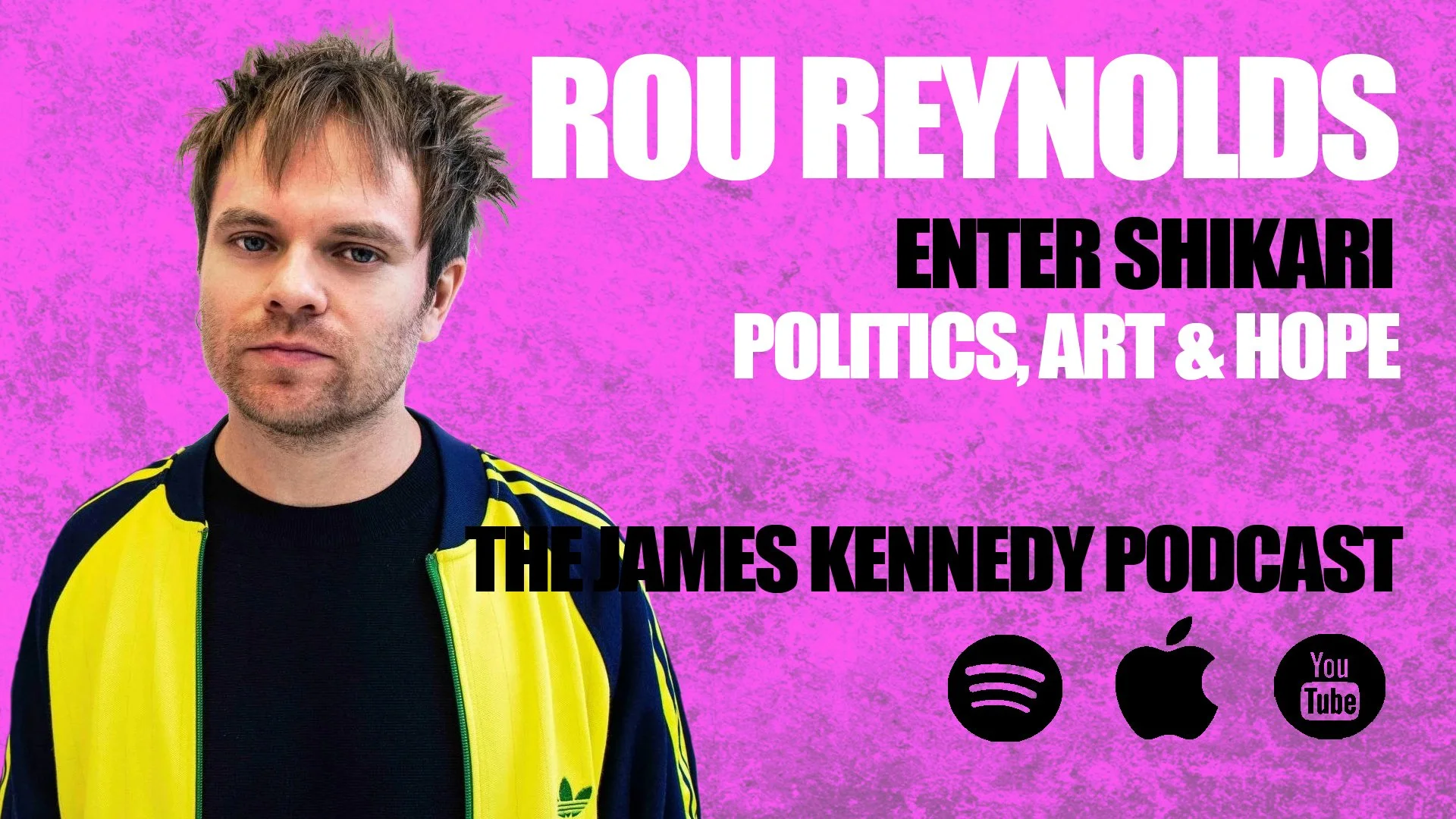
James Kennedy interviews Rou Reynolds, frontman of the alternative rock band Enter Shikari. They dive into the realities of staying independent in the modern music world and why maintaining total creative control is so vital. Rou also shares his candid perspectives on burnout, the necessity of stepping back from political overload to preserve hope, building resilient local communities, and what fans can expect from their upcoming album, A Kiss for the Whole World.
James Kennedy: Thanks so much for stopping in, brother. How are you doing?
Rou Reynolds: I'm good, thank you very much for a lovely introduction.
James Kennedy: I'm glad to hear it, man, because I know how crazy busy you always are. So, what's happening right now? What's going on?
Rou Reynolds: Oh yeah, all sorts. I mean, our album is basically kind of a month away now, so everything's going well. We're just amping up loads of press, doing the final video shoots for the next two singles, trying to get the next leg of shows and the setlist all sorted, and stuff—so lots of programming. "Firefighting" is what I've come to call it. You get one thing off your to-do list done and six more things come up.
James Kennedy: Yeah, I can't imagine, man. That all sounds awesome though, dude. I imagine that you're probably quite well-adapted to that workload, having been at it quite relentlessly for over 20 years now. The vibe I get is that you're all a very hands-on band, having spent much of your career as an independent band. Is that right, or have I got the wrong end of the stick?
Rou Reynolds: No, yeah, totally. Before we even released anything properly, there was, of course, the four years of touring up and down the UK, recording and releasing our own EPs and things. But then Take to the Skies was released on PIAS (Play It Again Sam), who at the time were just full of people who got it, you know? They were a great independent label. I think now we're on So Recordings, who are pretty much the only truly independent record label left—they're not a subsidiary of a larger major label, which is hard to do in the current climate. But they're smashing it and they're awesome. In between those two labels, we've done all sorts and tried all sorts of deals, but it's been an interesting run.
James Kennedy: Well, I imagine it must be a very specific type of label that would be able to handle a band like you guys, because you're all so talented in many different creative fields and very much involved in your own destiny and in the driving seat of your own careers. I can imagine that that could be intimidating or frustrating for some labels, so it's great that you've managed to find a home where you guys are able to still maintain that level of creativity and control. As far down the road as you are now with things, are you still completely involved in all aspects, or are you able to kick back a little bit more now?
Rou Reynolds: Yeah, absolutely everything. I think everyone is to a degree. Often I find it funny when you see fans sticking up for their favorite artist who's done something that's a bit shit—or, for instance, started doing paid meet-and-greets, charging their fans to meet them. Their fans will go, "Oh, but it's not their decision, it's all their management or their label coaxing them into this." Well, you don't have to do anything you don't want to do. I think there can be a kind of willful ignorance in that respect from the artist's position.
At the end of the day, for us, it's very much—I don't know, you could call us control freaks, or I would just say it's naturally what you want for your art. You want to know everything about it, you want to know how it's being released, you want to be involved in everything. Certainly in terms of the creative area of the band, we've never let that go whatsoever. Even on that brief stint when we were on Interscope, it was funny because we got on really well with the people there, and I think they did get what we were trying to do. But there were some funny situations where the A&R representative was in the studio with us going, "Oh, what if the chorus did this?" or "What if we got to the chorus quicker?"
James Kennedy: Right, right. Fuck off, pal.
Rou Reynolds: Yeah, we were like, "Sorry, you do know who you're speaking to?"
James Kennedy: Yeah, Jesus Christ. The gall of some people, man. I'm sure he meant well, you know what I mean? I'm always fascinated by people's relationships with their label, because you hear so many bad stories from bands about being shafted by their labels and stuff. So yeah, I'm super interested to know how you guys are getting on with the new guys. Tell us more about them.
Rou Reynolds: Yeah, so it's So Recordings. As I say, they're kind of the only real independent left, self-funded. They have a sister label which does primarily classical music, film soundtracks, and things like that, which is awesome. And then they have the rock label, which does us, Placebo, and just released the new Hundred Reasons album—which, oh man, I'm just overjoyed that they're back. They've always been one of my favorite bands. It's a brilliant label; you get the attention and the passion that you want. As an artist, you want your team to truly understand your message and what you're trying to achieve, right? You don't want to have to enthuse them—they should be enthused by the music. You want people who are going to bring that energy, and that's what we've got from them. We've only released one album with them—well, about to be two albums with our new one—but it's been going great so far.
James Kennedy: That's wicked, man. I'm glad to hear that, dude, because the terrain has changed so much now for artists, hasn't it? There are so many more avenues available for releasing your music, and you guys have been successful and have experience in several different models now, be it independent, with a label, or a combination of the two. What is the overall most important thing that you need, regardless of the model, as a band releasing your music at this stage?
Rou Reynolds: Speed, perhaps, for us—to give it a broad term. The real struggles we've had are when we've got an idea and can't act on it. To put it into a solid example, I always remember the video shoot we did for a track that was released after our first album—it was a bridging single, "Destabilise." We had this idea and were able to just get it done. I co-directed that with a friend, and it was just a few of us in this location we got. There's something about the energy when an idea is being conceived that is just really pure and electric—you get something done and get it out there quickly.
The times when we've been in deals that aren't so flexible or aren't able to give you the attention you want to get things out quickly, that's been the worst. You have to go through layers of bureaucracy to either release the funding for a video or release a single that isn't part of an album campaign. In some deals, there are just so many levels you have to go through to finally release some art, so it can be incredibly frustrating. Concentrating on an accelerated process has been key to us, because then the art feels a bit more pure. It doesn't feel stale to us, and we can still go and perform it and be super excited by it when it hasn't been sitting in the cupboard for six months.
James Kennedy: Yeah, a lot of people say that. It's like the bigger the label, the bigger the bullshit, almost. You're not their only horse in the race, so you've got to wait for ages. I've had that conversation several times. So I guess there's a sweet spot, which it sounds as if you guys are in now, where you can have the level of efficiency that you want so it's still fresh and exciting by the time it hits the stage.
Rou Reynolds: Absolutely, yeah. I feel very grateful for the position we're in at the moment; it feels gratifying and satisfying. I think there's a weird sense of—I don't know whether it's Moore's Law or just the general rat race and the hedonic treadmill, whatever you want to call it—where when an artist gets to a certain level, they're never satisfied. They always want more.
At the level we've been at for a while, every band that we look at sideways—our peers—they're all striving to get bigger, striving to make sure every tour they do is an arena tour. It's just exhausting, and I don't think it's that satisfying either. I don't have some massive ambition to be a huge, worldwide arena band; that's not really what we're about. Because that isn't our ambition, we don't need a major label. We don't need that extra serious oomph where you hold the people who pick radio playlists by the throat against the wall and go, "You will support this band!" We don't require that. So yeah, I think we're in a really good position and comfortable with what's available to us in terms of growth and sustainability.
James Kennedy: Yeah, and I think you guys have got the most important thing, which is an awesome, loyal, passionate, hardcore audience that fucking loves the band and has followed you guys for a long time. That is something that no label can give you, and it's not something that any label can take away from you either. You guys have built that, you know what I mean?
I'd be interested to know, because not only is the band fucking kick-ass and working hard consistently, putting out good stuff for so long, but there are lots of bands who are good and work hard who don't have that level of Enter Shikari shit happening for them. Why do you think that is? What do you attribute that to?
Rou Reynolds: Oh, it's a tough one, man, because I don't know any different, so I don't have a great deal to compare it to. I often thought it was something to do with the breadth or diversity of our music. We've always made music that has a great deal of variety, because that's what I was brought up with, so it's very natural for me to make that kind of music. What happens when the music is varied is there's always a degree of surpassing or dodging people's expectations. There's an element of—not so much shock, because trying to shock people doesn't massively interest me—but I think even our worst songs are interesting, and every album we release is interesting.
What that does is sustain a core element of a fanbase. If you bring out the same album again and again, you can have massive success, but there's an element of loyalty that you gain from having music that takes effort to understand. Thom Yorke used to describe bland music as "fridge buzz." If you're making music that's completely bland and banal, you may get a very enthusiastic following, but they haven't put much into the equation to understand the music. When you've got that effort, it gives you a greater deal of appreciation for your audience, and vice versa—it's just a greater connection. If you've had to think about what you're listening to, you're connected to it in a deeper way than if it's just background, middle-of-the-road radio fodder.
I'm sure there's a load of other things as well, but I suppose consistency and honesty are really important to us—authenticity. We've never really tried to be anything that we're not. We've never tried to take over the world. The amount of bands that I've seen where that's been the headline, the one-liner they tout on all the magazine covers, and then they sort of come and go... I think people understand with us that they're getting something that's real, and the passion and dynamism are real.
James Kennedy: I completely agree with that. As well as all of those things, I think it's the topics as well. You guys have always spoken about things that are real, whether it's personal, social, political, or environmental. I think that gives it an extra layer of depth and connectivity that people resonate with, rather than the example of the two-and-a-half-minute earworm that's an absolute banger for three weeks and then it's over and you're sick of it. You guys have got so many different layers of depth that are real and mean something to people, and I think the words have a big part to play in that as well.
Rou Reynolds: Yeah, I think it's the same sort of thing. If people are thinking about the themes and topics within a song, they're going to feel greatly connected to it, more so than if it was just a repeated line or the same old topics and lyrics we've heard again and again. That's just what we were brought up to think was normal. I was first brought up with Motown and Northern Soul, where the lyrics were often quite thoughtful, melancholy, and beautiful in an aching way. Then obviously it got much more politicized as the movement went on.
As a teenager, I discovered our local hardcore punk scene. When you're running around like a headless chicken on stage shouting your head off, for me, it was the complete norm for the music and lyrics to obviously be about something that the singer believed in. So yeah, it's strange for me. I've had some interesting experiences, especially over the last five years, trying a bit of pop songwriting and stuff. I'm really glad I did it, and I felt like I grew quite a lot as a songwriter, but it's a totally different thing. It's very mechanical; there's no sense of soul or meaning to it. You are creating a commodity.
James Kennedy: Factory music.
Rou Reynolds: Yeah, and that's completely unnatural for me to do. Music for me is an incredibly emotional, cathartic release, and a way of organizing my thoughts about myself and about the world. So yeah, it's just been something that's quite normal for us.
James Kennedy: Yeah, I'm exactly the same, man. Growing up, I was always more drawn to artists who had something to say. They were more interesting—like Pink Floyd, Roger Waters, Frank Zappa, Rage Against the Machine, The Clash, whoever it was. There are loads of cool bands that I love, but the ones with that intrigue about them always had something to say; there was that little edge, you know what I mean? I think that counts for a lot.
I wanted to ask: what role do you feel art plays in advancing progress and change? Do you feel it has a role to play, and if so, how important do you think it is?
Rou Reynolds: Yeah, I've gone back and forth on this over the years. What I can say with certainty—not just from my own experience as an artist, but as an audience member and supporter of music, bands, and artists—is that it's fuel for the fire. If people are feeling disconnected, lonely, or full of rage over whatever crisis is affecting them, music can be a way of channeling that and thinking positively. It can make you feel very activated as an activist—either literally as an activist, or in a broader term, making you feel like doing something. Even if that isn't actual activism per se, it means you might change something about your own life or think about something in a different way.
Music certifiably does that. It's a fuel; it motivates and galvanizes people. It's really the only thing left that brings us all together indiscriminately. Sport does that to a certain extent, but it's not really indiscriminate because we have teams, so it's quite competitive and divisive as well. Whereas music, for the most part, is a way of thinking about something differently. Even a modern-day festival is kind of the only thing we have left that brings us together to celebrate our shared vulnerability. We're all impacted by the music we're about to hear; it hits us in an emotional sense and reminds us that we're all the same and work in the same way. That's becoming increasingly more important to remind us of in a world that's becoming more divisive and tribalistic. I hesitate to make very grand statements about music being this power that can change the world, but it can be a galvanizing, motivating force for sure.
James Kennedy: 100%, man. Brilliantly put as well. As you said, we need that now more than ever. As we look at the state of the country and the world, it does not seem to be going in a very good direction right now, to put it politely. You're someone who has traveled the world, tuned in, and enlightened on these issues, and you've got an interesting perspective because of what you do. What do you think are the main pressing issues facing us, not just as a nation, but as a global community right now?
Rou Reynolds: Oh, I mean it's thoroughly depressing and disorientating. The list of crises just grows by the day. The main thing that frustrates me is that people often don't look at the links. Especially in the media, it's the most immediate, shocking thing that's plastered everywhere, and there isn't room, space, or time to actually look at the core reasons why whichever crisis it is is happening. That's just heartbreaking.
One of the things we've spoken about since day one is system change. It's amazing now seeing the youthful energy, fortitude, and galvanization coming through for actual system change. This was something that 15 years ago no one was addressing or speaking about. What's happened in those 15 years is that we've gone so far in terms of reaching the boundaries of our planet that we cannot now expect to fix problems with just band-aids like, "Oh, we'll just change this law" or "We'll just do this little fix." We're so far gone that we need system change.
James Kennedy: Yeah, 100%. I think your analysis is bang on. I do a lot of political episodes on the podcast, and that is always what it comes down to. Yes, we can campaign for this cause or this issue, and there are gains to be made in those areas that are necessary in driving us in the right direction. But as you say, without broader systemic change, we are not going to make any progress—certainly on issues like climate change, which is priority number one for everybody on this planet, right?
The problem is that the people in charge, who are behind the wheel of this fucking high-speed burning train heading towards the edge of a cliff, have a vested interest in the system staying exactly as it is. They function essentially, as far as I'm concerned, as a kind of collective sociopathic organism that doesn't seem to care at all that they're heading us towards disaster.
Rou Reynolds: Yeah. Well, the system has an inbuilt protective nature because it promotes and rewards narcissists, sociopaths, and psychopaths. Really, if you look at it, that's what it demands. It demands us from day one to compete against each other for our own stability and profit. A system that at its very core sets us all against each other—like market-based economics—makes becoming a self-interested brute a logical, rational way to survive. It's almost like a defense mechanism within the system: it's always going to promote the people who will most protect the system because it birthed them, gave them power, and gave them wealth. Now they're obviously going to want to protect what they've built up.
It's an infuriating Catch-22 situation where change isn't going to come from the top. Systems protect themselves. So we have to start building something new even before tearing this down. We have to concentrate on the ways we can start new communities or organize communities differently—start local, and all this kind of thing. I think that aspect is pivotal, along with creating awareness of deeper thinking—thinking about systems theory and asking, "What is the core problem?" I think the only way really is education, making people aware of how bad things are, but also how massively we need change on such a deep level.
In a way, it should be kind of exciting. We're living at an incredible time where we need to change this juggernaut of a system, this behemoth that we've had for centuries. Obviously capitalism has morphed and changed from feudalism onwards, but now we're living in an era where we need such dramatic change that it should hopefully feel quite thrilling—putting aside the fact that if we don't achieve anything in the next hundred years, the prospect of the annihilation of human civilization is very much on the cards.
We talked a lot about this on our last album, Nothing Is True & Everything Is Possible. I got to speak with Toby Ord, an incredible philosopher at Oxford University, and he puts the chances of a complete catastrophic civilizational collapse at one in six. So, yeah, not great chances, but the odds are still in our favor. We've got the ability, the science, the technology—we've got it all. We just need to pare down on what is so bad for us.
ENJOYING THE CONVERSATION?
GET JAMES KENNEDY'S LATEST INTERVIEWS, WRITING AND LIVE SHOWS STRAIGHT TO YOUR INBOX
James Kennedy: Amen, man. Brilliantly put as well. You hit on a key word there, which is "community." As you said, the system is self-perpetuating, and the mindset shift imposed upon us to survive in that system is that we've become part of that transactional, capitalistic mindset, whether we realize it or not. It's invaded so many parts of our mind and psyche. In order to survive within that system, you have to kind of become it as well. We've all been tainted by this Thatcherite, Reaganistic cultural shift in society toward individualism, whereas that's not always the way it was.
The antidote and counter-attack to that is community—actually coming together, helping each other, and working together on shared solutions. Music is a great catalyst and galvanizer of people and communities. But man, we have got one hell of a fight ahead of us, because the enemies are clearly winning right now and have done a very good job of fragmenting us, dividing us, and removing our collective power.
Rou Reynolds: Yeah. I always find it fascinating looking at the audience of any artist. An audience is a microcosm of what society could or should be—it's very supportive. Fandoms are like incredibly supportive families. We call our fanbase the "Shikari Family" because it's amazing how they step in where society has failed. Where the state has torn down support for its citizens, these communities step in to fill those gaps. You see people offering each other such support, and that's the beautiful thing about community and compassion: it's incredibly contagious. Once you experience it, you want to bring that feeling from inside the venue tonight out into the world, because you realize, "Wow, this sense of inclusion and togetherness is what's been missing from my life." It's something that has been completely stripped from our society as a whole.
James Kennedy: Beautifully put. Live music in particular really is that communion that reconnects us to our primal selves, our primal sense of community, and all the things being deprived of us elsewhere in society. We reconnect with that at a live concert. That's why I think what a band like you guys gives to the world and your fans is such a beautiful and powerful thing—delivering that joy, reconnection, and sense of community night after night. It's awesome.
Rou Reynolds: Yeah, it's the same with any artist to a degree. You share a story, a sense of togetherness, feeling as one, and feeling connected to other people. It's beautiful and severely lacking in our society.
James Kennedy: Speaking of society, how do you feel when you look at the state of the country that we both live in at the moment, and what, if anything, do you think we can do to dig ourselves out of this?
Rou Reynolds: I don't know. I feel a sense of exhaustion even talking about this stuff. It's so hard to... I have no pithy, uplifting answer to that question. It's just relentless. For me, first things first, getting rid of the Tories has to be the number one thing on everybody's plates. Essentially, it's a government of criminals. It's gone so far now and for so long. For the first time in a long time, it actually looks hopeful when you look at the polls. But then, of course, you see Keir Starmer, someone who isn't exactly offering something massively different.
So on one portion of this podcast, I'm talking about system change, and now I'm talking about taking one step in the right direction. Really, all it is is relief for those who have been beaten down so much by the Conservative Party. I think there is an ethical duty to get the Conservative Party out just for that reason, but I don't think anything will change in a real, big way through that—that's going to come from other places. But yeah, it's just this fascinating, infuriating, criminal circus at the moment, and it's utterly exhausting.
For me, I don't have a great deal to say at the moment because I just haven't been following it. I'm very lucky to have this bubble I live in with the band, and there's so much to concentrate on with the album that I'm just not following the news. I think sometimes that's important to say, because we all need to give ourselves a rest from it every now and then.
James Kennedy: Oh, dude, I'm so glad to hear you say that, man, because I feel exactly the same. We all feel a pressure to be as clued up as we can, keep the fight going, and not let these fuckers slip anything by us. But it is fucking exhausting, man, and really bad for our health as well. So you saying that as someone in the spotlight, who is expected to have answers for everything all the time, will make a lot of people feel better about their own situation. Because Jesus Christ, it is fucking exhausting.
Rou Reynolds: Oh, absolutely. It's really debilitating. You don't want to be so plugged into it and constantly enraged that you end up becoming a nihilist, which really is the worst of the worst because you become completely inactive. You step back from it all, and people think you're relinquishing responsibility. It's a freeing thing for you personally, but all it really does is let the powerful continue.
For me, every few years I take these breaks—I'm about six months into one now. As I say, I have music creation and all these things that I'm very lucky to have as an escape. But if you don't give yourself those months off and those moments of escape—whether it's being in nature, reminding yourself of human connection, or concentrating on the small communities we can cherish—we'll just become completely inactive. Essentially, that's what the most powerful people in society, the guardians of the status quo, want. They want us to be inactive, exhausted, useless, and feeling powerless.
That's something we talked about a lot on this new album: the more you're convinced that you're powerless, the less you will use whatever power you have, and the more you will shrink. That's exactly how they want us—knackered, thinking of ourselves as small and up against this mighty thing. It's very easy to fall into that every now and then, so having a break is an incredibly important thing.
I also understand that if that little clip were edited and presented by itself, people might say, "Oh, but you're just lucky that you have somewhere to go and escape the intensity of it all." Yes, I'm very aware that I'm incredibly lucky to have this band, but there's always going to be a way to criticize anything. I think it's a relevant criticism, but hopefully I'll come back feeling much more rejuvenated and powerful when we start touring again, being in the communities we play in, talking to people, and seeing what we can do.
James Kennedy: That was going to be the clip I was going to use as well. Shit!
Rou Reynolds: Ha!
James Kennedy: No, I totally agree with that, man. I've got a lot of activist friends who are very active all the time, and they go through so many episodes of crushing depression, debilitation, apathy, and nihilism. It has a really detrimental effect on their personal lives, relationships, and health because they're deep into this stuff all day, every day, fighting an uphill battle with no off-switch. It's what they're consumed by. As a friend, I see the toll it takes on them, and I keep saying, "Guys, you've got to take some time off. You're a human being; there's nothing wrong with doing that. Take some time off, and when you come back, you're going to be fitter, stronger, have more clarity, be more resilient, feel better, and have a lot more fight in you to achieve more." I know it's difficult to do because I've been in that hole myself, but I really think taking time off is an essential part of effective activism.
Rou Reynolds: Absolutely, yeah. It's almost a cliché now, but even a smile is a sign that you're going against the will to be beaten down, fatigued, and destroyed in terms of your hope. If you don't have hope, you can't act. So anything that builds resilience, community, and hope is the most important thing.
James Kennedy: Love it. And are you hopeful right now?
Rou Reynolds: I think you have to be in order to be alive. If you're not hopeful at all, then you are an island, a fatalist, or you are evil. There's a glimmer of hope in all of us, even the most bedraggled and frustrated. As soon as we get out on the road and start speaking to people, my hope inflates. We did a book release signing and talk for our biography that came out last year, and I remember the amount of real, incentivized, motivated energy that night gave me. One minute I was meeting an NHS doctor, the next minute a geoengineering student, and the next minute someone surprisingly high up in terms of climate change solutions in government. Music brings people from all kinds of backgrounds together. When you see them enthused by music—whether it's ours or other people's—it enthuses the artists to make more. It's a lovely cyclical structuring of hope that gets passed back and forth, builds, and grows. It's something I'm really looking forward to with the album we're about to release, because I know once we start playing it in rooms in front of people, it's just going to blossom.
James Kennedy: I bet you can't wait, man. Well, look, let's steer out of the bleak waters of politics and get back to the music. One thing I want to ask you about as an independent artist is work-life balance. For me, having to do everything myself—working 24 hours a day, juggling 15 different roles at any one point—you alluded to it earlier: your job essentially at the moment is firefighting. Put one fire out, and six more turn up behind you. As someone who's been doing this pretty consistently, how do you maintain your work-life balance?
Rou Reynolds: Oh, it's incredibly hard. Anyone at any level who isn't on a major label with a massive team has to become a multi-tool wielding, no-sleeping robot where you do so much yourself. I'm lucky that I have a band at least—I speak to a lot of solo artists who literally have to do everything themselves. We all have our strengths and chip in a lot, but it's relentless at the moment. We're doing everything from programming the lighting show for our next tour to planning production for festival season. At the same time, I'm directing the videos for this album campaign—we've done two and have two more singles coming out with videos. Plus the artwork! You just have to be brutal and stubborn about making time for yourself, but it means something has to suffer. You get to choose whether that's your own mental and physical health or something in terms of your work. It's a hard choice to make, but that essence of DIY hasn't left us at all.
James Kennedy: What I'm hearing here is you basically don't have a work-life balance—you're just working your ass off all the time, right?
Rou Reynolds: I suppose most people are. We're entering the era of capitalism where any hobby has to be capitalized on, everything has to be a side hustle. There's no spare time: you're either studying, working, acting, or hustling in some way. It's all a bit gross, isn't it really? But that's where we're at at the moment.
James Kennedy: I think that's a clip I'm going to use: "It's all a bit gross, isn't it?" Well, before I get into what's happening with you guys, I've got to ask you something. I released an album during lockdown called Make Anger Great Again, which was a political punk rock record. It was a new project because my band had broken up, so I was going the solo route with a new band and needed a new logo and branding. I came up with an idea that I thought looked cool as fuck on paper: I took the inverted hierarchy triangle so the many were at the top and the fewest at the bottom, and framed it within a circle representing equality and the circle of life. I thought, "Man, that looks fucking kick-ass!" So I raced ahead, put it on my CD, merch, and artwork, feeling very proud of myself. Then the album comes out, and I start getting a barrage of tweets from pissed-off Enter Shikari fans pointing out in no uncertain terms, "Hey, you do know that's Enter Shikari's logo, right?"
Rou Reynolds: Wow! I'm not sure we can even claim that we came up with that. As you say, it's symbology, and we're using it to say what sounds like the exact same thing, which is kind of beautiful. Yeah, no, I love it.
James Kennedy: Was that the thinking behind the logo?
Rou Reynolds: Yeah, you described it exactly right. I think it was our third album where we first used it. At first, it was just the inverted triangle, and the circle was an addition as time went on. It was essentially part of our lighting production at first—we had LED bars that made the triangle flash for color. We've stuck with it ever since because it's concise, simple, says a lot, and is easy to understand.
James Kennedy: So do I have to fucking bin my merch, or am I okay for a bit? You're not going to sue my ass?
Rou Reynolds: No, I've definitely seen other artists use an upside-down triangle as well, so go for it! Solidarity!
James Kennedy: Oh, thanks, man. Next time I get an ass-kicking off your fans, I'll say, "Look, Rou said it's okay!" All right. Moving swiftly on, we've got to end by telling everybody what is coming up in camp Shikari, because you guys have got tons of cool shit coming up. Tell everybody what's coming up.
Rou Reynolds: Absolutely, yeah. A Kiss for the Whole World is our new album, out on April 21st—which I've finally memorized! It was an album written after a very prolonged period of not being able to write at all. I was one of those people during lockdown who just couldn't write; most people, it seemed, were incredibly productive, but that was a pretty grim time for all of us.
After we started playing shows again, I felt refueled, re-energized, and felt that sense of purpose and human connection again. That's what this album is: an extremely excited and relieved album. You can sense that relief of, "Oh my god, we can create again and stretch this output out into the world!" That's why it's called A Kiss for the Whole World, which feels like what the whole world needs right now. We're starting to play some songs from the record live, and it's so nice being able to write a song, release it, and play it live straight away instead of waiting a year and a half like we had to do on the last album. Seeing them in their full form and seeing that cyclical energy live has been amazing. We're touring all over the shop this year and next, and headlining Slam Dunk Festival in May.
James Kennedy: Can't wait! I was going to plug the live shows, but they're mostly sold out already.
Rou Reynolds: Slam Dunk is the only UK one that isn't sold out yet, but I've heard it's well on its way. We'll hopefully announce some other stuff as the year goes on.
James Kennedy: Awesome stuff. I know everyone is going to be super excited, as demonstrated by the fact that the tour is essentially sold out already. I know the album is going to be an absolute banger and do just as well, if not better, than everything else you guys have done.
Rou, I'm going to let you go off and get some rest or jump onto the other six fires you've now got to put out. Thanks so much for taking the time out to speak with us today. I really appreciate it—it's been a fascinating chat. Best wishes with everything coming up, and I hope to see you again soon, man. All good!
Rou Reynolds: Yeah, thank you so much for having me. It's been an absolute pleasure speaking to you!
Key Points:
Guest Rou Reynolds of Enter Shikari talks about the band's upcoming album "A Kiss for the Whole World," released on April 21, and their current intense workload of press, videos, and tour preparation.
Reynolds explains Enter Shikari's preference for independence and speed in releasing music, valuing creative control over major-label bureaucracy and arena-level ambition.
Reynolds attributes the band's loyal fanbase to musical diversity, authenticity, meaningful lyrics, and the effort required to understand their music.
Both speakers agree that art and music serve as fuel for activism, fostering community, shared vulnerability, and motivation for change.
Reynolds argues that systemic change is necessary because capitalism inherently rewards narcissists and sociopaths, making reform from the top unlikely.
They discuss the importance of rest and self-care for activists, warning that constant engagement leads to burnout, nihilism, and ineffectiveness.
Summary:
This episode of the James Kennedy Podcast marks its one-year anniversary, with host James Kennedy reflecting on a year of diverse topics and guests. He discusses his own struggles with censorship, shadow banning, and algorithmic suppression while promoting his album "Make Anger Great Again," and announces upcoming shows with his band.
The guest is Rou Reynolds, singer of Enter Shikari, who joins amid a hectic schedule promoting the band's new album "A Kiss for the Whole World," out April 21. Reynolds discusses the band's independent approach, their relationship with the label So Recordings, and why speed and creative control matter more than major-label backing. He attributes the band's dedicated fanbase to musical diversity, authenticity, and meaningful lyrics that require thought.
The conversation covers the role of art in social change, with both agreeing music galvanizes activism and builds community. Reynolds argues systemic change is essential because capitalism rewards sociopathic behavior and protects itself. They also discuss the importance of rest for activists, warning that constant engagement leads to burnout and nihilism. Reynolds expresses hope through music and human connection, and Kennedy closes by urging listeners to subscribe and support the podcast.
The James Kennedy Podcast is a Society and Culture podcast hosted by musician and author, James Kennedy. Exploring the big questions around health, social issues, the arts, politics, mental health, the human condition and how to navigate this thing called life through casual conversations with scientists, activists, rock stars, philosophers and academics. Please subscribe, leave a rating and support the show.