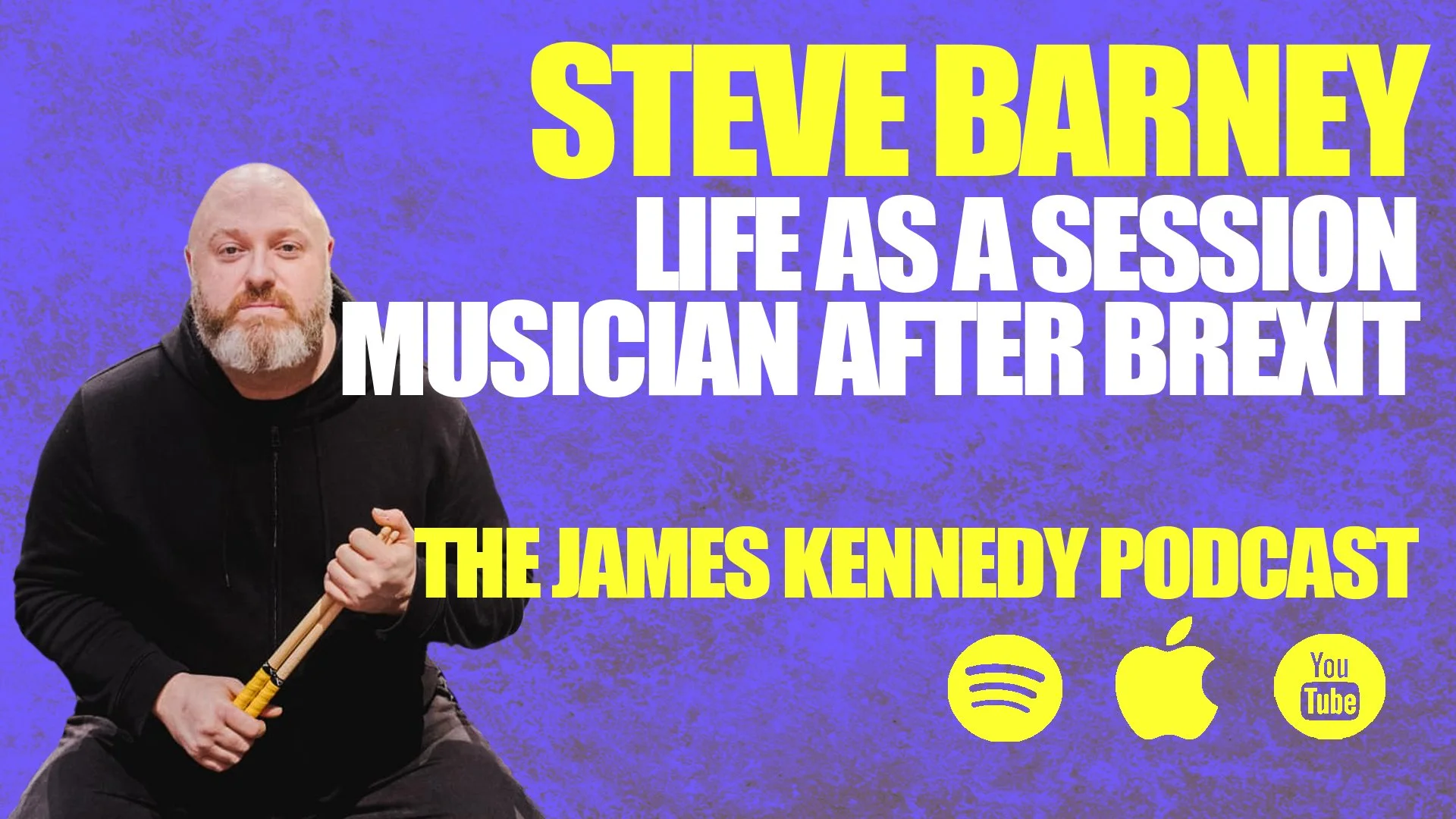
James Kennedy interviews session drummer Steve Barney about touring with icons like Jeff Beck and Annie Lennox and life as a session musician. They also discuss the realities of life on the road and explain the devastating impact of post-Brexit travel restrictions on British musicians and crew.
James Kennedy Mr. Steve Barney. Thanks for joining us, man. How are you doing?
Steve Barney Good morning. How are you, man?
James Kennedy I'm good. Thanks, bro. How are you doing?
Steve Barney I'm very good. I've been looking forward to this and it's good of you to ask me on the show.
James Kennedy Thank you. Well, thank you for taking the time out to come and speak with us, man. We really appreciate it. And the listeners won't know, they won't be able to see, but we are currently both sporting very winter aware black hoodies, very stylish, I might say, very in season. We are, man. Anyone that follows me on Instagram will probably believe that I spent all of my life pouting in a leather jacket and ripped jeans. But the truth, unfortunately, is far, far from that. So we've got a load of stuff to get into today, man. You've got a really interesting career and life story. So far, there's tons of angles that I want to get through on this. But before we get into it, do you want to introduce yourself to those listeners that don't know of you yet or what you've been up to and give us an overview of who Steve Barney is and what you've been doing?
Steve Barney OK, well, my name is Steve Barney. And I've been a drummer as far as I can remember back, from when I was a very young kid and I just sort of grew up in a household with my dad's enthusiasm for music and his record collection. And him coming back from concerts and just generally smelling of music. A concert experience where I grew up in Norwich, there was a venue on the North Norfolk coast in a place called West Runton, which is near Cromer for anybody that doesn't know. My dad would often go to this place called the West Runton Pavilion, where quite a lot of bands would go to prior to the UK tour starting. And kind of the warm up show. So my dad would often go there. He saw people like ACDC with Bon Scott and a lot of the original great rock bands. So he would often come back from those gigs and kind of, I guess, wake me up to say good night. But then I could just feel this kind of—I could almost hear sort of—I don't just mean the smell. That sounds kind of—I don't mean a bad smell. I mean, like enthusiasm in there. It's kind of lovely music. So, as I said, I sort of grew up in a house where music was very at the forefront of the household, and that's not a musician and neither is my mom. But I guess a little turning point for me getting into music was in 1980 when I was nine. My dad and my uncle got me or got them and me concert tickets for Genesis. The band Genesis were playing. They were playing a UK theater tour, I guess, even though they were like arena sized bands. And they wanted to sort of reconnect to do like this. I think they did a 40 day UK tour.
James Kennedy So you were nice and up close and you could see the drums.
Steve Barney Yeah. And we—like Genesis of all places came to Great Yarmouth on the coast, which is mad to think that that happens. But I again, I think I knew it was a big deal. My uncle getting the tickets for the concert kind of queued all night with a sleeping bag and blast. Old school kind of way. So even though I wasn't aware of how special it was that we got these tickets, I think I kind of, and even to this day can remember almost the feeling of the golden ticket, the Charlie and the Chocolate Factory. So maybe just that night seeing Genesis, and Phil Collins and Chester Thompson, the drummers in particular really hit a really sort of struck a chord with me. And I pretty much left the concert that night. I mean, I want to be a drummer.
James Kennedy Beautiful. Yeah, man. I could totally relate to that because I had a very, very similar experience at the same age as well. Like when I was nine, that's when I came across the guitar and discovered my love for the instrument. And I was just obsessed, ever since then. I can still remember that moment. Like, it's crystallized in my memory forever. So I can totally relate to that. So you knew right there and then that you were a drummer and that was your calling and you were in for life.
Steve Barney I did. I was already playing. But that concert—I was already playing. So that night just felt like I was struck by a bolt of lightning. And that's so corny, it's so corny to say. And when you repeat these things, it just sounds like a cliche, corny story. But I really, I can't be more honest about how I felt that night and subsequent concerts that dad told me to see. I saw the great Buddy Rich, jazz drummer.
James Kennedy Wow.
Steve Barney Playing Norwich at the Theatre Royal, which I knew was kind of a special thing. We even kind of hung on the side stage trying to catch it. We were watching before we arrived and we were waiting. I said, oh, dad, you know what? We might as well just go in. He's not coming. And my dad said, don't just wait five minutes. You'd never, like, I said, the show's going to start. We're going to miss it. And there, I think it was either a BMW or a Mercedes or a Rolls Royce or something quite posh. And I stepped Buddy Rich and we kind of quickly met him and I shook his hand. What? I think it was 10 or 11. So that felt special as well.
James Kennedy So you had a cool dad then. Fair play. Your dad, he was responsible for all of this.
Steve Barney I did and do have a cool dad. He's not in the best of health these days, but he's still a very, very cool man. And he's got a lot to answer for, for the way my life went.
James Kennedy He sounds like a legend, man. And we thank him as well for the gift of music that you've given us over all these years. So fast forwarding then from there into you becoming a professional session drummer, how does that happen? How did it happen for you? Because I'm always interested in how people get into that world.
Steve Barney Well, I'll fast forward through all the years of being in Norfolk until I moved to Liverpool where I live. I mean, now next year will be 30 years since I moved up here. And it was a leap of faith. So when you say professional, I consider myself when I—although I had a great grounding in Norwich and Norfolk playing around the pubs and clubs and cabaret circuit and summer seasons, I started very young. I was in quite young bands doing talent competitions, all sorts of stuff. It's just playing, mate. It's my job. But yeah, I consider from 94 is when I kind of left my normal job and I went, I just got to give it a go. So I answered an ad in the NME in the Melody Maker for an advert for a band up in Liverpool called Bully Rag and it was a heavy rock kind of ragga rap sort of crossover mishmash of styles with a very scouse kind of attitude about it and I answered this ad and I came up to Liverpool for an audition and I got the job. So that was me making or rather taking the leap of faith and I'm really proud of myself, man, that I'm sitting here almost 30 years later still playing drums and that's become my job, albeit...
James Kennedy So you were in the band it wasn't a session gig you were actually in that band?
Steve Barney I was in the band. So I joined the band in 94 and between 94 and 2000 we got signed to Mercury. We made one album, released about four singles, we did an awful lot of touring quite often supporting larger alternative rock acts. Rock hadn't really broken on commercial radio as much as it did then, and who knows what would have happened if we'd been signed slightly later. But I don't regret anything and it was a great grounding being in that band. There was some great musicianship and it was a great time. I remember I had an album with a guy called Chris Hughes producing, who was the drummer from Adam and the Ants, who went on to produce Tears for Fears and Paul McCartney and Robert Plant. So that was very...
James Kennedy That must have been awesome, man.
Steve Barney Yeah. So that kind of brought me to Liverpool, mate. And when that band disbanded or imploded like bands do...
James Kennedy Yes they do, yep.
Steve Barney I was like, man, what are we going to do? And I really didn't feel like continuing down the band route. I just reached out to various producers and musicians and managers that I'd met and was just trying to carve a route of getting something more freelance and self-employed. Which does take a while when you put all your eggs into a band basket and you suddenly tell people that you want to be a session drummer, but yet you've got no previous experience of session. No one—they obviously ask, "Well, what have you done then?" You go, "Well, I've been in this band for six years." So it took a few people to—god bless them—give me an opportunity. And strangely, I took a massive left turn musically from what I'd been doing and I got the job as a session player for a pop girl group called Atomic Kitten.
James Kennedy Wow, that was your first gig.
Steve Barney Yeah, that was my first session gig. That's not bad. And they had a number one at the time with "Whole Again", the pop song, and we ended up doing a live Top of the Pops thing. And it wasn't playback, it was a pretty simple song, but that was a big deal, man. Getting Top of the Pops for me was, as we all kind of remember, or people of our age at least...
James Kennedy Speak for yourself, granddad.
Steve Barney I'm probably a lot older than you, but ultimately anyone that knows Top of the Pops knows that was a great boost for me.
James Kennedy That was the one to have on the CV for sure, yeah.
Steve Barney Yeah. And I subsequently continued to play for them and the manager brought in a musical director, which is quite common as you'll be aware. But also what you'll be aware of, many musicians will be aware of, is that musical directors tend to bring in their own players, again because of previous experience and then working with them or friendships with them. But I was fortunate enough that there was a guy who was brought in to do the MD for them called Mike Stevens. He's a great musician and subsequently became a great friend. And again, he was a real golden ticket for me. I didn't realize it at the time, but ultimately he came down and he checked me and some of the other local players out and kept me on board. So I did that for a couple of years with them.
James Kennedy That's awesome, man. I mean, Jesus Christ, what an opportunity to kick off with, that must have been amazing. And is it like it is in other branches of this industry whereby, you know, once you've kind of got that first foot in the door, that it is a lot...
Steve Barney I think it did. I think work can breed work and if people just see you about and on things they can think of you. I mean, oddly enough, London being the center of things in this country that everyone seems to think you have to live in London to be doing stuff. And for the most part that's kind of true, but I never wanted to move to London. I've lived and worked in London on and off at various points and I really love London, but financially I wanted to see if I could make it work staying in Liverpool yet working in London. Well, that's not always been the case, and doing these types of interviews that we're speaking now and I kind of fast forward and edit my life, people may think that just because you're asking me about my career that we go from one thing to the next because I'm trying to remember the good stuff. And it is good, and I've been incredibly lucky, mate, but there's a lot of highs and lows, mate, there really is. I've had times where there's not been so much work, so I'm not trying to go off a subject here, but I'm just trying to sort of get a balance. So when you talk about once you're in, kind of breed work, it definitely does. But I think ultimately for me in particular, meeting Mike Stevens, that musical director in particular, really helped me a lot and he—while he put other people up for lots of gigs, he definitely gave me a call for some really great work which we can talk about.
James Kennedy Oh yeah, 100% man, we've got to get into all that stuff. But I think it's really interesting that you mentioned the balance, because that's something that I'm personally interested in as I've mentioned on previous episodes, because I think it's healthy for people who are coming up in the game, who are starting out, they're working their ass off, they're doing all the things that the rule book says—be professional, be nice, be easy to work with and all that sort of stuff—they're doing all that stuff, they're talented as all hell and they just cannot catch a break for whatever reason, they're just not getting any luck at all and they're getting despondent, they're questioning their decisions, they're struggling with mental health or struggling with their finances, they have to juggle day jobs and stuff. So I think it's really good that you mentioned that it wasn't just one straight line from Atomic Kitten to Anastacia, Annie Lennox, Jeff Beck, just win after win after win after win, because that just makes other people then think, oh shit, well what's wrong with me then? So I think it's really cool that you mentioned that reality, because I'm sure in between all of those amazing successes you had that there were periods when you were struggling or questioning your decisions or...
Steve Barney Definitely. And you know what, I still do. I mean, I don't mind being honest about it, even to this day. I mean, I know we're going to speak about my situation that happened last year with my open letter and the 90/180 situation I got caught up in. So even to this day, there is struggles for us all with work, and let's be honest, I'm a drummer, so let's talk about drummers, there's some incredible drummers around, many of them are my friends and peers, and we're all eating off the same plate. And everyone can offer something different, so there is a lot of really good people around. And it sometimes is luck, just being in the right place at the right time. Some people network like hell to try and get work off the next man or woman and find out what's going on. And I think that's the thing that's really important, is that people just wait for the phone call and sometimes you get a phone call out of the blue that you've not tried to get a gig for and it just happens. Some of the best bits of work I've had have come to me like that, which I'm very grateful for. It's just whatever you want to call it, luck, or my name just crops up at the right time. But no, I think it is important to speak honestly about this, because I think no one likes—for their own pride, nobody likes to talk about the down times because who the hell wants to hear about that? But if you just talk about, as you just pointed out, all the gigs and the high times, then people—and I do want to inspire young people who are up and coming and want to do freelance or session work that it is possible, but maybe it'll make them understand that it's not all stepping from one tour bus to the next on the motorway without even going home, like he's literally just going from one bus to a jet. Well, that's what it looks like sometimes. And sometimes, mate, it has been like that. You're lucky, going, "Man, this is great." And then sometimes you think, "Man, have I upset somebody?" It's a balance, and you have to—the irony of self-employment, the word "self" is in there, and you have to believe in the self, because if no one—if you don't believe in yourself, how the hell is anyone else going to trust your self-employment? So it's a constant evaluation and trying to improve yourself. And mate, I just try and be a decent person when I'm on the road with everyone and I'm certainly not the best drummer in the world, I'm not even the best drummer in my house, my son started to play drums.
James Kennedy Oh look out.
Steve Barney I'd like to think and hope that I've been a really solid, reliable drummer for artists to have with them on stage, and I think that says a lot about my particular drumming, that I've been solid and reliable and hopefully make everything feel good on and off stage.
James Kennedy I think that makes a difference as well, isn't it? Because it's not a meritocracy in the sense of it's just about how good you are. You've got to be easy to work with, you've got to be reliable and professional and all those things as well, especially as a session player. So I think that's worth pointing out for up and coming session players as well who are trying to get into the game, that it's not necessarily just about being better than the next guy, because as you said there's so many fucking great musicians out there. And to think that we're in competition with each other I think is the wrong mindset. I'm not in competition with anybody in my community, we're a community of brothers and sisters. But where you'll gain the upper hand, I suppose, is in those other things: you've got to be personable, you've got to be reliable, you've got to be professional and people have got to be able to work with you, because it's tough on the road, man, you're in whatever capacity...
Steve Barney Absolutely, everything you've just said I agree with. I mean, literally if you've got all the most technical chops and ability with your instrument in the world, but you're a complete and utter dick and you have just no sense of people around you and their space and their well-being—you don't know what people are going through on the road, obviously everyone's got individual lives back home, yet you're on a tour bus together and you're sharing each other's days. And let's face it, just stating the obvious, there's an awful lot of hours, more hours off stage than there are on. So while the music and the stage and the show is ultimately number one—that's the reason we're all there—it's vitally important to give each other respect and just trying to be aware of each other's personal space and actually just try and be a good person to be around. And I'm sure I'm not that all the time, but I do try and I do like having a laugh and I do like trying to make the room happy. But no, I think it's important like you sort of say to find that balance with not just being a crazy technical musician because that will not get you or that will not keep you the gig long-term.
James Kennedy Yeah, oh no, I know from personal experience, some of the best musicians I've ever played with in my life would just be impossible to be in a band with. And ultimately when you're on the road, especially when you're in an original band struggling on a shoestring budget, you just haven't got the infrastructure to be putting up with that stuff. I'd rather go with someone who's not as good, but sane.
Steve Barney I agree, man, I agree.
James Kennedy Well, sticking with the reality of this lifestyle for a second then, let's pick a little case study: so what would, say, an average day look like? You're in the middle of a tour with an artist the level of someone like Anastacia, what does an average day look like? What's the reality of that life?
Steve Barney Okay, so if you're on a tour bus, you're pretty much doing it on a tour bus as far as travel's concerned, unless there's long journeys where you've got to get from one country to the next. If it's doable by bus they will do it in that particular way. But your average time, you would wake up in the morning in your bunk and—this is going to sound crude, but it's kind of true—if you wake up and the call of nature is calling—and I don't mean a number one, sorry. So quite often, and also for anyone that doesn't know, tour buses, you're not allowed to do a number two on there. So you might want to start your day—I think you're very primeval here talking about stuff, but it's true, man. You might be parked up outside the venue, you might be throwing some clothes on, you might be trying to bang on the door to try and get in the venue early, which is usually locked, because you're trying to go to the toilet. But no, so eventually you would get up and the catering would be there in the venue and you'd go in and you'd have your catering and have a shower. And then you'd have time throughout the day to do—it's kind of free time. If there's nothing to be improved on or something to be learned with regard to the show, you would use your time to do that. But I would spend my day either free and sort of like traveling around the city that I'm in to just take a bit of interest in where I am, or catch up with email. And then before you know, after having some lunch, you'll be ready for a mid-afternoon soundcheck. And then after soundcheck, the band would soundcheck first and then the artist would stick it in—say Anastacia, she would come on and do whatever songs that they want to check from the night before or something. And then you'd have a couple of hours before the show, do the show and then you're back on the bus. And you just really try and keep an eye on your hours, because after the elation of being on stage—even though the applause is connected to you, it's not for you, but you can't help but be caught up in the emotion of making people feel good...
James Kennedy Mate, let's be really honest about what it is: you're up there doing your thing, you're up there smashing shit out of your kit, up in the lights, you got the applause, you got the adrenaline, you're just as much in it as anybody.
Steve Barney It's just entertaining people. And when you come out of a room, say for example 2,000, 3,000, or even 500 people, you've entertained people, it feels good. You've shared your talent with people. So it takes a while to come down from that. So you might be on the bus having a few drinks, but trying not to let that go to sunrise. It's a bad balance, like with everything you spoke about musically, it's a balance as well within how to look after yourself on the road. Which people have been tested, and I'm no angel with regards to that. But that's just one scenario of a day. You don't always stay on the bus, you don't always sleep on the bus, you stay in hotels, so it varies from gig to gig and artist to artist. I had a great experience in 2019 going to Japan for the first time and I was there working with a phenomenal guitar player songwriter called Hotei, who's most famous internationally for the soundtrack to Kill Bill—you've probably got this instrumental that he did. But I'm sharing this because it's the absolute opposite of the Anastacia scenario or that particular tour bus, where I was based in Tokyo in my own apartment in Tokyo for three, three-and-a-half months. And he predominantly works just weekends, so like Friday and Saturday you'll do a show and we had the whole week off, which was just an absolute joy, free holiday to be on. Well, don't say that to my wife.
James Kennedy You're working really hard.
Steve Barney It was really, no, as far as the way we could live and enjoy the country and that city, it was a great experience, incredible. But his particular music was seriously high energy, and in a funny way to have a whole week off of not drumming and then having to go in once a week at that level was definitely psychologically more of a challenge to kind of—so it was very different. But yeah, those two...
James Kennedy Those are the true riches, I think, that we get, because money comes and goes, good times come and go. And I think when you look back on your life though and you've got all those stories, and hundreds of others I'm sure, and those memories, that's priceless. You can't put a price on that stuff, can you? You've seen things that most people won't and you've done it because of music.
Steve Barney Absolutely. I know I'm so grateful to be able to say a lot of the things that I've been connected to, and I've been really lucky in my life, mate. For example, like we just talked about Hotei, to be in Japan with one of the biggest artists in Japan on a Japanese stage, it's just the best feeling in the world, to be so far away from home with an artist that's singing in a different language yet you're there experiencing that. It's just, you can't be anything other than grateful to be there really. For—it was a particularly special one.
James Kennedy Oh, I can imagine, man. Yeah, Jesus Christ, what a trip that must have been.
Steve Barney I was so lucky thinking about, man, if it had happened a year later and the pandemic hit, it would have been—god knows what would have happened.
James Kennedy Oh, so this was 2019?
Steve Barney The summer before, yeah. I got home mid-September of 2019, and who would have thought six months later it would have been like what happened, happened.
James Kennedy Oh yeah, man, that is some seriously good fortune right there. I mean, to have not lost out on that amazing opportunity and experience just for the sake of a few months difference before the pandemic. Jesus Christ, that would have sucked big time. So let's name some of the other guys that you've worked with, and we've mentioned quite a few of them already. I'm sure who have been some of the other notable and awesome artists you've had the pleasure to pound the skins behind?
Steve Barney Well, just just last year—so after the pandemic in the couple of years which was a particularly challenging time for everybody let's face it, but particularly the arts—just last year going back out with an artist called Gianna Nannini, who's an Italian singer, and she asked a friend of mine, a British guitar player friend of mine called Milton McDonald, to suggest some British drummer names for her to think about for a tour. So I spent all of last summer out with Gianna doing stuff, which is great, again being predominantly traveling around Italy with an Italian singing artist, which was another phenomenal—especially after the two-year pause that a lot of musicians have felt, I felt very fortunate to get back out and doing what I did. But yeah, going back to the other names you mentioned, there's a lot of phenomenal artists. This year—again, going back the guy that I mentioned earlier on, he put me up for that after seeing me play with Jeff Beck the previous year. And I think, god bless Jeff Beck, who we've sadly just lost earlier this month. I was so, so lucky to spend a small period of my career with him making an album which came out in 2003. And then it was during 2002 that I was recording that album with Jeff that he got asked to do a three-night career retrospective at the Royal Festival Hall. And I think just maybe because I was lucky enough to be on the session at that time playing drums on this particular record, this call came in for these shows, he asked me if I would be the house drummer for that event. And I was like, "Sure, yeah." And I thought about all the incredible drummers that have been with Jeff over the years who I would have to try and emulate, which is just—when you got names like Simon Phillips and Terry Bozzio and Narada Michael Walden, I'm not even going to—I don't even belong anywhere near those guys. But the type of album we were making was more incoherent with say what I play like, I think heavy groove-orientated rock kind of beats is the album that we were making. It was closer to say Chemical Brothers and Prodigy from a rhythm section point of view. But anyway, I said yes, and I found myself in September of 2002 in the Royal Festival Hall with Jeff Beck for three nights with a whole host of friends and guests of Jeff's that we got to play with every night: from John McLaughlin from the Mahavishnu Orchestra; and Roger Waters. We played "What God Wants", do you know that song? Mate, it was like This Is Your Life, you know, it's just unbelievable. But my friend Mike Stevens was in the audience that night watching me after seeing me play with Atomic Kitten, which is such a juxtaposition of—it couldn't be more different from the pop gig I'd done. But I think that showed my versatility. And when he got the call the following year to put a band together for Annie Lennox's first solo tour, he kindly put me forward. So I went over to Annie's house and we met and we talked about music and she played me her new album. Wow, it was—that was the audition, just kind of meeting her and listening to her album. And then I got that—I fortunately got offered that tour, and I toured with her in 2003, '04, '07, and then 2010 we did promo for her Christmas inspired album called A Christmas Cornucopia. And she's an amazing, amazing artist as you know, and everybody knows that. I absolutely love playing with Annie Lennox, it was probably one of the best touring times of my life. Oh wow, man, playing with her—we did a tour in 2004 opening for Sting. Jesus Christ, across North America. So to be on stage with Annie for an hour, go and grab a beer and then watch Sting play some Police classics, it was just the best, man, I think...
James Kennedy I'm done with this conversation now, man. I don't want to hear anymore.
Steve Barney No, no, but as we know mate, there is highs and lows and stuff, I'm just sharing some golden nuggets and fortunate opportunities.
James Kennedy Well, you've given us some of the realities of this life, so yeah man, these are the—like I said, these are the rewards man, so you got to revel in it, because you have done this shit.
Steve Barney Apparently! So, I mean, it's quite funny, not kind of like with a twist of irony, but quite often when you jump off these tours and it doesn't take long for me to get into sort of home life and you think, "Was that me? Didn't I—" I mean, it was, and it sounds kind of silly that I'm saying that probably, but it's like for example even me reminiscing something with the great Jeff Beck, which was 20 years ago now. And I did—and I think, "Did I really do that?" And then I keep kind of stuff and I've got my memories thankfully and I know I did that. So it is fortunate to do it.
James Kennedy 100% man. Yeah no, that does make total sense, because I mean I had this conversation with Benji Webbe just a few episodes back and he was saying, you know, when you're up there doing all these amazing festivals and stuff and there's fucking hundreds of thousands of people there or whatever, you're kind of—for want of a better word, you are kind of working, you know, it's not—you're not working in that sense like you're just punching in the clock or whatever, but you are immersed in what you're doing, you're concentrating on that. And if you stop and soak it all up for a second, it throws you off your groove, you know what I mean? Or you start panicking about it. So you're kind of just in the moment doing it and then it's only afterwards when the adrenaline dies down it's like, "Fuck man, did I just do that?"
Steve Barney You're right. I mean, when you're up there on the drum riser—you know, as we're talking about drums—you really, no matter what kind of musical jobs I've had—whether it be some people might smirk when we talk about Atomic Kitten, for example—but every single gig, whether it be a pop thing or a robust rock thing like Hotei or Bully Rag, my old Liverpool band I was in, or Gianna Nannini last year playing big powerful Italian ballads, you really have to focus on every style of music that you're playing and be honorable to that music, as you would know. So you're right, I mean, in the moment you really are focused on making things feel right. You're the anchor of the band, hopefully, and just trying to make everything feel good. But I have unfortunately moved about 14 months ago, and so trying to get sorted with—I've sort of held on to a lot of stuff from my career, and I don't just mean the instruments, but like, that sounds crazy, but tour passes, laminates, itineraries—I haven't thrown them away because to me they mean so much to me. Like some people would probably at the end of the tour throw them in the bin, to me every single one of those passes, laminates, bracelets around, you know, backstage bracelets—they're all golden nuggets of my career. And I've actually been sorting through them in the last week, which has been quite mad, you know, to look back on some of the stuff and it's reminded me of these things.
James Kennedy I think it's important to do that, you know, because so much happens in life and then, like I said, you got your home life and stuff to deal with as well. So they're your mementos, you know, that's your kind of legacy really of all the things you've done. And it's a reminder for yourself as well, because in that fast-paced lifestyle of stage to tour bus to stage and then another tour and stuff like that, you're bound to forget some stuff, you know. And these are precious memories, man. I mean, you mentioned Jeff Beck, what was it like working with Jeff? I mean, obviously we lost recently one of the best guitar players the world's known, so I think it'd be cool to give a little shout-out and a nod to the incredible Mr. Jeff Beck. You got to work with the man himself, what was it like? That must be crazy.
ENJOYING THE CONVERSATION?
GET JAMES KENNEDY'S LATEST INTERVIEWS, WRITING AND LIVE SHOWS STRAIGHT TO YOUR INBOX
Steve Barney It was amazing. I mean, when I got the call from a producer friend called Andy Wright, who I'd met while I was in Bully Rag—he was one of the guys I'd reached out to after my band broke up saying, "Listen, I'm looking for session work"—and Andy called me maybe a sort of six months to a year after I'd first got in touch with him about trying to get work and he said, "Mate, I've got a project for you which I think you'd be great for." And I was like, "Oh great," I presumed it would be a new artist or something fresh that he was working on, and I said, "Who is it?" He said, "It's Jeff Beck." And I couldn't believe it. I said, "Have you got the right Steve?" He said, "Oh definitely." He explained—so Andy had already done a really successful album with Jeff called You Had It Coming, I think that was out in 2001, and it was quite a—for Jeff, they had a really phenomenal cover version of Nitin Sawhney's song called "Nadia". I don't know if you've heard of it, you should check that out, it's amazing. So anyway, he said, "Listen mate, come down to Metropolis Studios in Chiswick, we'll get you a great kit set up, we'll play the song for a couple of hours, Jeff will walk in, you'll sound great, he'll love you." And that's exactly kind of what happened. I was playing this song that Andy put up for me to play to and I was so focused on the kind of drummer—my head was down—and I looked through to the control room and there was Jeff Beck kind of, arms in the air, giving me a great—what? Is that Jeff Beck, who I've seen in like '85 with Terry Bozzio on the Guitar Shop tour? So there I was, somehow—I don't know how, I mean, I don't know how you get from being a teenager in an audience at the Birmingham NEC watching the guy to being in a studio and suddenly he's on the other side of that. I imagine I was just very, very lucky. But he was great to work with. I ended up contributing maybe to six songs on those sessions.
James Kennedy Great work, dude!
Steve Barney Man, it's called "Plan B", I think it won Best Rock Instrumental Performance. Amazing. But Jeff was just and will always be the greatest guitar player I think this world has ever seen. What can you say that hasn't been said before about him already? He was—I'll tell you one thing that maybe people don't know about Jeff, is that he's a really funny guy. He had a great sense of humor. We were always laughing and joking around. One of the things for some reason that came to mind recently because I found a letter that he wrote to me after I did those Royal Festival Hall shows, and he reminded me because he said, "Oh, maybe we should do a Bum Gravy tour over the USA." And I remembered that we were joking about coming up with funny names for our band, you know, our sort of—and one of the names was Fünf, which is German for five, I believe, we thought we'd call ourselves Fünf. And then Bum Gravy was randomly one that Jeff seemed to love, and that's the one he remembered. So no, he loved to laugh, mate, but he had an otherworldly ability on the guitar as we all know. And to play with him in a studio context was just—to meet the guy would have been enough, but for me to get that experience of playing with him at the Royal Festival Hall was just something I'll never forget. And he was a great guy, man, and he's going to be dearly missed, but I think forever cherished and listened to by people.
James Kennedy Oh 100%. I mean, what an absolutely priceless experience. And of course, big shout-out and respect to Jeff, rest in peace Jeff Beck, rest in peace, what a loss. Yes, for all of us, it really was. For you, I mean, what an experience that must have been to have actually played with the man, let alone meet the guy. Totally. Well, things like that are obviously a dream gig, right? And so many of the things you've talked about just sound like they've been incredible experiences, both personally and musically. But I would love to know, for the sake of gossip—and I'm not asking from your personal experience, because I know that obviously you can't name names—do you know of anyone in a similar field to yourself who's had the opposite experience of working with an iconic artist who turns out to actually be a fucking dick?
Steve Barney Definitely, yeah. There's definitely people that people within our industry kind of know about that are very, very difficult to work for and seem to go out of their way to make your life a misery. It might be an incredibly well-paid gig, right? And so once you've done it and you're associated with that name, but ultimately, I don't know, especially the older I get, would you really want to put up with being treated so bad by somebody, or just someone who's a bully? But there are people out there, but I wouldn't say I hear about loads of people like that, but there are people that—there's definitely one name that I wish—I'll tell you off here, mate. Tell me later. There's one person who's meant to be really just not a great artist to work for, but yet it's held in such high regard, but yet not kind of great. But yeah, I guess artists, they have—especially, I mean again, no names, even with the people that I've worked with, but even some of the artists that I've worked with, I think in the build-up to it, so during rehearsal periods, during that period, the incubation period where you go out for a tour when maybe the artist might still be trying to get comfortable with the band or comfortable with what they want, they may have an idea of what they want from a song or a show, but it takes trying to add every day and then any awkwardness they might have about explaining to you what they mean. Even, you know, there's been scenarios with artists where they're feeling quite vulnerable during the rehearsal period and you quite often feel way more than on the tour that you're really earning your money during the rehearsal period, right? Yeah, because it's more intense, basically. But, you know, that's part of the job and you are there hired for the job and you keep rehearsing the songs as many times as an artist would need. But yeah, we just all do our best.
James Kennedy All right, nicely dodged. I guess some names here after we finish recording. Well, we need to shift gears now, because we've been talking for the past 40 minutes about how awesome this line of work is and this industry and this gift of talent and music and joy that we give to people with what we do. But you've also become known for an open letter that you posted on the internet last year about how Brexit has personally affected you, and it went viral, didn't it? I was there in the House of Parliament when your open letter was read out to the MPs and the Lords that were there, and they couldn't believe what they were hearing. It was a real talking point, it became a central theme actually of the rest of the proceedings, because they just couldn't believe what they were hearing. And you kind of really had a lot of help to amplify that conversation around this issue about how Brexit has been so disastrous for the music industry—not just the musicians, but the crews and the lighting techs and the sound techs and everybody, and so many different associated industries and of course completely unassociated industries as well. It's just been bad all around if we're honest, right? But your open letter, which went viral, has really helped to personify this issue away from cold facts and figures about how this actually affects real world music and the music industry. And I think it's really important to work with people's lives, and we've heard about all of the wonderful experiences that you've had and your long hard-won professional career as a musician. And then you wrote about how all of that has come to a devastating and terminal end as a result of the British public's decision to leave the EU. Now some of my listeners might know about this already, because we have done quite a few episodes specifically on this issue. We had Tim Brennan on, of course, from the Carry On Touring campaign, we've had Kevin Brennan the MP talking about it, we've had our mutual friend Mr. Peredur Gwynedd on a few episodes back talking about this, and several others as well. But as your personal story has become so central to this issue now, I would love to reiterate it again just for those people who need this repeated as to exactly why this issue is so important. So if possible, if you don't mind going over this again, tell the listeners what happened with you in the Anastacia tour, what went down.
Steve Barney Sure. So Anastacia is an artist that I've been working with since 2009. And I was kind of set to do her tour of late last year, which the rehearsals were going to be starting in late August. And basically what happened was, after the two-year pandemic that we all know about, I unfortunately got asked, as I spoke about earlier, to go on tour with Gianna Nannini. So there I was back on the road enjoying myself playing these shows with this great Italian artist. And apart from the weirdness of just going back out there and being on the road, once you've got familiarized with how to play drums again and how to tour again and how to wear a mask, basically it kind of dawned on me, "Hang on a minute, this Brexit thing has happened." I obviously knew it happened, but what it reminded me was that there was a 190/180 situation with basically 90 days in every 180 days that British residents are allowed to be in the Schengen EU area. So I obviously was out with an Italian artist predominantly touring the EU, so I started to count my days up and I flagged it with Anastacia's management and production manager, saying, "Listen, I'm out with this Italian artist and I'm just thinking ahead here, but in order for me to be able to do this—well, in order for me to do the Anastacia tour, which was going to be at least six weeks in the EU that I knew, because I was with this Italian artist, that it was going to be without some type of visa extension on the 90 days, that we were going to run into trouble." Because no one's—this is a whole new dawn of this situation and I've been going backwards and forwards like all of us to the EU for years without counting at all, it's not a bit about counting or the end of freedom of movement as we knew it. So I was aware of, the more stuff I was doing with Gianna Nannini, the days were adding up. And basically in a nutshell it came to a head when I was speaking to the production manager for Anastacia about visa waivers and stuff. And really, the more we looked the more we realized it doesn't—there isn't a Schengen-wide visa that covers all of the Schengen, it doesn't exist. And so I was aware that there is individual—I think you can get individual visas for each Schengen state, but that's individually purchasing a visa, which they would need flight details, hotel details, where you're staying. And quite often, as any touring person will know, a lot of those details for the hotels and flights aren't confirmed till quite close to the tour. So it was going to be near impossible, it's basically red tape, it would take me forever to get that sorted. So without a full Schengen-wide visa, I was unable legally to do the Anastacia tour. So it came to a head where Anastacia's manager rang me and he had to make a call on it because it was getting closer and closer to the time when she was going to be starting rehearsals, probably in about a month after when he made the call. He said, "I'm really sorry mate, but we're going to have to make a call on this." And I said to him, "Don't even say the words," like I didn't even want him to say it, I said, "I'm really sorry mate, but I'm afraid you can't do the tour," I just—I didn't even want him to say it, mate. So, and I think you and your listeners will be understanding when I say this, I kind of felt almost—because I've been lucky enough to go back out, and let's face it, I was trying to make up like all of us for the last two years of no money with touring work, and to have another tour, I was very fortunate to have that set to happen. So it was a sort of psychological hardship to lose that Anastacia tour and financial. It was a loss, and just even now, that tour is still ongoing now. And listen, we all know the expression "the show must go on" and I have complete understanding and I've nothing but good vibes with Anastacia, and I definitely wish her well. It wasn't her fault, they run a business and they couldn't take a chance on having someone on the bus that if we would have got pulled over on a border and I'm on day whatever 110, that they—I would have been—well, at worst you would have been given a fine or I've heard of potential bands, a band from the Schengen area and a black stamp in your passport, and I wasn't willing to take that chance no more than they were. So I came home from losing that tour and our mutual friend Perry kind of phoned me because he saw me post about it—well, I think he saw me post something which he thought, "Hang on, something's not right here"—and he kind of encouraged me to write about it. And I was—I'll be honest with you mate, I was in two minds, because quite often in life we don't want to put our heads above the parapet and talk about these things. But when Perry sort of said, "You can't suffer in silence man, let's this is massive what's happened to you," and I initially wasn't sure, but after a couple of weeks of being at home I really started to think about what Perry had said, and he was right. Put pen to paper.
James Kennedy Well, it's a brilliant letter and it really has done the rounds and it's been so important as well in advancing the conversation on this issue. So for those people listening who haven't heard the previous episodes where we've talked exclusively about this for the entire hour, what Steve is talking about right now is that crew members musicians, lighting tech, sound tech, everybody in the UK cannot work in the EU area, in the Schengen area, for more than 90 days at a time. So once you've expired your 90 days, nobody can hire you or employ you in the Schengen area for another 90 days. It's 90 days off, isn't it, collectively?
Steve Barney Yeah. I mean, it rolls forward every day going forward. I mean, there's kind of the Schengen apps now that you can get on your phones to help you work out how many days you've got. For example, now I've been at home for a period of time—I mean, I was fortunate enough to go after losing Anastacia, so I was fortunate enough to be able to go back out with Gianna Nannini at the end of last year just for a couple of weeks, which still was within my lot of time because I've gained days from being back home. It's crazy when you kind of go back and forth, it's like an egg timer situation. And thank you for speaking out about it. But I really, while the letter is about me and my scenario, ultimately the reason I wrote it is because I wanted to speak on behalf of us all. And I encourage every single person affected by this to do the same thing. We can't just have—I'm not saying I'm the only letter out there, but I'm certainly not aware of many letters of musicians that have written about this like I've tried to do. And I'm not saying that I'm the number one poster boy for—I am not celebrating this at all, trust me, I would rather be on the Anastacia tour entertaining people. And of course the show goes on and that's gone. But I really do encourage other people to speak about this, because it's vitally important. Like right now, even though I've written that letter and I didn't think from one letter change was going to come about, we're still in the same position, nothing's changed. Even though last September when you were in the House of Lords and you heard my letter, we're still in the same position right now. I mean, so there does need to be a conversation. Whichever government is going to be the UK government is going to have to go back to the EU with their tail between their legs, because we know that the EU already offered an ability for touring people to come, but we know that had to be reciprocated over here, which I believe that the government wasn't willing to do, which is indirectly we shot ourselves in the foot by doing this. So I mean, I guess the only way I can see forward for it working without literally stopping people from doing what they've always done—right now, I'm still concerned about how I'm going to move forward with this. I mean, sure, I've been home and I'm gaining days, I can go back out, and obviously you can work closer to home, there's nothing to say I can't work here where I live in this country, and I love touring here, I've toured there many times. But just having that inability, that freedom to tour, is—I don't know, it's brutal, you know, it's brutal.
James Kennedy Well, it's important to point out as well that although all of the glamorous and amazing stories you've been sharing with us over the past hour, this is your job. You're not doing this for the craic of it. You're a professional who gets paid to do this stuff. And as I just mentioned, it's not just the musicians who get to have fun on stage, it is all of the crew, the drivers, the lighting techs, sound techs—entire industries have been terminally affected by this. This is whole livelihoods of people who now can't do the job that they've spent their entire life doing. And we got some of the best crews in the world in this country and we can't export that now. Not everybody can be constantly on tour in this little island, that's just not the way it works.
Steve Barney And the way it works out with the government sort of saying it would have to be reciprocated, so the fact that, for the sheer size of the EU and the amount of countries in the EU, the fact that an EU band can come here and follow the same kind of guidelines—you can get around by doing, let's face it, the average band that would come here would do—they'll likely play London, Manchester, Glasgow, Birmingham, maybe a couple of places and they can go. Whereas for us to do a European, EU tour, it's going to take a lot more days because you've got traveling in between those countries. The Musicians' Union is doing what it can, you know, Naomi Pohl has been really strong in speaking out about it, and they kindly got behind—I don't know if you knew, but they kindly shared my open letter in their last magazine, the MU magazine, which was good of them, they wanted to share someone's scenario. So again, I'm not trying to be a poster boy, I wasn't looking for sympathy, I just felt it was the right thing to say. And as I say, I really encourage people to follow suit. But it's not just—obviously we're speaking because we're in the music industry and that's our domain, but maybe the scenarios of people as ski instructors in the EU, there's people that are travel bloggers that travel around doing travel blogs, people—I don't even know if people know this, but it's not just when you're working, it's actually just literally stepping foot, yep, holidays, foot in an EU country, your Schengen days start immediately. Even—again, I'm sure my good friend Milton McDonald won't mind me sharing with you that he went on holiday last year, I guess he wasn't thinking it was connected, but even being on holiday in the EU cuts and evens your Schengen allowance. So I know it sounds crazy, but I can't even think about going on holiday to any of the EU places, the places I love, for example Italy, I would love to go with my family there. I know I can't help but think that some people might be listening to this thinking, "Well, what a sob story, lucky you, go somewhere else." But I can't believe we've done this to ourselves, but it's done, Brexit is done—not on my vote, but it's been done, and ultimately the government has to find a way out of trying to encourage a way of getting some type of visa waiver to encourage more days.
James Kennedy Yeah, 100% and well said man. Do you feel that a visa waiver would be the answer to this?
Steve Barney I do think that's the answer, yeah. I mean, I don't know, of course rejoining the EU would be the answer, and even with the most positivity in the world, even if we had a referendum tomorrow—which we're not—and even if we did and this entire country voted to get back in the EU, we've got 27 countries to let us back in, yet it's going to take years, man. It might not happen in my lifetime. And I just—listen, the early part of this conversation was all the golden nuggets and parts of my career and I'm so fortunate to be able to talk about that, and while I don't think that's over and done and dusted—they were the good times of my career and as you asked I've shared them with you—but this is the reality right now of, god forbid this was the end for me of doing something I've loved all my life, I'll be heartbroken mate. And I don't know where I would fit in to society after being a drummer for so many years. But I'm more concerned—what I'm trying to say is that if it was the end, I've got so many things which I've done and I've been very, very lucky, but I'm more concerned for the upcoming musicians and artists that haven't even got their foot on the ladder yet, they may not have that opportunity to even get out on a European tour.
James Kennedy Yeah, 100%, it's a concern.
Steve Barney But we know our mutual friends the Carry On Touring campaign, they know an awful lot about this and they're forever daily updating people with information. So I'm sure you'll agree that the Carry On Touring campaign—yes, Tim Brennan and Ian Smith—was definitely a campaign that people should follow, because they're 100% on top of the daily things moving forward with that.
James Kennedy Oh 100%, yeah. Big shout-out to Tim and Ian again for the Carry On Touring campaign for getting it up and running off the ground and for everything that they've done. I mean, they've made massive gains on this conversation through their tireless effort on this. Those guys are just around the clock on it, all of us owe a lot to those guys. I mean, getting this issue heard in the House of Lords, building a huge body of ambassadors both in the industry and in the creative sectors as well behind this, educating people, the brilliant website full of resources—they've done so much, we all owe them a lot. But as you say, it's frustrating because, you know, we're still legally no further down the line. I mean, we've made massive gains in awareness and education on this issue, but in terms of the legality and the guys in the houses whatsoever, it's so frustrating. And as you say, any meaningful change on this is likely to take years in bureaucratic minutiae and that's just not going to help. But I honestly don't see—and I echo what you said—I honestly don't see why a Schengen-wide visa waiver can't be granted to people who are working in those territories. That feels to me like something that could be pulled together quite quickly, you know.
Steve Barney Well, it's a win for the British people that want to go out there and entertain the people that live in the EU. But surely it's also a win for the EU to be entertained by people. I mean, let's make it clear, the people that live in the EU didn't vote for this, we did. 100%. I mean, so I think some people can get it twisted, especially some people that have misunderstood my letter—not many people, but some people have thought, "Well, hang on, it's like you did this to yourselves." I know we did, I mean I certainly didn't, but I know as a country we did. But it's trying to find a way out. We're no further, as far as any kind of extension on days in the EU, we are no further down the line, but we are further down the line in the case that people seem to be talking about it a lot more. But I don't know how much more we—well, we just keep talking about it until something happens. But I just, yeah, it's very frustrating, mate. I mean, and going back to the early part of the conversation of being a freelance person and feeling like one tour leads to the next, I mean, for a lot of crew people it quite often does and did, because they quite seamlessly go from one tour to another. But I think I know of a great guy who runs a tour bus company that he can only be in the EU now for six months every year, it's going to kill his business, you know? It's like we used to be back and forth in the EU all year round. So there's so many scenarios. And of course I'm here talking to you, but it'd be great for more people to speak up about their experiences and not suffer in silence about it.
James Kennedy No, I totally agree man. And you've made a lot of great points there which I know I can't see anybody would find anything in there to disagree with. But what is your situation now? I mean, are you able to still keep yourself afloat somehow?
Steve Barney Financially you mean?
James Kennedy Yeah, I mean are you able, with what's available in the UK and within sticking within your 90-day movement within the EU, are you able to do that? I mean, are you able to continue to survive as a musician?
Steve Barney So, because of the way it works, that it gradually refills, I'm now on 76 days that I could work in the EU for right from today. And I think it resets the 90 on the 1st of March. As I said, there's Schengen apps that kind of tell you that. So I've had some inquiries about some festivals and some possible touring later in the summer, so I'm waiting to see about exactly what's going to come in. Right now I have nothing definitive. But I can, to be honest, even without Schengen and the situation we're in, that periodically has happened in my career before, where right now there is a tour that I should be on, but it's quite hard to just land a tour overnight when you've lost something. I mean, there was another tour that I did—I didn't even speak about this publicly, but there was another tour that I could have done because I've toured with this production called Era, which is a French show, and I did that in winter of 2019 and they toured in November/December just gone of last year. But because that clashed with my offer of Anastacia, I had to turn that down.
James Kennedy Argh, no!
Steve Barney And then of course the Anastacia thing had gone, I actually probably could have done it because I would have been home. So it's like fuck, these type of knock-on effects, they're really difficult, mate. But you know what, I haven't given up hope, you got to just keep marching forward. But I'm definitely part of trying to encourage a way out of it for us all.
James Kennedy Yeah, likewise, man. It's frustrating as it is. And what's doubly frustrating as well is that, you know, it obviously will eventually rectify itself, however long that's going to take. But in the meantime, there's got to be that generation of people who are going to be the first victims of this, and in our case, in our situation, that's us.
Steve Barney I think so, yeah. I do think that. I wish I had a definitive answer, but it seems hearing from the Carry On Touring campaign that the Schengen-wide visa is kind of the way to go. But obviously we got to get the whole of the EU to kind of agree to that really.
James Kennedy And what would you like people listening to this, who may or may not be connected to this industry in any way at all—what would you have, is there anything you could say to them that they could do to help?
Steve Barney I think, anyone that can write to their MP about their experiences, or even saying they've heard about friends or work colleagues or family that have been affected by the post-Brexit scenario and getting caught up in the travel side of things, I just think people should put pen to paper and speak out about it. If you're a ski instructor, if you're a travel blogger traveling around the EU and you've not been able to continue doing what you do, or you work for a holiday tourist kind of company and you used to do six months in a block of weather in the EU, you can't. I just encourage people that are either caught up in it and have lost work because of it, or people that care that other friends and family have lost work, to speak up and to write about it to their MPs or to the government, really. I think that's all we can do. I mean, we can—it's one thing to just sit in a corner and moan to each other about it, but I think we have to be proactive. And that's why I was even into two minds, as I said to you earlier, until Perry kind of lit a flame under my backside and says, "Mate, you can't feel quiet about this." And that's why I wrote what I wrote. But here we are.
James Kennedy No, I think you've made the right move and I think you're totally right as well. I think we all need to be screaming about this. I mean, the problem is there's so many issues, especially right now and in the sorry state that we find ourselves in—in Tory Britain of 2023 there are lots of things to be pissed off about and a lot of distractions, and people got a lot of worries. So it is easy for issues to have their moment and then to die away again. But I think—and I suppose for many people they might see this as not being a priority issue when most people can't afford to turn their fucking gas on, but and I totally understand that as I'm sure you do, but it is important to keep the pressure on this issue because it is a light right now and I think it's important that you keep that going. And I think outside of pressuring your MP, people can help by keeping the narrative alive as well, keeping it going, telling people what is going on. And like I say, anyone that is affected by this, tell your story, put it on social media and let it spread.
Steve Barney I agree, I totally agree, that's my main thing. It's a repeat—my open letter, while it was about my scenario, it's not about me, it's sharing my scenario but actually trying to encourage others to do the same, and speaking about this.
James Kennedy 100%, and we have to maintain hope as well, because without that we got nothing. I mean, you know, we got a difficult struggle ahead of us. I'm hopeful that we will get some kind of resolution on this issue, but in the meantime, we've got to keep the fire alive in our belly and we've got to stay hopeful, you know.
Steve Barney Absolutely, you have to be.
James Kennedy And you said it right to start with, the show...
Steve Barney ...must go on!
James Kennedy Well, on that note Steve, thank you so much for doing this mate, I really appreciate you coming on and giving us your time today. It's been amazing to hear about your story and all of your amazing adventures with these iconic artists that you've worked with. And thank you so much as well for being so open and honest, putting yourself out there on the issue of Brexit that we've just been talking about, all of us really really appreciate you for doing that. Thank you. Hopefully it's not going to be too much longer before you're back out there travelling far and wide, doing what you were born to do, bringing joy to people all over the world, smashing the skins under those red hot lights and doing your thing.
Steve Barney I can't wait mate, thanks for giving me this opportunity to talk to you, it's really nice to share a widespread of topics.
Key Points:
Guest Steve Barney is a session drummer who has performed with Jeff Beck, Annie Lennox, Anastasia, The Wanted, Will Young, and others.
Barney's career began with a childhood Genesis concert in 1980, followed by joining the band Bully Rag in Liverpool in 1994.
His first session gig was with Atomic Kitten, and musical director Mike Stevens became a key figure in his career.
Barney emphasizes that reliability, professionalism, and being easy to work with matter as much as musical ability for session musicians.
He describes the realities of touring life, including tour buses, sound checks, and the emotional highs and lows of the profession.
Barney wrote a viral open letter about how Brexit's 90/180-day Schengen rule caused him to lose an Anastasia tour.
He encourages others affected by Brexit travel restrictions to speak out and contact their MPs for change.
Summary:
This episode of the James Kennedy Podcast features an in-depth conversation with session drummer Steve Barney. Kennedy begins by sharing personal reflections on rebuilding his health, managing anxiety, and returning to creative work after a difficult winter. He then introduces Barney, whose career spans decades of work with major artists including Jeff Beck, Annie Lennox, Anastasia, The Wanted, and Will Young.
Barney recounts his musical origins, from a formative Genesis concert at age nine to joining Liverpool band Bully Rag in 1994. He explains how he transitioned into session work, starting with Atomic Kitten, and credits musical director Mike Stevens for opening doors. Throughout the discussion, Barney offers honest insights into the realities of the music industry, emphasizing that reliability and interpersonal skills often matter more than technical ability. He describes the daily routines of touring life and reflects on memorable experiences, including working with Jeff Beck on a Grammy-winning album and touring Japan with Hotei.
A significant portion of the conversation addresses Brexit's devastating impact on UK musicians and crew. Barney details how the 90/180-day Schengen rule forced him to lose an Anastasia tour, prompting him to write a viral open letter. He encourages others to share their stories and pressure MPs for a Schengen-wide visa waiver, stressing that the industry's future depends on collective action and sustained awareness.
The James Kennedy Podcast is a Society and Culture podcast hosted by musician and author, James Kennedy. Exploring the big questions around health, social issues, the arts, politics, mental health, the human condition and how to navigate this thing called life through casual conversations with scientists, activists, rock stars, philosophers and academics. Please subscribe, leave a rating and support the show.