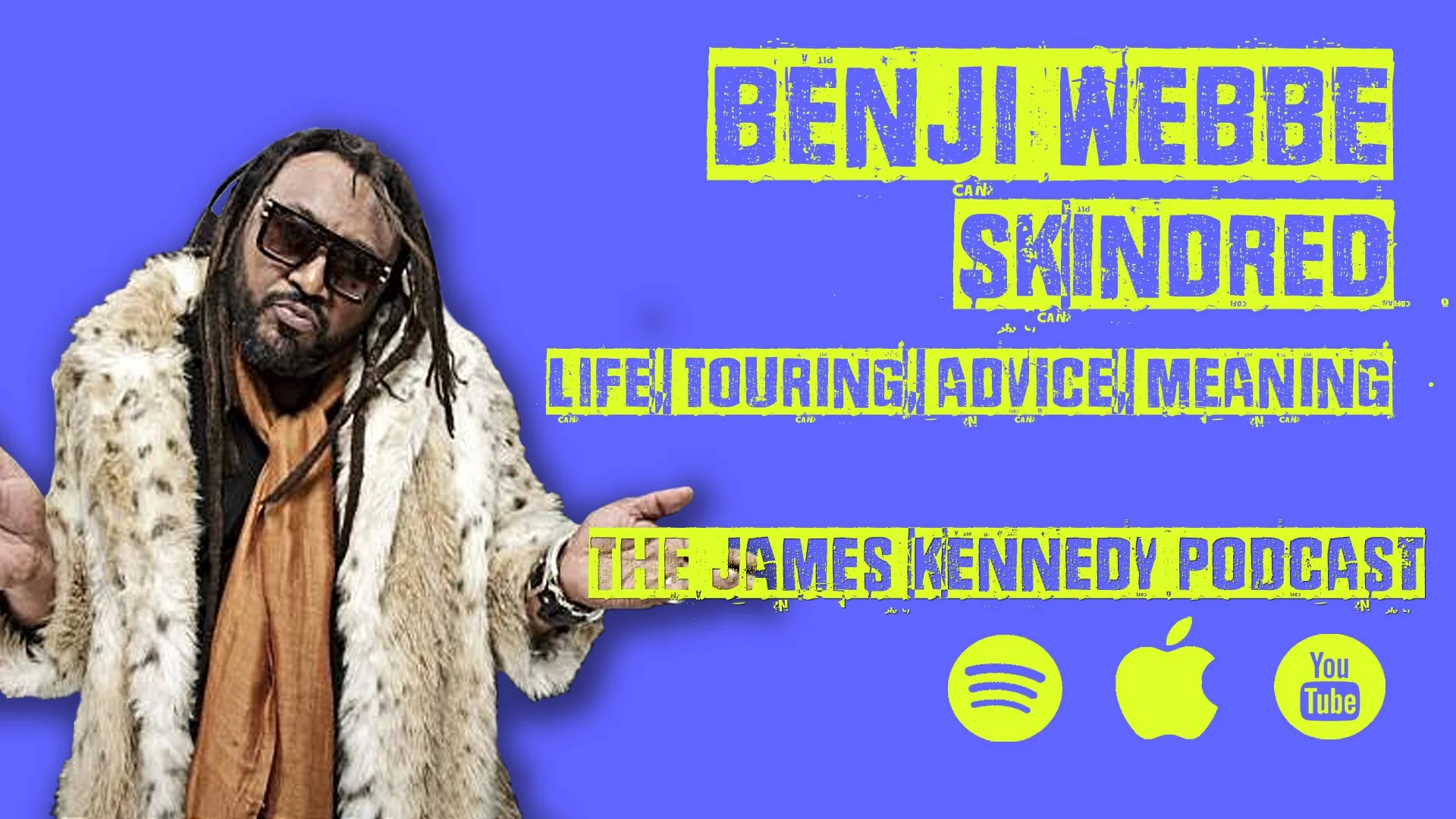
James Kennedy interviews Skindred singer Benji Webbe about his career, Dub War, touring realities, his clothing style, work-life balance, his thoughts on the music industry, life and what really matters.
James Kennedy: Mr. Benji Webbe, thanks for joining us, man. How you doing?
Benji Webbe: I'm good, brother. All is well, alhamdulillah as the Muslim people say. Yeah, I'm good, mate. I'm really well. I'm working, man.
James Kennedy: Glad to hear it, dude, because you're a busy guy, man. What's been happening lately?
Benji Webbe: I was in a record shop last week and I was talking to a friend of mine called Mikey Cole—Mikey Cole played bass in a band called The 60 Foot Dolls. I haven't seen Michael for 20 odd years, 30 years I reckon, and he said, "Benj, you're a workaholic." And I looked at him and I thought, I guess I am. I do a lot of stuff. I do a lot of stuff, but I do it for me, bro, and I enjoy serving myself, because I know if I wasn't doing something, I just would go crazy, bro. So I think working, it gets me in a place where I feel like I'm alive.
James Kennedy: Definitely, yeah. The Devil makes work for idle hands, don't you know?
Benji Webbe: Amen, brother. Amen.
James Kennedy: That's what they say, keep yourself busy, dude. Well, you've got the tour coming up with Dub War in March. Is that the main focus right now? What's happening?
Benji Webbe: Yeah, with the balance between Skindred, that is the main focus right now. Funnily enough, Skindred went out on tour, we did a massive European tour with a band from Copenhagen, Denmark called Volbeat. We did a massive tour from September right the way to the 20th of December, and we're all over Europe. So that wrapped up.
Skindred's got some festivals coming up, and we've got a new single out called "Give Me That Boom", which is going really well. It's doing really good in Germany, a lot of people are loving that track. But my main focus at the moment is trying to fill up the venues around the UK with Dub War for this Westgate Under Fire album.
James Kennedy: Hell yes, what a record, dude! Jeff Rose, my good friend, I do all my records I do with Jeff, so big shout out to Mr. Jeff Rose as well. And I know I just caught the post earlier that you put on social media about Mike Doling and Jamie Miller on the track "Crying Clowns" off the record. Well the last band I toured with, with my band Kyshera, was around Europe with Snot. So there's a funny connection, because you guys toured with them back in the 90s. Snot with Lynn in the band—incredible.
Benji Webbe: That’s right mate, ‘95. Never knew Snot until we got to America. We were supporting Fishbone. Fishbone was going on last, we were opening up, and Snot was in the middle. And yeah, we toured with them for six weeks, mate, and we made friends for life on that tour, definitely. It was definitely one of the strangest tours, but a tour is strange at the time, but the magic and the romance comes later when it's all over, mate. That's something I learned.
At the time you're like, "Fuck, this is shit, I can't wait till it's over." That's the truth, and that's most tours for me. But when I finish I go, "Man, what a good time I had." I think I tend to do that a lot, even on stage, big festivals like Download, I'm doing a Newport helicopter, doing all the things, doing the front man thing and thinking, "Fuck, I can't wait to get off." But when it's over, I sit back and go, "I had a good time." It's not strange.
Because you got to remember, I'm working up there, bro. I'm looking for the next thing to fucking make the people rock, and put their hands in the air or spin around or do something. So I'm thinking, as I'm performing, I'm working on working if you know what I'm trying to say? So it's only when I sit back and I watch the TV and go, "Fuck me, that was cool," I watch YouTube or whatever, I think that's when I think of it. I think when you're actually doing it, the romance comes later. Because at the time it's just work. And that's something even from the last show we did with Volbeat.
James Kennedy: I'm guessing you're touring in a lot more comfort now than you were back in the days with Snot. I can imagine touring across America—I'm assuming in something similar to a transit van.
Benji Webbe: It was a transit van with a trailer on the back, and it was hard, but that's all we knew. We pull up next to Fishbone and Snot, it was the same—they had fuck-all either. All they had was a trailer and a U-Haul—they call them U-Haul things—with all the gear in the back. Fishbone had a bus, and you know what's really funny? The bastards never even invited us on there all them weeks, and we never even got to go on it.
I always say to people, like, I love taking opening acts. I get very—I feel gratitude when I go and I take a band that's never been on the bus and say, "Come and check the bus, man," and they walk on the bus and go, "Oh yeah," they go, "Wow, my God!" And I remember the first time I've seen that as well. And I think you got to pass it on. Yeah, as a musician you pass it on.
Too many people I know in the music business and acting game, they get somewhere and instead of letting the fucking ladder down, they pull it up, the bastards! 100%, 100%, yeah, man. And they just want them to be on top of the game. Not everybody can be a rock star, so just calm the fuck down, don't be so greedy.
But I always enjoy taking bands, local bands on the bus and vibing with them and showing them, like, we worked hard for this bus. This wasn't given to us in any shape or form. We worked very hard, we had a lot of arguments, a lot of fucking tears, a lot of blood. But I want to share that with people when we go somewhere. I even grab, like, if I see the milkman delivering milk, "Oh, that's nice, man, that's a lovely bus. Come on, have a look at it, bro, come on!" And they have a look and they go, "My God, it's better than my living room!"
And I like that, because I think we got to, as musicians, you've gotta share it. You gotta share what you got. And I do think that taking the band aside who's opening up and bringing them into your dressing room, or just going into their dressing room before they go on and encouraging them, that's what I remember, the people who did that to me, and that's the guy I want to be.
James Kennedy: Good for you, good for you, man. Yeah, when we toured with Snot, they had a double-decker fucking—it was bigger than a double-decker bus, it was huge.
Benji Webbe: And you never went on there?
James Kennedy: We never went on there! No, the fuckers! It was a bit fractious, that tour, through no fault of ours, but we didn't really get on with each other on that tour because our manager stiffed us over for our contribution to the tour. And I didn't know about this until like the third week, and I was like, "These guys are a bit fucking frosty, we pass them in the street, they don't even say hello." And it's like, we've been on tour for three weeks!
Benji Webbe: There's things that go on that the artists don't know, the management's dealing with it, and that's it, see? And I’ve heard that a few times, not about you, but a few times about bands that's been on tour and they're supposed to pay half of the berth of the bus to be on the tour, and they haven't paid, and the band don't know about it, and they're walking around smiling, "Yep, yep."
James Kennedy: Yeah, exactly that. I was like, "What the fuck is wrong with these guys, man?"
Benji Webbe: It's a weird game, man, it's a weird game.
James Kennedy: Such a fucking iconic band, such a great fucking album. I still listen to it to this day, and I was like, "Oh man, this is going to be fucking awesome."
Benji Webbe: I was really surprised because I've never lost contact with Mikey. Obviously before Facebook I did for years, like 10 years I never spoke to him before, but as soon as Facebook came along me and Mikey was in contact, and then he joined Soulfly, because I did some work with Cavalera as well, so we were always friends through that. But as soon as I asked Mikey during that pandemic, "Mikey, you guys up for—I'm doing some stuff for me and Jeff and Rich," and they said yeah. Like, it wasn't even a case of like, "Oh, let me think about it." It was like, "Yes, send it. Send me the tracks, we'll get in the studio and we'll lay down," and that's exactly what they did. "Crying Clowns", I think it's just a great song, it's that wow factor that Mikey is famous for. Yeah, I was very happy with that.
James Kennedy: Oh, the whole record rocks, man. And yeah, luckily I bumped into Doling in Belgium a couple of years back and we managed to rectify everything once he knew what the situation was and everything, and I made sure they got their money, because I was just fucking like I said, walking around with a dopey grin on my face, oblivious, in Italy. So luckily we patched it up because yeah, I love that band, I love that record, man. So he plays in a band called Channel Zero in Belgium as well, they're big in Belgium. He's got a couple of projects actually, but he's like you, man, he's busy as fuck.
Benji Webbe: Well, bro, I just can't sit still, like I said, I just gotta keep doing it. I wrote that children's book now, so I've got The Wonderful Adventures of Colin the Kitten, right? But what I want to talk about is people who "yes" you to death and then they fucking flake on you. I'd prefer someone to say, "Fuck off, you bastard, I'm not interested." We can work it out, and then you end up being the bad fella for calling them constantly going "what's happening?"
James Kennedy: So what have you gotta get off your chest? Go for it, tell them.
Benji Webbe: No, I just feel like when you're doing something with someone, whether you're playing guitar, whether you're writing something, whether you're making, designing t-shirts—I actually thought it was something in the fucking injections that was given to people to make them unpleasable. My own conspiracy theory.
But I had like four or five things which was going great, man, like really, really well. Like I was working with this artist on some cartoon stuff, and I was working with someone else on the t-shirt, some really cool screen printing stuff, and we were going really well. They were sending me the designs, I was blowing up on it, and they were going, "Yeah, we're gonna try this, we're gonna try that."
I don't know whether they all got together and said, "Benji's—I can't, don't do anything for him," the whole thing went quiet. The three blokes—I had one guy in Liverpool, one guy in Bali, one guy in Australia, one in Canada! And I thought, "What, is it me? Is it fucking me?" And I'm really scratching my head, I'm asking my wife, "What the fuck? What am I, some sort of asshole?" She said, "Yeah, but maybe not in this situation."
James Kennedy: Well, for me, this is music to my ears, because I get that shit all the time. I think they call it "ghosting", where everything's going great, you can see when people have read the message and they just stopped replying. It's a pain in the fucking ass, cause I'm like you, I'd rather they say, "Dude, we can't do it, all the best," and then you stop wasting your time. So I prefer that. But it happens to me all the time. But I'm on a different rung of the ladder to you, so I always just assume that this shit only happens to me because I'm sort of down at this level. Once you get up to Benji Webbe level, that shit don't happen, so I'm glad.
Benji Webbe: No, it does happen, bro. I think it does make you check yourself and ask, "Have I done something wrong? Has my conduct been—?" And I'm checking my conduct all the time. And now I'm working with people, and the first thing or the second thing I say to them is, "You don't have to do this, please tell me to fuck off!" Now, so far I'm bugging you in all ears from now. But anyway, that's something I'm just going to encourage every person out there, if you don't want to do something, say yes, but come clean quickly that you're not interested. 100%, yeah. I never not answer people's fucking texts and messages, not the rudest thing you can do. Oh, there's no need for it. Like, I text you, mate, ghost. I text you, mate, ghost. Nothing. I just think people need to go, "No, I'm not going to try to do it, not interested," because then maybe I can find someone who actually fucking says it. You can keep it moving instead of you wasting my time.
And then the people are telling you, these t-shirts, this guy designed in Bali, they were outstanding, bro. It's not even worth me trying to recreate them right, because basically a friend of mine was introducing me—Jason—Jason Repose, an amazing photographer, he turned me on to this guy. And for the first three months, the guy was all over it. I was telling him ideas, everything he did was based around the Newport helicopter thing, right? And I was trying to make a design for a shirt and for a clothing brand, all about the Newport helicopter, then it was going really well, but he was very creative anyway.
What I was telling him, he was just did what I told him, and he was sending it back, and I was blown away, because he was doing some fucking Rasta shit, some metal shit, and I was like, "Wow, wow," we met the death. And then one day he said, "Okay, I'm gonna send you some shit, and it should be with you by next Wednesday." Next Wednesday came, what? Nothing.
James Kennedy: So you got that far, dude? You got as far as next Wednesday?
Benji Webbe: Bro, I got to a room! I got to the point where the guy showed me a studio with all the shirts he designed laying up in his living room.
James Kennedy: So you got to the fucking finish line and then nothing?
Benji Webbe: I got to the finish—this is what I'm saying. I don't mind if it's like a chat, one conversation, and then you fuck me off, of course. But when you put your—because one thing is spinning me up now, it's not the money, it's what did you do with all them fucking shirts, bro? "Yeah, I'm gonna send you one, bro, right?" Fucking dude! It doesn't say Skindred, it's not like that. You'd look at it and you go, "Wow, that is cool." Because then when I say that's Benji Webbe's thing, you go, "Fuck me, I can see it now," you know? It was that kind of cool.
James Kennedy: How long has it been since you got a reply from this guy?
Benji Webbe: It was really cool for the first, I'd say, six months, so I reckon it's been about 18 months now he hasn't bothered with me. Oh, yeah, that's fine. The worst thing, right? I left him a message saying, "What the fuck, bro? What am I black or something? Sort this out, man," and he totally ignored that. And I went, "Okay, I think I shouldn't have said that, I'm trying another one," and I asked him again.
And the worst thing is like he disappeared there for like four months, and then he appeared again with this woman in his life, and I was like, "I'm happy for him, I might be free." I've seen her on Instagram, and then he disappeared again.
James Kennedy: That's weird.
Benji Webbe: Oh, yeah. What I'd like to say to any human out there, if you're doing something with somebody and they're the creative and you're the actual person who's doing it, and they're giving you the ideas and you're sick of it, tell them you're sick of it before you wind them up too much.
James Kennedy: And if you fuckers are listening, answer Benji's fucking messages!
Benji Webbe: It's cool, though, bro. Life is full of lessons, and as long as we learn from them, that's cool.
James Kennedy: Amen, 100%. But I just can't believe that that shit happens to you at your level. I would have thought any t-shirt designer of worth would want to work with Benji Webbe and Skindred.
Benji Webbe: No, mate, it happens. It happens. Listen, I got a friend in Metallica, and it happens to him, too. Believe you me, I think it's just the human condition of bullshit, it's called. People get excited, right, but I wish they'd get excited and go, "I'm not excited no more," and then it would make your life easier. I'm sure your listeners are like, "Fucking get over it, folks."
James Kennedy: No, but it's interesting, man, because we don't think that this shit happens to people higher up the food chain than ourselves. And I think it's healthy for people to hear this shit, because otherwise you could think it just happens to you. And there's so much of that now in our culture with social media and everyone's life looks like it's so much fucking better than yours, and everyone's band looks like they're so much more successful than yours. And it trashes people's mental health. It's not good, it doesn't help the cause at all, man. So I love it when I get people like yourself who are so open and honest about the true reality of what life is like on their rung of the ladder. It gives the rest of us a bit of hope when we think, "Okay, it's not just me. Cool, I'll crack on then."
And it kind of segues nicely into something that I wanted to ask you about, which is a bit of a curveball question, because I know in interviews people always want to hear about or ask about the successes and the name drops and all that sort of stuff, and the rock and roll glamour. But I actually think there's more to learn from the failures. I think it helps people out to know that other people have them as well, and also other people can learn then from those who've been over the trenches before them. So I'd be really keen to hear of some situations that have been like what you've considered to be crushing disappointments or near misses or missed opportunities or anything like that, just to give the rest of us a little bit of a morale boost.
Benji Webbe: All right. Listen, I modelled, even to this day, I always think of us as the band that nearly was. I even do this day, really. I mean like pulling as many people as Rammstein at Download on a Friday evening was pretty cool, right? But I always look at it like we're the band that nearly happened. We nearly happened. And that's how I feel even to this day, bro. Maybe it's a good thing, because I'm always striving to be the guy. I don't rest on my laurels. From that, it makes me go, "You know, I want—"
It's like the other night I was watching something called 60 Years of Welsh Pop Music. Now, I've always felt like the black sheep of Wales, no one ever was interested. But then I realized how much I have got going compared to some of my mates. Because some of my mates have been doing this music thing as long as I have, and they've never had a break, they've never played Download. They're still playing the shipping lanes, and I'm going on a Wednesday night. And you've got to take into account how blessed you are, and it makes me feel like that.
Like the other night I was watching 60 Years of Welsh Pop, and I do watch it, because I do like Super Furry Animals, and some of the bands I never even realized were Welsh, like Andy Fairweather Low and stuff like that. And I'm watching a single with—oh, this is cool as fuck. And next thing you know, they put us on that, and my wife said to me, "See, you're always moaning that they never talk about Skindred," then they did. And I was like, "Wow!"
But one thing I'd say is, back in the day, one of the most crushing disappointing things that happened to me and Jeff in the early days of Dub War, we released a single called "Cry Dignity", and this was the record company's last shot. They were like, "Fuck them. After this, if they don't happen after this, they can fuck off." So "Cry Dignity" came out on the Friday, and we had a good call from the label saying, "Hey, it's going really well, it's doing really, really well," and we're like, "Wow, that's cool." Sunday—and then they said, "Well, but we're not going to find out until Sunday until the chart is on the actual chart show on BBC Radio One."
So me and Jeff and Richie and James all met in this cafe down in Newport. We got a little transistor radio, we put the radio on at number 40, right? And we go, "Okay, top 40, we're listening," they go down 4, 5, 6, they do like—they've got the top 20, and we're looking at each other, "Yeah! Oh my God!" I'm looking at Jeff, and getting in the top 10, bro, we're still there. It got to number four, and we're looking at each other going, "Oh my God, no way!" Got to number two, and we're like, "This can't be right!" And we're still excited. And then the guy said, "Number one, a band called Upside Down." They were the first ever band with a TV documentary about them, and that TV documentary was on the Friday night, so that just boosted their sales.
So when we called the label on the Monday—actually one of the guys called Ginge called the record label that evening, and they said, "James, we got the phone, you were in the British charts—41."
I dragged my feet, I was like a wet fucking rat coming home from town. I remember walking—I looked, and I think because we were like—we were drinking cider and fucking, yeah, we never won. The record company did all they could do, we did all we could do. But we got number 41. But the funny thing was like we listened from 40 to number one, and we were just on the other side of it.
James Kennedy: Oh, this is like therapy.
Benji Webbe: So that was pretty fucking heartbreaking. When we were doing our Dub War thing, we were quite good and people were digging us, like when we played Reading and Phoenix Festival and all these cool old school 90s festivals we did. We did the Manic Street Preachers tour, which is absolutely incredible. Another romantic thing that was shit during the tour, but now it's beautiful. But at the time it was hard work.
The Word was another one that we were told we were going to be on, and we were on tour with a band called The Blaggers ITA, and we were told that during the tour there's a possibility that we are going to be picked to go on The Word, and we're like, "Wow!" And the guy from The Word came to see us in a place called Harlow. And a week later we went home and we're all expecting—sat down there, I was watching The Word, the fucking Blaggers was on there! I just remember looking at the table, "My God, maybe they got the wrong band."
Someone said to me, "You got to be tough to be in rock and roll," and it's not to be a hard man, it's just to take the beatings. Thick skin. And it's true, you look around you and you see bands doing so well and you wish them well, but you still think, "Fuck, I wish that was me."
James Kennedy: So you said you got a friend in Metallica. Do they say the same thing? Is this a human condition thing?
Benji Webbe: The shit I moan about, they moan about. "This one's a wanker, that one's a wanker, he wants everything for him." Same thing, bro! Where I complain—I'll be honest with you, I have more arguments in the world now than I ever fucking did, but Skindred started up sailing a little easier. I think we're growing with it. 20 years with the same fucking lineup, there's something to celebrate. Jeff, when we first started and recorded the first album, Jeff and Ginge was in the band, but they left quite quickly. The first American tour we did, Dan McKinnon was playing, and then we revamped the album so that Mike and Dan had music on the album, so they didn't feel like it wasn't actually part of it, not just playing other people's music. And we did that. So being a band for 20 years, I think that's pretty successful.
James Kennedy: And it's still going strong as well, dude.
Benji Webbe: I think so, bro. When you see some people on their Instagram, they put a picture of their dog and they get 90 million fucking watercolors, and I put a picture of me singing this beautiful aria and get two likes. People say to me, "You're doing so well," and yeah I do realize and I do count my blessings and I know that I'm doing well, but I think sometimes you've got to be blinkered. Don't watch the other horses in the race, just run your own race. I think I've learned to do that without getting upset, without saying, "Well, I'm good, what's wrong with me?"
James Kennedy: This is therapy for me, dude! I'm so glad that you're speaking so openly and honestly about this.
Benji Webbe: I think everybody is the same, all of us that look up to Skindred, we all feel exactly the same. In our level, just like in the sketch with The Two Ronnies, "I look up to him, but he looks down to me." We're always looking up there, but there's always someone complaining.
It's like we played with Volbeat, and some of the venues was absolutely incredible. And I could see it that some of the nights they were gutted because it wasn't rampacked. But they're there! You walk down this hall to get to the stage and you're walking past like Bring Me The Horizon, Dolly Parton, Cliff Richard, Michael Jackson. Humble Pie and all these people have been in this place where you are.
I think for me personally a lot of the time on that tour I consoled myself with the fact that I'm doing great things. And that's it. It's a cliche, but it is the journey, not the destination. Because if you were dragging your ass around America playing with Snot in a beaten-up transit van, I'm sure there were tons of adventures. When you look back now you've got fine memories because of it. But if you're working in an office and you stayed there for the rest of your life, you wouldn't have any of these riches, no memories.
Even stuff that's happened to me, like divorce and things like that, at the time it was murder, and I said this to a lot of my friends who were going through that kind of stuff. At the time it's murder, but once you get through the battleground and then you find somebody else who you care for or you love—that's the sweet spot! And you think to yourself, "Thank God, got away from her in the end," "I got away from him," because I'm in a better situation. My heart and my mind was, "I'm in a better situation."
Sometimes you gotta fucking go through the really shit times. One time I heard someone say, "When you're going through hell, keep on going, because you're only going through hell." You're going to come over the other side, and that's the same with music, and it's the same with life stories as well. You just gotta keep going.
James Kennedy: I love it! This is like a philosophy session, I love it man! This is great. Keep the wisdom coming, dude. Because I oftentimes have successful musicians and stuff on the show, and this is the sort of shit that I like, because it's more interesting than just talking about, "Oh yeah, I was hanging out with Mick Jagger one night," we've heard all that. This is the interesting shit for me, and this is the useful shit, because it helps people on their journey, because they feel like, "Oh well, Benji's going through that and he's done XYZ, so okay, yeah, I'm gonna keep pushing through hell and come out the other side like he did." So I think it's good to have these kind of conversations.
ENJOYING THE CONVERSATION?
GET JAMES KENNEDY'S LATEST INTERVIEWS, WRITING AND LIVE SHOWS STRAIGHT TO YOUR INBOX
Benji Webbe: Yeah my bro, I'll be honest with you, my favorite singer in Wales to this day is a guy called Nigel Smith, who does my fucking garden! GreenFingeredNigel, right? I'm telling you, that guy's voice is so soulful, and he only pisses around, he's doing a garden, some dancing, and I'll stop and look at him, and he's doing his thing, and he starts singing, "Oh, listen to this, Benj, I wrote this last night." And I tell you what, bro, his voice is so soulful.
He looks like Father Christmas, right, but he sounds like God! He's got that Zeppelin tone to his voice. But there's a richness to it. And I've been on the telly, Nigel's been knocking around the pubs and clubs and open mic nights for years, right? But I recognize the talent in his voice.
I put Nigel my gardener on a par with Kelly Jones from Stereophonics. I think he's a beautiful writer—Rod Stewart and Kelly Jones. He's got that rasp, he's got the gravel. There's something about their voice which is special, bro. But I put Nigel up there with them. He's got that tone to his voice, man, and he's nobody famous. He's just a beautiful guy who I used to know from bands. He still plays, he can play guitar, he can play bass, and play drums. Ask me if I can play? Fuck off!
James Kennedy: It's a great point. Because there's so much—especially around here, man, there's so much fucking talent, there's so many good bands. And they're working their ass off, and they're all professional, and they're doing it on a shoestring with no label, and having to work around day jobs and stuff like that. And it's fucking heartbreaking, man, because there's only so many opportunities. And yeah, there is an unfortunate element of luck, because you've got to grab that opportunity. If one doesn't come your way, you can be the best fucking singer in the world, but where do you go from there? So it's difficult to know what to tell emerging bands or bands that are hammering the circuit, because it's tough out there now, man. We know the state of venues and streaming.
Benji Webbe: One thing I always say to people: take your eye off trying to be rich, just enjoy yourself, man. Take it off trying to be famous, just enjoy yourself. And another thing—I know I might sound old when I say this, but if you're making a career out of music, a bricklayer, if he did a wall, he's not going to let everybody see the wall he's just built for the first fucking time. He's going to work on that wall.
I'd say just do it for the love of yourself, and look around you. If you can look around you on stage and say "that's my favorite guitarist in the world," that's the blessing, bro. Chasing the dollars is one aspect of it, but when you stand on stage, if you look behind you, you see a drummer you love—not just love, you actually dig the way he plays and you wouldn't want to be without him.
I think that's the magical thing in rock and roll—and I know I'm blessed from a very early age, from the first time I got in a band, and I didn't even get a record deal till I was 26. I'm 55 now, and I didn't get a record deal till I was 26. Because a lot of stuff was happening, bands were happening, singers were happening, but I didn't do it until Earache Records came into my life. But I was doing it not trying to get a record deal, I just didn't want to work with my brother's painting and decorating! I was never going to do that, as much as I'm the worst fucking renderer you'll ever see. When my brother used to give me work to paint and decorate, he'd have to go back and do it himself after. He'd say, "I'm doing it because I love you, not because you're fucking good."
James Kennedy: That's great advice, man. I know because I've been there. I did it for 10 years, we never got above the transit van level, washing in the car park with warm bottled water and shit like that. It's fucking horrendous. That's what I put in my book, and I think the reason the book did well is because it had that appeal. More people could relate to it than they could relate to stories about private planes, cocaine, and groupies. I think that was the appeal because most bands, that's the level they do stay at.
Benji Webbe: Well, in all honesty, I think what you're talking about there is 95% of the musicians, not the elite who actually get to play Download and they've got Andy Copping's phone number. There ain't many musicians who got that vibe going on. So your book will appeal to those. I mean, there's so many musicians I respect and I love that never left the transit van. They're still in the transit van, but the main thing is they are in a transit van, but they're still doing it, they haven't given up.
Once you go, "I'm not doing this no more," that's when it's over, right? That's for me anyway. And I got so many people go, "You want to buy my amp?" "No, I don't want to buy your fucking amp, keep it!" "Oh no, I've had enough, bro. I can't—if I can't—" And that's when it's over for you, because you've given up now, totally.
People come up to me all the time, every other day, and go, "Still singing, then, Benj?" I go, "Yeah, I'm still singing, bro." "Oh, I've seen you on the telly before." "Yeah, I'm still doing it, bro, that's what you do." I mean, I'm pretty shit at painting and decorating, that's my brother's business and he won't even give me a gig!
I did say to him when the pandemic hit and we had no money and nothing was coming in and nothing was being sold, no gigs—I live my life through rock and roll shows. If I'm on the phone to you, I ain't making money doing this. I'm only making money when I'm running up and down like an idiot. And I did say to my brother during the pandemic, "Can you help me out?" Not a fucking chance! My brother said to me, "I might as well get my dog and get a fucking paintbrush and put it on his tail."
James Kennedy: That's fucking interesting, dude. So you reached out to your brother in the pandemic?
Benji Webbe: Yeah, and he said, "Fuck you, man." He said, "Go and see Richie. He might give you a couple of quid."
James Kennedy: Man, I'm surprised at that shit. I'm surprised that you had to reach out, a guy this far in the game.
Benji Webbe: Listen, I was all right, believe you me, I was all right, but I was thinking if it got fucking worse, it got worse. Okay, that's what I was thinking about. I wasn't really like Desperado, but I did say, "Listen, if worse comes to worst," and he said, "Don't fucking ask me for work, okay? I don't care who you are. I might as well stick a fucking paintbrush on a dog's tail, bro."
James Kennedy: If anyone's out there listening to this, and Benji ever falls on hard times and comes knocking at the door with a fucking can of paint in his hand, just shut the door in his face!
Well, that's interesting, dude, because that leads me into something I wanted to ask you about. You've been in the game a while now, you've seen the industry change. You came up in the old model in the 90s, and now you're very much in the new model. You've seen the whole shift, and you've stayed afloat in it. So what are your thoughts? Do you think it's better now with social media and the ability to make your own records?
Because for people like me who don't have a record deal—I've done seven albums, it didn't cost me a penny, I did them all in this fucking room. I was able to keep it moving, self-distributing myself. Some of them did better than others, and I was able to do my thing. I couldn't have done that in the 90s because you couldn't make your own record back then, it's too fucking expensive. So I'm kind of an evangelist for the new model, but it's because it's all I know. What are your thoughts?
Benji Webbe: I think both ways are great, bro. Knocking door-to-door, Bible salesman—music is the way to go. And also if you can get the big monster behind you, it's the way to go. There's a lot of ways to skin a cat, bro, and we haven't got to follow a model.
I used the other day—not that I know anything about urban music, but Stormzy—Stormzy hasn't even got a manager, really? Yes, mate! Stormzy's done all that shit himself. The thing I always go, "You need a manager, you need this, you need that." There's a lot of acts out there with the internet and Spotify and YouTube—I think what you need is a clever motherfucker in a room with a fucking computer, that's what you need now, and you can be the biggest in the world on that circuit.
There's more than one way to skin a cat. But if I had my chance to live again, I would get four clever bastards with a computer, and I think they would help with your social media, because your social media thing is really important. If you get a team of people who are behind it—I do my own social media myself, and I'm too tough to spend money on somebody to do it for me, but I know that looking at it, when you see somebody's acts out there, people come at me and say, "You know this one and that one?" I've never fucking heard of them. "Oh, they sold out Brixton Academy five times!" Yes, happens all the time, man.
And that's what I love, that it's not all BMG or Sony or someone. It's Martin from Fraser's Road and started and shit his shit out. And I think that's beautiful. I really do. I'd love to be in a situation where I wasn't dependent on a record label or waiting for a time slot. Because being with Earache Records, I gotta wait for that stuff and I gotta wait for this and I gotta wait for that. But I just think there's so many ways you can skin the cat nowadays, it's not just one way.
I do think social media—that kid in his room who's got it down and knows how to do the memes and knows how to do this and knows how to do that, and they keep their ear to the ground and they know what's happening—if you can get a team of people like that, you're in a better position.
James Kennedy: 100%, because in the lockdown I was making about 500 bucks a month just from Spotify, not because I was getting loads and loads of streams, but because I've got a seven-album catalog and I own 100% of all of it, because I'm independent. So I got the label side, I got the publishing—I set up my own publishing network—and I got the writer side, producer, so I get everything, the performance. So, it's only a few hundred bucks, but it helps.
Benji Webbe: Chuck D said "if you don't own the masters, the masters own you!" And you telling me that, that's pretty brilliant, that is absolutely—I put out during the lockdown a covers album, which obviously doesn't belong to me, but it was just fun to do that kind of thing. It was called 2020 Isolation Project, right, and it's still out there. Basically, it's classic rock songs, and I did Reggae and Ska versions. And I had a lot of fun doing that, but that was more for my own mental well-being more than anything.
I would have wanted to do it with Skindred, but the boys are—I find musicians the worst. They're just so like, "Oh, I'm not sure about that," so in the end I did it with Jeff on his keyboard thing, and we just did that isolation project, which is really good. But for you to have all that going on, bro, that's brilliant, man, that's really good.
James Kennedy: Well, I wonder sometimes, because I do it all by myself and it's a 24/7 job. I miss so much socially and in terms of what other people are doing, because doing that just stays afloat independently. Because I play all the instruments, I do all the production, I run the label, I got a commission for my second book now, I'm doing the podcast, I'm like you, I'm busy as fuck. But because I'm independent, I don't have anybody to bounce anything off or anybody handling media or promotion or booking or anything like that. It can feel a little bit overwhelming and like, "Am I doing this the right way? Have I made a rod for my own back?"
Benji Webbe: I think you have made a rod for your back, but at least you're giving yourself the hiding, do you know what I mean? Especially you, you make that rod for your back but you can actually put the pressure on or take it off, bro. You've got the foot on the gas and you want it to drive great. What you're telling me now, it makes me think, "Well, you got it going on, bro." I'm signed to a record label. I'm starting to do a label. Whatever. It's not important like it was before. And that's how I view it, I really do. There's so many ways that people can get to where they need to go.
It's lovely to go to Rockfield, it's beautiful to go to B7 in Los Angeles, all these places. I wouldn't be able to go then if it was just me. I would need that in order to go to these amazing places—and I've been to some of the best studios in the world.
The last Skindred album we recorded called Smile is coming out on the 4th of August this year. We've dropped one single called "Give Me That Boom", but we went to a studio in Worcestershire called Vale Studios. Such a beautiful recording studio, and it's actually in a Georgian mansion. And the good thing about it, the guy who runs it, Matt—he was just the biggest head guy that you'd want, he'd come into the studio in the morning, it wasn't troubling you or getting in your way.
I know that doing the double album in my house and at Richie's house and at Jeff's house was great fun, but the actual going to the studio for that memory, you know, it's like I'm trying to get the record company—because we got a lot more on this record of Skindred's, it's heavy as fuck, but it's a lot more dance and reggae vibes in there as well—and I'm trying to get fucking Earache to pay for us to go over to Jamaica to do all the videos. I'm really working on it, because I really want to go to Jamaica to do the videos, because it's made of memories, bro!
Not because—I'd fucking put my money out of my own pocket to go there just to have the memories of doing the videos in Jamaica, going to Dunn's River Falls, going to Kingston, Jamaica, doing these really cool fun videos, making it look like the Fugees. And I got that in my head. Making memories is a very important thing as a musician as well. Like you said, being in your room on your own, it's lonely. Being in a team, it's like a double-edged sword, you can't win. You're damned if you do and you're damned if you don't.
James Kennedy: That's why I look at it, you know. Mate, you are dropping so much fucking wisdom on this, I'm loving it, man. It's going to put a spring in my step for the rest of the week, honestly. I'll pat myself on the back after this. Have you always been like this?
Benji Webbe: Yeah. I've always been like this, I've always had the fight and the desire. I try to keep the coal alive, you know? It's like when you've got a piece of coal, you take it out of the fire, it's going to go cold. Sometimes I piss myself off because I'm trying to encourage the boys in the band, because you know it's not easy being in a band, no matter who you are.
So I'm the one who sends the stupid fucking, "We gotta love each other and live together, cheerleader! Come on, guys, we got this." That's what I'm trying to do with Skindred sometimes. I do that, because we do fall into places where songwriting shit weighs heavy on you. So I just want to be in them. One thing about a band with longevity, the fire goes out as in let's sort it out and stuff like that, because I don't care who you are, we're not all like Mark and Wise living, sleeping in the same bed, having a good laugh.
Sometimes you really gotta watch the people around you, because mental health is something that you let go, you let it slip real quick. You won't even know your friend—the people in my mind are suffering this shit, suffering from mental health, including myself, including them, so we got to watch how people's lives are, not just, "I'll meet you on stage next week." I want to call Dan up and go, "Hey, how are you doing?" I want to call Mikey up and say, "How are you doing?"
Especially living in Newport, I can pop over Jeff's house, I can pop over Rich's house, see him, look him in the eyes. But when you don't see each other for four, five, six months, I want to make sure that the people in my band are still okay. Not all of us got beautiful wives and families and all that stuff around. Some of us are on our own. I think you need to be there for people, and I want to be there for people. Not everybody's there for everybody, but I want to be there for my bandmates.
I always say when I introduce my guitarist, I go, "This is Mikey, my friend. He also plays guitar with me." It's not just my guitarist. I don't want it to just be my guitarist. It's not just the money-making machine, it's about the memories that we make, it's a family, man.
I try to find—in the last four years I put on a lot of weight. About four years ago, when I went from 19 stone down to 14, and I kept it off, and now I'm about 16. Now I'm 16, so I kept two off. But I tell you, it's not easy to go to the gym every day. I fucking hate it most days, bro. But what I found—the love that me and Mikey had on the last tour is he started coming to the gym with me, right? So we can get up in the morning—I'm an early morning guy, up at seven most mornings. So I get up, I'd find a gym, text him and go, "Look, Mark, this is where the gym is. Come on down, I'll be there in a half hour." And we get to the gym, and I think that was really good, because when you're doing weeks—the last thing you want is your guitarist pushing more than you. It was very motivated. Exercise is so good for mental health as well, man.
James Kennedy: I've had those battles myself, and I also lost a couple of stone a few years ago and I got really, really into it. Cardio every day, lifting, weightlifting and nutrition and all that sort of stuff, and it can get quite addictive and obsessive. And I just felt fucking great, but then in the lockdown, it all went to shit. So I'm trying to get back on it now, so I can totally relate to that, because that bond you're talking about through fitness as well, even if it's unspoken or intangible, it's there.
Benji Webbe: Definitely. And like I said, going to the gym—me and Mikey, we were on the road for nine, ten weeks, and I think we went to the gym like five days a week.
James Kennedy: Wow! And still playing in the night as well. You must have been fucking burning some calories, man, Jesus!
Benji Webbe: Well, that was the beauty of it, because I did feel much better for it. Listen, I love beer, I love chips, and I love beans and eggs, bro, I love that stuff. But this balance that we have to have, especially on the road, it's like I love a drink, I like acting crazy, but you've got to do it a few times, not every fucking night. I don't think my voice could hold out drinking booze and screaming at the top of my voice in nightclubs every night, going to after-parties.
I don't do the after-parties thing no more when I'm touring, because after performing, screaming, running up and down—from the microphone in the living room in your studio to a stage, you're using a different form of your voice totally. The things you do in the studio with the mic, you can't do that unamplified. So you really got to give it all you've got.
I gotta give it all I got when I'm on stage, so hence when I come off stage there's no usually going to a fucking after-party. And I found out—and it took me a while, mind—that I'd do a tour and the first four shows I'll be great, and then for the rest of the tour I'll be struggling. And what I found out is just rest your voice, go to bed.
The good thing about supporting Volbeat—God bless them, they're beautiful guys and all that—but by the time they've gone on stage, I was wrapped up in my paper. I like the shows on a Saturday, I'm a Saturday night kind of guy, so I like to watch, because I know no one's got work in the morning, or very few of them have work in the morning. So I'd like to go watch Volbeat on a Saturday, right?
And what I was finding, it was more beneficial as a vocalist and a performer if I went to bed, got an early night, woke up, went to the gym, I spent the afternoon doing whatever. Walking around the city—I'm a shopaholic as well, so I do buy a lot of shit. So I'm walking around cities and then when you get back to lunch at half past four, you have your lunch, then it's showtime at about 6:00, 7:00 o'clock. And it was a routine that I got into, and I know the reason why my voice held out all that time was because I was resting right.
James Kennedy: Makes a lot of sense, yeah. And more great advice for bands, man. How do you manage then doing everything that you do whilst also having a home life and a family and a wife and personal stuff? How do you balance all that? I'm always interested in how people manage to strike that balance.
Benji Webbe: I believe in this, bro: me first in the gimme gimmies, bro! I'm the first. And I've got four children, I've got 16 grandchildren, with a beautiful wife. I would never want to meet my 16 grandchildren at the same time, as much as I love it. But at the end of the day, it's all about balance, everything is about balance.
I'm fortunate to live in a neighborhood where everybody in the neighborhood knows me. It's quite a heavy neighborhood, but just helping in the community and doing stuff around for some of your mates, just being of service to people. Like a woman the other day—someone says, "Someone got cancer, what can you do?" The best thing I can do is give you a framed photograph signed by the band and send it to you.
I find my time is taken up a lot by just doing that, taking stuff around to people. But I'll be honest with you, other than singing and having that blessing in my life, one of the most rewarding things I ever got involved in was voluntary work for church, helping people, just helping the homeless and stuff like that. I thought that was really good, bro.
I worked with the volunteer work in a place called Kevin Hands in Newport, and I was there for about four years. That was just before Skindred started. And it was so rewarding, because I met a lot of people on drugs, a lot of people just fucked up, and their life turned a different corner. They didn't expect to be homeless or anything like that, but I was the one who would just take them into the room and give them showers and pick their clothes. And I loved it.
Amazing, to take the transformation! People covered in lice from head to foot, scary shit, the nails are like Nosferatus. You gotta cut their nails, their toenails, their feet, sometimes wipe their ass. But I just felt like it was something where—they'd say thank you, but inside myself the reward, the massage to myself is so beautiful, and that's the only way I can describe it. Saying, "You've done good today."
James Kennedy: That's amazing. That was between Dub War and Skindred, right in the middle of it. How do you find the time to do all this and have four kids and a wife?
Benji Webbe: Yeah, no more, they can all fuck off! They look after themselves. I look at it like this: I want to be their dad, bro. I want to be their friend as well. I want them to be able to confide in me, and I want people to be able to tell me stuff. If I can't say my missus is my best friend, she shouldn't be my missus. So I should be able to tell her something and not get upset, and back and forth.
I want that to be in a relationship, and I try to get that with all my friends, no matter what their mindset or their beliefs are, I try to just be true, like Willie Wobble Dagger said.
James Kennedy: Who?
Benji Webbe: You know Willie Wobble Daggers, don't you?
James Kennedy: No!
Benji Webbe: Yeah, you do! Willie Wobble Daggers, some people call him William Shakespeare. Willie Wobble Dagger said—and I think this is fucking true—"To thine own self be true, above all things." And I think that's fucking great. I think that being true to yourself, and sometimes when people say to you—going back to the original conversation—when people say, "Yeah, I'll do that," and then they fuck you over, it'd be nice if at the very beginning they said, "Wait a minute, I don't want to do it, Benj," instead of getting you excited, because look how excited I am talking to you. I'm an excitable fucking person, I love it. And that bubble gets burst so fucking easy when people let me down in that aspect.
I get personal if I get an idea for a song and I say it to my bass player or my guitarist and they go, "Yeah," I'm like, "What? Yeah, you don't understand, one day you'll see what a genius I—" I'm like that. I want everyone to be as excited as I am about everything. But it's contagious, man, I'm feeling it now. I play a song to my bass player—it's funny, because he'll play me a beat and I'm fucking banging my head, my head's moving, you can't see it, but it's moving. I'll play him something and he puts his hand on his lips, "All right," I'm like, "What the fuck? I just bled for you while I was dancing." So I guess it's just different strokes for different folks, isn't it? People act in different ways in different situations.
James Kennedy: Totally, dude, I'm loving this, man. And that energy is contagious as well. I was going to ask you how you stay inspired, but I don't think you need to. I think it's just you're you, it's just in you. You always—you've got this energy and you've got this passion and this need to create and enjoy the moment, and I think that seems to be what fuels you.
Benji Webbe: I think, like you said earlier on, when people—I do enjoy even the aspect of someone saying, "Look, my whole life," even on that Volbeat tour, the reason why I found it so difficult at first, because people tell me I'm good all the time, but we were the support act.
In all my life I've been dying to do the OVO Arena Wembley, main support of a big act. Sometimes you can't choose your gig. If it was up to me, it'd have been System of a Down, because I love them, there's nothing them guys can do that I think is wrong. But no, I was given this band from Scandinavia, wasn't that friendly, they didn't come in the dressing room and make sure we were okay. They said hello sheepishly in the hallway and just walked past.
But those were the breaks that I had to deal with. At first going on that side I was like—when I meet people I'm always like, "Hey, man." You learn to play the game with the cards you've been dealt, and that's exactly what I did with the Volbeat vibe.
Now, I know at the beginning the tour manager was pretty standoffish, the production manager was standoffish, stage manager was standoffish. Nine weeks after that, for eight weeks, I'd say for like six weeks they were fucking standoffish. But you know what? The last two weeks, people started opening up, telling you how happy they were to have you on the tour. "You guys are a breath of fresh air, thank you so much."
And there's me thinking, "Oh, they fucking hate me." No, bro, it's all in the—the battleground was in my mind. They were doing a job, and everyone's dealing with battles. You think about their own battles going on that you didn't know about. But I was going to say, I went home twice on that tour in nine weeks. Them poor bastards from Atlanta, Canada, they never went home. So why the fuck should they care about me running around, acting all silly? But by the end of the tour, the same people I thought didn't really like the band or didn't give a fuck really enjoyed us, and they made that known, and that was the best part.
And then my drummer looked at me one day, because he knows what I'm like, and he went, "See? It's not all about you."
James Kennedy: That's just great to hear, man, thanks so much for sharing this with us, Benji. A lot of people are gonna really relate to this, and it's gonna make them feel a lot better about their own journey as well, because like I said, everyone kind of feels like this shit only happens to us.
Benji Webbe: Good. At the end of the day, bro, I could have lived anywhere in the world and I wanted to live in Newport. I wanted to be in a place where the musicians around you—you aren't going to do anything more than just be yourself, ever. And I think that's important. Somebody had to check for me over the years, and some of the singers and the musicians, I'm like, "Wow, I can't believe they did me like—" but people see talent in other things, and you haven't necessarily got to see it yourself.
James Kennedy: I love it! I love your whole attitude, man, your attitude on life. And one thing I also love—which I think is a reflection of what's inside—is your fucking style, man! Where do you get your clothes, and where can I get a pair of those sunglasses from?
Benji Webbe: My style—when I was a little, little boy and they asked me to be the king in the Nativity play, I went to rehearsal, and then three days before the show I put the king clothes on, and the feeling I got from putting them fucking king clothes on, the crown and the weird little Arabic clothing thing they put me in, was magical. And I never did anything like that until I was much older.
When I started singing in bands, it wasn't about the way you dressed and all that, I knew you couldn't portray that. But when it comes to Skindred, I was like, when Elvis walks into a room, you know Elvis is in the room. When Michael Jackson walks in a room, you know Michael's in the room. When the Pope walks in a room, you definitely know he's in a room. And when Freddie walks into a room—oh yeah!
And I thought, "I want a piece of that." And that's when it started small, like a little fucking shiny bracelet. It started small, but then I got this alter ego called Nigarachi, he's the black bastard son of Liberace! And when I'm putting all this shit on, bro, and putting on all this, I just love it. I think there's nothing—putting on the clothes and doing all that stuff is the best. And I love the dress-up thing, I love putting on the spiky glasses and just becoming the alter ego. Like I said, my other hero is Nigarachi.
James Kennedy: Is your alter ego different from the real Benji, though? Because I imagine—I just think if you dress like that in the house—
Benji Webbe: Well, no, what's happened is the alter ego—it used to be something I could do now and again, but now it's just taken over. You're right, there is no Benji Webbe, the other guy. And I love that. People say it all the time, "How the fuck could you wear that?" I said, "I don't know, I just put it on this morning." He said, "Well, I wouldn't get away with it." And I said, "I agree."
I'm working, man, it's confidence, isn't it? I think in whatever you do, if you've got confidence and you just say right, I don't walk into a pub full of West Ham supporters and feel sheepish. You're going to walk in feeling it. And that's what I feel like. I still feel like putting on the clothes and wearing the outlandish shit is what I want to do and what I want to portray as a frontman.
James Kennedy: Love it! Do you customize your clothes yourself, or do you buy them like that?
Benji Webbe: This first pair of glasses I did try to make, but the spiky ones, that was fucking fun, yeah, that was real fun. But I see things and I go, "Right, wow, that jacket looks good, I wonder if I could do that like that." And I got a few different people around the country, like—I had one of the Download suits, I call it Knievel because it's based on Evel Knievel, but I want a Russian military vibe to it as well. And that's the way I do it.
I got different things, like I got one called King Kong, which is this full-on fucking black fur. And that's the vibe. I'm very movie orientated, I'm crazy from Saturday Night Fever all the way up to Pulp Fiction, I'm just crazy for movies. And sometimes I see things in movies and I go, "I wonder if I could just add that with that and see what it'd look like."
Unfortunately, I got people around the world who I can send pictures to, and they know my voice and they know what I want to see. And I said—it's the same with the guy with the t-shirts, he never had the idea for the shirts, I've given the ideas and then he made them up and I went, "That's it." And I do that a lot with different things and different people around the world, and sometimes it looks fucking brilliant and sometimes it's like, "What are you doing?"
James Kennedy: Well, Nick from the Manic Street Preachers does that with his jackets, doesn't he? Because he's got a girl down south that customizes it with stencil stuff and stapling things.
Benji Webbe: Oh 100%. When I saw The Clash as a kid growing up—the Pistols, you'd have to go to the West End and buy that shit. But with The Clash, you could get your dad's jacket and spray some shit on there.
The Clash were cool, man, and I'm still doing it. The shirts I wore on the last tour we did in the UK, I did myself. I actually did them at the show on the morning of the gig. Get to the gig, go to Primark, go to The Works. Go into The Works, get a t-shirt, and go back, make a stencil, and just do that shit. I enjoy that, and when I was a kid I couldn't afford bondage gear.
I remember when the Sex Pistols were still together, I was a kid. My dad looked at the paper, showed me a picture of all these punks with pins in their nose and said, "And they call us animals," that's what my dad said. "And they're from the jungle, like you know." But I remember that. I remember going and finding old trousers and ripping them and sewing zips on them. And that's what we did as a kid growing up, and I love that fact, and that's true punk rock, man. That's a punk rock aesthetic, DIY in all things. I always say Blue Banana's got some cool shit, but you can't beat making your own. And I think that's what punk is about, DIY, it definitely is.
I still get that aspect because I went to Graceland—fuck me, I can honestly say I've been to Graceland six times! Because when I got a day off and I'm in Memphis, that's where I'm heading off. I've been there about six times, and the third and fourth time I went there, you see a lot of things different. The clothes are different, and you realize that Elvis' '68 Comeback Special is not that special when you go close to it and look at it, and take the time to look at it, you can see it's in a glass case.
All these cool catsuits, but you can see how rough they look, and there's nothing better than smoke and mirrors, bro. When you get on that stage and there's a little smoke in the lights, it's something else. So if I were on stage, you wouldn't fucking believe it when you see it up close. But the smoke and the mirrors add the sparkle and the sequins.
James Kennedy: Well, I'm gonna be going down to The Works as soon as I put the stop on this podcast now and get some spray paint. Actually, it's in the other room, but I'll send you a picture of it.
Friends of mine over in Essex have got a company that do like bespoke custom kind of denimwear stuff where they get distressed denim and then they paint these amazing fucking works of art on it, like heavy metal Gothic-looking shit, and then they sprinkle it with crystals and stuff, and it looks fucking amazing, because they're totally one-offs. And when my album came out, Big Anchor Great Again, they sent me a jacket totally just for free, which is fucking awesome of them, but the album cover covered the complete back of the jacket, and dude, it looks the absolute shit, honestly. So big shout out to Jean Jacket Designs, man.
Benji Webbe: Oh, send me a picture, man. That's what I'm saying, I like that shit, bro. And that's my vibe really. I think dressing to go on stage is so important, and I'm glad that my guitarist in Skindred has sort of stepped up. Mikey wants to wear cool shit now as well, so we got these black hats and glasses. It looks cool when I'm walking the stage with Mikey and the boys. The whole band looks fucking badass, man!
You know what? The guys from Bad Wolves were saying to us—and I thought they were taking the piss at first, but they were the opening act on the Volbeat tour, and the guys from Bad Wolves would say, and they genuinely meant that—when we were going towards the stage, you look like you were going to do some fucking damage. You look like a fucking rock and roll band. Amen, brother! And that's the way you want to be, right? Damn fucking straight, 100%, man.
James Kennedy: Well, speaking of the band and everything you've got going on, before we wrap up, fill us in one more time: what's happening, what's coming up, what's going on?
Benji Webbe: Well, Dub War is releasing that album on Earache Records called Westgate Under Fire. Beautiful thing about that, 25 years—25 fucking years, can you believe that shit since we released the first album Pain on Earache Records! So that's really cool. Skindred signed to Earache as well, and I thought that was such a good thing, because time is a healer and it's a revealer.
James Kennedy: Oh, dude, there's a line for my book! That's in my book. I thought I came up with that.
Benji Webbe: No, no, I did read your book before I came on. And what I thought was like—I can't remember what we're talking about now. Yeah, and being with Earache Records, last Monday, 29 years ago to the day, a song of ours called "Gorilla" came out. I spent Sunday evening in shock, I just couldn't believe it, I kept—Julie said, "You're gonna fucking say that again." It's been that long.
I've had so many good times, bro, more than bad, and I've lost some beautiful people along the way, but their memory stays with me and still makes me smile. They're not there to make me smile, but I could go back to that memory bank and bring them back for that time when I need them. They still make me laugh, but looking back at that—29 years, it's been a long journey. But I feel like I'm on the winning side.
James Kennedy: 100% dude, 100%. And long may it continue, bro, as well. Let's hope you got another fucking 29 in you, man.
Benji Webbe: Bro, I got a lot of fucking—yeah. So what I got happening is this: the Dub War album Westgate Under Fire, that starts on the 1st of March and ends on the 9th. We got an amazing television program in Germany to do on the 18th, which is really cool, because Jeff was watching it the other night, and you've had the Deftones on there, you've had Frank Black, just amazing! I can't remember the name, I'll drop you a list of it, but yeah, we got that going on.
And I'm really excited, because the next Skindred album is probably the best since Babylon, and I can say that honestly, it's just so—the pandemic, as much as it was a curse, it was a blessing for people who want to be creative. And I know that I took the time to rewrite and really think about my subject matters on this. I'm always going to be singing as long as the world is unjust and fucking horrible, I'm gonna be there to sing about it, it's going to be good songs. It inspires me to sing, don't get me wrong.
We got a song on the new album that we performed at Download called "Smile Please", l-o-v-e, and we had the opportunity to play something really heavy or play something really nice, something reggae and different from what you would get at Download. And I wanted to play something heavy, and I thought Ali was fucking with me at first, he said, "Well, let's play that reggae kind of vibe at Download," and I said, "All right," he sort of sold it to me. And when we played it in a field full of nuts, heavy metal, hardcore people, they all dug this song called "Love", and I thought that was the best thing. It really made me go, "You know, I don't care what color you are, what sexuality you are, you want love," and that is the most—I can't express in my musical career enough that love is something that I love to watch. I love to see people smile when I play, and I love to feel that energy coming back.
And the best of all is when they're walking out the venue, sometimes I just sit in the bus and watch people coming out the venues, and I just see them hugging, smiling. It's priceless! It's priceless!
James Kennedy: It is priceless. You're doing great work, man. It's the same ethos as when you were working in the homeless shelter all those years ago and helped that—
Benji Webbe: I know, it's the same thing. You're spreading love, man.
James Kennedy: You've got a lot of love out there for you as well, you know? We appreciate you, man. Thanks for everything you're doing, thanks for coming on the podcast and giving us all this fucking awesome wisdom from your incredible life journey. We really appreciate it, and please keep doing your thing. Long may you continue to shine, brother.
Benji Webbe: Yeah, man, I'll send you some shit on WhatsApp, all right?
James Kennedy: All right. Thank you, Ben, speak to you soon. Thanks again for doing this, man. Take care.
Key Points:
Guest Benji Webbe of Skindred and Dub War discusses his busy schedule, including a Dub War tour in March and a new Skindred single.
Benji reflects on the importance of passing opportunities to younger bands and treating bandmates as friends rather than just musicians.
He shares a crushing early disappointment when Dub War's single "Cry Dignity" missed the UK Top 40 by one position, reaching number 41.
Benji criticizes people who ghost collaborators after showing initial enthusiasm, urging honesty instead of wasting others' time.
He emphasizes that failures and near-misses are universal, even among successful musicians, and that social media often distorts perceptions of success.
Benji values mental health, exercise, and routine on tour, and describes rewarding volunteer work with the homeless and his family life.
He praises DIY punk aesthetics and the new music industry model that allows artists to own their masters and create without labels.
Summary:
In this episode of the James Kennedy podcast, host James Kennedy interviews Benji Webbe, frontman of Skindred and Dub War. " He reflects on the importance of supporting younger bands, sharing his own experience of touring with Snot in the 1990s and his disappointment when Fishbone never invited them onto their bus. Benji opens up about a crushing early career moment when Dub War's single "Cry Dignity" reached number 41 in the UK charts, just missing the Top 40.
He criticizes people who ghost collaborators after showing enthusiasm, calling it rude and wasteful, and shares his frustration with a t-shirt designer who disappeared after months of work. Benji emphasizes that failures and near-misses affect everyone, even famous musicians, and warns against social media's distorted picture of success. He discusses mental health, exercise routines on tour, and his rewarding volunteer work with the homeless.
He praises DIY punk aesthetics and the new music industry model, noting he owns his masters and earns income from streaming. Benji also talks about his fashion style and the importance of making memories.
The James Kennedy Podcast is a Society and Culture podcast hosted by musician and author, James Kennedy. Exploring the big questions around health, social issues, the arts, politics, mental health, the human condition and how to navigate this thing called life through casual conversations with scientists, activists, rock stars, philosophers and academics. Please subscribe, leave a rating and support the show.