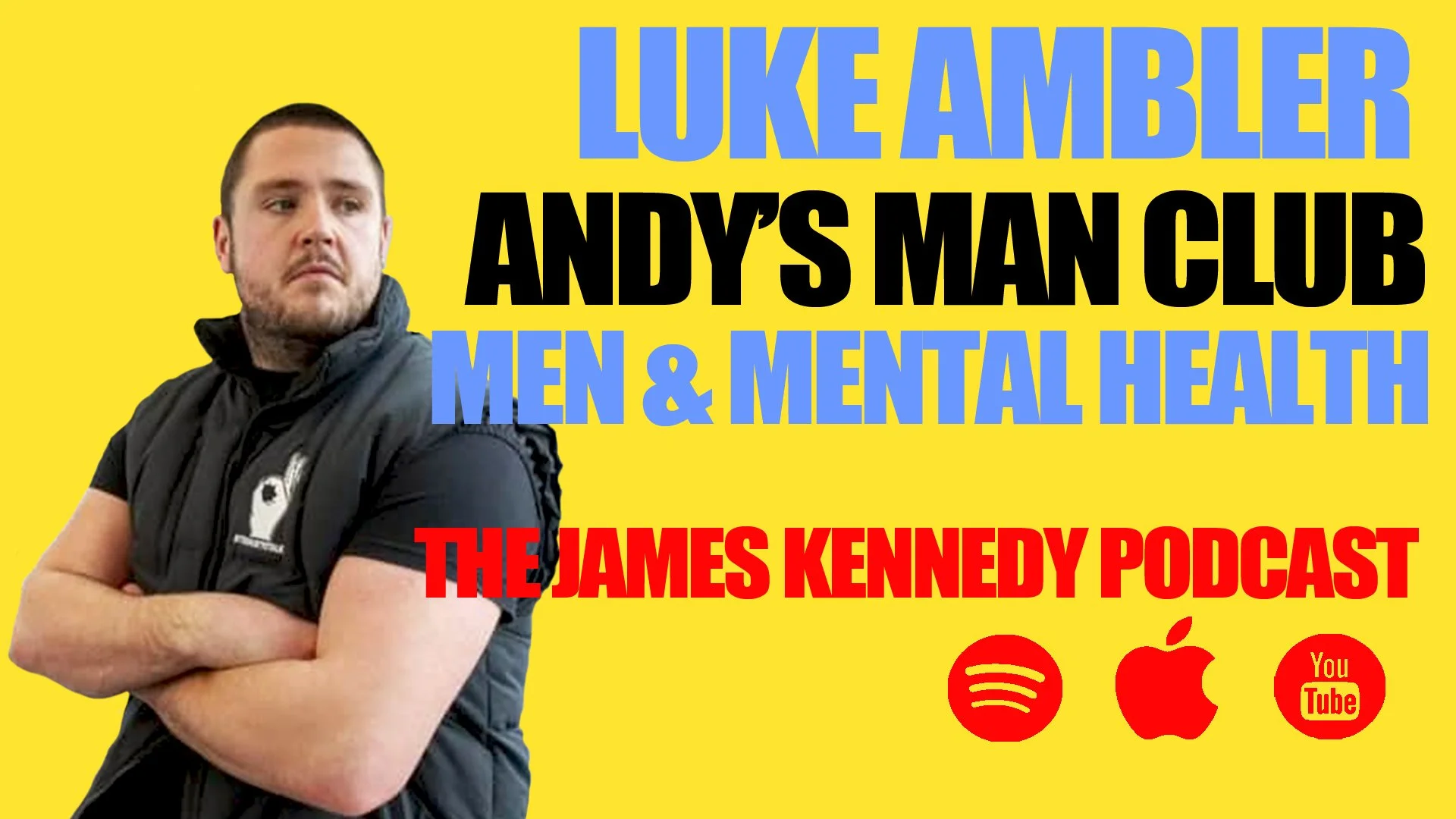
James Kennedy interviews Luke Ambler, co-founder of Andy's Man Club, to tackle the stigma around men's mental health. Born out of personal tragedy, the charity now provides thousands of men weekly with a safe space to talk without judgment. Luke explains why vulnerability is a strength and offers practical steps to move from coping to thriving.
James Kennedy: Please welcome onto the podcast Mr. Luke Ambler. How are you, sir?
Luke Ambler: Yeah, really good, thank you. Thanks for having us on.
James Kennedy: Well, thank you for being here, man, and thanks for everything that you've done up until now as well with the brilliant and beautiful work that you've done. We're going to get into all that today, but I'd first like to start with: what is Andy's Man Club, and how did it get started?
Luke Ambler: So, the what is talking groups for men, basically. In a very simple way to explain it, we have talking groups in a hundred-plus locations all over the UK, and men just like us, going through storms, meet up for a brew and a chat in a real simple model and format, but that works. And we're attracting over 2,600 men a week now, so big, big numbers.
So how it started, why does it exist, is my brother-in-law Andrew Roberts died by suicide back in April 2016. So I came up with an idea that we need to get men talking. So I spoke to my mother-in-law about doing it in his name, and she agreed. And then I went and said alongside her late, and then about a month later, I started a campaign called "It's Okay to Talk," which completely blew up. At one point, that reached over 100 million people, trending at like number two on Twitter at one point, and it just skyrocketed the awareness side of things.
Which I think you'll probably agree, this last five, six years has been a big boom talking about male mental health, which is amazing. I put it all down to that. I think that did spark a fire that was already there in a lot of people.
And then what I didn't want to do, though, was just tell men to talk, just break down stigmas. I want to give guys a safe space and platform to do so. And that's what we created in Andy's Man Club.
James Kennedy: Absolutely incredible. And what were you doing for your work before that? What was your life like prior to all this starting?
Luke Ambler: Yes, I was a professional rugby player. I played professionally, and also had a speaking business alongside talking about mindset, motivation, mental well-being, which is what tied in with everything.
I don't work for the charity directly. We have 17 staff that do what I directly line manage. So I'm chair of the trustees, but I also sit as voluntary CEO. And obviously the general manager and everyone else, so it's busy.
Although, you know, I wouldn't change it, because obviously it'd be a lot nicer with Andy back and not having this happened. But you've got to play the cards that you're dealt. I don't look at what I'm doing as good about me. This is the hand that we've been dealt, and it's helping a lot of people, which is beautiful.
James Kennedy: It is beautiful, man. I mean, what you've done is turn something so tragic and traumatic and dark into something so positive and helpful for so many people. And I know that you've changed so many lives. And is it true that you were awarded the Queen's Award in 2021, is that right?
Luke Ambler: Yeah, we've been very fortunate with awards. And the beautiful thing behind the scenes is that we don't do anything we do for awards, and I think as a result, that's probably why we win quite a lot of awards. We've won the Queen's Award, National Diversity Award, JustGiving Awards, the list goes on.
But for us, as I say in any speech I ever do up there: as nice as it is winning this, it's not a reflection of who we are or why we do what we do. The bonus of winning this award is because it may raise some more awareness, which is what we're all about really.
When you've got an organization growing at the rate ours has for the last six years, it's about trying to keep everyone's feet on the ground. It's quite easy to get carried away with the big stuff that happens. You know, we've got a lot of partnerships going on at the minute, big, big-name brands wanting to be all over us and collaborate with us. But as I always say to the team, don't let success go to your head, and don't let failure go to your heart.
James Kennedy: I like that. I'm guessing your background in motivational speaking and sport probably places you very well for doing a job like this. I mean, is that the case, or have you had your own experience and your own battles and struggles in the past as well to draw from?
Luke Ambler: No, definitely. I've overcome quite a bit. The main reason why I started Andy's Man Club is not just because of Andy and the frustration there, because I already had an idea to start something within the mental well-being space. I had a gym at the time, and I had a room at the side that I thought would make a great classroom, and I'd already started delivering workshops for disengaged youths, but not just youths, young adults as well.
So I think when Andy died, it was tough, because I'd been through, if we talk about just the major setbacks, the short story is: eight years old, my parents separated. There's no evil neatness to that. Everyone's had separations in their life, and we all deal with them very differently as well. My way was comfort eating. So you can imagine a kid going to school, I was a very, very big kid, very, very big kid.
And then my dad wasn't around much. And then my mum was in a car crash which leaves her with a severe mental illness, brain damage and a mental illness where she has drop attacks to this day. So my mum will just, her brain will switch off, and she'll hit the deck, fall, can knock her teeth out.
Growing up understanding mental illness, and then mental health issues as a result of that—social anxiety, not leaving the house for four years, not once, depression, being suicidal—so I understand mental health from a very young age. You know, I've had my own insecurities. When I was younger, they'd call me a "natural worrier." Now, we'd diagnose someone with severe anxiety.
So yeah, I guess I like to tell the story differently nowadays. I used to, you know, there's been all sorts that's happened between that, like getting let go from Leeds Rhinos, and I used to talk in a very victim way: "This happened to me." But if everything didn't happen how it did, I wouldn't be doing what I'm doing now. So I think at some point, you've got to rewrite the story of what you tell yourself about what happened, because cards are dealt to us all the time, aren't they? And I think we've just got to get to a point where we can accept where we're at with it, whether positively or negatively, and then build on that. That's the only way we can get ourselves back up.
James Kennedy: Such a great outlook, man. And I think because of that and the story you just shared, you're not just someone who is talking about this from a motivational perspective or something that you've been trained in, you do have that personal experience to draw from from within your own family and from within yourself and your own struggles and your own journey.
Luke Ambler: 100%. I think you're very right on that. I probably work with 100,000 people a year on a normal year, and I'm yet to meet anyone—from CEO level to prisoners in prison who I work with—that have not been through some form of storm.
Like you say, the level of intensity of that storm usually comes down to a variety of things, from how we deal with stuff. And I know a lot of people use that phrase as an easy way out: "We all deal with things differently." My own parents will say stuff like that. But that doesn't make it right. You know, someone can deal with something in a way that helps them progress, and someone deals with it in a way that causes regrets—they turn to drugs, they turn to drink, and they become depressed and anxious. That's clearly not a positive way to deal with what's going on. Great point.
Especially, you know, I think why Andy's Man Club worked, if I'm being completely honest, is our focus on life appreciation. If you think of what the opposite of suicide is, it is life appreciation. So I think I'm continually a walking experiment myself. So I'm doing a lot of things right now, daily habits that I'm putting myself into uncomfortable positions to see the overall benefits, and then pass that back to people. So it's not just a stand-up-front-and-tell-people, running this organization and telling people what to do. I try and hope that I'm leading by example each and every day.
James Kennedy: Oh, you totally are, man. Jesus. And I suppose we should probably address the elephant in the living room at this point as well. I mean, I know the answer to this question, but I'm going to ask it anyway because I think it opens up a whole lot of other questions around men's mental health specifically: why is Andy's Man Club only for men?
Luke Ambler: So in the early days when it first started, all the stats were saying that male suicide was accounting for three in four suicides. And then when the first night happened and we put it out for men to talk, Lane came to that first session, and then I learned something after: I think they might be more comfortable if there's no ladies there. Some guys will be more comfortable speaking with no women, because some of the topics that come up on the days could be around domestic violence in terms of the guy receiving that from his partner, or it could be something to do with some insecurities around his body, or whatever. You know, the topics vary so much that we just felt at the time that men speaking to just men, to strangers, became this safe space for men.
James Kennedy: Yeah, and I totally understand that, man. It makes a lot of sense. I think it's very easy, you know, when you have these invisible struggles, to believe that they're only happening to you. And sometimes the best cure, I think, is to vent it out or laugh it out with a bunch of mates over a drink and realize that actually, we're all feeling the same way, and it's almost like a normal part of the human experience.
You know, I mean, God knows I've been through it, man. I mean, I've done therapy, I'm still going through it now in many ways. I cut out booze for three and a half years and then went back on it again big time, something I'm trying to get a handle on again. I'm currently working on doing some yoga and some meditation and some exercise and changing my diet, and I've recently discovered the magic of breathwork, which has changed my life. So it's an ongoing project, and you're never really at the top of the hill.
So I can totally relate in my own way as well. But unfortunately, for many people, these struggles and these battles can make them quite solitary or withdrawn or isolated, or they just carry on as normal so that people around them would have no idea they were even going through it. And all of those things compound the problem and just make it all so much worse, forming a kind of feedback loop of negative self-confirmation or something.
So by breaking that cycle and getting men talking in a neutral and supportive space around other people who understand exactly how they feel, I think it's so important in breaking those cycles.
But why is it then, do you think, that there is still such a stigma around men's mental health, and why is it still such a difficult, taboo subject for men?
Luke Ambler: Three reasons: burden, weakness, embarrassment. And I don't think these are just for men, because suicide in females is on the up, because with equality and gender equality, when you tip the scales, everything tips. So females now are becoming more masculine, and that is proven in the way that females are taking their lives. Females used to end their lives in a certain way which was considered more feminine, and there's a masculine way to take your life, and that's definitely turning.
I believe just look at roles. At one point, my granddad might have gone to work, my nan might not, or started to go to work part-time. Now my wife and most people's partners work full-time just like they do, and society is changing.
So the three stigmas for both male and female are burden, weakness, embarrassment. You've probably experienced it yourself.
Burden is that you don't want to tell someone what you're going through who is close to you because you don't want to put your shit onto them, because you know that they've got their own stuff to deal with—they don't need yours on top. Burden is bullshit, because I know from firsthand that Andy taking his life left a far greater burden than whatever he was going through.
The next one is weakness. I don't think this is weakness in the typical sense that most people think. I think the weakness comes because we're living in a success-driven society, and everyone wants to be successful, but the majority of people don't know what success is. I speak to blue-chip companies, multinational companies, and say, "Put your hand up if you want to be successful." Everyone in the room will put their hand up, maybe bar one stubborn person. And then ask them to put their hand up again if they know what success is, and six people out of a room of 300, 400, 500 people raise their hand. It's crazy that we're all striving to be something, but the majority of us don't know what it is.
So by giving away weakness, or perceived weakness, we believe that we're not going to get to this idea that we're going to be successful and strong and masculine and winners. But actually, I believe true vulnerability is strength. Vulnerability is doing something where you don't know the outcome—asking someone out on a date, going for a job interview, taking that chance in life, going traveling, opening up about your sexuality, opening up about your mental health. Because just because the first person doesn't understand it doesn't mean that everyone else won't. So by being vulnerable, more times than not, it helps to create strength.
But I do believe that talking is only the start. I believe that we can all sit and talk about problems all day long, but unless action comes from the talking, nothing changes. So my theory now is that talking helps to get rid of the shit, the bad stuff, the darkness. The actions that you do away from that then help put the good back in.
So you mentioned a few good activities earlier: breathwork, meditating, natural sunlight, getting outdoors, exercising. All these create the opposite to sitting and bottling up your feelings, which is an increase in dopamine and serotonin, which releases or decreases stress, anxiety, depression, thoughts of isolation and loneliness. And then as a result, we'll be more confident to talk to people and make friends and be around people. So true strength is being vulnerable, but being vulnerable to not only be courageous to talk about problems or deal with them, but then to move forward with that baggage.
And the last one is embarrassment. We live in a culture where we don't really give anything away about ourselves that could be used against us in any type of way—by an employer, by a friendship group. So sometimes it feels easier just to keep that to yourself. But once you understand that everyone you know is fighting a battle you know nothing about, the embarrassment goes away. Embarrassment is always something that you create in your head. When you realize that everyone's going through that same storm, everyone's been through that shit, there's nothing to be embarrassed about. But again, it takes acceptance to understand.
James Kennedy: 100%, dude. I agree with everything you're saying, and I've experienced a lot of it myself within my own journey and amongst my peers and people I've been around. So yeah, I completely echo everything you're saying.
I mean, action is the important thing, isn't it? For me, I've been in those ruts, and they can last months or years. And then eventually, like, I would say that my biggest rewards in life have come from those times when I've hit rock bottom, when you get to the point where you snap and think, "Actually, no, I'm going to do something about this. I can't wake up another day feeling like this anymore." And that's when you do something about it.
It's hard, and it's difficult, and it's scary, and it's challenging and terrifying to confront some of your demons and try and do something about it. But when you push through and you come through the other side, you look back and you think, "Man, that was the best thing that ever happened to me. My life is so much better now as a result of dealing with that rather than just ignoring it or burying it under booze or whatever it might be, or just wallowing in self-pity." Some of my lowest points have been my biggest awakenings. So I 100% agree with that.
So when people come to the club then, what can they expect? It's primarily a safe space where men can talk and be vulnerable and open about whatever amongst other people who are also going through similar journeys—that's the primary thing. So what can people expect when they turn up on day one?
Luke Ambler: Yes, because there is a difference that I want to get clear between what I personally do and what AMC does, right? So there's a difference there which we might elaborate on.
AMC is a set model. The stuff that I do in the morning—cold showers and all that stuff—is not enforced upon people or even recommended at AMC.
If we're talking about AMC specifically, there's two arms to AMC: one is the groups, and one is the awareness side of things and breaking stigmas. On a Monday night, what happens is a guy will walk through the door, and there'll be some guys at the door called facilitators. Those facilitators are there to welcome you. They're not paid; they're volunteers. They're guys who walked through the very same door that you walked through at some point, whether at that venue or a town down the road, and then they've set up a group in their area. So they know either what you've been through or they've been through a similar journey and come out the comfortable side.
You'll then get invited to come in, sit down in a big circle, and the main facilitator will just give you the list of rules of stuff we don't talk about, which is like religion, politics, that type of thing. And then it'll kick off with just your name and a positive reason for being there. You don't even have to use your real name if you don't want to—you can use a made-up name, because it's dark outside. But just a positive reason for being there, just to get you comfortable to open up.
Then it's always, "How's your week been?" That's the second question around. The third question will always be, "Anything to get off your chest?" And it's up to you—you can pass the ball on as the ball goes around, you can pass that ball on every time, or you can share.
So the first question is name a positive reason for being there. Then you get, "How's your week been?" Then you get a positive from your week, and then anything to get off your chest.
And then after that, the fifth and sixth questions change every week. That might be, "What's a goal you've got between now and next week?" Quick-fire. Or it might be, "Who is someone you appreciate right now in your life and why?"
And the point of that is just to give you those little seeds of hope—that there are people in your life, you can have goals, giving a bit of inspiration to move forward next week, providing a bit of balance to what you might be caught up in in your head, you know?
ENJOYING THE CONVERSATION?
GET JAMES KENNEDY'S LATEST INTERVIEWS, WRITING AND LIVE SHOWS STRAIGHT TO YOUR INBOX
James Kennedy: 100%. So you've got the positives, you've got a big negative space, and then you've got a couple of positives to finish off to rewire some of those thought processes that you've been having. Love it.
Now, it's such a brilliant thing, man. And you said there's a difference in the official AMC model compared to some of the things that you talk about personally. I'm guessing with your background in sports and motivational speaking, you've probably got a lot to offer that might not fit in with the AMC talking model. So I'd be interested to hear some of that, in case it's of use to anyone listening who's going through some of this stuff.
Luke Ambler: AMC is a model that works. A facilitator isn't going to sit and talk to you or be as blunt as I am; they're there to listen, they're there to guide. Where my approach is maybe a little bit more "you've got to deal with what's going on," AMC is more of a softer love, an arm around your shoulder—let's talk about how we feel, which is amazing. And the questions do that process, and then that brotherhood that's often talked about is created.
Where you can go on that journey with people then, either you come for a few weeks and you leave and get back to your life, or you might become a facilitator yourself, or you might start a group in your area. We have over a thousand facilitators now across the country who are all volunteers, and that's not including the tens of thousands of actual volunteers that we have to event and raise awareness for us.
James Kennedy: It's incredible, man. Such incredible work you're doing, and still going strong as well, going from strength to strength. I mean, it must be amazing to see it blossom into what it has. The figures you quoted speak for themselves. But I'd be interested to know: what effects on people have you actually seen in the field as a result of attending Andy's Man Club?
Luke Ambler: Firstly, AMC won't work for everyone, but it is there for everyone. Not everyone's going to come out thriving, and I have to say that because sometimes people think it's going to be their saving grace, and internally it's not quite for them. But also, I'd say to those people: give it a few weeks. Don't just come once and think it's not for me, because I can guarantee if you go to your first PT session, you're probably not going to like it either.
Once you get into it and start to understand the benefits, I could give you thousands of stories where lives have gone from survival mode to thriving mode—from not wanting to be here anymore to suddenly getting job promotions, seeing their kids, being a better father, being a better human being, becoming part of our facilitator team, helping other guys, starting groups in their areas, and maybe even now working for the charity.
One story always stands out for me. We get thousands of emails saying, "The group saved my dad's life," "my brother's life," "my uncle's life." And they don't lose impact, but because it's words on a screen, it's very different to when you literally see it. Last year, a dad dropped his kid off at school, pulled his car down, motorized across, and approached me just to say, "Are you the Andy's Man Club guy?" I said yeah. He said, "I just want to say thank you. I got to drop my daughter off today." Times like that, you don't need to pinch yourself—this is why we started, this is why we care.
James Kennedy: It's amazing work. And, you know, hats off to you and to all of the listeners. I personally have friends—I was introduced to Andy's Man Club by some friends of mine who had been, and they said it changed their life. And I can personally vouch for the fact that they're in a much better place now. They got rid of all the bad habits and behaviors and things that they were attached to. That's all gone. They're living much better lives, much more fruitful lives. So we all thank you for that. I know people who have personally benefited from it.
So yeah, it must be an incredible thing to see blossom from your own tragedy into what it is now. You mentioned that you have a much more direct, hands-on approach. I'm guessing that comes from a background in sports. What would your personal approach be? You said it's a bit more forthcoming.
Luke Ambler: What I mean by that, it's not like Army style. I believe that the talking helps, and what you do after that, what you do in the six days that you're not there, is as important as the one or two hours that you are there.
For me, I'm reading a lot and learning a lot, and I have done for the last 10 years, and implementing it. Like a whole-food diet—I think diet is so undervalued in terms of our mental health.
I believe that we live in a society where we say, "One won't hurt me," but we never have just one because we're extreme. If I go for a pint with a friend, it's never just a pint unless I've got that self-control. Most people, when they're struggling, go for a big session for two or three days, and then you've got this constant head-on-floor. There's never a middle path, as we call it in Buddhism.
For me, I've developed since Boxing Day a real stringent routine. I get up every day, do three rounds of breathwork, get a three-minute cold shower. And the cold shower, like this morning where I'm living, it's snowing up here, it's minus three degrees, so the cold temperature coming in this morning was horrendous. But I feel amazing now.
I do simple stuff like I take magnesium before bed every night, because the studies around magnesium in terms of physical and mental health are astronomical.
And then I exercise. I'm obviously quite an extreme character. I'm training for two Ironmans this year, down in Wales depending how I do. So I've got a real stringent routine. I'm doing a challenge where I plan to stick to a series of things for a full year without failing. It's normally 75 days for this challenge, which I've done before. I decided after Boxing Day and New Year's Day that I'd add a couple extra things like the breathwork and cold shower, and I wanted to try this for a full year to see the benefits of committing just one year of your life. Because I've committed the other way—I've eaten junk food for a year, drunk for a year, not exercised for a year. But what is it like when you truly commit?
And what I put at the end of the course is: regardless of whether you want to do an extreme challenge or not, if you can just drink more water with electrolytes, read and educate yourself daily (whether it's five pages of a book, whatever it may be), eat a majority whole-food diet, and get outside and exercise in whatever form that may be (even going for a walk daily), you give yourself a much better chance of progressing your life and going from what I like to call coping strategies to thriving strategies.
Because what I want to get to a point is where mental health isn't just spoken about in terms of anxiety and depression; it's spoken about in terms of self-confidence, self-belief, being patient, being calm, being present. A lot of the time we speak about poor mental health, I don't think there's enough talk on positive mental health.
People will often say, "You don't know what it feels like to not want to get up." They assume that I don't know what that feels like. But I also know what it feels like to constantly ruminate with your thoughts, feel heavy, feel like you have no motivation, feel like you don't want to move forward with life.
So doing that cold shower for three minutes, as an example, is horrendous at that moment, but I know the benefits that that gives me for the rest of the day. I know that drinking a certain amount of water gives you more energy. If you actually just sat here on a very simplistic model: what is my mental health suffering from? Where are my energy levels? Very low. What sort of activities am I doing? Drinking, maybe sitting around watching TV, spending time on social media, consumed in my thoughts—all those are energy-taking activities.
Energy-giving activities are things like breathwork, hydrating your body, eating whole foods, going out and exercising in any capacity. All these are energy-giving activities. And I believe if we could start doing more energy-giving activities, which take more energy to get started, as a whole society we'll start to feel better.
James Kennedy: I totally agree, man. I mean, I recently read a book which changed my life. It was called The Body Keeps the Score by a guy called Bessel van der Kolk. It's all about how trauma manifests itself in your physiology. You might not be consciously aware of it, but it's there in your body, it's there in your immune system, it's there in your fatigue, it's there in your tension, it's there in your headaches, your agitation, your fidgetiness, or your inability to sleep. Whatever it is, it's almost like it leaves an imprint on your physiology and your nervous system.
This doesn't have to be war-veteran level stuff; this can just be childhood shit, just the environments that we're raised in, whether at home or in school or wherever. A thousand micro-events can add up to the same net effect as one massive trauma. I think it's called complex PTSD, and it's manifested in your body.
So if you're able to tune into that, you're able to read the signals of what your underlying tensions may be. The complication comes in when you're someone like me who dealt with things by numbing themselves—which is why I guess alcohol would be my drug of choice. You're actually numbing yourself to what your body or your brain is telling you, which is the reverse of what you should be doing.
If you're able to tune in better to what your body is telling you and realize, "Hey man, why is my chest tight? I'm just watching a movie. Why am I gripping the side of the sofa or grinding my teeth when I sleep? Why can't I sit still?" All of these things, we're used to it so we don't notice it. But as soon as you're able to become aware of it and tune into it, you realize, "Oh actually, yeah, this is like some childhood shit that I'm dragging through my life with me." It's an absolutely fascinating read, man.
And he goes on to explain how to break that cycle: it is to basically reconnect with your physical sensations and tune more into it. And the way that you can do that is things such as, like I mentioned earlier, yoga, exercise, nature, breathwork.
And breathwork, I've got to be honest, man, I hold my breath a lot. I don't even realize I'm doing it, I've been doing it so long. And that affects everything: it affects your heart rate, it affects your lungs, it affects the oxygen getting to your brain, your brain fog, all that sort of stuff. I often hold my breath for most of the day—it's like an underlying tension that I just haven't been aware of for the first 40 years of my life.
So doing breathwork has been an absolute game-changer for me. Just breathing deeply and slowly and controlling my inner tension. It's hard work, but I'm telling you, man, the results have been absolutely mind-blowing in a really short space of time. So I'm hooked on that shit. For me, that's been a game-changer.
But I'm very new to all this stuff. I only read that book a few weeks ago, so I'm still digesting a lot of it. But you said yourself that you do breathwork as well, and I know that you are a lot further down the road with all this stuff than I am. So I'd be interested to know: what kind of breathwork do you do, and can you share any tips for the listeners?
Luke Ambler: Brilliantly said. I think there's a right way of doing breathwork. Mine is the Wim Hof model, so it's more about oxygenating the body.
To give you a brief example, I do 30 breaths, which are quite powerful breaths. So you're breathing quite hard, and then you just let go. On the 30th breath, you let out and then you hold your breath until it gets not too uncomfortable, but until you can't anymore. Then you breathe in and you hold that breath for 10 to 15 seconds. Then that's round one, and I do three rounds of that.
There's a lot of studies on this. I've followed Buddhism for a long time, so I've understood the breath and grounding and being present, but this is more to really oxygenate the blood, relieve stress, and it just sets me off for the day. It primes me and fires me up, I guess, because it gives you a big surge of oxygen.
James Kennedy: 100%, yeah. I didn't realize how much difference that makes, because like I say, I tend to hold my breath and breathe very shallow. And I get heart pain and chest pain and all sorts of things. As soon as I started oxygenating myself in the morning and throughout the day, just being more mindful of my breath, I feel so much better.
And everything you've said I can vouch for, because I'm currently doing it myself. Hydrating more—I was previously hydrating myself with bourbon and whiskey, which I still love, you know, they're the fruits of life, got to enjoy yourself too. But I don't do it every night now.
And I tell you one thing for definite: since I've not been drinking every night, I've just been hydrating and going to bed early and getting some routine and doing breathwork and doing yoga, I've been sleeping like a baby, feeling a million times better just as a result of doing that.
That doesn't take away the demons and the challenges, but it makes me a bit more able to see them for what they are, and gives me the strength to confront them because I've got the reserve in the tank, you know what I mean?
Luke Ambler: That's the big one. And I think what people don't understand is—and the other one I meant to say when I was talking about the things that I believe in—is sleep.
I had a friend text me last night, actually. I used to be a real get-up-and-go, early-morning guy. It's not until I truly understood sleep... I'd be a guy to go running or do something crazy, motivational-speaker type: "Let's go again, come on guys!" And then I realized...
If your listeners type in "Andy's Man Club" on YouTube, there's a LADbible video—second in Europe. There's a video of me... you can see the difference in how old I look there. A lot of studies show that aging comes from lack of sleep, because of the increase in cortisol, your body's stress mechanism thinking that you're not going to get enough sleep, so it protects what energy it's got and holds onto it. It's pro-aging rather than anti-aging.
So I make sure now, and I've got a watch to track it, that I'm getting at least eight hours a night. I have a really stringent routine before bed: a hot bath, getting some form of heat at night. I'm very lucky that the gym I use has got a sauna, so I go for a sauna at night.
And then I always believe, from the studies I'm reading, it's cold in the morning, heat at night. Your body needs a natural two-degree temperature drop to be able to get a good sleep. So it's magnesium, it's heat, and then I read my book as I get in bed. I've got 10 pages to read every day, and when I'm on page six, I'm already nodding off, and then I'm asleep.
Other stuff that people don't talk about which helps you get to sleep is getting sunlight. If you go and get sunlight during the day, it actually helps beat insomnia. Most people who are tired stay in the house all day. Going out and getting an hour of sunlight a day—this is where people say, "Oh yeah, nature really helps me." In way more ways than what you think.
If you go out and look towards the sun, you've got a natural defense mechanism called blinking. There's a great doctor called Dr. Huberman, and he's doing loads of studies on this, putting all sorts out there.
Also, an increase in salt intake, that's a huge one. We're told to decrease salt intake, but those studies were done on people with hypertension. Those with normal, regular bodies should be increasing salt and electrolytes so that they're well hydrated. Being well hydrated means you're going to sleep better at night as well. So sleep's the key. I love sleep.
James Kennedy: Me too, me too. I undervalued it for so long. I actually prided myself on being a guy that got four hours sleep a night. It's like I was getting shit done. As you said earlier, subscribing very much to that model of success and the modern man of having to crush it all the time. All I crushed was my fucking self.
Luke Ambler: I understand. I tell you now, I'm crushing it way more now that I'm sleeping, dude, honestly, 100%. And I think that's an energy-giver, isn't it, what we're talking about?
James Kennedy: 100%. I think what's coming through loud and clear here, dude, is action. You've just given the listeners a ton of actual stuff that is easily achievable by working it into your daily habits. A little walk around the block for some people who literally don't get out of the house for the reasons you've mentioned, that in itself is a massive fucking start, you know what I mean? Just getting out of the house, taking a walk around the block will make you feel better. Making an effort to drink a glass of water in the morning rather than before you reach for the coffee. These are small actions that people can work into their daily habits that would make a massive difference.
Luke Ambler: Even at work, instead of sitting in and eating, bring your lunch on the road with you and go for a 30-minute walk. There's lots you can do, and it's just about actually going and doing it.
That's the hardest thing, I think, is actually starting and doing it. I've said to people in the past when they get caught up in "oh, but I can't do this, what if that happens?" I say: don't worry about it. It starts with a decision to change. You figure the rest out after that. You just say, "Tomorrow or today, I'm just going to start," and you figure it out as you go. Action it, you start.
I think sometimes people can struggle to do that if they don't have a plan. If you have a direction you're aiming towards—whether that be a goal to feel a certain way or whatever that may be—and then an acceptance that there's going to be stumbling blocks along the way, things are going to change and set you back, but that's fine as long as you stay on that path. And your "why" is strong enough, whether it's to be a better human being for your community or to be a better parent.
One thing that we often neglect is the skill of patience. We all wish we could have more patience. But doing things like breathwork and getting outdoors, all these slow activities where you don't distract yourself, creates the skill of patience and the ability to slow down time.
James Kennedy: Yeah, 100%. I've personally benefited. I'm the biggest stress-head going, I'm a thousand-miles-an-hour guy. I don't have kids, so I fill that time with extra guilt-laden stuff, like "I better do this, that, and the other instead." And I've personally benefited from it.
Like you said earlier, it's difficult to get to the action phase if you haven't figured out entirely what your demons are, or whether they are surmountable. And that's why I think what you're doing at Andy's Man Club is so essential, because you can't get to that action phase until you've figured everything out. Being in that safe space where you can talk to other people who've been through similar things or are going through it with you, it helps you figure it out. It helps you realize that you're not alone and that you can do something about it. So it's absolutely essential, what you're doing.
For people listening to this who hopefully are going to be fully signed up and want to come along to their local group, how do they get started? Where do they find their local group? Have they got to register, or can they just turn up? What do people do?
Luke Ambler: So the beauty is that we don't have a referral system, we don't have a cap on numbers.
So what you do is, there's two ways. Firstly, if you go on our website, which is andysmanclub.co.uk, there is a link where you can put your address or your town, and it finds your nearest four or five clubs.
If for any reason that isn't working—because I know we've had some issues just purely due to data, how many people have been finding their nearest club, it put a huge demand on that system—we always have a backup, which is to email info@andysmanclub.co.uk and we'll get straight back to you.
We do have online groups as well for people who don't have one in their area, or for whatever reason aren't comfortable leaving their house. We do have online sessions as well, from the comfort inside your house.
James Kennedy: Brilliant, that's amazing. I'll plug the links to stuff after, but just to reiterate: it's andysmanclub.co.uk. There's a ton of stuff on there as well, resources and stuff like that. It's a great site. Social media, you guys are on Twitter and Instagram @AndysManClubUK, and Facebook at Andy's Man Club, so you're easy to find. And LinkedIn as well.
Luke Ambler: Who uses LinkedIn though, really?
James Kennedy: So that's amazing. It's basically find your club and turn up, essentially.
Luke Ambler: Right. We've had guys who've sat in the car for weeks on end, but yeah, you just turn up and just get through that door. We always say the toughest thing is getting through that door. But once you're through that door, just know that it's okay to talk, and that's what we promote within that session.
And if it's not for you that day, try again or give it a few goes. And if after three weeks it's not for you, go and find your thing that might be for you. But hopefully it will be. You'll find that brotherhood, you'll find that camaraderie with people who have been through those storms like you. And then who knows, you might end up being the lighthouse in someone else's dark time, like someone in that room will be for you.
James Kennedy: Love it, love it. It's a beautiful thing, man. And how do you guys stay afloat? I'm guessing that you're a charity, so I'm guessing you survive by donations from the public?
Luke Ambler: Yeah, 100%. We're quite unique in the fact that we never ask for donations. If people want to donate, they can, that's completely fine. We're an awareness-first organization. We want to raise awareness of our groups. It's probably, in some senses, a very risky model to always promote awareness first, but we're doing all right this far.
We have 17 staff who are banging the drum. We don't apply for any central funding, we don't ask anyone for money. People kindly donate, whether through businesses or individuals, to help keep this movement going. And we'll keep the original values as we are, which is always awareness first, guys first, families first. And then if anything comes off the back of that to fund our growth, that's what it's about.
James Kennedy: Amazing. So if people listening to this are incensed to want to donate, can they do that through the website as well?
Luke Ambler: Yeah, I would recommend emailing info@andysmanclub.co.uk or going through the website.
James Kennedy: Awesome. Please send it their way. Dude, thank you so much for joining us today, man. This has been such a fascinating, brilliant chat. Thanks for sharing your story with us, and all of these great tips and everything that you've gained from your own personal journey as well. And thanks for everything you've done to help change lives and change the narrative around men's mental health.
Addressing this issue will have a massive positive effect which will reverberate through all of society. So on behalf of all of us, we salute you and we thank you, man. What a huge achievement and an incredible thing to have done. I hope you're proud of it, dude, and long may it continue to grow.
Luke Ambler: Thank you so much, man. And long may it continue to grow, because I still genuinely believe we haven't even scratched the surface yet. So let's see what's to come.
On its fifth birthday, the goal was to have opened 10 groups, and we opened 50 on its fifth birthday. Wow. And since that point, we're just coming up to our seventh birthday in June, and we've now got by that point 150 clubs. So if we can keep growing at the rate we are...
James Kennedy: That's absolutely incredible. Think of the lives you've saved, man, and the lives you've changed. That must be such a rewarding feeling.
Luke Ambler: There's still a lot to do here. Ever the sportsman, a hell of a lot to do.
James Kennedy: Well, please keep doing it, brother, because you're doing great things. Luke, thank you so much for joining us today, man. This has been a fascinating chat, and I wish you nothing but the best, and hopefully we'll see you soon. Take care, man.
Luke Ambler: Thank you so much. See you later, guys.
Key Points:
The podcast focuses on men's mental health, highlighting that 75% of suicide deaths are men and suicide is the leading cause of death for men under 50.
Luke Ambler co-founded Andy's Man Club in 2016 after his brother-in-law Andrew Roberts died by suicide, creating free talking groups for men across the UK.
Andy's Man Club now operates in over 100 locations, attracting more than 2,600 men weekly, and received the Queen's Award for Voluntary Service in 2021.
Luke identifies three main stigmas preventing men from seeking help
The club operates on a simple model where men sit in circles, share their name, a positive reason for being there, how their week has been, and anything they need to get off their chest.
Luke emphasizes that talking is only the start; taking action through breath work, exercise, hydration, better sleep, and diet is essential for genuine recovery.
The charity is awareness-first, does not apply for central funding, and relies on voluntary donations to sustain its growing network of volunteer facilitators.
The host shares his own mental health journey, including therapy, breath work, yoga, reduced alcohol consumption, and reading "The Body Keeps the Score."
Summary:
This podcast episode features host James Kennedy in conversation with Luke Ambler, co-founder of Andy's Man Club, a men's mental health charity. The discussion opens with stark statistics: 75% of suicide deaths are men, and suicide is the single biggest cause of death for men under 50. Luke shares how he founded Andy's Man Club in 2016 following the suicide of his brother-in-law, Andrew Roberts, aiming to give men a safe space to talk rather than simply telling them to open up.
The conversation explores why men struggle to discuss mental health, with Luke identifying three core barriers: feeling like a burden, perceived weakness, and embarrassment. He argues that true vulnerability is strength, and that talking must be followed by action. Luke details his personal routines, including breath work, cold showers, exercise, hydration, magnesium, and prioritising sleep, all of which support mental wellbeing. He also explains the simple, effective structure of Andy's Man Club meetings, where men gather in circles to share without judgment.
The host contributes his own experiences with therapy, alcohol reduction, yoga, and breath work, reinforcing Luke's message. The episode concludes with practical advice: start with one small decision, take action, and remember that asking for help is courage, not weakness.
The James Kennedy Podcast is a Society and Culture podcast hosted by musician and author, James Kennedy. Exploring the big questions around health, social issues, the arts, politics, mental health, the human condition and how to navigate this thing called life through casual conversations with scientists, activists, rock stars, philosophers and academics. Please subscribe, leave a rating and support the show.