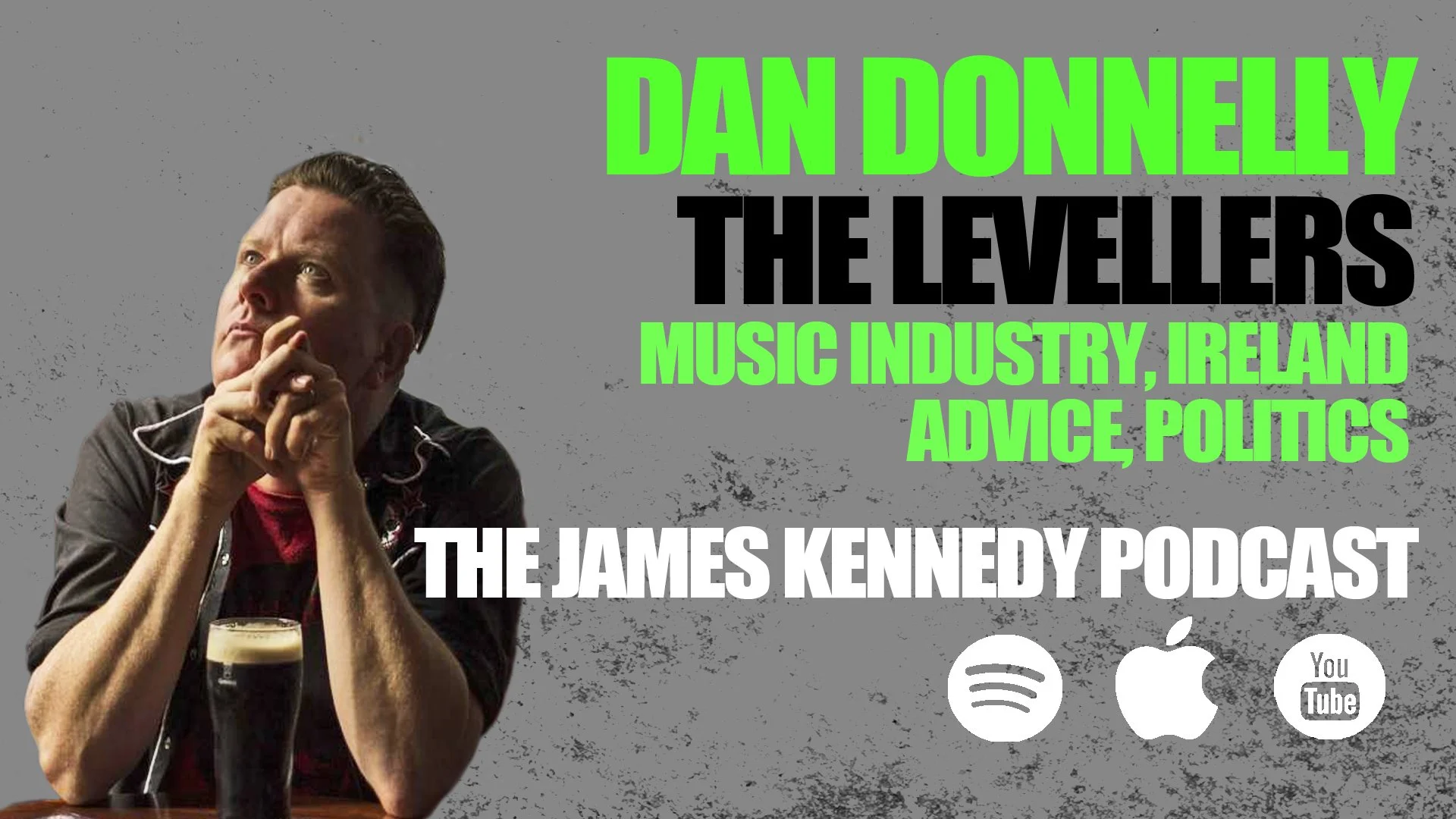
DAN DONNELLY / THE LEVELLERS - MUSIC AND POLITICS
James Kennedy interviews Dan Donnelly (The Levellers) about wild touring stories, navigating streaming and royalties, practical advice for independent musicians, and their shared frustration with UK politics
James Kennedy Without further ado, we are joined today by the singer-songwriter, multi-instrumentalist, and most recent member of the Levellers, Mr. Dan Donnelly. Dan, thanks so much for doing this, brother. How you doing, man?
Dan Donnelly Hi James, great to be here and good to meet you again in a bit more of a chilled and more expected setting.
James Kennedy Yes, what Dan is referring to is the last time that we were in a conversation together was on stage at the Beautiful Days Festival in Devon most recently when we were doing a talk with Mark Chadwick and Tom Gray about the music industry and streaming. And Dan was really fucking right-on, very opinionated, very direct, and you spoke a lot of truth that really resonated with me and of course the audience as well. So I'm really looking forward to continuing that chat today.
Dan Donnelly Well, it's similar to you. When you decide to make music your main thing, you have to know what's going on. You've got a lot of things going on and you've got a lot of sort of know-how on how you're going to navigate making money, which is a really important thing to live. That's why I know about it. In the lockdown, essentially whenever I stopped playing, I had to really start looking into where all the money was going from all the music that had made it.
James Kennedy Yeah, didn't we all? Well, before we dive into that, because we've got a load of stuff I want to get into today, can you give the listeners a brief tour of who is... Obviously, we know you now as the most recent addition to the mighty Levellers. Yeah, you've done fucking loads of stuff before that, man. Super interesting journey. So can you give us the brief bio of who is Dan Donnelly?
Dan Donnelly My parents didn't want me to be a musician, so they told me not under their roof. So I moved out and became a busker. I was living on my mate's couch, and him and I would go busking in town. Then we saw that there was a battle of the bands in a local pub, and the prize was 150 quid. That was the first time I'd ever been to a local pub. It was more money than either of us... Like he was on the dole and I just lived off busking. It was more money than we'd ever seen in our lives. So we essentially got a third guy who played double bass. He played acoustic guitar, I played mandolin, and we got a double bass player. We entered this battle of the bands and won it, and then one of the judges became our manager when we started gigging. Then we put out a few records, got charting, and then started selling out bigger. Then we recorded the Levellers in like 1994. Wow, that's when I met those guys, so I've known them for a long time.
And then that band split up and I moved to America and did a lot of mad indie rock. So I was in an indie rock band called Joyzipper and we played with the Darkness in the Paradiso in Amsterdam. It was one of the most insane nights I've ever had in my life. I've heard to that, then moved back here, played a little bit on and off with the Levellers, then joined a band called the Oysterband, that folk thing. Then I joined the Wonder Stuff for five years. Wow, and then I joined a French band called the Celtic Social Club for about three years, which was just stupid, being in a band in another country.
And then Simon had pretty much done with touring, and I was going to get divorced if I spent any more time in France than I like. Mark was playing in my town and I went down to see him and said, "I think I'm going to jack in this French band. I just can't, like all the traveling post-COVID was doing my head in." And he was like, "Right, you need to join my band because Simon just doesn't want to tour anymore." And I've been playing with the Levellers now, but that was the third Beautiful Days I've done with them.
James Kennedy Oh shit, so that’s how long you've been with those guys. I thought it was much more recent than that.
Dan Donnelly Well, the first thing I did was Beautiful Days 2021, so two years. Right, okay, cool. And how's it been? They looking after you? Well, I've known them since I was a kid, as I say, like 1994. Well, I've known them since I was about 18, 19 years old. Right, and we supported them in Ireland and got on really well with them. We were sort of of a similar ilk. I came up through the sort of punk crusty thing. We all lived in a van. Right, and then they invited us over to England because we didn't really play in England that much, and they put us on one of their tours. We just drove around in our little van after their tour bus and we became really good friends then and stayed mates with them. So it's almost like, having been in a load of other bands and other successful bands, it's like some of your oldest mates going, "Do you want to join our band now?" Yeah, nice.
And they just happen to be, you know, the fucking Levellers. Yeah, but they know me and I know them, so it's not like, "Right, what's this new guitarist going to be like?" They know exactly what they're going to get. They know my limitations, they know my foibles, and I know theirs. Yeah, so it was a perfect sort of match really. And they're my best mates, you know? That's a beautiful thing.
James Kennedy And what a fucking band to have joined as well! I mean, with such an amazing back catalog of awesome music. Yeah, it's a fucking great gig, bro. You know what I mean? And I love the fact that one thing I talked to Mark about when he was on the podcast was their model: they're independent, they do things 100% their way and on their terms, and they've had fucking loads of success doing it as well. Which is, you know, it's a beautiful thing. Just to see them with the message they've got and the music that they've got, doing it their way, and seeing so much success through it as well—yeah, it's a beautiful thing, it's a great thing to see.
Dan Donnelly It is, yeah. And the thing about their success is they are true anarchists. You know, like I'm a bit of a confirmed socialist, but there's no boss in the band, which is a bit mental because nobody really makes decisions. But because of their sort of DIY punk attitude, they've ended up being really successful. So instead of hiring a studio, they got an advance from a record company, bought a building, and put a studio in it. It wasn't like they're anarcho-capitalists like, "Let's gather all the shit together," but their DIY attitude just served them really well because they now have a massive building in Brighton with a great studio in it. You know, they own their own label, they built their own brand themselves, and it's just all happened really well for them.
James Kennedy Yeah, and I find it doubly impressive that they were doing what has become the mainstream standard model now for artists. I mean, artists such as myself and all of my friends and peers, we're all doing things independently: making our own records at home, releasing them independently through our own little labels, distributing them digitally, and things like that. That is now very much the established model, but they were doing that back in the day of the physical era, you know, when it was a lot more expensive and logistically difficult to pull off. Yeah, so the fact that they had the foresight and the good sense to actually do that and pull it off successfully back in the bad old days when it was nigh on impossible to do that...
Dan Donnelly I think it deserves a lot of respect. My band went and hired studios. I had an eight-track machine, like I lived in a farmhouse and we used to demo stuff in my house. But whenever we wanted to make a record, we'd spend thousands hiring a proper studio and a producer that would tell us what to do until we didn't really like the record anymore, because it wasn't as good as the demos because this guy just shouted at us. We were too young to shout back. And then all the money was gone, and then the band was gone, and that was it, you know? Whereas they stayed really true to their principles artistically and financially, and were just like, "No, we're not doing that," which has stood them really well, and they're still like that.
James Kennedy You know, I think it's great. I think it's a real testament, a real example to others as well: just stick by your guns, stick by your values, keep doing your fucking thing, and it'll work out. You'll certainly still be able to keep doing your thing. Like you said then, which happens to most bands, you give a little here and a little there, and you start following the system's rules, the established path. And for so many bands, it's the cause of their fucking death. You know what I mean? You fizzle out because of money, or arguments, or you've lost your songs to the label, or whatever. And it's the death of so many fucking great bands, I find. But with the Levellers, even if you don't get to their level of success, following their strict model of sticking to your guns and just doing your thing your way, at least you're still going to be able to keep fucking doing your thing, you know? Yeah.
Dan Donnelly Yeah, and I've been in bands and seen a lot of contemporary bands that just ever-decrease in circles: put out an album, go around all the O2s, wait a year, put out an album, go around all the O2s to slightly less people, wait a year, put out an album, go around all the O2s to slightly less people, and then slip down the bill at all the festivals and get bitter, tired, sad, and hate what you're doing. You'd rather be doing a nine-to-five, do you know what I mean?
James Kennedy Oh, 100%. That fucking calls for all of us at some point. You're going to fucking make a choice between faking it till you make it, or "Am I going to put food on the table and put the fucking heating on?", you know what I mean?
Dan Donnelly Well, I always have at least three things going on for my mental health, right? So even now, I'm really, really happy being in the Levellers. But I've been in bands where I don't particularly like it. So usually I've got my solo thing, which has been going on all my life, and then I'll have something else that I do. Like, I've tour-managed, I've driven bands, I teach—I do all that type of stuff so that if the teaching's doing my head in, I can say to myself in my head, "This is not the only thing that I do, don't worry." And I've left big bands. I've just gone, "I don't want to do this." When you've got multiple things that you do, you can go, "You know what? I don't want to do this thing right now, I'm going to focus on my other thing."
James Kennedy And that's a lot more difficult to do when you're tied into a label deal as well, especially a major label deal. You know, it's literally impossible to say, "Look, I want to take a bit of time out to focus on my teaching, or my mental health, or I've got this other project I'm going on tour with." If you're signed to a deal with a label of any kind of clout, the very thing you're describing is not a fucking option for you.
Dan Donnelly Yeah, major labels, well, if you're in a big machine... I think the major label thing is just a different world. I've been in a band that was signed to Mercury and it was stupid. We just racked up so much debt. We were flying from LA to London and getting put up in Belsize Park for a month right to do one gig, things like that. And then the band owed Mercury millions—just so much money that the album could never recoup, and then we just got dropped. That was the end of it.
James Kennedy Yeah, classic story, man. I mean, it happened to a band literally last year from around the corner from where I'm sat right now with a major label. It's mental to me that given how much everything has changed in this industry, the major label model is still very much exactly the same as it's always been: throw money at something, throw shit at the wall and whatever sticks go with more of that, and just drop the rest.
Dan Donnelly Yeah, absolutely. Because when you do it yourself as well, you can go, "You know what, I'm taking a month off for my mental health," or "I'm not doing this for a while, I'm going to become a window cleaner for a bit," or whatever makes you happy. You said that you've been through periods where you were bedridden for a while?
James Kennedy Yeah, I mean that was kind of a different thing. That was a special case, really. I had a lot of trauma last year coming out of the lockdown. My father was diagnosed with terminal brain cancer, which was quite a slow and cruel journey that I was very close to. He passed away last year. And then a few months after that, I was assaulted by the organized crime squad while sitting in my car. You know, they kind of roughed me up a bit, stripped me naked, fucked up my hand and everything.
And I think just as a result of the lockdown and my dad, my nervous system just kind of gave up on me for a few months. I had migraines, vertigo, exhaustion, and all sorts of fucking problems. I've been in and out of the hospital more times this past year than ever before in my entire life. But I'm kind of out the other side of that now. I've done a lot of work and I feel like things are kind of coming back to normal.
But yeah, in terms of what you're describing, I've totally had periods like that. In fact, I spoke very openly about that in my book Noise Damage, about how I had the opposite experience to what you're describing. Where you've been able to maintain balance by being an independent artist, I actually had the opposite problem in the sense that I just became completely addicted and obsessed. I would never take time off. I was my own boss, and I was the worst boss to myself in the world. I wouldn't sleep, I would work around the clock, I would just be completely overly driven and motivated all of the time juggling all the different components to being an independent artist, to the point that I just completely trashed my mental health. I was underweight, I was an insomniac, I was drinking every night for 10 years, I was incredibly depressed and socially isolated. It was like an addiction, and like all addictions, it takes everything from you: your money, your girlfriend, your house, your stuff, your health.
So I've kind of learned the hard way now as an independent artist moving forward the importance of exactly what you're describing in maintaining balance. And I have that now. Music for me now is a beautiful and essential part of my life, but it's not all of my life anymore. It fits in amongst a variety of other things which keep me sane, keep me grounded, and keep me happy—not things to do with music.
Dan Donnelly Like your podcast is kind of to do with music. I teach music, and I like to be in the music world and deal with musical people. I don't want to go and work in a toothpaste factory or something, you know what I mean? But I would hate to be just a touring musician, because it's like anything: when you do one thing too much, it gets grim.
I've been jumped and held at gunpoint by the police as well. What happened to us was... Do you remember the IRA blew up Canary Wharf? Right. Well, it was Phil Lynott's birthday, around St. Patrick's Day, and they had this thing called Vibe for Philo, which is a Thin Lizzy tribute evening. We were a popular Irish band, so this guy Smiley Bolger who ran it got us over to play in Brixton Academy. Everyone we knew who lived in London came to the show, and it was a big thing for us to be playing in Brixton Academy. It was sold out, Scott Gorham was there, and it was cool.
Our mates lived in Walthamstow, and they were a punk band called the Skinflints. There was all sorts of reprobates—must have been about 30 people in our van all carrying various different bits of this and that. There were some people carrying weed, people with Es, people with mushrooms, in various stages of drunkenness. Our drummer Rab was driving. I was in the back with about 15 people sitting on top of all our gear, probably smoking weed, etc. Rab got lost and drove a big white van full of Northern Irish people into the financial district of London that had just been blown up about three weeks ago.
So the van stopped, and we were in the back where it was pitch black. We heard something up in the front and kept quiet. We sat in there for ages and nothing was happening, and then all of a sudden the back door opened and there was a SWAT team—full-on police with baseball caps, machine guns, M16s.
James Kennedy Jesus Christ, yeah!
Dan Donnelly So they essentially thought they'd caught the IRA, because there were people from Belfast, people from Derry, people from Fermanagh. They all looked like dickheads—everyone had long hair. As you can imagine, the local police thought that they'd caught the IRA. The SWAT team guys knew that we were just dickheads, right? I was wearing lime green flares, a dark green shirt, and a lime green waistcoat, and I had an Afro. Given it was my band and I was the only one from the band in the back, and we were like a bunch of refugees—about 15 people in the back of a splitter van—I thought I better speak up first.
I came out with my hands up, loads of guns pointed at me: "Don't shoot, don't shoot! We're just musicians, we're just musicians!"
And this SWAT team guy down the end of an M16 pointed in my face said, "You're lucky we're not the fashion police, mate."
So they searched us all, lined us all up against the wall, and kept us till about 6 a.m. stood against the wall in London till they phoned every local police station in Ireland and managed to ascertain who every single one of us was, because some of us didn't have ID. Guns were trained on us the whole time! I had to go for a piss with an M16 pointed at the back of my head.
James Kennedy Oh my god, man! What year was that again?
Dan Donnelly Must have been the '90s at some point, whenever the Canary Wharf bombing was—like a week after that, or the day after that.
James Kennedy They were not messing around at that point either, were they!
Dan Donnelly But the thing is, for us coming from Northern Ireland, I was used to that shit because it happens all the time at home. When you're from Northern Ireland, you just expect that stuff. Being in a band in Northern Ireland, we were driving around late at night all the time. We had an ice cream van burnt out in front of our van, we had to turn around in the street, we had army jump out of the bushes and stop us—these 19-year-old British kids with a gun. You can see he's looking at you, he's shaking, he's got a gun pointing in your face, and you're going, "Listen man, calm down man. We're a band, we're a band, don't worry, don't worry." You can see his finger's on the trigger and he's shitting himself, and it's pointed right in the driver's window at your face.
Oh my god, I was kind of used to that sort of stuff happening. I'd been in an armed robbery before as well when I worked in a bar.
James Kennedy I don't think we have enough time for all this! I gotta hear about this. What was all that?
Dan Donnelly Well, I was just working in a bar and these guys came down with guns and robbed the bar, got everyone on the ground, and took all the money. But we were paying protection money to the IRA, so we got it all back the next day. But that's just Northern Ireland, which is why I left.
I came out after doing a gig in a place called the Duke of York, and I'd borrowed my mum's car. I had this cassette that someone had made me, a compilation tape that was my favorite—it had loads of Sonic Youth on it and stuff I was really into at the time. Someone had broken into my mum's car, smashed the windows, ripped the cassette player out, taken this cassette and spooled it all out down the road. So I was pretty bummed about that.
Got into the car, drove to the end of the road, and the army came out and said, "You can't drive out of here, there's a sniper over there on the roof of that church."
And we were like... So they were having a shootout with a guy at the end of the street! I had to sit in this little area where my car had just been broken into for about an hour and wait for this sniper to go away so I could drive home from this gig. I was like, "I am leaving Northern Ireland, I am getting out of this place, I do not care." And that's when I moved to New York.
James Kennedy And how did that fare up to life in Northern Ireland? Many similarities, or completely different?
Dan Donnelly Oh, it was brilliant. New York was great. I arrived there with nothing to do. We'd done gigs in New York before, so the first thing I did was book myself a solo show supporting Shane MacGowan and the Popes. Oh nice! And the promoter gave me a dollar for every poster I put up. I had nothing really else to do, so I just walked all over New York, up and down Manhattan. Every time I saw an Irish bar, I went in and said, "I'm a musician, I'm doing this gig, can you put a poster in the window?"
So I kind of got to know the whole Irish community, booked myself some solo gigs, and just started playing. I had no bank account, I had nothing, but the amount of money you could make just being Irish and playing in Irish bars was insane. At some point I would make two grand in a week back then as well.
James Kennedy Yeah, out of nowhere! Well, that's right, dollars were worth about 60p, right?
Dan Donnelly And I was hiding money all over the house and just living like a king, spending... Yeah, crazy, great times. Crazy times, but good.
James Kennedy Oh man, I bet bro! You should be writing a fucking book, man.
Dan Donnelly I will do one day. I'll have to wait till my parents pass away, because if they read it, they'd probably be very ashamed of some of the things that I've done.
James Kennedy There is that! I didn't know I was writing a book when I did mine, because if I'd known that it was going to get published and be on the shelves of my local Waterstones, I wouldn't have put half the shit in there that I put in! I name everybody by name, I'm slagging off bands we used to play with, and promoters and labels that fucked us over and stuff. So I've got a few kick-ins waiting for me around the place now, but you know, maybe that was part of the appeal.
Dan Donnelly I'll have to make it semi-fictional and base a few characters on things, or I'd be seriously defaming some famous people.
James Kennedy Yeah, no, mine were all just bottom-feeding cunts basically, so I'm happy that I named and shamed them! You know, just labels, managers, and agents that just existed to screw small bands out of every fucking thing they could. Those guys! But that notwithstanding, yeah, there's probably a few kick-ins waiting for me around the place.
Dan Donnelly You just need to get a bigger psycho than their psycho, really.
James Kennedy That's true, that's how it works, right?
Dan Donnelly Yeah, speaking from experience!
James Kennedy Oh man, what a fucking life you've had! For me, I feel like we've got so many troubles in our industry, and we have had for a long time regarding getting paid, stability, mental health, substance abuse, and all that sort of stuff. For me, one of the few rewards that we get outside of the fact that we get to do the thing that we love—making music, being around our mates, and traveling—is these fucking stories, man. You know what I mean? If you'd gotten a job when you were 17 straight out of school and stayed in an accountancy firm until you retire, you wouldn't have any of this fucking stuff to talk about. Who else can say these stories, you know what I mean?
Dan Donnelly Yeah, like you retire at 65 and someone goes, "Well, what have you done?" "Oh well, you know, I went into this office every day and pressed a button on a computer."
But the amount of stories... I mean, I could sit here telling stories from now till next week. The beautiful thing about joining the Levellers is they've all got a bunch of stories that I haven't heard, and I can tell them stories that they don't know. When you're in a band, they've been together for nearly 40 years, so they know all everybody else's stories. But when someone new comes in, they can retell all the stories to me, and then I'll be like, "No way!" So we're all buzzing to be sharing new stories and gossiping. It's great when bands get together, or like a tour manager who worked with a load of different bands—I love all the stories.
James Kennedy Oh, we've all got loads of them, man! The conversations just go for fucking hours. Then they'd be like, "Oh yeah, I got to this one time I was in Italy and that happened to me." You know, for me, that's part of the love of it. So much bad shit has happened, and it is difficult if you're just focusing on music to stay afloat. Like I say, you've got to do a lot of other things—a bit of teaching, or a bit of this or that—to kind of bump it up. But I wouldn't change it for the world, man. It's the memories, it's the life experience, it's the things you've got to overcome within yourself as well. To have the balls to put yourself and your creations out there and take the rejections and the doubts, you know?
Dan Donnelly It's all good stuff. It's like electing to be bipolar! It's like, "Do you want to be 75 percent of the time clinically depressed, and then the other 25 percent of the time elated beyond belief?" Yeah, you electively go, "I'll take the 75 percent shit for the 25 percent of absolute joy. I'll do it, I'll do it!"
Because you watch a movie and it's some dweeb at school, like in Back to the Future—what does he do? What's the big finale at the end? He gets up at the school dance and plays "Johnny B. Goode" on the guitar! I get to do that every night. I get the end of Back to the Future every night! Or School of Rock—the end of the movie, the big finale is they do a concert. It's been the Hollywood movie ending for loads of movies, and you're like, "Well, that's my fucking job!"
And it is a blessing to be able to do that bit, but the rest of it's fairly grim. Even being on tour, hanging out... I always say I do the gigs for free, but it's all the hanging around I get paid for.
James Kennedy Yeah, that's a great way of looking at it. And I must add as well, in badass clothing! I mean, what other jobs do you get to fucking dress up like a rock star, you know what I mean? Speaking of which, I just discovered last night as a result of your Instagram post the amazing Red Mother Clothing, which you were sporting at Beautiful Days Festival, looking fucking badass, I might add. That stuff, man, that clothing is right up my street, and I've messaged him already because I got to get my hands on some of that shit.
Dan Donnelly He's great. Dan will work with you as well. I brought a boiler suit and a Clash t-shirt to his house—he lives near here—and some nice socialist patches, a load of things that I was interested in, and basically threw them at him and said, "Can you make this into something for me to wear?" And he just did it.
James Kennedy That's so cool, man!
Dan Donnelly It's like bespoke bandwear. He does all Captain Sensible's clothes for him, so you can go to him with an aesthetic. What I said was, "Right, the Levellers have their thing, they've got that look, but I want to look more like The Clash."
James Kennedy Oh, 100%! Yeah, that's totally my thing as well, man. I mean, I fucking spray paint my tops, put slogans on them and stencils, and just that fucking punk rock DIY gritty graffitied kind of aesthetic—that is totally my thing. When I saw Red Mother's clothing, particularly the one he did for you, I was like, "Fuck man, that is my fucking vibe!" So we've definitely got to connect.
Dan Donnelly Yeah, I can put you in touch with him. He'd probably be an interesting podcast guest because he does the clothes for loads of people, he knows loads of musicians, and he goes around festivals selling cool clothes that he makes.
The thing is, I could stencil something, but I'm never going to sew. I'm out of sewing! That's always amazed me when I go to biker festivals—I've played loads of biker festivals where you've got all these really tough guys, and you look at their clothing and you're like, "Either you sew, or you live with your mom and she sews, or you know someone who sews, because there's a lot of needlework on your jacket!" Dan at Red Mother is the kind of guy that will sew stuff on a jacket, which is something I just don't have the patience to do.
ENJOYING THE CONVERSATION?
GET JAMES KENNEDY'S LATEST INTERVIEWS, WRITING AND LIVE SHOWS STRAIGHT TO YOUR INBOX
James Kennedy Same! Well, another big shout out for Dan at Red Mother Clothing. Check him out on the 'Gram and check out his stuff. Hopefully you'll see me sporting one of those bad boy creations really shortly, because I got to get my hands on some of that stuff. So yeah, big shout out to Dan at Red Mother.
So one of the things I wanted to take a deep dive on—I think now is the time to do it—is the last time we spoke on stage together was obviously talking about music streaming specifically, and the music industry. So let's just fucking kick the hornet's nest and jump into it, man, because you were very well informed, articulate, and outspoken on the subject, and I think you've got a lot to offer the listeners on that subject. So let's get into it: what are your thoughts on the current state of the music industry, digital music, music streaming, and all that stuff?
Dan Donnelly I started off when there was no such thing as an MP3, and you had to spend money in a studio and you couldn't record at home. There was no such thing really as Pro Tools, it didn't exist. So there was almost a gatekeeper factor: you had to be good enough to be able to afford to go into a studio and make a record that sounded like a record. Like I said, I had a reel-to-reel eight-track in my house, but I couldn't make anything that was releasable at that time on it. I guess Sebadoh had done something that was really lo-fi, but it just wasn't generally accepted that you could release stuff with loads of tape hiss on it and your cat meowing in the background and stuff like that.
So you had to get together a couple of grand to go to the studio, make a disc, get it pressed, get an ISRC code made by the label, and all this kind of stuff. And then, I think it was just when I first moved to New York, they removed music from the physical product—i.e., they made the MP3. So once people started getting into computers and recording on computers, I thought, "This is amazing, this is the future!" But once you were able to separate the MP3 from the physical thing that it was in, music became half a product.
Limewire started and everyone just started stealing music because you could just send it over the internet. Which I thought was brilliant at the start as well. I had Limewire and I was listening to everything and thought, "This is really cool." And then when I finished my album, I thought, "Hang on, people are stealing my stuff as well, not just famous people's stuff!" And then I thought, "Oh no..."
But it was still all right for a while, people still bought physical stuff. But recently, in the last 10 years, pretty much everyone's just stopped. Sometimes they don't even bother bringing CDs to shows anymore because it's just like, what's the point? Music's become a loss leader for live shows for me, essentially. I'll make it and record it because it's what I do. It's like keeping a diary for me—I write songs even if the music industry didn't exist, just for my own mental health. But I don't make money from recorded music much. I've had a song taken up by a film that I did with the French band that I was in, and it's on general release in France, so I might see something from that on the PRS. My PRS is sometimes pretty good, but I don't make enough to live on, certainly.
James Kennedy So how do you feel about the new model now that the dust has kind of settled? Because the period that you're talking about, the 10-year transition adjustment period, that was kind of a no man's land, wasn't it? Nobody knew that the old model was actually done and dying, and nobody knew what the new model yet was. There was just kind of this weird no man's land in the middle of what CNN called "music's last decade," which is kind of when I arrived on the scene to be honest, so I didn't know any different.
But I've seen the change now because I've lived through it, and I can see that there very much is now an established model, and it's one that I've kind of learned to embrace and one that I do like. Because in the previous incarnation of the music business, if you couldn't get a deal, as I've said many times before, it was fucking over for you. The door was closed, you couldn't make your own record. So I'm a big fan of so much of what the new model gives us in terms of independent empowerment and freedom, and the ability to be your own boss and carve out your own truth and your own path.
But streaming is an interesting one, and I do think it's here to stay, so we have just kind of got to find ways to work with what we've got. As soon as you separate the music from the physical host that you were actually paying for when you paid for music, we have to then ask ourselves: what value does music have? And so far, the only people who've been part of that conversation have been major labels and huge fucking tech companies, and the value they put on music for the artist is essentially fuck all. So how do you understand the streaming world? What are your thoughts on it?
Dan Donnelly Most of us think it's terrible because smaller people like us don't recoup that quickly, and that's the main problem. I think Tom, who's massively studied in this, his main problem is how slowly the money comes in—it drip-feeds in. It disincentivizes you unless you're independently wealthy.
Because what used to happen was: you press up a thousand CDs, do a load of gigs, sell a thousand tenner CDs, and get 10 grand back. Then you were able to spend that 10 grand hiring musicians, going into a studio, making another album, pressing a thousand of those, going out on tour, and getting a thousand tenners back. Now you do the same process—it's probably a bit cheaper now because no one expects to be paid that much anymore, and studios don't really expect to be paid that much anymore—and it just drip-feeds you a little bit of money every now and then.
Technically—what I was saying when I was trying to be devil's advocate—if you write the next "Merry Xmas Everybody" or "Baby Shark," something that people will stream all day every day, in the past model you got your tenner for it and that was it, and then people took it away and owned it forever. But now with the streaming model, if people listen to your song a hundred times a day every day, you could potentially from a really good song make more money eventually. But it just takes you a longer amount of time—you'd probably be dead by the time you'd make the amount of money you would from the old model.
In theory, if you were Daniel Ek or whatever, you could just say your songs aren't good enough to make enough money because people aren't streaming them enough, so you need to write more songs. And then you just become a slave to an algorithm. It's like if you want to win the lottery, buy more lottery tickets, you know what I mean?
So essentially, maybe if you are Paul McCartney or The Weeknd or something, you may quite like streaming, because people, rather than buying your album once, are buying it again and again and again very cheaply. So for those guys in the top five percent, it's probably really, really good. But for us guys that need to generate income, music is essentially a loss leader for live shows, so that people will go on and stream your stuff. You make a little bit of money from it—not enough to live on—but when you go to Narberth, people in Narberth will know your music because it's free to listen to. Someone who knows my music might go and stream your band now from listening to this podcast, or someone who likes your music might go and stream mine, whereas beforehand they'd have to go and physically find it or order a copy and they mightn't have bothered doing that.
Music's much more accessible, and with the model that is there now, people are spending more on music than they ever have before because even people who don't like music have a subscription to one of these things.
My main gripe is with Spotify, because they don't create anything. Apple creates stuff—there's Apple TV, so Apple gives a vehicle for musicians to get their music onto films and television. Amazon does the same with Amazon TV and Amazon Fulfilled. But Spotify does nothing except take money from musicians. It needs to start doing something: start a label, start an artist development scheme, or start making films. But all they do is take, take, take. They're the ones I hate the most.
James Kennedy That's a very good point, yeah. Very good point.
Dan Donnelly The only thing they do well is data. Spotify for Artists gives you a really good idea of where your stuff's being listened to, how much you're downloading, and all that kind of stuff. You can go on an artist page and see how many streams they get or how many listeners they have a month. But that's all they do—they're sort of like data jobs, generators, and music vultures.
James Kennedy A bit like social media platforms. You know, the biggest content providers in the world like Facebook don't create any content. They provide the platform, we filter our shit into it, and then an algorithm decides what the other person gets to hear.
Dan Donnelly And as musicians, we realize that we are the product. People using Facebook, Twitter, and Instagram think it's a product, and you're like, "No man, you're the product! You're giving away pictures of yourself in a bikini on holiday for free, and you think you're adding to this product? No, you're the product." People are looking at your holiday snaps and maybe laughing at you—you're the product.
MTV was the first thing to do it, and we were all killing ourselves to try to get our videos on MTV. They show other people's hard-earned product that they'd spent ages making. At least if you got on MTV, or got TV plays or radio plays, you got a decent return. The return from streams is just so low. And if you get that lucky, like the lottery that you were talking about...
James Kennedy I think the lottery is a great analogy. I had Simon Raymonde on the podcast, from Bella Union Records and the Cocteau Twins. He said they had Beach House, and they got lucky—somebody on TikTok, an influencer, used one of their ballads as backing music and it went fucking crazy on TikTok. Then they had something like 600 million streams on Spotify, made more money than they'd ever made combined before, made a shitload of fans, and then sold out their next record and tour. But that is essentially... It was possible, and it's amazing that that's now possible these days.
Dan Donnelly And it just takes that one thing, and then they both went interstellar, and Snow Patrol became huge! Then everyone wanted to co-write with Iain, so Iain co-wrote Jake Bugg's stuff, James Bay's stuff, and stuff with Liam Gallagher, because everyone noticed that when he became a co-writer with Snow Patrol, they became huge. So people went, "Who do we get in to co-write?" Now Iain's got a beautiful big studio in Brighton and just co-writes—that's what he does.
As a singer-songwriter in Northern Ireland, he would play to 30 people, and Snow Patrol as an indie band would have played to 100 or 200 people until that one thing happened. So the music industry was always like that: somebody would get plucked from obscurity and then suddenly be famous. It was always like a lottery. The top five percent of people in the world always earn more than the other 95 percent put together, and the music industry was always like that anyway.
People like us always struggled. Whenever there were physical sales, I wasn't doing much better! So I do get it. During the pandemic when we weren't able to play live, it was a big deal for me, and I sat down and sorted out loads of my copyright—the stuff that you can never be bothered doing.
The only thing I couldn't sort out was around 2002, I made an album when I was living in America. I didn't have a bank account and got it distributed by a company called The Orchard. They used to send me physical paper checks to my house for the royalties! Then I moved out of that house, and there's probably checks still being sent there for this one album released on the digital/physical cusp—a load of checks for $22 that my old landlady has to keep throwing out, and I still haven't managed to sort that out.
But I knew there were loads of songs I'd written that were getting played where I wasn't getting any of the money—they were getting sent to a DJ called Dan Donnelly who lived in America! Once the money doesn't get claimed—a mate of mine's pretty high up in the PRS, so I had an off-the-record conversation with him—if you leave it there, Paul McCartney gets it all, or Bono takes it, or the people with a team of lawyers that search down royalties. It'll all just go to them.
Luckily, this other Dan Donnelly was a dance producer, but he hadn't updated his bank details, so all this money was sat in his name. I joined the PRS when I was 16 as Daniel Donnelly, and then I joined a couple of bands. I was in a band that was signed to Sony Publishing, and they sent all the publishing to Dan Donnelly, so it bypassed me and went to this other guy.
During lockdown, I was able to trace it all back, go to Sony BMG, create myself an alias on PRS as Dan Donnelly, make a phone call, and eventually got all that money back! Now all the money from those songs is coming to me. If it wasn't for lockdown, I would never have done that. I'd still be doing gigs, because it's the admin stuff that nobody wants to do.
James Kennedy Well, publishing is fucking boring as well, isn't it? I set up my own publishing company and it's fucking grim, man. It's so boring, but it was the one thing that actually brings money in, ironically—apart from touring.
Dan Donnelly I made a band out of an argument called The Wooden Faces, and we got signed to a label. Everything was going really well until lockdown, and then the guys who were running the label from London stopped going to shows and hanging out with bands in Denmark Street drinking cocktails and sniffing coke, and realized that the other side of running a label was just the most boring thing that you could possibly ever do. They said, "Yeah, we don't want to be a record label anymore, we're folding the label. Sorry, too fucking boring."
And it is! But for me, I got massively into "Where are all my royalties going?" at that point, because I literally thought I was going to starve if I wasn't gigging! So I learned a load about it, which is probably why I sounded knowledgeable about it when we were doing that talk: "Where's all my money gone? How come I'm not getting paid for this? How come we're not getting paid for that?"
James Kennedy Lockdown was good for that, I guess. But you're making me think now, man, because there's a reality TV douche in America called James Kennedy who I always get mixed up with online. Despite the blonde hair, he's a TV douche, we look nothing alike, and we exist in polar opposite worlds. But I still get mixed up with him all the time on social media—Us Weekly even did a feature on how ridiculous it is. But he's a DJ, so he's got a music channel on Spotify and stuff like that. If that motherfucker gets any of my royalties, I'm going to be really pissed!
Dan Donnelly You know who got some of my royalties? Declan from Ant & Dec! But I got it back—PRS corrected it automatically. Because he was PJ & Duncan and did pop songs in the 1990s.
James Kennedy It's not even the same fucking name!
Dan Donnelly No, it's not at all! But the weird thing was it was for this really boring song that I wrote that I didn't think would generate any money. It wasn't that much money, but it just got auto-corrected right from Declan Donnelly. If you start to look into it, I'm sure you'll find there's money being misdirected somewhere, because it's just a huge quagmire of people that are probably 21 trying to do a boring admin day job, going down a drop-down menu.
James Kennedy So it's not as airtight as we might think, then. That's a great example for any musicians listening: as boring as it is, go through and do the fucking admin, man. I did the same thing in lockdown: I had a spreadsheet, I had all my song codes, I went through and re-registered everything and got rid of all the duplications and stuff like that. I was like, "Oh my god, fucking boring!" But I think it needs to be done, you know?
Dan Donnelly That's why I've signed a 50/50 publishing deal with the Levellers' publishing company, because they have a guy that will literally sit and do all that stuff. I can have 50% of a lot of money or 100% of a lot less money! Because I know I won't do it. It'll be on my list of things to do, but I'll need to cut the grass instead, or sit and write a song instead. I will not do it.
James Kennedy I signed a sub-publishing deal with Kobalt for that exact reason. I was like, "I never have to do this ever again!"
Dan Donnelly Do you want 80% of 10 grand, or 100% of two grand? I'll take the 80% and never have to do a spreadsheet ever again! It's soul-destroying, and that's why I feel really sorry for kids coming up, because they've got to do all this.
James Kennedy Oh, it's so hard, man! They've got to do everything. They've got to create content constantly. You've got to be a graphic designer, a fucking secretary, a video editor, a photographer, a publisher—everything.
Dan Donnelly You record your own audio, you mix it, you master it. I don't think I'd do it now—I'd rather just be a postman!
James Kennedy For me it's a bit different because it's all I know. My first record was done where I did everything myself. Literally nobody was involved in it apart from me: I wrote everything, played all the instruments, produced it myself, released it myself. It was done out of necessity rather than anything else. I lived in a little village, didn't know any musicians, had no money, so that was the only option available to me at that point. Now that's kind of just the way that I've always done things, because that's all I know.
But it's incredibly insular, isn't it? Luckily for me, I'm an anti-social motherfucker, and I'm able enough on various instruments to be able to do that. Whereas I know for most musicians that's not the case, and most people prefer the collaborative, social aspect of it. It's great for weirdos like me, but most people are just not going to do that. It's doable, but it's boring.
Dan Donnelly You could never have a girlfriend and buy a sex doll if you wanted, but it would be terrifically boring, do you know what I mean? Your life would be simplified, but extremely boring! For me, I just like interacting. Certain instruments I just don't play that well—I'm a crap drummer. I can program drums, but nobody wants programmed drums. There's a double bass player and a fiddle player I always play with when I make my solo albums, and I just love the sound of it. Sometimes we're not in the same room and just send each other files, but it's nice to have somebody else involved you can talk to about it.
And touring on your own as well—I remember being in Bristol on a Sunday when the venue doesn't open till six o'clock and you're hanging around. You were playing in Taunton the night before, so it only took you an hour to drive there, and you can't drink because you're driving. The amount of crap movies I've been to see just because I've been on tour on my own and had nobody to talk to! You're lonely. I kind of realized I don't do so many solo gigs anymore because I'm enjoying being in different bands and working with other people. Music's more of a social event for me.
That's why I really didn't do any of the online lockdown gigs, because I am not sitting in my attic playing a gig into my laptop. I'm just not going to do it. It was fucking weird. It's the most crackless thing I could imagine doing. I actually did one for a festival that I was booked to play down there, but I did it beforehand: I recorded it, edited it, and sent them a 45-minute video, so that I wasn't finishing a song and then staring into the laptop going, "Right, this next song is... Thanks guys, you've been awesome."
Some people did really well at it. My mate in Ferocious Dog made a fortune—he turned his whole house into a variety show sort of thing every week in lockdown. It really improved his career. He did a weekly thing, sold a load of merch, and did really well. But it wasn't for me. For me, it's about human interaction. I think it is for most people.
James Kennedy Some genres lend themselves to the lone wolf thing—electronic genres perhaps, or solo artists. To me, it's kind of all I know, and I am a bit of a fucking control freak anyway. But I think it works out well because I'm quite fast at it now, so I can just do it all quite fast and put it out. But I think most people get into music for the human connection—it's a social sport, you know?
So given that, and given the situation that we're in now with the way music is made, consumed, and distributed, what would you say to bands coming up now that want the same dream that we had? They want to play in a band, get out, do some shows with their fucking mates, see a bit of the world, and have run-ins with the police and shit like that—how do they do it?
Dan Donnelly I still think you get in a fucking van or your drummer's car, you gig-swap with other bands, and you go and play to 10 people, then 20 people, then 30 people. I still think that's the best way. There's so much noise on the internet—a hundred thousand singles get released every day! People have so much power and agency that they will move on to the next thing really quickly. But if you drive down to the local pub, The Dog and Duck, and play, they will remember you and stream your songs more, and you keep a genuine connection.
My first band used to make a little magazine that we photocopied ourselves and mailed out to a mailing list every month. Make a genuine connection with people, and I think a part of that needs to be going out and doing gigs. I know some people say, "Oh, you can just get famous on TikTok or whatever." I'm old school. Just because it's on the World Wide Web doesn't mean everyone in the world is going to listen to it or want to listen to it.
One thing I did when I was at a particularly low ebb in my life and had nothing to do was house concerts. I went around playing in people's houses.
James Kennedy I've done some of them, they're awesome!
Dan Donnelly You make a lot of money and you make lifelong fans, because you've met their mom, you've played with their kids, you've stroked the dog, they've fed you dinner, you slept on the floor, and you're hanging out.
James Kennedy I mean, that's what I did when I did my solo tour before the lockdown. I had the same experience as yourself: sitting around in a fucking airport by yourself, sleeping on the bench for hours, bored out of your mind. But because I was sleeping in the van, it gave me the opportunity to actually just do the show instead of having to pack a ton of gear into the van and head off. I just hung out and got to spend time with people. It's a wonderful fucking experience, because not only is it the show, but you're deepening that connection. I hate the term "fans," but they become lifelong friends almost, and it deepens the connection for both sides.
Dan Donnelly Yeah! The thing is, it's like a pyramid. At the top of the pyramid, there's people that just love everything you do, will listen to everything that you do, and come to all your shows. You probably know them by name, and if they got in touch with you, you'd probably put them on the guest list—they wouldn't even have to pay in. They go between fans and mates.
Then a level down the pyramid, you've got fans—I know you hate the word "fans," but people that are fanatical about what you do.
Then further down the pyramid, you've got a wider strata of people that know who you are, that stream your stuff every now and again, and might go to your show if they're free on the night and it's a reasonable venue and price.
The internet, I think, is only good for the bottom bit—the really wide bit—which is funneling a load of people into that bottom space. Once you have stuff out there, it's like putting a ticket link up saying that you exist so that they're able to buy tickets. The only way you move them up the pyramid is by getting in a van, going to their town, getting your picture taken with them, accepting a pint that they buy you, and then they've got a story that they can tell about meeting you. Nothing drives people up the pyramid of fandom like going and gigging.
That's the model I came from. If you got someone on who's 20 years younger than me, they might say I'm talking total shit and that I should be making more content. But I can't even go on TikTok, that's way too difficult! "Dan, it's a piece of piss, mate! Just shoot a video on your phone, put it out on TikTok, and you're fucking done. You don't even have to leave the house!" I can't open TikTok. I can go on Instagram because it's slowly paced. When I open up TikTok, it brings me straight to a load of stuff of people that I don't know for a start, and it's usually people either having a fight, or a scantily clad girl that looks really close to being underage, or just something that I feel like I shouldn't be looking at! So I usually open it up and go, "Whoa!" and close it down again. Fuck this!
James Kennedy 100%! You're not missing anything, trust me. I've delved into that world, posted a bit, and tried to get a feel for it, but no, I don't think you're missing anything at all. It's very much what you described. Unless you go fucking viral—which, speaking of Skindred, they had a viral dance blow up on TikTok a couple of weeks ago from a song they did 20 years ago, which helped them get to number two in the charts last week! But that wasn't through design, that was just through fucking randomness. So unless that happens, TikTok is fucking literally just a waste of time.
Dan Donnelly To a certain extent, you and I are talking about an area of the music industry where it's actual industry. The TikTok success thing is lottery ticket shit, isn't it? That's like a golden hand coming down from the sky, plucking you up into the clouds, and making you a superstar—which was the equivalent of Richard Branson walking into your show at The Dog and Duck in our day and going, "Oh my god, here's a million quid, let's go to Hawaii and make a record!"
There is an actual whole industry there of people that nobody ever finds out exists unless they're in the know. We're in that area of the industry where people do actually work, and they don't win their career off the telly in a competition. My advice to those real musicians and real people sitting writing songs who earnestly have something to say is: get in your car, book yourself some gigs, get a support slot, go to gigs, and do physical stuff. Fuck the internet, really! It's a useful tool, but it's only 50% of the world, and the other 50% is really rewarding if you get out into it. So turn off the laptop, get into your car, go down to The Dog and Partridge and go, "Can I come to the open mic on Monday and sing my songs?" Start there! Do physical shit, the internet isn't everything.
James Kennedy Love it, love it! I totally agree as well, man, totally agree. I know it is expensive these days to get out and gig if you want to do some gigs in London or something like that, but stay local, man. You can fucking all drive there in one car, and sleep in your own bed at the end of the night so you haven't got to worry about where you're going to sleep.
Dan Donnelly Fuck London! The more obscure a place that you can find, the more grateful they are that there's something going on. Drive to Narberth, or drive to Skipton in Yorkshire, and everyone will go, "Oh, there's a Welsh guy playing in the local pub on Saturday, it's only a fiver in, shall we go and see it?" And then you meet them, and then they go home—and this is where the internet becomes useful—and go, "Let's listen to his records." And then next time you come back and it's a tenor, they'll come and buy a t-shirt this time because they've been listening to your stuff. Obscure places are always just happy that you're there, because no one ever goes there. You go to London and nobody gives a shit! They're like, "Ooh, we saw The Cave last night, I'm not going to buy that." Or they'll come to your show and stand there waiting for you to impress them. They're not at all grateful that you've driven a hundred miles, paid 40 quid for your van to get into the ULEZ, and are staying in a £150 hotel that night. They're just like, "Ooh, I saw Tom Waits last week, that was much better."
James Kennedy That's great advice, it makes a lot of sense as well! Yeah, definitely, it's true. In my own experience it was always like... At least they've got money down there!
Dan Donnelly Yeah, oh yeah! Like we said, for people with disposable income, they'll buy a t-shirt just to give to their children to make themselves look cool.
James Kennedy Yeah, that was always my experience. We'd be on a tour, and you'd always have those couple of dates where you'd be like, "I don't know what the fuck that is, but hey, it's en route to the thing on Tuesday, so let's do it." And it's always those ones where you're going down a little lane thinking, "There's no way there could be a fucking rock club down here," and you find this little pub that's got a stage in the back. There's nothing for miles around and you think, "This is going to be a fucking washout." And then everyone turns up because there's nothing else going on, and it turns out to be like the best gig you fucking did, you know?
Dan Donnelly Have you ever heard of a bar called Tan Hill?
James Kennedy No.
Dan Donnelly It's the highest pub in England. You can book yourself a gig there. The first time I ever went there, I thought someone had played a prank on me, because you literally drive into the Yorkshire Dales into the middle of nowhere and there's nothing there. I didn't think the pub was there! I was like, "Someone's playing a really elaborate practical joke on me." And then I drove over the crest of a hill... Do you know what it is? It's the pub that they use in An American Werewolf in London!
James Kennedy Ah, right!
Dan Donnelly It's that pub! I fucking played there, wow. You go to it and go, "Oh my god, this is a mistake." You go in in the afternoon and there's nobody there. But there's loads of satellite towns and villages with feck all going on in them, so people all show up, sleep in the car park, and pitch tents outside. You go from thinking it's the biggest mistake you've ever made to it being packed full of lunatics that have all just come there and gone mad, staying in tents outside so they get hammered.
It gets snowed in every December. A band got stuck in there last year—it was an Oasis tribute band! So you went to see an Oasis tribute band and ended up having to stay three days with them, just stuck with the fuckers until a snowplough can come and get you out!
James Kennedy Oh, that's hell! Yeah, that's hell!
Dan Donnelly It changes management a lot because everyone who takes it over goes crazy, because it's literally in the middle of nowhere. I've played there about five times, and every time it's been a different manager because the last one's gone nuts. It's like the Overlook Hotel from The Shining—if you take it over, you slowly go crazy!
James Kennedy Oh, that's fucking brilliant, man! Yeah, I feel like that definitely needs to be on the itinerary for the next tour that we do. That's fucking wicked, man.
Well, man, like I said, I don't want to keep you all day. You're dropping a lot of fucking great insights, wisdom, and advice here for any up-and-coming bands who listen to the podcast. You did mention that you do a bit of teaching, is that right?
Dan Donnelly Yeah, I wrote a degree level for the University of Sunderland in Music Industry—essentially all the stuff that I wish I'd been told, like that you can actually get funding to make an album from the Arts Council, or get funding to develop your practice from the Arts Council, or how to pay your taxes and register with the PRS. You get all these degrees that tell you how to play "Sex on Fire," and you're like, "I don't want to play 'Sex on Fire'!" Or they tell you how to play a piece on the guitar, but no one tells Bob Dylan he has to be a better singer, or tells Woody Guthrie he's got to learn more chords on the guitar.
It's called Modern Music Industries. I'm actually working with one of our students who's from Newport—Ruby Kelly. She's just released a single called "Hometime" about missing Newport. It's getting some play down there in Wales—BBC Introducing in Wales, Adam Walton has played her, Radio Glamorgan has played her a few times, and she played the festival that we've just played. It was one of her first festivals, and she's starting to do really well. She's one of our students that's starting to take off.
James Kennedy That's wicked, man! What's her name, Ruby Kelly? Wicked, man. Right, well that's on my listening list for later on—a little shout out to Ruby Kelly there from Newport! Go and check her out.
Right, well I'm going to rapidly switch gears here now, Dan, because I know that you've got to go soon and I've already kept you over time. But we haven't done any politics yet, man, and you referred to yourself earlier as the big bad S-word. So I'd like to ask you: how are you feeling as a socialist in Britain in 2023?
Dan Donnelly Politically homeless. I'm politically homeless. To me, Jeremy Corbyn was a left-of-center kind of character, and to everybody else in the country they thought he was a raging communist because he suggested that some people should have free Wi-Fi or whatever!
I think that the working class in this country have been sedated by hot tubs, credit cards, fake tans, and Range Rovers on credit cards. Whenever a politician like Jeremy Corbyn comes along and talks about helping working people, they all go, "He's not talking about me. I'm not working class, I'm alright!" So the country's full of all these "I'm alright, Jack" people that don't realize that they're being ripped off, and nobody wants to admit that they're not doing so well. So Corbyn, well-meaning as he was, came across accidentally as slightly patronizing to a lot of working-class people by going, "I want to help, I want to help." It's like someone coming up to you and going, "Are you okay?" You'd be like, "Yeah, I'm fine, what?" And that's what Britain was like with Jeremy Corbyn.
So Keir Starmer... When I met you, I was dressed as Keir Starmer! That's right, you'd get sponges thrown at me. I was Starmer because I bear a resemblance to him. But Keir Starmer is essentially a placeholder for the establishment, that's the way I see it. He'll build up a bit of public goodwill, everyone will forget how terrible the Tories are, and the Tories will get back in in five or ten years. The Labour Party, just like under Blair, will have built up a bit of public confidence and public money, put a little bit of money back into the NHS and education, and everyone will start to feel, "Oh, this is alright again." Then the Tories will get in for another twenty years and just steal it all again, essentially. Everyone's just sleepwalking into this again.
I'm being told that I should vote Labour because we need to get the Tories out. So it's kind of like saying to your mate that's on heroin, "Just go on the methadone so you stop doing the heroin," rather than going, "Do we just let him bottom out on heroin?" Maybe this country needs to bottom out on capitalism. I mean, it almost has bottomed out on capitalism: the rivers and the seas are full of shit, companies are just raping everybody—the gas companies, the water companies, the banks. This is just a paradise for large corporations to prey on normal people, and nobody realizes it.
Maybe we just need to take it as far as we can till everyone says, "You know what? Maybe this is not a good idea. Maybe putting in a different version of the Tories that is still saying we need to privatize the NHS, you're not allowed to strike, and we're not going to revert things is not a good idea. Maybe we just need the Tories to get back in to realize that trickle-down economics doesn't work, and that capitalism doesn't work."
I'm not saying communism works, but I think we should just have a benevolent dictatorship! Because democracy doesn't work, because people in this country are stupid! They're stupid, they're too stupid to vote. The way they pick the Dalai Lama in Tibet, we should just go to Stephen Fry like, "Right, you run the country. We'll do anything you say, and whenever you die, you get to pick who runs the country next till they die." I'm down with that!
Like Turkmenbashi in Turkmenistan: he made it illegal to lip-sync, he made it illegal to have facial hair, he had a heart attack so he banned smoking, he replaced the word for bread with his mother's name... But he was a benevolent dictator of Turkmenistan, and he called the country after himself because he was called Turkmenbashi. Love it! And it was fine! He's an incredibly interesting character. But we should have a Turkmenbashi—just pick somebody intelligent and say, "You run the country," like Sandy Toksvig or something like that.
James Kennedy I'm actually down, dude! You've converted me, mate! Yeah, because I don't think we're ever going to bottom out and have a revolution rise up in this country—I don't think it's a British thing. The French are setting fire to the town when they just want to change a bus lane or something! They beheaded their monarchy, how fucking cool is that?
Dan Donnelly I know, yeah! But no, you're right, we're too gutless to do that. We're too gutless to do that.
James Kennedy Never going to happen. I don't know if the politicians that we've got are reflective of the values in our society right now—this "I'm alright, Jack" mentality, which is the only reason I can think of that we keep electing the fucking Tories for 13 years in a row, when they've done nothing but wreak havoc on the lives of everybody apart from the 1% and their mates.
Dan Donnelly We haven't even elected the last couple of them! Exactly, nobody voted for Sunak. Nope, do you know what I mean? Nope! But weirdly he's an improvement on the last two! Like Liz Truss, for fuck's sake—the woman who was outlasted by a lettuce! And then Boris Johnson, who just is incapable of telling the truth.
James Kennedy Yes! And it's not even like they have to hide it anymore, it's kind of like the Trump era. The era of the strongman where you can just overtly laugh about it and lie on camera in public, and no one gives a shit anymore. It doesn't matter, we live in a post-truth society now.
Dan Donnelly I am a confirmed socialist, right? But I find myself sometimes politically aligned to libertarian right-wing people where things are concerned. So we almost live in a post-ideology, post-truth society.
For example, Brexit: whenever we were going into the European Union, me and all my mates were anti because it was big business, it was globalization, it was Reagan, it was Thatcher—we were totally against it. And then when we first went to come out of it, I thought it was a good idea because it really turned Ireland into a different country than it had been before. But then I looked at Boris Johnson and Rees-Mogg, and I was thinking, "Why have they got the same sort of beliefs that I do that the European Union is like big business and it's bad?" I realized I voted to remain because once I saw people like Rees-Mogg were into it, I realized there was something wrong with it.
It used to be a line where at one end you had left-wing socialist anarchists, and at the other side you had libertarian right-wing people that don't believe the government should interfere in your affairs at all. That's bent into a circle now where the lines are blurred. On certain issues like COVID or Brexit, you almost find yourself aligning with right-wing libertarians. So the line has become blurred, ideologies have become blurred.
I know that this country will never accept... So what's going to happen is probably Labour are going to get in, and Keir Starmer is going to be seen as center-left. Then the right gets the ability to lurch further to the right. Tony Blair became the center-left, whereas in comparison to Michael Foot or Tony Benn he was quite right-wing. And then the Daily Mail and the Sun say those are lefty policies. I don't know how far the right can go—they'll just want it to be legal to hunt the poor or something, I don't know how much worse it can get!
James Kennedy And we'll probably fucking go with it if that happens, because the Daily Mail and the Sun will tell people, "If we don't do that, the fucking small boats are going to come and invade us!" And we'll go, "Okay, we better go and hunt the poor then."
Dan Donnelly Yeah, yeah! People are thick. Most people in this country are thick! You know when you go to a gig and ask the crowd to request songs? It's a bad move! You'll be on your second-to-last song and they'll ask you for some ballad that you did about breaking up with someone when you were 16, or they'll say "Wonderwall" or "Free Bird"! You're like, "You know what? I write the setlist because you guys are thick, you can't be trusted! I know how to make sure you guys... You're stupid!" That's the way it goes.
That's why I think we should have a benevolent dictator—there we go. Someone that's intelligent, and get rid of democracy. Either that, or you have to have an IQ test to get in to vote—some sort of exam you got to fill in, like a historical exam about things that have happened, like who actually won the World War and stuff like that!
James Kennedy Well, there we go! What a place to round off, man! You've just solved it. We've had enough of this fucking left and right bullshit, let's just find our guy, you know?
Dan Donnelly Yeah, I've inadvertently called everyone who's listening an idiot! Well, if they listen to this podcast, they probably are, dude, to be fair! I've just called everyone in Britain an idiot. There you go, my shows will empty out pretty quickly! I'm Dan Donnelly, you're all idiots, goodnight!
Key Points:
Dan Donnelly, the newest member of the Levellers, has had a long career spanning bands like Joyzipper, Oysterband, The Wonder Stuff, and the Celtic Social Club.
He grew up in Northern Ireland during the Troubles, later moved to New York, and has survived dramatic experiences including an armed robbery and a SWAT team incident after the Canary Wharf bombing.
He praises the Levellers' DIY, anarchist, independent model, which allowed them to own their label, studio, and building long before it became the industry norm.
He argues that separating music from its physical format destroyed its perceived value, and streaming now drip-feeds income too slowly for most artists to survive on.
He criticizes Spotify specifically for taking money without reinvesting in artists or creating content, unlike Apple and Amazon, which have broader media ecosystems.
He strongly advises new bands to get in a van, play small and obscure venues, do house concerts, and build genuine human connections rather than relying on TikTok or viral luck.
He explains how lockdown prompted him to sort out misdirected royalties, including money wrongly paid to another Dan Donnelly and to Deckland Only.
Politically, he describes himself as a homeless socialist who sees Keir Starmer as an establishment placeholder and jokingly suggests a benevolent dictatorship instead of democracy.
Summary:
In this bonus episode, James Kennedy interviews Dan Donnelly, singer-songwriter, multi-instrumentalist, and the newest member of the Levellers. Donnelly recounts his journey from busking in Northern Ireland to playing with bands like Joyzipper, Oysterband, The Wonder Stuff, and the Celtic Social Club. He shares vivid stories from the Troubles, including a terrifying SWAT team encounter after the Canary Wharf bombing, and his time in New York playing Irish bars.
The conversation shifts to the music industry, where Donnelly criticizes streaming's slow royalty drip and Spotify's lack of artist investment, while praising the Levellers' independent, DIY model. He urges new bands to prioritize live gigs, house concerts, and genuine fan connections over TikTok virality. He also discusses sorting out misdirected royalties during lockdown and the importance of admin work, even signing a 50/50 publishing deal to avoid it.
Finally, he offers blunt political views, calling himself a homeless socialist, criticizing Keir Starmer as an establishment placeholder, and jokingly proposing a benevolent dictator over democracy. The episode blends wild road stories, industry wisdom, and sharp political commentary.
The James Kennedy Podcast is a Society and Culture podcast hosted by musician and author, James Kennedy. Exploring the big questions around health, social issues, the arts, politics, mental health, the human condition and how to navigate this thing called life through casual conversations with scientists, activists, rock stars, philosophers and academics. Please subscribe, leave a rating and support the show.