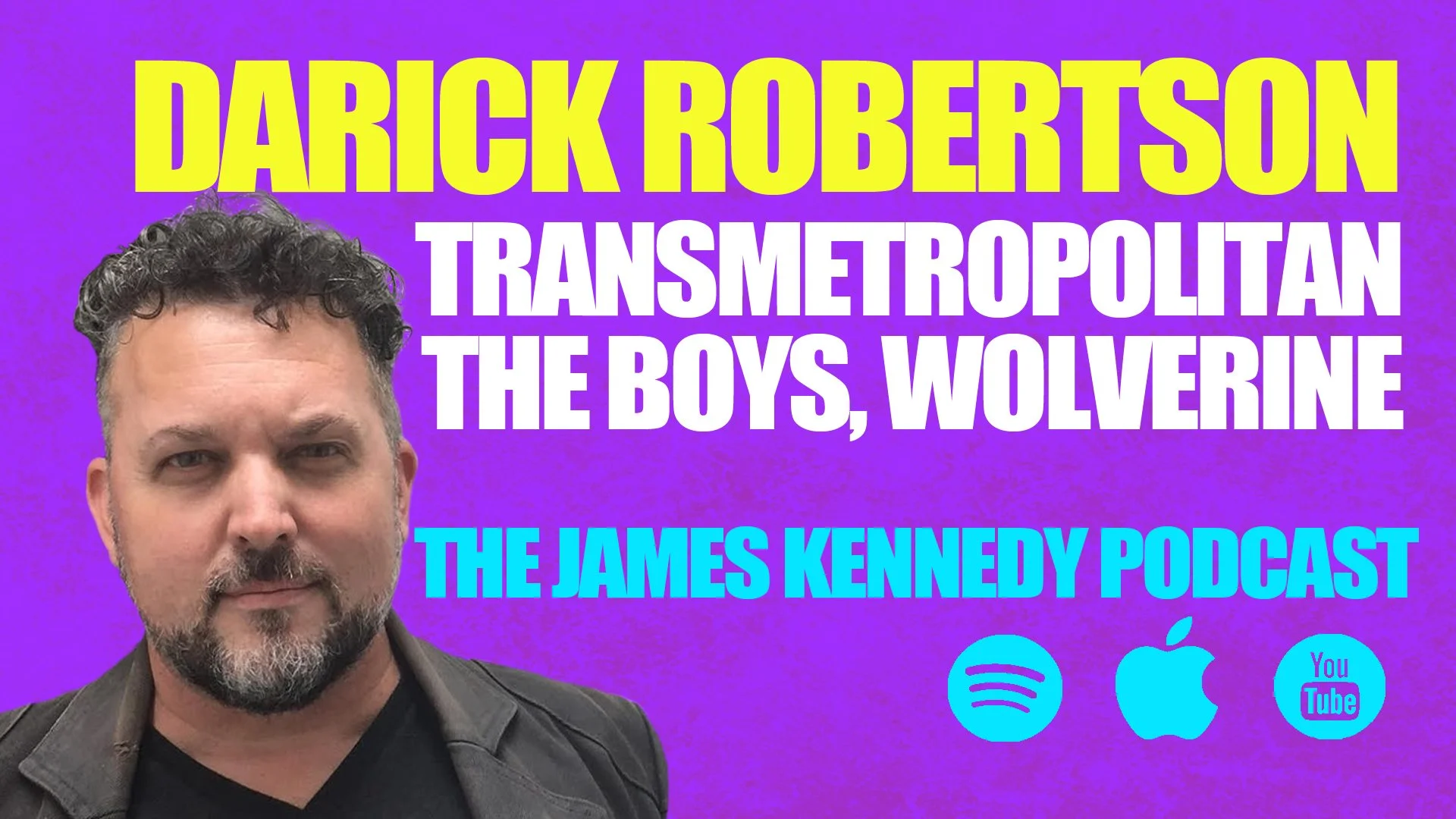
DARICK ROBERTSON - MAKING THE BOYS AND TRANSMETROPOLITAN
James Kennedy interviews legendary comic book artist Darick Robertson about co-creating Transmetropolitan and The Boys, his work with Warren Ellis, his career origins, and the comic industry. Robertson also performs a live song on guitar and plugs his series, Greaser: Gemini Blues.
James Kennedy It is my absolute pleasure to welcome onto the show today, artist and comic book illustrator to some of the most popular characters ever penned, including The Boys, Wolverine, Deadpool, Spider-Man, and my personal favorite, the iconic, subversive, anarchic masterpiece that is Transmetropolitan. I'm speaking, of course, about the uber talented, the one and the only Mr. Darick Robertson. How the hell are you doing, sir?
Darick Robertson Hi, Jamie. Nice to meet you.
James Kennedy Yeah, you too, bro. I've been looking forward to it, man.
Darick Robertson Apologies to your listeners that I'm not Warren Ellis, but I'll try to hold up my end of things.
James Kennedy He didn't draw the pictures, bro. That is the main thing for me. Obviously, everything about Transmetropolitan is fucking genius.
Darick Robertson Yeah, that thing would not have existed without him. That is one of the most pure and excellent collaborations I've ever had as far as getting to be me. And then at the same time, bringing in what Warren wanted, because he was a really great collaborator as far as knowing when to let go and knowing when to be specific. That's a very rare combination. We made it work for 60 issues, which is really a miracle, considering that the scripts would come in pretty slowly and in pieces. I'd have to take on other work waiting for an issue and then finish it all up really quickly and still try to keep that detail level up. So I don't think I could do that job today, but I'm happy it exists.
James Kennedy It feels very much to me—I talk about this with musicians that come to the podcast—there are some albums like, say, Dark Side of the Moon or something like that, where you could just tell that everybody involved is on. It's just one of those rare moments in time when the stars align and everybody involved is just on. It's the right time. Everything just works right. I felt like that when I discovered Transmetropolitan. I was like, the dialogue, the commentary, the artwork, the vision, the whole world is just on, you know?
Darick Robertson It really set me free in a lot of ways because the original vision for the book, with very little detail, was more like a nutshell concept. But I had worked with Warren at a small company called Malibu Ultraverse. I had done a creator-owned book for them that I was basically waiting for a green light. I co-created a character that got finagled away from me in a way that I'm still salty about. They offered me other work in the meantime, and our editor was Hank Kanalz, who would go on to help found Image. If you see that classic photo of all the Image guys, the guy that's not an artist in there, that's Hank. He founded Image with those guys. Those guys split off, and he ended up helping Malibu Ultraverse get going, which was a fun company. I wish it had lasted. They ended up selling off everybody to Marvel. The opportunity I had in the meantime, while I was developing my creator-owned work, was like the story of my career. I always show up at the pool party, and about the time everybody's drunk and we all get naked, the cops show up. That's my career.
James Kennedy Sounds like your career sounds like my party.
Darick Robertson I got to make it over to Wales. But it's always been that kind of weird timing. The good news out of that was, because I had a late start going in with my own thing, I got paired up. They needed an artist for a few issues of this book called Ultraforce. If you look at the early covers done by the brilliant late, great George Pérez, who I loved and miss, you could see there was a lot of potential in them. But it was the nineties, and the nineties had a habit of, how can we regurgitate new heroes with this one kind of archetype over and over again? This is your Storm type, this is your Superman type, this is your this type. Then they would come up with a variation of that.
This segues into The Boys, but the one that was really great though is that they handed me these scripts by a guy I'd never worked with before named Warren Ellis. I'm reading Warren's script, and the weirdest part was there was another writer named Ian Edginton who was doing the dialogue. In retrospect I go, there's no world where you want somebody besides Warren Ellis to do the dialogue. I mean, that's Warren. It's like the Beatles singing backup for Tony Sheridan on "My Bonnie Lies Over the Ocean". They were just poor kids hoping to get some money. "Hey, we're in a recording studio, look at us, maybe this will go somewhere." You've heard of the Beatles? It didn't really take off for them. It's a shame how they've been lost.
James Kennedy Yeah, they had a lot of potential, those guys.
Darick Robertson It's a shame, man.
James Kennedy Yeah, I don't know them and the Rolling Stones, they just never found their audience.
Darick Robertson It's a shit business, bro.
James Kennedy Yeah, I know, it's not fair.
Darick Robertson So Warren wasn't writing his own dialogue, but his scripts were amazing, and he would just put these weird little details in there. I could smell the room reading his writing. I got a feel for what their boots must have felt like to walk around in. There was just something very palpable and real about how he approached these otherwise goofy characters, and I was blown away. I had a really good time drawing those issues. There was lots of action in them, and because they were silly, fringe, not real popular characters, I had a lot of freedom to exaggerate them and do my own thing with them. It ended up being a fun three issues to draw. They were interesting plots.
He had a moment where the characters were sitting around working on a case, and the description was they're eating bacon sandwiches and drinking black coffee. I was like, that's a nice detail. I could smell the room all of a sudden, and I knew what that would look like. I could see these guys eating bacon sandwiches and drinking black coffee, so I had one of them pouring. That was what was really fun.
Towards the end, I said to the editor, "Can you put me in touch?" This is pre-email because I'm old. I said, "Could you put us in touch? I'd like to talk to him." So I rang him up and said, "These are the best scripts I've read in a long time." I have a nose for talent like nobody's business. I can brag on that with decades of experience now, because I told Jim Lee when I first met him and he was drawing Alpha Flight, "They should put you on X-Men."
Anyway, with Warren I just said, "I think you're going to be huge in this business, you're going to be a superstar." He was real modest about it, like, "Good luck with that, I was lucky I got this gig." He was very humble. And I was right. I said, "If you ever want to do a monthly book together, please keep me in mind, I'd love to collaborate with you on something on an ongoing basis."
It was really shitty because in that little window—I still have those time machine moments where I wish I could get in a time machine and undo a decision—Marvel came to me and said, "Alan Davis is leaving Excalibur, would you like to be the replacement artist on Excalibur?" That's drawing Nightcrawler, Rachel Summers, Phoenix. It was a good book. But the idea of it was a little bit like... Have you ever seen Walk Hard: The Dewey Cox Story?
James Kennedy Oh yeah, yeah, yeah.
Darick Robertson There's a great scene where he's a fictional rock and roll star. John C. Reilly is amazing in it, and he sings his own music. At one point, he's got Buddy Holly and Elvis, and then it's his turn. That's kind of how I felt. The book wasn't doing great, and I'm like, "So you want rookie of the year to come in and take over for Alan fucking Davis?" I assume it's okay that I swear, right?
James Kennedy Fuck yeah, go for it.
Darick Robertson Okay, all right. Yeah, so I'm following up Alan fucking Davis. I'm like, there's no way. I was a little bit on the fence, and then also I was supposed to do this creator-owned book that didn't get off the bench, so I passed on it. Also, I didn't know who the writer was going to be, because the guy that was supposed to come on backed out. So it was going to be an unknown writer, following up Alan Davis, on a monthly book. But that was at the time when Marvel was selling and giving royalties to artists, so I could have made a killing financially. Turns out that writer was Warren Ellis.
James Kennedy Typical.
Darick Robertson Yeah. Instead of Transmetropolitan, there might have been a long run on Excalibur, which would have been awesome, but it didn't work out that way. Life is funny. It didn't work out so bad because when Marvel went bankrupt, Warren called me up and said, "They're starting this new company called Helix, and I pitched a book that they want to do. Do you want to be the artist?"
We had done another small project together called Man of the Atom, and he was very happy with what I did there because it was a lot of sci-fi and talking rather than superhero action. He wasn't sure how I'd handle that, and he liked it. I was known primarily as a superhero artist at the time, which is very funny, because after I did Transmetropolitan, people didn't know I could do superheroes. They want to pigeonhole you wherever they can.
James Kennedy Yeah.
Darick Robertson But Transmetropolitan was exactly the kind of book I was dying to do, because I loved indie comics. I loved Love and Rockets, Peter Bagge's Hate, and the weirder the better. I was really into new wave and punk music, that was really my taste, and I really wanted to do something that would unleash that. Spider Jerusalem ended up being my spirit animal. He is the me I wish I could walk around being. Apparently I'm not alone, because so many people identify with him.
It was Warren's cynicism and my happy anger, but also he was just a fun character. I was already a fan of Hunter S. Thompson, and Warren was much better read than I was with an understanding of what politics were happening at the time. I like to say Warren made me a better American, because I was not as dialed into what was happening as Warren was. By the time I finished that book, I was unstoppable. I can't help but consume everything. I am Spider in that chair of fire going, "Give me information."
When you see me outspoken online, it's because as half of that team, I feel like it's my responsibility to be that guy. As the other half of Spider Jerusalem, I feel like I have to represent. It ended up being a really great thing, but the editor at the time wasn't sure if I could handle the job because she thought I was a superhero artist. The editor-in-chief, my friend Karen, was unsure, so she said, "Have him try out on this other thing."
The editor wanted me, the writer wanted me, it was an original idea, and I had already drawn designs. I was like, "No, I'm busy." At the same time, Marvel had offered me Spider-Man Team-Up, and I had to make a choice. Ultimately—I'd still love to do Spider-Man Team-Up, but that's fine—my friend gave me some good advice: "If you do something original and it takes off, Spider-Man will still be there."
I rolled the dice. Marvel had just gone through bankruptcy, and I was literally thinking about getting out of comics entirely.
James Kennedy Right.
Darick Robertson It looked like the comic book industry was imploding, and I wasn't finding work. I thought, "I'm still young." My wife talked me out of it, thank God. This was before we were married, so she was really banking on me doing okay as an artist.
James Kennedy Well, God bless her, man.
Darick Robertson Ultimately I had to decide, and I really wanted to do this book. It sounded like a great idea, and the script was awesome. I had already gotten the first script at that point, but they wanted me to audition before I did that. I said, "I'll tell you what I'm going to do: I'll do the first three issues, and if you're not happy with them, I get my ownership for designing and creating the characters and I'll move on. You can bring on whoever else you want, is that fair? But I don't have time to audition for you. I've simply been around too long and done too much to audition for a book that I'm creating."
James Kennedy Yeah.
Darick Robertson They said, "Okay, that's fair." So I turned in the first four pages of number one, and my contract showed up the next week. They were very happy with it, and I went on to do all 60 issues. We got nominated for Eisners, we've been a perennial seller, and we made the top 100 of multiple best-of-all-time lists from multiple publications—Rolling Stone, Comics Journal, Playboy magazine at the time heralded us as one of the 10 best ever.
I was amazed how well we did after the book was published, because while we were doing it, we barely stayed afloat and they kept trying to cancel us. But we kept the team together. From issue five on, we kept the whole team. We went through like nine editors, but we kept the same artistic team.
James Kennedy It's the classic story that there are so many iconic creations, like Life of Brian by Monty Python, or Nirvana's Nevermind. They have that same sort of story where they were doing it on the bones of their ass with no budget, up against resistance, and then it just became this fucking timeless masterpiece classic, you know what I mean? It sounds very much like the same sort of experience.
Darick Robertson You can't imagine the world without it. I'm not bragging about my thing specifically, but I know what you're saying. There's a world where Tom Selleck was Indiana Jones, but if it weren't for Magnum, P.I., we wouldn't have Harrison Ford as Indiana Jones. He probably would have killed it—I love Tom Selleck—but it would not be that movie, 100%.
James Kennedy Yeah, man. Yeah, no, it's funny how life works out like that sometimes, isn't it? It's beautiful when it happens, especially when it gives us such an iconic piece of work like Transmetropolitan. That's not even to mention all of the other iconic stuff that you've done, which we're going to come on to. But you must be so proud looking back at the huge cultural landmark that you made quite unknowingly during that time.
Darick Robertson It remains my favorite of all the creator-owned stuff I've done so far. It still holds a very special place in my heart because of the entire experience. I went through the five craziest years of my life working on that book, which I'll return to.
James Kennedy Okay, well I'm dying to know already, but I wanted to ask you: when you look back at Transmetropolitan now, as I have done recently, are you shocked at how fucking close to the mark you guys actually were in terms of how things would turn out politically and socially?
Darick Robertson That is the craziest part of that book, how prescient we ended up being. What's funniest is we were thinking of a world decades away, hundreds of decades away. The other funniest thing is, I'm about to hold up my iPhone, this is the only thing I couldn't predict.
James Kennedy Right, of course, social media and iPhone. Was it just chance then that you got so much of it right?
Darick Robertson Yeah, that was total... Well, I'm going to be a little more philosophical about that statement. If you ever get anxious about the state of the world, you know what will calm the fuck out of you? Read history, because we are in a loop. We go through loops. My father explained it to me once: it's a pendulum, it'll swing back and forth. Never panic too much, because it's always going to swing the other way. When things get a little too left wing, they'll come back to the right; when they get too right wing, they'll come back to the left. It's a pendulum, it just goes like this.
At the same time, history, as Split Enz sang, it never repeats. But the truth is it does, and we're living through a time now where we're watching some very familiar patterns play out. It's scary because we know how bad it can get, but it's also comforting.
With Transmetropolitan, Warren was tapping into the post-Watergate years in American politics. The Beast was representative of Nixon. The Smiler was supposed to be representative of a couple of politicians, but physically we based him on Tony Blair and Jimmy Carter. We were both loving Hunter S. Thompson, who I had read and was a fan of. By the way, before he died, he gave Transmet a big thumbs up. He was not crazy about parodies of himself, but in the early days of websites, I found a very nice write-up on Hunter S. Thompson's website about Transmetropolitan. He liked Spider Jerusalem so much, which made me feel like I did something right in this world.
ENJOYING THE CONVERSATION?
GET JAMES KENNEDY'S LATEST INTERVIEWS, WRITING AND LIVE SHOWS STRAIGHT TO YOUR INBOX.
James Kennedy That's an endorsement right there.
Darick Robertson Yeah, exactly. I wish I knew how to do a screen grab back then, but my technological skills were too early.
James Kennedy With your Polaroid camera.
Darick Robertson Pretty much, yeah, it would have been that. That's the only screen I probably could have got it on.
That's where we both came from, so in a weird way, Warren was casting a wide net for what he saw the future to be, but we were both discussing it. What I really love about that world and creating that world with him is that I had a lot of freedom to bring my own ideas in, and he was a wonderful collaborator in playing "Yes, And." He would never say "No, but." That was an old Chuck Jones way of running his cartoon writing room. You couldn't say no, you had to say "Yes, and." It's an old improv trick, works in music as well. You pick up on what your other player is doing, and so we were like a good band.
I would throw something in the background. With issue one, I was much younger. I'd stay up very late at night watching late night TV, getting high, and getting through deadlines. I'd stay up till six or seven in the morning, sleep from seven to one, and do it all over again. I didn't have kids, I was in my twenties, it was a very different world. Cable TV and satellite TV with 500 channels was kind of a new thing, or DVDs and VHS. I was consuming mentally, and anything that caught my imagination, I would weave it into whatever panel I was working on. That's why there's a real stream of consciousness going on in the backgrounds.
There was no wrong for me, and I loved that it was so freeing. I would make sure all the details Warren asked for were in there. For example, in issue one, Spider is coming down off the mountain, pulls into a toll booth, and there's a guy working there. The only thing Warren mentioned was that he's got a switch on his neck and he's kind of scratching at it. So I made sure there was a switch in his neck. But in the background, I threw a paper calendar up that said "Sex Puppets." It just made me laugh, like something I would have written on my binder.
Later on, he came back and said, "Hey, what was Sex Puppets about?" I said, "I imagine in the future they would try to do a Sesame Street show for sex education for kids, but the first thing that would happen is they'd want to profit off it, so it would go from PBS to Cinemax and the girls would get hotter." There was also a movie called Meet the Feebles that I'd seen around that time that made me laugh. So that was Sex Puppets. When he got to issue five, he goes, "I like that, I want to write it in." So by issue five, Spider is watching Sex Puppets. We kept bringing them back around, but that's where Sex Puppets came from: that little calendar in the background of issue one.
The design drawing I did of Spider Jerusalem right out of the gate was one of the most fully realized characters I ever sat down and just drew. His original name was Caleb Newcastle.
James Kennedy Yeah, the editor thought it was too English.
Darick Robertson Yeah. The only descriptions I got from Warren were that he was bald, covered in tattoos, and wore a black suit with no shirt. I sat down and designed him. I gave him hovering piercings that floated around his ear magnetically—I have a fascination with magnetics—but Warren said, "Piercings are overdone, let's leave the piercings out."
I gave him choppy, cropped hair and stubble, not knowing he would go into the shower and lose all his hair. Warren said, "No, he's burned all the way down, no hair at all." I left his eyebrows because I figured the shower would be programmed to avoid your eyes.
I didn't want to draw the tattoos because I knew I'd have to do them issue after issue. I got a lot of pushback, so I ended up making a custom action figure out of a Michael Jordan from Space Jam. I painted him up and drew all the tattoos on him as a reference so I could turn him around and remember what's where. I still have that in a box.
James Kennedy I'd love to see that sometime, man.
Darick Robertson Next time he surfaces, I'll take pictures of him. But I finally succumbed, drew the tattoos, and Spider Jerusalem was born.
On the initial design drawing, I drew a crazy mutant cat next to him that had just finished taking a piss in an alleyway. I gave him three eyes, two mouths, and five legs. Warren asked, "What's with the cat?" I said, "I figure in the future, God knows what's ended up in dumpsters, strays would be eating leftover pharmaceuticals or looking up the liquids of all the shit Spider consumes, and they just start to mutate. You have these weird freaked-out looking animals walking around." He goes, "That's cool, I like that cat, let's make it his pet."
The glasses and the shoulder bag were all me. I figured he needed something to carry his computer in, because laptops were as far as I could imagine in the future. I didn't even think about smartwatches. I kind of liked the tangibility of him. One of the things I love about Star Wars is that it feels like a real world where Han Solo has to pound the side of the Millennium Falcon to get it to start up. There's something very real about the mechanics in the Star Wars world, so I like bringing that element to anything I create. I gave him that Indiana Jones-inspired shoulder bag and those glasses.
I never like to sound like I'm trying to take anything away from Warren's brilliance, because those scripts were fucking brilliant, but the more we went on, the more he let me play. If I was Ray Manzarek, he was Jim Morrison. He would do his thing, but I was there doing the bass with the keyboard. The scripts would say less and less unless he had a very specific thing he was trying to achieve. Sometimes he would just write, "Draw a low or a high vision of the city, make it loud and noisy." That's all he'd write for a splash page, and I would just go to town.
All the little signs in the background, like Mr. Tree... In issue eight, I drew my friend Brian Posehn, who you can see in the first episode of The Mandalorian. He's holding up a little pamphlet that says "Insane Posehn's Used Porno Clones." I just thought it was funny and wanted an excuse to draw Brian into the panel.
James Kennedy What a project to have at that age. You're in your 20s, consuming all this content, and you've got the freedom.
Darick Robertson The world was changing so quickly. Technologically, we had just gotten used to email and were starting to understand the reach of the internet. Amazon.com was only selling books back in 1997. If I'm going back in time, I'm also stopping off to buy stock.
James Kennedy It sounds incredibly similar to my experience with my first album, Made in China. I was 22 when it came out, absorbing everything—music, books, political ideas—and I was very lucky that I had a project to spew it all out into without any restraint or label interference. Complete and utter freedom to just explore and be as wild and ambitious as I wanted to be. I look back at that innocent time of discovery with a lot of nostalgia. It sounds like Transmetropolitan was a very similar experience for you.
Darick Robertson That freedom is a definite plus. I don't know that I knew what I had. It was a very strange time in comics, and we were so close to getting canceled all the time that it felt like nobody was reading it. A little part of me thought, "Nobody gives a fuck about my crazy future world ideas, nobody likes this character." That's what my brain was feeding me.
Then it kept getting attention and Eisner nominations—losing to Preacher, ironically. I could slowly see that we had something good. They were considering canceling us at issue six when the entire line of Helix Comics went under, but we were the only thing selling, so they brought us over to Vertigo. Warren and I were absolutely sure we were going to get canceled after four issues because Spider Jerusalem is making the president shit himself in a bathroom. We thought, "They're not going to publish this." Guess we were wrong.
James Kennedy Thank God. Do you think that was a timing thing, though? Could that happen now?
Darick Robertson It helps to do something different. The smart thing I did early in my career was not give up on the idea of making something original. The very first thing I ever did that got published, I was 17 years old, and it was a book called Space Beaver. It was a funny animal comic. A lot of people thought I was inspired by the Ninja Turtles, but I was into much geekier stuff like Rocket Raccoon (drawn by Mike Mignola at the time) and DC's Captain Carrot and the Amazing Zoo Crew drawn by Scott Shaw. I loved Scott Shaw's art style and storytelling so much that I wanted to create something like that. I made it up as a doodle in summer school and someone got ahold of it.
I was a published artist and writer straight out of my senior year in high school. I got thrown in the deep end. I didn't know I should have four issues done before publishing issue one, so I was scrambling to get issues out. The Ninja Turtles had blown the black and white market up, so everybody wanted to find the next Ninja Turtles. But right as my book came out, that balloon popped, so my book got lost to time. It almost became a TV series, but it didn't happen.
It did get me going to conventions and meeting other professionals like Jim Lee at the beginning of their careers. I found an old briefcase from 1992–1993 in my attic last weekend, and inside was Stan Lee's business card from Marvel Films, which he gave me. In those days, a big convention was 4,000 people total, and Stan would be there hanging out. I had a pro pass, so I shot the shit with Stan at an afterparty and he said, "I like your stuff, kid, here's my card."
Breaking in during the late eighties gave me a wealth of knowledge. I learned how every aspect of the comic book industry worked because I was writing, drawing, and going out to Diamond distributors at two in the morning on Tuesdays to unpack boxes. The guy that published my book owned a comic book store, so I worked behind the counter and at the distributor. By the time I got into mainstream comics, I really knew what I was doing, and I kept a healthy work ethic. If my book is late, that fucks up the distributor and the retailer, so I try very hard not to be late.
James Kennedy There are a lot of parallels there with the music world. As an independent artist, I had to learn about distribution, promotion, retail, mastering, and barcodes because I've always had to do all of it myself. I'm really glad I had that experience because it gives me a much deeper appreciation of every aspect of the chain and where I fit into the schedule. When I speak to people signed to a major label from the age of 19, I'm amazed at how little they know. Knowledge is power.
Darick Robertson People with big egos are the ones who don't understand the chain. You don't realize how many people it took to build the stage you're standing on. It's an honor to be on that stage, and it's about what you can bring to it.
James Kennedy 100%. If you take everybody else away, you've just got some dude dancing in silence and darkness on stage. How has the industry changed then? The music industry is pretty fucked these days.
Darick Robertson The comic book industry is kind of fucked, too. Old paradigms are dying. Historically with comic books, we've been through this a number of times. Transmet was born of me getting ready to leave the industry and Marvel being bankrupt. Today, the idea that Marvel could go bankrupt seems outrageous, but imagine a world where Spider-Man is just a character people used to like. Mark my words, it's going to happen.
When I was seven years old, The Lone Ranger was super popular. How often do you hear about The Lone Ranger anymore? When's the last time Flash Gordon or Hopalong Cassidy was super cool? These characters will go that route eventually. The miracle of Superman and Batman is that they keep getting reinvented and passed on, but the times reflect how we consume them. In a weird way, The Boys is our version of taking the superhero trope, twisting it upside down, and shaking it to see what comes out of the bottom.
Now we're living in the age of superhero movies, which are based on comic book stories from the late seventies and early eighties that us nerds have known for decades. But big corporations have swept in and taken over the comic book companies, which used to act fairly independent of the money people. It's a very strange time, and I'm fortunate that I planted the seeds for this cornfield in the 80s.
I love history and listen to music from all eras. I was the youngest of a lot of kids, with parents who had me very late in life. My dad listened to Frank Sinatra and Big Band music, while my mom loved classic country western like Marty Robbins and Johnny Cash. I saw Johnny Cash live in his prime around '72 or '73. My sister loved 70s pop like the Bee Gees, Bob Seger, and ABBA. My parents were religious, so I wasn't allowed to listen to anything with a scary cover. I didn't discover Led Zeppelin until I was on my own, and now they're my desert island band.
James Kennedy You're not alone, bro.
Darick Robertson That forms the foundation of my artistic taste. When I started issue seven or eight of Transmet, I moved to Florence, Italy. Sitting in the Piazza della Signoria with my drawing board, I looked at how the ancient buildings were constructed. My apartment building was 500 years old with a 300-year-old lock, but downstairs was a fancy clothing shop with neon signs and Wi-Fi. That became the main philosophy for Transmetropolitan and my art: the past never goes away, it's just where it gets put.
James Kennedy My best friend hates Snow Patrol.
Darick Robertson I like Snow Patrol and Coldplay, along with a lot of other stuff. I'd rather talk about what we both like than what we hate.
James Kennedy Well, hatred is a big part of my personality, so don't take it away from me. I've always leaned more in the direction of the angry punk rock reactive kind of music.
Darick Robertson I met Joey Ramone back in the day, I have a picture with him. But if a song tells me a story, makes me think, or kicks me in the ass, I'll listen to it.
James Kennedy Let's talk about music then. You mentioned you're a musician yourself. Where are you at in your musical journey?
Darick Robertson I'll play something for you. (plays guitar and sings "Stand by Me")
James Kennedy That was a podcast first, baby, live music performance! That sounded great. I didn't know you could actually properly play. Are you self-taught?
Darick Robertson I'm self-taught. I played piano for a lot of years as a kid, so I know music theory and write my own stuff. Once I understood how the six strings on a guitar relate to keys on a piano, it took off. If we were hanging out and jamming in C or A blues, I could play along on the piano no problem.
James Kennedy That is so cool, man. You mentioned that now that illustration is your job, music is the thing getting your juices going.
Darick Robertson I only do it for me, but I have massive respect for people who do it professionally. You're doing what I wish I could do.
James Kennedy Music is kind of my job now, so I have this fantasy that one day I'll retire, stop spending time in a transit van, and spend my time down the Mediterranean painting. I've never painted before, but it's something I'd do purely for fun.
Darick Robertson Jamie, I want to challenge you: don't wait! There's nothing wrong with being terrible at something. Waste some paper, do some shitty paintings right now. We all make the mistake of thinking we have this imaginary future where we're happy and old, but we never know. Go spend $40 on a watercolor kit and paper, make some mistakes, and paint some bad paintings. YouTube will show you how.
James Kennedy You are totally right, I've been dragging my heels for way too long. I'm really excited about having a new challenge to learn from scratch.
Before I let you go, this has been a really fun chat. We've got to do some plugging and let the people know what you've got coming up.
Darick Robertson A lot of great talent is starting their own companies now. I'm working with Magma Comics, founded by two industry veterans, Denton Tipton and Bobby Curnow. They've let me write a book called Greaser: Gemini Blues. It's the first time I've written a book that I'm not drawing. My friend Stephen, a 20-plus year veteran in professional animation, is doing the art. His style has a sweetness to it, so putting his cartoon style on top of a grungy, dark, apocalyptic story created something magical.
James Kennedy Tell the folks what it's called, when it's out, and where they can get it.
Darick Robertson It's from Magma Comics and it's called Greaser: Gemini Blues. That's the first four issues.
James Kennedy There we go, boys and girls, from famous musician Darick Robertson! Darick, dude, this has been so much fun. I really enjoyed it.
Darick Robertson It was a pleasure, Jamie. If you ever want me back, let me know, I'd love to talk again.
James Kennedy 100%, let's definitely do this again. Greaser: Gemini Blues issue one is out now on Magma Comics. The brilliant Mr. Darick Robertson is at darickrobertson.com, @darickwr on Instagram, and @darickr on Twitter. Give him a follow and some love. And for everyone watching The Boys on Amazon, remember Darick is the co-creator and original illustrator. Darick, thank you so much for stopping by and for all the legendary art. Take care, man.
Darick Robertson You too, Jamie, I really enjoyed it. Good day, man. Cheers.
Key Points:
Guest Darick Robertson, legendary comic artist of The Boys, Transmetropolitan, Wolverine, and Spider-Man, discusses his career and creative process.
Robertson explains that Transmetropolitan was a pure collaboration with Warren Ellis, born from a chance pairing at Malibu Ultraverse that led to a 60-issue run.
He reveals he almost took a mainstream Excalibur job instead of Transmetropolitan, a decision he now views as a fortunate near-miss.
Robertson describes how living in Florence, Italy shaped Transmetropolitan's core philosophy: the past never disappears, it simply gets repurposed alongside the present.
He shares stories behind Spider Jerusalem's design, including the mutant cat, the glasses, and the "sex puppets" background gag that Warren Ellis later incorporated into the story.
Robertson reflects on the cyclical nature of the comics industry, comparing it to music and noting how characters like Wolverine and the Lone Ranger rise and fade over generations.
He announces his new creator-owned comic Greaser Gemini Blues on Magma Comics, his first time writing a book drawn by someone else, and performs an impromptu guitar piece.
Summary:
In this episode of the James Kennedy podcast, host James Kennedy welcomes legendary comic book artist Darick Robertson for an in-depth conversation about his career and creative philosophy. Kennedy opens with brief commentary on Julian Assange's release and the UK election before promoting his ongoing tour with Amongst Liars.
Robertson, known for his work on The Boys, Transmetropolitan, Wolverine, Deadpool, and Spider-Man, discusses his origins in the industry, beginning with his self-published Space Beaver at age seventeen and his early days working at comic shops and distributors. He explains how a chance pairing with writer Warren Ellis on a Malibu Ultraverse title led to Transmetropolitan, a 60-issue series that became a cultural landmark. Robertson reveals he nearly passed on the project to draw Excalibur for Marvel, a decision he now views as a fortunate near-miss.
The conversation covers the creative process behind Transmetropolitan, including the collaborative "yes, and" dynamic with Ellis, the design evolution of Spider Jerusalem, and how living in Florence, Italy inspired the book's central philosophy that the past never truly disappears. Robertson also reflects on the cyclical nature of the comics industry and shares his musical influences and self-taught guitar playing.
Robertson announces his new creator-owned comic Greaser Gemini Blues on Magma Comics, his first time writing for another artist, and performs an impromptu guitar piece. The episode concludes with Kennedy encouraging listeners to support Robertson's work and subscribe to the podcast.
The James Kennedy Podcast is a Society and Culture podcast hosted by musician and author, James Kennedy. Exploring the big questions around health, social issues, the arts, politics, mental health, the human condition and how to navigate this thing called life through casual conversations with scientists, activists, rock stars, philosophers and academics. Please subscribe, leave a rating and support the show.