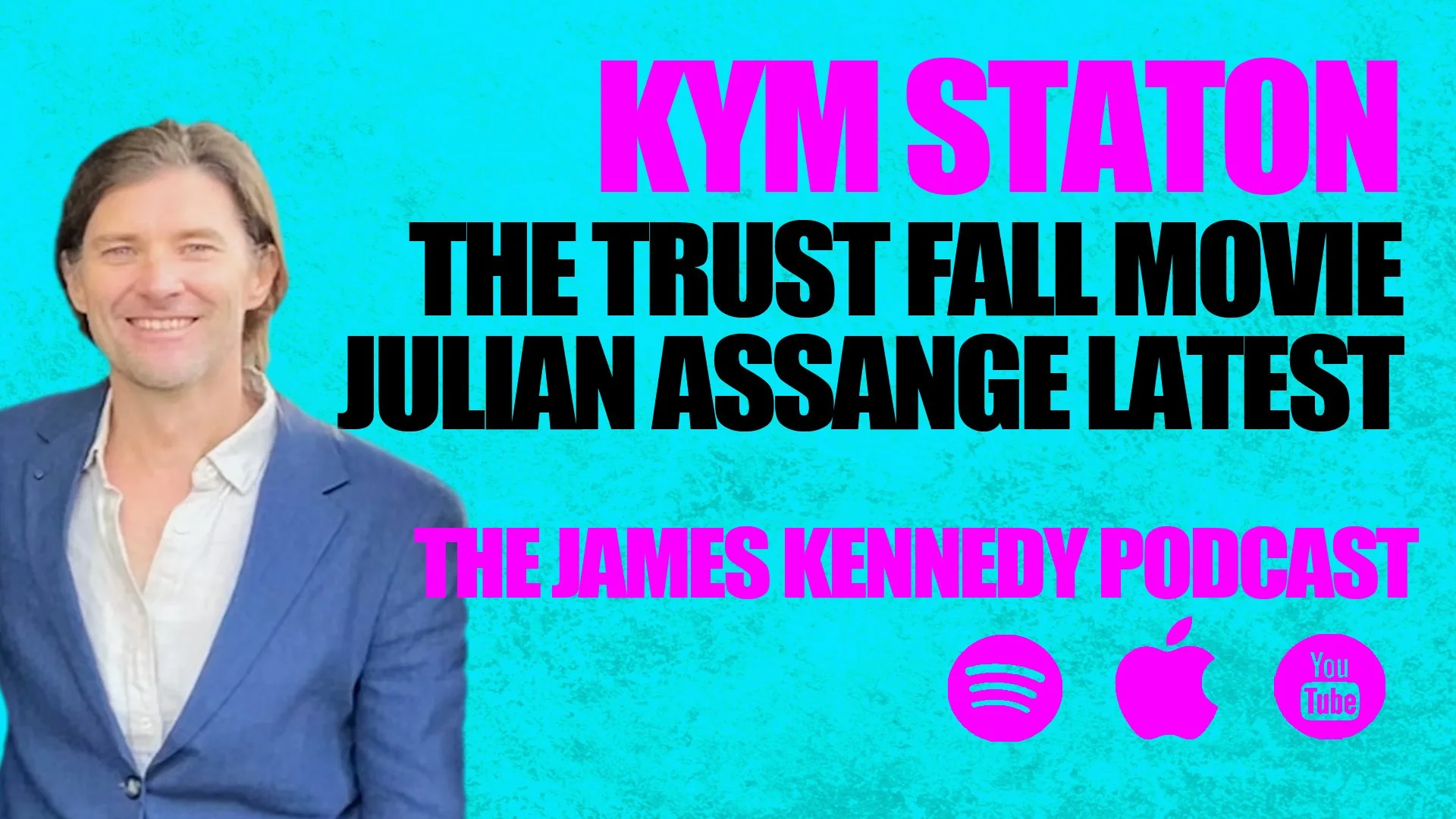
KYM STATON - THE JULIAN ASSANGE CASE
James Kennedy and filmmaker Kym Staton discuss the recent release of Julian Assange. Staton discusses his documentary The Trust Fall, the history and broader implications of the Assange case for press freedom, and his experiences witnessing Assange's return to Australia.
James Kennedy Please welcome to the podcast, Mr. Kym Staton calling in from Australia. Kym, how are you doing? And also, how are you feeling, man, given the other news that we've all recently received?
Kym Staton Feeling good. I mean, last week was just such a mind-blowing week. We have huge news, and from Natalia, my partner and co-producer of the film, some travel because we happened to be in Canberra. We were on the way to Canberra, actually, to appear at a screening of The Trust Fall at the National Film and Sound Archive and just happened to be there at the right time. It was really kind of almost serendipitous that we were actually there.
You know, Australia is a huge country. And with the amount of short notice that everyone sort of had that he was free and then arriving in Canberra, like no chance we would have got down there. And so we just happened to be there, and it was incredible. And we just got back a couple of days ago, and I'm still processing this. It's a big adjustment actually, because it's been for me personally three years of full-time awareness building, education, activism on this cause. You know, I've been there for a long time.
Massively in his favor though, you know, 70 to 100 literally one count out of the 18 counts that he had to plead guilty to. And it wasn't one of the worst counts on the indictment. It was one of conspiracy to obtain classified information and disseminate that information, which is basically a publishing charge, just one of the many publishing charges. It wasn't the computer intrusion charge. So, you know, but as you say, like, the main thing is it's so important that he got free right now because he could only survive so long in those conditions, extremely oppressive conditions, solitary 22 hours a day in a six-meter-square cell. You know, it's enough to drive anyone mad.
He'd had a mini-stroke about a year ago, and things would have got worse in the U.S. He could have been up for 175 years. Prison sentence, they would have tortured him. They would have kept him under what they call SAMs, Special Administrative Measures, which is basically torture. So, you know, it's really a life-saving result, this plea deal. It's to save his life. And it was wonderful to see that despite all these health concerns that he, you know, walked to that private jet unassisted, and he seems to be quite well. Quite well, you know, considering I'm sure there's a lot of health issues that he has to look into. I know that he had a nurse on board on the plane with him. No doubt he'll be getting a lot of attention on his medical side of things over the coming weeks and months.
James Kennedy Yeah, it's going to be interesting to see how this one unfolds. And obviously, if Julian does return to public life, what new information he'll be able to give us about the journey, the journey that he's been on for the past decade or more. But what does this case represent to you, more broadly speaking, not just focusing upon Julian's personal circumstances, but what does this case represent to you in terms of, you know, press freedom and democracy? And what precedent does the outcome of this case set for other journalists around the world who are doing similar work to Julian and being punished in a similar way? What does it represent to you?
Kym Staton Yeah, it represents a lot of big things. And that's why the support has just grown and grown. And the U.S. knew that that support was growing all around the world and from many different camps, people in very different opinions, both the right and left side of politics in Australia and in the U.S. As Stella Assange said at her speech in Sydney when she visited about six months ago, she said this campaign has brought together, you know, people that I perhaps wouldn't otherwise have a conversation with.
So, you know, it's about free speech. It's about press freedom. It's about world peace, you know, journalism. And it's also, you know, about the freedom movement broadly. I think freedom is, I've really noticed in Australia here when we had the, when the cinema run here kicked off with The Trust Fall, we had freedom fighters, as they're called, in massive support. It didn't take long for us to hear from those people, and they were so willing to help for no benefit of their own just to get the word out about the film and come and, you know, be on the panels and just put it out and attract a lot of people to come and hear this story and understand this story because they understand the connection between Assange, what he exposed, the work he's done, and the broader movement of all of our freedoms.
They say that free speech is the first freedom because all our other human rights stem from that. If we can't say what we want, challenge government, speak our mind, how can we have any other sort of human rights? How can we fight for any other cause? There was, you know, a wonderful speech that Kristinn Hrafnsson, the current editor-in-chief of WikiLeaks, at the beginning of the extradition trial in London, there was this huge protest down the street and prior to that they had speeches with people like Tariq Ali and Roger Waters, and Kristinn Hrafnsson in that speech, at the end of the speech, said, you know, you will not be able to fight for any other cause. This is about the fundamentals. We put that in The Trust Fall film because I just thought it was such a powerful line. It hadn't occurred to me actually until I heard that, that if you're, for example, fighting for, you know, animal rights or women's rights or human rights or whatever, you're not going to be able to fight for any other cause. How do you fight for that if you can't put out truthful information?
So, you know, this is a decade and a half that this has been going on, and Julian has been taking on this massive empire. It's really a David and Goliath story. And Julian is the brave David taking on a Goliath of an empire. The US is the biggest empire on the planet, probably the biggest empire that's ever existed. Army bases around the world, they have interference or involvement in pretty much every country on the planet. And they're the big guys. And, you know, Julian, a single man with a wonderful team behind him, taking them on for nearly 15 years by putting out this shocking information through these leaks that occurred in 2010, 2011. Incredible stuff that was put out at that time that got the US really freaked out and really riled up and going after him with everything that they could muster.
James Kennedy 100%, yeah, man. It's a fascinating story. And it's really interesting to be here at this moment in history when it's playing out, you know, in front of our eyes. And I agree with you. It is a massive win for the reasons you've mentioned. And I think this is a perfect place to launch into talking about your incredible movie, The Trust Fall. It's doing so well. And it's just about to launch in cinemas in the States. Is that right?
Kym Staton Yeah, that's right. Releasing in cinemas in America on the 17th of July. Just before we get into the film, I just wanted to mention, because you said just then, it's so incredible to be here, you know, to be living at this time in history. And we have this wonderful, incredibly courageous figure being Julian Assange. In my mind, you know, I don't know if you've heard of Gandhi or Mandela as far as his achievements for human rights and his courage to stand up against the hegemony.
I just wanted to mention that my partner and I, we were, yeah, just being amongst a very few number of people at the RAAF hangar in Canberra because we just happened to be down there. And we, you know, figured out where he was going to land. And, you know, we had to see him get off the plane with our own eyes, whereas, and there was really only 50 people there and 40 of them were news photographers. There was just maybe 10 or so there.
Funny story of how we actually happened to be there. Not just that we were down in Canberra, but on the day, you know, on Tuesday when we heard the news, you know, the first thing we said was, well, where is he going to land? It might be in Melbourne because his father, John, and his brother Gabriel live there and he went to university there. Could be Melbourne. Could be Sydney because that's the main airport in Australia. Could be somewhere near where his mother lives, which is, I won't say where that is. But, you know, it could have been any of these places.
But then, you know, Stella, I think, posted some flight details of his flight path of this private jet. And, you know, we found out it was Canberra. And it's like, wow, we're here. And we actually had plans the next day and we had to cancel them, which is something I rarely do. I'm someone that likes to really stick to my plans and not muck people around. But on this rare occasion, I was going to be reading poetry from my poetry book, The Trust Fall, and other poems in a town called Bowral, south of Sydney, inland from Wollongong, the next day. And I had to cancel that even though I was really excited to go there and share my poetry, do this reading. But, of course, they understood because they were all Assange supporters.
And so, you know, now we realise, okay, we're going to book an Airbnb in Canberra, we're going to be here. Now we've got to find out where exactly he's coming out at the airport. And so we thought we'll just lob in there to Canberra International Airport and we'll just hang around in the international arrivals area. And if it's the right place, then the press photographers and reporters are just going to gather, and his supporters. And it'll be hundreds of people there. And we're like, okay, we've got to find out where he's coming from.
We take photos, but there's no one there, it doesn't look like it's going to happen there. We're all hanging around for about an hour, an hour and a half, it's getting closer to 7 p.m., he's due to land in only about an hour, still don't know if it's the place. And then she said, "Oh, top management, the office people just told me it's at the RAAF," which is like, you know, we get on Google Maps, ah, that's the other end of the airport. And so we drive around there at night, and there's all, of course, the boom gates and everything and all the big fences. And we're thinking we might have to jump the fence or something. But you know, there's all the reporters, we saw dozens of cars and all the cameras out and tripods. And so we basically found the right place, and then we're all out there in the freezing cold. It's probably zero degrees out, Canberra night in winter, and saw the plane come down.
And it was just extraordinary, you know, just as I said, to witness it with your own eyes is really special. The plane just came in, they opened the door, he pops his head out, does a big thumbs up, and then, you know, dances down the pretty much dances down the tarmac and gives his dad a big hug and picks up Stella off her feet, which everyone saw, of course. I mean, imagine how many people in the world watched that.
And something that occurred to me, which I think is really fascinating, is I wonder if any single person on the planet in history has ever had that amount of support that Julian Assange has had in the last week or year or so, but especially with this news, because, you know, I mentioned Mandela and Gandhi, but you know, they lived before the time of social media. And I think it's quite fascinating in that, you know, the internet and social media, Julian has this quote about the internet, I can't remember the exact words, but it's something like, you know, the internet is the best thing that's ever happened to humanity. And he really was warning us 15 years ago about the internet, that it would be co-opted by corporations and it could be really beneficial to us or not, depending on how it was used.
And so I think it's interesting to consider that it could have been easily one or two billion people saw that footage, understood even if they don't understand the whole story of Assange, they at least know, they get the gist of it. He took them on, he exposed their crimes, he had to take a plea deal, and now he's free after 15 years of suffering, just that simple story. And I think it's interesting to consider that, and any decent person has to side with him, regardless, you know, mainstream still trying to perpetuate all these garbage myths and lies and smears about him. Yeah, but...
James Kennedy I mean, I can't imagine, I mean, it's such a historic piece of footage now already, isn't it, of him walking down the tarmac and his fist in the air and then he kisses Stella and everything. And I mean, I've watched it several times, and you can just hear people screaming, "Thank you!" and "Well done, Assange!" and stuff.
Kym Staton Yeah, that was us, you know, that was all the people right next to us. I thought it was all journalists at first, but so many cheers and claps and everyone was screaming out, and he walks right over right near the fence and just waves. He was so excited, he was so happy, not just because he'd arrived back home after all those 15 years and he's free, but also just I think really pleased to see so many supporters there even though they didn't put it out. They must have been told, you know, not to put this out, but as WikiLeaks love to do, they leak something, just a little bit of information with that little flight log was enough to sort of help people figure out where exactly where they were going to land.
James Kennedy Yeah, well I was following the flight. I think Stella put it out, didn't she, saying like, you know, until he's on Australian soil, you know, follow the flight in case something happens, because we still didn't know at that point, you know, like going to some remote island in the middle of the Pacific Ocean or whatever on American territory, it's still, you know, anything could happen I guess, you know. So that was doing the rounds on social media. I was kind of following the flight and everything as well from over here in South Wales.
And yeah, to just see the footage then confirm that he'd finally touched down, you know, and to see him waving to the crowd and everything was, I knew straight away, I was like, that is going to be a piece of historic footage. And you're exactly right, because I mean, like every time that I went to the Royal Courts of Justice to do my thing there, there was tons of press there, but I didn't notice any of the mainstream media. I didn't see any BBC, I didn't see any Guardian, and we were actively looking for them. And I checked the news reports on the websites and social media, nothing.
But now he's free, you can't find anyone that doesn't support him, you know? It's like even the people that I used to talk to who'd never heard of him because he wasn't in the news, now they've all seen that footage because as you rightly point out, you know, it's social media. We've got that aspect now with this particular case as well. Everybody now knows who he is and what he's done, and you can't seem to find anyone now that doesn't support him, you know? It's interesting how things go full circle.
Kym Staton Yeah, it is interesting how, for example in Australia, ABC television covered it massively. They've been covering it for years, I guess, but throwing in some of the old smears: he put lives at risk and stuff. I mean, they literally did that simultaneously as news love to do, which is a good thing, but then they were throwing in these sort of old, hackneyed smears throughout, which was really bizarre.
And then you've had these Murdoch-owned channel Sky News putting out absolute rubbish. Like, I saw some little clips out of Sky News with them saying, you know, he put lives at risk, didn't redact data dump, all this stuff. And then you had like The Age, the Australian newspapers, the print media, putting out all the smears again over the last few days. So I was pretty shocked to see, you know, the level that they stooped to with all of this disgusting criticism and just opinions. Who cares about their opinions, you know?
And these people, they either fail to see the big picture, they have some sort of vested interest, or their family or something is involved in the security agencies or something, or they're journalists that have been in it for, you know, their whole life and they're just simply jealous. They can't get over their own jealousy that Julian won like three dozen awards or something. It just makes them really cranky, and so they write all this disgusting stuff.
But as you say, the public, they know what's up. They can discern a hero from a villain, and he can't be painted as a villain anymore. I think this is a progression in this whole sort of story, this whole setup of independent media versus mainstream, the powerful elite with their industrial war complex being taken on by a journalist that actually wants to bring about a more peaceful world through transparency. So that whole conflict between those parties that's gone on for all this time, now this is a turning point where he's free.
To some degree, he's basically, you know, most of the charges dropped, only one token charge was agreed to. And so I think it'll be great to see if more of the public can look into this story and can look past the individual and past this personality of Julian and the criticisms of him, and look at what they exposed, you know, look at that information, what's in the leaks, what's on the WikiLeaks website.
James Kennedy 100%, yeah. I don't think it's inconceivable in our lifetime we're going to see Julian awarded some kind of Nobel Prize or something like that. I think he's going to transition universally from being a divisive figure or a villain to being known universally as a hero. I think that's going to happen in our lifetime, very much like the Mandela analogy. At the time, Margaret Thatcher and several other world leaders declared him a terrorist and stuff like that, and now he's this global icon. I think the same is going to happen to Julian in our lifetime.
Kym Staton Yeah, well, Mandela won a Nobel Prize and he was actually a terrorist, whereas Julian, you know, he was called a high-tech terrorist by Biden and others. I think, well, look, the Nobel Prize has become a bit corrupted over the last 10 years or so, but you know, it would be nice if he won that award or some other award. But yeah, definitely public opinion has swung massively in his favor. I think it just takes time for these rumors to sort of be debunked and for them to just be gradually weeded out.
And you know, that's something we did in The Trust Fall. We didn't shy away from sort of bringing up these smears, but we just basically brought them up and kicked them out of the park because they still perpetuate. And Julian, the Swedish smear for example, he described that in an interview as the worst day of his life, seeing that sort of lie on the front page of newspapers. So I think those sort of rumors and smears can't really last much longer because anyone can go read up on it, or go on YouTube—even YouTube has some really well-done videos explaining and debunking all of those rumors. And so, yeah, hopefully the public attention can shift over onto the important stuff.
ENJOYING THE CONVERSATION?
GET JAMES KENNEDY'S LATEST INTERVIEWS, WRITING AND LIVE SHOWS STRAIGHT TO YOUR INBOX.
James Kennedy I think it will, yeah. I think you're exactly right. And what is your gut feeling then on how this is going to play out? I mean, obviously it's an impossible thing for anyone to say at this point, and obviously all of us just want whatever Julian needs and wants to be happy and healthy and enjoy the rest of his life, you know? The man's done enough, and if he just wants to kick back and have a normal life with his family, then nobody would begrudge him that. But that doesn't seem to fit with his personality type from what I know of it. So I'd love to ask you, you know, what are your thoughts? What is your gut instinct on what you think is likely to play out in the future once Julian has recovered and recharged? Do you think it's conceivable that he might actually come back to doing what he does best?
Kym Staton Yeah, well, it's a fascinating question, and I think every interview I've done since this momentous event I've been asked that question. You know, of course the first thing we hope is that he just does what he wants to do and what feels right to him. First, he certainly needs to recover his health, and that may take quite a while.
My opinion, my feeling from what I've learned about Julian over this last few years of intense research and making this film, I had a few interactions with people that gave me quite an insight into his sort of mission in life and his drive, his commitment to this cause that he's been fighting for for much longer than WikiLeaks has been in existence—it started a lot earlier than that. I'll share a couple of anecdotes that will give you a bit of a picture and understand my feelings on it.
When we were in the production stage with the film, I had random people all the time sending me photos and videos, donating footage, which was fantastic. And one day there was a lady from a town called Lismore where Julian did live for some time as a child. It's in northern New South Wales, and this woman used to work with his mother, Christine Assange, and they were working on a puppet show together because Christine was an artist. So Julian and this lady's son used to play together, and they would come to the house frequently. And one day this woman asked Julian, "What do you want to be when you grow up?" And he said, at the age of eight years old, "I'm going to end corruption in the world."
It's mind-blowing. I mean, never mind fireman or professional tennis player. I've never heard a kid say that, it's crazy, right? And I think that indicates that he was, without getting into woo-woo, it was like he was on a mission here right from that early age. And I know from reading interviews with his mother and talking to her over the phone that when he was around that age, his favorite word was "why." And her and Jeff Assange, which is sort of the guy that brought him up because John was not around, they didn't shy from that, so they used to take him door-knocking to advocate for dolphins and for rainforests and causes like that. So he's sort of brought up in an activist family, right? So that's the first thing.
And then I guess the next one, apart from his courage and fortitude with going through this situation... it's in his 20s, if not his early 30s, where as a hacker, which was something he was into from his teens to his 20s, he was an ethical hacker. I should point out that he went to court at one stage for hacking, and the judge actually pointed out—they dropped the charge—and said, "I can see that you were just curious and looking around." So he was an ethical hacker.
When he had that skill, because he was a computer genius, on two occasions he helped the Victorian police track down pedophiles. So this is before the days of WikiLeaks, so that gives you a bit of an idea of what his mission is.
Another one is when I was talking to Suelette Dreyfus, his long-term friend, and she's an encryption professor at the University of Melbourne. She was actually there at the hangar on Wednesday night greeting him. She told me in the interview that when he was at university, he was horrified that the University of Melbourne were doing projects with the students which was about improving weapons, like making tanks that could nicely drive over the top of dead bodies and this sort of stuff. So these sort of little things give you a bit of an insight into Julian, his vision, his idea about the world, and that was the inspiration for creating WikiLeaks: to use technology to speed up the dissemination of truth, to give us more access to leaks.
So with all that in mind—and oh, one other anecdote is when he was in the embassy in London and the big DNC, the diplomatic cables came out, and then the U.S. were determined to find out who was the source of these cables. They were so fired up about that, and he refused to give that away. Even though Trump did put it on the table way back then, that's about 13 or 14 years ago, it was on the table that he could be pardoned if he just gave up the source of the DNC leak, and he didn't do it. And he said, "My principles are not for sale." This is the Julian that I know.
And so I can't imagine him not at some point going back to this mission of bringing about justice in the world. Either that or he becomes the next Prime Minister of Australia.
James Kennedy Oh man, Jesus Christ, one can wish! Can you imagine if he was in politics?
Kym Staton He did dabble in politics. There was a WikiLeaks Party for a year or two back around that time. And you know, there was this wonderful video I saw once, which was Julian around that peak time when they were so prominent with putting out those big leaks in 2011. He spoke through a live stream to the Big Day Out festival, this massive music festival in Australia. He had so much popularity at that time because he was putting out these huge drops, these truth bombs, and running for the Senate in Australia before the U.S. came down on him and started to try to destroy his character.
James Kennedy Well, everything you've just described there does not really suggest a man who's likely to spend the rest of his life just with his feet up, just fucking chilling out, you know? Unless, of course, that's what he wants to do, in which case nobody would begrudge him, like I said. The man has fucking done more than enough and paid the price for it. But if, at some point, however long that may take, if and when he's ready to come back and do his thing in whatever form that may take, that would be a beautiful thing, because the world needs him now more than ever.
Kym Staton Yeah, well, I think, and it's interesting to consider that in 2006 when WikiLeaks was created, an anonymous dropbox that was encrypted that could give complete anonymity to the leaker was an innovation, it was an invention. Encryption had only been used by the elite, by the powerful, and he made it possible for the serfs and the slaves to have access to this information. But now it's old hat; all the big media outlets have an anonymous dropbox. But Julian is an innovator, he's brilliant. He hasn't lost his brilliance, you can see that from many examples over the last year or so. You know, that witty letter to Prince Charles, or did you hear the one about how that Australian artist who did the portrait for the Archibald Prize was able to sketch Julian in prison?
James Kennedy No, tell us, man!
Kym Staton That's a brilliant story, because I've been looking for signs for some time because I'm so concerned about Julian's well-being, his mental state, that I'm looking for any little sign to show that he's still there, he's still really clever. So there was that really witty, funny letter that he wrote to Prince Charles, and then about six weeks or two months ago, there was an Australian portrait artist who wanted to paint him to enter the Archibald Prize.
Now, one of the criteria to enter into that competition is you have to sketch your subject in person, and so that posed a problem because you're not allowed to bring anything into Belmarsh Prison. You can't even bring a pencil and paper. And so Julian's brother Gabriel was talking to the Archibald Prize and said, "I'm not allowed to bring anything into Belmarsh Prison," and they were trying to figure out how they could sketch him.
So they came up with this plan. There's a little shop in Belmarsh where visitors can buy snacks and lollies and treats, so you're allowed to bring money in and you can go to the shop. And so they hatched this plan that he would use chocolate to sketch Julian—melted chocolate on a 10-pound bill. And so this artist, he found out what brands of chocolate they're selling in Belmarsh, and he experimented to work out which chocolate has the best qualities for sketching. Then he grows his fingernails nice and long so he can use it like a pencil, and then he checks into the prison with a 10-pound note in his pocket so that he can buy the chocolate and be left with the note change to sketch on. And then he sits there, melted chocolate in one hand, and sketches him with his long fingernail using the melted chocolate.
And guess whose idea all of this was?
James Kennedy Let me guess, that was Julian.
Kym Staton So when I heard that little anecdote, I went, yeah, Julian's still all there, brilliant, he's still clever! And no doubt he's been through some really dark times in those situations, and he's had to be on medication—I'm not sure what the medication is for.
There's a guy in the UK you might have heard of, Tommy Robinson, who was actually in prison with Julian. I heard in an interview with Tommy Robinson that he felt that Julian was losing his mind. And we had Nils Melzer and Dr. Sondra Crosby, another doctor that went and assessed Julian under the Istanbul Protocol two or three years ago to see whether he was a victim of torture, and they did notice that his mind was not functional as you would expect. So whether it was the medication or the isolation or a combination of all that and the stress, it was really playing on his mind.
But it's just wonderful to think now that he's having some peace. He can go for a walk on a beach or in nature, he can spend time with his loved ones, and I think hopefully quickly, because if a human being is in the right conditions with support around them, we have an amazing ability to recover, especially if we have missions in life and we're very creative and aspirational of what we want to do here on the earth.
James Kennedy Yeah, I think so, man. I mean, I can imagine it's going to take a bit of time. You've certainly got some readjustment to make. The mental and psychological toll of what he's been through is just unimaginable to me. That's going to take a long time to fully recover from, if that's even possible, you know? But then, as you said, he's clearly made of different stuff, and that flame I'm sure is still burning deep inside him. So who knows, man, just maybe we may see the re-arrival of Julian Assange back on the world stage doing his thing. But if not, I'm sure we would all completely fucking understand.
Kym Staton Yeah, if you're listening to this, Julian, no pressure at all! You know, if you want to just come up to Byron Bay and I'll give you a surfing lesson and we can just relax, that's okay as well.
James Kennedy Well, there you go, that sounds pretty good to me, Julian! And if you're listening, the offer is out there, man!
Right, well, we've got to talk about your movie, dude, because I can't keep you all day and that's why we're here, right? Because The Trust Fall is soon to hit cinemas across the United States, and I wanted to ask you, obviously the movie is an incredible overview from start to finish of this entire crazy fucking case, right, for you from the start right up until last year. But the problem is there's now been this very recent curveball that the man that the whole documentary is about is now actually fucking free. So how is that going to change things for you? Obviously, you're in the middle of a promotional campaign right now for the movie. What twist does this add for you now given that your movie is a campaign piece essentially arguing the case brilliantly for the release of Julian Assange, who's now free?
Kym Staton Yeah, well, we're going to make a little update to it before we get to the end of the movie, before we do the digital release, which hasn't been set yet—it's quite a way off I think. But we do plan to just at least update the timeline chapter, the little bit that has a summary of the whole 15 years that has gone past. And so, you know, we'll add a little conclusion to that to show that he was freed, and slightly change the wording of the narration, especially in the last chapter of the film.
We sort of got a plan for how to make it because we want to turn it into a timeless piece that people can watch in 500 years, a thousand years, and be horrified, you know, like a horror movie for the future generations. But it's certainly reframed the film in a big way really, with Julian free now.
I don't think it's lost its relevance because people do need to understand this story. Documentaries are not usually for campaigns; it's been a campaign tool, but now it's a story, a lesson for people so they can understand what happened, what they did to Julian, and why. And also we can try to prevent it never happening again by building that awareness.
But yeah, it's reframed it a little bit. We're still attending some of our screenings around Australia, and it changes the way that I introduce the film and the things that I say and read before the film in my little presentation. I had to quickly adapt the way I do interviews because I was so used to talking about him being captive and in Belmarsh. I had to really be present and sort of change everything that I'm explaining to talk about it in the past tense, when he was in Belmarsh. It was really surreal, the first bunch of interviews I did after he was freed, because now I'm talking in the past tense. But it's a pleasant problem to have, you know; it's a good thing.
So yeah, it's changed the context of the film, but it's important that we keep battling on for this issue because Julian is just one of over 500 journalists that are in prison around the world for their work. David McBride is an Australian whistleblower who is the only person who has been jailed for what the Australian army did in Afghanistan—the only person jailed is the whistleblower, not the ones that committed the war crimes that he exposed. Assange needs a pardon, and I understand once Julian recovers and gets back to work that they'll be pushing for that pardon.
And then we got Snowden in exile—I'm not sure what country he's in—but he needs a pardon as well. And this issue of press freedom and our rights, it's not going to go away anytime soon. America's still going to be going after journalists, and other countries just as much if not more. We're in a world in conflict where there's literally these massive, gruesome conflicts going on, most notably and awful is the genocide in Gaza. We're just a world in strife, the state of the world is horrifying.
Julian is aware of that because people have written letters while he was in Belmarsh. He didn't have access to newspapers or the TV or radio even, but people wrote him letters and came and visited him and updated him on what was going on. I remember reading a comment from him about his extreme concern for all the journalists—I think over 100 journalists have died in Gaza so far. So yeah, this story of Assange is just really the canary in the coal mine of a horrific state of the world.
James Kennedy 100%, that's a great point well made. I mean, the documentary is amazing, dude. You've done such a great job, and I hope you're really proud of it. I really enjoyed it; I've seen it twice and I found it completely unputdownable, as they say, because it watches like a fucking action thriller, you know? I mean, this case has been going on such a long time now that I'd forgotten a lot of the fuckery that went on, and it is such a crazy story which, as you rightfully said, really is the canary in the coal mine for journalists the world over, the future and present, who want to put their head above the parapet and speak truth to power and keep the rest of us informed about what our governments do in our name, and the punishments that you should receive should you do so.
And you have documented all of that, not just Julian's personal journey and the scandalous campaign against him, but what the state and the powers that be can and will do to anyone who challenges their interests. So I really, really would recommend everybody to go to thetrustfall.org, find out where the film is screening near you, and go and watch it while you can. Because not only is it a really, really important film on so many levels, as well as being a much-needed reminder about exactly what went down with Julian Assange, but it's just a great fucking watch as well. It's so well put together, man, and props to you and much respect to you for all the work and efforts and time and resources that I know must have gone into it. So I hope you're really proud of it, man, because it is a really massive achievement.
Kym Staton Oh, thank you so much for your kind words, James. I'm really glad that it resonated with you. I'm a bit concerned you said you enjoyed it; I thought it was an awful thing to watch, but I know what you mean, yeah. It's a tragic, shocking film. In the last chapter, we attempt to inspire people and give us some motivation. That's one thing now, knowing that people are going to watch it knowing that he did get free, so it's no longer "Free Assange," it's "We did free Assange."
But I want to say to people, we freed him, but we are also responsible for what happened to him. I feel it sounds like a contentious thing to say, but for myself, I was so late to this, to just even understanding what this was about, and when I did understand, I felt like I had to do something. But I've been very aware that I took nearly a decade to have any involvement at all, and that's ultimately why this goes on. We can't blame governments or the law; we have to look at ourselves and we have to look at... well, this happened on our watch, and we have to prevent it from happening again. In order to understand the future, we have to understand the past.
James Kennedy 100% bang on, man. And how the hell then does one get Roger Waters to feature in their movie, man? Do tell, that was hard!
Kym Staton We had a wish list of celebrity voices. Some of them knocked us back, and Roger Waters, he's so passionate about Julian. He's such a great campaigner. But I must have tried for about six months trying to find some contact for him. These people, of course, they don't put their email up on a website or anything. Finally, I just kept persevering, and it was Nils Melzer, who was the Special Rapporteur on Torture and wrote the brilliant book The Trial of Julian Assange. I was in contact with Nils through the film because we had an animated extract of his book in the film, and I was just chatting with him one day and complaining that I'm having trouble reaching some of these people we'd like to narrate. And he said, "Oh, I've got Roger's phone number, I'll text him for you." And literally three minutes later, I had an email from Roger saying, "Nils said you want a narrator, happy to do it."
James Kennedy No way! Yeah, that's nuts.
Kym Staton You know, if you find the right person, it comes about. And look, it was lovely that most of the narrators donated their time and were so willing to help. These talented, well-known people were behind Assange. See, there's another example where you have to adjust—he had so much support from everywhere, and that's just testament to his incredible achievements.
James Kennedy Yeah man, 100%. Well, what is next for you then, sir? Because I'm guessing you're going to be neck-deep in this one for the foreseeable future, but do you even have any plans beyond this now? Is there another project in the pipeline, do you have any ideas as to what the next project might be beyond this one, or is this documentary going to dominate the foreseeable future for you?
Kym Staton Yeah, I think we're going to be busy doing publicity to support the rest of the theatrical release. The film hasn't been in cinemas in the US, Canada, or Europe yet, let alone other countries. It's had a lot of success in cinema, which is rare for a documentary—it's the most watched Australian documentary of the year so far. So we want to keep pushing it out through the cinema before we rush into the digital space.
Once it goes out to digital, I think at that point, after over three years, Natalia and I will be able to finally have a break. We've only had one week off in this whole time.
I'm not actually a career filmmaker; this is my first documentary. It might be the only one I make. I enjoyed it, and it certainly stretched me in many directions, and I think it was very satisfying to produce, but my main passion is actually music, like yourself. I've been a singer-songwriter and a classical violinist before that, and my instruments have gathered dust over this whole time. I dropped everything to sort of go to bat for Julian, and so hopefully I can get back to my main passion quite soon.
James Kennedy That is fucking crazy, dude! This is your first documentary? I did not know that. This looks like the work of a seasoned professional movie maker, so props to you, brother. You clearly have a talent for it, so I hope that you'll have the desire to make some more movies in the future should you want to. What you've done with this movie is a very, very important piece of the campaign and the telling of the story of this crazy moment. I think it's going to stand the test of time as a documentary piece, so much respect to you again for putting it together. It's a brilliant work.
I hear you, man, you probably want to get back to making some music, doing what you love most and what you know you do best, and after everything you've done to help this campaign, I think you've earned it, bro, and you deserve it. If you're ever over in South Wales, then let's have a jam and make some noise together, man!
Kym Staton Yeah, for sure, for sure. Thank you very much, and yeah, look, I was happy to put things aside because this is so important, and to make some difference in this campaign. Wonderful that Julian's free. Look forward to getting back to my music, and I'd love to have a jam with you sometime. Good luck with your music, and good on you for taking time out of your music to be part of this campaign as well, especially with your platform. You were a great help with sharing the film in our UK release recently. Thanks for taking the time and putting the effort into this successful campaign where we got Julian free.
James Kennedy No, thank you so much, brother, I appreciate that. And you know, of course, we're all happy to do it, and I think we've all got cause to celebrate, bro. This is a real massive win I think for people on the right side of history. Who would have thought, Julian Assange is free!
Huge props to you, brother, for everything you've done. If anyone wants to go and check out the movie, they really, really should: please go to thetrustfall.org and find your local screening. You can also follow Kym on his socials, and you can get updates on the movie at @thetrustfalldoc on Twitter and Instagram.
Kym, thank you so much for taking time out to speak with us today. It's been a fascinating and insightful conversation, and thanks again for everything you've done to support this cause and make such an incredible piece of movie making. It really has been such an invaluable contribution. I wish you nothing but success with it and all the best moving forward with your music and everything else that you do in the future. I'm excited to follow what comes next.
Kym Staton Likewise, I enjoyed the discussion. Thanks for the coverage, thanks for your advocacy, and good luck with everything.
Key Points:
Julian Assange was unexpectedly released after 14 years of confinement, including five years in Belmarsh prison, following a sudden plea deal.
Assange pleaded guilty to a single charge of conspiracy to obtain and disseminate classified information, with 17 other counts dropped.
The plea deal was a life-saving outcome given his deteriorating health, including a mini-stroke, and the risk of 175 years in a US supermax prison.
Kim Statton, director of the documentary "The Trust Fall," was in Canberra by chance and witnessed Assange's historic arrival on Australian soil.
The case represents a major victory for press freedom, free speech, and the broader freedom movement, with global support spanning political divides.
The documentary "The Trust Fall" will be updated to include Assange's release and is set for US cinema release on July 17.
Mainstream media continue to perpetuate smears against Assange, but public opinion has overwhelmingly shifted in his favor.
Over 500 journalists remain imprisoned worldwide, and Assange's case is described as the "canary in the coal mine" for press freedom.
Summary:
This podcast episode celebrates the sudden release of Julian Assange after 14 years of confinement, including five years in Belmarsh prison. Host James Kennedy speaks with Kim Statton, director of the documentary "The Trust Fall," who happened to be in Canberra when Assange landed in Australia. Statton describes the surreal experience of witnessing Assange's historic arrival, walking the tarmac with a raised fist before embracing his wife Stella and his father.
The plea deal saw Assange plead guilty to a single charge of conspiracy to obtain and disseminate classified information, with 17 other counts dropped. Statton emphasizes this was a life-saving outcome, given Assange's deteriorating health after years in solitary confinement and the threat of 175 years in a US supermax prison.
The conversation explores the case's broader significance for press freedom, democracy, and the freedom movement. Both speakers highlight how public opinion has shifted overwhelmingly in Assange's favor, though mainstream media continue perpetuating old smears. They discuss the documentary's upcoming US release and potential updates to reflect the new ending. Statton also shares anecdotes about Assange's lifelong mission for justice, including his childhood declaration to end world corruption at age eight. The episode concludes with reflections on this rare victory and the importance of celebrating such wins.
The James Kennedy Podcast is a Society and Culture podcast hosted by musician and author, James Kennedy. Exploring the big questions around health, social issues, the arts, politics, mental health, the human condition and how to navigate this thing called life through casual conversations with scientists, activists, rock stars, philosophers and academics. Please subscribe, leave a rating and support the show.