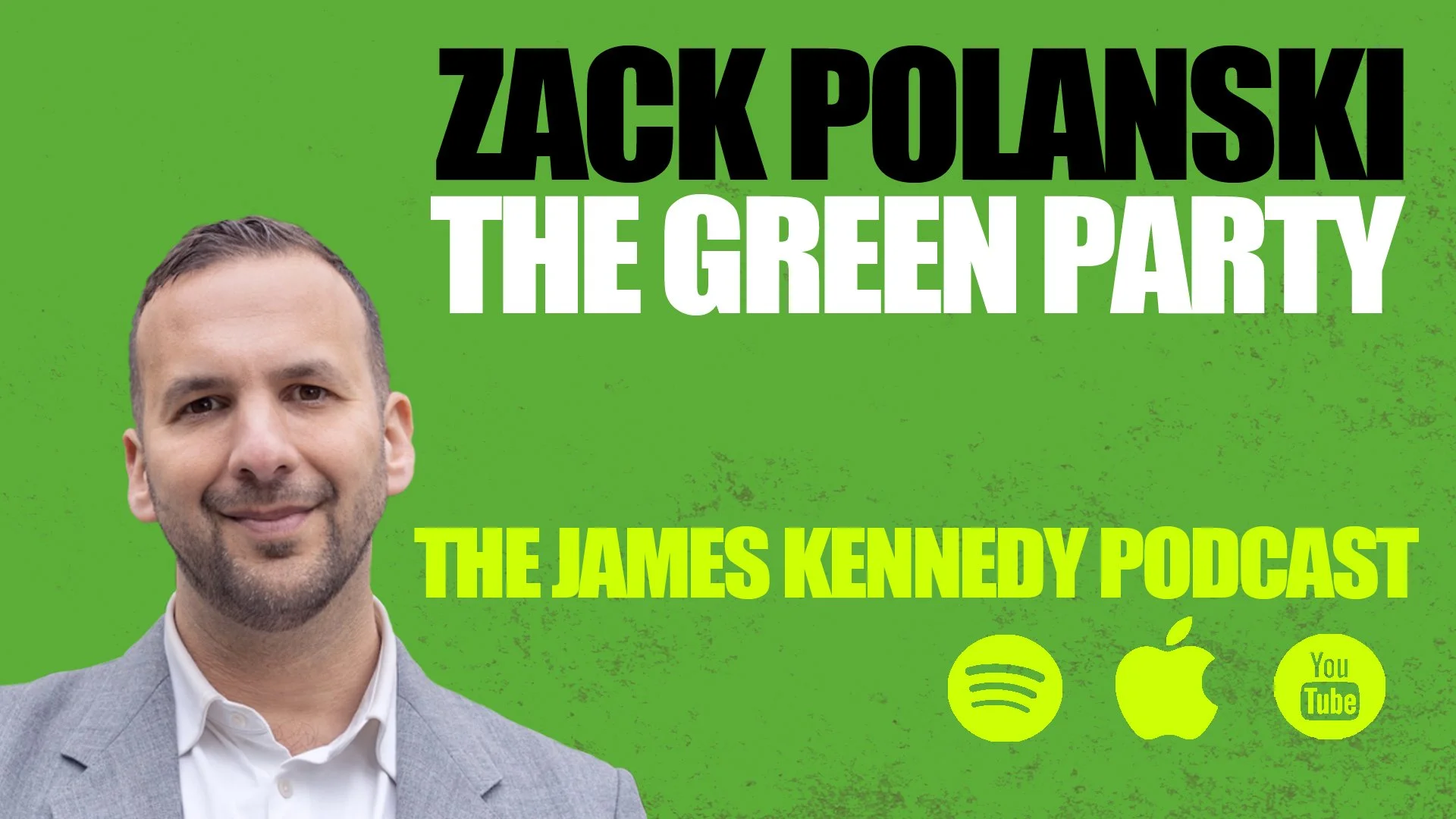
ZACK POLANSKI - THE GREEN PARTY FOR A BETTER FUTURE
Green Party Leader Zack Polanski joins the James Kennedy Podcast and argues that both Conservatives and Labour fail to offer progressive change, criticizing Labour on issues like the two-child benefit cap, workers' rights, and Gaza. He advocates for Green policies—including a wealth tax, a £15/hour minimum wage, housing retrofits, and welcoming immigration policies—to address systemic issues and underfunded public services.
James Kennedy: Mr. Zack Polanski. Thank you so much for joining us, man. How are you doing?
Zack Polanski: I'm great, James. Thanks for having me on. How are you?
James Kennedy: I'm okay. Thank you, man. A little bit worse for wear, as I said, you know, but hey, that's my own fault. But I mean, it must be a crazy busy time for you right now with everything happening with the election coming up and everything. So what's going on with you right now, man? What's happening?
Zack Polanski: It's pretty wild at the moment. So as we're recording this, there's a lot of running around the country, a lot of that as usual. But actually, I'm up for election in London myself. So I've been visiting every borough in London. And it's a really cool time, though. I love the actual job of being elected. But I also really, really enjoy the campaign, in some ways, even more so, because there's no meetings, there's no bureaucracy, no voting. It's just being out and about with communities and hearing what's important to them. And it's a lot of fun, too. So yes, it's a lot of hard work. But actually, I think it's important to enjoy it, too.
James Kennedy: Oh, 100%, man. Yeah. And I think it's just unfortunate that for most people, they only really see their elected representatives or potential representatives during election time, like now, you know, when they're all knocking the door. But the Green Party, for me, I've always felt like a party that's much more connected to and built upon the grassroots direct involvement with their members and, you know, the community generally.
Zack Polanski: I think that's exactly it. We always have resisted the idea of being a top-down party. And although I'm deputy leader, the party policies are made by members. So it's one member, one vote. If someone joined the party this morning, or they've been in the party 20 years, they kind of have equal power in terms of their say when it gets to the conference floor. And exactly what you said, I really enjoy going around the country and seeing what our councillors are doing, because very often, it's supporting a grassroots campaign that they have then got involved with in the council chamber. So campaigning is really important. It's also really important to get elected, because that's how you turn that kind of energy and that momentum into making sure that, essentially, when decisions are made, they're made by the right people.
James Kennedy: Yeah, I love it, man. And I want to get into, you know, the policies and the manifesto of the Green Party. But before we do that, I think it's important to remind everybody, where we're at right now, where we're starting from after God knows how many years of Tory devastation. I'm sure nobody wants a reminder of that, because we're all feeling it pretty hard right now. But before we look at the solutions that you guys have got to offer, I think it'd be good to just have a recap on exactly where we're at right now. So what is your assessment? What is your take of where we are at in the UK right now?
Zack Polanski: Well, I think it's absolutely broken. We've had 14 years of conservative austerity that has damaged our public services. It's also been toxic and divisive, if you're a migrant, a trans person, a person of colour, someone who's disabled. Any of those marginalised communities in particular have been hit harder, almost than any other community. But it's not just for conservatives, 14 years of austerity. It's also a legacy left by Tony Blair and neoliberalism that goes back decades in this country. And it's really people are looking for something different and an alternative. And naturally, I'm here to argue that is the Green Party and that we are the party that offers hope. But hope is not just like buying a lottery ticket and sitting around waiting for your numbers to come up. Hope is active involvement. It's about getting involved with those local campaigns we were just talking about, making sure you vote, and also getting involved with the party. And I think that is the difference here. I think back to the conservatives, it's not just for policies as well. It's the way that they've done politics. It's for lies, for misinformation. It's for nastiness and running towards cultural wars. So people would look to the Labour Party in the past to be the natural opposition to that. But on every really key issue from Keir Starmer, we've seen him completely complicit with the conservatives. And I think that's the difference. And I think Conservatives are complicit at best, at worst, sometimes even going further than the Conservatives in the nastiness.
So some very quick examples. So I'm qualifying that statement. The two child benefit cap, experts say this is one of the leading kind of policies that is keeping children in poverty in this country. One in four children are growing up in poverty. And it's even worse in Wales where you're speaking from, James. I think it's one in three there. One of the biggest things we could do, not the only thing, but something that would really make a difference is to lift that child benefit cap. The argument is not a hard argument to make. No child should be living in poverty. And, you know, people can make arguments about parents' choices and even argue against some of those arguments. But even if we took those arguments as correct and legitimate, it is still not the child's fault that they're growing up in poverty based on decisions made before they were even born. So it's cruel. It's inhumane. And I think, you know, to see the Labour Party backing the Tories on that is grim.
Then we've got all policies on workers' rights. I'm really proud to stand on picket lines with workers. Labour have criticised me before saying this is performative. And actually, they wouldn't do this because governments in waiting don't stand on picket lines. That's absurd. If you're someone who wants to run the country, I can think of very few places more important for you to be than with working people listening to their disaffection. Is that the only thing you should be doing? No, not at all. If you're just doing that, then it's performative. But that's a very basic and necessary step in order to then make policies, to then be voting based on having listened to people on the picket line.
And then I couldn't answer without talking about what we're seeing in Gaza, the absolute atrocities that have been committed, where I was going to say Labour have turned their head away. But I think that's even too generous to them. We've seen in Keir Starmer, someone who has cheerlead, who has said things like Israel has the right to defend itself, whilst also talking about cutting off water and electricity. I'm pleased that the Labour Party have moved position slightly on this, but we're still nowhere where we needed to be. And meanwhile, every day that this goes on, innocent people are losing their lives. And it's really important that both the Conservatives and the Conservatives government and the Labour Party are held to account on that. People will say, what difference can a Labour opposition make? Or what difference even can the Prime Minister make? But they're not looking at their history. There have been times before where we've had these kind of incursions from the Israeli government, and then the UK have abstained, or even voted against the United Nations, or sorry, voted for a ceasefire. That resulted in America abstaining, and that resulted in Israel calling a ceasefire. The whole point of being an elected politician, the whole point of it is to use the leverage you have to put pressure on the people who make the decisions, whether that's regionally, nationally, or internationally, to make the right decisions. And I can think of very few examples more important than the life and death of what's happening in Gaza and Israel at the moment, where the Labour Party should have been there from day one, calling this Israeli government to account. Yes, making the argument about releasing the hostages. Yes, making the argument about ending the violence altogether.
But, you know, even to have Sadiq Khan yesterday—and Sadiq, by the way, I'm sure we'll get into this because I work to hold Sadiq Khan accountable in the London Assembly. That's my job on some issues. He's not that bad. He's certainly better than Boris Johnson. I think there's certainly gaps in his plans. But it was really grim to see him yesterday standing against the boycott of Israeli products and goods and services. This isn't a blanket boycott. This is a targeted boycott. So this is saying, you know, if a musician or an athlete wants to represent the Israeli government, whether that's at the Olympics, whether, yes, that's at Eurovision, wherever it is, that shouldn't be allowed. And that's the exact same logic we followed with Russia and also the Green Party have a list of about 20 other countries that we call for boycotts on in the last few years saying this is not, you know, this is not Israel being picked out or singled out. This is about standing against regimes or governments that are not holding human rights law in any way, shape or form.
James Kennedy: Amen, man. And brilliantly put. I'm glad you brought that up as well, because the issue of Israel and Palestine and what is happening in Gaza right now really does demonstrate, unfortunately, the lack of difference between Labour and the Conservatives when it comes to the big issues that actually matter. And with regards to Keir Starmer, you know, it calls into question his moral compass. You know, can we trust a guy that won't even denounce what is happening? You know, how can we trust someone that can't even bring himself to acknowledge that the loss of innocent children's lives is a disgrace and we need to have a ceasefire right now? What's so difficult about saying that?
So, yeah, unfortunately, you know, as you rightly mentioned, you know, since the Blair years, there is very little difference now between Labour and the Conservatives. Thankfully, that's where you guys come in now, which is why I was previously a member of Labour, you know, for most of my life until, you know, the past few years when I joined the Green Party. So even though we are living in bleak times and desperate times and a lot of people are struggling and feeling the burn, you know, harder than I've ever known in my life, there is hope because there is now, for the first time in a long time, an actual ideological alternative.
Zack Polanski: I realise that must be a very other obvious one too, but that's a £28bn investment in the green economy, and I'm sure we'll get on to that. I'm sure we'll get on to that. But the Labour Party, for a long time, have tried this argument, if you want green measures, you shouldn't vote green, you should vote for Labour. But then again, on the most basic of measures to invest in a Green New Deal, you know, I always thought, I didn't talk about the £28bn, this was what they were pledging, too much before they dropped it, because I always presumed there was no way they were going to drop this. I thought they were kind of creating a false drama, because £28bn isn't nearly enough. But I thought if they wind up the green environmental movement enough, that we'll start shouting £28bn and then they do it, they could proclaim themselves as the hero of the environmental movement. But to see them even drop that is pretty grim.
Because, so if we take retrofitting, for instance, this is like upgrading people's homes to make sure that they're not leaking energy and that they're not cold and damp and mouldy. We have the leakiest housing stock in Europe. So we already have houses that are creating bills that are astronomical for people. And people talk about cost of living crisis, but really, this is an inequality crisis, because you have multimillionaires and billionaires doing better than they ever have before. In fact, they've often profited from the pandemic. And then you've got people who are living in these leaky homes, whose bills are going higher and higher and higher. And if you invested in retrofitting, so upgrading these homes, that's a triple win. Yes, it reduces the emissions on the planet, it reduces their bills, really important in an inequality crisis, but it also creates good green jobs that we can make sure in the public sector that are trade unionised, that can look at a different kind of society that we're building to get ready to tackle the climate crisis.
Again, these arguments are not hard to make. And any future government that wants to proclaim to be progressive, or, you know, give a very kind of least care and compassion towards tackling the climate and nature emergency, should be able to put front and centre of their policies, tackling the climate crisis and the investment needed to do that at the front and centre. But instead, we have this Labour Party that say, we have to stick to our own fiscal rules. Those fiscal rules, by the way, are completely imaginary, they're completely made up by the Labour Party. And on, you know, the number one fundamental fiscal rule, I would say, is to tax the wealthiest multimillionaires and billionaires, if we tax their assets, and that's those with 10 million pounds or more in assets, just 1%, we'd be raising 10s of billion pounds a year that we could be putting straight into the green economy. But they've even ruled out wealth taxes.
So anyway, I always take a pause here, because there's no words for how sick I am of the Conservative government, and how much they need to go, and we need to get rid of them. And I think it's important to acknowledge that. But I think everyone's at that point now. So I find myself sometimes talking more about the Labour Party than the Conservative Party, just purely because I take it as read that people know we need this government to go. But I don't think it's good enough to just be a little bit better than the worst ever government we've had, certainly in our lifetimes, if not in history. You've got to offer the electorate a little bit more than that, or a lot more than that. And on that, that's where the Labour Party seem to actively be inflaming tensions, and pretending to be Tory-lite as opposed to offering a real credible alternative.
James Kennedy: 100%. 100% agree with you. I'm more angry at the Labour Party than I am at the Tories, because I don't expect anything better of the Tories. But the Labour Party, they're supposed to be our party, the party of the people, you know, the party that was founded upon the trade union movement and workers' rights, the party that gave us the NHS, the party that's supposed to protect us from the interests of the elite. And to see them now completely co-opted by the interests of the 1%, and to the point where you couldn't get a rizzle of paper between them and the Tory party, just absolutely infuriates me. I feel let down by the party. I'm disappointed. And I'm deeply angry at the disrespect to the party's history and the principles upon which it was founded. And I wanted to ask you, how did we get here with the Labour Party? What happened? How did it go from the party of the people to Tory-lite? What's your take on how that happened?
Zack Polanski: It's a really good question. And I guess other people would probably be more qualified to answer better than I have, if they've been at the heart of the Labour Party. Certainly, Owen Jones, who, you know, recently has endorsed the Green Party alongside independents, had talked about the dishonesty of Keir Starmer's campaign. So here's a man who flew on the coattails of Jeremy Corbyn, said that Jeremy Corbyn was right to challenge anti-austerity. Keir Starmer was very kind of anti-Brexit, while that was inconvenient for Jeremy Corbyn. But then as soon as he became the leader of the Labour Party, he seems to have dropped conversations about the EU entirely. And then there's lots of other pledges, including proportional representation, where Keir Starmer was making warm noises about it. The Labour Party as a whole voted for proportional representation at their conference. And then Keir Starmer just said, "No."
And I think, you know, sometimes I hear the argument, and I think, if I'm being generous, I can hear and understand this argument, that they think Keir Starmer is saying or doing whatever he needs to do or say to get rid of the Conservative government. And then once they're in power, he's going to pull all of these progressive policies out of his hat and start doing progressive things. But Preston chose that the Labour Party, whenever they get into government, govern to the right of where they campaign. So they're already campaigning in a pretty ripening space, which I think is very, very important.
So I think, you know, I think it's important for the Labour Party to do what they're doing, which on some issues is to the right of the Conservative government. We can go straight back to Israel and Gaza, actually. And it's astonishing that David Cameron is in a position that's slightly more progressive than where Keir Starmer is in terms of talking about the occupation, not just on international affairs. There's other issues, too, where the Cass review that was just released yesterday, you know, highly problematic things in that Cass review that just feel like they've not been done in consultation with trans people. The Labour Party came straight out the gate and said, we accept every recommendation in this report, a 400 page report in a time that I imagine they probably didn't have time to read that report. Whereas the Conservative government came out and said, we will consider this carefully. Now, that's a whole nother conversation. But just it struck me that the Conservative government were in a kind of more cautious place towards the rights of trans people and including their voices than the Labour Party were in.
And so what's happened to the Labour Party? I think a lot of it is fear. I think we have an inherent fear. And I think that's what's happened to the Labour Party, inherently right wing media, which is why it's really good, James, that you're doing this podcast, and I always support independent podcasting groups like Novara Media. And again, Owen Jones, who I think are giving people the platform to have alternative voices, where we've got to challenge the rhetoric of the Daily Mail and the Sun and Sky News that are just pumping out Murdoch's lines the entire time. And they're terrified of all of those news outlets. And I think there's something about wanting to run against the Tories, but still know that you have to deal with the culture war stuff. And in the Green Party, I would always say that you deal with the culture war stuff by being bold, by being courageous, by being valued, by following your values, by listening to people and making sure that you communicate clearly. That's how you challenge the culture war stuff. You don't challenge the culture war stuff by appeasing it, or even worse, by falling into the same traps and then making their argument for them. And I think on a lot of those issues, the Labour Party have completely lost their way.
And then I think finally, there's just the point that this is a whole other story, but I think it's worth telling. So just two days ago, I was in Ealing, where the council is run by Labour there, a council leader called Peter Mason, who I've had runs in with the past publicly, particularly around the site called Warren Farm, which is a nature reserve. He was looking to de-wild it, so to destroy the nature. I called him out on it. And he sent kind of several, I would say, childish kind of tweets. Anyway, we put on lots of pressure, and they've now reversed that decision, which is really good. So that's an example of where we pushed the Labour Council into winning. And one of the arguments we made was that they were making deals with property developers, quite obviously. One was Berkeley Homes, and then they were sponsoring Pride events. Peter Mason also took thousands of pounds worth to go on a holiday in Cairns. He then apologized for that and said it was a mistake, et cetera.
All of these things were going on. Anyway, this is all context for what I'm about to say next. So I went to an estate that's been called the Green Quarter. The Green Quarter is housing that has been built next to contaminated landfill. The housing is largely luxury developments with a few blocks of social housing. That social housing has been put right next to the contaminated landfill. When I walked through this site with the residents, there's a very obvious smell of petrol. You can feel it in your lungs. It makes your eyes itchy. These residents time and time again have been sounding the alarm about the fact that these property developers have just been not listening to them, and that this seems to have been done in stock with the Labour Council. The Labour Council, under the guise of saying we need to build more homes and not worrying about whether that's social housing or unaffordable luxury homes, have been pulling up these homes all over. There are air pollution monitors in that area, and they were collecting the data. They've just put in an application to build thousands more homes on the same site, and the air pollution monitors have just disappeared and gone missing.
So I don't want to do weaselly words on this because I don't have the obvious evidence and proof because the air pollution monitors have gone. I don't have the contracts between the Labour Council and these housing developers. But what I would say is there's certainly other examples in other Labour councils where there are very clear links between the people making the decisions and the property developers. That can either be at the same time the decisions are made or more often than not, the councillor retires, having made years on the housing department or on the planning department, and then it's a revolving door straight into working for a property developer.
So what has gone wrong with the Labour Party? I'd say it's the same with the Conservative Party. It is lack of transparency. It is lack of accountability. And it's for profit motive, where ultimately this kind of hyper-capitalist neoliberal system has meant that they are ultimately worrying about their own vested interests. And they have disgustingly built it upon the language of doing this for working people and building social housing, whereas if you want to build social housing, build social housing. But we never see social housing built. It's always just a couple of blocks that are built with other properties. And by the way, in the same project, there are facilities that are open if you're in the luxury apartments, but those same facilities aren't open to you if you're in the social housing, and this is in the same neighbourhood. This is no different to the idea of poor doors, which used to be built in social housing blocks where the expensive kind of buildings or expensive rooms would have one door. But if you're in the social housing, you'd have another door. This is something else that my colleagues in the assembly have been calling out, which is poor playgrounds, which are playgrounds that the unaffordable luxury apartment families are allowed to use, but the social housing children aren't able to use them. So I think that's a big problem.
That breaks my heart. The idea that there is a young person who will see a slide or a roundabout and go, mum or dad or whoever's at home, can I go play on that? No, we don't have access to that. Like, what kind of society are we building if that's the kind of society their child's growing up in? Sorry, that was a huge tangent. But the question was, what's gone wrong with the Labour Party? That's multifaceted answers.
James Kennedy: Huge tangents and rants are what we're all about here, man. So go for it. No, that was awesome. I totally agree with you as well. I mean, if they want to talk about performative, nothing's more performative than the Labour Party paying lip service to Labour values and left-wing ideas when they're actually just lining the pockets of the 1% and further enabling the complete corporate takeover of all of our hard-won assets and every facet of our daily life.
And there's a guy that I had on the podcast previously called Professor Richard Wilkinson, who wrote an amazing book called The Spirit Level, who I quote quite often on the podcast because his work makes it an indisputable fact that all of the growing societal problems that we've had in this country and that we've seen explode in the past few decades, are as a result of growing inequality that began in the 80s with the arrival of Thatcherism and Reaganism. And he proved without a shadow of a doubt that there is a direct correlation between a whole range of societal problems and the level of inequality within that society. And if we look at the Labour Party of today, there is absolutely zero chance that they are going to do anything to reverse that race towards an ever more unequal and unfair society.
ENJOYING THE CONVERSATION?
GET JAMES KENNEDY'S LATEST INTERVIEWS, WRITING AND LIVE SHOWS STRAIGHT TO YOUR INBOX.
Zack Polanski: The argument always is, you know, someone works for it, not have that much money, but let's take Beyonce for example. I adore Beyonce, let me start with that. Don't we all? Lemonade is one album we've ever made. But ultimately, you know, she made a lot of money that she rightfully made from being incredibly talented, but also there comes a point where you can't make that much money as she's made from being talented. You then put that money into housing, into assets, and then you're making money on money for doing absolutely nothing, and so the gap just gets wider and wider and wider. And again, this is not a knock at Beyonce, but that has nothing to do with her talent or her hard work. That's to do with a system that is inbuilt to widen inequality gaps.
And as you talked about from Richard Wilkinson's work, that actually is bad for everyone, including the super rich people, because everyone profits from their well-being rather than economically from a society that has equality at its heart. Because, you know, if we don't have a good functioning national health service and that creates the mental health crisis that we're seeing, and if we have a privatised healthcare service that means people are ill, and we saw during the pandemic if people are ill that affects everyone whether you're rich or poor. If you have a police service that's not funded properly, then that creates crime, and crime affects rich people as well. And so having a more equal society where everyone has a stake in it and you have properly funded public services is good for everyone, whether you're someone who directly uses those public services or not.
And I think on top of that, it's about making sure we pay people properly. So we were the first party, I think the only party, to have publicly backed trade union calls for a £15 per hour minimum wage. And I think again that's really important. In terms of people say, well, you know, how do you afford these things? Well, you afford these things by making sure you're prioritising the right things.
And then finally, just on the cost of living crisis policy, I'd say I'm proud to stand with a universal basic income. This is known about in Wales more than almost anywhere else because the Welsh Senedd have given care leavers from the age of 18 a universal basic income for I believe 18 months. And the results are starting to come out there from an amazing Professor Guy Standing who's done a lot of work on this. He was a former advisor to John McDonnell and definitely a very good friend of the Green Party and a personal friend of mine who has been really, really valuable in advising and steering around our economic policy. But the results are showing, yes, these people are less poor, that's very obvious if you give them more money, but I would say much more interestingly, it's affecting things like nutrition. People are eating better, people are able to go into education, training, because they're not just worried about putting food on the table. And also it's niche, but I think really, really important, they're able to engage politically, because actually to get involved in politics you have to have a bit of free time while you're doing your job.
And I was an actor, so I was fortunate enough that, you know, when you're an actor in London, same for lots of musicians, fortunately not you, James, but lots of people when they're doing these artistic roles, they're also having to do about 10 other jobs. So they're a barman, they're a waiter, they're working in a call center. And I was doing all of those jobs, but the flexibility of those jobs meant I could also get involved in politics. But if you're working a nine-to-five job Monday to Saturday, you probably want to rest on the Sunday, and lots of political action isn't necessarily happening on the Sunday. So people are being kept out of the political loop and being kept out of making political decisions.
So universal basic income would both transform people, yes, in terms of their economic situation, but it would also make sure that we're enriching people's lives in all of these other ways, too. And I'm really proud that in London, eventually in a place called Grange, we're looking at getting a pilot off the ground, and that's something I've been pushing hard on the London Assembly. And also Jarrow in the northeast somewhere, which historically has had huge deprivation and poverty, and in the early 1900s there was a famous march, March for Jobs, where people walked from Jarrow to London to protest the government's decision. So symbolically having a universal basic income pilot there is really important, too.
I can keep going on with this question because I guess cost of living crisis is almost everything, like how do you enrich people economically is the fundamental question, but I think those are kind of some of the key headline things. Oh, and also I want to say that I think there's a lot of work to be done by the London government as well as the eighties which have fundamentally disempowered our trade unions, and people need a fundamental ability to organize in their workplace. That is and should be a fundamental human right, and there's been a very targeted dismantling of this both from a Conservative government, but again cheered on by the Labour Party, which is absurd that they're called the Labour Party and they haven't been there to stand up for trade unions. But that is very much at the heart of our party policy as well, it's standing up for workers.
James Kennedy: Wow, man. Well, you're getting me fired up just listening to you, man. It's like, you know, taxing the rich and levelling the playing field and strengthening the unions and universal basic income—who, what's not to love? Who's not going to want that, you know what I mean?
Zack Polanski: Well, the corporate CEOs are the people who don't want it, so that answers your question, and that's the problem we have because they're funding the media and they're funding the Tory party and frequently giving donations like private healthcare to Wes Streeting. So it's exposing these things, which again is why these podcasts are really important, and then it's not just exposing them, people have to vote differently. We get the politics we vote for, and if people want Green and they want a difference, then they have to vote Green.
James Kennedy: Well, I had your friend and colleague Mr. Anthony Slaughter on the podcast last year and we were talking about effective means of change. I was talking about activism and protest and direct action and my general feeling of disillusionment in the electoral system, and Anthony said all of the above are essential components and tools of a democracy and progress, but ultimately without systemic change, real economic, political, regulatory and legal change can't happen unless the machinery of power changes. So we can make as much noise as we want and we should, but without real governmental systemic change we're going to have a long mountain to climb. What are your thoughts on that? Do you agree with that?
Zack Polanski: 100%, and shout out to Anthony Slaughter, too. I'm really proud of Anthony, he's the leader of the Welsh Green Party. I think he's like the perfect example I often think of of someone who's so embedded in communities and doing the work, and not necessarily doing it for Anthony—if you'll mind me saying this—in the kind of delivery or showbiz way, although I think he was a drummer in a rock band. Say, he's a punk rock band, yeah, yeah, yeah. So actually maybe I'll take it back, the show business is there. But I think, you know, fundamentally you talk to Anthony for five minutes to hear how deeply his issues of justice are within him and what a difference he wants to make for Wales, and he'll be running for the Senedd in 2026 is the next Senedd elections, I believe.
And I think national government and Westminster often get the headlines, and it is really important that we have representation at a national level to be able to change things, but also those regional assemblies—or obviously Wales is a regional assembly, but the assembly for Wales with Senedd—being able to make the difference there would make a huge difference. And I think it's a huge difference for Wales because all of these issues I'm talking about, there's places like Wales, but also obviously the north of England and the northeast where the economic disparity is so blatant and the gap has just got wider and wider and wider.
And so when Boris Johnson talks about levelling up, I don't often say this, but it's one time that Boris Johnson was right. Of course, every solution he had to it was only going to make things worse, but the principle of regional inequality is something we should all talk about, and we shouldn't shy away from talking about it, and we shouldn't reject that agenda. We just need to be clear that the solutions they offer would make it worse, but there are clear solutions to dealing with regional inequality.
And sorry, I'm tying myself in knots here, but the very last thing I want to say is this isn't saying, though, that London has it all easy, and I think there's often that misconception. You can walk down the street in London and see multi-million pound houses and then right in front of them, homeless people. Again, I think in London it's just even more intense that kind of massive inequality. But particularly in the south of England, I think there's lots of places in this country that have been really neglected and lost, and we need those voices from within them speaking out.
James Kennedy: Yeah, you're totally right, man. I mean, the inequality is so stark now. I mean, it's everywhere, you can't avoid it, everybody is exposed to it now, and it is more pronounced in a place like London, you know, where you've got those two polar opposite worlds kind of slammed together on opposite sides of the street where you can have a row of high-rise banking buildings overlooking, you know, a real poor housing estate where people are genuinely struggling to get through the day-to-day. But I'm seeing that stark divide now more and more everywhere that I go when I travel around the country. I mean, I walk the streets of Cardiff or Newport, you know, where I'm based, it's just I've never seen a homeless situation so bad. It's exploded beyond anything that I've ever known in my life living here, you know. And it's not just the mind-blowing number of people who are now living on the streets, it's the extreme grimness of the situation that they're living in, the desperate level of their poverty is just visceral. And that's happened in the last 10 years. I just do not remember it ever being like this 20 years ago. And everybody feels that now, you know, like we all share the same high streets, rich, poor, in the middle, so everybody is aware of this now. Nobody can pretend any longer that our social situation is not as bad as it is.
Zack Polanski: Yeah, I went to visit recently and also went to Port Talbot, and you kind of, it's just, it was avoidable. It's just a very obvious thing. It's not like for decades people haven't been saying we need to transition, we need a green transition, let's create new industries, let's create jobs, let's make sure they unionize, let's make sure people pay properly. And just again from the Conservatives and from Labour, there was no sense of creating a different way or having the imagination or creativity to create a different way, and they have let thousands of people down. And those people are in these horrendous situations.
And so I went also to Swansea and visited a baby bank there and a warm bank, and just, you know, amazing work that people in the community are doing where people are homeless or they've got homes but they can't afford to heat them, so people are gathering in the day and they're also creating social space. And these people running these spaces are incredible. There are no words I have for how much love I have for the work they do day in, day out. And by the way, you know, I'm an elected politician, but I put the work they're doing so far above what any politician is doing because it's just grounded in the work and it's serving the community every single day. But they absolutely shouldn't be having to do that, and every day that they're doing it is a failure of politics to be able to serve them.
So it's not discounting what they're doing, they're filling a gap that badly needs filling, but ultimately if we keep filling those gaps and if we keep relying on charity and community people to do it, that furthers the austerity agenda because it just requires the kindness of people, and kindness will only breed resentment in the long run when people can't afford to give kindness or don't have time to give kindness. So again, that's a shout out for everything they're doing, and we need to—and I'm sure they would agree—create a space where they're no longer needed to do those things because I'm sure they don't even want to be doing them, they'd rather be giving love and compassion to creating art or to create nice things and positivity, not to just making people survive hour to hour.
James Kennedy: Yeah, well put. Well, moving on to a different topic, what about the NHS, the other biggie, you know? What would the Green Party policy be with regards to our beloved National Health Service?
Zack Polanski: Yeah, so the NHS is in a really bad way, and, you know, it sounds sweet, but the very first obvious thing is you need to fund it. And like people will go, yeah, I can imagine if it's a Conservative politician on this call—which gladly there isn't—but if there was, they'd be going, we keep throwing money at them and it's inefficient, and I think there is some truth to that, as in there are certainly ways that the NHS could be operating in a more democratic, more service-led way, and I'll talk about those in a moment. But that argument should never be put in front of the funding argument. If you don't fund things properly, then of course they're going to break down, of course staff are going to be resentful, of course people who use the NHS are going to feel like they're not getting a good service. And I shouldn't speak for everyone, by the way, I've certainly used the NHS recently and had a really good service, so it's not to say this is every single person's experience, but the stats on waiting lists and on waiting times for treatment are pretty stark and are failing.
Now, we know this has been managed because from a Conservative government and the Labour Party, and Tony Blair through PFI contracts, who have never believed in a National Health Service, so it's been in their interest to run it down. I won't tangent there, but the BBC being a similar thing where they've created such a poor environment around the BBC that I find myself rallying against the BBC and complaining about the BBC while still absolutely believing in the need for a public state broadcaster, and this is what happens when they damage these institutions so badly that people then end up turning against the institution as opposed to the people running the institution badly and the bad decisions, while still actually protecting the NHS and still protecting the BBC.
It's a tangent, but I think it's an important one: my partner Richie works in palliative care, and the fact that the majority of hospices, where people are going in their very illest state where they're literally about to die, are being run off charity and private donations rather than from a National Health Care Service is a massive indictment and failure of how our services are running. And I met with the chair of the BMA recently, the British Medical Association, and spoke to him about palliative care, and it's something that they've just done a report on recently. I'm only putting it out there because obviously I'm biased because of what my partner does, but I do feel like there's not often a conversation about death in society and also the need for dignified dying and assisted dying, and I think all those conversations are starting to bubble up to the surface, and I think that's a really healthy thing despite the toxicity of our politics at the moment, because I think we need to have conversations about how people can be cared for in their last few days and weeks.
Back to the point, though, on the NHS. Where it clearly cannot go is where Wes Streeting seems to be pushing it with every kind of sentence he pushes, which is towards a privatised system or privatisation through the back door. We should be really proud of our National Health Care Service, and I went to see Nye recently, the National Theatre play about Nye Bevan who created the Health Service, and I think we need to get back to those fundamental principles about a service that is free at the point of need and free at the point of use, and that cannot be up for negotiation.
I think what can be up for negotiation, or needs to at least be discussed with a national conversation, is: is it the best use of GPs' time to be doing business and accounts? And from the GPs that I hear from, they don't think that's a good use of their time. They feel like they're rushed, and from the decisions that are made, that they're not able to have those patient-centred conversations. So very often it's about just diagnosing the problem as quickly as possible, which is what happens when you incentivise targets and incentivise getting people through the door as opposed to having those holistic conversations and joining up the mental health crisis that we have with people's physical pain and being able to have those conversations.
And then finally, it's slightly off the question, but I think it's important: I met with an organisation recently called Debt Relief Advice, so this links in with the cost of living crisis slightly, and they're again a great organisation. They're there when people have got themselves into horrendous debt, or any debt at all, and just want to talk about how they manage that debt and not make it worse, and who do they pay first, etc. And they've started to create kiosks where people can go to, that they would like to be in shopping centres, where someone can go into this kiosk if they're worried and there will be a counsellor there on the other end, there will be debt relief advice on the other end, there'll be gambling advice on the other end, there'll be mental health support on the other end. And I could think of lots of other services that could be there on the other end, so you're starting to join the dots together.
Now, just a caveat in here, my slight kind of skepticism is I think people need more human contact and need more to be in a space with a human being, so I'm a little bit nervous about removing human beings and replacing them with a screen where you get to talk to another person, but I do think there is something to be said for the efficiency of someone being able to contact all of these people who would be very difficult in the same space and be able to be where someone might be, which is a shopping centre. So I don't think it should be a replacement for human contact and those services, but I do think there's something really important—and this comes back to the NHS question—about being in the spaces where people aren't necessarily looking for that help. They might be ill, they might not go to a hospital or to their doctor for whatever reason, but they might see in the shopping centre or a centre a kind of space they can go and know that it's a safe space where they can reach help.
I just think that that's really important because the people who need the most help, my experience from going around to communities, are often the people who seize up when I come in the room because they don't want to talk to a politician, they don't want to talk—I wouldn't consider myself establishment particularly—about anyone connected with any formal institution. They worry about them punishing them or sanctioning them. Now, there's ways I found around that, which is to build a rapport and to build a connection and just think about how I approach that situation, but I think about the people who wouldn't even be in the situation where I am to even have that first point of contact, and I think there's so many people being left behind that we've got to get to them. The phrase is often used 'hard to reach', and I hate that phrase because no one's hard to reach, it's about how you do it.
James Kennedy: Love it. Yeah, I totally agree again. I mean, I'm finding it hard to find anything to disagree with you about, to be honest. But I'm going to play a little bit of devil's advocate, because I think another massive issue of concern for many people is the subject of immigration, and we run the risk as lefties of being seen as being soft on this issue, and, you know, as a bunch of like woke, naive, wishy-washy, hippy-dippy, lefty snowflakes. And the subject of immigration is already being used as a kind of electoral battleground, you know, and I think it's a dealbreaker issue as well that will sway many people, and unfortunately sway them towards policies that would inevitably be detrimental to their broader interests. So I'd love to know what the Green Party's policy would be on the subject of immigration.
Zack Polanski: So I'm going to start by linking this directly to the NHS: that people are worried about seeing a GP or getting a dentist appointment, and they're right, they should be worried about those things because they're not being funded properly. But they're not being funded properly because of years of austerity and the Labour Party refusing to challenge austerity. They're not NOT being funded properly because of migrants, refugees, asylum seekers. These are some of the most vulnerable people in our society, also some of the most resilient. If you've come across in a lorry, you've clearly shown incredible resilience. But these people absolutely deserve every ounce of compassion we have, and not just compassion, but ultimately the policies and the support that put them in place.
I talk about immigration all the time with our very pro-migrant policies, and, you know, I don't think migration is something that should just be tolerated, I think it's something that should be celebrated. This is something I say about 20 times a week, so I'm very used to saying this, but the reason why I paused just then is I was speaking to someone just a couple of days ago who shaved my beard, actually, my barber, who is a migrant. And he talked to me—I've known him for a while and we talked about lots of things about politics, but it's the first time he opened up to talk about his journey, and I'm not going to give any specifics just to keep his anonymity, but talking about crossing the borders and the journey that he made, and just went into intense graphic detail about what it was to make that journey.
And I just, I talk about migration all the time, and it's something that I feel very, very instinctively that I want to do everything I can to support people and treat them as human beings, and it's still slightly abstract until you're with someone and you're looking them in the eyes and you see their humanity. And, you know, I meet asylum seekers and refugees and migrants fairly commonly when they go on protests or rallies, or speak with them on panels, but that's in a very particular context, and it was just quite something for someone I've known for such a long time to then open up in that way. That really affected me and has reaffirmed my desire and want to talk about this as much as possible.
Because, you know, to come back to the beginning, people do have legitimate fears about infrastructure, about housing, about the NHS, but this is in no way problems of migration. And I also think I sometimes see politicians be compassionate towards refugees and asylum seekers, and that's important, I'm pleased they're doing it, but they really separate them from migrants. And yes, they are separate to an economic migrant, but I still think we should be making the same argument about an economic migrant: if you are someone who is looking for a better life, who has grown up in poverty or a place where you don't feel like you have a chance, then the only reason why our country would decide that you're not welcome here to contribute to our tax system, to our businesses, to our culture, is because of some petty-minded racism. And I think it needs to be called out as racism, because that's exactly what it is.
And when we see people open up their arms to Ukrainian refugees, which we absolutely should do—and this is nothing against the Ukrainians, they're suffering a horrendous incursion, we should do everything we can to defend them, and particularly see their humanity and giving them homes, and I'm pleased people have done that—but where is that same compassion for Syrians, for Yemeni people, for Somalians, for people suffering in Sudan through this absolutely horrendous crisis? And I'm led to it can only be called racism, and I don't know what else it could be, so I'm open to having that conversation, but I've never yet heard an argument against someone fleeing from war, from suffering, from persecution, or running away from economic poverty or lack of feeling like they have a future and wanting to make a better life. And I don't think the restrictions to a better life should be where you happen to have been born.
Is that a complicated question around migration? I was about to say yes it is, but I don't even think it's that complicated. We are going to get migrants, frankly, whether we want them or not, because of the climate crisis. We're already seeing places that are uninhabitable, where it's getting hotter. Syria, the civil war of course is primarily because of a brutal dictator, but it's also often missed that that brutal dictator is able to be so brutal because of an increasing lack of resources, of scarcity of food and water, and we know that those conditions are going to happen across the world and also, frankly, here in the UK, too. And so we need to have those very difficult conversations about scarcity of resources and how we find the compassion to do that in that way.
The epilogue I want to put to this, though, is I sometimes hear—and I'm hearing it less and less, which is good—people then go, "But you're a Green and you support migration, but what about overpopulation?" That's an argument that's made, and it often verges into what I would describe as eco-fascism: this idea that they start talking about minority communities who have lots of children, or other countries. But we need to be really clear that we are a country that benefited from the Industrial Revolution, we're a country that benefited from Empire and colonialism.
James Kennedy: Thank you as well for calling this out for what it really is all about at its core, because, yeah, we've all seen a vastly different attitude to Ukrainian refugees than those people who are fleeing Syria, or Afghanistan, or Iraq, and I can only imagine why that might be. But there's an interesting irony to that. I mean, if you are really concerned about immigration for whatever reason, then it makes more sense to support the sort of things that you're talking about as part of the Green Party policy, such as: let's work to reverse the climate crisis, which is only going to exacerbate mass migration, and also, hey, let me stop arming and training and supporting foreign dictatorships because it's good for our oil industries, and then maybe, just maybe, people wouldn't want to flee their homeland that they know and love in the first place. So, yeah, I completely agree with you on all of that, man.
Zack Polanski: What we actually oppose is housing on the greenbelt. So if you've got land that's there for biodiversity, whether it's there for wildlife and species, then that is obviously not the first place you go to build housing, and I don't think that that should be controversial. It's only been made contentious because very powerful property developers' vested interest has started to try and paint this idea that that's a problem.
If we had no other places to build houses, if there was no brownfield sites, if there was no empty buildings and empty properties, then there would be a different conversation to have about the greenbelt. I'm not saying for a second that I would then go, yes, let's build on the greenbelt. I would certainly be willing more to have that conversation and to work out where we need to build those houses. The evidence is very, very clear, though, that if you add up all the brownfield sites, all the sites in London, for instance, that TfL has that aren't being used, you'd have a constituency the size of Camden. CPRE, the Campaign to Protect Rural England, have done lots of work around the hundreds of thousands of buildings that are completely empty all across the UK and aren't being used at all, and actually you could retrofit and bring these homes back into use.
So anyway, the reason why I'm linking this to the migration question is the argument is always, "We're a small island, we don't have places to put people." We have masses of empty homes, masses of places. And is this an argument to say, yes, let's have mass migration and bring everyone in? Not necessarily. I'm not arguing for more migration, I'm just arguing the point that when people say we can't handle the migration that we've got, it is an absolute nonsense argument. And it's linked to the same nonsense argument that you need to build on the greenbelt to tackle the climate crisis. You absolutely don't. We're in a nature and ecological emergency. You can both protect green space, you can protect biodiversity, and you can have the houses that people need. This does not have to be a trade-off, and it's been created as a trade-off because it's in the interest of property developers to build on that green space because they can charge more for it. The idea that a family who are homeless, who are living on social housing, are going to be able to live in this beautiful space that's been created on the greenbelt is clearly nonsense and a completely disingenuous argument.
James Kennedy: 100%. Yeah, I totally agree. Well, as we come towards the end of the time that I've got you for today, I'm going to try and summarise a little bit because we've covered a lot of ground here in this conversation. So would I be right in saying that we know all the answers to these problems and probably have done for quite some time now, whether it's how to fix the NHS, how to protect workers' rights, how to fix the housing and the homeless crisis? I'm going to start off by saying that we've got the answers already; they're quite well known. We just don't have the political will from any of the mainstream parties to actually implement any of this stuff.
And is it also fair to say that by addressing the urgent climate crisis, which will affect absolutely all of us regardless of where your politics lie, that the things that we're going to have to implement in order to address that urgent existential crisis will also inevitably, by their very nature, set off solutions? Am I kind of in the right ballpark there?
Zack Polanski: I mean, you summed it up beautifully. I guess all I'd power it back really is a very quick thought experiment. So suppose it's the 1960s again, and for some reason in this version of reality, we don't know about the climate crisis. We are living through a society where there's a lot of inequality, but we elect different governments, and actually through the 70s, 80s, 90s, and now in 2024, we have an amazing government. We have an incredibly equal society. Everyone is happy, everyone is being looked after, and people don't have a lot to complain about. And then suddenly we discover the climate crisis. And as a politician, they would then have to come forward and say, "This is incredibly difficult, but everything needs to change." That would be so impossible to sell and to get people to vote for, because you would be talking about changing an absolute perfect society to a different society because of the climate.
We are not in that situation. We are in a situation where our society is fundamentally broken and we need to tackle the climate crisis. We can change everything to have a more equal society where people feel more valued, where they have money in their pockets, food on their plates, heat in their homes, and lives lived with purpose, and we can tackle the climate crisis at the same time. This is not a hard sell. People just need to vote for it. And in fact, in the last four years, the Green Party have over quadrupled the number of councillors at the local level, and I think that's because the message is getting through. What we need to now do is take that to the national level and make sure we get more Green MPs.
James Kennedy: Brilliantly put, yeah. And I think that's a perfect place for us to park up. What do you want to tell people who've listened to this conversation to do next? Where can they go? What can they do to help get involved?
Zack Polanski: I mean, the most obvious thing is to join the Green Party, so that is greenparty.org.uk/join. If you're not yet ready to join a political party—and I've spoken to lots of people who, for instance, were very supportive of Jeremy Corbyn, feel very burnt over that and say, "I love what the Green Party are saying, but I'm just not ready to join a political party at the moment"—we also have a supporters network, so you can go to that on the same join page.
What I would say, though, is that this is an argument I've made to lots of people in Labour, and lots of people have eventually come around to the argument that even if you supported Jeremy Corbyn and you're kind of hoping that the Labour Party after Keir Starmer will go back to a left wing party, Keir Starmer has fundamentally dismantled the mechanisms that were in place to allow Jeremy Corbyn to even ever have happened.
James Kennedy: And what a time to join as well and to get involved. There's a real zeitgeist happening right now, man. And God knows we could all do with some hope right now. And the Greens are really the only party that are providing any tangible, real hope in this upcoming election. So the choice is not just between Labour and the Tories, guys. There's another real alternative now. So please get involved. The guys in Green would love to have you on board. And God knows we need all the help we can get right now if we are going to wrestle the bad guys.
Thank you so much for everything you're doing. I know how hard you're working and I know how much this means to you, and I know how genuine and sincere you are about these issues. I wish you and everybody else in the party the best of luck for the upcoming election on July the 4th. The future is green, I know it. The times, they are changing. And whichever way it goes down, we are going to be sending a massive message to Labour that they have got to get their shit together.
So head on over to greenparty.org.uk. Follow the party @TheGreenParty on Twitter and Instagram. And you can follow Zack Polanski personally on his personal Twitter @ZackPolanski. Zack, thanks so much for giving us your time today. This has been a fascinating conversation. I wish you nothing but the best, and we'll be rooting for you, man.
Zack Polanski: I really appreciate the platform and lovely to e-meet you. Hopefully we'll meet in real life one day soon.
James Kennedy: That'd be great. Yeah, 100%. My best wishes, bro, and thanks again for coming on. I appreciate you.
Zack Polanski: Amazing. Thank you so much. Really, really appreciate it.
Key Points:
The podcast host James Kennedy endorses the Green Party for the upcoming UK general election, expressing strong dissatisfaction with both the Conservative Party and the Labour Party under Keir Starmer.
Guest Zack Polanski, Leader of the Green Party of England and Wales, discusses the party's grassroots, member-led structure and its focus on community campaigning.
Polanski critiques 14 years of Conservative austerity and Tony Blair's neoliberal legacy for damaging public services and increasing inequality in the UK.
The Green Party proposes key policies including a £15 per hour minimum wage, universal basic income pilots, wealth taxes on assets over £10 million, and a significant investment in retrofitting homes for a green economy.
The conversation heavily criticizes the Labour Party for abandoning its traditional values, being complicit with Conservative policies on issues like the two-child benefit cap, workers' rights, and the conflict in Gaza.
Polanski defends pro-migrant policies, arguing that fears about infrastructure and services are caused by austerity, not migration, and condemns the racism in differing attitudes towards refugees from different regions.
The Green Party's housing policy prioritizes building on brownfield sites and retrofitting empty properties over building on the Green Belt, which they argue is a false trade-off driven by property developer interests.
The host and guest conclude that the solutions to the UK's crises are known, and addressing the climate crisis can simultaneously create a fairer, more equal society.
Summary:
In this podcast episode, host James Kennedy speaks with Zack Polanski, Deputy Leader of the Green Party of England and Wales, to advocate for the Green Party as the only viable alternative in the upcoming UK general election. The host begins by expressing his profound disillusionment with both the Conservative Party, which he accuses of 14 years of destructive austerity, and the Labour Party under Keir Starmer, which he claims has become indistinguishable from the Tories. Polanski echoes this sentiment, arguing that Labour has abandoned its founding principles and is complicit in Conservative policies on welfare, workers' rights, and international law.
The conversation then pivots to the Green Party's platform, presenting it as a hopeful and necessary alternative. Polanski outlines key policies such as a £15 minimum wage, universal basic income, wealth taxes, and massive investment in a green economy through retrofitting homes. He argues these measures would simultaneously tackle inequality and the climate crisis. The discussion also covers the NHS, housing, and immigration, where Polanski defends a compassionate, pro-migrant stance, arguing that resource scarcity is a result of political choices, not migration. The episode concludes with a call to action for listeners to join or support the Green Party, framing the election as a crucial opportunity to vote for real, systemic change.
The James Kennedy Podcast is a Society and Culture podcast hosted by musician and author, James Kennedy. Exploring the big questions around health, social issues, the arts, politics, mental health, the human condition and how to navigate this thing called life through casual conversations with scientists, activists, rock stars, philosophers and academics. Please subscribe, leave a rating and support the show.