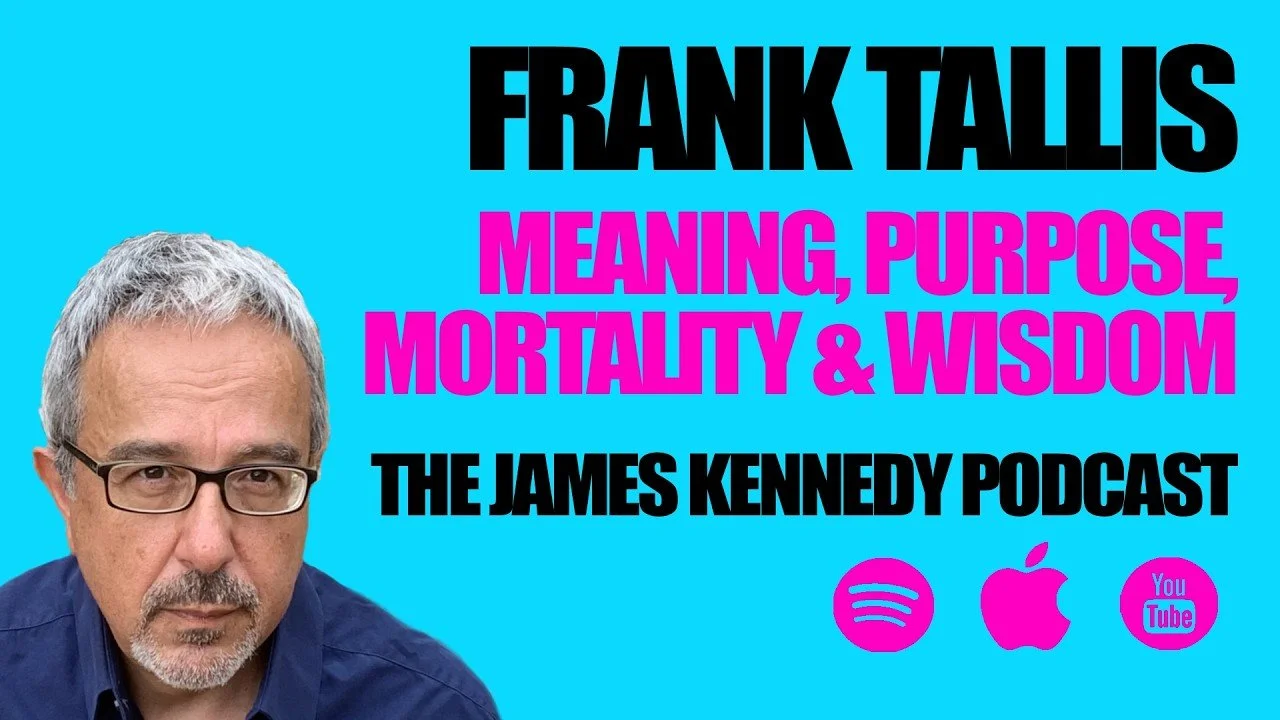
DR. FRANK TALLIS - FINDING MEANING AND LIVING WISELY
Dr. Frank Tallis is a prolific author and clinical psychologist specializing in psychoanalysis and obsessive compulsive disorder (OCD). He is the author of over 30 books spanning non-fiction and fiction, including Wise: Finding Purpose, Meaning, and Wisdom Beyond the Midpoint of Life, The Denial of Death studies, and numerous works on psychology and human nature.
James Kennedy: In order for us to talk about some of the themes within the book—finding purpose and meaning in life, talking about life and how we live it—we need to talk, I think, about death. Because, as you explain in the book, death plays a pretty omnipresent role in how we live our lives. How so?
Frank Tallis: Well, I suppose the starting point is really that we don't engage fully in life because we have the illusion of being immortal. Freud actually said that nobody really believes in their own death. Other writers have taken up this particular theme. We can conceptualize other people's deaths, but we find it very, very difficult to conceptualize our own.
It's an interesting question: why might that be? I guess a simple answer to that would be that every day ends with you losing consciousness, and in the morning, you're resurrected—you come back. That is your experience throughout the entirety of your life, with the exception of one day, which is the day that you die. So we're very, very resistant to accepting our own mortality.
There was a very fine existential writer, Ernest Becker, who in the 1970s wrote a famous book called The Denial of Death. He said that, to some extent, we don't engage in life because we are always trying to involve ourselves with "immortality projects." Because we never accept our own mortality, we don't make the most of the time that we have.
James Kennedy: I'm glad you mentioned immortality projects this soon into the conversation, because I love that concept. I think it's such a powerful idea that sums up pretty much what all of us spend our lives doing.
Is it a bad thing? It seems to me that our immortality projects—whether they're having children, having a career, taking over the world, or creating art—are the things that give us our life's purpose, our memories, and our growth. They give our lives definition and character unique to our lived experience, even if it is, without us consciously being aware of it, our individual attempt to escape inevitable death. Is it a bad thing to have an immortality project?
Frank Tallis: I think we need to make a distinction between a positive aspect and a negative aspect of this. You can look upon certain types of legacy as immortality projects, and that's fine. But if the immortality project is unrealistic for the individual, it kind of detaches them from reality.
For instance, when people go to the gym in an obsessional way to effectively avoid the prospect of dying—which is difficult when conceptualizing one's own death—it can be negative.
Becker said something very interesting about immortality projects: they have a very dark aspect, and what we call wars are, in fact, clashing immortality projects. If you look at the absolute fundamentals of why wars happen, you often have two groups that both want their way of life to continue. They want their immortality that way—their religion to last for eternity, their art, and everything that they are to continue immortally.
Wars are so complex, but fundamentally, why do people want to win wars? Becker's idea was that what we're looking at are clashing immortality projects. It does have a dark aspect. In the same way, for the individual, wanting and hanging on to prevail too much can be excessive. That's certainly something worthy of reflection.
James Kennedy: 100%. That's such a fascinating point, and I totally agree.
There's a whole host of adjacent questions that come out of that. Immortality projects are probably the things that drive most art, existential inquiry, having children, running businesses, and trying to leave legacies beyond death. Is there a balance? Are there good and bad immortality projects, or is there a spectrum?
Frank Tallis: Sure, there's always a balance. Nobody would object to the immortality project element of art, because we all benefit from it. It's the way we understand ourselves, it gives us joy, and it takes us to places that crude reality doesn't. So, of course, it has a positive side.
As with all things, if you can acknowledge the good while facing the bad—because often we don't face the bad because we're defended against it—and get the balance right, then there's nothing wrong when the desire for immortality manifests as love of children or artistic endeavors.
James Kennedy: Love it. For me personally, I find it such a fascinating concept because it defines the activities of all of our lives in various ways.
You also pose some really interesting thought experiments in the book on the issue of immortality and how thoroughly unbearable and boring it would be. Surely the alternative to dying is much worse—living forever. Rather than trying to avoid death, we should embrace it as a reason to enjoy the life we've got while we've got it.
Frank Tallis: It's really interesting how writers have thought this through. When you have immortals described in fiction—like vampires or Highlander—they're often just infinitely bored.
As you get older, no matter how positive you are, you realize the limitations that exist in terms of your options. There are only so many classic jazz albums you can collect, and after you've listened to them several thousand times, it isn't quite the same as that initial excitement of discovering Miles Davis. You've been around the block a few times.
There are only so many artists you can collect; there's a sense that these things have a natural limit. I don't mean that in a negative way—life is always exciting and has potential—but to some extent, we are limited by who we are. The things you like are in a sense exhaustible, which is why immortals in fiction are portrayed as bored because they've done everything.
We are limited by our biology and by reality. Perhaps there is an optimal time to be alive, beyond which life becomes less enjoyable even if one is physically healthy.
A way around that for many people is spiritual belief—the idea that you can find eternal sources of pleasure. But there we're talking about something transcendent, going beyond the body, which doesn't acknowledge what may be a harsh reality: that this is all there is, and this is who we are.
James Kennedy: Are there opportunities in the second half of life? Having spent the first half running on the so-called hedonic treadmill, experiencing our first loves, heartbreaks, and jazz albums, the world becomes less colorful because we've seen and done a lot by that point.
As we get closer to facing the specter of death and it becomes more of a reality in the second half of life, are there opportunities that come from that growth, experience, wisdom, and self-awareness?
Frank Tallis: Absolutely. A key figure here is Carl Gustav Jung, the psychoanalyst. He said that perhaps the first half of life is characterized by an external focus. We have obvious practical goals: people learn, get qualified, get jobs, form meaningful relationships, have kids, and take on responsibilities. The person is outward-looking.
Then you get to a notional midpoint—not a mathematical midpoint, because none of us know when we're going to die—where the individual feels that all those things that worked before aren't leading to the same satisfaction. Jung said it is necessary then to turn inward and begin a path of reflection and personal development, looking for things neglected in the first part of life—things to do with spirituality and meaning.
This opens an exciting phase of life where you reap the rewards of a deeper, more spiritual approach to existence. We're talking about finding wisdom and meaning, which has tremendous benefits.
If you think of an existential writer like Viktor Frankl—a psychiatrist who was put in concentration camps during the war—he noticed that people who were able to find meaning, even under those circumstances, tended to survive longer.
Meaning is really important in enriching life. Recently, a study was done looking at the effects on longevity of either meaning or happiness. We're told in our society to pursue happiness, but research shows that meaningfulness actually gives you an advantage. If you lead a meaningful life, you have the potential to live longer than if you live a merely happy life. So there are all kinds of practical and psychological benefits to discover in the second half of life.
Another aspect of Jung's thinking worth highlighting is that we're living through a mental health epidemic—depression, anxiety, eating disorders, loneliness, everything is getting worse. The traditional approach has been to try to treat or solve the problem. Jung suggested that toward the end of his life, what you need to do is not engage in a massive, difficult struggle with your problem, but rather develop as a person and outgrow it.
It's a very gentle and compassionate idea. It doesn't involve self-denial. Depression can be seen as a clinical condition, but also as a kind of social sensitivity: you look at the world, see terrible things happening, and it's depressing. That's part of who you are.
Approaching mental health through personal development means looking at integration. Throughout the history of psychology and philosophy, the idea repeatedly emerges that if a person is better integrated, it leads to better mental health. When there are divisions within the self, people experience stress and discomfort; when a person is whole, it leads to better outcomes.
Integration means harmonizing the polarities within a human being—mind and body, conscious and unconscious, rationality and intuition. Jung suggested that achieving integration makes you more content and wise.
Modern neuroscience supports this. For example, thinker Iain McGilchrist has written about the optimal relationship and connectivity between the left and right hemispheres of the brain. Having an optimal integration between the hemispheres is crucial. While this might sound "new age" to rationalists, the neuroscience behind it is solid and consistent. Divisions within the self are problematic, whereas integration and wholeness are good.
If you ask yourself how you want to live wisely, standard advice like diet, exercise, sleep, social life, and avoiding toxins is good, but everyone already knows it. People are looking for something deeper. The principle of integration and wholeness is singular; you don't need to keep running around trying to do everything, you just follow that one principle in whatever way works for you.
In clinical psychology, what works for one patient might not work for another because everyone is different. Following this principle through creative projects or physical practices like Tai Chi or Yoga helps achieve integration.
I was tiring of a market saturated with books offering definitive, conceited answers. It smacks too much of being a guru. I prefer the modesty of offering a principle to try out for yourself to see how it works in your life.
ENJOYING THE CONVERSATION?
GET JAMES KENNEDY'S LATEST INTERVIEWS, WRITING AND LIVE SHOWS STRAIGHT TO YOUR INBOX.
James Kennedy: I love it. You covered so much ground there.
The second half of life makes integration easier because you know yourself better, you've made mistakes, and you know who you are. Could this move toward wholeness be summarized by Socrates or Aristotle's phrase: "Know thyself"?
Frank Tallis: Certainly, that's the spark that kindles the journey.
In the book, I write about being sensitive to indicators that it's time for change. Narrative anthropologist Joseph Campbell studied myths across cultures and concluded they represent "frozen wisdom." He identified the "monomyth": a hero gets a call, goes on a journey involving a descent into the underworld (a stand-in for the unconscious), faces trials, overcomes them, and returns with a gift, which we can think of as wisdom.
Examples include Dante's Divine Comedy, Star Wars, or Greek legends. Campbell said these narratives suggest there is a great deal to be gained from an inner journey.
To begin, you must be sensitive to "the call." In the real world, portals don't open, but subtle emotional shifts occur that we often ignore due to modern living. Sudden feelings of joy, sadness, or getting tearful in front of a painting are small things that matter. Remembering a childhood memory in the shower might be worth reflecting on.
Freud instructed his patients to say the first thing that came into their heads, no matter how silly, because he thought those random thoughts were important. When you have an intuitive sense or wonder why a certain memory popped up after 20 years, these subtle, elusive emotions are potential callings. They are departure points for your own monomyth to dive into your unconscious, address neglected areas, and achieve wholeness.
James Kennedy: I love it, man. You cover so much in the book, traveling through philosophers from the Ancient Greeks to Joseph Campbell and Albert Camus. Camus alluded to something similar in the opening of The Myth of Sisyphus: if we accept the meaninglessness of life in a post-religious world, why not just kill ourselves? Pushing back against that forces you to connect with the innate thing within you that is worth living for.
Frank Tallis: Absolutely. It's a very famous and powerful passage because it states that there has to be a reason to live. It pulls you up and forces you to think.
There is immense value in the pursuit of meaning. However, meaning isn't something you can just decide to go out and find; it evolves out of integration and wholeness. As you become more evolved as a person, it becomes clearer what meaningful objectives are worth pursuing.
It's like time management: books tell you how to optimize your time, but that advice is meaningless unless you know what you want. We borrow time management ideas from industry, assuming efficiency equals profit. But human beings aren't businesses. Doing "unproductive" things like sitting and watching the sunset can be highly profitable for personal growth.
James Kennedy: How do you feel about nihilism? It feels like a rational conclusion that in a meaningless universe, nothing we do matters. Michael Jackson's immortality project didn't prevent kids today from not knowing who he is. I struggle with nihilism because while it's based in reason, it doesn't lead to a fulfilling life if you just think, "What's the point?" What are your thoughts?
Frank Tallis: Clinically, telling a suicidally depressed patient that there's no point to anything is not helpful. Mental illness can be a metaphor for the human condition, so we look for productive solutions.
There are ways around nihilism without succumbing to escapism. William James, the father of American psychology, wrote The Varieties of Religious Experience around 1900. As a pragmatist interested in outcomes, he believed having a spiritual outlook was beneficial. He suggested incorporating spiritual objectives in non-religious ways.
Since the mid-20th century, psychology has recognized that "rational spirituality" is good for personal development. Religion is often a dogma or code of rules involving notions of sin, which I am setting aside. Spirituality is about asking questions about life, meaning, and feeling connected to nature, others, and the universe.
Abraham Maslow studied people he called "transcenders" who had spiritual experiences. Research into altered states of consciousness shows people experience raised consciousness through meditation, nature, or art and music.
Music curiously activates almost everything in the brain at once, which relates back to integration. So, while the world contains brutal truths, embracing the spiritual aspect of being human helps us live in a difficult world.
James Kennedy: What a beautiful way to frame that.
Bringing this to the modern age, how challenging is it to apply these ideas in a digital age of quick fixes, fast content, and low attention spans? Mental ill-health is rapidly increasing, AI is coming, and technology is changing fast. How do we find personal identity and meaning in this new world?
Frank Tallis: It is very problematic. Before the internet and mobile phones, there were gaps in the day where people did nothing—like waiting at work for ten minutes. People would just sit, think, and be with themselves.
In those gaps, people introspected, reflected, and did mental housekeeping. It gave space to feel subtle emotional changes. Now, whenever there is a gap, people take out their phones, check social media, and do stuff. There are fewer spaces to do self-work.
Because of this, people aren't sleeping as well. If you don't do mental housekeeping during the day, unprocessed thoughts surface when you turn off the light at night, keeping you awake.
Furthermore, internet giants operate an attention economy designed to capture our focus and direct it algorithmically. Attention isn't just something you shine outward like a torch; you must also shine it inward to bring yourself into being. If your attention is fractured by social media and iPhones, you lose the ability to focus on yourself.
James Kennedy: It's concerning. Simply taking rest is a simple fix, though these platforms are designed to make us addicted. In essence, doing nothing should be the easiest thing to do.
Frank Tallis: Eastern philosophies are often better at this—the idea of sitting with yourself and achieving more by doing less.
James Kennedy: I had neuroscientist Joseph Jebelli on the podcast talking about his book The Brain at Rest, discussing the measurable benefits of letting your brain daydream like we used to before TikTok.
Frank, I could ask you a hundred more questions, but we want people to read the book. Wise is a rollercoaster ride through the history of philosophy and psychoanalysis, consolidating all this wisdom into an accessible, concise read.
I want to thank you for the book and encourage everyone to buy a copy of Wise, out now everywhere. The audiobook is also great.
Frank, thank you so much for stopping by and sharing your wisdom. How many books have you written now—is it 36?
Frank Tallis: I've lost count, to be honest!
James Kennedy: I'm on two, so I'm hot on your heels!
Frank Tallis: Thanks very much for inviting me. I've enjoyed it immensely.
James Kennedy: Anytime, Frank. Thank you for taking the time out; we appreciate you. Check out Frank's other books, and hopefully, we'll cross paths again soon. Great to meet you, man.
Frank Tallis: Thank you. Take care. Bye-bye.
Key Points:
Guest Dr. Frank Tallis, a clinical psychologist and author, discusses his new book "Wise," about finding purpose and wisdom in the second half of life.
Tallis explains that people live with an illusion of immortality, which prevents them from fully engaging with life, a theme explored by Ernest Becker in "The Denial of Death."
Immortality projects, such as art, children, and careers, can be positive but may become destructive when unrealistic or when they clash, as Becker suggested is the root of wars.
Carl Jung's concept of a midlife transition is discussed, where people turn inward from external goals to pursue integration, wholeness, and meaning.
Victor Frankl's research showed that finding meaning, even in concentration camps, helped people survive, and recent studies suggest meaningfulness may promote longevity more than mere happiness.
Joseph Campbell's monomyth is referenced, where heroes answer a call, descend into the underworld, and return with wisdom, mirroring an inner journey of personal growth.
The internet and digital distraction reduce the mental gaps people once used for reflection and emotional processing, harming mental health and sleep.
Summary:
This podcast episode features host James Kennedy interviewing clinical psychologist and author Dr. Frank Tallis about his book "Wise," which explores finding purpose, meaning, and wisdom beyond the midpoint of life. The conversation begins with the idea that humans live under an illusion of immortality, preventing full engagement with life, a concept explored by Ernest Becker.
Tallis discusses immortality projects, the legacies people pursue to transcend death, noting they can be positive, like art and children, or destructive, as when clashing projects fuel wars. He references Carl Jung's idea of a midlife transition from external achievement to inner reflection and integration, which promotes better mental health and wisdom. Victor Frankl's concentration camp observations and modern research on meaning versus happiness are cited to show that meaningful lives may be longer and more fulfilling.
Joseph Campbell's monomyth is used to illustrate the inner journey of answering a call, descending inward, and returning with wisdom. Finally, Tallis warns that constant digital distraction eliminates the reflective gaps people once used for mental housekeeping, damaging mental health and sleep. He suggests embracing a rational, non-dogmatic spirituality and pursuing integration as a guiding principle for living wisely.
The James Kennedy Podcast is a podcast hosted by musician and author, James Kennedy. Exploring the big questions around health, social issues, politics, mental health, art, the human condition and how to navigate this thing called life through casual conversations with scientists, activists, rock stars, philosophers and academics. Please subscribe, leave a rating and support the show.