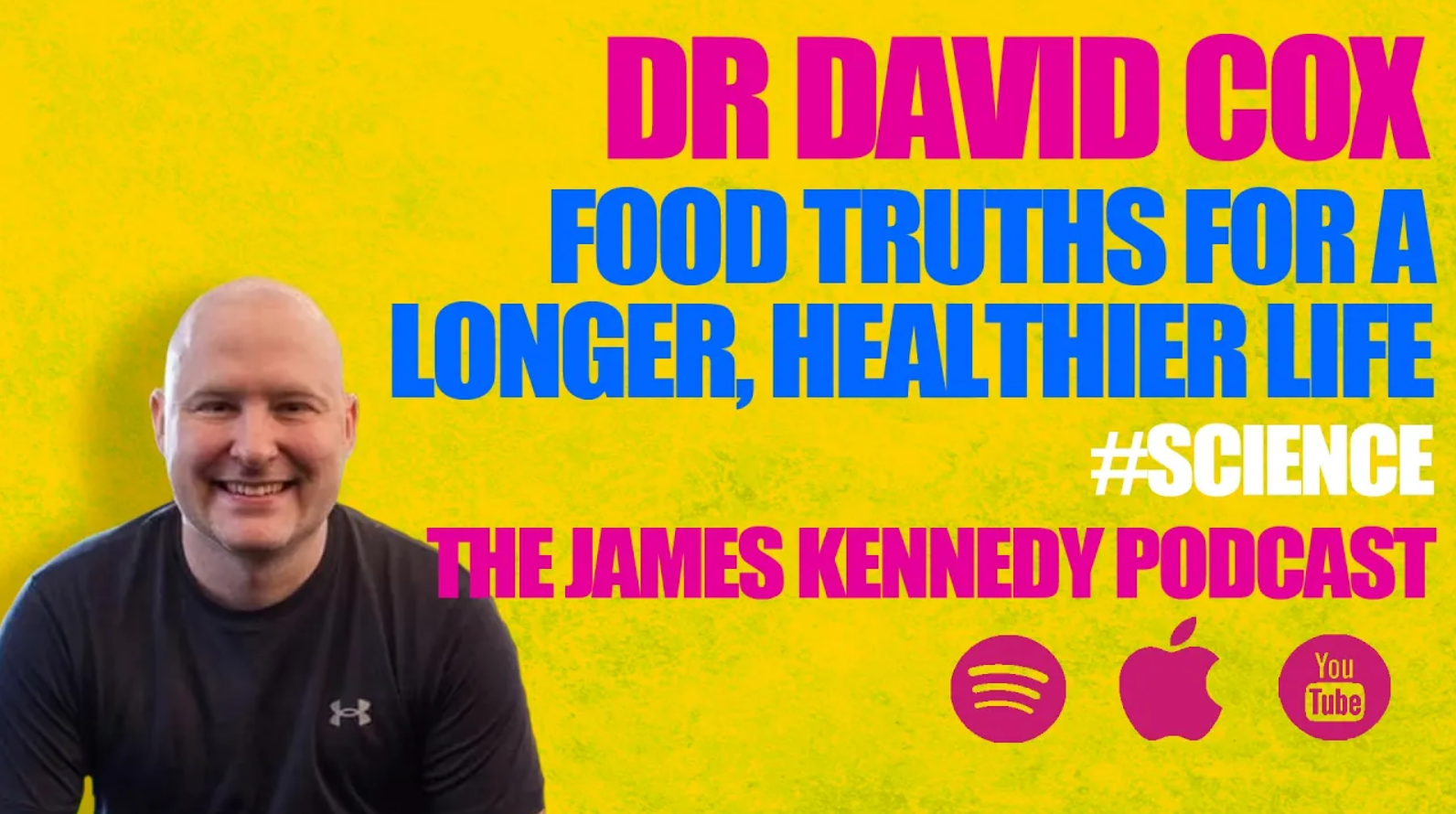
DR DAVID COX - LATEST FOOD SCIENCE FOR A LONGER, HEALTHIER LIFE
James Kennedy interviews neuroscientist Dr. David Cox about his book The Age Code, covering how to lower your biological age through simple, science-backed habits like eating earlier, getting more fiber and omega-3s, and cutting back on ultra-processed foods.
James Kennedy: David, we really appreciate you taking time out to be with us here today, mate. How are you doing?
David Cox: Good, thanks so much James. So looking forward to discussing all this with you.
James Kennedy: Me too, man. I mean, I must confess straight out of the gates that I'm doing this purely for selfish reasons, not for the audience's benefit, because I want to glean all this knowledge for myself. We all want to live longer, right? Surprisingly so, right? But I think we should probably explain from the outset that even though the book is called The Age Code, and of course it does deal with living a longer, more fulfilling, happier, healthier life, there's another factor that determines that, which is the biological age—which is not always the same as our actual chronological age. And it's that internal biological age that you focus on predominantly throughout the book. Would it be worth explaining to the listeners from the outset what the difference is between the two, what is biological age, what are some of the factors that affect it positively or negatively, and what are most of us doing wrong on that front?
David Cox: Definitely, definitely. What aging is, is so interesting, and in the book I try to break it down into these two different types of aging. You've kind of got what I call programmed aging, which is the aging you can't really control—like, we all know there are certain things which happen to us at different time points in life. We all go through puberty, women go through the menopause, men go through the andropause. All of that, and we also know that there seem to be certain changes which happen in our late 70s, early 80s, which represent another time point.
But beyond that, it is very much a gray area, which is something which we find really, really fascinating. And it's the reason why we have some people—I think the super-agers, as they're known, are some of the most interesting populations. Because everyone gets a little bit hung up on the centenarians and the supercentenarians, but super-agers are people who get to 85, 90, and they don't have any disease, which is really, really, really interesting. Because a lot of people think, "Do you really want to live a long life if you're going to spend so many decades of that in poor health?" But if you can be 95 and still living your best life, you don't have heart disease, you don't have anything impacting your ability to see friends and family, that's pretty great. So those people are really, really interesting.
And we've started to see—because over the past 10, 15 years, scientists for the very first time have developed these tests actually measuring different aspects of the aging process, from how well your organs are doing, how much stress they're under, to how well your DNA is aging. And from that, we can really see there are quite big differences. If you look at say the average 40-year-old, you will get some who are perhaps many years biologically younger in different ways, while other people are many years biologically older.
And for me, I think you saw this perhaps in a really big way during COVID. Because we got people in their 80s and 90s who got COVID and they weren't really affected at all; they just had a mild infection, felt a bit grotty for a few days, and then, like the rest of us, bounced back pretty quickly. And other people, even though they were a decade younger, were affected by COVID so much more strongly. Their immune systems weren't equipped to respond, and they ended up being hospitalized. That's an example of what biological aging really is—these different variations. And being able to unpick that is really starting to yield a number of secrets which show us what we shouldn't be doing and what we should.
James Kennedy: Yes, fascinating stuff, man. I mean, the book is very broad, very dense, but also a very concise and easy-to-read book as well. I whizzed through it; I couldn't put it down. And there's no way we could cover everything in the book in this conversation today, and nor should we, because we want everybody to go and get their copy. But what are some of the main bad guys, the main processes that cause the worst of the damage and accelerate this internal biological aging? You mention tons of them in the book—things like inflammation, visceral fat, oxidization, free radicals. Would you say that those are amongst the main processes that we need to understand and address if we're going to reverse the damage and change the rate at which most of us are aging a lot faster than we should be?
David Cox: Yeah, 100%. I mean, these are some of the big biological processes going on within our bodies. They're completely invisible; we have no idea really that a lot of these things are playing out, but they're silently aging us over time.
But I think what's quite interesting is some of the dietary habits which we're all doing and we all kind of just slip into, particularly through middle age as life gets busier and stuff like that, which are silently enhancing some of these things in the background. And I think one which is quite fascinating is actually just the timing of meals. In the UK, and to be honest most of the western world, dinner has always been the biggest meal. And in fact, if you look at aging science, it should be completely the other way around. As humans, we've evolved to work with the sunlight. Really, we should be eating during the daylight hours. We should be getting the bulk of our calories across breakfast and lunch and having a small dinner. The reason because of that is if you're having a small dinner relatively early, it's not going to impact your sleep. And we know that sleep is so, so important for immune health and repair.
If you just look at the core of a lot of stuff relating to aging, it comes back down to this balance between damage and repair. So many of us are doing things which inflict more damage on our bodies without giving our bodies enough chance to repair. Because the body is actually quite incredible at repairing—at any one time, there are millions of really sophisticated repair operations taking place within our cells. If we give our body more chance for that to happen, then over the long term, the benefits can really be quite profound.
James Kennedy: That's interesting, man. Why is it then—I mean, people talk about the Mediterranean diet as the one that people should aim for, but when I travel to the Mediterranean, which I love to do, they eat super late, man. I mean, like in Greece, they don't eat until 10 o'clock at night. Why is that?
David Cox: I think unfortunately, it's just simply how we've evolved in the last 200 years, isn't it? I mean, I think in many ways, artificial light is to blame for that. Because back 200 years ago, when we just had candles and oil lamps, most of us had to eat quite early because it was getting dark. Our sleeping patterns were completely different, and our routines totally changed in the last 150 to 200 years. Because of that, we've ended up working later and eating later.
I'll tell you just one fascinating little nugget which really illuminated that for me. There's a massive nutrition study in France which is really, really incredible. It follows about 200,000 people and tracks all of this information about their lives. They've followed these people for decades, and they were looking at what are some of the behavioral habits which correlate to heart disease. Fascinatingly, the two which really stood out are not skipping breakfast and having an early dinner. Those were the two biggest predictors of whether you're going to be protected from heart disease. That's really, really fascinating because if you look at some recent dietary changes, intermittent fasting has become really, really popular, but a lot of people who intermittently fast skip breakfast. They don't start eating until midday. Intermittent fasting can be good, but if you're doing it earlier in the day—if you're doing it between 8 a.m. and 6 p.m.—that makes a much bigger difference.
James Kennedy: But hardly anyone does that! You see, you're already dispelling some popular myths and dropping a truth bomb, which is why we appreciate you. Because intermittent fasting is fashionable, and we live in the age of lots of noisy, conflicting information from very credible-seeming influencers with millions of followers, all telling us to do different and conflicting things, and it's impossible to know which way is up, what's the right thing and what's the wrong thing. So that's why your book is so important right now, because what we don't realize with these influencers online is that, one, they've got all the time in the world to spend 5 hours at the gym and drink hundreds of pounds' worth of expensive supplements every day, but also they get a lot of this stuff for free, and a lot of the stuff that they're pushing and the knowledge they're pushing has basically come from their sponsors, you know? So this book is a really important, science-backed antidote to all that stuff, just to get some clarity.
And so then, sticking on the theme of establishing what the bad guys are first before we talk about how we can make things better for ourselves: we've talked about processes, what about some of the ingrediential—if that's even a word—ingrediential bad guys? Things like fructose, and obviously sugar is just the devil. What are some of the others?
David Cox: Definitely. I mean, I think the interesting thing is a lot of us are simply eating too much, too often, which is one of the biggest things. And I think the real reason, if you get to the core of why ultra-processed foods are so, so damaging, is they're so addictive. No one eats just one cookie. And that's the whole problem at the end of the day—they just make it so easy to consume more energy than we really need.
So when putting the book together, I wanted to try and live it. I didn't just want to speak to the scientists; I wanted to look at what I was doing. I wanted to walk the walk of longevity and aging science. I got a nutritionist to map out the amount of calories I was consistently consuming on an average day right at the start of the book. And I got my resting metabolic rate really scientifically calculated. Now, this is the number of calories your body just really needs, and that's quite important to figure out because it varies so much depending on your height, your body type, your gender, your age. And for me at that point in time, I basically should have been consuming about 2,100 calories a day. In fact, I was consistently getting 2,700 calories—so just that 600 more calories.
This is the interesting thing: if you're just doing that for one or two days, that makes little difference; your body can cope with that. But if you're doing that over a decade, that really adds up and correlates to consistent weight gain. One of the things we've realized is that a lot of us have kind of assumed that our metabolism, our ability to process energy, kind of slows down through mid-life, which is why a lot of us gain weight and get middle-age spread. But that doesn't actually happen. It's more the fact that probably through ultra-processed foods, a lot of us are just consistently consuming too much, and doing that over 20 years takes its toll on the body.
And I was doing that. I was eating twice as much sugar as I really should have been, and when people told me that, it all kind of made sense. I had gained 10 kilograms between my university days and my mid-30s, and I had a lot of these scans done—I had too much visceral fat. So I think that's one of the big issues of ultra-processed foods: they just simply make us eat too much.
And one of the interesting things is that if you're constantly not giving your body any breaks, your body's constantly in growth mode. Growth mode is really great when you're a child; you want to grow as quickly as possible. But when you're 35, you don't need to be consistently growing—you need those breaks. And it's those breaks when you're not eating which is when your body is actually repairing. A lot of us are just not doing that, so I think that's the core of why ultra-processed foods are bad for us.
With sugar, it's quite interesting because this actually comes down to a class of toxins which no one on the street has probably really heard of. They're called AGEs or Ages, and they basically correlate to pretty much every single aspect of the aging process. So when you eat loads of sweets, or even when you eat refined carbohydrates like white bread, because there's no fiber really in them, they hit your bloodstream really, really quickly, and you get a big overload of starch essentially into your blood. This actually causes caramelization. In the book, I sort of liken it to when you see a chef making a crème brûlée—you kind of get that caramel. That's actually happening in your blood! If you have a packet of Haribo, this is happening. And it's quite disgusting when you think about it.
The problem is, it basically takes proteins which are very, very good for you, like the collagen in your skin, and it kind of dries them out and stiffens them. It's why we get wrinkles over time—it's due to the formation of these AGEs. More invisibly, they cause your heart to lose elasticity. We now even know that they're involved in pretty much everything from cancer risk to risk of Alzheimer's disease. Again, the problem with a modern food environment—too much sugar, too many processed foods—is a lot of us are getting too many of these AGEs, more than our body can cope with over time.
And saturated fat again—there's a huge amount of misinformation about saturated fat, but when you look at aging science, the issue is if you're getting more saturated fat than fiber, for example, or healthy fats like omega-3s, it actually creates a lot of inflammation in your gut. One of the key things we really see which differentiates the super-agers from the rest of us is they manage to keep their immune system working for much longer. The issue of having too much saturated fat over time is it's just aggravating your immune system, accelerating immune aging. Then that makes your immune system less capable of fighting off pathogens, spotting cancers, things like that.
So, yeah, sugar really is the devil. Sugar is the devil, you know, and I think what people sometimes maybe misunderstand with some of this: it's not about giving up chocolate for the rest of your life, it's just about finding a slightly better balance. Same with saturated fat. As a health journalist, I've written the "should you eat butter or margarine" piece numerous times—people love that argument. But ultimately that one doesn't really matter, because how much butter are you really going to eat? No one's eating a whole pack of butter. It's more about getting the balance right. Most of us are, through ultra-processed foods and ready meals and pizzas and things like that, getting a massive dollop of saturated fat and relatively little healthy fat. It's just all about trying to—not eliminate foods, but just change, shift the balance of it.
James Kennedy: That makes a lot of sense. That's very reassuring to know as well, that we haven't got to give up all of our vices, because I am a full-blown chocoholic. If there's a box of chocolates in front of me, no matter how big, I will be annihilating the lot of it. I'll still be shoving the chocolates in my face as I feel sick. I think I've got one of those genes that you mentioned in the book where if I like something, I just cannot stop. And so I switched to dark chocolate so I could have my cake and eat it, so to speak, because apparently that's really healthy and it's got loads of polyphenols in it and it's considered a superfood. But then other people say, "No, no, it's really high in saturated fat, you shouldn't have too much of that." Oh my god! What do you do? How do you win? So this is really reassuring to know that, yeah, we can still enjoy some of the fruits of life, but in moderation.
David Cox: Exactly, I think this is a problem now. There's so much health anxiety because everything is in such black-and-white terms. The reality is it's just so much more nuanced. Even with ultra-processed foods, I say that the average British person is getting 60% of their calories from ultra-processed foods, which is too much. But it's not about getting that down to zero; it's just about shifting that balance a little bit. If you can get that to 60% whole foods, 40% ultra-processed foods, then you're doing a lot better. If you can push it to 70/30, you're doing even better.
So I think that's the easier thing to keep in mind, because we've built the world this way, you know? You can't fight it too much, and your body can cope with a lot more than you realize. It's just about giving it a bit more assistance.
James Kennedy: Yeah, I was going to say, because it is very difficult—especially for myself as a traveling musician, it's really difficult to eat the way that I would at home. When you're on the road, it's just impossible. Everything is garbage in petrol stations.
David Cox: You know, exactly, yeah. I mean, it was quite funny when I was doing my first longevity diet for the book, which was basically—the aim of it was to completely revamp my diet for two months, actually try and eat 2,100 calories a day, cut out all processed foods entirely, and replace them with more nutrient-dense whole foods. I did two conferences in that time, and it was really, really difficult. Ironically, one of the difficult times was covering the World Cancer Congress, where I was listening to all these talks about the dangers of sugar and all of these things, and you come out of the main seminar and all the snacks are sugar, you know—Coke, all of that! So when you're traveling and going to these things, it is really hard to eat healthy.
James Kennedy: Well, it's good to hear that we can have the occasional lapse because it's just the nature of most people's work-life balance these days, without trashing the main mission here, so that's good to hear. Just a quick one on processed foods before we move on: what about things like Huel? These are massive now, and they're convenient, and we all snack on these things when we're out on the road thinking that we're eating a healthier version because it's full of minerals and vitamins and stuff like that. But it's not real food, you know—it's a meal in a bowl, and that's technically still ultra-processed food, right?
David Cox: Exactly, exactly. I feel like sometimes some of these things kind of help a little bit in terms of getting in a few more micronutrients, but the most important thing really is whole foods. Just because when you're drinking an artificial shake, you're getting certain nutrients, but your body doesn't absorb them in the same way as when eating broccoli or eating a potato. And also, when you're eating a vegetable, you're getting such a variety of things—you're getting fiber, you're getting vitamins, you're getting minerals, you're getting all of these things in one package. I think that's why ultra-processed foods can never quite replace that.
Also, the other issue is a lot of the steps within food processing—they might be adding certain micronutrients in, but the processing is also destroying other nutrients. We know that the heating, we know that some of the most common preservatives are basically inactivating key vitamins and minerals. And also, there's some really interesting stuff about some of the flavorings, the dyes, some of these artificial chemicals—because the body doesn't recognize them, they are actually aggravating your immune system over time. So, yeah, I think that's ultimately why nothing can really replace whole foods.
James Kennedy: Right. What we need to come on to then, because that sounds like the info that we all need—a little word of reassurance before we delve into that for the people who haven't read the book yet and might be thinking, like I would have before I read it, that I'm too far gone. I'm middle-aged now, I'm a child of the 80s and 90s raised on Kellogg's cereals with white sugar on top, Coca-Cola, McDonald's, and smoking, and we all thought all that stuff was fine. Are we too far gone? How much is reversible? Do we stand a fighting chance? Is it worth us bothering to do the sort of things that we're going to talk about next?
David Cox: It's a very good point. And I think that's the message I really wanted to try and address in the book, because it's never too late with so many different things. Actually, smoking is a really, really interesting one. Because everyone who's smoked for 40 years and gets to 60 thinks, "Why quit now? My risk of lung cancer is probably already so high." But actually, in fact, it's probably all the more important to quit at 60 than it is anywhere younger. Because with things like heart attacks—we know smoking causes heart attacks—if you quit as a 60-year-old lifelong smoker, your risk of a short-term heart attack is really, really high, but if you quit, that drops massively within just two weeks. So that's just one example of how taking a small step to protect your body—even switching from smoking to vaping overnight—makes a big difference, simply because you're bombarding your body with fewer toxins.
And the same with food. The interesting thing with food, which a lot of people just don't realize, is that your body's needs for nutrients actually go up with age. Really, at 90, we should be eating way healthier than we are at 30. There was a fascinating study I came across while reporting the book that came out about six years ago, and it modeled our bodies' requirements for different vitamins and minerals across the life course. You could really see how much vitamin C you need at 20, how much you need at 50, how much you need at 70—it just keeps going up. The reason is the body is just getting less efficient as we age; everything is slowing down, getting a bit more sluggish, and you just need assistance for your body to help kick it back into gear and give it some extra fuel to fight off and do all the things it needs to do.
So it's very interesting. We actually see people who in their 20s and 30s are doing all the bad things, but if they change at 40 and stick to it for the next 30 years, they're biologically much, much younger when they get to their 70s.
James Kennedy: Right, so definitely we can reverse this and turn the tide around from all those Happy Meals and chocolate cookies and things like that that we munched up. My health was terrible until I was about 35, and then I got really, really into this stuff, lost a load of weight, was exercising loads and stuff like that. So it was always in the back of my mind: "Have I done the damage? Is the damage done?"
David Cox: Me too, you know! Ironically, I was a neuroscientist doing a PhD, and probably at the same time, my lifestyle and diet could not have been any worse—which is probably why I did all these biological aging tests at 35 and found, "Oh yeah, I'm biologically older." But there is the good news that there's so much you can do in a very short space of time which can make a big difference. The body is a wonderful thing, isn't it?
James Kennedy: Well, I took a load of notes throughout the book for my own personal use as well. So as we come towards the halfway mark for the conversation, we've established what we're all doing wrong, but there is hope, we can turn the tide around. One of the main things that you talk about—if I'm going to try and summarize very simplistically—would one of the main things that you suggest people should do be a low-calorie, nutrient-dense diet? Is that accurate, and also what does that look like for most people on a daily basis?
ENJOYING THE CONVERSATION?
GET JAMES KENNEDY'S LATEST INTERVIEWS, WRITING AND LIVE SHOWS STRAIGHT TO YOUR INBOX.
David Cox: Definitely. I feel like the low-calorie, nutrient-dense diet is a good mid-life health kick. The interesting thing about it is even in a month or two months, you can do that as a New Year reset or a summer reset, and you can see these differences in such a short space of time. I mean, I did it, and by the end, I could not only see the benefits in the tests—like my immune system, I think the age of my immune system had gone down by like three years within this two-month period—but I also just felt sharper. I was writing the book at the time, and I rattled off six chapters in the time it had taken me to write one or two before. So I was performing at a better level as well.
It's very interesting just how quickly you can make a change. Obviously, it's tricky to stick to a low-calorie, nutrient-dense diet for months or years, simply because of the way the food environment is. So that basically involves trying to—there are these calculators online, I list a few of them in the book, which you can use to estimate your own resting metabolic rate, the number of calories you really need, and then just try and stick to that for as long as you can. But again, I don't want to stress people out too much, because I eliminated all processed foods for two months; doing that long-term is tricky. But I feel if you manage to get that reset and then maybe do that just for two months of a year and keep doing that over time, that will probably make a long-term difference to your health.
In terms of just on a day-to-day basis, it's just some of the principles of that which make a bit of a difference. We should all be getting, for example, more vitamin K. It's one of the micronutrients no one really talks about, and you get that in things like egg yolks, dairy, soy beans, and leafy greens—things like spinach and kale are really the forgotten superfoods. The reason why vitamin K is really, really important is because it stops calcification of the arteries. Vitamin K is really, really important in transporting calcium to where you actually need it, which is in your bones. You can actually see when people get to their early 50s, the amount of calcification they have in their arteries really correlates to their life expectancy. So the sooner you can try to get more vitamin K in your diet, that can make a really, really big difference to how long you're actually going to live.
James Kennedy: That is incredible, man. And with personal feedback like from your own story as well, that's just insane. And as you said, there are no hard and fast rules with these things; everybody's biology is different, everybody's situation is different. But if we're talking general principles, a low-calorie, nutrient-dense diet is clearly one that we should be trying to work into our lives. But another one which is very prominent throughout the book is that we should all be getting a lot more fiber.
David Cox: Yeah, 100%, 100%. Fiber is kind of the macronutrient which really gets forgotten. Everyone is massively focused on protein at the moment; we're living in this protein obsession. But there's a nuance to protein which always gets left out. Again, this comes down to marketing, because protein is an industry worth about 90 billion dollars worldwide—it's colossal. There are huge amounts of influencers, brands, and a lot of people making serious money on this and promoting more and more protein.
What no one really talks about is more protein is great if you're working out. If you're one of those people who is actually doing 150 minutes of moderate exercise a week and doing strength training two to three times a week, then great, eat more protein—your body will be able to use that to build more muscle. But your average 50-year-old is probably not doing that; they're probably just eating more protein. From an aging perspective, the problem with that is protein really promotes growth. If your body's got nothing to actually use that protein to grow, you're just going to be growing all kinds of other things you don't want to grow. You're going to be creating more inflammation, you're going to be creating more fat.
Also, if you've got damaged cells and growth pathways in your body being activated, it's more likely that one of them might spiral out of control and eventually develop into a tumor. Which is why we see that people who eat more protein but aren't doing the exercise, their risk in the next five to 10 years of all kinds of different chronic diseases is actually a lot higher. You even see it in animal studies as well, which is quite interesting. They take rodents, give them a low-protein diet and a high-protein diet, and the ones on the low-protein diet actually live 30% longer. So there's a lot of misinformation about protein, which is quite interesting.
James Kennedy: Yeah, it's crazy. And that's what I love about this book, and why I would share it with everybody. I mean, you've given quite a lot of great advice and wisdom from the book already just in this half-hour chat we've had so far. But people need to understand that this is a broad book, and you go into all the science behind it, your personal journey, and all the tests that you personally did and what that uncovered about yourself, which was one of the most fascinating parts of the book for me.
If people really want to expand on this stuff and understand why the things you're saying are the truth behind it and the evidence behind it, they need to do a deep dive into the book. It's also a great reference point, because I've been leafing back through it, because you've got breakdowns of all the minerals and what they do and where we can get them from. It's a fascinating reference book. So I would urge everybody to rush out and get The Age Code, because it's kind of the Bible of where we're at with modern food science, understanding, and health.
I just want to wedge that in at this point in the conversation to remind people that there is a book out and they need to get their hands on it, because it's really life-changing stuff that's going to make all of our lives happier and healthier. So coming back to the chat—just dropped a little advert in there for you! We don't want to give all this stuff away for free, right? I want people to go out and buy the book because they need to.
So one of the things that I was fascinated about—because I already do this, as a guitar player who worries about arthritis happening at a later age—is I take a lot of omega-3s. I didn't realize—I only take it for that personal issue—I didn't realize how important omega-3 is to a whole range of bodily functions. Could we talk about that for a second?
David Cox: Yeah, definitely, definitely. If someone just picks one thing from that entire book to do, there's probably a good argument that that should just be having more omega-3s. That alone is probably going to make a significant difference, both in the short term and the long term, to how well you're aging.
I'm going to give you an example of that. So I'm now 37. I love playing tennis, and at certain time points in our life, we just really start to notice like, "Oh, okay, I am actually aging." I had one of those little awakenings when I was 35. Just for the very first time, I started waking up feeling a little bit stiff in the mornings. I remembered when I was 18, I could play three sets of tennis and not feel it at all the next day. Now, after playing tennis for a few hours, the next day I'd wake up in the morning and feel so, so, so stiff. So I started taking more omega-3s, and then suddenly the morning stiffness started to go away. It was really, really interesting.
Omega-3s are, at heart, really anti-inflammatory nutrients. We know that they actually play a really, really big role in muscle and joint health. One of the really fascinating learnings in sports science actually is the omega-3 index, which measures the amount of omega-3s you're getting compared to different types of other healthy fats. Now, in the Premier League, in the Six Nations, it's quite routine for the sports scientists working for different national teams or clubs to be constantly measuring how much omega-3 the players are getting and the levels present in their blood. Because over the course of the season, they see that makes a big difference in terms of how resilient the players are to injuries and how much better they recover.
And that correlates to all of us—if we get more omega-3s, we're more resilient to getting injured. We also maintain muscle a lot better, which is one of the big changes that happens to so many of us across middle age. Our bodies go through this sort of invisible change in body composition where we go from having quite a lot of lean muscle to becoming progressively more and more fat, which is really, really bad for many aspects of the aging process. But actually, getting more omega-3s in your diet can really help you avoid that and maintain muscle, and it can make such a huge difference to a lot of us over time.
James Kennedy: And it's such an easy thing to get. I mean, I take a supplement which gives me a gram of omega-3 every day. It's so easy to do. So, yeah, that's really powerful that you said that if there's one thing people can take away from the book, it's that. It's such a simple fix that we can all put into practice.
So we need to talk about one of the main organs involved in this as well quickly, if we can. We had the great Tim Spector on the podcast previously doing a whole episode specifically on the gut. I'd love to get your thoughts on the functionality of the gut and the role it plays in this just briefly. And also, is there any updated science on this since we had Mr. Spector on the podcast which may change the nature of the conversation about the gut's role in this stuff?
David Cox: Definitely. I think the gut is so, so, so fascinating, because everyone kind of thinks about the gut in terms of fiber and all that kind of stuff. But the gut is connected to so many different organ systems—there's all these spidery networks which link out between the gut and the brain, the gut and the liver, even the gut and the muscles. So actually keeping your gut healthy plays a huge role in keeping all kinds of different organ systems healthy. Obviously Tim has played such a big role in enhancing a lot of that science.
Around the world, there have been some really fascinating studies. For example, China has a blue zone—China has this one particular hotspot in a very remote region where they have quite a high proportion of centenarians, and they've done some studies on them. One idea seems to be that they simply manage to keep their guts healthier for longer. Why that's really, really key—if you're going to highlight just one reason—is there's this big link between the gut and your immune system. Everyone kind of forgets a little bit about the immune system when it comes to longevity, but it's absolutely key. Because when we get to our 70s and 80s, our risk of being hospitalized with infections massively goes up. Having a more active immune system which can fight off all these bacteria and viruses plays such a big role in screening for cancers, as well as removing toxins from your brain—so people who have a better immune system are going to be much less vulnerable to getting dementia. Your immune system is even important in protecting the heart. So all those major killers which we become more susceptible to—if your immune system is working, it can delay a lot of that for much longer.
And that comes down to the gut, partly because two-thirds of your immune cells basically lie in your gut. So what you're eating has a very direct impact on the health of your immune system.
James Kennedy: I'm guessing things then like acid reflux, bloating, cramps, or anything like that are indicators that something in the gut is not happy.
David Cox: Definitely, definitely. And it's interesting—I think a lot of this can be mitigated again in a relatively short space of time by simply increasing the amount of fiber in your diet. To give you an example of how it's never too late: there was a fascinating study that came out last year or the year before. It took people in the early stages of cognitive decline—so these people had early, early Alzheimer's—and they simply increased the amount of fiber in their diets. Over the course of five months, their performance on all kinds of different cognitive scores just improved. Again, that's because you're stimulating your immune system, which in turn stimulates the brain, so you can get all of these very short-term benefits.
Keeping the gut healthy also mitigates against frailty. One of the reasons why we become both physically frail and cognitively frail is related to the immune system, leaving us much less resilient to trauma. But increasing fiber, increasing fermented foods—all of these things help the gut produce lots of useful chemicals which can then be used for all of these different organ systems, helping massively delay and even reverse aspects of frailty.
James Kennedy: It's so fascinating, isn't it? That's super important stuff, and it can all be enacted so simply with just a little bit of understanding about what we're eating, when we're eating it, and how we're eating it. Just eating actual food, I think it comes down to for the most part. It's so simple and so powerful, and can enhance all of our lives. Again, thank you for the wonderful way you've condensed all of this stuff into one really accessible book for us all to refer back to.
You also, throughout the book, as I mentioned, undergo a variety of very fascinating and obscure, bizarre tests, which I think I would be hesitant to do myself because I wouldn't want to know the results. I'd love to expand the list on just a few of the more interesting ones that you undertook, because there are tons throughout the book that you did which are mind-blowing. Also, if you could recommend just one of them as the most important one for people to spend their money on, which one would it be?
David Cox: Yeah, I think this is the great thing now, because 10 years ago we didn't really have much in terms of actually measuring aging. If you think about a standard NHS health checkup, you're measuring your BMI, your blood pressure, but these things don't really tell us that much about some of the key organs which are really, really important in longevity. Keeping your kidneys healthy, for example, is hugely, hugely important because they are the organs which regulate toxins from the blood. Same with your liver—it plays a huge role in your ability to break down alcohol, metabolize caffeine, and all of these important functions, and none of that is captured by the typical things we pick up in healthcare.
To give an example of one particularly interesting test I did: I got my DNA sequenced. We now know there are big variations between one person and another in terms of how something like coffee affects them. Coffee is a really, really fascinating drink because there's been a lot of research which has shown that coffee really is something of a superfood—people who drink more coffee have better brain health. More coffee actually is even great for the liver; there are now some liver doctors, particularly in the States, where if someone has fatty liver disease, one of the first things they prescribe is to start drinking more coffee. Because coffee has all these beneficial properties—not just caffeine, but all these beneficial plant chemicals within it which can nourish the gut and activate a lot of these different organ systems.
Whether we should be drinking caffeinated or decaffeinated coffee really depends on a particular gene, and this seems to split the population roughly 50/50. For some people, they're the fast metabolizers. These people can happily drink five cups of coffee a day and have no ill effects. Basically, they have enzymes which break down caffeine much more quickly, so they can break down the caffeine, suffer no ill effects, and benefit from everything else within coffee. But for the slow metabolizers, that caffeine is lingering around for so much longer in the body. It's why some people get really anxious and jittery from drinking coffee—some people call it "panic juice" for that reason—and for them, they probably should stick to one or two cups of coffee and then go to decaf, or just purely drink decaf.
It was a really, really interesting one for me to do, because I had noticed in the past that when I drank particularly strong coffee, my eyelashes would actually start twitching. I subconsciously knew this, but persisted in drinking coffee anyway, as many of us do—I am a massive coffee fan. But then I did this test, and it said, "You are a slow metabolizer. If you are consistently drinking three cups of coffee a day, that might have some benefits for your brain health, but it's also going to be raising your blood pressure and stressing your heart, so it's bad for you for that reason." So instead, I now just drink one cup of coffee a day, and then maybe two or three cups of decaf.
It's that sort of information which allows us to make these more tailored decisions. I also found out that I'm a super-taster of fats. I love chocolate digestives, so I find it really, really hard to eat just one or two—I will devour an entire pack. It's because my body is primed to sense that fat content within them, and then it tells my brain to secrete more and more. So you learn these things, like, "Okay, I know now that I need to stay away from those foods because I'm going to find it harder to control myself."
James Kennedy: Yeah, this stuff is fascinating, man. These tests, unfortunately, as esoteric and interesting as they are, are quite spendy, aren't they? So would there be one you could recommend as a starting point for people, that if they were going to get one done and put their money down, which one would it be?
David Cox: I think a good one is called PhenoAge, which you can now get privately through a few providers, like Randox Health and various others. That's really, really interesting because it basically provides an overview of the amount of stress your organs are under. It measures different biomarkers in the blood—like albumin, which reflects your liver health, and another which reflects your kidney health—and you get a good top-line overview of how each of these organ systems in your body are doing. It also measures one protein which reflects inflammation.
I think that's a good one to start off with, and the good thing about PhenoAge is it's quite responsive. If you make changes, it's reflected in that quite quickly, which is positive feedback. It's relatively cheap compared to some of the others—some of these tests can cost £300 or £400, but PhenoAge costs about £70 to do. You can do it a couple of months apart to get feedback on what your changes are actually doing and if it's something you still need to improve on.
James Kennedy: Yeah, that's great to know, and thank you for sharing that. I will be getting my order in ASAP.
Now, one of the questions that I know is going to be on a lot of people's minds right now after listening to everything you've said so far is: what about Keith Richards? What about Anthony Bourdain? My nan is 99, and she's drunk neat whiskey every day for the past 60 years of her life, but she's still going strong! What do you say to the people who would be like, "Those guys spent all their lives smoking and drinking and rocking and rolling and doing whatever the hell they like, and they're fine, so why should I bother with all this healthy eating stuff?"
David Cox: It's very true, it's very true. Keith Richards is probably going to live to 100, isn't he? He's balked every expectation of him. I kind of hope he does, just to defy us all!
I think that just shows there is a significant role which genetics plays in all of this. The thinking now—there was a fascinating paper that came out in Science, which is one of the most prestigious journals, at the start of the year—suggests that the likelihood of living to 100 is 50/50 in terms of genetics and lifestyle. So genes can play a really, really big role. There are some people who simply seem to have these genetic variants which mean their body's repair systems are working three or four times more efficiently than the rest of us. So it could be that Keith Richards simply has one of these genes where, yes, he's smoking and taking all of these substances across his life, but his genes are working overtime to clear away a lot of that damage.
The interesting thing in longevity science in the next 10 years is we're going to start honing in more and more on exactly what some of those genes are. We already know a few of them, which is really, really interesting. In 10 years' time, you'll probably be able to get your DNA sequenced, and they'll be able to tell you, "Yes, you probably can keep drinking alcohol for longer, because you have some of these genes which are mitigating a lot of that."
Where diet is still really, really important is because diet allows you to max out what you have. For example, you might be someone who's got great genes and the potential to live to 120, but because of the lifestyle aspect, you might only live to 90. Whereas on the other hand, you might have really, really bad genes, but by doing the right things with your lifestyle, you will live 20 years longer than what you otherwise would have done. So your genes just set this framework for lifespan—a little bit like they do for height—but what you're doing and eating allows you to max out your capability.
James Kennedy: Can you imagine if Keith Richards read your book? Jesus Christ! (Laughing) He'd still be roaming the earth! He'd be a little bit juicier than me! (Laughing)
Well, I've got to let you go soon, because I could pick your brains all day long, and I know that's selfish of me to do. So I just want to end with one question. When everybody takes on board everything you've said—and hopefully they will—is it still possible for us to live and enjoy the fruits of life: pizza, cake, whiskey, beers, all that good stuff, and still work within the framework that you're proposing within this book?
David Cox: Yeah, 100%! I'm all about balance basically within the book. Right at the end of the book, I encourage people to maybe just pick three things out of all of the suggestions—three things they think they can commit to. It could be that you just continue what you're doing, but you simply have more omega-3s. You maybe just change the timing of your meals, or start getting more leafy greens. There's a whole chapter in there on how you can change your cooking, which can help you live longer. Just some of these things.
So you can still keep your treats, but just incorporate a couple of these little tips which can help mitigate some of that. It could be that if you're having a big pizza several times a week, but you're eating most of your calories across breakfast and lunch for most of the week, and you have those pizzas at the weekend, your body's overall still going to be repairing better.
James Kennedy: Amen to that! Thank God! (Laughing) That's great to hear.
Ah, David, we've got to let you go, unfortunately. Thank you so much for your time. You've been very generous today with sharing some of the wisdom from within the book—very empowering stuff. I totally appreciate what you've done in writing the book and sharing all of this amazing research with us in such an accessible way, so thank you for that.
The brilliant The Age Code is now available everywhere and packed with so much more of this good stuff. You need to get your hands on it. Buy a copy for your friends and your relatives as well. Go out and get it right away, you will not regret it, and set yourself up for a happier, healthier, longer, lovely life. I'll put a link to buy the book directly in the show notes as well to make it easier for you to click on. You can also keep up with what David is up to on Instagram @drdavidcoxhealth for updates.
David, this has been a real gift. Thank you so much for everything you're doing; we appreciate you. Thanks for giving us your time today.
David Cox: Absolutely, thank you so much! I fully enjoyed it.
James Kennedy: Me too, yeah. Thank you so much, David, and best wishes with everything. Best wishes with your mission as well to make us all healthier. We appreciate you. Thank you, thanks a lot. Cheers, thank you, man.
Key Points:
Biological age differs from chronological age and is influenced by factors like inflammation, visceral fat, and oxidative stress.
Poor dietary habits—especially late-night eating, sugar, and processed foods—accelerate internal aging.
The book emphasizes a low-calorie, nutrient-dense diet and increased fiber intake as key to slowing aging.
Sugar and processed foods contribute to harmful compounds like AGEs, which damage cells and increase disease risk.
Omega-3 fatty acids, gut health, and immune function are critical for long-term vitality and disease prevention.
Lifestyle changes, even in mid-life, can significantly improve biological age and health outcomes.
Personalized testing (like Pheno Age or DNA analysis) offers actionable insights into organ health and metabolic function.
Genetics set a baseline for longevity, but lifestyle choices can substantially extend and improve quality of life.
Summary:
Dr. David Cox, author of The Age Code, discusses the critical distinction between chronological and biological age, emphasizing that internal aging is influenced by diet, lifestyle, and cellular processes rather than just time. He highlights key damaging factors such as inflammation, sugar, processed foods, and poor sleep patterns, while advocating for a low-calorie, nutrient-dense, fiber-rich diet as a practical and effective way to slow aging.
The book stresses that even in mid-life, significant improvements in biological age and health are possible through consistent lifestyle changes. Cox shares personal experiences, including how he reduced his biological age by three years through diet and supplementation, and underscores the importance of gut health, omega-3s, and immune function in longevity. He also addresses common misconceptions, such as the idea that lifestyle is unchangeable, noting that genetics provide a baseline but lifestyle can maximize lifespan.
Practical tools like Pheno Age testing and personalized nutrition are recommended to guide individual decisions. Ultimately, the message is one of balance and feasibility: people can enjoy life’s pleasures—like pizza, cake, and alcohol—while still adopting science-backed habits that support long, healthy living. The book serves as a comprehensive, science-driven guide to health and longevity, offering actionable, real-world strategies accessible to everyone.
The James Kennedy Podcast is a podcast hosted by musician and author, James Kennedy. Exploring the big questions around health, social issues, politics, mental health, art, the human condition and how to navigate this thing called life through casual conversations with scientists, activists, rock stars, philosophers and academics. Please subscribe, leave a rating and support the show.