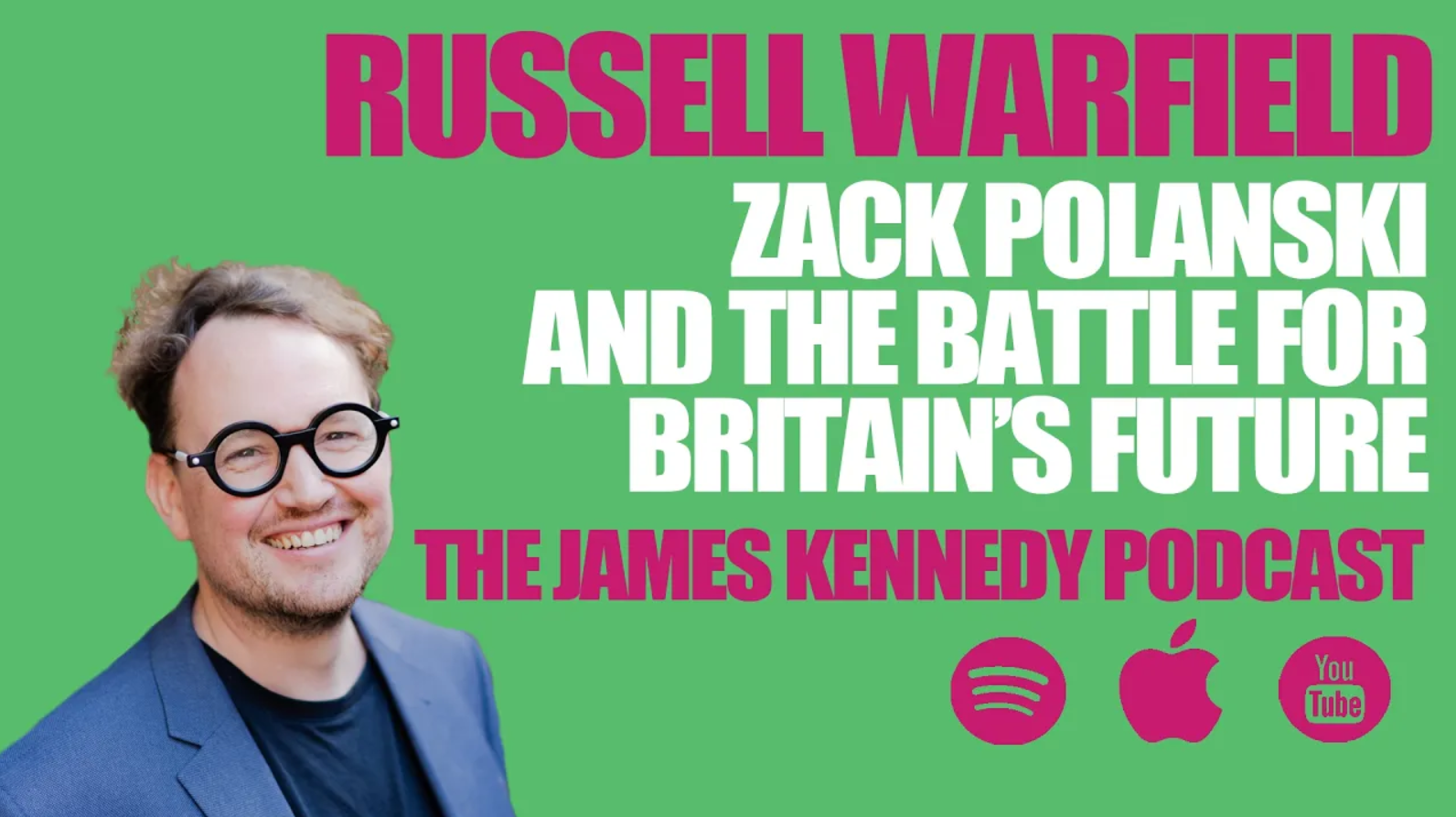
RUSSELL WARFIELD - CAN THE GREEN PARTY TRANSFORM THE UK
Host James Kennedy chats with author Russell Warfield about his book, The Green Socialist, exploring the Green Party's history and evolution under Zack Polanski, its recent electoral wins and its growing influence on British politics.
James Kennedy: We are joined today by Russell Warfield, whose new book, The Green Socialist, explores the meteoric rise of the modern Green Party and what this means for the future of the left. The book is out on September 20th, so it's fresh out of the oven and I want to hear all about it. So let's get down to business and welcome onto the show, Mr. Russell Warfield. How are you doing, sir?
Russell Warfield: Oh, I'm very well. Thank you for having me, James. It's a generous introduction as well. Thanks so much.
James Kennedy: Not at all, man. Thank you for being here. Maybe we should start then with: could you give the listeners a brief overview of who you are, what sort of things you're involved in, and what your connection to this particular issue is?
Russell Warfield: Yeah, definitely. So I joined the Greens in the middle of the 2010s, around the 2015 election, which, for listeners of a certain age, will remember was the last time that the Greens had a sort of comparable surge to the one they were experiencing on the national scheme. It was a smaller scale at the time, but it's proportionally quite similar from the baseline they were surging from. So that was kind of in response to the anti-austerity movement of the first half of the 2010s under the coalition government. And yeah, the Greens, as a consequence of their position on that, about quadrupled their membership at the time, and I joined them then. And then I ended up working for them from 2016 to '21 in their comms team. The last thing I did there was I ran the comms for the London 2021 elections. So I mainly spent my time supporting the mayor candidate, who was Siân Berry. She's now the Brighton MP. But that election was notable for also being the election in which Zack Polanski was first elected to a public office. That's when he became a London Assembly member. So that's where I got to know him a little bit. Then last year in '25, I stayed in touch with him and a bunch of other Greens for that matter. I got a little voice note in spring of 2025 about a little project that he was working on, and then was pulled into his campaign team for the leadership election of 2025, and did a lot of the press and comms for that. So that's all the preamble to what led me to write this book in the end, and I could say a little bit about the specific impulse for the book if that would be interesting to you.
James Kennedy: Yeah, yeah, please.
Russell Warfield: Yeah, well, I guess what I was... so there was always a little bit of talk about doing something that sort of chronicled the leadership campaign, because it was quite an interesting phenomenon. It's easily the most high-profile leadership campaign the party's ever had, had unprecedented media interest, and surging membership, even just for people who want to come in and vote for Zack, and that sort of thing. And one of the things that happened immediately after he won, and with the attending heightened media interest there was in him and the party, was two things were quite clear to me. The underlying one was that quite a lot of the establishment press had really very little understanding of how the Green Party worked, its history, its culture, how it was different from the main parties of the UK, that sort of thing. And along with that, there was this widespread sort of assumption or belief that Zack Polanski represented this sort of really violent, rupturous break from the party's recent and deeper past, which I think was a misreading, basically. And that's what the book's about, really. It's sort of trying to argue that Polanski's leadership is really a product of the party's longer history, and there's a much stronger story of continuity to be told about how Polanski ended up being the leader of the Greens than there is a story of how he's some sort of break from its former purpose.
James Kennedy: So you've really been in there, then; you've seen the inner workings through that whole period which you're describing in the book.
Russell Warfield: Yeah, absolutely. Yeah, I've seen some highs and lows. I mean, one of my proudest contributions was, of course, I was there for the 2017 general election, where I played a pivotal role in halving the Greens' vote share on that occasion, under Corbyn's high point, obviously. So, yeah, I've sort of seen the high and low ebbs of the Greens over the last 10 years.
James Kennedy: Interesting, man. Yeah, I mean, I've been a member since about 2015, I think, and just before the lockdown, I was actually interviewed by Anthony Slaughter, the leader of the Welsh Greens, on their YouTube channel. One of the things we talked about in that conversation was the need felt at the time to address the popular misconception that too many people had at the time, that the Green Party was a one-issue party. You know, they had nothing to say about housing or employment or immigration or any of those things, that they were essentially kind of out-of-touch talking about abstract things like the environment, heaven forbid, which was then, as it is now, completely untrue. So it's beautiful to see that in just a short few years, that's totally turned around, that more and more people are really getting the message now that the left alternative is no longer Labour, it is the Green Party. And it's super interesting to know that during that time period, you've actually been deep within the machinery.
Russell Warfield: Almost like a transition. Yeah. Well, I mean, you've put your finger on one of the key, one of the real, one of the foremost manifestations of the thing I was talking about there, which was the accusation against Polanski that he sort of ditched the environment, right? But this imagination that people had that the Greens were this sort of really narrowly interested, just sort of quite traditional conservationist group, almost apolitical, basically. I think that's a really, really good example of the sort of thing that Polanski's been able to transcend, and it's not for lack of trying that that hasn't happened previously. There's not some previous version of the party where it was basically just an apolitical extension of the World Wildlife Fund. If you look at the most recent parallel, which we've just both talked about implicitly, of the surge in 2015, that was under the conditions of there being an insurgent anti-austerity position for the party, which had little ostensible connection to the environment at a surface level. And going as far back into the history of the party as you want to go, the leadership of the 70s and the 80s always articulated the ecological crises of our time as being contextualized by broader political and economic crises and structures, right? So if you take a figure like Jonathon Porritt—the party didn't have conventional leadership in those days, but for the sake of simplicity, we'll call him an early party leadership figure—he wrote a seminal book called Seeing Green in the 80s, I think it was 1984 it was published. Caroline Lucas cited it as an entryway into green politics. Even as far back as that, Jonathon Porritt was drawing a distinction between green thinking and environmentalism, right, which was that you could conceivably be an environmentalist that is concerned about the state of the pond at the end of your road or the park or whatever and want to seek to preserve it and conserve it, et cetera, et cetera, but not necessarily delve any deeper into the root causes of why environmental degradation is happening at a systemic level. That was the distinction he was drawing between the green political tradition and certain manifestations of environmentalism. That's always been the stated position of the Greens. Natalie Bennett, the leader in the first half of the 2010s, I spoke to her for the book and one of the things she told me about was how she was trying to get out of that straitjacket quite desperately. She was saying, "Anytime I was on the telly, the backdrop was always a recycling tip or a seagull covered in oil or whatever." What she cites as being one of the real breakthrough moments of her period of leadership is when she went on a mainstream news current affairs program to talk for an hour about something that wasn't ostensibly connected to the environment—I think it was welfare reform or something like that. Yeah, that was one of the first times the Greens managed to do that. I think that Zach has been successful in doing that, and sort of contextualizing the environmental crisis within the broader political offer of the Greens is something that many of his predecessors have tried to do but have not been permitted or not been able to do for whatever reason.
James Kennedy: But what do you think then underlies the success that Zach has had, because it's been spectacular to watch, hasn't it? It's been really extraordinary and it really feels like this time is different. What do you think underlies that? Is it just because Labour have been so horrifically, traitorously bad, or is there more to it? I'm assuming that there's more context to it.
Russell Warfield: It's a bit of both in my view. The prevalent political conditions were definitely necessary, but not completely sufficient for Polanski. Obviously the fact that Labour under Starmer had pursued this electoral strategy of trying to preserve and win back Reform-curious voters or actual Reform voters, whilst leaving space to their left—not even leaving space, but actively alienating their left and sneering at them, smearing them, et cetera—created this vacuous space into which something was going to move, obviously, and it was the Greens under Polanski. But it is also important to remember now, because it is easy to forget, that there was a good full year after the 2024 election where you might reasonably expect the Greens, who had also broken through into parliament from that general election, going from one MP to four—which for the Greens was absolutely historic—that you might expect them to take a step forward on the national stage and compete a bit more forcefully with Reform, which didn't really happen. The Greens carried on at their then-current polling levels for quite a while. Starmer was perfectly unpopular at that point as well, and he had really embroiled himself in all sorts of problems over the Gaza genocide. That was the height of his problems over the Gaza genocide, obviously, and the terrible things he was saying about that and the position they'd taken Labour into on that question. And the Greens were failing to capitalize on that. So I think that what Polanski was able to do as a figure was basically what he straightforwardly promised to do in his leadership election, which was to offer this more eco-populist platform, basically. Which was to observe the successes of what far-right projects and parties were doing, like Reform in the UK, but also across the continent and most advanced Western economies, basically, which was to create a more insurgent political programme, which was more ready to talk in terms of class conflict and antagonisms, and marshal resentment among a broad coalition of the popular classes against a small number of elites, basically. So, mirroring in a broad way a lot of the storytelling and framing of the far-right where they demonised migrants, trans people, Muslims, or the rest of it, but marshalling a lot of that justified resentment that's in the population towards a different set of root causes, basically.
James Kennedy: One hundred percent, yeah. And I think it really does help as well that Zack is such a charismatic person as well, who's great at what he does. He's brilliant on the media. He's relatable, he's honest, people like him, you know. And of course, kudos to the rest of the team behind the scenes as well as the campaign, because I feel that already, even though the Greens aren't a party in power, they're already influencing the parties that are in power. You can see Labour now sliding its way back over to the left with its tail between its legs, trying at least performatively to pretend that they're a party of the people. They've got this new guy now, Andy Burnham, who is basically Labour's attempt at a Zack Polanski. You know, he's got this younger guy, he's here, he's cool, he's a DJ, man, he goes to gigs. Any of the policies that come out of that attempt to try and claw back some of the left-wing credentials is going to be as a direct result of the popularity of the Greens. So even without being in power, I think they're still moving the needle of the parties that are in power in a direction that we all need. But I'd love to get your thoughts on that. I mean, are you reading that the same way that I am? Do you see Andy Burnham as basically Labour's response to Zack Polanski?
ENJOYING THE CONVERSATION?
GET JAMES KENNEDY'S LATEST INTERVIEWS, WRITING AND LIVE SHOWS STRAIGHT TO YOUR INBOX.
Russell Warfield: Yeah, absolutely. And I think not just Zack Polanski as a figure, but also a growing number of hard electoral facts that unfolded over the period of the first year of his leadership. Chief among them would be... well, actually, let me take this back to the beginning of his leadership. Mere days before Polanski announced that he was going to run for leader of the Green Party, by a complete coincidence, it was reported in The Guardian from an anonymous Labour minister, I believe—this is pretty close to a direct quote from memory, so go look it up for anyone that's interested—they said, Labour were really not doing very well in the polls and already knew things were not going well under Starmer, basically, and a Labour minister was quoted to have said, "We're so lucky that the Green Party is shit. Because if they had any sort of charismatic or populist leader, we'd be like another 10 points down in the polls." So, onto the stage walks Polanski. Then, once he's leader, you see that surge in the membership, surge in the polls, that would have spooked Labour to a degree. But I think what the really, really key things were were the twin shocks of the Gorton and Denton by-election. That was the parliamentary by-election in February of this year, where Greens won their first ever parliamentary by-election and pushed both Labour and the Conservatives into third and fourth place respectively. The Conservatives lost their deposit in that election. I think it was the first time since the 1940s that Labour or the Tories hadn't come first or second in a parliamentary race. So it was a really unprecedented result. And then in May, in the local elections of this year, Labour lost four times as many votes to the Greens as they did to Reform. So I think that in particular really put the writing on the wall for anyone with half a brain in Labour, that you couldn't justify whatsoever continuing to pursue the electoral strategy which they were pursuing, which was to try and attract votes back from Reform or stop them going to Reform. They were hemorrhaging support to the left, and weren't winning it back from their right. The electoral bloodbath of that was completely evident. The wider context of that problem for them as well was that they lost Scotland years ago, the Red Wall famously crumbled in 2019—and you can have a conversation about how useful that is as a concept, the Red Wall, but we all know broadly what was meant by that—and the Muslim vote had completely gone because of Gaza, obviously. So it was actually really hard after the May local elections for them to articulate what their social base in the country was at all. They'd lost graduates, they'd lost everything, basically. Even as terrible as the result was for the Tories, you could still sort of see what their base was, which was basically pensioners in the South, retired pensioners with property in the Southeast, basically. You could build from that and consolidate it. For Labour, it just really wasn't clear where they were going to reconstitute their voting coalition. In that respect, I think that is unquestionably the product of Polanski. Labour were forced to clear the way for a figure like Burnham specifically, who was able to try and reconstitute their progressive left, basically.
James Kennedy: One hundred percent. Yeah. Well, do you feel that that changes the nature of the game plan for the Greens in the sense that, are their main electoral opponents still going to be the traditional main parties of Labour and the Tories? Or is there a very real threat from these parties such as Reform, Restore, I don't know, Re-furnish, whatever the other ones are that seem to pop up every two minutes? Is that where the focus needs to be? Or is the main opponent really still the Goliath parties that have been in power forever?
Russell Warfield: Yeah, that's a really good question. I think there is still a macro-framing to politics at the moment, which is around insurgency versus establishment. I think that completely remains intact. But on the question of the extent to which Burnham is trying to reconstitute its progressive coalition, it is to the credit of everyone that's been involved in making this happen that we now have a sitting Prime Minister that is at least at the level of rhetoric committing to a break from Thatcherism, which I genuinely never really expected to see happen. Certainly not this year, potentially not even in my lifetime, really. So that's something quite huge. But for the Greens basically, the gap between rhetoric and reality is only going to continue to grow in Labour, basically. If you see the rapid-fire announcement of policies that Burnham undertook over the summer, all of which were decent political positioning—it was a good piece of strategic political comms to sort of signal he's on the side of the public against big business or that sort of thing—the policy prescriptions on offer were not really going to match up to the structural problems that the economy is facing. The example I always cite is the subscriptions thing. Obviously, yeah, it's annoying if you've signed up to something and can't get out of it, and five pounds goes out of your account every month, but it's not as annoying as half your income going to pay someone else's mortgage, right? And another huge chunk of your income going to water companies that are just flooding the waterways with sewage and all the rest of it, charging you more and more and more for the privilege. These are really, really big structural problems in the British economy, which require going up against really, really established, protected, vested interests. The reality of Labour's willingness to do that—with a parliamentary Labour party that we should remember has also been cherry-picked and gerrymandered by the preceding Starmer project to be basically the most right-wing Labour parliamentary party of all time, with very little appetite for revolutionary reforms of this kind—is going to be a very big political job. I think that gap between rhetoric and reality is going to widen, and crucially, people are just not going to feel the attendant rise in their living standards. It's a really volatile, restless electorate at the moment. I think we'll be seeing the Greens will have a lot of space to maneuver in the coming years, regardless of how Labour try to position themselves.
James Kennedy: Amen. Well, it seems as if everything's going very well at the moment, which is great to see. But we'd hate the winning streak to slow down at any point. So what other potential hurdles do you see that could potentially hinder the wonderful momentum that we're seeing at the moment for the Greens?
Russell Warfield: Well, it's what we were just discussing. In all honesty, Labour have correctly identified the actual electoral problem that they were experiencing, basically, which is that they were just sneering at everyone to their left. They've been forced to correctly pick a successor to Starmer who is moving left rather than punching left, basically. That obviously presents in the immediate term some political problems for the Greens. In terms of that hurdle being cleared, the Holborn and St Pancras by-election is underway at the time of speaking. For that to fall in what passes as Burnham's honeymoon is potentially... time will tell, but we might come to see that as unfortunate timing for the Greens in the sort of seat where you might reasonably expect the ebb and flow of support to return back to the Greens over the coming years anyway. It's a very Green-curious seat, but yeah, the "Burnham Bounce" is an immediate hurdle, really. What I would say about that whole problem is that one of the things I found when I was writing the book was whilst it is obviously the case that in terms of just maximising the raw national vote of the Greens, Starmer was obviously a more favourable Prime Minister in pure political calculation for the Greens—because he was just so deeply unpopular, just hemorrhaging support to the Greens, etc.—what was very hard to see was a path, because he was that unpopular, through the next general election where you could avoid Farage becoming Prime Minister, basically. Because Labour were losing everywhere they used to have strongholds or safe seats. There's still a fair amount of geographical space in the country where the Greens are realistically unlikely to have put themselves in a position to take the seat by 2029. So I was struggling to conceive of a narrative where the Greens could be playing a significant role in a broadly centre-left parliament. That's less true under Burnham, and I think the baseline assumption of what the Greens will achieve is still largely the same under Burnham as it was under Starmer, which is a block of somewhere between 20 to 100 MPs, depending on local conditions and how popular the government is at the time of the election. It's a much more preferable state of affairs for that block of Green MPs to be pressuring, improving, and holding to account a Labour-led centre-left parliament than it was to be one block among many blocks of centre-left opposition parties under a Reform government, right, which would have diminished the role that the Greens could play in political life. So, all of which to say, really, what looks like a hurdle is potentially reconcilable with the Greens' longer-term political ambitions in the long run, and could give us the route to actually blocking Farage at the next general election, whilst retaining the ability for the Greens to hold a really prominent role in British political life as well.
James Kennedy: Beautiful. Yeah, brilliantly put, man. I mean, blocking Farage has got to be priority number one for everybody with a soul at this point, isn't it? Well, I know I can't keep you forever, and we'd both die of a cold right now, and you're going to get a power nap in, because I can imagine how busy you are right now. What could you say to those people listening to this who are still on the fence about the Green Party and the policies of the Green Party? I know you're not a politician and you're not here in that capacity right now, but you do know the party very well. So, what could you tell those people listening to this right now who still might be undecided about where the Green Party stands on issues such as welfare and employment, housing, crime, and immigration, and all those issues that too many people unfortunately feel are only being taken seriously by people like Nigel Farage and Reform?
Russell Warfield: Well, I will give you an evasive politician's answer to this in the first instance, actually, by first of all drawing attention to the fact that the Greens, unlike the establishment parties in this country, are a very differently constituted and structured party, which means that joining the party means you have a genuine democratic stake in shaping the policies of the party. The Green Party conference, which is coming up in a couple of weeks, is the actual sovereign decision-making body of the party. What gets passed there by members is actually the position that's held by the party. It's neither advisory nor, as is increasingly common in Labour, flatly ignored by its leadership. It is actually the decision-making body of the party, and that's conducted on a one-member, one-vote basis, right? Anyone can propose policy. The membership votes on the prioritisation of hearing that policy at conference. Anyone can vote on the policy if it passes. That is the policy. That sort of democratic principle runs through the whole structure of the party. The other notable example of this, quite topical at the moment because of the by-elections, is that every election is subject to open selections. So even an incumbent MP or councillor has no automatic entitlement to running for their seat again. Every time, they need to seek a fresh mandate from their local party; local members get to choose who represents them every single time an election comes up, basically. All of these things are the primary quality of the Green Party, regardless of any particular individual policy that's on the policy books. But the policy offer basically has always historically been ensuring that we decentralise the profit motive from the economy, ensure that there is investment in the public realm, and create an economy that gives everyone what they need to have a good life whilst remaining within ecological limits, basically. That's the prevailing vision of the Greens. The interesting thing as well to say about it is that I think that has its most timely expression—and we've already alluded to this—in the first half of the 2010s, when all of the pre-established policy platform of the Greens had a really natural expression and articulation in the anti-austerity movement against the coalition government's savage cuts to the public realm and the public sector. The Green policy platform was a natural corrective to that, basically, and found a really, really popular basis in the country. I think if you look through recent decades of any polling on this issue, you'll find that the Green position on so many things is the natural preference of a huge proportion of the public. What holds the public back usually, or has done historically, is the belief for a lot of the party's history—justified then—that the party can't win where they live or nationally, basically. What has happened over successive surges of the party and the waves of electoral success that it's had is that it's really corroded that belief in the public that it can't win. People can now see that it is a serious electoral proposition that keeps winning and winning. Over the last five or ten years, in most local elections, they've literally doubled their number of councillors every time, basically; the growth has been exponential in terms of elected representatives. So that chips away at that nagging feeling that it's a wasted vote. I've never said it's a wasted vote myself, but you know what people mean. So, yeah, it's a platform of public ownership, common ownership, and good investment in the public and civic realm. And to try and meet everyone's needs, eradicate poverty, without smashing through ecological limits. Amen to all of that.
James Kennedy: I mean, who doesn't want all of that stuff? Well, I've got one last question before I let you go. We're living in perilous times right now with some pretty formidable enemies and the stakes are quite high, aren't they? Are you hopeful, with everything up against us right now? Are you hopeful that a better future is possible?
Russell Warfield: A better future is always possible. Absolutely. I am a hopeful person. I think that with what we've seen over the last year, basically through Polanski's leadership and outside of it, is just how quickly things that seem nearly inevitable become nearly impossible. And the opposite as well, you know, we're quite quick to forget stuff that happened during COVID, right? So many things that we are told are literally impossible suddenly become completely inevitable when there's a crisis on the table, and then suddenly the political will is found. I know it's a cliché that's often repeated by figures of the left, that there's always money for war and never money for hospitals and all the rest of it, but all of these things are a question of political will, and when the political will is found, solutions can follow. I think that the volatility and the unpredictability of the last few years should be a caution against fatalism and despair, because many other futures still remain available to us.
James Kennedy: Love that. That's the promo clip I'm going to use right there. Russell, thank you so, so much, man. I know I've got to let you go, you're a busy man. We have got to also remind people that there is a book coming out. The book is called The Green Socialist: Zack Polanski and the Battle for Britain's Future by Russell Warfield. It is out on September 20th and it is available everywhere. I'll put a link into the show notes as usual so you can grab it straight from there, and whether you're already on the green side or whether you're really, really not, either way, I would really recommend that you check it out and then make your own mind up. You can also follow Russell's updates and further work on X @RussellWarfield and on Instagram @RMWarfield. Russell, it's been an amazing chat. Thank you so much for taking time out to speak with us today, man. Best wishes with the book and everything coming up. Up the Greens!
Russell Warfield: Lovely to see you, James. Have a great day.
Key Points:
Russell Warfield’s book The Green Socialist examines the rise of the UK Green Party, particularly focusing on Zach Polanski’s leadership as a continuation of the party’s long-standing commitment to environmental and social justice.
Polanski’s success stems from breaking down misconceptions that the Greens are a one-issue, apolitical party, by integrating environmental issues with broader economic, housing, and social policies.
The party’s growth is rooted in its democratic structure—members directly shape policy at conferences and elections, and incumbents must win mandates anew, ensuring accountability and public engagement.
Key political shifts, such as Labour’s electoral decline and the Greens’ wins in by-elections and local elections, have exposed a vacuum that the Greens are now filling, pushing Labour to adopt more left-leaning rhetoric.
Despite Labour’s attempts to reposition itself through figures like Andy Burnham, the gap between rhetoric and real structural reform remains wide, especially on issues like inequality, public investment, and corporate accountability.
The Green Party’s rising influence is reshaping political discourse, making the left more visible and forcing mainstream parties to respond to public demand for change.
A major challenge ahead is the Greens’ ability to maintain momentum in the face of Labour’s internal contradictions and potential setbacks in key by-elections.
The book argues that a better future is not only possible but already emerging through grassroots political energy, democratic engagement, and the growing public belief that the Greens represent a viable left alternative.
Summary:
Russell Warfield’s new book, The Green Socialist, traces the meteoric rise of the UK Green Party, centering on Zach Polanski’s leadership as a logical evolution of the party’s long-standing commitment to ecological and social justice. Warfield argues that Polanski’s popularity stems not from a radical break from the party’s past, but from a deeper continuity of its democratic and progressive values—challenging myths that the Greens are a one-issue, apolitical movement. The party’s growth has been fueled by its democratic structure, where members directly shape policy and hold leaders accountable through open elections.
This shift has significantly disrupted the political landscape, especially as Labour’s poor performance on issues like welfare, housing, and Gaza has led to a realignment of voter sentiment. The Greens have gained traction in local and by-elections, forcing Labour to adopt more progressive rhetoric through figures like Andy Burnham, though structural reforms remain limited. Warfield emphasizes that while political challenges remain, especially in maintaining momentum and overcoming ideological gaps, the Green Party is now a credible and influential force.
He concludes with hope that political will—fostered during crises—can lead to transformative change, proving that a better, more equitable future is not only possible but actively emerging through democratic engagement and public demand.
The James Kennedy Podcast is a podcast hosted by musician and author, James Kennedy. Exploring the big questions around health, social issues, politics, mental health, art, the human condition and how to navigate this thing called life through casual conversations with scientists, activists, rock stars, philosophers and academics. Please subscribe, leave a rating and support the show.