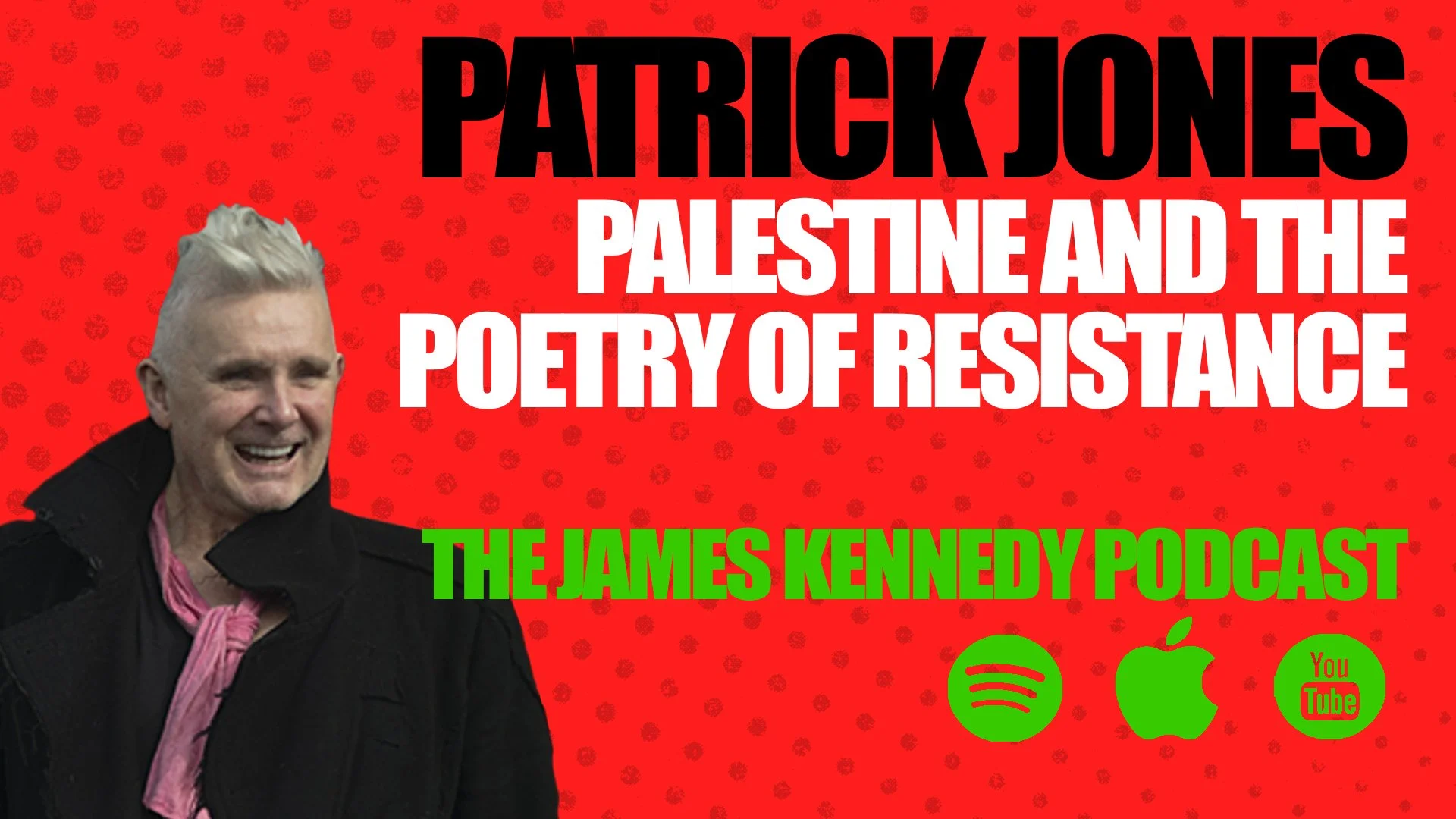
PATRICK JONES - PALESTINE AND THE POETRY OF RESISTANCE
Welsh poet Patrick Jones joins James Kennedy to discuss Palestine, poetry and resistance. They explore Patrick’s 2023 visit to Palestine, his new poetry collection Antidotes to Dissolution, politics and the role of art in affecting change and healing wounds.
James Kennedy Without further ado, we are joined today by the poet, playwright, activist, style icon, fellow Valleys boy, and all-around awesome human, Mr. Patrick Jones. How are you doing, sir?
Patrick Jones Hello, James. Lovely to be here. It's my first sort of podcast for years to have a chat with, so I'm a bit excited, a bit nervous. Obviously, you worry about what we're going to talk about, but yeah, not worried so much, just like, how do we cram it all in because there's so many things.
James Kennedy That's the problem, yeah. I think we're not going to be short on topics, but we might be shorter on time. Yes, well, the center of the conversation today is going to be centered around—you have brought the world another glorious collection of beautiful wordplay, fire, rage, truth, despair, and hope in poetic form, being released in October, called Antidotes to Dissolution. Tell us all about this new gift you're bringing to the world.
Patrick Jones Well, thank you for that description of it, James
We've decided now to do it as two books because, thematically, they're very different. Richard, publisher at Parthian, after he had read the first book, he said, "Oh, I needed a break. I needed a rest," because they're all about Palestine and the ongoing genocide.
So, yeah, I was thinking corollaries, not so much literary-wise, but I was thinking, "Oh, Use Your Illusion I and II," you know? We won't sell as many as that. Also, I didn't realize that Bruce Springsteen did Human Touch and Lucky Town; they were going to be one album, and they were released on the same day. If you look at the artwork now, you can see they correspond, right? I'm not a huge Springsteen fan, but I like some of his Nebraska sort of era.
So, sorry to go off about that. The style of these two books, Antidotes and Disruption—Part One: The Heart is a Security Risk, Part Two is called Hold This Dust—because the last couple of years have been quite a personal journey myself with grief, coming out of toxic relationships, surgery—which is a poem you might have come across in the second book about the surgery, which sort of links in with the rise of the right-wing fascist elements we've got to exist with at the moment.
Of course, the main inception was my time in Palestine in June '23, occupied West Bank, where I went with my husband and my wife. We went to Martin Joseph's charity and the Amos Trust, and we met the most beautiful people I think I've come across on this earth. There was no fake stuff when you go. It wasn't a holiday, I got to say that. But when you go on holiday sometimes or abroad, you're faced with this overly nice welcoming thing from the indigenous people because they want to sell you something, essentially, in that. Whereas Palestinian people just welcomed us into their homes, their community spaces, their streets, their shops. There was no pressure like that.
And the stories that they told us—really, because, probably like you, I thought I knew what was going on over there, James, from the news and trying to be self-aware. You go in through Tel Aviv airport, and straight away you know what's going on—this apartheid, occupation state.
Then we met with the Palestinian people—just ordinary people, taxi drivers, shoppers, shopkeepers, people who are working in the arts, tour guides—and then you start hearing these stories, and you just think, "Oh, I didn't realize it was as it is," if you know what I mean.
So, I started writing then. One of the main things is because, leaving, I suppose we felt a bit like, "For years we're going back to Wales; we're not going to be shot at, or our water tanks shot, or our electricity turned off, or our children imprisoned for no reason," so we felt a bit guilty. I said, "Well, what can I do as a writer?" Many people just said, "Please, just tell our stories." I just thought, "That is it. That's all I can do. I mean, I'm not a politician."
So, that book came from the time when I was there, and then, of course, what we've witnessed for the last nearly three years now—which, again, is a huge subject we could spend hours talking about. Every day in the news, there's something. Look at the Ed Sheeran and Macklemore situation that has just erupted there. Then you see—I didn't know Robert Kraft, didn't even know the name to be honest, owned these stadiums, huge Zionist supporter—and it's just every day there's another chess piece.
In a way, my book is like a chessboard, putting all the pieces together to make sense in my head. Because, probably like you, I still talk to people about it, and they come back with the stock answers, "Oh, I always sided with Israel; it's written in the Bible," and you just think, "You've got to believe that shit for a start."
Then the rest of it, so I feel I'm banging my head against the wall. Words to me, in my way, like music to yourself, are how you make sense of it, put it out there, and let people deal with it, you know? So, sorry for that long rattle.
James Kennedy Beautiful, beautiful. I mean, what a story for a start. I can't imagine what it would be like being over there; I've never visited the area. I'm very passionate about the subject, as you are, and I think that would be a lot in both ways. I mean, like you said, the amazing people that you met, and you describe it so beautifully in the poem The Heart is a Security Risk. I love that. I've heard you read that, and it's a stunning piece which really does capture everything beautiful about the people, the place, and your visit.
But like you say, coming home and knowing what you're leaving behind, and coming back to your safe, lovely green life in the Valleys—and the situation out there, many of the people you met are probably no longer with us anymore—that must have been such a difficult, bittersweet, heart-wrenching paradox of an experience.
Patrick Jones Oh, totally, James, yeah, it was. Because you have such beautiful times there, talking, sharing drinks and food. Palestinians are so generous with food-sharing and that communal spirit. Then we come back, like you said, to our little world, leaving behind that they've still got to deal with those snipers on the edge of their home streets. Their villages are blocked off, like Blackwood would have a gate on it saying, "No, you cannot leave, or you cannot go into your hometown," and there's nothing you can do about it. Because, as you know, you might phone the police, or the army turns up, and there's only one side they actually support, obviously.
Psychologically, that must be—I don't know. Martin Joseph has got a beautiful song called The Luxury of Despair, and that came from a quote from someone he met over there. Martin said, "I don't know how you cope. How do you cope with this?" And he said, "We do not have the luxury of despair," meaning they just have to carry on.
You know, that word "resilience" is used, usually by middle-class people in arts projects, but that is true resilience, not having a choice or just giving up. So, words are my only ammunition, I suppose. That's all I've got to sort of fight back and speak about it.
When I came back in June 2023, July, I did try to speak about it—got in touch with WalesOnline, Nation.Cymru, many different outlets, and no one was interested, didn't want to know at all. I don't know why—maybe because I wasn't Michael Sheen, perhaps. People didn't... Now they do. I think Nation.Cymru are quite engaged in being witness to what's going on, yeah.
But it was interesting at that timeline. Again, I just thought, "Oh my God, I'm going mad." I almost thought, "Perhaps I didn't see what I saw," because people who I would talk to would sort of—it's like gaslighting. It's like gaslighting in a relationship; you feel as if you were going mad. "Oh, I saw that. I saw that Palestinian tour guide not allowed to walk down his home streets in Hebron by an IDF 18-year-old female soldier who had all her nails painted. She said we can walk down, but he couldn't." You just think, "This can't..."
I think I live from my heart, I work and create from my heart, and that just really upsets you. It's upsetting me hearing about it, and I know it's going on—we all know, and worse.
James Kennedy Yeah, and much, much worse. We all know, but just simple things like that—it's just the inhumanity of that that people have to live with every day is just brutal. But as you say, we have the—how did Martin describe it, the privilege of despair? Was that what it was?
Patrick Jones We have the luxury of despair, yes.
James Kennedy Right, they don't, yeah, exactly. So, that's how I feel. I have the luxury of feeling that way, but there's also the frustration of knowing, "What can I do?"
It's beautiful that you've sort of confronted that in both visiting and seeing for yourself the reality on the human, everyday level, but also expressing it in such a beautiful and powerful way. You're not fucking around in these poems either, you know what I mean? You're not pulling any punches, and there are facts in there as well, and figures. You're not sugarcoating this issue or dressing it up at all.
There's the poetic side where you're dealing with the heart and soul and the humanity of the issue, but then you're also tackling the political and the military issue as well, head-on. So, hats off to you. I mean, it's poetry, and it's beautiful, but it's also very, very powerful on an issue that is very real right now. Thanks, James.
Patrick Jones Yes, yeah, you're right. I didn't try to be overly abstract because some of those instances and issues they dealt with, I couldn't deal with them in a highly abstract sort of way. I never compromise, I suppose.
They are poetic images, and one does again feel a bit guilty about being poetic-wise as opposed to a hard-edged newspaper journalist article, but that's my currency, poetry. I don't want to confuse people; I wanted people to feel what I felt when I was there, and to try and bear witness to what we've been witnessing as well. It's streamed in 24/7, isn't it? It doesn't seem to touch many people. One has to live one's own life as well, of course, because it would drive you mad.
There's the poem And They Know Their Names, which is about all the children murdered in Gaza since October 7th—over 23,000 children, all those beautiful lives wiped out. What can I do to change it? I can't, but I can write a poem about it, speak about it.
I also saw on Instagram today, actually, it was about an organization called "Stitch Their Names," where they're stitching every single name of a child killed in Palestine on this massive tapestry. You can imagine how big this is. They were also saying that they had been attacked or banned somewhere because of anti-Semitism, just because they're bearing witness.
So, yeah, we all play our tiny little parts, I think, in it. But things are changing in many ways. I don't know what you think about that...
James Kennedy Well, I think things have changed, certainly on the narrative front this past week. I mean, we were chatting beforehand, and obviously it's inevitably going to come up in a conversation on this issue, what's happened this week with Ed Sheeran. It seems kind of like a different world to anyone that's actively engaged in and aware of this issue like we are, just to be talking about who gives a fuck what Ed Sheeran thinks about it.
It kind of does raise the issue for me as to the role of the artist and the role of art in exposing the crimes of our times. That was one of the things I wanted to ask you, obviously. You've kind of already answered how you feel about it with what you do, but I do think that it has massively amplified the issue in the mainstream arena. Whether people agree or don't agree, I certainly think the narrative has been amplified this week because of the fact that Sheeran's been kicked into it. What do you think about that?
Patrick Jones Oh yeah, totally. I think it's totally backfired for all of them involved because they tried to oust Macklemore. When you think of it, two words: "Free Palestine." So, does that mean if you're against that, you want Palestine imprisoned, occupied, destroyed, eliminated, really? To me, that's the hate speech that we should be addressing. "Free Ukraine"—everyone wants that, so rightly, people can talk about it. If you say "Free Palestine," it's almost like a dirty phrase, but it's not, of course. We're made to feel that.
The ramifications, you're right, I think it's made people who haven't been engaged in it or who don't know what's going on maybe look into it deeper. I do think that the State of Israel doesn't want people to know what's going on; it's a covert operation. As soon as people see it, I do think then, unless they're totally inhumane or so far-right or brain-dead, they think, "This is wrong." If you've got young people talking about it, maybe in the future things can change, and they're not going to put up with it, perhaps, and they will know more.
Like you said, the narrative has changed. Then you had two weeks ago with Ed Miliband's speech, which I thought was very measured and really made a statement. Good for speaking out about this.
You've got these tiny little parts of the jigsaw coming together, and perhaps there is a sea change in how we are viewing it and what people are prepared to put up with anymore with the gaslighting. So, I think it's a good thing that we're able to do that.
I take a little bit of hope—I don't know if you saw, his name is David Miller, and he was a professor...
James Kennedy Yes, yeah, he won his case!
Patrick Jones He won his case, that's right, so we're getting these small victories.
James Kennedy We are getting them, yeah, yeah, I totally agree. I mean, it's not enough, but like you said, we've all got to do our little bit, and all those little bits do make a difference, you know? If only just keeping ourselves fucking sane through having to witness this, you've got to get it out of you somehow, and you've done that beautifully in this book.
I'm going to keep coming back to the book because, obviously, we're talking a lot about Palestine—as we should, as we all should—but we do want to remind people that you're expressing this issue beautifully in this amazing book which will be out soon. We've got to do a little bit of promo as well, trying to straddle the line between talking about Palestine and promoting a book.
Patrick Jones Yes, yeah. I'm looking forward to getting out and doing some readings and sharing these poems. Again, no holds barred; I say it as it is and as I've written them, and whatever unfolds, unfolds, you know?
James Kennedy Well, I was going to ask you if you wouldn't mind reading us a little from the book—a short one, maybe, whatever you're comfortable with.
Patrick Jones I'll get my old glasses these days.
James Kennedy Could this be a podcast debut from the book?
Patrick Jones Yes. I thought you might have—"liked" is the wrong word, but gravitated to it. You probably know Alternative Ulster by Stiff Little Fingers, yes? Did you know that?
That has always been one of my favorite songs from 1979, I think. It just came to me one morning about the oppression in Northern Ireland, and Gaza, and Palestine. Anyway, the words sort of came out there. I'm practicing on guitar, but I don't think I'll get there—it's quite a simple guitar one—but I think I'll keep it quite short for the podcast.
James Kennedy Thank you, thank you, appreciate it.
Patrick Jones That's okay. Let me see what we got.
I'll do this one. It's called Khalas which is an Arabic word which means "enough," like a real scream of "enough." I wrote this because I was doing a lot of marches and protests and rallies, and sometimes people ask me to read a poem and you need something quite direct. A couple of the songs on your album almost become like chants, and you need that rhythm. So I wrote this based on that; it's quite short and direct.
I'll share this, okay?
Khalas
This desolation, appropriation, isolation, occupation, demolition, forced migration. They are violation, exploitation, condemnation, or conversation, representation, or recognition. This zionization, dispossession, segregation, colonization, demarcation, starvation, this militarization, annihilation, this immolation. Where is the mediation, de-escalation, solutions, revolutions, prosecutions? There must be sanctions. There must be sanctions. There must be sanctions. There must be sanctions. Resolutions, a cessation, a constitution to build a coalition, a foundation for emancipation, self-actualization, cooperation, and transformation for this brave, battered, and beautiful nation.
James Kennedy Absolutely stunning, love it. Beautiful, so powerful and so true.
ENJOYING THE CONVERSATION?
GET JAMES KENNEDY'S LATEST INTERVIEWS, WRITING AND LIVE SHOWS STRAIGHT TO YOUR INBOX.
Patrick Jones All those words, when you think about them—my God, they all, in my opinion and yours I'm sure, encapsulate so much of what has gone on and is going on.
James Kennedy Nothing else needed, just those words. You've just encapsulated the whole issue. Beautiful, stunning, thank you.
Patrick Jones On the album, I got a lot of sound samples on that one, with the UN Commissioner who opens it up, and it ends with a speech from a Palestinian oud player based in Cardiff, Salih Hassan. He does a short speech at the end of it which gives me goosebumps.
James Kennedy There's a spoken word version of this coming out as well?
Patrick Jones No, it's on the album, The Constellation of Sorrows. I think you got it.
James Kennedy Oh, I did buy that! Where the fuck is that?
Patrick Jones You forgot about it!
James Kennedy I hope it didn't die in my car, because it's a CD, isn't it? I bought a bunch of stuff for the last one. I've got the book Fused by my bedside, which I dip into now and again.
Patrick Jones I'm not testing you, don't worry!
James Kennedy Well, you've just reminded me! I've got to hear that, man, because I put the CD in my car, and I was wondering where the fuck the spoken word stuff was as I was preparing for the podcast. My last car had a bunch of CDs in it, and it blew up. The car actually blew up! I was doing a concert, and I came back, and it looked like it had been firebombed on the side of the mountain. Everything in there got destroyed, and now I have a feeling it might have been in there.
Patrick Jones Okay, well, that's the best excuse ever, yeah!
James Kennedy My car blew up!
Patrick Jones I'll send you another one anyway.
James Kennedy Oh, thank you so much, I appreciate that.
No, yeah, because your readings are amazing. I've heard you read live a few times, and one of the things I was going to mention as well: for me, with poetry, obviously we all read things in our own voice, but when you hear something live, it's a bit like when you hear an album by a band—you don't quite get it, but then when you go and see them live, you're like, "Oh fuck, this is the best band in the world."
I feel like that with poetry, and when you specifically read your own stuff, it carries a whole different energy and dimension to it, which makes the whole thing make so much more impact, you know what I mean? That's how I feel when you read, so I've got to hear that for my own personal enjoyment.
Patrick Jones Well, thank you. I agree about spoken word. Poetry does come alive, or it fails on its arse. It's that engagement with that live poet reading. If you feel they believe in it and care about it, I think it conveys. People have said, "Oh, you sort of rant on," or "You do this," and I just do it the way I have to do it, really.
It's like the way you perform. Someone can say, "Oh, James, slow down a bit," but it's you, isn't it? That's all I've got, that's how I do it.
James Kennedy True artists, yeah. I've been to so many poetry readings where I'm almost nodding off. It sounds terrible, but yeah...
I was talking to—do you know the comedian Mark Thomas? He was on the podcast, and he's doing a play at the moment. We had this exact same conversation about stand-up and the theater. He was like, "I don't want to have a play or a stand-up routine that people are just sitting there politely applauding. I want them to walk out feeling like they've been punched in the fucking stomach, you know what I mean?"
I was like, "Yeah, yeah." It's the same in stand-up, poetry, theater—having that oomph, because these are sort of almost considered to be highbrow arts, aren't they, oftentimes? So what you're doing is like fucking rebel poetry; it's like punk poetry, you know?
Patrick Jones Well, thank you. Exactly, without compromising. I don't do it as a fake thing; it's just how I do it. But so many poetry people, it's as if it's just going through a routine for them, and they almost want to confuse the audience. I don't know if that should be it.
James Kennedy How clever they are, yeah.
Patrick Jones Yeah, exactly. So I do it my way. I'm too old to go any other way.
James Kennedy Well, you've been consistent, and the fucking fire hasn't dimmed in how many decades you've been doing this?
Patrick Jones Oh yeah, I don't think I'll ever retire. People talk about pensions and all that—well, I don't have that luxury. On my dying day, I'll be picking up that pen.
James Kennedy Love it, love it.
Going back from your dying day to where it all started, I want to ask you what your influences were. Do you mind if we mention your brother, because your brother is, of course, Nicky Wire from the Manic Street Preachers? For those who don't know, he's also a very literary-interested figure as the lyricist of the band—a lot of heavy, highbrow references in the Manics' lyrics as well: Primo Levi, Sylvia Plath, Miller, all those guys.
It makes me wonder what your home life must have been like growing up with you both having that interest. Was that a result of your parenting or the household in some way, or was it just coincidental?
Patrick Jones We were a working-class family from Blackwood. My dad worked; my mum stayed at home. In those days, in the '70s, money was always tight. We never had a foreign holiday—two weeks, maybe, in West Wales or Cornwall, very simple things, which gave us a good grounding. That's what I've tried to do with my own children.
I have a saying: "Live small, think skies." When you say that, it sounds a bit like a David Brent quote, but I really believe in that—keeping things small. When people talk about millions of pounds and all that, I find it absurd.
Going back to your question, we had a very simple, grounded, working-class upbringing. My dad was self-taught—he left school at 14 and loved reading, so the house was filled with books. But we weren't gently pushed into things. I remember when my kids were young, I was always like, "Oh, try drama," or "There's a dance thing going on." These days, people have schedules for their kids, don't they? We didn't have any of that, really. Maybe I went to a youth club once, but I didn't like the funny smell in there; I never liked joining things.
Me and Nick talked about it—that part of finding your voice was being bored, just staring at a wall for a couple of hours. It's hard to understand or explain these days, isn't it?
Nick had his thing—music was more his vernacular. In an organic way, we just found ourselves raging against things. I had been bullied in school, and I always remember this sense of being really scared of being myself. I wasn't a very good fighter, so I never really fought back, but I built up revenge narratives in my head. Some might have been violent, but they came out in words in later life. I couldn't understand why someone would do that sort of thing. I was quite innocent in many ways, so I went through a strong sense of injustice at a young age.
I was always watching, observing, standing back a bit. The artist sucks the world in like a sponge.
My mum was a vegetarian before it was cool to be a vegetarian in the '70s. My dad always read. We weren't far-left; we were quite centered, really, just about the basic things of life—looking after people, paying your bills, living simply. My parents never had a credit card, for example.
I'm not a rock and roller, really; I'm quite simple, but my head is bursting open with ideas and a sense of injustice, and I had to write about it. Nick made his music and his songs. Of course, James, Richey, and Sean—they had their band. They never let me join! Bastards! They said I was too fat and too ugly, and fucking look at the state of them now! Who's laughing now? But no, they were right. I can play a D chord with a hammer-on, and that's it.
James Kennedy Yeah, well, they're an interesting band because the lyrics are such a big part of what they do, and there are not many bands out there with these literary references. Apart from precursor bands like The Clash, who are clearly an influence, not many bands are so open about the politics and the literature. I find it interesting that the household that cooked Patrick Jones and Nicky Wire is not the household you're describing, which is fascinating.
Patrick Jones Yeah, that's right. Education was a big part. I remember when I was 17, I had this girlfriend who said, "Why don't you leave college, get a job, and come live with me in Risca?" I remember going back to my parents, and at the time I almost did that. My mum said, "No, we're not allowing you to do that. You carry on with your studies, then you can decide."
Of course, she was right. You've got to see the world and break out a little bit. I went off to university to study literature at Swansea, which definitely broadened our minds. Going off to Swansea, living there, going to the library—it was a love of learning.
Nick's lyrics were almost little manifestos built from what he was reading, which they all brought, and then Richey came on board with his style of writing.
I don't quite know where it came from, really. When you think of Blackwood in the early '80s, there was the miners' strike and the sense of Thatcher crushing communities, which filtered into our DNA—this sense of, "My God, we're being crushed."
When you look at the Musks, the MAGA movement, the whole lurch to the right and laissez-faire government—40, 45 years ago, the seeds were planted. We didn't know it at the time; miners were living in fight-or-flight, but a lot of things were planted there that have grown now. Sorry for my long-winded answer.
James Kennedy No, I love it. I think it's fascinating. It's the cultural times that you were both seeded from that have led to this.
Patrick Jones Yeah, because you were a bit younger, obviously. You were about what, 40, James?
James Kennedy I'm 46 now.
Patrick Jones Oh, you look a lot younger than I am!
James Kennedy I get that a lot, yeah. I tell people, "You want to see the painting in my attic? It's fucking horrific."
Patrick Jones So, a similar generation—well, you are like 15 years younger, obviously. Where did you grow up?
James Kennedy Well, I'm a bit of a mountain goat. I was born in Cardiff, raised in Barry for about nine years—I remember the Poll Tax riots and stuff—then moved to Pontypool, then Caerphilly, then Cardiff, and now I'm in Aberdare. So, kind of all over the place, really. A Valleys boy, for sure.
Similar background: working-class parents, a lot of books, a lot of Tony Benn, a lot of anti-Thatcherist sentiment, a lot of rock and roll in the house. So yeah, I can see how that could have produced Patrick Jones and Nicky Wire, for sure.
Patrick Jones Thanks, yeah. One of our neighbours had grandchildren who went to public school up in Bromley. A couple of years later, when I was trying to be a writer, I asked, "Oh, what's Mark doing?" "Oh, he's gone off to Devon to become a writer." Basically, he was quite upper-class, and it almost seemed like a good career move.
Whereas I had been writing for five years and no one gave a shit because I was just walking up and down Blackwood High Street. The class differences in me saying I was going to be a writer compared to someone who had gone to a posh school were astronomical.
I don't want to become a victim, but being a writer in the Valleys saying you're going to be a poet, people did think you were weird and just wanted to avoid work—probably the same as a musician. Whereas if you say, "I'm going to be a boxer or a rugby player," everyone goes, "Well done!" Poet? Fucking mad! You're weird. So, maybe I'm going to carry a bit of a chip on my shoulder: "I am going to show the bastards." At 61, it should be gentler on my shoulder now.
James Kennedy No, no, no! Because it's feeding into the work. There's nothing worse than those artists that get too comfortable and the work starts sucking. We hope that you're going to be burdened by that chip for many more years to come. Keep this good stuff coming!
Patrick Jones I hope so; it feeds me. Our environment shapes our artistic creation. I was always inspired by Idris Davies, who wrote For the People, you know?
James Kennedy Right, I was going to ask about that—who were your influences when you started out, and who are still influences now?
Patrick Jones Quite a smattering. I started going to Crosskeys College when I was about 16 or 17. Music was a huge influence—and you might be surprised to hear this, because they're not exactly on the left wing: Rush! They were deemed a little bit Ayn Rand and all that, but I just loved the music, the fuzz pedals, the wah-wahs, the choruses, and the concepts of Hemispheres. Juxtaposed with Stiff Little Fingers, Billy Bragg...
James Kennedy Musical influences that influenced your poetry?
Patrick Jones Definitely. When I went off to university, I discovered all these literary works. I discovered the Beat Generation writers.
James Kennedy I can see some Ginsberg in there, for sure.
Patrick Jones Definitely. Ginsberg, Kerouac, Emily Dickinson... I remember reading a fantastic book by Ralph Ellison called Invisible Man—an amazing story of Black America and being a rebel, like your album title. Maya Angelou...
Kerouac made writing accessible to me and made me think, "My God, you can walk down the street, you can go up a mountain, you can write about what you feel, and that's literature." Before that, it was The Rime of the Ancient Mariner or Kingsley Amis—esoteric, abstract stuff I couldn't connect with. On the Road, I can't read that now—it's a little bit adolescent—but anyway.
Poets that wanted to say something alongside non-fiction books like Frantz Fanon or Paulo Freire in South America—Pedagogy of the Oppressed, what a brilliant title about how education can save us.
A pivotal moment was seeing a poem called V. by Tony Harrison. It was about him visiting his father's grave up in Leeds. He was a Yorkshire poet, working-class. It was about all the conflicts that existed, from football rivalry to class war to world ideologies. It was on Channel 4 late one night, and I thought, "Oh my God, that's poetry as well."
Even today, I'm always rooting out new things. You've got to keep developing your map in life. Who's inspiring you at the moment?
James Kennedy Oh, man. Just opening the window and looking outwards has always been the way for me.
As you mentioned, the title of our new album, Rebel, actually has a literary connection: it's inspired by the book The Rebel by Albert Camus. I fucking love that guy; he's my hero.
All of the lyrics are inspired by the works of Camus in the sense of literal rebellion against the issues and injustices of our times, but also rebelling against the absurdism of the human condition. The song The Rebel on the album is more about rebelling against the enemy within—the internal demons that we have to wrestle with every day.
The whole album is inspired by that concept of literal rebellion and personal rebellion against the existential turmoil of being alive. It's a very punk rock, shouty, "four chords and the truth" kind of album on the surface.
Patrick Jones Yeah, it's a bit more than four chords, really! It's a great little riff. I love how your voice takes us on different journeys. You remind me of Serj Tankian from System of a Down—quite operatic. Rage Against the Machine is definitely an influence, would you say?
James Kennedy A hundred percent, favorite band.
Patrick Jones You're unafraid to speak your truth on that album, which was so refreshing to hear in this age of tepid "oh, don't go there."
Going back to The Rebel, it's one of my favorite books. I've got a copy here where I underlined bits.
James Kennedy It's not an easy read. Of all his works, that was the one that took me the longest, but by the end, I was like, "All right, I get it now." But it did challenge me.
Patrick Jones Me too. Me and James really loved the Camus books—The Plague, the brevity and simplicity of The Stranger. He wrote so many essays and plays.
James Kennedy I've read pretty much all of them. What a visionary, and died by my age!
Patrick Jones It's amazing when you think what he achieved and the depth of his intellect. He was a working-class boy from Algeria with a single mother.
James Kennedy She was deaf or mute, with no money at all.
Patrick Jones He really connected with young people, which not many writers do these days. Great inspiration.
Speaking of existentialism, I'm going to try to do a clever segue now and bring it back to your amazing new book. The second part of the book steers away from your thoughts on the genocide in Palestine and deals more with existential issues and universal themes of the human condition—from death and existentialism to the simple pleasures of Hobnobs dunked in tea. Is that a fair analysis?
Patrick Jones Yeah, that's a good juxtaposition of the simple pleasures of life that can armor us.
Post-COVID, I talk to a lot of people who have gone back to the basics of looking after their mind and finding a sense of protection. From the simple thing of gratitude—I never thought about how gratitude can affect your mental state—to sea swimming. It sounds a bit New Agey, and it makes me sad that it's been monetized—breathwork costing a thousand pounds, when you can just go up the mountain.
These poems are about trying to control what you can, because it's hard to control war or what's out there. But our reactions, our physiology, and our mental state—we've got to retain our agency over that. The second book is about saving yourself, protecting yourself, and staying sane through all this overwhelmingness from the outside.
I had a few very toxic relationships that really damaged me. It was quite hard to disentangle and find myself again from being involved with controlling people. I wrote about it to try to make sense of it, and I started seeing connections between a controlling relationship and a controlling governmental structure. These tactics people utilize to contain power and keep people in a state of fight-or-flight are very similar.
James Kennedy That makes total sense to me.
Patrick Jones It opened my eyes a bit. By writing about it, I try to bear witness so other people know they're not alone. You do not have to put up with controlling, coercive relationships where you feel humiliated every day and embarrassed to be yourself. It took me until 61 to get to that point—I wish I knew 30 years ago.
A lot of it is dealing with losing my parents within a year of each other in '18/'19, trying to bear a little testament to their lives. It's about not giving up. The "antidote to dissolution" idea is: what are the antidotes? What makes us give up, and how can we transcend that and not submit—whether it's a domestic coercive relationship, or Donald Trump and Netanyahu making us afraid that we're going to be destroyed or imprisoned for speaking out? Similar tactics. How do we survive that? Did I articulate that very well, James?
James Kennedy Honestly, yeah, it's stunning, and it's such an important thing to give to the world right now with everything going on. We're all struggling to make sense of things externally and internally. There's so much information and misinformation. Staying tethered to the simple things that make us human and get us through the day—articulating that through beautiful wordplay is much needed right now.
Patrick Jones "Tethered"—that's a great word. It's like an anchor, being tethered to the good things of life that sustain us.
Tethered by good people around us. Beautiful things are happening. In Newport recently, I went to something called the Repair Café—so nourishing in there, and people aren't trying to rip you off. I took my vacuum down there, and there was a human connection with a lovely retired person fixing it while you make a donation. It's like we're going back to capture something we had lost.
With the whole AI thing, we'll be handing over our cognitive agency, but that human interaction is so vital. I know you've had mind-body experts like Rowan Hooper on your podcast...
James Kennedy Rowan Hooper has been on, yeah!
Patrick Jones So you were interested in that side of life as well.
James Kennedy A hundred percent, yeah! That's what this podcast is: trying to do concise hour-long conversations with people who are helping us navigate this crazy thing called life—whether it's health, mental health, the arts, Palestine, or AI—people who can help shed a little bit of light. You do that with a massive bonfire of poetic fury and rage, and we love it.
Patrick Jones I try. It's all I can do, really. I'm too old to try to retrain my poetic mind to appease the establishment.
James Kennedy No, fuck those guys!
There's a lot of love, humanity, and hope in the book as well. It's a very balanced book that doesn't pull any punches, but it's beautiful to read and covers the full scope of the human experience.
On that summary, I'm going to plug it once more: Antidotes to Dissolution is out on October 5th and is available to pre-order right now. I'll put a link in the show notes so you can click it and grab it straight away.
Patrick, I know I can't keep you all day, but you're a wonderful gift to our culture, humanity, and the fighting of the good fight. We appreciate you, brother, and long may your flame continue to burn bright, my friend. Thank you for joining us.
Patrick Jones Thanks, James, lovely to chat to you.
James Kennedy You too, brother. Best wishes with the book.
Patrick Jones Thank you, man. Bye-bye.
Key Points:
Poet, playwright, and activist Patrick Jones joins the James Kennedy podcast to discuss his forthcoming poetry collection, "Antidotes to Dissolution," out October 5th on Parthian Books.
The collection is split into two books
Jones describes his June 2023 visit to the occupied West Bank with the Amos Trust and Martin Joseph's charity, where Palestinian people asked him simply to tell their stories.
He explains that his poetry serves as his only ammunition against injustice, combining raw political facts with heartfelt human testimony.
Jones discusses how the mainstream narrative on Palestine has shifted, citing the Ed Sheeran controversy and David Miller's legal victory as signs of change.
He reads his poem "Khalas" (Arabic for "enough"), a direct, chant-like piece written for protests and marches.
Jones reflects on his working-class upbringing in Blackwood, his brother Nicky Wire of the Manic Street Preachers, and the books and music that shaped him.
The second book explores how tactics of domestic coercive control mirror governmental control, and how simple pleasures and human connection can act as antidotes to despair.
Summary:
In this episode of the James Kennedy podcast, host James Kennedy speaks with Welsh poet, playwright, and activist Patrick Jones about his new two-part poetry collection, "Antidotes to Dissolution," released on Parthian Books on October 5th. The conversation centers largely on Palestine, with Jones recounting his June 2023 visit to the occupied West Bank alongside his husband and wife, where he met Palestinian families, tour guides, and shopkeepers whose stories compelled him to write. He explains that the collection's first book, "Heart is a Security Risk," bears witness to the genocide and the apartheid conditions he witnessed, while the second book, "Hold This Dust," deals with personal grief, toxic relationships, surgery, and existential questions of survival.
Jones reads his poem "Khalas," an urgent, chant-like piece meaning "enough" in Arabic, and discusses how poetry and live performance can convey political truth in ways conventional media cannot. He also reflects on his working-class upbringing in Blackwood, the influence of his brother Nicky Wire and the Manic Street Preachers, and the writers and musicians who shaped his voice, including Ginsberg, Camus, and Billy Bragg. Throughout, Jones emphasizes resilience, bearing witness, and the small daily antidotes that keep us tethered to hope amid overwhelming injustice.
The James Kennedy Podcast is a podcast hosted by musician and author, James Kennedy. Exploring the big questions around health, social issues, politics, mental health, art, the human condition and how to navigate this thing called life through casual conversations with scientists, activists, rock stars, philosophers and academics. Please subscribe, leave a rating and support the show.