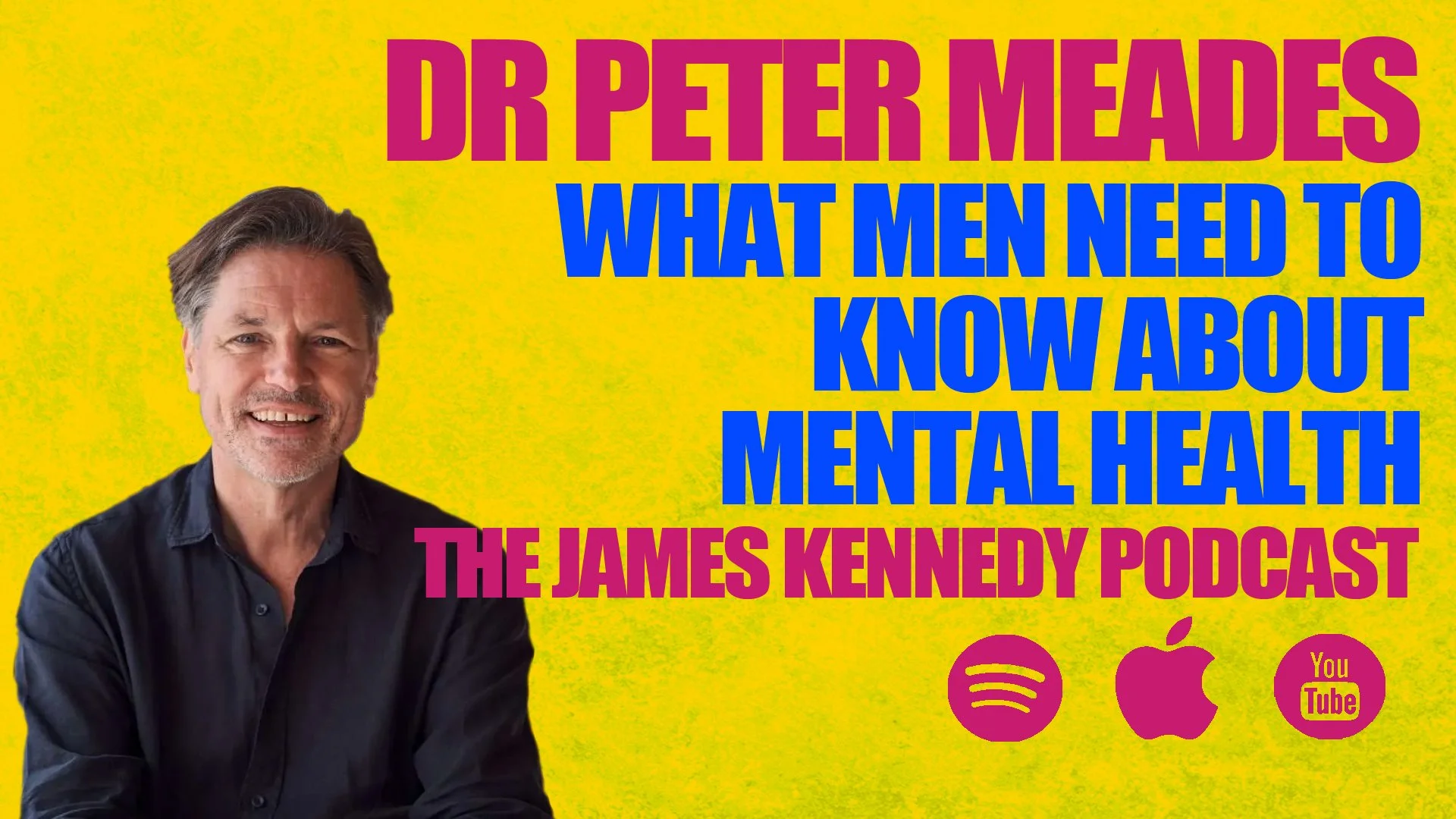
DR PETER MEADES - WHAT MEN NEED TO KNOW ABOUT MENTAL HEALTH
James Kennedy interviews psychotherapist Dr. Peter Meades about men's mental health and his book I'm Fine But Not Really. Together, they explore why men struggle to ask for help, masculinity narratives, practical exercises and techniques, that help and how friends and family can offer better support.
James Kennedy: Dr. Meades. Thank you so much for joining us. How are you doing, sir?
Peter Meades: How are you doing, James? Thanks for inviting me.
James Kennedy: Thank you for being here, man. We really appreciate it. I mean, I know that you're super crazy busy right now. The success of the book, which is amazing to see. It's a brilliant book, very much needed. So thank you for writing it. And before we jump into the book and some of the themes within it, I thought it might be useful to remind the listeners, why is it exactly that men in particular need a book about mental health?
Peter Meades: I think in a way when I was reflecting on who I wanted to write the book for, I realised there is a huge gap actually on the bookshelves for sort of men's mental health. In particular, and it just seems to be a topic that's kind of overlooked a bit. You know, we tend to think more broadly about sort of mental health rather than thinking that men have, they do have kind of particular sort of themes around their mental health that needs to be kind of addressed.
James Kennedy: Well, we do seem to have a mental health crisis amongst men right now, demonstrated by that truly disturbing fact that the leading cause of death amongst all men under the age of 50 is suicide. I mean, that is truly shocking. What are your thoughts on that? And is there a mental health crisis amongst men right now?
Peter Meades: Yeah, I think we have to be slightly cautious about sort of talking about men being in crisis very broadly, because men are not one kind of homogenous group, you know. So I don't think all men are in crisis. But I think for me, perhaps what the crisis seems to be more around the difficulty that men have in asking for help. And it's that kind of old, you know, the old joke about men won't ask for directions, you know. And there's some sort of truth in it, really. And I think that's what's problematic. If there's a crisis, it's that. It's a crisis of men not being able to ask for help or finding it very shameful or difficult to reach out and ask for help. But you're absolutely right about some of those suicide statistics, that they are very worrying. And certainly the fact that 75% of successful suicide victims or suicides in the UK each week are men. And like you said, under 50 is the worry as well. So, yeah, men tend to wait until they reach breaking point before asking for help. And I think if there's a crisis, it's that.
James Kennedy: Right. Very interesting point. Yeah. Why do you think that is then?
Peter Meades: I mean, there's lots of reasons, really. I mean, obviously, there are different factors, like sort of personality and culture and, you know, beliefs about independence, responsibility, that sort of thing. But, I mean, why is that? I think that men have been taught for generations and still continue to receive messages from being very young to kind of growing up that they have to be able to cope, that they have to be competent and strong and, you know, financially successful, sexually independent, sexually strong, successful, emotional partners, you know, emotional and gentle fathers. And so there's these kind of expectations on men that in some ways don't match the way that kind of the culture and society is changing, and it is changing rapidly. Yeah. So I think that there's a kind of tension and a pressure point there between those things.
James Kennedy: It's really interesting. Yeah, there's still, I think, we've still got one foot in the old traditional idea of masculinity, haven't we? And like you said, the world is changing very fast, and there's a kind of disconnect there between the world we're living in now and the values that we're still trying to conform to as men.
Peter Meades: Absolutely. That's it.
James Kennedy: Yeah, yeah. What are you seeing in your practice then? Because you've been doing this, what, 25 years or something like that, I think, isn't it?
Peter Meades: Yeah, I've been a therapist over 25 years. I worked in the NHS for 33 years and left a couple of years ago. And I think, you know, there are kind of recurring themes with men. The main point is that, you know, men are one of the smallest user groups of services. Right. So, by far. And we see men when they're much further down the line than women. Right. So women tend to be much better at identifying that they might need help sooner. So by the time a man gets, it's difficult to ask for help, you know, it's very hard to get to that point. It takes a lot of courage to actually walk through a therapist or a counsellor's door. But by that point, men are often experiencing thoughts that life's not worth living. They usually are getting around that kind of stage. Whereas we see women asking for help much sooner, you know. Right. So there's that. But the themes we tend to see are quite common are things like isolation. Men can become very isolated, particularly as they approach sort of the midlife. When relationships, you know, friends are marrying off and travelling or spreading away, moving away, that sort of thing. So it becomes more difficult to stay in contact with people. Shame is a huge problem. And shame, in some ways, is very different to kind of guilt. Guilt is more a kind of a belief that I've done something bad or I did something bad. Shame is a more core fundamental belief that I'm worthless or useless, that sort of thing. So that's a common thing. And actually, in the research that was done in the States, and here, looking at suicide notes that were left by men before ending their lives, that's a very common kind of language that's used. I'm worthless. You know, I feel useless. There's no point, you know. I'm a burden. Those sorts of things. Exactly. So work and meaning. You know, men get very caught up in kind of work in order to kind of build a life. But they get very kind of stuck in work. Work becomes the meaning for life. So there's a lot of kind of issues around work, work relationships, work stress, all that sort of stuff. And obviously, in midlife, when work is changing or coming to an end, there's obviously a lot of kind of identity issues around that that then come up.
James Kennedy: Yeah, it's a strange one, isn't it? It's like, for the most part, still, our whole identity is centered around what we do, you know. It is. It is. It is. Yeah, it's a tricky one, isn't it? Because, like, it's so distressing when you see that common use of language that is very, like, purpose-orientated or lack of, rather. You know, things like, I'm a failure or I'm a burden. It's very upsetting to think that people are feeling that way about themselves, isn't it? It is. It really is. So are you seeing any difference in that pattern and in the therapy room? You know, are you seeing more men coming in now? Are you seeing younger men, perhaps, or older men? Are you seeing any signs that things could be changing a little bit on that front?
Peter Meades: I mean, I am now, obviously, because of the book. I'm seeing a lot more men approaching me, which is great, you know. But I think that a lot of work has been done to destigmatize talking therapies and talking generally and being more open outside of therapy, because I'm not necessarily saying that therapy is for everyone. I mean, it's not. It's not the only route to self-understanding, but certainly it's a very useful one if you're able to engage with it. But I think that, you know, there are changes. I remember I was telling you earlier that I'm from Wales and I worked in Cardiff for some time. And I remember men would come to therapy like they were in the red light district in Amsterdam years ago. There was so much embarrassment. that someone might see them coming into the sort of therapy office or whatever. And that's changed. So I do think a lot of the work that's been done to destigmatize talking has improved the situation a lot. But again, like I said, the problem remains that men are waiting until they reach breaking point. Seventy five percent of men in a BACP survey recently that did eventually ask for help said they wish they'd done it sooner and they found talking therapy really useful. So there's definitely a lot of benefit for men when they do eventually engage, but it's getting men to recognize when they perhaps need to talk a bit sooner, really.
James Kennedy: Well, I can 100 percent vouch for it because I did CBT in my 20s and I absolutely loved it. It changed my life for definite. It gave me tools to understand it. It didn't fix everything. I'm still a work in progress. We always are, you know, but it gave me some really good tools which I was able to utilize still to this day and to understand the internal weather system and everything. And you know, what's the mechanics that are happening there? So I did it for about a year. And it really did affect me so I can 100 percent, you know, for all the fellows listening out there, if you haven't sort of thought about this yet or you're still on the fence, I can say from personal experience that it's 100 percent worth every second of it. So that's brilliant.
Peter Meades: That's really good to hear that. And there are lots of different types of therapy and it can be a bit of a minefield, really trying to find out who to see and how to, you know, I think that's half the problem, really. A lot of people wonder how do I get help or who do I see when I am asking for help? Because there's so many different approaches. There's so many different types of therapy and so many different therapists as well. So actually, if you know somebody that's had a successful experience of therapy, it can be a good thing to start talking to them and maybe ask them who they saw. And yeah, you know, personal recommendation is a good way in, I think.
James Kennedy: And also, I think you've got to be comfortable with the therapist as well, because I've had that exact situation where I've referred people and said, oh, you know, so-and-so was amazing for me. Here's their number and they go and they totally didnconnect with them at all, which is, I don't understand, you know, just different. So if that happens and you take the brave step to meet a therapist and you don't resonate with them, that's okay. You just need to find the person that you click with.
Peter Meades: Exactly, exactly, exactly. Yeah, it's really important that you feel safe and comfortable and, you know, able to open up really when you meet the person and that you feel that person is really listening and understanding where you're coming from. That's very important. If you don't have that experience in the first appointment, then it's probably not the right therapy for you. Yeah, don't give up. Don't give up. But I mean, you know, I sound like I'm flying a flag here for therapy and it is helpful. And you had a really good experience with it. It helped me. It changed my life as well. When I went into therapy quite early when I was sort of 18, 19, it made a huge difference to my life. But the reason I wrote the book is recognizing that a lot of men will never walk through a therapist's door. There's so many men that won't. Yes. I just thought it would be really useful to kind of draw on a lot of experience over the years, a lot of knowledge that I'd gained and put it into a book that can be listened to or read. A lot of men don't buy these sorts of books, apparently, which is not good for me, but they do listen to audio books. They do tend to buy more audio books. So that's a good thing. And it's another way of improving self-understanding really and getting some strategies to kind of help, you know.
James Kennedy: 100%. Well, we need to come on to this. We need to come on to the book because that is a perfect point you just made because I've currently got a copy of the book here, which I'm waving around. The book is excellent. And like you just said as well, we're not here to convince anybody that therapy is the only answer and the solution to that. What you've done in the book is brilliant because you can listen to a book when you're out, you know, on a walk on the audio book, or you can go to the gym or in the car or whatever it is. Nobody needs to know about it. It can be a completely private experience and the same with the book. And then maybe it can be a stepping stone, you know, once you've understood a bit more about what you're going through to consider other developments from that point onwards. But the book is interactive. I would definitely recommend I've done both. I've done the book and the audio book. I would recommend people definitely grab the physical copy because it is kind of an interactive workbook almost, isn't it? You explain a lot of what's going on under the hood and you give some brilliant exercises and things that people can actually engage with that make a difference in the moment. And again, this is something you can do in the car park, nobody needs to know. You can do it completely privately by yourself, but it will make a massive difference. So I appreciate you for doing the book. I think it's quite unique in that sense.
Peter Meades: Thank you. That's good. I'm really pleased that you found it helpful. Yeah, that's great. That's really great feedback. I mean, if it helps one person, it's job done for me, you know, it's music to my ears really. Because there are so many men struggling and I really do feel for them, when I work with men that eventually get to therapy and they're in such a bad way psychologically, you know, I think how many men there are out there that are not able to ask for help or go for help. And so I really hope the book is of help to people. I am getting some positive feedback coming through already to suggest that it is really being helpful and useful to people. So that's great. That's brilliant. It's really exactly what I aimed for.
ENJOYING THE CONVERSATION?
GET JAMES KENNEDY'S LATEST INTERVIEWS, WRITING AND LIVE SHOWS STRAIGHT TO YOUR INBOX.
James Kennedy: Yeah. A hundred percent. Well, it's simple to read. It's not a big dense trope of technical terms or anything like that. You can whiz through it and it's helpful in the moment. So yeah, fellas, definitely check it out. So talking about the book for those people who haven't got it and are still thinking, oh, bloody hell, I don't know where to start with all this stuff. Can you give us some of the more essential strategies from your practices or within the book perhaps to help people begin to understand what's happening in the neighborhood here, you know, what is the internal weather system governed by?
Peter Meades: The book is full of different kinds of practical exercises you can do, but the first chapter in a way is about owning your story. And I think that is very important because even though we kind of know what our experience has been, we very rarely stop and sort of map it and sit back and reflect on it, you know? So one of the key exercises I would suggest to start with is called the timeline and it's a really powerful exercise. I use it very often. I use it very early on in therapy when I'm doing therapy with men as well. And I suggest that what you do is get a sheet of A4 paper or bigger, if you can, bigger is better really, but draw a line right across the middle of the page. And that represents the timeline of your life. So horizontally divide the page into columns. I would suggest that you do that for every 10 years of your life. And then on the vertical axis going down the side, decide on a range of numbers. It could be 0 to 10 or whatever works for you. So above the line, 0 to 10, and then below the line minus down to -10. And then in those columns, just take some time to reflect on what are the kind of key moments in your life that stand out where something was impactful. It might be something very positive, an achievement, a success, or when something went really well, or a relationship that was great. And just plot all those things above the line. And then below the line, plot the things where your mood was low or things where you didn't feel so great, or there were significant changes in your life in a kind of more negative way, perhaps, or when there were struggles or challenges, and just plot those. And then stand back from that. Take your time doing that. You don't have to do it all in one sitting either. You can keep coming back to it and adding things to it, but then sort of sit back and reflect on it. And it's quite interesting doing that because when you take it out of your head and actually put it on a page like that, and you can look at it, you can begin to see patterns actually. And it's amazing what comes up for people, you know, so someone might sort of identify that every time the mood was low or something negative was happening, it was following a kind of relationship dispute or a dispute in work or a relationship breakdown or something like that. And then that might give you some kind of evidence of where you might want to be looking, putting your energy to kind of think about what was it about those particular relationships or disputation situations or work situations that resulted in my mood dropping to that level. And is there something around that that maybe I need to focus on or work on? But it can be a really interesting exercise to do that, you know, and also looking above the line. And I think it's really important to think about engaging in something new or travel or something like that that you can identify as a pattern that kind of lifts you up. So those sorts of things, that's a really good starting exercise I think.
James Kennedy: Totally. I'd never actually heard of that one before and it was really interesting to me to see that one because I've done quite a lot of self-development work. I'm interested in that stuff and I was like, oh, that's really interesting because stories are so important, aren't they? Now the narratives that we tell ourselves are often at the root of a lot of these things. I personally tell myself a lot of negative stories about myself: I haven't done enough, I'm not this, I'm not that. And then when you're able to take that big look at the whole of your story and say, oh, actually I'm all right, I've done some cool things, I'm a good guy. I've done my best.
Peter Meades: I've done my best. Exactly, exactly. That's right, exactly. So that's a really useful exercise. And then the other one I would say is quite a big one and an important one is called the interpersonal map. I don't know if you remember that one. And again, take a sheet of paper and draw three or four concentric circles, so like you've dropped a pebble into a pond and the rings are going out that way, so three concentric circles. Right in the center put yourself—so "me" or your name or whatever you want to put there. And then have a think about everyone in your life and start to map them on the page. Put them in relation to how close they are to you, not geographically but emotionally. So someone very close to you personally and emotionally put them right in the inner circle with you. And then the further away someone is from you emotionally, put them further out and just keep doing that, mapping everyone in your life. Use some kind of code. I suggest maybe a solid line when the relationship is strong, a dotted line if it's a kind of weaker relationship, and maybe a zigzag line if it's a kind of disputatious or problematic relationship. You might also want to put people on there that are not living anymore that are still important to you. It might be that you think about somebody a lot or talk to people that are not here now and map them as well, but put a cross next to their name so you know that they're not here. And then again, it's a process of stepping back from it, putting it on the wall or on the table and giving yourself some time to think about it and reflect on it. Because again, it's one of those things that we just hold in our minds. Sometimes men can think they're very lonely and actually when they start to map it out, they can see that their life is quite well populated and there are a lot of people in their lives. And then it's thinking about who in my life do I want to bring a bit closer and who in my life perhaps do I want to create some distance from, you know? So you can start thinking about those things as well. I think that's a very powerful exercise.
James Kennedy: Oh for sure, yeah, and there's tons more of these exercises in the book. I mean, the two examples that you've mentioned so far work for me because I'm very visually orientated and I think that when you can condense what seems like chaotic multi-layered noise entangled in your brain out onto a clear sheet of paper and look at it as a big picture and think, oh actually the answer is pretty clear to me now. And also the act of doing it as well helps to get it out of your system, to get it out of your head and onto the page. So yeah, the book is awesome because there's tons of these exercises, some will resonate with you, some won't, and that's great, you just find the ones that work for you and work on those, you know? But you're also talking in the book about the physical aspect of this because things like depression, tension, stress, anxiety, there is a very physical component to this which oftentimes we don't realize because for many of us it's just normal, you know? But things like pain, fatigue, headaches, tight chest, a bad stomach, all of these things can have and do have a very real connection to the physical aspect of what's happening in our head, you know? Absolutely, you explain that brilliantly in the book, and also the fact that the opposite is also true—there are very physical things that we can do when we're in the middle of the storm to help snap us out of it. So whilst we're on the subject of strategies, what are some of the physical things that we can do when we're caught up in the middle of that moment to help us hack the system?
Peter Meades: You're right about that and one of the chapters talks about the body and mind being one. I think you're absolutely right, a lot of men will go to see their GP eventually when physical symptoms get strong enough and often there isn't anything physically wrong, but actually it's an expression of struggling psychologically. GPs are quite in tune with that and will refer to therapists, counselors, psychologists when they think that's happening. But I think there is an impact and men carry a lot. It's a bit like having a backpack that you're constantly putting stuff into without ever stopping to take stuff out really. If you're doing that throughout your life, the backpack just gets heavier and heavier and heavier until men become completely overburdened and overloaded and they start to struggle. I think the breath thing is incredibly powerful. We don't think of breathing like that, we just think well, we just breathe, in fact we don't even stop to consider breathing because it's just something we do automatically. But the breath is incredibly powerful, and if we manage our breathing it has a direct effect on the vasovagal nervous system. Deeper breathing sends a signal to the brain that we are safe, that we're not in a state of danger. Shallow breathing sends a signal to the brain that we need to be prepared, that we need to be alert for danger. So stopping and taking a deep abdominal breath on its own changes the neurological signal to the brain about safety. So you shift from an emotional state of alertness into a state of contentment and safety. So it's a very powerful thing to do. Practicing mindfulness is an amazing practice, but it isn't for everyone, some people struggle with it. But I describe it a bit in the book because I think it's worth knowing about and I've seen the difference it makes particularly to men's lives when they do begin to engage with it. And what a lot of men think initially is, oh god, meditation, I'm not sitting on a yoga mat and that's not for me, you know? But actually when they realize that mindfulness is just about becoming present, coming into the present moment and just noticing, for example, your breath and noticing your breathing—is it shallow, are you taking abdominal breaths, and noticing stuff around you, noticing the colors, the shapes, the light, the sounds, what you can feel. Because sometimes we can get so internal, so much in our head that we forget that we're present with nature, with life around us. So stopping and looking at the colors of the leaves or the changing seasons, that sort of thing is incredibly important for mental health as well as physical health.
James Kennedy: Oh for definite, yeah man. I mean, there's some really basic, ordinary, normal stuff that we just don't get to do enough of these days because of the pace of our life and work and the system living that we live under now. But just things like stepping out and having a walk around the block by yourself, just catching five minutes of peace and quiet to collect your thoughts, you know? For me, like just sitting in the front seat of my car and just closing my eyes for a couple of minutes, doing some calm breathing before you go face first into the rest of your day or into work or whatever situation you're going into. Simple little things like that can just cool the system down a little bit, calm your head down. Or maybe you're a gym guy, I mean some people love to sweat it out in the gym and they feel great when they come out, you know? The physical side of things is very important and it can be something as simple as breath work, like breathing out slower than you breathe in so that you slow your heart rate down and things like that, that's very effective. Going for a fast run and just burning all that cortisol off, or just having a little lie down for 10 minutes man, you know? The physical aspect of this is very, very powerful because like you said, there is that connection between the body and the mind which is a very real thing.
Peter Meades: Yeah, that's it. While you're doing it, if you're sitting in the car as a good example, you can do a quick body scan as well. Starting with the top of your head, just pay attention to your body and notice each part of your body, starting at the top and going down through your shoulders, down through your chest, your abdomen, your spine, down through your legs and into your feet, and notice any tension anywhere. Just notice where you're holding tension, because different people tend to hold tension in different parts of the body. For a lot of people it's their neck or their shoulders or their legs or their back, you know? And just noticing that, and sometimes paying attention to your feet. We forget about our feet sometimes and just telling yourself: how are my feet, are my feet cold, are they hot? Just drawing your attention to your feet and then feeling your feet in contact with the ground is a very grounding exercise and can also take the body out of a state of danger and alertness and readiness into a state of contentment and relaxation.
James Kennedy: It's fascinating stuff, isn't it? It's so fascinating. What a great line of work to be involved in.
Peter Meades: It's a great privilege to do it, yeah, yeah.
James Kennedy: Changing people's lives. I'm conscious of the time, I've got a few things I want to ask you before I try and let you head out early. What can partners, friends, and family members listening to this do to help if they recognize that somebody close to them might be struggling? What can they do?
Peter Meades: Essentially, you were talking about walking, and one of the things in that BACP survey found recently was that many men find walking and talking really helpful. I think that's because for men sometimes the eyeball-to-eyeball thing can feel too intimate maybe or can feel quite difficult. It depends on your relationships and the sort of man you are I guess, but a lot of men do say they find looking into the whites of another man's eyes quite difficult when talking about their feelings and that sort of thing. So what a lot of men tend to prefer is side-by-side activities, which is why I think a lot of men are drawn to sport and music maybe, and doing things where they're more side-by-side rather than face-to-face. So walking—if you think somebody's struggling, and some of the big signs of that might be if you notice a friend of yours or a family member that's withdrawn, that's a key indicator that they may need some extra contact or you might need to reach out to them and suggest a walk. Something as simple as that, suggest a walk. And what I would say is that we are inviting men to talk more, and I think that's great, but we also do need to get better, everyone needs to get better at listening to men when they are communicating, when they are talking. Because for a lot of men it isn't always just about being very articulate in what they're saying. They might already be trying to express something, but it's not being heard in a way. So it's very important to really try to listen and notice when a man is trying to communicate something to you. And men communicate in different ways, it's not always very obvious. I was walking—I've got two miniature schnauzers—and I was walking them in the park a couple of Sundays ago on an early Sunday morning actually. I don't know why this guy was in the park, I think he was smoking a joint I have to say, but he was a very typical central London, southeast London lad, with his hood up and he was sitting on a bench there. These schnauzers are ratters, so their instinct when they see a squirrel is to chase it, you know? And this is central London, so people are not used to nature as much maybe. Anyway, the dogs chased the squirrels, but they've never caught one, but this Sunday they caught up with it and did catch it. A quick shake of the neck and it was over for the squirrel. But this guy suddenly got his phone out, started getting mad with me, got his phone and said, "I'm gonna put you on TikTok and control your dog" and all that sort of thing. He was really raging actually, becoming quite threatening. And I think what I saw actually was that he was shocked and quite sort of disturbed by what he'd seen. He obviously hadn't seen nature in action before like that. So instead of getting aggressive back—I didn't care about TikTok anyway, put on what you like, five minutes would be great—so I didn't argue about that, but I approached him gently and just said, "I know, I can see you're upset seeing that. It is shocking to see something like that happening if you haven't seen it before, but it's instinct, it's nature, you know." And he just, I don't think he'd had an experience of somebody really seeing him in that way before, you know? So he immediately kind of softened and then we started talking about it. And then he shouted over to me when I was leaving, "I've deleted it, I've deleted the video!" It was his way of saying, it's cool. I think there was this moment, like a little exchange that felt like quite an intimate moment. But I'm using that example because what sometimes can look like anger might be something else, particularly for men, because men have been taught that anger is a male emotion, it's an acceptable expression of an emotion, whereas sadness, vulnerability, maybe that's not so acceptable. So we need to get better at noticing: is this really anger? Aggression is a different thing, but when someone's angry, what's going on? Is it really an expression of sadness perhaps, or fear? It could be one of those things. So I think we need to get better at listening as well when men do talk, and not shaming people. It's surprisingly common—and I'm not saying all women—but it's not uncommon to hear men say that when they are vulnerable, women will be shaming of them being vulnerable at some level, you know? So if that happens, men can then learn that maybe it was safer if I was just quiet or if I withdraw. So when they do open up, be respectful of the fact that a person has taken that risk, and that's not easy to make oneself vulnerable. So those are some of the things I would suggest as a starting point, yeah.
James Kennedy: Brilliant, yeah, great point. Well, as we get towards the end, I'd like to loop back to where we started out where we discussed some of the social constructs and ideas that many men are still defined by, which are kind of the source of a lot of these problems and the reason why more men are still uncomfortable speaking out about this stuff, i.e. traditional ideas of masculinity and what a man is supposed to be and do and all of the problems that that story causes. So to your mind, how would you define a healthier, balanced idea of masculinity that's compatible with the world that we live in today?
Peter Meades: It's difficult that, isn't it? Because there isn't one form of masculinity, there probably are as many types of masculinity as there are men, you know? Right, right. The press and media get quite obsessed with this idea of toxic masculinity and what's good masculinity. The last thing I would want to do is say that there's a particular type of masculinity that you have to be. But what I would say from an emotional health and mental health perspective is that it's helpful to see some of those qualities that are stereotypically masculine—like protection, strength, independence, coping, those sorts of things—they're not bad qualities, they're good qualities to have. The problem is when they become rigid and inflexible. So some kind of flexibility, some balance so that a man can be strong and tender, confident and able to need someone, to be courageous but also be able to be frightened as well, to be responsible but also able to receive help from others as well. That level of flexibility I think is what's healthy in a sense, yeah.
James Kennedy: Another great point. Well, I got one more question before I'm gonna let you go because I know you're a busy man. To all the men listening out there that haven't begun their journey yet with this conversation, what would you like to say to them? Is change possible? Is it worth them opening up Pandora's box and tiptoeing into the world of self-development?
Peter Meades: It's absolutely possible, change is possible. And if you're struggling, the important thing is to try and find someone that you feel safe enough to speak to. But maybe like five percent more, you don't have to change everything on Monday morning sort of thing, you know? Taking little steps, making little changes, little steps. But it's absolutely possible. Therapy isn't for everyone, you know, you might find my book more useful, but there are other ways to self-understanding. Music, the arts are amazing ways to get to understand yourself better. But try having a look at your network and think about what relationships you have. You might have hundreds of people in your network and still feel very isolated, or you might have very few people and feel quite well connected. So it's about building more intimacy in the relationships you have, but change absolutely is possible and things do get better and can get better.
James Kennedy: Amen to that, brother. Well, Peter, we've got to let you go. Thank you so much for joining us today and for making this brilliant book and sharing so many real gems of insight that will help so many people. We appreciate you and wish you all the best with your mission.
Peter Meades: Cheers, James, thanks so much
Key Points:
Dr. Peter Meades, a psychotherapist of over 25 years, joins the show to discuss his book "I'm Fine But Not Really," which addresses men's mental health.
Suicide is the leading cause of death for men under 50 in the UK, and 75% of suicides each week are men.
The core crisis is that men struggle to ask for help, often waiting until they reach breaking point before seeking support.
Men are among the smallest user groups of therapy services and typically present much further along in distress than women.
Common themes in men's struggles include isolation, shame, work-related identity issues, and difficulty expressing vulnerability.
Dr. Meades offers practical exercises like the "timeline" and "interpersonal map" to help men understand their experiences.
Physical strategies such as deep abdominal breathing, body scans, and mindfulness can help manage stress and anxiety.
Summary:
In this episode of the James Kennedy podcast, host James Kennedy welcomes Dr. Meades to discuss why men in particular need focused mental health support. Dr. Meades explains that while men are not a homogenous group, there is a crisis in how men ask for help, often waiting until breaking point.
He highlights alarming statistics, including that suicide is the leading cause of death for men under 50 and that 75% of suicides in the UK are men. They discuss common themes in therapy such as isolation, shame, and work-related identity issues. Dr. Meades shares practical exercises from his book, including the timeline and interpersonal map, which help men visually assess their lives and relationships. He also emphasizes physical strategies like breathing techniques, body scans, and mindfulness to manage stress. The conversation covers how friends and family can support struggling men through side-by-side activities like walking and talking, and the importance of listening without shame.
Dr. Meades defines healthy masculinity as flexible rather than rigid, allowing men to be both strong and vulnerable. He encourages men that change is absolutely possible and worth pursuing.
The James Kennedy Podcast is a Society and Culture podcast hosted by musician and author, James Kennedy. Exploring the big questions around health, social issues, the arts, politics, mental health, the human condition and how to navigate this thing called life through casual conversations with scientists, activists, rock stars, philosophers and academics. Please subscribe, leave a rating and support the show.