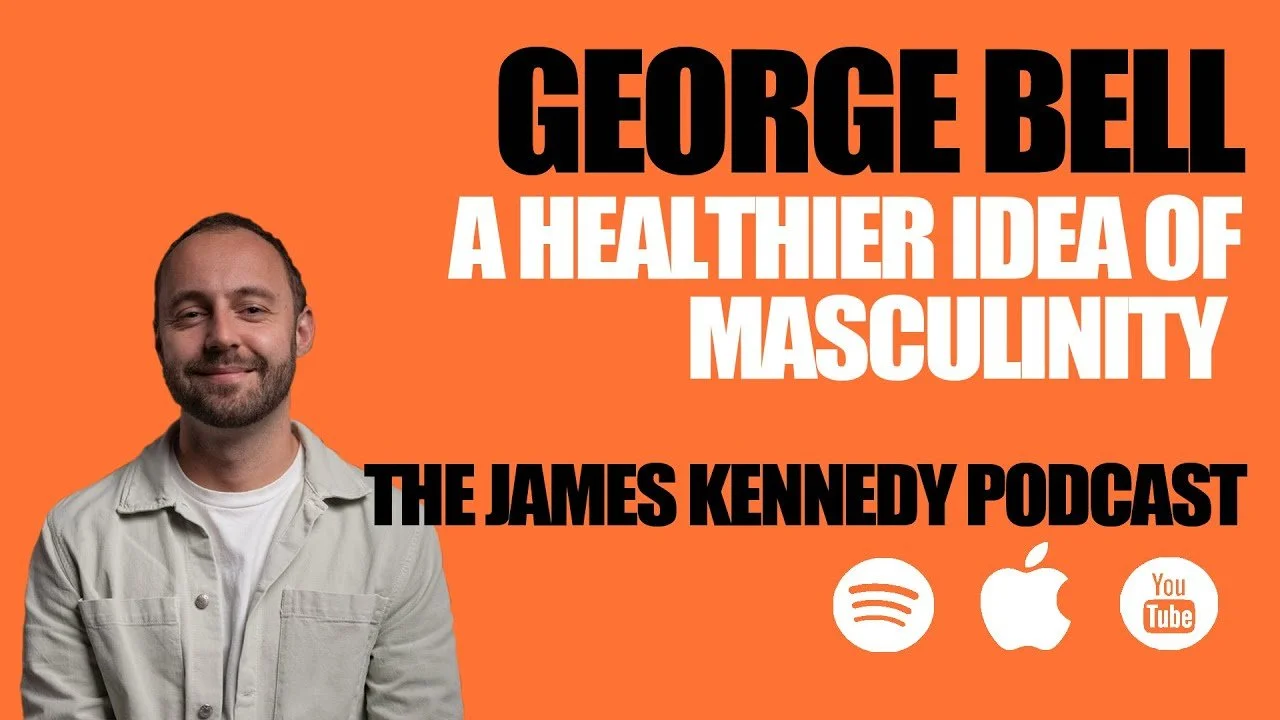
GEORGE BELL - A HEALTHIER IDEA OF MASCULINITY
James Kennedy speaks with author George Bell about his book, Be a Man About It: Building a Healthier Idea of Masculinity. Drawing from his personal journey through severe mental health struggles, Bell breaks down the dangers of male emotional silence and discusses how expanding our definition of masculinity can help save men's lives.
James Kennedy: George, thanks so much for being here, brother. How the hell are you doing?
George Bell: Hey, James. Yeah, good to be here. Thanks for having me. I feel good. I feel good. Obviously it's a big week, book's coming out, you know, there's a lot of emotions with that—pride and terror and anxiety and the rest of it. But my first copies have literally just arrived. So my books have arrived today, nice big box of them. So, yeah, literally as we record this now, I'm still feeling the emotions of seeing my first book for the first time.
Yeah, I think it's an interesting one because, obviously, personally and professionally for me, it's a really big thing. My first book, I feel really proud about that. And also there's this feeling of the subject matter. It's not like a fiction book about fantasy or whatever. It's a nonfiction book about what's happening to men and how too many men are losing their lives too soon or too early. So I think I'm also holding that emotion of professional pride and also, I don't know what the word is, but like, I know this book is needed and I know these conversations are needed. So there's a sort of sense of responsibility, maybe pressure. Yeah, I think that's the right one.
James Kennedy: Yeah. Well mate, we are going to talk all about the book and the contents within it throughout the rest of the conversation, and kudos to yourself for this issue as well in a book form. Because men, unfortunately, are not, for reasons I'm sure we're going to explore, usually at the forefront of talking about these sorts of issues. So I think just the fact that you've done it is amazing and urgently needed.
But before we unpack all that stuff, I thought maybe we could start with just getting a little bit of background on your personal journey with this stuff. What's your personal connection to the issue? How did you get started with exploring this?
George Bell: Yeah. Yeah. And you know, I think in some ways it's probably the most important question that we can go through here. And I do think it is really important because I've written this book because of a very personal story and a very personal journey. And I think it's really important for people to know that because I know that my story is not necessarily unique. I know that men all around the world will be able to relate to it. So I think that's why it's so important. I've not just written this book just for the sake of it, or just to try and fill up bookshelves. It's come from a real, real place.
And for me, that was just over 10 years ago, I was making plans to take my own life. So I was in a really difficult spot, really, really challenging spot. Obviously grappling with a real mental health issue there—it was depression, anxiety, and that culminated in these suicidal thoughts. So, a really, really difficult period there.
And I think, without going too much into maybe the mental health issue side of things, which obviously is a big part of the story, the other big part of it, and what's pertinent to this conversation, is there was a masculinity part to that story as well. And arguably the bigger part of that story, really. I think at the time I didn't realise that, but in subsequent years of going through therapy and recovery and all the rest of it, I realised how big a part of the story that is.
And the reason for that is because almost my sense of masculinity, or what I thought it meant to be a man, created the foundations where I then ended up struggling. And then when I was struggling, I didn't reach out and I didn't do anything about it. I didn't just sort of wake up one day and then I was depressed and anxious and had suicidal thoughts. There was a journey, and it was made worse because of the silence, this sort of self-imposed silence.
I had a really good network around me—great family, great friends, I had a supportive girlfriend. On paper, I had that support network. And I told no one. I told none of them what was going on. Even my girlfriend that I was sharing a bed with every night knew nothing about what was going on in my head.
And I think that—we'll obviously get into all this—but I think that's really sad. That's really, really sad. When I look back on that, I feel sad for myself back then. And then I feel sad for the men that I know are still in this position now. But yeah, I just didn't think I could talk about it. I didn't know how to talk about it. I didn't know what was going on. Didn't have the language. Didn't think I had a right to talk about it. Didn't think I could because I'd be shunned and shamed, and that's not what men do.
And yeah, I think I just thought that kind of, if I ignore it, it will go away. And I sort of played into the masculine code of suppression and silence and stuff like that. Obviously it didn't make stuff go away, and it got to a real crisis point. I had to then work on the mental health issue side of stuff, but I've had to also then sort of deconstruct and rebuild my sense of masculinity over the last few years as well, because as I said, I think that was almost the cause of where I ended up.
James Kennedy: That's so interesting, man. I can relate in so many ways as well. I mean, I've had very similar journeys myself. What was the turning point for you then, overcoming that to a degree and seeking help? Because that's a massive one, isn't it? You know, for us men, what was the turning point for you?
George Bell: Yeah. So my girlfriend at the time that I mentioned, she called me out for abnormal behavior. I'd become very cold and withdrawn and distant and pretty emotionless, I think, which obviously is really, really hard for a partner who wants love and time and attention, all the rest of it. So she called me out. She said something like, "You're so cold and distant sometimes," which was like a slap to the face in a way, because that's not in my character. That's not who I want to be. I want to be warm and someone that people enjoy to be around.
I think up until that point, I felt like I was keeping the two worlds quite separate—what I was really feeling, and then out in public, I was making sure I kind of fit into the masculine code of happy and jovial and confident and all the rest of it. I think when she said that, it sort of tore that veil down. It was obviously clear very quickly that the two worlds were sort of merging.
So yeah, I think I just felt confronted with it, and fair play to her, she wasn't going to let me off the hook. She said that and then she let that hang there. She was just staring at me. She wasn't going to kind of let me off the hook.
So I just said something. I don't really remember exactly what it was. I think it was something like, "I feel weird" or "something's going on in my head." It was very inarticulate, which is fine. I think that's the only language I had for it back then. I didn't know I had a mental health issue or any of that, but the important thing is I said something. For the first time ever on this issue, I had voiced it and someone else knew.
Again, I don't remember the conversation we had after. I think it was awkward, but it was out in the open. And then she later went and told my mum, which I was angry about at the time, but very grateful for now. Both of them were instrumental then of stepping in, getting me to go and see a doctor, getting a diagnosis, getting into treatment. And then it was just a journey from there, therapy and all the rest of it. But it really started with a woman, and then two women, kind of intervening and sort of forcing me to open up in a way. And that really kickstarted the journey of recovery.
James Kennedy: Well, amen to that, man. Kudos and hats off to the strong women in your life that helped to support you in that direction, because taking that first step is often the hardest, but the most powerful one that we can take. So what forms of treatment did you explore? Which ones did you try? Which ones did you resonate with? Which ones did you stick with?
George Bell: Yeah, it was a real journey. I think journey is the right word because it wasn't like I went to doctor and I was like, "Here's what's going on with me," and then it was like, "Right, here's your plan. Stick to that. You'll be better in two weeks" or whatever.
And I think I approached it in that way at first. I had to overcome that. Again, that was my sense of masculinity in a way. I took a very manly approach to it of DIY, quick fix, like surely it'll be done in a couple of weeks, not that big a deal.
And also, I think the big part is I was fighting against myself. The emotions that I was feeling, particularly depression and anxiety, those difficult emotions, the way I saw it was like I was at war with myself. I remember at the time I had a really strong feeling of wanting to almost crush the depression and crush the anxiety, like it was an invader.
James Kennedy: Yes, I get that, yeah.
George Bell: That just made everything worse because these things are still emotions, and they're still a part of us, and they're there for a reason, trying to tell us something. But I fought back against that narrative for a long, long time.
I remember someone, I think it might have been the doctor, recommended this book to me called Self-Help for Your Nerves by Claire Weekes. She's sold millions of copies of it, it's a worldwide best-selling book, she obviously knows what she's talking about. I read the book and I was like, "Bullshit," because she said how you've got to slow down and work with your anxiety and that's how you recover. I remember at the time I was like, "I'm not listening to this nonsense, I'm not working with my anxiety."
Stuff didn't get better, so I eventually had to learn to kind of go slow with this stuff and work with what was going on and pay attention to what it was telling me. I think that was a big part of it.
I did try medication. I tried three different types of antidepressants. I didn't gel with them, so I asked the doctor to come off them. I know plenty of people who have taken them and still take them, life-saving stuff. It affects everyone differently. For me, I just felt like it stripped all my emotion away. I didn't feel as bad anymore, but I just felt nothing, and it was a really, really scary feeling. So yeah, I came off them.
Therapy—I started with CBT, which is Cognitive Behavioral Therapy. It's one of the more modern therapies, I guess you'd call it, and the whole premise of it is you can get rid of your anxiety and you can change your thoughts and your behaviors, which changes how you feel. It's very interesting, and it's generally a shorter period of therapy, generally speaking.
I think I was attracted to that because, again as a man, I was like, "Okay, it's more practical, it's shorter, it's changing my behaviors, I don't have to dredge up the past loads and all this sort of stuff." So I did that, which was really helpful for me. That was really, really helpful for me. I only had about two months' worth of sessions, and then I took a load of tools from that and learnings, and then I implemented that daily. I was religious with it. It was my main priority every day, just focusing on those tools.
There's all kinds of different stuff I was doing, like journaling stuff, and I was taking a notebook with me everywhere I went. I'd go out with my mates—it was winter at this point—and I had my journal in my pocket, and I was like, "I'm gonna go out with it if I need to do anything." So I was just absolutely religious with it because I really, really wanted to get better.
So I think that combination of learning to slow down, understanding more of my emotions—I was telling people at this point, you know, I told my girlfriend at the time and my mom, and neither of them had run away and shamed me. So I sort of learned I could tell people and my world wouldn't collapse in on itself. I think that combination of telling people, therapy, understanding myself better, and time together was the medicine I needed, I guess.
And then I got better, and I went traveling and stuff for a bit, which was cool. But I went back to therapy a few years later—not in a period of crisis, but I got into a new relationship with my partner who I'm still with now, and a bunch of stuff just came up for me where I was like, "Well, there's quite a lot here," and I could feel related threads to some of this place I'd been in before. So that's when, being older and wiser, I was like, "Okay, I should get ahead of this one."
So that's when I went to therapy, and I went to psychotherapy specifically. I wanted to go deep. That was really useful and transformational for me because I think that's when I really went into: what does it mean for me to be a man? And some of the stuff that's impacted me throughout my life, right back to childhood, and how my sense of being a man and masculinity as part of that has caused me to feel certain ways which caused this crisis a few years ago, and maybe has caused some stuff to keep coming up. So that was work that came a few years later, and was deeper, and is all part of the journey.
James Kennedy: Did you do any physical things as well? Because obviously there's a huge interconnectivity in the physiology of this thing between the physical and the mental. Did you explore things like meditation or exercise or going to the gym or anything more physically oriented?
George Bell: Yeah, good point actually. I've missed some of the more basic stuff "quote-unquote" I was doing then as well.
For me, I just went walking, long times, like an hour or two hours a day. I should say I was living with my parents at the time and I had quit my job—I just wasn't in a good enough place to hold it down. So I was in a situation where I was somewhat fortunate, I guess, where I was able to live at home, my parents didn't have kids or that sort of responsibility, so I was able to be really quite ruthless with my recovery. But even if I was working, I would have had to just try and build this stuff in in different ways.
For me, walking was really, really important. I got out of the house, I left my phone at home to try and sort of clear my head a little bit, just out and moving. So I think that was a really big one for me.
I really worked on my diet. I had just graduated from university when all uni students' diets are notoriously unhealthy—
James Kennedy: Musicians, yeah.
George Bell: Yeah, and I think I just never had the—it sounds ridiculous now—proper education around diet and the gut-mind relationship. I was just putting stuff into my body that was impacting me in different ways: a lot of alcohol, a lot of coffee, junk food, ready meals, not much organic whole foods. Of course that's going to make me feel worse and more anxious.
So I was really careful around that. I cut out alcohol for a bit, I cut out coffee, really focused on my fruit and veg, and trying to cut out ready meals and stuff like that.
What's really challenging with mental health is it's really hard to point to the thing that made a difference or even say how much difference it made. It's not like you twist your ankle or break a leg or whatever. With this stuff, we never know.
I did try some meditation, for example. I didn't really gel with it. Was it making a difference? Maybe it was, I don't know. But I think you find the combination of stuff that you feel makes you feel a bit better.
James Kennedy: Yeah, it's like trying—I think you have to do the trial and error to a certain extent. It's just music to my ears because I've also done all of those things as well, and some of them worked for me, others didn't. But for me, it's a personal prescription, isn't it, that you have to kind of put together for yourself? You have to try all these things and see what works, you know?
And walking, I think, is a pretty universal one, and leaving the phone at home, just having space to yourself to disconnect from the noise and the chaos of the world in your life. I think that seems to be a pretty universal one.
George Bell: Yeah, it is, but I think for men, it's one they don't always approach in the right way. I'll explain, because it sounds ridiculous—like, it's just walking, right? But a lot of men always want to be busy. A lot of men will tell you that they go for walks a lot, but I guarantee it's with a podcast in, or music in, or texting, or something. Obviously people listen to stuff, that's fine, but I think the deeper issue with a lot of men is they don't know how to sit with their own thoughts and their own boredom and their own feelings, or it makes them really scared and uncomfortable.
So I think a lot of men just don't sit with what's going on, and also they're kind of conditioned not to. We're told as men: to be a man, you should be busy, right? Busy and successful. You will have met the same people who almost tell you how busy they are, and it has a way of communicating their masculinity.
ENJOYING THE CONVERSATION?
GET JAMES KENNEDY'S LATEST INTERVIEWS, WRITING AND LIVE SHOWS STRAIGHT TO YOUR INBOX.
James Kennedy: Well, I'm one of them, dude! Yeah, that's me.
George Bell: We all do, right? If someone asked me this week, "How's the book stuff going?" I'm not gonna go, "Ah, you know, I'm not doing much." You want to communicate you're busy, right? But when we dig into that, it's clear why we do that, because we're told that busyness equals success, and success equals you're a real man.
So I think a lot of men don't know how to sit with what's going on with themselves. I know I wasn't doing that back then, or hadn't done for a long, long time. I'd get on a train, I'd have to be doing something. I couldn't just sit looking out the window. So it became really important to go for walks, but without my phone, and to actually just kind of sit with or walk with what was coming up, what feelings I was feeling, and what my thoughts were. I think that's the really, really crucial part of it.
James Kennedy: That's fascinating. I haven't gotten to that stage yet. The idea of that terrifies me. What happens when you do that?
George Bell: Exactly, and I think that's why it's so powerful. It's not easy. It sounds ridiculous when you say it's not easy to leave your phone at home and go for a walk, but I think that shows—and this is so much what I focus on in my book—it actually just shows the decades of cultural conditioning that we're working against with this stuff, right?
It's the same with a lot of the messaging around men's mental health in recent years, which has been to say to men, "Just talk, just go and talk," again maybe missing the fact that actually for decades men have been conditioned to not talk. So it's not the case of just saying the thing and then it's easy to do.
It's the same with this kind of thing, but I would say just start small and see what comes up. Start really small. If you want to pop downstairs to grab yourself a coffee, a lot of people will just grab the phone instinctively. Put it in your pocket, just leave it upstairs, and just see how it feels going down there without that, and just being with your thoughts. And then you kind of expand it out: can you go to the local coffee shop, and then can you go for a 10-minute walk?
James Kennedy: Just thinking about that makes my chest tight! Isn't that so bizarre? I don't even know what about that freaks me out. My physical reaction to just imagining doing that—I don't even know what about that freaks me out.
George Bell: Sitting with your thoughts and feelings is everything that we as men have been taught to never do. So yeah, it's bizarre.
James Kennedy: Well, how did the men in your life react then? Because as you mentioned, the people that got you on this track were both women, but when you were on the journey and you're going out with your mates and taking your journal with you like you mentioned, and starting to talk more openly about these things, what was the reaction you got from your male friends? Was it what you were expecting—a pushback, a kind of macho "man up" and banter and things like that, or were you pleasantly surprised?
George Bell: Yeah, I was definitely surprised. I'd kind of catastrophized this situation of how I was going to almost be neglected and have all this banter fly my way and all this kind of stuff, and that didn't come. So I think that was a nice surprise.
I say "nice surprise," but when I look back now, it was just my anxiety that was making up these scenarios. I knew they were a really good group of guys, so I knew there wasn't going to be ill will there.
What came from it, and what's really important to say for a lot of groups, is that everyone dealt with it really well, but it was a bit awkward. People didn't know what to say, and it was the first time a lot of people had been confronted with something like that. It was a bit of, "Oh, sorry mate. Should we just go grab a drink or something?"
I wasn't expecting this, but it wasn't like someone sat me down and I'd get a half an hour free therapy session from my mate. I had to learn that they were there as a support structure, but I had to do the work myself. But just knowing that they were there helps you to keep going.
I didn't get any hate or anything like that. I got a couple of comments where people just didn't understand it. They were just like, "Hold on, but you're always out and laughing, so what's going on?" I got a bit of that, but no ill will, which I feel is the case for most people 100%.
There is such a good network around people, and I know it might come in different forms and sizes for people, but as a society we have demonized mental health and demonized emotions, and almost made out—we told people they shouldn't talk about them. But we're all going through stuff.
James Kennedy: And for men this is a serious issue as well, this is no joke. Correct me if I'm quoting out-of-date figures here, but is it true that suicide is still the leading cause of death for all men under 50 in the UK?
George Bell: Yeah, in the UK, yeah.
James Kennedy: That's horrific, man. That proves that this is clearly not just some fringe issue that only affects certain men that perhaps need to "man up" or something. This is a massive, massive problem.
George Bell: Yeah, it's one of the leading causes of death worldwide. Suicide in men is greater than in women in pretty much, if not every single country around the world. Every minute of every single day, a man takes his own life somewhere around the globe. This is a global issue that we're dealing with, it's not just one country or one culture.
And I don't think we've focused on it enough. It's not just mental health as well, by the way. There are scary stats around men: more men are dying from cancer or cardiovascular disease, they've got a shorter lifespan than women, they're more likely to be homeless, have an addiction, fall behind in education, lose their job, commit crime, or be a victim of crime.
When you take the data—and obviously there are a lot of reasons why this stuff can happen, you can't just paint one linear line to it—but when you look at the broader picture around men in health and life and work, it is a worrying amount of stuff going on that we've sort of missed and not talked about. There are definitely real reasons for this.
None of this is to take away from where we've been focusing in recent years—feminism and LGBTQ+ and all that kind of stuff, all that stuff is still really, really important and crucial. For me, what's important is recognizing that there is a real challenge going on with men, right? I think we've maybe assumed that because men have had all this unearned privilege for so long and always been at the top, that they're just doing all right. We've sort of forgotten that that kind of privilege at the top isn't shared equally down the ladder, and there are a lot of men struggling in a lot of different areas now.
James Kennedy: Brilliantly put, man. That leads nicely into the next question, because I want to steer us now specifically to the issue of masculinity, as I know that is a central theme to your book as well as your own personal journey.
Before we get into the hows and the whys of that state of flux that masculinity may be in right now due to much-needed societal changes that we're going through, what is your feeling on where we're at currently? Are there rays of hope coming through the cracks, or are we far, far behind where we need to be on this conversation?
George Bell: I think it's a bit of both. There are definitely rays of hope—let's start with that. We're here talking about it now. My book's being published on the subject. Publishers are businesses, they have to publish stuff that they think is going to sell. If there weren't people that would buy this, they wouldn't publish it. There is clearly an appetite for the conversation. We're seeing more celebrities talk about it, it's coming out in the news more, so I feel hopeful around that, I really, really do.
And then, I think that we're still in the immature phase around this conversation. I don't think we've reached the point where we're having really healthy, expanded conversations on this stuff. This is starting to change, but generally if you see masculinity talked about in the media, it just focuses on extremes.
You've got these harmful influencers and stories of the most violent and dangerous and aggressive men, and all that is a really important part of the conversation, but it is only one part, and it's an extreme. And our counter to that in recent years has just been to say to men, "You just need to cry more," or "It's okay to cry." There's an important message in there, but that is also another extreme.
James Kennedy: Yes.
George Bell: That's basically been the conversation: very binary, very just extremes. Actually, if you take most good men, they don't align themselves with this really extreme, violent sense of masculinity, but they also don't actually want to be overly emotional all the time. They understand it, but it's not how they want to be all the time.
If we can't have a more nuanced conversation around masculinity, we're actually going to miss a lot of men. And there is also still a narrative of, "How dare we talk about men and masculinity when there's so much else still going on in the world?" I've had it myself just talking about my book, where people essentially say, "How do you think you have a right to talk about men when there's still stuff going on for women or other groups?"
There's still a real sense of anger and frustration floating around, and I think that leads to a place of an "us versus them," zero-sum game mindset.
James Kennedy: Yeah, yeah.
George Bell: That is still very present, and that is a real barrier to progress with this conversation. I've had to spend so much of my time having to justify why I think this conversation is important alongside other conversations, rather than just getting into the actual conversation and helping people. Meaning that, yeah, there's hope, but we have some maturing to do around how we have this conversation.
James Kennedy: Excellently said, I totally agree with you, man. Why then do you think there is such a resurgence in appeal with a version of masculinity that's kind of outdated now? Why are we seeing a resurgence of the "strong man"—Donald Trump, Andrew Tate, Putin, Farage, Tommy Robinson—these kind of "tell it like it is, get shit done, no matter who you've got to stomp all over" guys, the lone cowboy out there imposing his macho will on the world? Why is that making a resurgence, and why is it still appealing to so many men?
George Bell: They've been the type of men that have always been popular, right? The form they take might change, but they're always the men that are successful, have money, have women around them, and are strong. That's been the form throughout history, it's just changed a little bit these days with social media influencers.
They fit the traditional masculine code perfectly of what men have been told they should aspire to have in order to be a man. You see Andrew Tate working out, he's strong, he's got women around him, he's got money—and that's what a lot of boys and men have been told: "You do that and you're a man." That is one part of the challenge.
Another part of it—I don't have hard stats around this, but I've read reports from charity workers and teachers working with boys in schools—is that because of this narrative around men focusing on extremes and toxic masculinity, people use that phrase unhelpfully as a blanket catch-all term for masculinity. What that's done is pushed a bunch of people away. We're humans, we want to feel pride and good in ourselves. If the message you're getting all the time is that you're bad, broken, and wrong, and then enter stage right these people who, whether rightly or wrongly, make men feel proud to be a man, you can see why it's a seductive message.
There is individual accountability in this as well. Boys and men aren't just getting completely sucked in, they are also choosing to listen to this stuff, which is an important part. But we can see how we've cultivated the situation where these messages are being surfaced more. The algorithm rewards them—it rewards this extreme, clickbaity content.
A lot of men and boys are feeling displaced. Their role in society is changing, which is right and needed—we've needed a rebalance and more equality in society, all decent people agree with that. But that has caused some displacement in men, and they've maybe not been given or told the new position to fill. Feminism in recent years has had a clear goal and message of empowerment, equality, and justice, and we've maybe not got that same clear message for men.
A lot of men are like, "What do I do? Everyone's telling me I'm bad and toxic, and I've got these influencers over here that the algorithm keeps showing me that are telling me I can feel good about myself." You put all that together with what they were taught growing up, and you can see how we've got into a perfect storm.
There are good men talking about emotional vulnerability, compassion, community, and being allies to women, but the algorithm just doesn't want to reward that as much, sadly.
James Kennedy: Yeah, I totally agree with you, man. But the tagline to your book is Building a Healthier Idea of Masculinity. So what, in your words, is a healthier idea of masculinity?
George Bell: For me, it's really important that there's not just a seven-bullet-point checklist that I reel off and everyone goes and does, because that's not how we work as humans. Everyone's different and unique, built differently, and values different things.
For me, I don't love the gym and this huge sense of physicality, it's just not that important to me. But for a lot of men, they would say that it's a massive part of their masculinity. That kind of thing has almost been labeled toxic in recent years, which is where you lose men.
It's recognizing that different people want different things. What makes it healthy is when we can all have an expanded sense of masculinity—where we recognize that masculinity isn't as narrow and rigid as we've made it. We've made it into: be strong, independent, powerful, successful, don't talk about your emotions, there you go, you're a man. Forgetting the fact that a lot of stuff which we typically label feminine traits—things like compassion, empathy, and emotional expression—is just part of being human. It's a human-specific thing, we all have them within us. If we didn't need emotions as men, I'm sure they would have been stamped out of us from an evolutionary point of view at some point.
So it's recognizing that we can expand our sense of masculinity. We can lean into and value stuff from the traditional sense—it's okay to want to be strong, powerful, independent, and to have times where you want to be resilient and show grit and toughness. That's absolutely fine. And we have emotions and the need to express them, and we need other humans to connect with and have a community around us.
At what point we lean into what traits and how much is subjective and will be different throughout our lives, but it's just recognizing that we're all humans and having respect for other humans—including being equal with women, and taking accountability over our mistakes. All of that together is just being a decent human, and for me that's what a healthy sense of masculinity is like: recognizing that as men and as humans, we're far more expansive than we've perhaps made ourselves in recent years.
James Kennedy: Amen, brilliantly put, brother. So what can we do as men within our society to promote this healthier idea of masculinity along with and amongst our fellow men, our brothers, our sons, our friends? How do we move this forward?
George Bell: If we start with better emotional awareness, that's the foundation. Not only focusing on the emotional side, because that's not the whole message men relate to, but we have to start with that. To what level we do that will be different for different people. I'm not saying people will listen to this and immediately be completely in touch with their emotions and understand them all, but if you can just shift your mindset to realize that emotions are natural and normal, it helps.
This stuff predates us by hundreds of thousands of years. I've only been around for a few decades, who am I to try and doubt biology that's predated me for so long? We're dealing here with science and biology, not subjective opinion. So just recognizing that emotions are normal, whatever's there is there for a reason. It might feel weird talking about it, but don't fight them.
That's the bedrock, and from that you can start to build healthier, real connections with people and talk about the real stuff. We need to have better conversations around everything that men go through every day: work, parenthood, relationships, friendships, alcohol, drugs, nights out, sex, porn use, gambling, hair loss. There are all sorts of conversations in there which feel taboo and shameful because they're so wrapped up in emotions that we avoid them, so men struggle with this stuff in silence.
You'll probably have a friendship group where people are experiencing the same thing or all going through something, but feel like they can't talk about it. The more we can normalize those conversations—however inarticulate they might be—the better. When I first opened up, my conversations weren't articulate, but I started, and that meant I talked to more people. Then, as a group, our emotional literacy level leveled up as we went through it.
The more we can have those conversations, the more we will be talking about masculinity. If you have a conversation about hair loss, you are getting into the threads of what it means to be a man and masculinity. None of this stuff is easy, but it just takes starting. We're coming up against decades of a certain version of masculinity. Just starting a conversation—even if it's texting a mate saying, "I've not seen you much recently, what's going on?"—starts to unwork some of that cultural conditioning of silence, and that's how everything starts.
James Kennedy: Beautiful, I totally agree. What I found is when I started doing it, everyone else around me started doing it, and I was like, "Oh my god, I'm not the only one!" It took me a long time to be a bit more open about what I was going through—similar experiences to yourself—and as soon as I started giving a little bit to my friends, it opened up this tidal wave of dialogue.
Now, with all my really traditionally macho "men's men" in my life, we all have these heart-to-heart conversations, tell each other "I love you, brother," and check in with each other. By opening the conversation a little bit, you make it okay for all your mates to do so as well. As soon as I started talking about it, it made it okay for everyone around me to go, "Oh man, I feel the same way as well," and now we're all exploring it together and we're all still men doing our thing.
So, yeah, I totally agree with you. George, thank you so much, mate. We've got to give a plug to the book: Be a Man About It: Building a Healthier Idea of Masculinity is out on January 22nd. Whenever you listen to this podcast—we're recording this about two days before that—it will probably be out when you listen to it. Please go and get it, it's available in all stores. It looks amazing, it sounds amazing. You need to get it—get it for all your men friends, get it for everybody.
George, we wish you the best of luck with the book, best of wishes with the mission and everything you've got coming up, and I look forward to following the rest of your journey, brother.
George Bell: Thanks so much, James, really appreciate being here. Good to meet you. Take care, man.
Key Points:
George Bell is a writer, co-founder of the online men's community Jack, and author of the new book "Be a Man About It: Building a Healthier Idea of Masculinity."
Bell's personal connection to men's mental health stems from a crisis over 10 years ago when he made plans to take his own life due to depression, anxiety, and suicidal thoughts.
He attributes his crisis partly to a restrictive sense of masculinity that discouraged him from reaching out for help despite having a strong support network.
His turning point came when his girlfriend called out his cold, withdrawn behavior, which led him to finally voice his struggles and seek treatment.
Bell explored various treatments including CBT, psychotherapy, medication, walking, diet changes, and journaling, emphasizing that recovery is a personal trial-and-error journey.
Suicide remains a leading cause of death for men under 50 in the UK and men worldwide, with broader statistics showing men face worse outcomes in health, homelessness, addiction, and crime.
Bell argues that the masculinity conversation is stuck in extremes, focusing on either toxic masculinity or telling men to simply cry more, which alienates many ordinary men.
He advocates for an expanded, healthier idea of masculinity that integrates traditional traits like strength with human traits like compassion, empathy, and emotional expression.
Summary:
In this episode of the James Kennedy Podcast, host James Kennedy speaks with George Bell, writer, co-founder of the men's community Jack, and author of "Be a Man About It: Building a Healthier Idea of Masculinity." Bell shares his deeply personal journey with mental health, revealing that just over a decade ago he was making plans to take his own life due to depression, anxiety, and suicidal thoughts. He explains how his rigid sense of masculinity prevented him from opening up to anyone, even those closest to him, despite having a strong support network. His turning point came when his girlfriend confronted him about his cold and distant behavior, which led him to finally speak about his struggles and seek professional help.
Bell describes his recovery journey as a process of trial and error, involving CBT, psychotherapy, medication, walking, dietary changes, and journaling. He emphasizes that recovery is deeply personal and that different approaches work for different people. The conversation then broadens to examine the alarming statistics around male suicide globally, with suicide being a leading cause of death for men under 50 in the UK and men dying by suicide at higher rates than women in nearly every country worldwide.
The discussion also explores why outdated, extreme versions of masculinity are experiencing a resurgence, with Bell attributing this to societal displacement of men, the rise of algorithm-driven content rewarding extreme figures, and a lack of a clear positive message for men. He argues that the masculinity conversation has become stuck in binary extremes and calls for a more nuanced, expanded understanding of what it means to be a man. Bell concludes by encouraging men to start small conversations with friends, normalize discussions about everyday struggles, and recognize that emotions are a natural, biological part of being human rather than something to suppress.
The James Kennedy Podcast is a Society and Culture podcast hosted by musician and author, James Kennedy. Exploring the big questions around health, social issues, the arts, politics, mental health, the human condition and how to navigate this thing called life through casual conversations with scientists, activists, rock stars, philosophers and academics. Please subscribe, leave a rating and support the show.