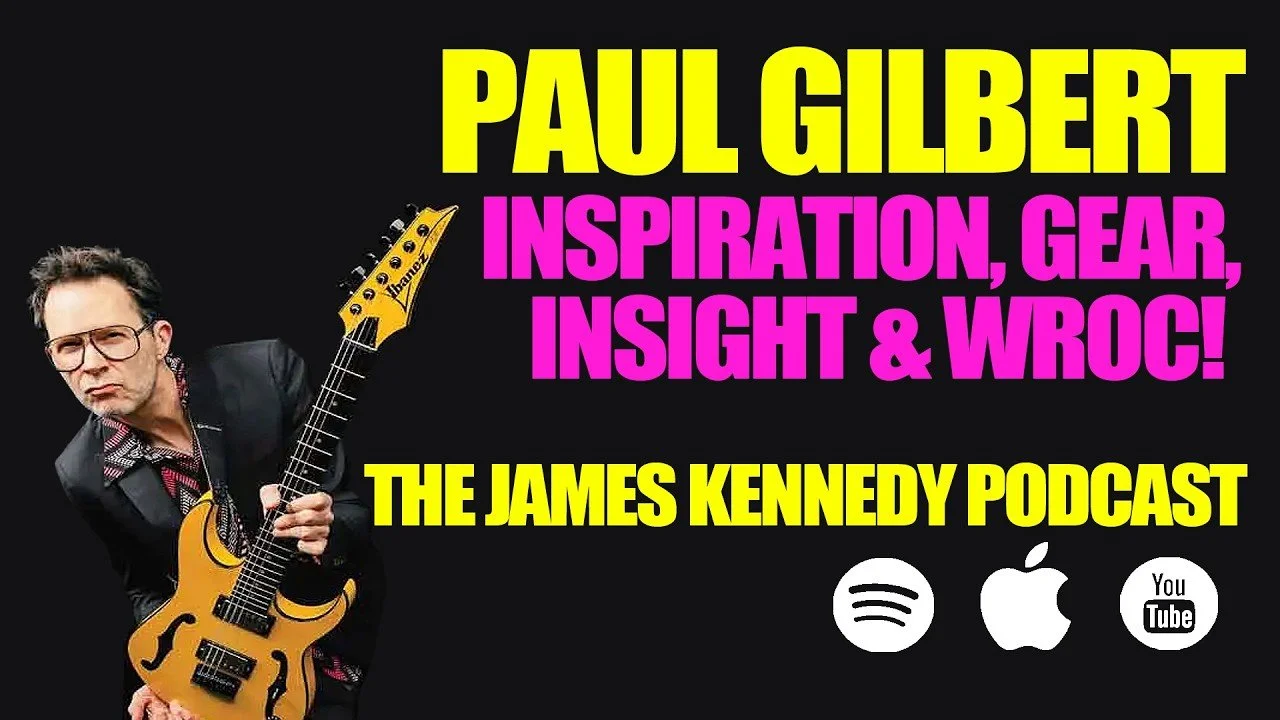
PAUL GILBERT - STAYING INSPIRED, SHREDDING MARIAH, TOP PEDALS AND WROC!
Host James Kennedy interviews legendary guitarist Paul Gilbert about his new album ‘WROC’. They discuss staying creatively inspired, learning Mariah Carey vocal lines on slide guitar, Paul’s thoughts on the music industry, playing live in the studio, and his top three pedal choices.
James Kennedy: My phone has been red hot all week since I announced that I had today's guest on the show, and I am honoured to introduce to you a literal guitar god, a non-stop creative tsunami, and an all-round awesome bloke. I'm talking, of course, about the one, the only, Mr. Paul Gilbert. How you doing, sir?
Paul Gilbert: Well, I'm doing really well after that great intro. Thank you.
James Kennedy: Well, I'm not lying, brother. My phone has been smoking hot ever since I announced you were coming on the show. I've had every guitar player I've ever known in my entire life, all the time—I've had every guitar player phone this week.
Paul Gilbert: Are you a guitar player as well?
James Kennedy: I am. That's my main instrument. Been playing, you know, for about 20-odd years, but I don't really play that much now. I'm mostly a singer in a punk rock band now.
Paul Gilbert: Now, I've got a question. When you sing in your punk band, do you play guitar as well?
James Kennedy: Sometimes, sometimes.
Paul Gilbert: What kind... what kind do you use, a straight stand or a boom stand?
James Kennedy: This is my stand right now. I'm using the punk rock stand right now, yeah. Straight, gotta be straight, because then you can swing it around like a prop and everything, you know. So I—
Paul Gilbert: I have to tell you a story about the straight stand, because I... the straight stand looks cooler, absolutely. Oh yes, yeah. You know, I can't use one because I have to manipulate it around my pedals, but yeah, I like the look of the straight stand. So the guitar that I play, which is called the Fireman, began its life as an Ibanez Iceman, which is well-known—Paul Stanley from KISS played one, Rick Nielsen from Cheap Trick, and I always loved that guitar. And I've been playing the straight stand for a long time, and then one day I had the idea to flip it upside down in Photoshop and cut a little hole in the bottom for my hand, and I called it the Reverse Iceman. And so I started playing it on stage, people saw it, and I got an email from a fan. And he said, "You should call it the Fireman, because fire is the opposite of ice," which to me is very Spinal Tap, you know—Fire and Ice being lukewarm water kind of thing. And so I loved it, and so I said... I changed it. It's not the Reverse Iceman anymore, now it's the Fireman. Just to thank him for coming up with the name, I sent him a Fireman, and it was one from my personal collection. I had modified it with a slide magnet, where there's a really strong neodymium magnet that's been mounted underneath the pickguard so you can't see it, but it's in there, and it holds a metal slide. Now, he is a singer as well, and he's a cool singer because he uses the straight stand, of course. You might have already predicted what's about to happen. So he walks up to sing, and the magnet inside the guitar grabs the stand, and, you know, the mic hits him in the teeth. I don't think he had any dental repairs, you know, I think he survived the crash, but it's just a warning to everybody who's got the cool straight stand and the guitar with the slide magnet—yeah, beware, because it will pull the stand towards you.
James Kennedy: If Paul Gilbert ever gifts you a guitar, be careful with metallic objects in the near vicinity.
Paul Gilbert: Yeah, I might be able to, like, erase all the memory on your phone if you put it too close to the guitar.
James Kennedy: Yeah, beware of gifts coming from Paul Gilbert, because, you know, there will be a high level of risk involved, as there is in being a musician generally, I feel. You know, I mean, I'm sure you've got your fair share of battle wounds, as have I, you know—broken ribs, smashed head, mic stand hitting you in the face, you know. Not to mention the hearing loss and, you know, the jet engine roaring in our ears 24/7, it's all for the cause. Exactly. And speaking of the cause, you have got a brand new album dropping this very month, the mighty WROC. The singles have all been mind-blowing. What can you tell us about the record, man?
Paul Gilbert: Okay, well, first of all, the pronunciation is actually ROCK. ROCK, okay. But as you said, it's spelled W-R-O-C, which stands for Washington's Rules of Civility. It's an etiquette manual written in France in 1595, according to my sources, and then about 100 years later translated into English. The English version found its way across the water and became a penmanship exercise for George Washington when he was a schoolboy. So he was, you know, copying the rules of civility in order to improve his handwriting, and I guess he took them to heart, and it affected his bearing, you know, how he held himself. And so, you know, I came across the book 25 years ago, and although it left an impression, I also completely forgot about it up until recently. And I was thinking, you know, I had done the farewell tour with Mr. Big, you know, we had played the last show in Japan, I'm on the airplane flying home, thinking, "Okay, well, Mr. Big is over, what should I do now? I want to make a new album." And, you know, Elton John has Bernie Taupin writing lyrics for him—this was my Bernie Taupin. And I would mold the lyrics in various ways. I mean, sometimes I could just pull it direct and it would actually work, but often I had to repeat a line because repetition makes it sound like a song, or I would maybe modify the end of the last line so each verse was a little different from the next one, you know. There's various songwriting craft I would apply to make it work, but boy was it fun.
And, you know, as I was doing it, I thought, you know, people might think this is a really insane idea and it's just not working, so I thought I should test it out on some unsuspecting victims and see what they think of it. So I invited two musicians over, Timmer Blakely on bass and Doug Rappoport on guitar. "I've got some new songs, I want to make some demos, will you guys come over?" And as we played the music and I sang it, I was watching them very closely because I wanted to see if they're staring at the floor in embarrassment or if they're smiling and making eye contact. And it was fortunately the latter, you know, they seemed to be having a really good time. So I thought, "Oh well, I'm gonna do it, I think this is gonna work." So we just kept going. I would write two songs a week, we'd make demos. I played the drums on the demos and then sent those to Nick, because he doesn't live close by, so he kind of prepared just by listening to the demos, and then we did it all live in the studio.
James Kennedy: Wow, that is insane, dude. I mean, the musicianship is interstellar, so the fact you guys did that live as well is next-level stuff. The singles have all been amazing, so I'm going to throw it at you anyway, because you've done a lot of music in your time, man, you know, and you're globally considered to be a master of your instrument. So at this point, how do you stay inspired? How do you keep things fresh? How do you keep things challenging? How do you keep yourself interested when you've already done so much?
Paul Gilbert: Well, it is fun to try to find something that I know no one else would do, because I actually... I mean, I love playing traditional blues-rock guitar and I would have the best time in the world doing a bunch of songs in E, with just traditional blues or blues-rock grooves and just playing the solos in kind of the style that all my heroes have, and really not creating anything new stylistically, just putting my fingerprint on that. Yeah, I could do that all day and be as happy as a clam. But part of me goes like, "Well, I could do that, but what if I could find something that I know Joe Bonamassa would never do?" You know, I know Joe Bonamassa is not going to sing a song from the Washington Rules of Civility. And so it feels like... it's not a secret, you know, I found some secret treasure and I'm the only one with the key to the treasure chest, and I'm probably the only one who wants... you know, that's the thing, it's not there because it's locked, it's there and then everybody else would look at it and go like, "I'll just... you know, I wouldn't even think to open it. We'll leave that to Paul."
Yeah, and so, you know, it requires some polishing. To me, it's like an undiscovered gem to find that creative idea, and so I get joy from that. And also, it's really helpful to have a band. You know, I mean, I could have done it on my own because I wrote the songs on my own, but to have that initial feedback of just playing it in a room with some other musicians and we're digging it and smiling and it's a good vibe in the room, yeah, that's a good indication that it'll be a good vibe out in the world.
James Kennedy: Yes, yeah. And do you, when you... so many of my musician friends whose passion has now become their job, even my artistic friends and things—I had Derek Robertson on here, the illustrator for The Boys. Amazing, amazing artist, one of my comic book heroes. And he said to me that he's learning to play guitar because now that painting, his original passion, has become his day job, when he gets home, the last thing he wants to do now is paint, he wants to do something else, so he's learning guitar. And I said I have the opposite problem, because guitar is now my full-time job—very lucky to have that—and I'm thinking of taking up painting as a new unexplored passion. Have you ever come into that headspace, or are you still, you know...?
Paul Gilbert: I love playing the drums. Right, right, right. I mean, it's still a musical instrument, but I get this spiritual rush from... you know, I'll do a lot of things where, you know, the secret of drumming is every limb has to coordinate with the other ones. You're doing all these complementary rhythms, but they're different from each other. And if it starts to get out of sync, I can tell, and I'll slow it down, and it's like this slow motion, getting everything to work together, and pulling everything so it's locked in. Yes, and I feel this energy. I never would have predicted it, but that's something I don't get from guitar. I mean, I get a lot of great things from guitar, but not that. And, you know, so, like I said, I played all the drums on my demos. Right, right. And sometimes I feel that, you know, my drumming technique isn't nearly as advanced as my guitar technique, but often I feel that in terms of just joy and choices that are a lot of fun, I have something.
ENJOYING THE CONVERSATION?
GET JAMES KENNEDY'S LATEST INTERVIEWS, WRITING AND LIVE SHOWS STRAIGHT TO YOUR INBOX.
James Kennedy: That's interesting, yeah, that's really interesting. And how about different styles of music? I mean, there's so many different styles that you've already really immersed yourself in. Is there any uncharted waters that you're excited by, that you haven't delved into, that you're fascinated by, even on the guitar, given that you are a master? Is there still stuff that you look at and think, "Man, I don't know how to do that"?
Paul Gilbert: Well, I mean, there's plenty that I don't know how to do. A lot of it, I mean... there's a lot of things that I don't know how to do, and the reason I don't know how to do them is because that's not my favorite sound. Right. You know, like hybrid picking, which to me is kind of snappy—it's got this snap to it. For whatever reason, it's a totally subjective thing. You know, it's like, do you like the taste of anchovies? Some people... it's not right or wrong. And to me, that snapping... I don't want to get rid of it, but I also don't want to do it myself.
Yes, right. But like vocals, I love vocals. And so, yesterday morning I got up and I was learning Mariah Carey's "Vision of Love," her vocal line. I found the isolated track on YouTube, I put it in my Amazing Slow Downer so I can get it really slow and hear the details, and I'm sitting there learning on slide guitar, having the best time of my life, because she's got some licks in there. She's got some things where, when I play that on guitar, it's like, "Oh, that's new, and I'm going to use that." Like, it's really... I mean, there's a treasure chest right there.
James Kennedy: That is fascinating, man. What are some of the things that have surprised you that you might have learned through doing that, then?
Paul Gilbert: Well, vocals are incredible because, well, first of all, it's a melody. And if you get a note wrong in a melody, it's really an obvious mistake, where if you get a note wrong in a fast scale, nobody will notice, maybe including yourself. Yes, yeah. So it's much higher pressure, it's high stakes to play a melody. And then, of course, it's not just playing the note. It's, you know, if you have to slide into it, how long does it last? Do you put the brakes on it or do you sustain it? What's the vibrato like? There's all these little details that... you could give the same melody to a hundred different guitar players, and everybody's going to sound different. And that difference comes from both their limitations and how they hear it, you know, and if they take the trouble to hear it.
And also from instrument to instrument—like the way a piano would handle a melody where you don't have any vibrato, but it might create it with a trill, which is still a cool sound, you know? So a lot of times when you translate a melody from one instrument to another, in the process of that translation, it can force you to do something that is not the same, but might be really cool. And one of the things on that Mariah Carey one is she goes from one note to the next, and when she goes to the next note, it's quieter, and then she brings the volume up. And it's like, man, I can't do that, you know, because when I attack a note, the beginning of the note is always the loudest part of the note. I can only go loud and then it dies down. Yes. It's like, that's the nature of the instrument. I mean, maybe I suppose use a volume pedal or something, but that's electronic, and to get it just out of my hands, I can never go quiet to loud.
James Kennedy: Yes, yeah, yeah, yeah.
Paul Gilbert: You know, a horn can—anything where the lungs drive it. And so whenever that comes to that part of the melody, I'm like, "Damn, I can't do that like Mariah can," and I just have to suffer.
James Kennedy: That is something I never thought I'd hear said in my life: Paul Gilbert saying, "I could never do what Mariah can."
Paul Gilbert: But I get the high notes, like all her... what people call the dog whistle notes, those are no problem.
James Kennedy: Yeah, you get that slide off the magnetic holder and whap it right up there. Yeah, man, exactly.
Paul Gilbert: You know, the range... the guitar is such an almost limitless range compared to a singer.
James Kennedy: I love the excitement. You clearly still got that childlike sense of excitement and wonder for the instrument, I love that. How do you feel about the changing music industry, just to shift gears? We will come back to the record, I promise, before we wrap up. But I mean, you're someone that has seen... you've been right to the top and you've seen the changing industry. You've done a variety of different projects, a variety of different band situations and things, but it's changed very much in the time that you've been doing your thing as well. How do you feel about it now? Obviously, people don't really buy records anymore, it's mostly streaming, there's AI coming into the situation now—should we be freaked out by that? What are your thoughts?
Paul Gilbert: Well, I'm going to steal someone else's thought, first of all, which was one of my musical heroes, Todd Rundgren. He was talking about the music industry and the changes in it, and he said something that I thought was wonderful, which is: Beethoven never sold a record. You know, Mozart never made a penny from a record. And so I think often people of my generation look back at the vinyl era as though that's like the golden period, and the only thing that's ever existed, and anything that's not that is somehow wrong now. I love the vinyl era, and I benefited from it both as a fan and as an employee or worker, but after hearing Todd say that, I realized like, recorded music is a relatively new thing in human history. I mean, I don't know how long human beings have been around making music, but a long time—200,000 years or 2 million years, whatever it is. The little slice of time when vinyl existed and you could make a lot of money selling vinyl albums is minuscule.
And so, obviously, there's a lot of technological changes, and you just take what's there and do your best. But I always think like, hey, Beethoven, he figured out, "Maybe I got to sell... I got to work for the local King, or I have to work with the city." You just find a way with whatever your situation is. And as much as a lot of the advantages that were around in the vinyl era might be gone—certainly I remember those checks coming in when CDs were still something that people would buy at a high price—now there's so much amazing stuff. And you basically look at what's there, you do your best, and even if I did have the most amazing advice for this moment, two years from now that's probably going to be different. So the real advice I have is, on top of doing your best with whatever's there, ultimately you really just have to keep a firm grip on the joy of being a musician, because that's the only thing you can control. To me, when I got up in the morning and learned that Mariah Carey vocal on my guitar, I don't expect a dime from it, I'm just warming up my soul from playing music that I love. And, you know, I might add that to the show and then people will clap, and then that'll monetize itself somehow in the future, but ultimately it all starts with the joy of being a musician. I just love this, and when I play it, I'm digging it, and I think for any musician in any era, that has to be what you can never lose, and I think good things do come from that.
James Kennedy: I love it, brilliant advice, yeah, brilliant advice. I mean, that is the real gift, which I think we lose track of a lot of the time because life is so fast now, people got to pay the bills somehow, the nature of the industry is changing, and the nature of content consumption is changing. But if we strictly rip away all that noise and get down to really why we started in the first place—why you picked up that guitar or that drum set or that paintbrush—it is because of that magic. And that is a real gift that we're so fortunate to be able to live with, so yeah, I mean, I totally agree with you on that, you put that beautifully as well.
We've got to do a little bit of nerd talk, because I know I haven't got you for too much longer and we have got to circle back to the album. My guitar playing buddies would kill me if I didn't ask you the following question: If you were kidnapped and stranded on a desert island for the rest of your life, and you could only have three guitar pedals, which three would they be?
Paul Gilbert: Oh, well, at the moment I would have the Xotic Effects AC Booster, and it's the new one that's got the extra button and a little knob on it. Now, besides that, let me look down and see what I've got... maybe a Boss LS-2, which is a Line Selector, and that would allow me to immediately switch over to a Boss Compressor. That way I can switch between having like that '80s Queensrÿche / Trevor Rabin clean sound, and then switch back seamlessly to my distortion, because lately I've been doing a lot of that, you know. When you see me in the videos from the new album and I've got the double neck with the 12-string—12-string electrics sound terrible with distortion, but they sound amazing with a clean, compressed sound. So I run all my amps clean, and then kick on the clean sound with the compression for the 12, and then as soon as I go to the six-string for the solo, I hit that Boss LS-2, it sends me to the Xotic Effects distortion pedal, and I'm wailing away on a rock solo.
James Kennedy: Wow, that's fascinating. I mean, much more functional pedals than I was expecting, you know, but I guess you're doing all the magic with this thing...
Paul Gilbert: Well, I had a giant... when I did this album, I probably had the biggest... I actually had two pedalboards, it was so big it wouldn't fit on one. And a lot of it, some of it was switching to be able to seamlessly go from one sound to another sound, because it was live in the studio, and I knew I didn't want to do overdubs. If you do overdubs, you go, "I'll do that clean sound later," but I was like, man, I got to get everything live. I even did a thing where I had a separate amp that I could turn on as a volume boost, which is a little bit ridiculous because during the mix, of course, the mixing engineer can boost you up, but I wanted to feel it right, and I wanted the band to hear it, like, "This is the solo and I'm louder in the room." I would be begging the universe for more than three, but the question was three, so I did my best.
James Kennedy: Yeah, I mean, as long as you got your fingers, I think you're good for the rest of eternity on that island. So Paul, we gotta round it up, because I know you've got another one of these to get to. Thank you so much for doing this. We've got to give a shout-out to the album. It is spelled WROC, but as Paul said, it is pronounced ROCK, which stands for Washington's Rules of Civility. It is coming out on February 27th via Music Theories Records. It is a multi-genre fantasia of punk, jazz, blues, and pirate hats as well. It is available to pre-order and pre-save everywhere right now, go and get your paws on it. Paul, this has been a real blast, thank you so much. I got so much more I'd love to ask you, but thank you for all the great music over the years and all the millions of people you've inspired, and for stopping by our humble show to spread your wisdom and inspiration with us. We appreciate you, brother.
Paul Gilbert: Right on, thank you so much. Have a good one.
James Kennedy: Thank you, Paul, best wishes, mate, speak to you soon, bye.
Key Points:
Guest Paul Gilbert discusses his new album "WROC" (pronounced "rock"), which stands for "Washington Rules of Civility," an etiquette manual George Washington copied as a schoolboy.
Gilbert explains that the album was recorded live in the studio with a band, using the historical text as lyrical inspiration after Mr. Big's farewell tour.
He describes his "Fireman" guitar, a reversed Iceman design with a hidden magnet for a slide, and shares a humorous cautionary tale about its magnetic pull.
Gilbert emphasizes maintaining the joy of being a musician as the one constant in a changing industry, citing Todd Rundgren's remark that Beethoven never sold a record.
He reveals he learns vocal melodies, such as Mariah Carey's "Vision of Love," on slide guitar to find new ideas and treasures.
When asked about three desert-island pedals, Gilbert chooses the Xotic AC Booster, a Boss LS-2 line selector, and a Boss compressor, favoring functional gear over effects.
The host reflects on Gilbert's childlike wonder and passion, encouraging listeners to subscribe and support the podcast.
Summary:
In this episode of the James Kennedy Podcast, host James Kennedy welcomes legendary guitarist Paul Gilbert. Gilbert discusses his new album "WROC," pronounced "rock," which stands for "Washington Rules of Civility," an etiquette manual George Washington copied as a schoolboy.
He explains how he discovered the text 25 years ago and turned it into lyrics, testing the concept on musicians before recording live in the studio with bassist Timmer Blakely, guitarist Doug Rappaport, and drummer Nick D'Virgilio. Gilbert reflects on staying inspired by learning vocal melodies on slide guitar, such as Mariah Carey's "Vision of Love," and shares his philosophy that musicians must hold onto the joy of playing, quoting Todd Rundgren that Beethoven never sold a record. He also describes his "Fireman" guitar and its hidden slide magnet, and names his three desert-island pedals: the Xotic AC Booster, Boss LS-2, and Boss compressor.
The James Kennedy Podcast is a Society and Culture podcast hosted by musician and author, James Kennedy. Exploring the big questions around health, social issues, the arts, politics, mental health, the human condition and how to navigate this thing called life through casual conversations with scientists, activists, rock stars, philosophers and academics. Please subscribe, leave a rating and support the show.