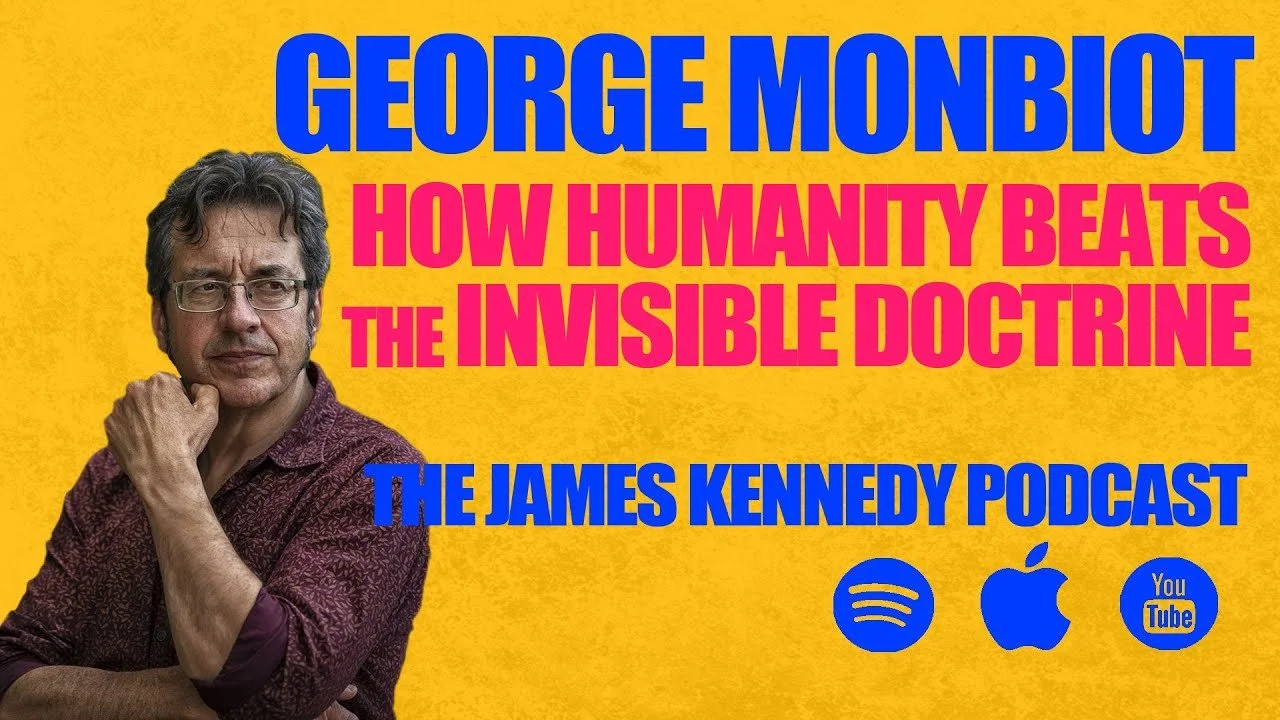
GEORGE MONBIOT - HOW WE BEAT THE INVISIBLE DOCTRINE
George Monbiot joins James Kennedy to discuss his book The Invisible Doctrine, calling for a "politics of belonging" over the harms of capitalism. He argues for community empowerment, participatory democracy, and "private sufficiency, public luxury" to tackle social and ecological crises. Monbiot draws on historical movements to highlight how local collective action inspires hope for lasting change.
James Kennedy The mighty Mr. George Monbiot. George, how are you doing man?
George Monbiot Thanks James. Yeah, it's a real pleasure to be on. Thank you for having me.
James Kennedy Well, we've got loads. We've got loads to talk about. I don't have you for as long as I would like, which would be about, you know, a whole weekend's worth of your time. So what I thought we would do to try and get as much into the chat today as possible, because obviously you've got so much wisdom and knowledge that I want to try and tap into. I thought I'd break this up into four sort of bite-sized chunks. Starting with, what's your assessment of where we're at right now socially, politically, economically, and where are we headed if we don't do something about it?
George Monbiot Well, it's a very dangerous moment. I think what we're seeing is the wearing off of the effect of two world wars, because what world wars one and two did was to really break the power of the oligarchy, which is the default state of politics in centralized hierarchical states like ours. And so, you know, we had 30 years or so of social democracy between 1945 and 1975. And then the neoliberals came in, the Thatcherites, the Reaganites, and the rest of it, to gradually erode that, to increase the power of the rich, decrease the power of the poor. And that led to a widespread disillusionment with politics. People were seeing that politics wasn't solving their problems. And whether it was the Tories or Labour who were in power, or the Republicans or the Democrats, the poor were still losing. And the rich were gaining more and more. And so we then reached almost inevitably the point at which people say, well, a pox on all their houses, to hell with them. They're not solving my problems. This guy says he stands outside politics. This guy says he speaks for me. He's doing things differently. So I'll try him. Why not? What's to lose? And so around the world, we're now seeing the rise of demagogues. It's Donald Trump. We had Jair Bolsonaro. We had Boris Johnson in this country. He was very demagogic. We've got Viktor Orbán, Recep Erdoğan, Benjamin Netanyahu, all over the world. Javier Milei, an endless succession of demagogic people on the far right. Giorgia Meloni, you know, you can go on and on, naming these people. And they threaten to take over almost everywhere because of widespread political disillusionment. And so we're returning to a situation very similar to that of 90 or 100 years ago, when Europe was plunging towards fascism. And this is a very dangerous situation indeed.
James Kennedy And you feel that's a very real prospect if you look at the landscape that we're in socially and economically as well. Do you see that as a precursor? It's the same sort of precursor that almost 100 years ago.
George Monbiot Well, 100 years ago, what we saw was capital trying to solve its biggest problem, which is democracy. And capital doesn't like democracy at all, because as soon as people get a vote, they start asking for outrageous things like better wages and shorter working hours and weekends and holidays and not having their arms ripped off by machinery and, welfare state and public services like health and education and clean rivers and clean air and all these outrageous demands that they make of capital. And of course, capital doesn't want to concede to any of that. So it's constantly looking for ways of stopping democracy. And it found this highly effective way in the 1920s and 1930s called fascism. Fascism is a really effective means of crushing democracy. And behind every ranting demagogue, there's always a billionaire who's funding them. And that worked very well for capital till 1945. And then fascism ran into a certain minor difficulty in the form of military defeat and the complete loss of credibility. And so then they started casting around for some other means of fighting democracy. And they found it in neoliberalism in this doctrine, which had only just been formulated really in 1944, which said that the state should get out of the way. The way we should solve our problems is through buying and selling, not through democracy. We should cast down regulations, taxes, trade unions, protest movements, all these things which might interfere with what capital wants to do. And they formulated this new ideology called neoliberalism, though they later dropped the term. And then from the late 1970s, when Keynesian social democracy started falling apart, that came to dominate our societies. And now, neoliberalism, as I was explaining, has led to this mass disillusionment, which means that capital wins again, because people then move to the far right and move potentially to fascism. And you know, we can argue about who deserves the label and who doesn't. We can say, is Trump a fascist? Is Musk a fascist? And we can argue about who deserves the label and who doesn't. I think there are arguments saying probably they are, but there are also counter arguments saying, well, they don't tick these boxes. It doesn't really matter. I mean, they're fulfilling the role that capital wants, which is that they want to crush democracy, sweep everything out of the way, and then blame minorities, scapegoats for the problems. And whether they call themselves fascist, whether like Musk, they give fascist salutes or not, the results are going to be the same. A horrible, sadistic politics, where instead of solving our massive problems, you blame other people who aren't responsible for those problems for them. Whether it's Jews, whether it's Muslims, whether it's asylum seekers and immigrants, whether it's trans people, gay people, black people, brown people, women, someone, there's an endless list of people with disabilities. I mean, Trump is already lining them up now. There's an endless list of potential scapegoats that you can turn to and point to. And it doesn't take long for those scapegoats to start to be persecuted. And perhaps it will go all the way yet again.
James Kennedy Right, right. Terrifying stuff, man. I mean, we kind of think that, let me look at the situation in Gaza right now. I kind of thought that genocides and things of that nature were of the past. But, you know, the more I see and the more I learn from listening to people like yourself, it seems as if things go in these cycles, doesn't it? And I recently read The Ragged-Trousered Philanthropists, and I couldn't believe in that...
George Monbiot It's such a good book. And, you know, it's a beautiful story, a tragic story surrounding it as well. But it's something which we all should read, you know, to see and to realise, these were our political ancestors. They fought so hard for the rights that we take for granted and are now tearing up. Yeah. And you're quite right. You know, we see this resurgence of things we thought we'd seen the end of. And the genocide that the Israeli government is perpetrating is a classic example of that.
James Kennedy Terrifying stuff. I mean, it reminds me of what Tony Benn once said, you know, that every generation must fight the same battles. There's no final defeat and there's no final victory. And how do you feel about that? Is it as simple as that? Is it different now? Obviously, we've got technology, social media, the oligarchical control over information and the narrative seems more pervasive now, or is it pretty much the same thing coming back that we've seen before?
George Monbiot I think Tony Benn was exactly right. To that, I'd add, there's no learning either. We sort of seem to have to start again each generation to learn those hard lessons. But, you know, there's this illusion that some people suffer from that state of society is democracy and that what Trump is doing and what these other frightening people are doing is something aberrant and something weird, which stands outside the normal way of doing politics. No, that is a normal way of doing politics for hundreds of years. We've had emperors, we've had kings who have tried to gain absolute power. They've been defended by a circle of courtiers who treat the rest of society as inferior beings and apply arbitrary laws to protect that power, constantly try to extend the power at other people's expense. This is a new variant of it. It's a particularly frightening one because it's backed by the powers of surveillance, by technology, by the means of persuasion, which are far more effective than they ever were before, but it's nothing new. It's a very old established mode of politics, which I think we can reasonably say is the default mode of politics in societies like ours. So to get democracy, or even a tiny bit of democracy, which is all we've ever had, I mean, let's face it, our societies are about 5% democratic, but to get even that, you have to fight and fight and fight for it against the tendency to revert to empire and oligarchy. Now, as I say, we've got this pathetic simulacrum of democracy where you can vote once every five years in our country, once every four years in the United States, and then the winning party or the winning president say, right, I've got a mandate to do whatever I want for the next four or five years, whatever I can get through parliament or congress. Now, so in other words, they presume that we consent to everything because they won an election once. We don't accept the principle of presumed consent in sex. Why do we accept it in politics? It's an absolutely preposterous way to run a country. And our systems, our centralised systems are not designed for democracy. They're designed for autocracy and empire. That's what they're designed for. If you look at even the symbol of parliament, take a look at the symbol, the mother of parliament, the UK parliament. A symbol is a crown on top, right, absolute power, above a portcullis exclusion with chains on either side. What does this tell you? I mean, when a system tells you what it is, believe it. Yeah, they've given away as little as they can possibly get away with. And as a result, we have a barely democratic society at the best of times. And even that now, we're in danger of losing.
James Kennedy Terrifying times, man. But fascinating to have your historical framing of where we're at now in that kind of cyclical pattern. So this is not a new battle, this is almost like how you described it as the default mode of politics. This is how politics gets done. And you describe in your latest book, The Invisible Doctrine, that one of the more recent tools in their ideological arsenal for perpetuating this age old system is called neoliberalism. And so I wanted to ask you if you could explain to the listeners what you mean by neoliberalism and what role it has played in getting us to where we're at in these terrifying times today.
George Monbiot So neoliberalism is a political tool used by capital to defeat its great enemy, democracy. And the tool consists of a philosophy, which claims not to be a philosophy, it just says this is a description. This is just the way human beings are. It's completely false. But it says, our primary characteristics are selfishness and greed. Our main form of relating to each other is competition. These are all good things. We should be selfish, we should be greedy, we should elbow everybody else out the way and grab what we can because in so doing, we will generate wealth, the rich people will become richer and their wealth will trickle down to enrich the poor. And so therefore, in order to allow this process to happen and to allow the right people to come out on top, we've got to get politics out of the way. These annoying, frustrating things like voting and protest and trade unions and regulation and taxes, all those interfere with the discovery of the natural order where the virtuous people come out on top, and the bad people end up where they belong on the bottom. And when this doctrine was first proposed, or formalised by people like Friedrich Hayek in his book, The Road to Serfdom and Ludwig von Mises in his book, Bureaucracy, both published in 1944, many people thought they were absolutely outrageous, obnoxious, disgraceful things to be calling for. How could anyone in their right mind think that this was a better way of organising society than the social democracy, which was then very much in vogue? But there were some people who thought, oh, I like this, I like this very much. And these were among the richest people on earth and the richest corporations. And within a few years, they were lavishly funding the creation of a neoliberal network operating internationally, started with a group called the Mont Pelerin Society, and then it proliferated into hundreds of these so-called think tanks. A lot of them don't disclose who's paying for them. They're really lobby groups operating on behalf of corporate and oligarchic power. But their role was to refine the outrageous, obnoxious things that Hayek and Mises were talking about, and try to make them sound like common sense. You want this, this is going to be good for you. This is going to work. And also, this is just the way things are. There's no alternative. You know, and Mrs. Thatcher, she picked up this phrase, used it so often that it became an acronym, TINA, there is no alternative. This is just humanity. We're selfish and greedy. Live with it, enjoy it, accept it. But the truth is, the great majority of us aren't, primarily. We have a cluster of values, and included in them is selfishness and greed. But they're by no means the dominant values for the great majority of people. The great majority of people, the dominant values are things like community, belonging, family, friendship, altruism, empathy, kindness, and selfishness and greed are way down the list. There is, however, about 1% of the population whose primary values are selfishness and greed, and we call them psychopaths. Now, you might think, well, we don't have to worry too much about them. They're just 1% of the population. Unfortunately, they tend to end up in charge. Broadly speaking, we are a society of altruists governed by psychopaths.
James Kennedy 100%. That is a conclusion that I have come to myself in all of these conversations I have had on this podcast and in my own experience of life as well. It's in trying to understand how we got here and how we stay there. You can only come eventually to the conclusion that we are governed by a sociopathic system that is run by and for the benefit of sociopaths. And I mean that in the literal sense, you know? And far from humanity at large having those values of selfishness and greed that you've outlined, it actually seems more obvious to me that we're actually predominantly quite trusting and gullible and innocent and kind and community-orientated, which is why we're so easily duped and dominated by these scumbags. So given the fact that this is a pattern that's been going on since the dawn of civilization, are we the 99% because of our inherently and innately decent nature just destined to be forever duped and dominated by sociopaths?
George Monbiot Well, we're really not destined to live like that. And there's a couple of brilliant books I'd point you to. One which some of you may have read, which some of your listeners might be familiar with already, The Dawn of Everything by David Graeber and David Wengrow, which looks at how humanity has organized itself in different parts of the world and at different times in history. And there's a vast range of ways in which we've done our politics. And there are some societies which have been highly hierarchical and oppressive, and there are others which have been totally egalitarian and distributive. And there's no one way. There are loads of alternatives. TILA, I don't know, or TALA, there are loads of alternatives. I don't know exactly what the acronym is, but, you know. And the other book is Jeremy Lent's magnificent book, The Patterning Instinct. Really must read it. In fact, it took me six months to read it because every page, it was like, oh, well, that's just changed my life. It was really fascinating. It's an extraordinary story of how human cognition works and how it's changed across the centuries and how certain cultural influences drive us down certain paths, which we're really completely unaware. And one of the things that I'm constantly trying to do, and it's a sort of theme of several of my books, is say, we've got to foreground stuff. We've got to be aware of stuff. We've got to name our values. What are your most precious values? Name them and then say, does this line up with these values? If it doesn't, let's not do that. Let's do something else. Let's name the political forces. So neoliberalism, you know, one of the great powers of neoliberalism is that it became anonymous in about the mid-1950s. They stopped using the term. They called themselves neoliberals in the 1940s and early 1950s—this is what we are, we are neoliberals, this is our philosophy—and then they stopped using the term and didn't produce any other term because they were saying this isn't a philosophy, this isn't an ideology, this is just the way things are. Right? This is like we're talking about gravity or talking about evolution, it's just the way things are, which patently is not true, but that's a very powerful position to close down the moral imagination. And so what I've tried to do, and in our latest book, it's not just me, it's co-written with the wonderful Peter Hutchison. What we've tried to do is to reopen the moral imagination by bringing these things together out of the shadows and saying, right, here is what's been happening, there are labels to put on these things which help us to understand them. We're doing what the great theologian Walter Wink said was naming the powers. It's a really important thing. You can't fight the powers until you've identified the powers, until you know what you're talking about. And we've tried to open up a whole series of terms which disguise things rather than reveal things, like the market or investment for example, which actually are recovering a veil put over a whole can of worms. Because when you actually open these terms up and say, what does this mean, what does capitalism mean for example, you find it doesn't at all mean what people think it means. I mean, to give that example, almost everyone seems to think that capitalism is the same as commerce. It's like buying and selling stuff, right? And commerce is something we've been doing for thousands of years in lots of different ways, and there are good ways and there are bad ways of doing it, but it can be a very egalitarian thing. Like the street market. If you think of the market, what is the market? You think of a street market, right, with stalls with stripy awnings, and the people selling you stuff have a very similar economic position that you do, and you can walk along the stalls and you can choose, say, I don't want to buy my apples from that one, I'll buy my apples from this one. There's choice going on. That's commerce. It's absolutely not capitalism. Capitalism is a totally different thing that started, well, we date it back to the island of Madeira in 1450, a very specific origin following the work of the tremendous geographer Jason Moore. And it was founded on colonial exploitation, on grabbing, on a boom-bust-quit model, extremely rapid exploitation, profit-making, destruction of resources, whether it's ecological resources, whether it's community, society, human bodies, human minds. And then you abandon it, abandon the frontier, move on, open up a new frontier and burn through that instead. This is a completely different model of organization based on the simultaneous commodification of land, labor, and money, and it hadn't been done before. And it's totally different because it involves coercion, physical violence, the seizure of shared resources and the conversion into private resources, and the total catastrophe in terms of ecological and social destruction. And so, what we see is neoliberals in particular who are constantly trying to sell capitalism to us, deliberately conflating capitalism with commerce and saying, if you're against capitalism, you're against buying and selling, you're against the person selling you stuff in that market stall, you're against your local bakery, you're against everybody because we're all involved in commerce and selling capitalism, which is the domain of extremely exploitative, brutal, horrible, psychopathic oligarchs, as being the thing that we all do, and it's not.
James Kennedy Brilliantly put. Yeah, I totally agree with you. It's often portrayed as the economic system is just like the weather, you know? It's like the economy's gone up, it's gone down, that's just what it does, we just have to grin and bear it like we have to do a rainy day or whatever. But it's not. These are man-made constructs and they behave accordingly to rules and boundaries that are put in motion by the very people that benefit from them, which is the psychopaths that you're talking about. So it's brilliant what you do is to demystify some of these ideological tools and excuses that enable the system to stay afloat for the few and not the many. Because it's a bit like the emperor's new clothes, isn't it? Once people can understand that this doesn't have to be the way that it is and we can see through the bullshit, then the possibility of change and a better future in a better way in a better life seems all the more real and achievable. So I'd like to steer the second half of this conversation into some of those alternatives, some of those better ways that we could be living our lives and also how we get there, because it seems like we've got pretty formidable enemies, especially now with the addition of all of this digital technology as well. It felt initially when social media came on the scene that that was going to be a helpful tool for the 99% of us, but now that's being co-opted and you can't tell what's real anymore. Even if you're watching a video of an event, you can't tell whether that's actually what you're looking at or whether it's something else. It's very confusing. There's a lot of information overload and onslaughts out there. So how can we inspire hope and clear purpose and a sense of possibility in people at the moment who are understandably feeling very ground down, very pessimistic, very apathetic, and very confused as to how else we could live our lives and how else we could achieve that? So I'd love to get your thoughts on that.
ENJOYING THE CONVERSATION?
GET JAMES KENNEDY'S LATEST INTERVIEWS, WRITING AND LIVE SHOWS STRAIGHT TO YOUR INBOX.
George Monbiot: Yeah, well, again, Peter and I have quite deliberately and unconsciously tried to answer that question, and you know, we recognize that unless you have a clear aim, a clear path to get to that aim, and a clear story which tells you how you're going to get down the path, then you're going to achieve nothing at all. And as you hint at so rightly, you know, we're flailing around at the moment because we don't have that clear way out of the situation. We're just being very reactive; we're responding to all the stuff which is being thrown at us. And deliberately, people like Trump are throwing so much stuff at us that we can't cope with it all, you know? And so, you know, just as you're sort of reeling in shock from the first thing he hits you with, the next thing—this is this sort of shock and awe tactic which he himself talks about using, you know? He's not shy about explaining what he's doing, and so we're constantly on the back foot, we're constantly on the back foot, we're constantly reacting. And you know, we can't afford to be in that place.
So some years ago, I conducted this sort of exercise in my own head and said, "Right, having listed my values and the things which I thought were good," I looked at these values and thought, "Is there any of these values which is shared right across politics?" You know, I'm very much on the left, but I recognize that if we're going to have big enough political movements, we've got to attract people who are in the center, and indeed the center of the movement. And so I've been doing that for a long time, and people who've been seduced by the far right, you know, we've got to get people from right across the political spectrum behind a set of social and environmental values which are going to work. But you know, you name a lot of those values and people say, "Oh, don't be so wet, don't be ridiculous—empathy," and so on.
So which of the values is common? And the one which absolutely stands out is belonging. Everyone on earth has a craving for belonging to something somewhere where they feel seen, where they feel heard, where they feel they're part of something bigger than themselves. This is such a fundamental human urge, and you can see belonging as this tremendously powerful political value which brought together the left, which has brought together liberals, but has also brought together the far right.
Now, we might mean slightly different things when we talk about belonging. I mean, belonging on the far right is a very frightening thing, you know? It's ethnically determined. You know, you belong if you're white, you belong if you're straight, you belong if you have a very determined set of political views, and you're prepared to wear the same uniform and march to the same music and give the same salutes, you know? But you know, it's a very powerful belonging, and a lot of lonely young men are strongly attracted to fascism because it says, "This is somewhere, something you can belong to, something bigger than yourself. You're going to have lots of mates, you're going to be surrounded by people who are going to protect you, and you're going to be part of it." And that's something that we all want.
Unless those of us on the left or even the center offer an alternative form of belonging, something else to belong to, then people are going to go for that brutal, exclusive form of belonging. That's an inclusive belonging—this is something which anyone can belong to, this is something where you're going to feel nurtured, you're going to feel looked after, you're going to feel you're part of a community, but it doesn't matter what your background is, what your skin color is, what your beliefs are, all the rest of it.
And Peter and I feel strongly that this has to start at the local level. It has to be in the neighborhood, it has to be in the community, because that is the one place where everyone is everyone, even if they're there just for a short period of time—they are in a place. The workplace used to be the focus of political organization, but that really has been smashed and dispersed. You know, we don't have these huge industrial workforces. In fact, even when we did, a lot of people were excluded. I mean, at the height of industrialism in Britain, there were more women working in domestic service than there were men working in heavy industry, and they didn't have a voice. They weren't included in that. So even at the bottom of the list, there were women working in domestic service and there were men working in heavy industry, and they didn't have the best of times. It didn't bring everyone together.
I mean, there was tremendous and incredibly useful organizing done around the workplace, you know, and it built the labor movement, it built our welfare state, it built so much that we still benefit from. But we can't replicate that; we have to find another locus of belonging, and the obvious one is the place where we live. And we build what Peter and I call a politics of belonging based on place, but bringing in some of the innovation which we've seen around the world in terms of politics and economics.
And the political innovation sort of pushes in the opposite direction to that sort of presumed consent, you know—the election every five years and then, "Yeah, you the electorate, fuck off and leave us alone, we're going to govern the country." It's about participatory, deliberative democracy—democracy where you can join in the process of decision-making whenever you want to. It's an ongoing, rolling thing which you can be part of on a daily basis if you want.
And there's an extraordinary aspect of participatory democracy, which is it works much better in practice than it does in theory. You know, if you say to political scientists, "Well, our idea is that everyone can be a decision-maker, that the ordinary citizen, in fact, is just as good at making decisions as a professional politician and we should be enabled to play that role," they'll say, "Well, don't be ridiculous! What does the ordinary citizen know about politics? What do they know about policy? What do they know about economics? What do they know about all these crucial things?" Well, when it's allowed to happen, extraordinary things result.
So, for instance, in the Brazilian city of Porto Alegre between 1989 and 2000, the people of the city were allowed to set the municipal budget every year, and every year tens of thousands of people came together to decide how the money should be allocated. And it was disproportionately—because they were the most affected and they could see this—disproportionately the very poor who turned up. A large number of them were completely illiterate; they could not read or write. And a lot of people would say, "Well, so who were they to make decisions?" But it turns out that the decisions they made were far better than the decisions that the city council had been making—a city council which was in hock to the local mafia, in hock to, "My brother-in-law wants to build a bridge, right, we're giving him some money." What we saw in Porto Alegre was that this city, which had been right down towards the bottom of the human development index in Brazil, came out at top-tier budgeting! Wow! Massive decline in infant mortality, in maternal mortality, massive improvement in sanitation and clean water, in public transport, in primary education, in primary healthcare—on and on it goes because the people were making decisions in their own interests. It wasn't somebody else at the top saying, "You people need this and you need that," which just happens—and it happens that my husband can deliver the contract for it, or my son.
So it was utterly transformative for the life of the people in the city. We're seeing similar things happen in Taiwan, which has had this remarkable success with its vTaiwan participatory project; in Seoul in South Korea; for a while in Reykjavik in Iceland; we've seen similar programs in Madrid, in Barcelona. Where it's allowed to happen, it can have absolutely transformative results.
Now, we're not allowed to do that at the national level in countries like ours. We have this highly centralized system which is constantly vulnerable to co-option by elites, by corporate lobbyists, by oligarchs, and we see the results all the time, and we become disillusioned with politics as a result. But we can start doing it at our community level, at our neighborhood level—we can get together with our neighbors. Look, like we have around where I live, as a result of the pandemic, we have a WhatsApp group where people share things and help each other out and stuff, and that can become the basis—I mean, it's just one example—but one way in which it can become a basis for shared decision-making about quite important things.
And then if we can introduce elements of economic democracy—and in fact, one thing that can be said for the current government in the UK is that it's introducing a community right-to-buy like they have in Scotland, so that communities can then own land, own buildings, own crucial assets which surround them—then you see how you can start to make quite powerful decisions about the development of your neighborhood and the things that you might need and might want to use.
And what we could see then is the revival of the commons. Now, the commons is a great, neglected sphere of the economy. Once upon a time, most of our resources were held in common. The community owned and managed these resources together and had a duty to pass them on to the next generation in good condition, whether it was land, whether it was forest, whether it was water sources—all sorts of things were held in common, and a huge variety of assets can be held that way. But then capital comes along and steals it all, basically. It was enclosed, it was stolen, and it was privatized.
What we need to be aiming for is a reversal of that, so we make ourselves powerful local citizens, and then we start bringing those local communities together. In a system which was very well described by the American political ecologist Murray Bookchin, we can then start devolving decisions upwards. So the primary unit of political decision-making is the local borough, the local village, your neighborhood, your community, and then he proposed this very clever system for how you can then move those decisions up the system, rather than having decisions imposed from the top down and landed on top of you from a great height.
So this is the sort of beginning of the new political story which we're trying to tell—sell as well, whatever—and but it's not the end of it, because you know, we feel we've got to take a sort of broader perspective in this as well. If you look at the standard approach, which is capitalism—because that has become the dominant economic practice everywhere, even if the great majority of us don't actually participate in it except being persecuted by it—what capitalism promises and the reason that people consent to it is that everyone's going to be a millionaire, right? Everyone is a temporarily embarrassed millionaire, and one day that finger is going to point at you and you're going to be covered in gold, and then you can have luxury—you can have your yacht, you can have your five super homes, you can have your island, your swimming pool, your art collection, your tennis courts, all the rest of it.
Well, number one: capitalism depends on exploitation. The reason some people are extremely rich is that they're exploiting other people, taking their resources, taking their labor, and keeping them poor. That's how it works. It's not a distributive mechanism; it's a mechanism for concentrating wealth. It mobilizes wealth, it turns natural wealth into money, and a wider group of people benefit from that in the short term, but of course in the long term, it means the collapse of natural wealth and Earth systems collapse and the rest of it, and none of us are going to benefit from that.
Ultimately, it is a great concentrating device, which is why, for instance, the 12 richest people in the US have tripled their money since 2020 and now have two trillion dollars between them, just to give you one example of insanity. That's how it works.
So, number one, that's why. Number two: What if it did work? What if we did all become millionaires? And we did all be able to buy a huge mansion with an estate and tennis courts and swimming pools, etc. Well, we run out of land, apart from anything else. There's not even the physical space. If everyone in London had that, then it would cover the whole of England. Where would anyone else live? But also, of course, we don't have the ecological space; it would burn the planet in about 10 minutes. Roman Abramovich consumes 30,000 tons of carbon a year. Climate scientists say the maximum is about two tons of carbon dioxide, and this is 15,000 times that amount! How can we all live like that? We can't; it's impossible.
So we can't all pursue private luxury, but we can all pursue public luxury. We can have magnificent public swimming pools, and public tennis courts, and public art collections, and all the other things that we might wish to expand into, but we can do so together. In doing so, when you create a public park, for instance, you're not taking land away from people—you're opening up land for people. If you create a private estate, you're creating a big wall and you're keeping people out, and there's less land for everybody else.
So one of our principles which we're building a lot of this around is what we call "private sufficiency, public luxury". So we can all have our own modest domain, our own home where we have the things that we need—I want rather more books than I need, but otherwise try to live quite modestly—we have our own place, that's fine, and we should have much better access to decent housing and all that. But if we want luxury, we pursue that in the public domain. So: private sufficiency, public luxury.
James Kennedy: Absolutely amazing, love it! And what a way to go out. You're getting me fired up just listening to you, honestly, man. I was going to go out and set my pitchfork on fire, but I think your solution is a much better one.
George Monbiot: Hold on to that pitchfork; we might need it later!
James Kennedy: Well, I just want to ask you—I mean, you've been in the game a while now and you've been very, very active obviously in the environmental game, which is a whole other subject we could get into which isn't looking great, in fact, it's looking pretty tragic. How do you maintain your hope? Why haven't you just given up by now and gone like, "This is pointless"? How do you keep the fire going?
George Monbiot: Well, it is sometimes tempting, but I mean, it's been 40 years now and there's been a lot of disappointments along the way. I can't pretend, you know—I don't want to claim that I just bounce out of bed every morning and say, "It's fine, it's great, we're going to save the world today". You're endlessly crashing into the brute power of oligarchs, of emperors, of capital, all the time, and this is the reality of the world.
I was very naive when I started off. When I was 22 years old, I got my first job in journalism, I was obsessed with environmental issues as I still am today, and I thought all you need to do is to provide the information and people will then see what needs to be done and everything will happen. It was a sort of magical thinking; I didn't realize that's not how it works at all. It's about power. And this is why I got so into... you can't achieve anything environmentally unless you address power, which is destroying the living planet as surely as it destroys human society and the human psyche.
And so what I've found over the years is that as I've come to understand a bit more—and of course, every day I realize there's still a mountain to learn, all the time—as I've understood a little bit more, constantly reading everything from scientific papers to government reports to interesting opinions, whatever it might be, just piling on the reading all the time, you begin to see where the possibilities are, where the chinks of hope are. That's part of what gives me some optimism.
The other part is the tremendous capacity of human beings to respond to change, to step up, the courage which people have. Throughout my whole campaigning career, which has run alongside in parallel to my journalistic career, I've seen amazing feats of courage. I was very heavily involved in the 1990s road protests, which was the most successful environmental action there's ever been in the UK. We stopped this massive road-building program, and the people at the forefront of it, the great majority of them were young women. The bravery I saw—people hurling themselves at these massive machines, swinging through the trees in front of men with chainsaws to stop them cutting the trees down—the physical courage, but also the moral courage, primarily of young women, quite a few men as well.
I thought I was pretty brave and pretty tough when I turned up at the roads protest because I'd done some crazy things in my youth abroad, but oh boy, I was really brought up short about just seeing just how much more courageous other people could be, and that gives me hope. We need to focus for it; when people are focused, extraordinary things happen.
We saw that enormous rise of Fridays for Future and Extinction Rebellion, for example, up until 2020, and then they were killed by the pandemic. It was really unfortunate—everyone had to go home and the movement fell apart, but it had got to the point where it looked very close to a tipping point, very close to effectively changing the status quo, forcing governments to respond to the ecological crisis and radically changing policy in many parts of the world. Well, it was a near miss, but we can get there again, right?
We have to have faith in each other and in ourselves, but we find faith in ourselves by having faith in each other. We gain our strength through our communities. One of the great paradoxes—we're endlessly told by neoliberalism that we're consumers, that we're individuals. I mean, we don't talk about people anymore; we'll say "an individual was walking down the road," and that we're atomized. This was always a policy: to atomize and rule.
But actually, you find your own individuality through other people. It's when other people are there to nurture you, encourage you, support you, that you can be your best self. So, for instance, if like you, you're a musician, you need people around you to say, "Hey, that's great, that's fantastic, you should take that on, and oh, I know someone who could help". You build it through the community. You're producing your own music, which is very much your music, but you're able to express that creativity and that individuality because you've got a supportive community around you.
So we have this tremendous paradox that you can't really be your own true self without the people around you. It's the society which enables you to become that person, and we strengthen ourselves through strengthening each other. It's a question of building that community, building that sense of belonging and turning it into something very deliberate, very focused, where we're going to walk the path together.
So what Peter Hutchison and I have done is to try to distill this into a very simple political story, because the story is absolutely crucial in politics. It goes as follows:
It says the world has been thrown into disorder by the powerful and nefarious forces of capitalism, and their neoliberal attack dogs tell us that our role in life is just to smash each other down, to grab everything we can, and to behave like selfish, greedy bastards, because that's how they behave and they assume that we're all like them. But we're not.
The inflection point comes when the heroes of the story, who are the ordinary citizens of the land, realize that that's not them that's being described at all, because we are very different people. We are kind, decent, empathetic people who want to belong, who want community, who want to look after each other, who want a better world for themselves, but for everyone else at the same time. And by coming together and building this politics of belonging based around the strengthening of our own communities, the strengthening of our decision-making, the strengthening of our economic control of what surrounds us, we can restore harmony to the land.
James Kennedy: Wow! Well, I'm not even going to try and follow that with anything, so I'm just going to tell everybody listening: George's new book, written with Peter Hutchison, called The Invisible Doctrine, is out now. It is available everywhere—please buy a copy, buy two, steal it, share it, do whatever you got to do, but make sure you get your hands on it and read the thing! George can also be followed on BlueSky at @georgemonbiot, and please check out his amazing website at monbiot.com for all of his latest writing, events, and loads more cool stuff as well.
George, thank you so much for giving us your time today, mate. It's been a real honor, and thank you for always being such a beacon of wisdom, light, clarity, and sense in a world that often feels like it's going crazy. Your work has inspired and continues to inspire millions around the world. So thank you so much for everything you've done to fight the good fight for your entire life, and long may you continue. Thanks, George. We appreciate you, man.
George Monbiot: Thanks so much, James.
Key Points:
George Monbiot argues that we are in a dangerous political moment similar to the 1930s, as neoliberal policies have eroded social democracy and fueled disillusionment that drives people toward far-right demagogues.
Neoliberalism is a political tool used by capital to defeat democracy by promoting selfishness, greed, and competition as human nature while removing regulations, taxes, and unions.
Capitalism is deliberately conflated with commerce to disguise its true nature as an extractive system based on colonial exploitation, coercion, and the commodification of land, labor, and money.
Monbiot contends that society is largely composed of altruistic people governed by a psychopathic elite, and that the default mode of politics is oligarchy and empire rather than democracy.
A politics of belonging rooted in local community and place is proposed as an alternative to the brutal, exclusive belonging offered by the far right.
Participatory and deliberative democracy, such as the Porto Alegre participatory budgeting model, demonstrates that ordinary citizens can make better decisions than professional politicians.
The principle of "private sufficiency, public luxury" is offered as a sustainable alternative to the impossible promise that everyone can become a millionaire under capitalism.
Monbiot maintains hope through human courage, community solidarity, and the belief that focused collective action can achieve transformative change.
Summary:
In this podcast episode, host James Kennedy interviews renowned journalist, author, and environmental activist George Monbiot about the current global political, social, and economic crisis. Monbiot argues that we are living in an extremely dangerous moment comparable to the 1930s, as neoliberalism has eroded social democracy and produced widespread disillusionment that drives people toward far-right demagogues funded by billionaires. He explains that neoliberalism is a political tool used by capital to defeat democracy, promoting selfishness and greed as human nature while stripping away regulations, unions, and public services.
Monbiot distinguishes capitalism from commerce, arguing that capitalism is a fundamentally extractive system founded on colonial exploitation and the commodification of land, labor, and money. He contends that while most people are altruistic and community-oriented, society is governed by a psychopathic elite. To counter this, he proposes a politics of belonging rooted in local community, participatory democracy, and economic democracy.
He cites examples like Porto Alegre's participatory budgeting and the principle of private sufficiency and public luxury. Monbiot maintains hope through human courage, community solidarity, and the belief that focused collective action can still achieve transformative change.
The James Kennedy Podcast is a Society and Culture podcast hosted by musician and author, James Kennedy. Exploring the big questions around health, social issues, the arts, politics, mental health, the human condition and how to navigate this thing called life through casual conversations with scientists, activists, rock stars, philosophers and academics. Please subscribe, leave a rating and support the show.