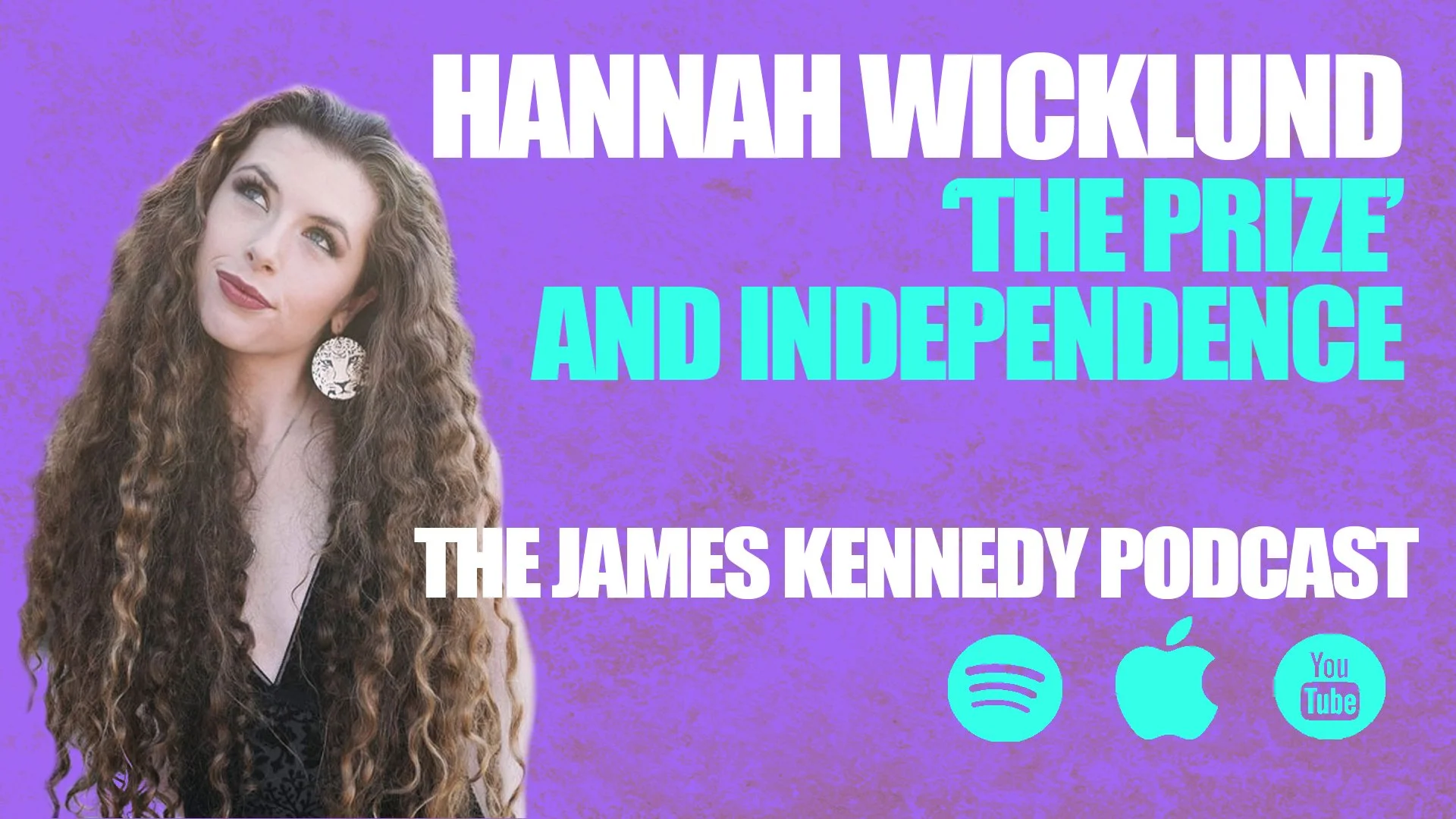
HANNAH WICKLUND - CARVING HER OWN PATH
James Kennedy interviews singer, songwriter, and multi-instrumentalist Hannah Wicklund. They discuss her journey in the music industry from starting her band as a kid on Hilton Head Island to navigating the challenges, bad deals, and sexism of the music business. Hannah talks about self-managing and founding her own label, Strawberry Moon Records to release her album The Prize. They also dive into her songwriting process, her visual artwork, and her upcoming tour.
James Kennedy: Hannah is sitting in what looks like a lovely, sunny Nashville afternoon. Very creative and chill. You've got plants and guitars everywhere and art and stuff. And yeah, it looks very, very cool and cozy there, man. Whereas I'm freezing my ass off in a podcast studio in South Wales where it's currently raining and gray and sleety and cold and drab. So, I'm a little bit envious.
Hannah Wicklund: I was recently in the UK and while it is kind of gloomy and kind of rainy over there right now, it is still so beautiful. So, I feel for you, but I also really love spending time over there. So, I don't feel too bad for you.
James Kennedy: Great recovery, man. I love that balance there. Yeah, well, you're actually coming back over here, aren't you, next year? And yeah, I noticed that you're playing my hometown favorite venue of The Globe in Cardiff, where I actually played with my own band just a few months back. So, we're going to get into all that stuff and let everybody know what you've got coming up. But to start with, could you give us the brief introduction to Hannah Wicklund: who you are, where you're from, your journey, how you got here, and what's going on?
Hannah Wicklund: Well, let's see. I was born and raised on a small island called Hilton Head Island off the coast of South Carolina. And I was born into a massively creative family. My mom's an artist and my dad's a musician, not by trade—he's a painting contractor. He paints people's houses, but he's really good at it. But he was a drummer for the first homegrown rock band on Hilton Head, and they used to play out—they were the band on the island. And so, I have an older brother and an older sister who are both quite creative people as well.
So I was really fortunate to be really supported at a young age to follow my dreams, whatever they were, music or otherwise. And I definitely found myself flocking to music. I started playing piano when I was three, I started playing guitar at eight, and I started my band six months after I started playing guitar. So it was a quick decision that I knew I wanted to play rock and roll and be like my older brother and my dad. Hilton Head was such a place that there was ample opportunity to play and develop my talent when I was young. So that whole phrase, the "10,000 hours" thing, I abide by and believe in.
By the time I was 16, I graduated high school a couple years early and I hit the road as a youngin. I've been through the wringer when it comes to the music business. I've been in all different types of rooms and meetings and all of that kind of stuff, and I have found myself coming out the other side self-managing, self-releasing, and kind of carving my own path at this point. So, that's kind of the nicely wrapped up version.
James Kennedy: Love it. Well, that's the nicely wrapped version, and now we're going to fucking pull it wide open and dive into the nitty-gritty. Because exactly like you said, you've seen this industry now from all sides. You've been in the boardrooms, you've seen the highs, you've seen the lows, and you've been kicking it a long time, man, and kicking ass as well. But I don't think people fully appreciate, when they look at someone where you're at right now crushing it—fucking touring half the world next year, you played Wembley last year, you're fucking flying right now, dude—people don't realize the journey. They see the tip of the iceberg. It's that whole thing: they see the tip of the iceberg and they don't realize all the shit that you had to go through to get there. People don't see that stuff, so I'd like to dive into some of that if you don't mind, because I think it's really healthy for other musicians on their way up to realize what people like yourself have had to go through to get to where you are now.
Hannah Wicklund: I think that this business is quite full of the smoke and mirrors. I think even when you're being authentic—which I've just now kind of rounded the corner of, where I'm really ready to discuss the actual business side of what I've been going through—because when I was 18 and started taking really serious, big-time meetings with people in the industry, that perception and what the people that you're meeting with want you to think is like you can't do it without them. It's kind of like leveling up, like everybody wants to have a team, everybody wants to be signed to a label, right? That's what we're all kind of told is the way to go about things.
So I've found I've had a lot of weird things happen. I've worked with some not so awesome people, my radar has been off before, and there are lots of different things that can lead to the ending of a business relationship, but I have found a lot of those. Coming out the other side and making the decision to self-manage, to not even entertain... like, that's the best part about where I'm at now, is that I'm not taking flagrant meetings, I'm not just having coffee with whomever, I'm not letting all these different people give me their opinion on my music. Which is something that happens so rampantly from the age of like 18 to 21, that all these people's opinions were going through my mind and there was no boundary around who I was meeting with. It was just kind of take any meeting, take all of them.
I think that now I've got my head screwed on in a different way to where I'm not really phased by the name-dropping at this point, I'm not really phased by the dangling carrots, so to speak. I'm more moved by action and follow-through, and that's what there is very little of in this industry. So it took a second to not feel almost embarrassed that I was self-managing and to wear it as a badge of honor, as opposed to being something that I kind of skirted around. Because the 18 or 19-year-old version of myself did not expect to be self-managing and doing the things that I am doing at this point. So it's a little bit of shaking off my own judgment from when I was young of my self now, and being like, "No, it's actually way cooler and way more rock and roll to decide that I'm going to do this the more untraditional way."
Which actually, if you look at a lot of the most badass women, I think us ladies have had to carve out our own path more often than not. Like Ani DiFranco and Joan Jett—those are two women that have built their own labels. When they were facing adversity on the business side of things, they took matters into their own hands and were like, "Oh my god, I'm gonna do this and I'm gonna do this." That's basically what I've done now with getting my new label together. I'm working with new partners, but I am very much the boss of Strawberry Moon Records and the boss of Hannah Wicklund. So it feels good to be in my newly claimed position.
James Kennedy: That's fucking awesome, dude. Fucking round of applause to you, dude, because that is a serious amount of work, serious commitment, and belief in what you do. Not letting the experiences of old trip you up and tarnish your belief, your passion, and your energy for this thing—to just keep on trucking, doing your own thing with you behind the wheel, that's amazing. Look at you go, man. You're soaring harder and higher than ever before, and you're in full control. So like I said, you should totally and definitely wear that as a badge of honor rather than anything else. You're in control—seriously impressive, man, super awesome.
I noticed that when I was getting the links and everything for the show notes, I noticed the release says that it's out by Flatiron Records. So I'm just assuming then that you have a licensing deal with those guys for distribution—is that the way you're doing it?
Hannah Wicklund: Yeah, so they're now kind of like the big umbrella, and I've basically created an imprint for Strawberry Moon Records underneath them. So while Strawberry Moon Records is home to just my music right now, I think hopefully in the future there's a place to add some other people to that roster. So yeah, it's a developing relationship, but I feel very fortunate to have people believe in not only my music, but also believe in me as a businesswoman. Which is the biggest thing that I have found with these new people that I'm working with: I'm respected on a totally different level.
Every other person that I've worked with, mostly being management... I think management is a very fickle thing for artists. I think if you find the right one and you find the right person that is a really good flow, then that's amazing. But a lot of times when you're young and finding that stuff, it's very hard to be respected in the business realm by those people. I think that's where the steamrolling comes in, and where some of the manipulation and things like that kind of are extra heavy—when people are young and don't know much about the business yet. So yeah, it feels nice to be growing my business side alongside.
James Kennedy: That's awesome. So okay, you got the label, which is your label, so you're in control, you pull the strings, you call the shots, but you've got guys to help you put it out. That's cool. No manager, no... but you must have a booking agent though, surely?
Hannah Wicklund: Oh, I've got the best agents. Yeah, I'm with UTA, and I've been with my agents since pre-COVID—Joe Wohfeld and Beth Morton. I've got a US and then a rest of world agent. So yeah, the agent side is very important.
I did book my own shows when I was young. I pretty much took over... I started playing out shows when I was nine and started getting paid around that age, and my dad handled the phone calls up until I was 12 years old. Then I took over all of the phone calls for all of the shows. I was the person: if you wanted to book The Stepping Stones, you had to talk to little Hannah. And we were heavily booked for being any band, let alone a kid band. I really despise that term, but yeah!
So I was naturally doing everything: running our website, running our socials, doing all that and going to school. So then when I graduated at 16, part of me graduating so early was because I knew I wanted to go on the road. I already knew what my life path was going to be, grand scheme. At 16, me and my drummer went out on a little road trip for like two and a half weeks around the Southeast and Northeast, and I went into every single club, every single venue that I could find on Google. I went in there with a CD and asked them to pass it along to whoever booked the venue.
I was lucky enough to meet a couple of the people that booked the shows. Actually, the venue and the show that we're playing in Atlanta on my Hell in the Hallway Tour next year—the promoter, Joel Grobe, I've known for 10 years. I was 16 and went into the Hard Rock Cafe where he was working, I gave him a CD, and he's the person that gave me my first ever ticketed, legitimate rock and roll show when I was like 17 or 18 in Atlanta. But up until that point, I was emailing... oh god, I would email like a hundred different places to get a response from five, maybe, and then we'd probably land like one show. It was extra hard getting people to book a 16 and 18-year-old filled band, but I did it.
I played my own agent, which is what landed me my first agent when I was 18. That was like the first real piece of the puzzle of my team that I had ever really put into place. So yeah, I would never, ever, ever do that myself again though. I love having a good agent.
James Kennedy: Having a good agent, oh yeah. My journey is very similar to yours, but you've been kicking ass way more than I ever did. It was always very similar. My situation now is the same as yours: I run my own label. In fact, my whole back catalog has been put out through my own label. I started doing that about 10 years ago, I think because I was just fed up of getting fucked over by people. The first deal I had, I had to take them to court because they ran off with all of our money, and then the guy went to jail for shooting somebody and all sorts of bullshit. So I just set up my own label, put out a bunch of albums myself, and now I've got my own publishing company which is sub-published by BMG Cobalt. So I do a similar umbrella sort of deal to what you've got going on as well.
And management—yeah, I've always self-managed. I've had managers, and again, one of them ended up with a court case, the other one just disappeared off the face of the earth. I'm sure you've experienced some of these lovely characters yourself. But a booking agent—you've got to have a good booking agent that's going to book you to the right scale for where you are, and it sounds like you've got the right package there, man.
Hannah Wicklund: You know, I feel very grateful. I have finally, in the last six months, really felt very secure when it comes to my career, which I've never felt since I was like 15. And that wasn't really quite a career—that was me playing gigs, you know? So in terms of where I'm at now, I certainly feel like I have landed at the right formula for myself right now. Who knows, maybe I'll hand over management at some point, but I don't really think that's the way things are going to go. I think I just need a good day-to-day manager—basically somebody to keep all the ducks in a row, make sure that your schedule is set, cross your t's and dot your i's. That kind of person is very important, and I'm lucky to have that.
It's very... I think that whole saying "too many cooks in the kitchen" is really true, especially if it sounds like you're the same kind of artist as I am, which is that I've got a very solid view of what I want my career to be. For me, my career includes not just music; I've also got the art side of my career, which now I've been able to tie into my music with my new record, The Prize.
I also have other aspirations. When I was a child I did musical theater, and I've had some people reach out to me about auditioning for TV and film. So I've actually started seeking out some auditions too, reconnecting with that side. Who knows—that's a toss-up of whether you'll actually ever land anything, but I think it's really helpful if you're a very aspirational person to have a good sense of direction on your own first. Even if you are somebody who wants a manager and you do end up adding that person in, you know exactly what you want. Because that was what my biggest mistake was with my first manager for sure—I didn't really have a strong sense of exactly where I wanted to go next, and that meant I went nowhere with the person that I was with.
James Kennedy: It's ironic, in hindsight in my career, the times I've had the least going on and when I've been the least busy has been when I've had a manager. So that's crazy, man, and I hear that so much from fellow artists.
This conversation has already taken a massive left turn from where I was initially going to take it. We are going to talk about the album, I promise, and we are going to talk about the tour and the artwork and all that sort of stuff, but I'm really interested in where this is going. I think this is super useful for other people to hear, especially up-and-coming musicians, because people don't have any idea what it takes to just fucking last two minutes in this game. Especially in the age of social media, musicians and people are thinking, "Oh, they're fucking doing this and they're doing that, why can't I catch a break? I'm working hard, I'm talented," and they think that it's just them having those struggles in those moments.
But you've been through them and now you're fucking slaying it higher, better, and harder than ever before. So I think you're a great example of hope to many musicians who are going through the experiences that you had early on in your career. Like, "Hey look, I've been through that, it wasn't the end for me, I learned from it, I got my lessons and my scars, and here I am now fucking smashing my own path."
So I'd love to just talk a bit more about those early experiences if you don't mind. For so many people, they feel like their career trajectory, especially when you start getting these guys on board at the early stages, goes up and up and up, and then all of a sudden it plateaus out and either falls through the floor and never recovers, or it just stays where it is and fizzles out. So I'm interested in how you went through all that and then came out swinging as you are now.
Hannah Wicklund: It's really hard for me to think of my story in that linear way—like it went up and then plateaued—because in my mind it's just been a complete roller coaster the entire time. I could take you through step-by-step exactly what happened, but the quick version, the less painful version, is that when I was 18 I started working with a booking agent. Scooter Braun was technically my very first meeting ever, like three days after I turned 18. He flew me out to LA, offered me an artist development deal. I was not ready to be "Hannah Wicklund" at that point—I had my band, The Stepping Stones—and I basically just never called him again.
I kept going down my "work harder, not smarter" path in some ways, and I got my first agent a month or two after that meeting. That agent worked really hard for me, but he had outside aspirations of doing more than just being my agent. He was basically managing me without it being that blunt, and the way I see things, he kind of fended off managers and dissuaded me from pursuing any management for about two years.
That whole time, at 18 and 19, I was opening up for Marshall Tucker, The Outlaws, Kansas, Jefferson Airplane, and all of these awesome acts that I listened to growing up, covered some of, and loved. So at 18 or 19 my eyes were wide open like, "Oh my god, this is so cool!" But I woke up a year and a half, two years later, and I had literally not met one artist my own age. I hadn't done any touring with any current artists. I had almost become this relic act opener, and even though we were building me as a headliner too, I just kind of got stuck in this classic rock loop.
Then I got my first manager who came on board and kind of saw what was going on. There were some other weird things going on inside of the agent relationship, so very quickly that manager got rid of the agent and opened my eyes to, "Hey, the last two and a half years, this is what's actually been going on." Then all of a sudden my perspective went through a huge shift where I saw the industry in a totally different light. That was kind of the first scar, and since then there have been many more, but I would just say that the path has been very up and down.
I've got lots and lots of stories to share, and a good transition to bring us into talking about my tour is that the tour I'm doing is called Hell in the Hallway. It is the first track off of my new record, which I wrote back in January of 2019, a few days after I fired my first manager. The song lyrics—"Rattlesnake, rattlesnake, who do you speak of?"—the snake is very much representative of those music business men.
My guitar maker at Anderson Guitars, a woman who works there named Rachel, I talked to her on the phone. I told her I needed something or whatever, and when I told her that I wasn't working with that manager anymore, she was like, "Oh, thank God, he was such an asshole!" I was like, "Well, thanks for telling me!"
ENJOYING THE CONVERSATION?
GET JAMES KENNEDY'S LATEST INTERVIEWS, WRITING AND LIVE SHOWS STRAIGHT TO YOUR INBOX
James Kennedy: Everybody tells you what they think of who you're working with afterwards.
Hannah Wicklund: Yeah, exactly! And you're like, "Guys, tell me this sooner!" It's like your friend dating some really shitty dude, and then when they finally break up you go, "Oh, thank God!" and you're like, "Wait, why didn't you tell me?"
But anyways, she told me... because I was really unsure of what was going on in my career. Now I didn't have an agent because he had fired my agent, I didn't have a manager, and I had just dropped Hannah Wicklund & The Stepping Stones. "Bomb Through the Breeze" was getting placed like crazy, and all of a sudden I didn't have a tour, I didn't have a team. So my lovely lady Rachel at Anderson says, "Well, my mom always used to say: when one door closes another one opens, but there's always hell in the hallway."
I go, "Can I use that for a song?" She said, "Yes, as long as you thank my mom." So, thank you, Rachel's mom!
James Kennedy: That's awesome.
Hannah Wicklund: Yeah! So The Prize is really that reference—it's pretty much the summation of the 19 to 21-year-old version of me and all of the things that I went through. It's a portrayal of not only relationships ending, but of music business relationships or business relationships expiring, and kind of what comes with that. Then it also touches on the relationship you have with yourself, or the relationship I had with myself, in the title track, "The Prize." So yeah, there's our good little bridge interlude into the other stuff.
James Kennedy: Yeah, love it. I love that segue as well—very professionally done, dude. You've clearly done this before.
Because yeah, let's talk about the new record. I want to give a shout-out first to "Hell in the Hallway," which you just mentioned, because I absolutely love that EP. It's fucking brilliant, dude. I think it sets the listener up perfectly for the new record, The Prize, because four of the tracks from the EP are on the album, and the whole album as an entirety is just fucking genius. Honestly, it's all killer, no filler. It's got everything on there, man: it's got the rock and roll guitar, it's got your voice, it's got the songwriting, it's got great musicianship, a great vibe, emotion... it's the whole fucking ride, man, and I just love it.
There's so many different sounds and influences I can hear in your sound, but I wanted to ask you directly: who are your influences? Are you kind of aware of who they are? Because I know when you've been doing this a while like we have and you're caught up in the middle of the process, you're oftentimes not aware. But who would you say are your sort of direct inspirations and influences in your sound?
Hannah Wicklund: Hmm. You know, I've never really thought about listening to my music and trying to hear what I hear, which I think is more of what you're asking, which I've never done. So maybe I'll try that—I'll try listening and thinking about what I hear.
Just based on me as a human, the stuff that inspires me is a quite broad range, because I always consider myself a terrible music fan—I don't necessarily nosedive into anybody. Growing up as a guitar player, I loved Jimi Hendrix, but I did not go and watch a million Jimi Hendrix YouTube videos, and I didn't listen to Jimi Hendrix's full catalog. So I was influenced heavily by a lot of people, but I'm more of like a sponge. Having my older brother, my older sister, and my dad who all love music, I like being a fly on the wall, having everybody else put on the music, and just kind of absorbing it.
My range of inspiration, especially now that I really think about it... when I was younger, 18 or 19, doing interviews, I was saying Jimi Hendrix and Lindsey Buckingham. I was just in this one lane. But Etta James, Sheryl Crow, Jeff Buckley, Tom Petty, Neil Young, Stevie Nicks, Fleetwood Mac... a lot of the classic rock stuff touched my brain growing up, so that's the obvious stuff.
When it comes to newfound inspiration, one of the big ones for The Prize... ironically, I finished writing this whole record in 2019, and in 2020 I heard Fiona Apple's Fetch the Bolt Cutters record. My brother was the one that was like, "You should listen to this," and I fell in love with that record. I think that was the most exciting album I had heard in my adulthood because all of a sudden these songs were just so... yes, they're songs, and once you listen to them many times I hear them as songs, but they just felt really abstract to me. I really enjoyed the way it was recorded.
Fetch the Bolt Cutters was actually the record that made me get the ball rolling on starting the recording of The Prize, because she had self-produced or co-produced, and she did a lot of that record in her house where you can hear her dogs barking. Actually, my dogs are on Hell in the Hallway too, so I took that little nod! So yeah, it's quite a wide range of stuff.
James Kennedy: I can hear Jeff Buckley for definite. I was hearing as well some Anna Calvi, some Nothing But Thieves, a little bit of Halestorm. You had not mentioned any of those bands, but it was interesting.
Hannah Wicklund: People hear what they hear in it, you know? Yeah, that's so interesting. I know of Halestorm and Lzzy Hale is such a badass, but I think that music is a little bit more on the rock side of things. I very intentionally call myself rock and roll, because I think that "rock" is too harsh of a category for me to live in. But like Tom Petty—I consider Tom Petty to be the ultimate rock and roll artist, where he's writing songs, but there's still guitar solos and the lyrics mean something.
James Kennedy: Well, Tom Petty is a badass, isn't he? And Fiona Apple as well. I think that's the beautiful thing about music—everyone can hear something different in it, can't they? You make what you make and it comes from where it comes from within you, and then as soon as you put it out to the world, everyone kind of has their own interpretation of it. It becomes their song then, it becomes their baby, and I think that's the beautiful thing about it.
You've already mentioned some of how you recorded the record, like having your dogs in the background. I'd love to delve more into that, into the process of how you put the record together: the writing and the recording process. What was the journey?
Hannah Wicklund: Well, I pretty much started writing this record in my parents' house. I was transient for about three years where I lived in LA for a while, but all of my stuff was in a storage unit in Nashville for a period of time. I had just gotten done with a massive seven or eight months of nonstop touring, and I went back to my parents' house for like a month. That was where the foundation of more than half the record was started.
Then I went to a little cabin that my grandparents had built up in the Poconos. It was the last time I got to be there because we sold it, and I was so heartbroken—I was really hoping to be able to go up there with my kids one day, you know? But I ended up finishing most of the album in that little cabin. I just went there, didn't see anybody, and holed up for a while.
Then I went back out to LA for a little bit, and that was where "Hell in the Hallway" was a co-write with Stevie Aiello—he's the guitar player for Thirty Seconds to Mars. We did that co-write, and "Hell in the Hallway" was one of the more obvious singles in my mind. Once that song was written, a lot of the record had taken shape.
Two of the songs that I really loved... "Witness" I had started writing at my parents', so that song was kind of marinating for a while. But I actually went on this cruise—the Chris Jericho wrestling cruise. I promise this will come full circle! It's really weird right now, but in January of 2019 I did a thing called The Rock Boat, which is a music festival on a cruise ship. The promoters did this thing where every year they would get a couple of the writers from some of the bands playing on The Rock Boat together on a different cruise four or five months earlier to write and record an album together. So with people you'd never met, you go and write and record an album in a makeshift studio on a cruise ship in three days.
It was too weird and wacky of an opportunity to not say yes to, so I went, and it was the first ever wrestling cruise. Everybody walking around the boat was like, "Making history, making history!" They had turned the swimming pool on the top floor of the cruise ship into a ring, and all of our meals were with all of the wrestlers. So I befriended all of these really intense, sweetest guys and gals, but basically we just spent the days writing and recording.
One of the songs that I wrote with a really awesome dude named Nick Talbot of the Talbot Brothers—we co-wrote the song "Lost Love" together on the Chris Jericho cruise ship. It was this hilarious, super top-secret project we were doing, so nobody else on the boat knew what we were doing other than the 15 of us involved. It was just so much fun. So yeah, that's a fun little tidbit about the writing part of The Prize.
James Kennedy: I would never have thought that that song was written on a wrestling cruise ship!
Hannah Wicklund: Yeah, exactly! It was a very hilarious moment in my life, and I came away having a deep appreciation for wrestling with those guys. What they do is pretty cool—they're putting on a show, very dramatic, very coordinated. But yeah, that was fun.
They had this really cool instrument—Seagull makes a little troubadour-style instrument called the Merlin, basically a dulcimer. I picked it up, and "Lost Love" we wrote within 45 minutes or an hour because the very first time I played that instrument, I started playing what turned into the "Lost Love" riff that you hear. So there's that kind of weird acoustic instrument in there, and that's what it was.
James Kennedy: That's awesome. Yeah, I love it when that happens. But is that something that you do as a songwriting trick consciously? Because I know as someone who's been playing guitar now for too many decades, when I put my hand on the neck, my fingers kind of go to familiar places, and I have to consciously do shit to stop falling into old habits. So playing an instrument that you know nothing about is like unexplored foreign territory, and can often lead to coming up with new and interesting shit because you're not following that muscle memory. Is that something that you do as a songwriter, or was it just a happy accident that time that led to the absolute gold of that song?
Hannah Wicklund: Moving through my life as a songwriter, it's a trick that I'm going to take advantage of more often—trying to write and challenging myself to write on different instruments outside of just piano and guitar.
I will say, I just bought... here, I'll show you. I know this is a podcast, but I just bought this 1920s parlor guitar.
James Kennedy: I can see it. That's all that matters.
Hannah Wicklund: Wow, it's by Herwin. Well, it was for Herwin—I'm still getting the story on it, but basically it's like a gypsy guitar. There's one small difference that I noticed that has made an effect on my playing: instead of the ninth fret being marked, the 10th fret is marked. So I have it in Drop D, and it's funny how just having the markings be a little bit different makes you play guitar a little bit different.
James Kennedy: Oh, 100%! Yeah, 100%. I started experimenting for a while with one of the Jimmy Page tunings and I wrote a bunch of songs because I just didn't know what the hell I was playing. You play standard chords and it sounds like complete shit, so you have to just follow your ear more than following your muscle memory, you know? So yeah, I definitely think experimenting with tunings is a useful thing for me as a guitar player anyway. And Drop D—any excuse to tune down to Drop D is a good one.
That guitar looks fucking sick, man! Well, we got to move on to talking about the tour because this is a big one, dude. You're pretty much touring the entirety of 2024. You're doing the whole of the US pretty much between February and April, and then you come into the UK and even Europe for some more dates as well. As I mentioned earlier, you're playing one of my favorite local venues just around the corner from where I live—The Globe in Cardiff, where I played with my own band just a few months ago. It's a great venue, so I'll come along to that one. But yeah, this is a colossal tour, dude. Are you excited?
Hannah Wicklund: Yeah, it's a lengthy one, but it is time. I am overdue for a nice, healthy headline tour. So it's a lot of dates, but with the exception of maybe a few of those UK dates, I've played all of these places before. So it's essentially me making a return, saying hello, and introducing everybody that I've seen and met throughout the years to the world of The Prize.
I think it's going to be the most fulfilling tour that I've ever done because up to this point, I've done a lot of touring, but this tour has a totally different purpose. Of course I am promoting The Prize, but this is also really the full-circle moment of me embracing that my world and my career is more than just music. So I'm bringing the art into the show and trying to do a few things to honor the paintings and the design and all of that kind of stuff that I've been doing over this time as well. So it's going to be cool—a neat culmination of all of my shit.
James Kennedy: Yeah, 100%, man. I was going to talk about the art book as well, because that's badass as well. This is why I said at the intro: you're like annoyingly multi-talented! It's such a struggle to be good at one thing, and you're good at like five at the same time—it's a pain in the ass.
But what's your touring package like? Because as an artist that's essentially independent—you're self-managing—I guess you're doing your own budgeting and stuff like that. How do you tour on a scale like that? Let's just focus on the US—that's a massive landmass. Are you doing transit van, sharing the driving, guys in the back sort of thing, or have you figured out a way to make this doable at an independent level?
Hannah Wicklund: No, I am holding strong in my sprinter van. At least it's a Mercedes, but I have been touring out of the same van since I was 18.
James Kennedy: Wow.
Hannah Wicklund: Yeah, so this van has been very good to me; it has taken me across this country and through Canada many times. But we are in a van. I'm really hoping that we don't have to bring a trailer next year, to be honest—I think we're going to be able to make it all fit.
We'll have a tour manager, me, and the guys in the band. I'm trying to work it out right now, but I think the next key player to add into my touring regime would be a killer Front of House guy or girl. I'm not positive yet, but it sure would be nice to have for this tour, so we'll see.
James Kennedy: You're clearly not someone that suffers obstacles for too long, dude, so I'm sure you're going to have that killer Front of House person before too long.
It's interesting—I love the fact that you've done everything you've done in one van. I need to know where you bought that van for a start, because mine used to break down every two minutes! But I listen to a load of podcasts and they all talk about the road to success, the best way to set yourself up for long-term success, and the one thing they all say—they all say the same thing—is: get in a van, get in a car, and just get out there. Play some fucking shows, knock some fucking doors, make some calls, turn up, kick some asses. You start playing to one person, then you play to 10 people, and you just keep on fucking doing it.
You are proof that what they're saying is the tried-and-tested way that this works. This is the rock and roll model—this is the DIY rock and roll model. You get in a fucking van and you just turn up and play some shows. You are living proof that that model, still after all this time in the digital era when things are so different now, is still the way to get it done.
Hannah Wicklund: And in the same van! Yeah, that saying, "If you want something done right, do it yourself," is making more and more sense to me as I get older. When people ask me for advice, I pretty much say a very similar thing: just get out there. At the beginning, say yes. At the beginning you have to learn things the hard way—you're going to have to learn what you do want to do and what you don't want to do, but the only way of really learning is by doing it.
And I'd say relationships: be nice, say hello, talk to people. One of the things that has saved me throughout this process is... when you work with a manager, a different agent, or different people, you're kind of getting introduced to their world. It's business, everybody knows you're not necessarily going to stick with the same people forever, but staying in touch with people that you meet along the way... I'm a big fan of staying in touch with people, just calling to see how people are doing, working on the relationship side. Because it's a mutually beneficial thing to think of other people and to be thought of. So also just try and be as gregarious as you can, I'd say.
James Kennedy: Well, people just need to follow your example, man, because you are doing it, bro. Long may you continue to do so as well. I'm going to enjoy watching the rest of your journey because I think you've set yourself up for success. If it ain't broke, don't fix it—you got a good thing going. Please don't let any more douchebags into the mix, and I think you're just going to keep on flying.
Hannah Wicklund: No more douchebags! Amen. I'm getting that on a bumper sticker.
James Kennedy: I think you're going to be all right, man.
Well, we got to talk about the artwork as well, because as you mentioned earlier, you are a painter as well. So you actually painted the amazing artwork that people can see on the cover of The Prize—that's you, right?
Hannah Wicklund: Yeah, that's all me. In a parallel universe, this record would have been released early last year, so it'll be almost two years behind where I had initially planned for and imagined The Prize dropping. Believe it or not, this process of getting this record out was extremely painful, and so the art was really born out of a place of me not wanting to give up on this music yet. I was having a really tough time getting this music released and finding a home for this record, which is why me building my label was exciting, but also extremely necessary.
By having my hands tied... again, we've got all those men in suits to thank for my shit kind of stagnating there for a while. But if it hadn't, and if I hadn't had my hands tied and wasn't able to tour for a period of time, I wouldn't have done all this art. I basically evolved this world and built this visual side around these songs to further prove, maybe even just to myself, how much they mean to me and how important this music is to me.
So when nobody was believing in it, I doubled down and decided to not only write the music, but do a massive art project to go along with it. That's what kept me sane, focused, and on track, because I could not write another song until I knew how this music was being released. So instead of having my creativity flow through my music for about two years, it's been flowing through my art instead. So I'm very grateful to have my paintings and my art as a very necessary release.
James Kennedy: Well, I think all of this says a lot about you as a person, your character, your hustle, your work ethic, and your survivor spirit. Because for many people, having been through what you've been through early on in your career and by the sounds of it, some of the hurdles with this record as well—that would have been the end for them. It would have been too much to overcome, too painful a setback, and they would have just given up.
That says a lot about you as a person that you found strength and lessons in all of these things in order to make it work. I think that's something really important to make you stronger moving forward, whether it's setting up your own label, or this record taking longer than you'd hoped leading to you pursuing visual art and painting, which is now a new thing to add to your long list of annoying talents.
Hannah Wicklund: "Annoying" is definitely a word that can be used about me sometimes! But no, I appreciate those kind words. I really hope that this record can be an inspiration to other people who might not necessarily have that perseverance in themselves—to be able to look to this story and look to this record, and if they like the music, know that just getting it out to the world was basically the fight of my life.
James Kennedy: Can we talk about that for a second? What were the obstacles?
Hannah Wicklund: I plan on telling this story in a very detailed, thought-out manner at some point. I'm not quite there yet—I'm still sorting it out without being...
James Kennedy: No, that's cool, I get it. I hear you—you want to work on your diplomatic version before you start saying anything.
Hannah Wicklund: Yes, thank you. I am working on my diplomatic version of this part of my life, and I'm not quite prepared yet. That's part of healing: knowing when you are not ready to talk about something yet.
James Kennedy: That's a mistake I make all too often, man—I'm the worst for it. I never learn; I just fucking open my mouth and out it comes, and I put my foot in my mouth one more time and end up in some country somewhere. I do it all the time and I never learn, so wise thinking.
Hannah Wicklund: Me too! That's why I've learned, especially with this story—it's a delicate one. But the gist is just that a lot of promises were made, and I had some very sexist bullshit and some really bizarre, annoying shit happen when it comes to getting this record out.
But yeah, here I am. It's about to be out, and all of that happened for a reason. I'm very, very comfortable saying that now. A year ago I was not in a place where I would say "this is happening for a reason," even though the whole time I knew. But until you've seen the light... from where I'm at now, as annoying as it is to say, I am grateful for the pushback that I had on getting The Prize out there. Because like I said, I wouldn't have done all of the art, I wouldn't have doubled down, and I wouldn't have Strawberry Moon Records right now. I wouldn't have a lot of things I'm very proud of in this moment, so it all works out.
James Kennedy: A hundred percent. Well, amen to that, man. Yeah, I totally echo everything you said, and I hope that we'll get that story at some point because I'm going to be looking out for the diplomatic version.
Hannah Wicklund: Well, it'll be coming in the book! No, I'm just kidding.
Key Points:
Guest Hannah Wicklund, a Nashville-based musician and visual artist, releases her new album The Prize on January 12th.
Wicklund grew up on Hilton Head Island, started piano at three and guitar at eight, and began touring seriously after graduating high school early at sixteen.
She now self-manages her career and runs her own label, Strawberry Moon Records, with a licensing deal through Flat Iron Records.
Wicklund described difficult early industry experiences, including a first manager she fired and sexist treatment during attempts to release her record.
The album's title track and tour name, Hell in the Hallway, came from a phrase shared by a friend at Anderson Guitars about doors closing and opening.
Wicklund wrote and recorded much of the album in her parents' house, a family cabin in the Poconos, and even on a wrestling-themed cruise ship.
She painted the album artwork herself and continues touring in the same Mercedes sprinter van she has used since age eighteen.
Summary:
James Kennedy introduces his guest, Nashville-based musician, singer, songwriter, and visual artist Hannah Wicklund, whose new album The Prize arrives on January 12th.
Wicklund describes growing up on Hilton Head Island in South Carolina in a creative family, starting piano at three and guitar at eight, and touring seriously from age sixteen. She explains how she now self-manages, runs her own label, Strawberry Moon Records, and works with a licensing partner and booking agents, while avoiding the exploitative industry figures she encountered early on. She discusses the long, difficult path to releasing The Prize, including broken promises and sexist treatment, and how that struggle pushed her into painting the album's artwork herself. She also shares stories behind songs like Hell in the Hallway and Lost Love, her influences, her DIY touring approach, and her extensive 2024 tour plans.
The James Kennedy Podcast is a Society and Culture podcast hosted by musician and author, James Kennedy. Exploring the big questions around health, social issues, the arts, politics, mental health, the human condition and how to navigate this thing called life through casual conversations with scientists, activists, rock stars, philosophers and academics. Please subscribe, leave a rating and support the show.