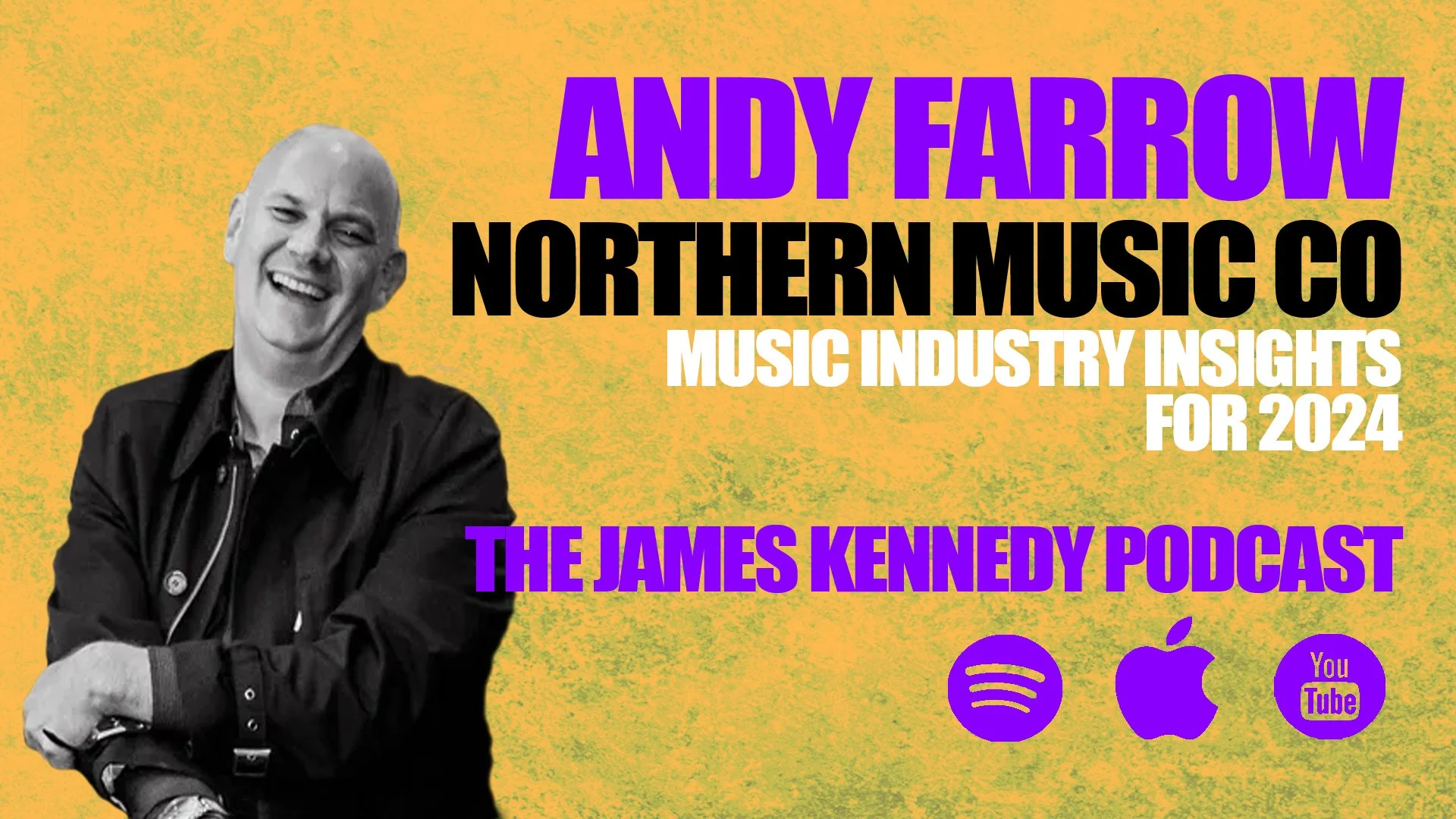
ANDY FARROW - SURVIVING THE MUSIC INDUSTRY
James Kennedy interviews Northern Music Group head Andy Farrow about his 35+ years managing bands like Opeth, Paradise Lost, and Katatonia. They discuss the transition from traditional label models to streaming, the reality of post-Brexit/COVID touring, grassroots fan-building over social media algorithms, and how artists can build sustainable, long-term careers.
James Kennedy: Andy Farrow, sir, thank you so much for doing this, man. How are you doing?
Andy Farrow: Yeah, I'm okay, thanks. Good to speak with you.
James Kennedy: Oh, it's good to have you with us, man. We appreciate it. To start with, I mean, obviously, I've been in bands and stuff for 20 years. I mean, me and anyone like me knows exactly all about who Mr. Andy Farrow is. But for those listeners who don't, could you give us a brief background on who you are, what you do, what you've done, and what's going on?
Andy Farrow: Yeah, so I have a holding company called Northern Music Group, which encompasses a management company, Northern Music Co., a record company, Graphite Records, a publishing company, AMF Music, booking agency, NMC Live, merch company, Omerch, that I co-own with Opeth. So I've been managing bands professionally since 1988. First band I got a major deal with Warners for. Prior to that, I was involved with an anarcho-punk scene. So over the years, managing bands, I've learned every aspect of the business. And opportunities came along to have a record label. So I had a band on V2. And they were like, "Oh, you're Mr. Rock, do you want to have a record label?" So I said, "Yeah." With publishing, I was managing Oceansize, I got them a big Orange mobile phone advert and Kobalt again said to me, "Mr. Rock, do you want a publishing company?" So kind of moving along. And then, obviously, prior to the pandemic, it became pretty evident that live was the big earner. And so, I thought, looking at booking agencies, much easier making money booking and managing bands. So set up the booking agency. And with the merch, again, Opeth, massive merchandising band. So we thought with the sales they do, we will be able to get the scope to get good prices. So set up an artist-owned company, and that's done pretty well. So it's not a 360 company where you have to sign to everything. It just means that if, for example, I publish you and I can't get you a record deal, I might be able to put the record out. So you can tap into whatever you want to use, really.
James Kennedy: That's awesome. Yeah, I mean, the term 360 has a different connotation these days, doesn't it, with a certain type of record deal, but that's not what you're doing over there. You've just got a massive kind of umbrella operation that houses all of these different elements that people can tap into if they want to.
Andy Farrow: It's a one-stop shop if you want it, or you can just go into sections. But I will say, actually, releasing records—whilst I do fight labels and really push them—releasing records is definitely a tough thing. The amount of work that goes into it, really, for what you get back or what you have to go through, especially if you're still doing physical, it's, yeah.
James Kennedy: Well, you've been sort of in the game now during the great change of the music industry. So you were kicking it in the old world, and now you're still kicking it in the new world. What's your thoughts on the transition? Is it better now for bands or labels? Is it harder, or is it just different?
Andy Farrow: Well, I think for labels, labels are making a huge amount of money on catalogs. So firstly, it was a case of when the CD came in, you know, The Beatles and Pink Floyd, "Oh, let's issue it on CD." So with all the new formats, record labels—majors—are making more money than ever before. And this is mainly down to catalog. You remember that 98% or 98.5% of bands that sign fail or they don't recoup or get dropped. So it's very much about catalog. As far as for bands, I personally think when the internet came along, and it was all like file sharing and stuff, and people worrying about bootlegging, to be honest, I think it's easier for bands now to establish an audience. Because people have got access to the music. When I started, you would buy a magazine and read about a band, and then you go to the shop and buy it. You already had a view about what they sounded like, whereas it's very accessible now. The only thing is that now, it's not the gatekeepers—anybody can put stuff out. So there's so much music. And then there's a situation of younger people, do they actually want to pay for music? If you talk to young kids, they expect it for nothing. Having a publishing company, sometimes with soundtracks, they say, "Oh, well, we haven't got much money. It's just music, it doesn't matter." Everything's spent on the other side. So overall, for me, different kind of deals. I think it's good now, and the kind of deals that I've got for my bands, where they're license deals, and they get their masters back, is good for them. And even when you talk about streaming, yes, streaming is not good when you've got record label distribution and everybody taking cuts. But when you go direct to the market, if you've got your catalog coming back, you can earn a lot of money streaming. 100%. I mean, admittedly, Spotify could pay more. But the reality is, releasing records, doing physical, getting returns, declining retail—it's difficult. So the thing with streaming is that you can reach an audience. It's all controlled, but I'd say that deals these days are better. In the '60s, they had life of copyright publishing deals. So I think deal-wise, it's better for bands. Obviously, they'll not achieve the huge sales they used to, but I do think if you're clever, or you've got a manager who knows what they're doing, you can certainly make as much money.
James Kennedy: On my first album, I played everything, produced it myself, put it out. And yeah, I did quite well with that one. So I just followed that model, really. But that was before Facebook. It was before the great transition, really—it was just starting. So it was all I've ever known. And I've stuck with it ever since, really. I set up my own publishing company just to represent my own catalog, which is now sub-published by—you mentioned Kobalt—sub-published by those guys. But in terms of making and distributing the record, I've experimented with it. I've experimented with all the things that have come and gone over the years, and it's kind of all I know now. So it's interesting when I speak to people with experience from the other side of the industry, the more traditional way of releasing things, I suppose. It sounds like a foreign world to me, because I'm a big evangelist as an independent artist who, exactly as you said, through COVID, I was making a few hundred bucks a month from Spotify, which is not Ed Sheeran money, but it's more than I was making selling fucking CDs, you know? So I think there is a lot to say for the new model for people who are willing and able to delve into managing those aspects of it themselves. But the hardest thing, I think, is being heard above the noise, which is what you alluded to—there's so much fucking stuff now. How does anyone, with a deal or without, get heard above the noise? Before social media and self-distribution, that wasn't even an option. So I think it probably is better now.
Andy Farrow: Because you get limited radio and TV. And even when you're looking at streaming, within that genre, it's still very behind pop and hip-hop. So when you're talking about going DIY, I do believe in record labels, because I think the problem when you do it yourself is you haven't got a marketing reach. For example, in Germany, if you don't advertise in a magazine, they won't cover you. You would fly journalists all over the place. Does having a good review or an advert sell records these days? Not totally, but it can give you the hype and everything. So I think the whole DIY model, yeah, you can get to market, but it's about what you're willing to give up. So if you went to a record label and you said, "All right, you'll do a license deal," that means you get the master back. Because sometimes with the amount of money they give you, you might have spent more on the master. And there are also acts, when you just mentioned Spotify versus physical, who do vinyl and they could sell 2,000 vinyl direct to their fans and make enough money to live on that way. But that is looking at the model as just earning money. I think if you really want a career, you'd have to look internationally. There's a lot of acts that have only sold in one country and might have been big in that country and been dropped, because with the amount that's been spent on them, they need a bigger, international audience.
James Kennedy: That makes a lot of sense. Yeah, well, I've certainly felt that myself. I mean, I'm able to make and put the record out, which is fucking amazing. Couldn't have done that in the '70s, you know. But yeah, touring, putting on your own tours and stuff like that, it's very, very, very difficult if you're just doing it yourself. You don't have the infrastructure or the know-how or the contacts or anything like that. And scalability is so hard as well. By relying on getting picked up by a playlist or an algorithm, you're essentially just rolling the dice and hoping for the best, rather than building a tangible long-term career for yourself with a manager or a label. So, I've had a few people on the podcast—like Simon Raymonde was on from Bella Union and Brian Slagel from Metal Blade—and they all said, yeah, it's great that you can start yourself off as an independent artist that way, but in order to think long-term and build something, you still need the industry. So, it's an interesting merging now of the two models, I think.
Andy Farrow: Oh, definitely. You've had a lot of labels doing artist services, and with some of my bigger acts, we were offered these deals. And I did say to one of them, "Well, what about me?" And they were like, "Well, we'll give you X amount of money," because it's a massive job for a manager. So, if you do a label services deal, you really need to be with the right kind of artist that is very business-like as well, because some acts that I deal with still want the mysteriousness, so they don't embrace digital assets and being available. So, again, as a musician or an artist, I think it's important to have an understanding about how to sell yourself, because I do tell acts, no matter how good your album is, it will not sell itself these days. You need to promote. I mean, there's countless releases. I'm signed up with the official charts company so I can see what every band has sold. And when you cut all the hype away, they can have Kerrang! covers, et cetera, and the sales are small. Because the other thing is, even when you're in the system, if you've not got a manager fighting, the labels are putting so much out that some go through the system and go out. But also running a label, I know how difficult it is. When you've done loads of work and you're like, "Well, we sold 450 albums, physical." For the amount of effort that goes in, that's not very much. But if you set up things like pre-orders, direct-to-consumer campaigns, doing in-stores, all that, there are ways that you can get your sales up. But I don't find a lot of labels do a lot of those things. Obviously Earache did it with Skindred where they do the in-stores, but then you've got clashes with promoters who don't like underplays. So it's like a constant thing. The whole chicken and the egg—it used to be release the record, then you go on tour. Now, if I want to get a band in charts, I release the record, I tour that week, I use Lightning Strike app for on-the-road sales, doing in-stores, got your pre-orders. The whole model has changed. And when people say, "Well, what does it mean with a chart position?" It gives you a bit of hype. With the internet, you can say you're number one in Finland. It's only 1,500 sales, but it's still number one.
James Kennedy: Yeah, it's mental, isn't it, that you can have 1,500 sales and be number one now, you know?
Andy Farrow: Yeah, yeah. So, if I was looking at the charts today—take Take That where six figures are number one. In the midweek, you can go top 10 with sort of 6,000 or 7,000 in the right month. So it's changed a lot, the actual figures of what acts sell.
James Kennedy: Well, you said it's not all about the money, and it's a great point because it's not, is it? If any of us were doing this for the money, we probably would have given up a long time ago, especially musicians. You know what I mean? But in this day and age where we're mostly funding things independently by ourselves, these aspects—the commercial ability and the hype factor and all that sort of stuff—anything that does shift units does make a difference, because we do need to fucking eat, and we do need to keep the show on the road. And that costs a lot of money, you know?
Andy Farrow: Yeah. But on one side, when you're an artist, you have to look at your income stream. Early bands, like when I took over Paradise Lost, they were on a small independent label. Roadrunner wanted to sign the band, but Roadrunner wanted merchandise and publishing for a small advance. So we didn't go for that. With Music for Nations, they didn't want publishing and merch. So I did separate publishing and merch deals, and that gave enough money for the band. We set up a company and then they have a salary. So it's about looking at income streams, which is where certain record companies are offering deals where they want to control web stores and things like that. It's very tough. What they're doing is—in the old days, people would sign on, get dole, and they'd go on tour, and somebody would say, "Oh, you're in Kerrang! this week, we're not giving you the dole." But you've got to allow a band the freedom to become a business, to sustain themselves. Because if they have to work, they can't tour. If they're not available, they can't do promo. And if a label or somebody comes in and squeezes all of those areas, then they don't get it. When you look at publishing, a songwriter should be in PRS. Bands don't fill out the PRS live income sheets, so they're losing loads of money. There's stuff you can do: knowing your market, T-shirts, all that sort of thing, and looking at yourself like a cottage industry. So it's important that the labels don't try and get it. I understand one needs to give bands tour support, that they want to earn on some other things, but if they're not actively bringing something to the table, why should they control it?
James Kennedy: 100%. And do you feel the power of social media has waned? I personally feel that. I think there was a gold rush period where how many followers you had was a metric as to how well you were doing. And then people started buying followers and buying comments and doing all this bullshit.
Andy Farrow: Well, there is that. But I can say as a manager, when somebody wants a support slot, you can tell my age, because I look at Facebook. Whereas new bands go, "Oh, no, no, we're just on Insta." And it's like, they're so cool, there's just pictures, there's not even music there. So, no, I still think people look at analytics when you're on social media. Maybe people might start looking at Spotify streams. But what I see in the metal/rock area, certainly with bands I publish, some of them have got tiny streams, but they pull a load of tickets and they also sell a lot of T-shirts. Social media is still there, but obviously the new thing now is TikTok. Major labels are looking at catalog and looking at things that are reacting to TikTok. Working in the rock/metal area, we're very behind on TikTok, and it's about how you tap into that. Having a publishing company, all of a sudden, some act's publishing hardly earns anything, and then because something's happened on TikTok, it's generated. So things move. Like I said, Facebook, then it was Instagram, Twitter I didn't fully get myself. People still look at it because you want to see—in the old days, you would just blag somebody and say, "Yeah, we can bring 20 people." Data is there now. I can look up record sales in America here, ticket sales you can get. The art of the blag is gone now because of the data.
James Kennedy: Well, that's good to know, because social media is rife with it. You see a band that you've never heard of, and you're like, "Man, how the fuck have these guys got two million followers? I've never heard of them." And then you look at the engagement, and the comments are all clearly paid for—it's the same comment over and over again.
Andy Farrow: No, no. I've seen bands where I've been like, "Oh, that is huge"—extreme bands. What I would like to do is if I could tap into marketing the way that other businesses do on social media, where you might have been looking at something and then it really is like they're listening, even if you haven't bought something yet and they keep coming back. With social media, on Facebook, you only reach a small percentage of people. When it comes to marketing, certainly from a live point of view, if you've got a 40-plus audience, I would push you to get a promoter to look at posters and flyers, not just rely on online. Because there are some people that don't live on their phones or computers, who are doing manual jobs and they're out and about. So that again is about knowing your audience, how to engage with them and aggregate them.
ENJOYING THE CONVERSATION?
GET JAMES KENNEDY'S LATEST INTERVIEWS, WRITING AND LIVE SHOWS STRAIGHT TO YOUR INBOX.
James Kennedy: I learned a very important lesson in the lockdown when I released my album. I've spoken about this in the podcast before: the album Make Anger Great Again. It came out a month before Trump was going for a second election, and I thought I was being very satirical and clever releasing a political kind of punk rock album hijacking the "Make America Great Again" slogan, because it was the opposite messaging to that—it was all about rising up against the power, the system, and stuff. I felt like I had everything in place because for a few years prior to that, I'd been building up my social media following exclusively because I'm 100% independent. I don't have access to the editors of all the big mags and stuff like that, so I threw all my eggs into the social media basket. Had everything lined up, my audience was great, very engaged and supportive, I'd done several successful funding campaigns, and everything was going great. So everything was lined up ready for this album to come out. Then, one day after the first video came out, YouTube took it down because they said it was politically inciteful. Facebook revoked my advertising rights so I couldn't do any boosted posts or ads, because for the same reasons they said it was politically inciteful. I was demonetized on Twitter, Facebook, and YouTube, and effectively shadow-banned. Nobody has seen anything posted on social media ever since then, and that was a massive wake-up call for me. I thought I had it going on, but completely unbeknownst to myself, at any moment in time, just by using social media, someone else can just flick the off switch and it's game over for you, which they did with me. Or an algorithm can get your hashtag mixed up with the far right, and then they're going to make sure that you get back-paged and no one sees anything you post ever again, which is where I've been. So I learned a lot. I learned that you don't really have control over ultimately who gets your stuff on those platforms, and also you don't own any of it. All those contacts, I only have access to through those platforms which I no longer do.
Andy Farrow: Yeah, you don't own it. But one thing that people are doing now that was done in the old days is mailing lists. Obviously when GDPR came in, everybody lost a lot of data, but that is starting to come back in marketing. Like you say, you've got all these multi-millionaires controlling platforms, and all these people running these platforms that can shut you down. Depending on where you've got your database, like Google, they still will have control. But this is an area that I've seen independent acts who are releasing themselves really engaging with: emails instead of just ads. If you've got your database there, you could say, "Look, you've signed up, so I'm going to let you know early when we're going on tour, or we're going to give you a free song." So you could have done that. Did you do that?
James Kennedy: No, I didn't do that. I mean, I have got a mailing list of several thousands, but I barely use it, again because I was sticking with what was working.
Andy Farrow: In the old days, we would literally have handwritten lists with people's details. Then the GDPR thing came in and it was very difficult, losing a lot. But I just think that you can refresh your database, you're not reliant on platforms changing or whatever they're bringing in, and you've got your people there. You look at artists like Fish from Marillion—he didn't even opt in to have chart-registered albums, he sold direct to his fans, and that is a way you can engage.
James Kennedy: Yeah, that's a great point. It's almost going back to the old school a bit, isn't it? Because I've been considering actually, instead of doing Facebook ads and Facebook events—because no one fucking comes to that, they might click on it, but they live in Australia, they're not coming—I've actually started resorting to flyering again with QR codes on the back, just old school. Benji from Skindred always carries flyers on him when he's in the supermarket and stuff. So I think there is definitely still a place for that now.
Andy Farrow: Oh yeah. I've always done flyering with releases where bands have got a strong fanbase, because they want to be part of the band's success. So you create your own street teams, which is what I used to do. You just say, "Right, can you put them in coffee shops or what have you, and then take a picture and you put them on a guest list or give them a T-shirt." I think that does work, definitely. Another thing that I used to do a lot of was stickers, but that resulted in a few local councils getting in touch about graffiti and stuff! But a mixture of old-school things and modern is the way forward. It really is, as an artist, about knowing who your audience is and not overselling, but keeping them engaged and giving them something for being engaged, so it's not like you're selling absolutely everything.
James Kennedy: Yeah, great point. So what does a band do then? Let's say that they've got their head switched on, they've got good business acumen, and they've done an EP, they've done their first release, they're hitting the local circuit. How does a band go from that level to working with Andy Farrow or Northern Music Company, or a label similar to their genre? How do they go from doing it all in-house to moving up the ladder to that next rung, where it's time to get some people on board that can actually help them build and steer a long-term career for themselves?
Andy Farrow: Well, in the old days, there would be buzz on certain bands in areas, and record labels would venture out. Obviously with the internet now, record labels and A&R people are seeing what's buzzing on the internet. For example, I have my publishing company AMF Music, so anything that's hot, I move on it. Green Lung is a band where I could see there was a very good buzz on them doing an underground label. So I met with them and helped them get five offers. And they're selling out, hitting the record charts. Another band, As December Falls, I set them up a distribution deal and they went to number 11. Sometimes a lawyer or somebody approaches me. So on the back of some of the bands that I publish, I've helped career-wise because I try to be proactive, whether that's getting them gigs or getting them a record deal, because that's what brings in publishing income—whether mechanicals, performance income, or syncs. Generally, you can see what is happening, or people just talk and say, "Have you heard this?" For me, if managers or bands come to me on publishing or management, I might say, "Look, I don't want to manage any more bands, but I'll do publishing and give you certain management services." How do they get on the radar? It's not difficult to find email addresses. You've got to understand, when I started out, you literally sent a cassette to EMI Records, Manchester Square, London, W1. That was it. Then you kind of developed from there. There were not even mobile phones—this was just a total different time. Do a bit of research to target the correct people. I get people sending me rap, and I'm like, well, you should have researched, because that's stuff I wouldn't know anything about. Again, research. Look at a band you like and think, "Oh, that label, manager, or agent's done well," and do some research. How do they do it? Get off their butts, basically, do a bit of research, and find people. If you believe in yourself, it's a fine line between badgering people and knocking on the door to remind them. I've had bands in the past where they might have come to me and I didn't get off my butt to go see them, and they've done well. But that's why if it's anything I'm interested in, I move. Again, it's that fine line between being annoying and just saying, "Oh, have you had a listen yet?" For me, if I get a band for publishing and I'm going to help them get a deal, I go to all my contacts, and even if nobody bites, I get irritated and think, "Right, I'm going to put it out myself and show you." It was a bit like with The Wildhearts. I was managing them and certain labels turned them down, and we got to number 19 in the charts, and I went like that to them!
James Kennedy: How the fuck could anybody turn The Wildhearts down, for Christ's sake? I mean, Ginger Wildheart is a fucking genius, man. Well, that segues into something I wanted to ask you about: the subject of luck. How important is luck? Because you mentioned at the start that 98.5% of bands are not going to recoup, they're going to get dropped, get the big deal and then fizzle away. God knows we've seen tons of them. In my lifetime, I've seen loads of my friends get signed to major deals, get loads of money thrown at them, and then the next year they're back on the building site. And I've also got loads of friends who work really fucking hard, got great music, do all the things that the rule book says you're supposed to do—like network, be professional, be nice, turn up, and work your ass off. They do all that stuff and have amazing music, but they just cannot catch a fucking break. Do you think that luck is the missing ingredient between the 98.5% of people that can't catch a break and that 1.5% that do, and also the ones that manage to actually stay there after catching the lucky break?
Andy Farrow: I think timing is important as well. When the nu-metal scene came along, so many people got signed, and there were so many also-rans. And then there were bands who were lumped in with nu-metal who all sounded different. In the punk days, majors signed loads. When U2 broke through, everybody was after stuff. So the problem with the music industry is that it's very conservative, especially in America. If you don't fit into that square box, and you're a bit different, it's: how do they categorize it? Because radio and everything is like that. You get the odd band that breaks through by being different. I always have a situation where bands go, "Well, we're not editing the song. Tool don't have to." And I go, "Well, Tool are Tool, but generally you can't do a nine-minute video." How do you get through? My thing always comes back down to fanbase. In the old days, I started out with anarcho-punk stuff, and then bands like New Model Army and Southern Death Cult—all of these bands had huge fanbases. Even Marillion—record labels could not turn them down because you are proving that people want to see it. I'm the agent, publisher, and record label for a band called Ferocious Dog, who sold out Rock City unsigned—that's 1,800 to 2,000 people. When it comes to the business, people go, "Who is this band?" I've sold like 9,000 albums here, but to the music industry they might still go, "Oh, no." My brother's involved with The Levellers, who built up a massive following. The business didn't like them—I know you did your thing with Mark—they were never the darlings of the NME, but they got so big. I was at that Glastonbury with the biggest audience; the industry can't ignore you. So if bands have good songs and stuff, it's got to be about your team as well—not just a manager, but the agent, and you as a band or writer playing your part. With the internet and everything these days, you've got so many tools at your hands, but not all acts use them. There is an element of luck, being in the right place at the right time.
James Kennedy: 100%. The Levellers are a great example. I had Mark Chadwick on the podcast and we were talking about how their journey has unfolded. They've just always stuck to their guns, always been 100% authentic to who they are, their message, and their music. They speak to their people, they've not given up on their music, and they haven't bent over backwards for the industry, cut any corners, or tried to change themselves in any way. I think that is the key to their success—that authenticity of speaking to your audience, harnessing your tribe, and doing it DIY style, which is how they do it. Funnily enough, their festival, Beautiful Days, I actually played with my band last August, and I think Ferocious Dog were on the bill as well. I didn't get to see them, I was too busy doing my thing. But yeah, another fucking great band, man. It's another testament to that spirit of just focusing on the fans, speaking to your audience, doing your thing, and focusing on who is really important, which is ultimately your audience.
Andy Farrow: Yeah, no, so you know what I'm saying. You've got acts like Yungblud and stuff that really developed, but if all else fails and you're not being picked up by the business, try to develop your audience and build a fanbase. The business can't ignore you if you have proved people want your product. Otherwise you're at the mercy of whoever's trying to sell your product. If you actually know who your audience is, you're going to be in an even better position when you sign a record deal regarding how a company with a budget reaches that wider audience. There is an element of luck, but it's about getting in the trenches, I think.
James Kennedy: Yeah, that's great advice. What do you think about the future then? Because we're on the precipice of an interesting future now with the arrival of AI. I don't think we're as far down that rabbit hole yet as people might be freaking out about, but certainly we're seeing more and more of it now—AI compositions and things. My personal feeling is that the first thing to go is probably going to be sync music, because that's kind of easy for a computer to replicate, and then we're probably going to see more and more of it doing the production work and studio things. Eventually, if we're going to go full dystopian, it could actually replace musicians and singers as well. These are a lot of the theories—what are your thoughts on it?
Andy Farrow: Well, to be honest, I've read about it. You look at a Beatles single that's come around through the use of AI. Technically you don't need a lawyer, you could just put stuff on AI. I think AI should be used for physical-type jobs, not creative ones. Kids these days are going to have virtual coffees, playing games or whatever. But much like bootlegging and everything before, can you really take away from actually being at a concert? Where AI is used for concerts, it's interesting. When you say about syncs, yeah, what happens is they don't want to pay The Rolling Stones, so they say, "Oh, we want something that sounds like this," and people do library music. Having just come through the pandemic, I haven't been getting bogged down in AI. I think it's much like everything in life: some of these advancements are not advancements at all. We can do this Zoom, which is great because it means I don't need to travel to see you, but with technological advancement you miss the human element. It's all about being human, that's it. Once the human element goes, things change, and I'm already seeing this post-pandemic in just the way people work.
James Kennedy: How have you seen a change in the industry since the pandemic? Because it's been compounded for us by the fact that we've also had Brexit. I did a talk in the House of Lords with the Carry On Touring campaign talking about how it's affected touring since Brexit, and I think there's been a big change in the industry since the pandemic. It's made it difficult for smaller bands to tour with the carnets and the 90-day rule and all that sort of stuff. But yeah, it's compounded by COVID, which I think we're still feeling the ripple effects of now. What are your thoughts on it all?
Andy Farrow: Firstly, I'm not a fan of remote working. I have 12 people—some are remote and some aren't. I think what has happened is businesses, including the tax office, had most people working at home over the pandemic, and I think some things are slow. Even with record labels, I do Zooms and people are in their front room or kitchen. Before, if I went down to London, I'd say, "Oh, I'm in town, do you want to meet?" Now it's, "Oh, I don't work that day." It's what you call a Tuesday-Wednesday-Thursday club that happens in the music industry in London now. I've never been based in London, so I've always had to travel, and I can understand the expense of London. But post-pandemic, you've got cities where buildings are empty. The music industry, film industry, all used to have big, expensive buildings. Now if you're Universal or Sony, people have got used to remote working, plus young people expect working duvet days—I shouldn't have said that, but anyway! So personally, I find stuff very slow, not just the music industry, but whether it's the tax office... During lockdown, they sent us a VAT repayment check for a large amount of money—two checks—and obviously no one was in the office. We've only after three years managed to get that money back off them, because you're ringing out and everything. So I just find everything is very, very slow now. I love Zoom so now I don't have to travel to a different country to meet a band, but much like the advent of email, when you're just emailing, you lose the human element. Actually meeting someone, thinking, "Oh, I get on with this person," you get a bit more business done. I know on email sometimes I come across as very abrupt and they might think, "Oh, he's a right twat," but in person I'm not as bad! So that's one thing post-pandemic. The other thing is what we did to survive: when everything shut down, we did a lot of streaming stuff, focused back on the bands' catalogs, and our merch company trebled its turnover. My only worry post-pandemic is that with technology, there's less human interaction, and if there's no human interaction, what's going to happen to live eventually? Is everybody going to want to just sit, as you say, with young kids having virtual conversations? As far as Brexit goes, I started out when there were carnets, but the real big problem, especially for the UK, is VAT. Getting a credit card machine for merchandise that was legally linked up to a bank was one thing, but now you're supposed to pay VAT in each country. Then you've got these venue concessions. What's happening is you're paying a venue concession plus local VAT. In Norway, you can look at a 46% deduction. So if you're a band trying to sell a CD, it's just not worth it. That is why, with a band like Gojira, everybody said, "Why are T-shirts 50 euros?" The paperwork makes it tough for new bands. You need to be an expert in Europe—it's a minefield. We've got a merch company and a warehouse in Lithuania, but the VAT in Europe, where they all have different rates... I'm not sure anybody in the government knows what's going on.
James Kennedy: I think that's general across the board, including the customs officials! What a fucking bullet to shoot ourselves in the foot with, you know what I mean? But hey, it's here to stay now, so I guess we've got what we've got.
Andy Farrow: I did have one of my bands go, "Well, that's all right, that means we haven't got competition from smaller bands if they can't build a career," which was a bit selfish! But you are having situations where you see bands just doing mainland Europe and not the UK, or one or the other.
James Kennedy: Well, there's an exemption if you're carrying it, then you're fine, you haven't got to have a carnet or anything like that. So for smaller bands, especially acoustic trios and shit, they're fucking fine—they can just stick their banjo on their back and their snare drum on their chest and they're away. But technically, how do small bands survive? Merchandise, right? You can't just print in the UK and go through with a big duty.
Andy Farrow: I was there back in the day, and me and Paradise Lost got fined in Sweden a lot of money and impounded. They took us and the bus! It was very heavy. So again, we try with Norway and that. Carnet is there, and the French and English don't get on brilliantly—the French didn't stamp it, you go to Germany, you come back and you could lose the money you put down. I used to do the carnet myself and go to the Chamber of Commerce and stuff, but then there was all that inter-country rivalry and bullshit.
James Kennedy: You mentioned Paradise Lost, and I was going to ask you what's coming up at Northern Music. I know Paradise Lost have got the anniversary of the iconic Icon album. What else is happening?
Andy Farrow: Yeah, so with Icon, it was the 30th anniversary. That was back when they had a record deal, so from EMI onwards we did license deals where we got masters back and we've seen how to monetize that. The idea was to re-record Icon. Some fans are going, "How can you do that?" but they don't understand the concept of how deals work. The band is doing a tour in unusual venues because we were already touring in Europe, so we had exclusivity clauses for a lot of mainland Europe. They're doing Shepherd's Bush Empire starting on Friday, which is sold out, and then a hometown gig at St George's Hall on the 16th of December. So we're doing that as a DIY release with the band. Next record, I've got Devin Townsend's Infinity record remastered and reissued, Katatonia on tour in America, Opeth will be recording a new album in February. So a lot of stuff going on with releases. The big thing as a management company is planning your time and income streams. Next year we will not have as many bands out on the road, and if they're not on the road, that reduces touring and merch income. So maybe we need to start looking back at anniversaries of albums, remarketing those albums, bundling with T-shirts, things like that. It's never a quiet moment here.
James Kennedy: So interesting, man. And the fact that you're still fucking crushing it after all these years and after all these changes in the industry... What keeps you going? Is it still in your blood? Are you still as passionate about it as ever, or is it all you know now and you can't get out? Or do you still wake up every day excited?
Andy Farrow: One thing is that I need to learn to put boundaries in on how it affects my life, because I've given so much to it that it became my life. I'm not driven by money, but it's about something being successful—like a sold-out gig, going to number one, or just getting that recognition. It's not all about the money. I'm still passionate for it. By doing publishing, I'm able to give some of the things I can do as a manager, but without having to deal with a musician's head, if you see what I mean! I can help you here, but having managed various people, creative people can be irrational and very difficult. Everybody talks about musicians' mental health; they rarely talk about a manager's mental health. So I think it's important that while I'm still passionate, I need to continually put more boundaries on how far I go with everything.
Key Points:
Guest Andy Farrow runs Northern Music Group, an umbrella of management, label, publishing, booking, and merch companies built over decades.
Farrow argues the internet makes it easier to reach audiences, but standing out is harder because anyone can release music.
Modern licensing deals that return masters to artists are generally better than older life-of-copyright contracts.
Streaming can pay off if artists own their catalogs and go direct to market rather than through multiple middlemen.
Building a loyal fan base matters more than industry hype, as proven by acts like Ferocious Dog and The Levellers.
Social media platforms can shut artists down overnight, so mailing lists and owned data are essential.
Post-pandemic remote work, Brexit touring rules, and AI raise major concerns about the industry's human element.
Summary:
In this episode, James Kennedy celebrates finishing his long-awaited book before welcoming music industry veteran Andy Farrow. Farrow runs Northern Music Group, which includes a management company, a record label, a publishing arm, a booking agency, and a merchandise company, all built over roughly three decades of managing artists such as Opeth and Devin Townsend.
Farrow explains how the industry has transformed since the CD era. Labels now profit heavily from catalogs, while bands face both opportunity and noise online. He argues that modern licensing deals, which let artists regain their masters, are better than the exploitative contracts of the past. Streaming can be lucrative if artists own their rights and sell directly, though physical releases and vinyl still matter for dedicated fans.
The conversation covers the importance of fan bases over hype, the decline of social media's reliability after Kennedy's own experience of being demonetized, and the value of mailing lists. Farrow stresses that artists must think like businesses, understand their income streams, and target the right people through research. He also discusses the role of luck, timing, and authenticity, citing The Levellers and Ferocious Dog as examples of acts that succeeded by cultivating loyal audiences. Finally, they address post-pandemic changes, Brexit's impact on touring and merchandise, and the uncertain future of AI in music.
The James Kennedy Podcast is a Society and Culture podcast hosted by musician and author, James Kennedy. Exploring the big questions around health, social issues, the arts, politics, mental health, the human condition and how to navigate this thing called life through casual conversations with scientists, activists, rock stars, philosophers and academics. Please subscribe, leave a rating and support the show.