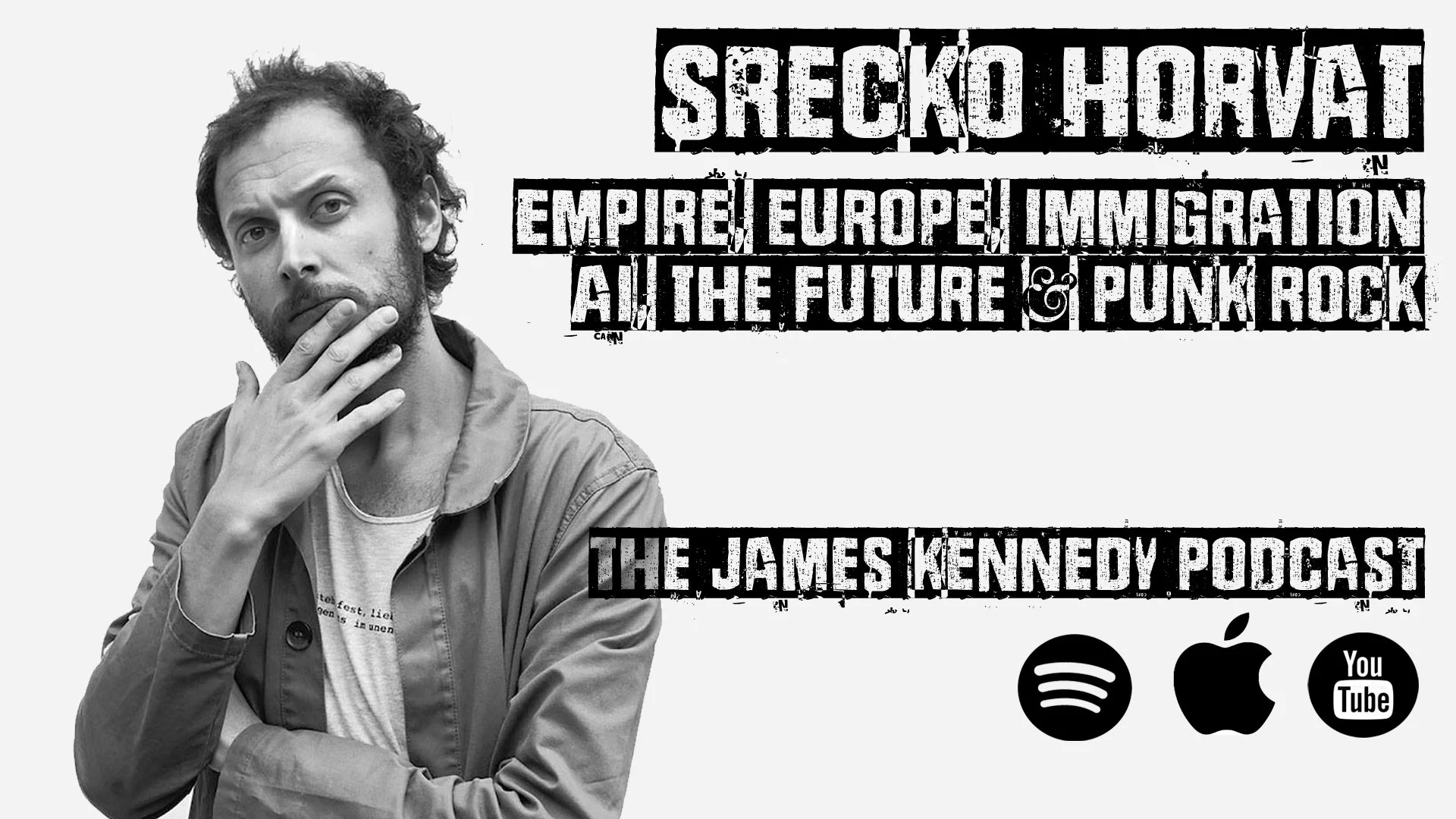
SREĆKO HORVAT - EUROPE, EMPIRE, AI AND PUNK ROCK
James Kennedy talks with Croatian philosopher Srećko Horvat about pressing geopolitical conflicts, the struggles of modern left-wing politics, and artificial intelligence. Reflecting on how punk rock sparked their political awakening, they explore Horvat’s efforts with the Island School of Social Autonomy (ISSA) on the Croatian island of Vis focused on building autonomous, community-driven ways of living.
James Kennedy Srećko, thank you so much for doing this, man. It's an honor. How are you doing?
Srećko Horvat I'm fine. I'm very excited to be talking to you, James.
James Kennedy Well, I hope it's not going to be a disappointment then, bro. Like I said, I'm going to let you do all the clever stuff. I'm going to load myself up on caffeine so that I can keep up with your amazing brain and do my best to see if I can make it to the end. But I thought we'd start with a biggie. I'm going to throw a big one your way because we got a lot of shit going on in the world right now, man. There's a lot of stuff to delve into. I wanted to start with getting your take on what the fuck is going on in the world. We've got a conflict in Ukraine, you know, a genocide in Palestine. We've got bombing in Yemen again. The economy's tanking, but then people are getting fucking richer than ever before. Are all these things connected? Is there a plan? Or are we just in a free fall? What is going on? What's your take?
Srećko Horvat Yeah, thanks for starting with this question. You at least have some coffee and I don't. Well, it reminds me of this famous response the German philosopher, a member of the Frankfurt School, Theodor Adorno, once gave to a Spiegel journalist who asked him, "Herr Professor, two weeks ago, the world still seemed okay." And Adorno responded, "Not to me." And in that sense, of course, what we are witnessing today seems unprecedented. It certainly is unprecedented given the possibility of nuclear annihilation and that human civilization came to a level that we are able to self-destroy ourselves, but also destroy the planet itself together in this ultimate annihilation. So in that sense, it is unprecedented, but it's not surprising. I mean, the occupation of Palestine has been going on for more than half of a century. It's not that it started in October this year; these kind of processes were happening throughout decades. Of course, what we are witnessing now is really the peak of mass destruction and suffering.
What I can see in this whole situation is that global capitalism is unable to resolve its contradictions on the one hand, and that on the other hand, what we can see is not a clash of civilizations, as much as these Huntington, Fukuyama kind of dreams are coming back. But what we are witnessing is a clash of various imperialisms. On the one hand, the transatlanticists, which means the United States together with the United Kingdom and some countries of the European Union. On the other side, you have Russia. On the third side, you have China. Then you have the Arab states and so on.
So what we are witnessing is, on the one hand, a very worrying, unprecedented situation because of the amount of already existing suffering and the possibility of even more immense human suffering. But in a way, even if it looks depressive, I wouldn't say it's that depressive in the sense that what we are witnessing is the creation of a multipolar world. And that by itself is not good as such, but it's definitely better than being stuck in a bipolar world, for instance, where you only have two superpowers. So I think this kind of situation opens up cracks in the current system.
We could have seen it in the past weeks all across the world, from the massive protests in the United Kingdom to the shutdown protests in the United States. There is a massive movement all across the world. But at the same time, this year, 2024, is also the year of major elections in the world. On the one hand, the United States, where, as you know, there is not really a real choice if the choice, again, is between Biden and Trump. And on the other hand, European elections in Europe, which is happening just before the summer this year.
And if you look at this kind of representative politics—we're not now speaking about mass mobilizations and social movements who are coming together, but we are speaking about representative parliamentary democracy—here, the situation, at least to my estimation, has never been worse for the left and for the Greens. The left is completely lost. When you look at the polls, for instance, in Germany, you will see that the German left, the so-called Linke, will have a very hard time to even pass and get any seat in the parliament. On the other hand, the Greens are in power in Germany, but you can see what their politics consists of, especially if you look at foreign politics.
About the United Kingdom, I don't really have to talk to you about it. You know the situation much better than me, but I would say the situation is not better in any other country. So we definitely left the landscape of 2015, 2016, which were the years, you know, Syriza in Greece, Podemos in Spain, massive mobilizations turning into new political parties. But these political parties are not new anymore. Many of them collapsed or compromised. It's sufficient to look at Syriza in Greece, where the current head of the political party is a former banker. So it's a logical kind of circle of this tragic experience of the so-called radical left in Greece.
And we could go on and on. So in that sense, I would say, on the one hand, yes, we have an unprecedented global situation where various existential or even eschatological threats are intertwining and reinforcing each other: the climate crisis, the nuclear threat, the permanent war, the migration crisis, the microplastics and so on, the violence which we witness every day, the rise of fascism and autocratic systems around the world. But at the same time, what we can witness is the creation of a multipolar world, a new energy in social movements across the world, and at the same time, a complete disaster, I would say, when it comes to left-green politics in representative parliamentary democracy. How is that for instead of a coffee?
James Kennedy Nailed it. Nailed it, man. That's done more to wake me up than this cup of coffee right here. Yeah, no, that's a brilliant answer, man. I think that opens up a whole load of other things which we could dive into. One of the things that I wanted to touch on, which you mentioned towards the end, was the impotence of the left, which seems to be a kind of universal problem. What's behind that? Is it because—I mean, it feels like in Britain, certainly, the Labour Party has had to fit into such a small groove of what it will deem to be acceptable by the elites and all the different players that they've got to please to get any kind of traction in the marketplace, so to speak. Is that what we're seeing around the world, or is there something else at play?
Srećko Horvat Yeah, what we're witnessing is not something new. The German philosopher, Walter Benjamin, a hundred years ago, almost had a beautiful and most precise definition of this, and he called it the left-wing melancholy, the left-wing melancholia, where he went deeper into the meaning of melancholy, which, unlike mourning, is a process in which, at least to the definition of Sigmund Freud, you cannot get rid of the object because of which you are suffering, or you are sad, or it completely changes your life. You stick to the object. You stick to it even in a way of fetishism, and you constantly revive the object.
To illustrate the point with a pretty banal illustration, you end up with a breakup, and then instead of going through the process of letting the person go, you constantly put a knife in your heart by watching old photos, videos, or whatever, and in that way, you can never get over the object or the subject which is the source of your suffering. So this is a kind of melancholy, and I would say the left very often suffers from it. I think the left still didn't recover from the defeats—and there were plenty of defeats—which it suffered in the last decade.
Very often, I would say also one of the reasons for the failure of the left, if you want to put it like that, or for the absence of a parliamentary success, resides in the fact which you mentioned, that the left very often—not just because it is pressed by the material circumstances and foundations of the system, which already in a way channels you in which way you can act or what you can do at all—starts to slide or incline towards the center, or towards what Tariq Ali, for instance, called the extreme center.
Your best example, again, is Germany, where part of Die Linke actually adopted an anti-immigration discourse, which, surprisingly or not, actually gives them a higher percentage at the polls currently, which is interesting as well. But most of the other cases end up in the following way: the left sees that it's not successful and it starts to incline towards the center in the sense of ideologies, narratives, policies, and so on. But the voters actually don't want this; they want a real, authentic radical left. So why would they vote for a center-left if they can vote for a right-center, which is very similar to this?
In any case, I'm kind of bored of this parliamentary politics already. I'm not saying it's not important and people shouldn't be mobilizing and shouldn't be trying to transform political parties or build new political parties. But me personally, after 20 years of being active in various social movements, even running for European elections in 2019 together with my dear friend Yanis Varoufakis, at the moment, I'm just not that much interested in it, because I see that the new energy, the new theoretical reconceptualizations of global capitalism and possible forms of resistance, is not coming from political parties currently, but it's coming, as was very often the case, from social movements.
Then, of course, we would end up in a chicken-and-egg situation: what shall be done? What to do in this situation where you have a desire, an urgency to create new political forms, to create new forms of living together, to create new forms of society? Well, my response these days is to just try to reinvent new institutions if it's possible. Not just what Rudi Dutschke famously during the period of '68 called Der lange Marsch durch die Institutionen, the long march through the institutions, but at the same time to build new institutions up and down. I think that's a very important thing to think about outside of the existing institutions. So that's basically where I am at the moment in the sense of my own aspirations—a crossroads, to put it like that.
James Kennedy Yeah, I echo that, man. I mean, I totally get what you're saying, and I want to come on to that in the second part of the conversation to do with what can we do as citizens and activists to kind of effect change outside of this binary ping-pong match that we get to have every four years, where we get to vote for the lesser of two evils if we're lucky to even be able to do that, neither of which truly represent 99.9% of us anymore. So I think I probably share your sentiments on what some of the solutions to that are going to be.
But before we get to that point, I want to kind of get a bigger picture of what we're dealing with on a global scale. So you've mentioned already that the power systems around the world and the power structures around the world are changing. You know, we've got a clash of empires now, but where does our beloved Europe fit in amongst all of this on the world stage now?
Srećko Horvat As you know it better than ever, it's sunny weather, everyone is living the life of their dreams, driving electric cars, and not polluting the rest of the universe, not involved anymore in crude colonialism or new sorts of imperialism, so we finally reached the end of history in Europe. But of course, it's a bad joke.
No, I mean, I've been dealing with Europe for a while. Back 10 years ago, together with Slavoj Žižek, we published a book which was first published in the UK and then later by Columbia University Press. It was called What Does Europe Want? It's a paraphrase of this famous question from Sigmund Freud. Freud himself never succeeded to come to an answer to this question, and similarly, I think the question "What does Europe want?" also leaves us not with an answer, but just with open questions.
I mean, it's the famous joke: whom do you call if you want to call Europe? Obviously, there is no one to call. There are unelected representatives—for instance, Ursula von der Leyen, who went to Israel immediately after this last war started, although none of the European citizens decided or had a say whether representatives should represent us in such a complex and urgent issue. Not to mention, of course, the other European financial institutions and the kind of business they are doing on the periphery of the European Union.
All in all, I would say the trend of the rise of right-wing populism, or even forms of fascism, is happening rapidly. It is something me and Žižek have been talking about 10 years ago already, and many others as well. What we kind of projected at that time 10 years ago is unfortunately something that is happening now: that the further escalation outside of Europe—which means new wars, which means a new influx of migrants and refugees—is occurring.
We were speaking about that 10 years ago. I visited Idomeni in Greece, this refugee camp with almost 20,000 people on the railways. I visited also five years ago or something, and I would say that the Idomeni camp was just small footnotes for what is coming, and we can already see it. The millions of people displaced because of the war in Ukraine, the hundreds of thousands of people displaced already from Gaza, millions of others from Africa, from Asia, who are affected either by wars, civil wars, or by the climate crisis—they're all coming to Europe.
And what we can witness—I can witness it these days in Croatia, maybe that's a good example to give you—is that unlike the United Kingdom, Croatia, first of all, was never an imperial power, so of course it didn't have colonies. Because of that reason, also, we didn't have such an influx of migrants to the space of what is now called Yugoslavia. With a small footnote: during the Non-Aligned Movement, of course, Yugoslavia had very good connections with the Global South, and at that time in the '70s and the '80s, we had people from Africa, Asia, and so on coming to study in Belgrade.
This situation changed. It's a very monocultural culture; it's a very white culture, and it's a nation which is dying out. In the last 10 years alone, Croatia has lost 300,000 people who left in search for jobs, mainly to Germany, Austria, and Western Europe. So at this moment, Croatia has a bit less than 4 million inhabitants. The projection is that in the next seven years, more than half a million migrant workers will arrive in Croatia, which means that a huge percentage of the population will be non-Croatians. At the same time, statistical and demographic projections say that until 2100, Croatia will only have two million inhabitants.
Now, of course, that sounds ridiculous—to be speaking from Croatia, as I am today, from a country which is becoming a kind of reservoir, like a zoo, in the sense that the Croatian white class, who was never imperial and is not as privileged as the West, is now pretty privileged compared to those people who are coming. There are no integration policies. For instance, I was a kid of—and still am—a political refugee, so I lived as a refugee in Germany in the '80s. Very soon after we came, my father got a free language course by the Goethe-Institut for six months. If you come from Nepal or Bangladesh—mainly the countries where the migrants come from to Croatia these days—there is no free language course to learn Croatian, there is no integration.
What is happening in the last year is literally every day in the newspaper we read about a new racist attack. That might not be new to you, although I would say the level, the statistics, the amount of these attacks is really astonishing, and it's something which points into a very bleak future, not just for Croatia, but for Europe as such. Obviously because of the climate crisis, but also obviously because of war, because war is the permanent state and peace, unfortunately, is just a pause.
Because of war and the climate crisis, we can definitely expect the numbers exponentially to rise. We will have hundreds of millions of refugees trying to reach Europe, at least at the beginning while it's still not completely fucked by the climate crisis, and Europe responding in the way which we could have seen during the last 10 years: either by outsourcing the refugee crisis at the beginning—you know, they outsourced it to Greece, to Idomeni. A few months ago, I don't know if you saw that, Italy and Albania made a deal that Italy will outsource its refugees to Albania, who is now building detention camps for migrants where around 30,000 or 40,000 refugees will be based.
So they are trying to escape war from, let's say, Afghanistan, pass through Greece, pay thousands of euros to smugglers, then they are deported back, they go back, and in the end, they arrive in Italy and then Italy will deport them to Albania. So on the one hand, what we can follow is this outsourcing of the refugee crisis, which acquires very dystopian science fiction characteristics—for instance, that boat in the United Kingdom, which is a floating refugee detention camp. So you don't even need a country anymore; you can just put them on boats.
More and more, we are coming closer to Alfonso Cuarón's Children of Men, where refugees are in cages and Europe is completely divided. So on the one hand, I think it's a very important thing to observe, but I think this outsourcing of refugees will become an even harder problem than what we could have seen in the last 10 years. What points towards the next 10 years is that the building of walls, electric fences, artificial intelligence is already being used by Frontex. These technological advances—using traditional forms like walls, but using also modern forms of technology like artificial intelligence—will rapidly rise.
We've seen it already in Hungary and with the regime of Orbán. If you already built a wall, at the same time Frontex—which is this migration army, to call them the official army of the European Union—is getting equipped with all this AI technology, which is now also being tested in Gaza, for instance. In which way through machines and technology can you scan people, influence their behavior, block them from entering public transport, make their lives miserable?
At one point, I think even a passport will not mean that much anymore, although at least for us who are still privileged, it still means everything. But I think the kind of control which is coming, the kind of biopolitics which is coming to Europe given the state of things and this whole situation which we just painted, is of course something which should worry us all. You don't have to be a weatherman to know in which direction the wind will blow; it's sufficient to look at the last almost 20 years since the financial crisis of 2007–2008.
From that moment, the European Union, although it had some new accessions—Croatia was the last accession member state—is imploding. It's imploding when it comes to demography; it's a continent which is dying out. You've seen it with these statistics about Croatia, but we could talk about other countries where fertility is going down. That's why I say it's a Children of Men scenario. In the meantime, Europe is involved in wars across the world, which like a boomerang is coming back to Europe.
For instance, for the last year or even more, we are using fracked gas from the United States now, but oil at the same time comes from Saudi Arabia and other Arab countries. At the same time, the standard of living for people in Europe is rapidly falling down. Just look at Germany, which is entering a recession, where you have huge farmers' protests. If these things are happening in Germany—which, as we know, is the core of the European Union, the foundation of the European Union together with France, but Germany was always the most important country—if Germany is hitting such a crisis, if Alternative für Deutschland, this far-right party, is rising that much in the polls that it's putting a shadow on all the other parties, it's Europe's elites' fault to be leading us in this direction.
This can just mean further escalation. It can also mean terrorism back home, because whatever happens in the Middle East, in Africa, or in Asia, as a rule, will return like a boomerang to the European Union as well. We had it already in the past, and it's just a matter of time when we will have it in the future.
James Kennedy Oh man, that's a pretty bleak prognosis for the near future, then.
Srećko Horvat You asked for it; I'm sorry.
James Kennedy Well no, because like you say, knowledge is power. We need to know that the storm is coming so that we can prepare and navigate accordingly, you know. So yeah, no, it's no good pretending this ain't happening. And you mentioned advancements in Web3 and the decentralized web could actually benefit activists and provide some kind of asset to us as dissenters in terms of proliferation of information, building networks, or organizing. Is there that capacity, do you think, or is this just another tool for the billionaire club to keep the peasants down?
Srećko Horvat Technology, of course, is always a pharmakon, as Plato called it, in the sense that it depends in which way you use it. But at the current stage, artificial intelligence—the developments and advances in artificial intelligence or, to be more precise, in machine learning—is completely out of control. We don't have any influence, and experts who are in this field also don't have any influence in which way it is being developed. So of course we should be worried, because what we are reaching now is a tipping point in the face of the advances of technology.
The German philosopher who is unfortunately pretty forgotten now, Günther Anders—although his Die Antiquiertheit des Menschen [The Outdatedness of Human Beings] will be published very soon in English—had a thesis that humans became outdated because we are not historical in the sense that it is humans who make history, but we are becoming historical in the sense that it's technology which is making history. Günther Anders wrote this half a century ago, influenced by Hiroshima and Nagasaki. He was really ahead of his time, writing mainly in the context of nuclear technology, in the sense that we succeeded to create such a thing which, as long as human civilization will exist—even if it's one hour more, 100 days more, 100 years, or 100 centuries—we will be unable to unlearn.
So the threat will always remain with us whatever we do, even if suddenly there is peace in the world, which of course remains a Kantian utopian idea and an aspiration of many of us who are still utopian. But even if we arrive at the stage of world peace, which is pretty unimaginable, we wouldn't be able to unlearn the technology we had invented. I think the same goes for artificial intelligence.
Another term which I think is very useful comes from Günther Anders, who said that what we are witnessing with the development of technology is something he calls the Promethean gap, which means that we are not able to understand the repercussions of our own inventions. We are not able to understand what kind of consequences our inventions will have. Of course, it goes for any invention. When the first wheel was invented, probably it wasn't invented with the idea that you could have a tank several thousand years later, but it was invented for carrying wood or whatever. The same goes for artificial intelligence, which is, of course, even more dangerous than the wheel, because we really cannot understand the consequences of this technology.
What we can understand at this moment is that it's certainly another phase in monopoly capitalism, in the sense that you already have a few Silicon Valley companies who are occupying the space of technology, at least of the Western world including Europe. What you will have now is even further stages of hyper-integration of algorithmic penetration into all spheres of life, which, to come back to your question, will of course affect activists and social movements.
Already now, the European Union has registers of activists, but then you can imagine to what stage it would come when you apply machine learning and artificial intelligence. What comes first to my mind is Philip K. Dick and Minority Report—or the movie, which might be a bit more famous because it's by Steven Spielberg and Tom Cruise—the science fiction scenario in which the police actually solves pre-crimes. Even before you yourself know that you will commit a crime, the state—or in our situation, it might also be a corporation, because this is also more and more being outsourced to corporations. In the same way Palantir is now in power of the NHS, the police might be a Tesla police or Zuckerberg's police or whoever, so it's being outsourced.
Of course this should worry us. What we can see in Gaza these days is the way they are already using AI in drones to affect the civilian population. This is the problem of technology. For years, Israeli corporations have been using machine learning and artificial intelligence in drone operations for agriculture, and then you can see that the step from using AI in drones for agriculture to using AI in drones for killing people is very small. In the same way, the step from using nuclear energy for peaceful purposes to using nuclear energy for war purposes is also very small.
In this sense, I definitely don't belong to these techno-optimists, techno-fetishists who think, "Yeah, it's sufficient to find a new technology, whether it's artificial intelligence, geoengineering, terraforming, or whatever, and this will be the solution for all our problems." No, I think we have to go much deeper; we have to go into the structural, systemic foundations of our system, which is producing technology in that way, producing inequalities, and actually laying the grounds for the final destruction of the planet as we know it.
ENJOYING THE CONVERSATION?
GET JAMES KENNEDY'S LATEST INTERVIEWS, WRITING AND LIVE SHOWS STRAIGHT TO YOUR INBOX.
James Kennedy Wow. Well, I think that's probably a perfect point to jump off and talk about what the hell can we do about this stuff. We've clearly got some massive challenges and obstacles ahead, as well as a rapidly shifting terrain in which to operate. So what are your thoughts? I know that you're very active in these areas and you've got a lot of things that you're involved in. What are your thoughts on what we can do as the 99% to steer things in a different direction, if at all possible?
Srećko Horvat I mean, of course I don't have a recipe for what we can do. It's a question Lenin asked 100 years ago, and through the last hundred years, there have been plenty of recipes or proposals—from Hardt and Negri's Empire and Multitude (unfortunately Negri also left us recently), to Chantal Mouffe's populism, to various other proposals, or Andreas Malm's How to Blow Up a Pipeline. You can see there are various proposals which range from building up a mass movement, to building up or transforming a political party, to creating a successful narrative which would be able to inspire people, and then we even go to more radical actions, attacking the sources, the foundations of the capitalist machine.
If you look at it, this is just out of my head, painting a possible landscape which exists today. Of course, we could then speak about the Labour Party and what kind of problems the Labour Party has, but I'm not really ready to ruin my morning by going into that story, or yours. So we could speak about the impotence of existing political parties, what went wrong, and in which way the enemy actually is even more successful by creating narratives about those in the party who wanted a radical change, like Corbyn, and then all these accusations of anti-Semitism and so on. This is something everyone will face at one moment when you are powerful enough to bring things into question.
This is something Julian Assange faced as well: this sort of character assassination, which had all the characteristics from rape to anti-Semitism, to him being a Russian spy, to him being annoying, to him riding a skateboard at the Ecuadorian embassy—even such bizarre, ridiculous things, which were all here to show that he is a problematic guy whom you shouldn't like. That's what happened in various ways to Jeremy Corbyn. That's also what happened on the European level, to a big degree, to Yanis Varoufakis when he was finance minister of Greece. They will really attack you with all the arsenal they have.
In a way, I think that's hopeful, if you want, because it shows that at some point the left actually has a possibility to bring power into question. You can see it by these harsh attacks, but you could also see it by various recent experiences—for instance, in Colombia with Gustavo Petro and his stance on geopolitics. You could see that even in some parts of the world, the left is in power, of course.
But that's party politics. You asked me what we could do. Of course, I've been involved both in social movements—mainly in social movements, organizing—and political parties. I think our starting point should be twofold. On the one hand, of course, it's internationalism. I think we are doomed without internationalism, especially in a situation where capital is international, the banks are international, and our enemies are pretty well connected on the international level. That's also the reason why I'm involved in an organization called the Progressive International, which is actually trying to recreate not just the spirit of new internationalism, but the conditions of further internationalist cooperation between the North and the South and the East and all sides of the world.
Our starting point should be twofold. On the one hand, it's internationalism; on the other hand, it has to be locally grounded. You can't just be—I've seen many people like that—an international traveler who goes from protest to protest, from conference to conference, from World Social Forum to World Social Forum. If you look back at their community, that person is not actually contributing much.
So I think at the same time, besides internationalism and trying to be connected as much as we can—even a person who is not in this kind of world, try to be connected with people outside of your milieu, outside of your country, on the simplest level. But of course, what we who are "professional activists," to call it like that, have to do is to build deeper connections and relations within this multitude. Unless we are able to build different relations of care, of love, of solidarity, of friendship on the local level—in our communities, in the building in which you are living, in the city in which you are living, in the country in which you are living—then I think internationalism is also insufficient.
This brings me to an anecdote I read for the first time in Tariq Ali, who said that at one point the Italian communists came to Vietnam to meet Ho Chi Minh. After two hours of a talk where Ho Chi Minh complained about the situation, they asked him, "Okay, so comrade, what can we do?" And he said, "Pack your things and go back to Italy, because the biggest help you can give us is to make a revolution in Italy." I think this is something internationalists should have in mind: unless we are also able to change the material conditions of politics, economy, and society in our own societies, then we also won't be able to do it on the international level. So we need a dialectic between these.
More and more, I also think that what we should be aiming at—and I have to warn you immediately, it's not an anarchist escapist dream—is to try to experiment by building new social institutions, by building autonomous spaces and autonomous temporalities. These are not outside global capitalism, because there is no outside of global capitalism. You can even travel to Mars and you will find Elon Musk's shit there in an electric compost toilet or whatever, so there is no outside.
What we can do is to build parallel institutions, parallel forms of life, parallel forms of being together, parallel forms of political, economical, societal formations which would be able at the same time to transform us before a political revolution, before a political party comes to power, before a petition, whatever, and at the same time enable us to lead a good life.
I think that's the most burning question on my mind, but also on many others with whom I talk—for instance, Franco "Bifo" Berardi, who is involved in the School of Autonomy. It is not just, "How do we survive these times?" because mere survival is not enough. Millions and billions are condemned to bare life these days, where you are forced to just search for food, shelter, protection, water, and peace. I know that for many people, the very question of a good life is a privileged question. But I would say that posing the question about a good life in times of extinction is crucial.
Why? First of all, it's a question which goes back to philosophy: what is a good life? It goes back to the question of what is good in the sense of ethics, good in the sense of morality—something which is, of course, completely unpopular today. Who even cares about morality or ethics or what is good? So it's connected to a sort of ethics. When we speak about a good life, it's not that much about hedonism, about just sitting on a beach reading a good book and not caring about the rest of the world (which people should be doing as well; it should be a human right to do things like that and completely switch off).
Good life in the sense of an ethical life: if I sit on a beach and read a book while I know that atrocities are happening, how can this reflect a deeper ethics or morality which is not castrating me from doing, from time to time, things which every human should be doing, but could actually be integrated into a broader moral value system which would then advocate also for others to have the same possibility? In this sense, a good life is not simply that you have a good life and I have another shelter. For me, that's not a good life; I'm definitely not interested in post-apocalyptic shelters.
Good life is: how can we, in such a situation, instead of having dreams of escaping to Mars and terraforming, actually start forming the Earth itself by diminishing poverty, inequality, racism, colonialism, imperialism, and the never-ending extraction and expansion of global capitalism? I think that's the question.
To come to my final point: what should be done? Yes, of course, someone should try to infiltrate political parties or build new political parties—I'm not opposed to it—and you must do this for 10, 20, or 30 years in order to maybe come to power. Sometimes there are shortcuts, but usually not. On the other hand, you could and you should be active in social movements. But I think we should all start posing these big questions.
That's my problem with hope. Hope is more like imagination, optimism, waiting for something to happen, wishing for something to happen. Nothing is wrong with that; I very often have various imaginations of things to happen, and of course you need to have a dream, a utopia, or a desire which leads you towards somewhere. Even if you don't achieve it, on the path, if you're lucky enough, you will realize that you actually found something close or different from that to which you were aspiring.
Faced with our global planetary crisis, what we need is not hope; we need determination, we need organization, and we need self-organization. Terry Eagleton had a beautiful term: he called it "hope without optimism." If you want to keep the term hope, maybe that's precise, because there is no reason for optimism, and we've seen it so many times already. Maybe I'm getting old, but this kind of investment of libidinal energy into, for instance, the success of a political party—you have so much hope that Corbyn or Alexis Tsipras will be the messiah finally. But fuck the messiah! The very concept of politics where you wait for a messiah is wrong from the start. It doesn't mean that we don't need charismatic individuals or people who can take a lead at a certain point in a certain field, but this awaiting of a messiah, of a solution which will come from the sky and suddenly lead us out of the land of tears, is precisely what is wrong with hope. So instead of that, we need determination, organizing, and self-organizing.
James Kennedy "Fuck the messiah." That's the quote I'm going to use from the episode.
Srećko Horvat Just don't tell it to the messiah, because maybe he comes the day before he was supposed to come and then I fuck it up, you know? "Finally he was supposed to come, but then he heard 'fuck the messiah'."
James Kennedy Srećko Horvat fucks it up for humanity! You would love that, dude, wouldn't you? You and all your Kafkaesque perversion, you would love that.
Well look, I think it's time. We've got to take a rapid curveball here, dude, because I'm mindful of the time, and I've got to ask you about this, because I think this is something that many of your fans and followers will not know about you, perhaps. But you have a background in punk rock. We share that in common, man. So tell me more: what's the deal with Srećko Horvat and punk rock?
Srećko Horvat Well, I'm not like you; I'm definitely not anymore, but I've never been a professional or successful musician. I was just a kid. It all started in 1992, which sounds like dinosaur times—I sound like a boomer now. Anyhow, it was Croatia; Yugoslavia was collapsing and the war was happening, of course. A cousin of mine came from Germany and brought this CD with a bald guy who is burning in a fire, and then in a typewriter font, you have written down "Rage Against the Machine." I think that was '92 or '93, and I was nine or ten years old, and it completely changed my life.
Before then at school, because that was the time, we were all learning these patriotic Croatian songs, which were pretty ridiculous, but it's this typical kind of ideological re-education which comes with a new state and so on. For me, this hardcore punk was an exit from the madness of war, from the madness of nationalism. I was not even yet a teenager. But I remember after I heard the first track, which was "Bombtrack," it really changed my life. It was like, "What the fuck is this?" as if some alien came and gave me a CD from Jupiter.
Slowly—it was still a problem then in our landscape, as we were in the period of transition from socialism to capitalism, so you didn't have the free market yet in the way we have it today, you didn't have that many Western products—it was really a problem how to find new music. I think that was actually one of the best lessons I've learned for the future of my life, because that was the beginning of self-organization. It was sufficient that one kid went to Germany, brought one CD, and we would dub it in hundreds of copies and everyone would have a tape with it.
In the mid-'90s, because I knew German and the internet just came—I think in 1996 or something, we got our first personal computer at home—I started to write to bands I liked. I even wrote to the biggest ones at that time, like System of a Down. I wrote a letter and I received a demo tape in 1998 or something like that. I wrote even to big bands who were not big then, like Refused. We were big fans of Refused, and they always responded. I was like 12, just starting high school.
For me, that was a way to hack my way out of ex-Yugoslavia, torn by war, nationalism, and turbo-capitalism. It was a way to also, at a very early age, get a push from—that's why I think what you are doing is so important—those people whom I admire. I was 12 or 13, and there was someone who was 16 or 18 and already had a band, toured around Europe, was publishing a fanzine, had views on the world, on vegetarianism, ecology, capitalism, was reading Chomsky, and so on. That's how I actually started to really have my first political subjectivation.
A bit later, I started a band. It was new school hardcore, Krishna core, Snapcase—this kind of new school stuff, very emotional, but also very metallic. We had a few concerts, even played with Converge. That was our biggest concert.
James Kennedy You know Converge? Of course! Yeah, hell yeah! That's awesome!
Srećko Horvat And I'm so happy that I had this experience of hardcore punk; it's still in me. I think it's really something which, unlike many other subcultures, was the best way for political subjectivation, because all the literature from anarchism, Marxism, and critique of capitalism was coming from there, from fanzines we were reading. I'm talking about the '90s, before the internet took over and many of these publications didn't exist anymore.
We were organizing our own concerts. You're in a band, so you know what kind of logistical sophistication and patience you need sometimes in order to put five people in a way, not to mention more, to travel from one town to the other to organize...
James Kennedy Oh yeah, so well!
Srećko Horvat And I think this experience was very useful later in life when I was organizing political or philosophical events for 1,000 or 2,000 people. I already had it in my guts; it wasn't science fiction. We've been organizing crazier stuff with punk hardcore.
Then, of course, I think the most important thing is the sense of community, the sense of belonging, the sense of being together with like-minded people having the same worries, the same troubles, whether it comes to first love affairs or family troubles, to the state of the world and the state of the planet. This sense of belonging is really crucial, and it's really something which I still carry in me, not in a nostalgic way, but in a way that I'm becoming more and more aware of how this experience of hardcore punk actually formed me as a person later.
James Kennedy Beautiful to hear, man. Yeah, I love that. A very, very similar journey, mate, to be honest. Rage Against the Machine was one of my founding moments. For me, it was a cassette copy. We had it like drugs—we were handing these copied cassettes around like illicit goods in case our parents or teachers found out about it, you know what I mean?
I remember listening to it for the first time. Hearing "Killing in the Name," I was like, "Well, you can say that? We're all thinking it, but he's saying it!" It was fucking brilliant, and just the music ignited something in me of possibility. That rebel spirit, that kind of defiance was okay—even better than okay, it was fucking awesome, and you could say it loud and proud. Just an amazing band; they really changed the game.
Going back further than that, as we all do once you discover something like that, you go digging. Going back to The Clash, or the DIY early days of punk: that punk ethos of fanzines, flyering on the streets, graffiti, stenciling your clothes, and stuff like that. That DIY ethos just really resonated with me, and it was the political aspect of it as well: the anti-authoritarianism, the anti-mainstream, the communal aspect of it. It was just a real fucking Molotov cocktail that went off inside of me at a young age, and still very much informs my politics and my way of doing things now.
When I couldn't get a record deal when I started out, I just set up my own label. I went punk rock, I did it DIY, and released my own stuff, and I've been doing it that way ever since. That's kind of the model that I live by now. So yeah, very much informed musically, politically, and in terms of how I handle my career as a musician. I owe everything to them, and it really felt like a movement back then as well; it felt like it was powerful, you know what I mean?
Srećko Horvat No, I mean, it was. Just the fact that the kids... Where were you growing up, exactly? In which city?
James Kennedy Cardiff.
Srećko Horvat How big is Cardiff?
James Kennedy Small, I don't know, like half a million people, something like that.
Srećko Horvat We don't even have a city with a million people in Croatia, so that's rather big.
James Kennedy I'm probably miles away, dude. I'll have to check; don't quote me on anything.
Srećko Horvat Yeah, you should, because they will not let you back into your hometown after this!
But yeah, I lived in Čakovac, which was like 20,000 people. And I think when you said it was definitely a movement—if a kid in Cardiff and a kid in Čakovac, a kid in capitalism and a kid after socialism, had the same kind of entrance into this world, then it shows the power of this movement. And the fact that even today we still talk about it...
James Kennedy It's cool, I like it. Yeah, what's funny, man, is that I've got two guys in my band who are like 21 or 22. They turn up to band practice in Rage Against the Machine t-shirts and Nirvana t-shirts and stuff like that. I think that's a beautiful thing, because that was a great time for music when it was authentic, before everything got fucking complicated when the internet came along. When I see guys that age or that generation still digging that music and wearing those t-shirts, it really makes me proud, because to see that music living on is really heartening, you know what I mean?
Srećko Horvat Yeah, no, I love that as well.
James Kennedy I think once we should just take one hour and just talk about hardcore punk.
Srećko Horvat And not just depress people with war, climate change, "everything is shit," and so on, but a bit more of this.
James Kennedy Dude, I'm game for that conversation anytime you want, man. But what's the music scene like in Croatia these days?
Srećko Horvat I have no idea, to be honest. I really have no idea. I now lead a family life, don't go out that much. We're building the school on the island. There is no hardcore punk scene on the island because it's very remote, so rarely do we even have concerts. So to be honest, I really don't know. I know there is a rich musical scene with different genres, singer-songwriters, and so on. It's pretty rich, but I just don't follow. That's what I would love to change; I don't follow music that much, just like I did before. That's maybe a bad thing. So send me some links and suggestions.
James Kennedy Yeah, please. No joke, I'll do better than that.
Srećko Horvat Educate me! Educate me! You play a concert for me.
James Kennedy 100%, I'm down for it, man. I'll tell you what we'll do: we'll do a trade. You can send me some book recommendations for all those clever dudes you mentioned earlier, and I'll send you some music. I'll do better than that: I'll send you old-school '90s style, I'll send you some CDs.
Srećko Horvat Great! Amazing, it's a fair deal.
James Kennedy There we go, done! Well, I know I'm keeping you a little bit over time, but we've got to talk about the island. Can we quickly explain to the listeners what is going on on the island of Vis and what you guys are up to down there?
Srećko Horvat Yeah, you pronounce it well. It's a remote island; you really have to take a ship which takes a bit more than two hours from Split, and it's in the middle of the Adriatic Sea. It had a rich history: it was the first polis founded by the ancient Greeks, the first city-state in this part of the Adriatic. Later all sorts of people, including the Brits, came, and then in the '40s it was crucial because when Europe was occupied by the Nazis, Vis was the only liberated territory in this part of Europe. It was never occupied by the Nazis, and in fact, Tito, the leader of the anti-fascist movement of Yugoslavia, was operating from a cave on Vis.
Some 10 or 15 minutes' walk from this cave on the top of the island, we are building a school called ISSA, which was also the name of the first polis two and a half thousand years ago. But for us, we use it as an acronym which stands for Island School of Social Autonomy. Among the co-founders of this project are the artistic group Beatnik, my dear friend actor Gael García Bernal, Pamela Anderson, Franco "Bifo" Berardi, Hito Steyerl—so we have from philosophers and actors to practitioners.
The idea is basically to build a hybrid model of education, which I think is the only model that still makes sense: set in nature, set on an island in a landscape which itself is surreal (although changing due to the climate crisis), and at the same time combining theory and practice. For instance, the main aim is to respond to and reflect upon the question: how is it possible to create levels of autonomy and a good life today? We are doing philosophical reflections on it, but at the same time we are trying to prototype it in reality.
For the last two years, we've been reconstructing an old water tank. It's a method which has been used since the time of the Greeks, more than two thousand years ago, using dry stone walls. In the case of the water tank, you have piles of stones, and rainwater is collected as it slides through the stones into the tank. We learned about this traditional method from the islanders—we learn a lot from the people on the island, which you could call a sort of indigenous knowledge. It's a knowledge which goes back to the Greeks, the Illyrians, the Romans. What we're trying to do is combine this traditional method with modern methods of collecting rain, like cloud collectors.
This summer, we were experimenting with a pirate radio station. We got the equipment and succeeded in covering the whole island with our signal.
James Kennedy Yeah, maybe next time you can come do your podcast from there with a better view, hell yeah! Better weather for sure, man.
Srećko Horvat Yeah, definitely. But the thing is, with these kinds of prototypes, we could actually build something which responds to the question of autonomy and a good life, and which—most importantly—could be translated into different contexts. What we are doing, the idea is that these kinds of things could be done, and very often are already being done (we are not the first ones), in other places of the world. The aspiration is to share this knowledge and to start working on creating a network of similar projects across the world who are doing stuff like this.
For this year, we're organizing plenty of activities. From spring onwards, we are most of the time on the island, and then in October we will have our annual event. During summer and other months, we are involved in a lot of physical action: carrying material, building, constructing, learning from the islanders themselves, and doing little public programs, and then in October we plan to do a big one. I'm very bad at promotion, but if you want to find out more, go to issa-school.org and you can find more information.
James Kennedy Absolutely fascinating, man; what an incredible thing to be involved in. I'll put a link in the show notes so that people can click on it directly: it is i-s-s-a-dash-school.org. You'll notice in the top right-hand corner there's the very important button that says "Donate," because the guys are doing this on their own budget, and donations to fund this incredible project would be very, very well received, I'm sure.
Srećko Horvat Yeah, that would be really helpful because we are still running only on our own funds. We don't have any funds, basically, and if anyone can donate a little—you see, I'm very bad at this—but if you can donate, we would really be grateful.
James Kennedy Get on it, guys! I'll give it a plug as well after the conversation, drop that in the edit, and see if we can get some shekels for the project, because you're doing amazing work down there.
Srećko, I'm aware that I've kept you over time, so I'd better let you go, but thanks so much for this amazing, fascinating, and inspiring conversation. You're doing amazing work, please keep doing what you're doing, and hopefully we'll get to share a beer at some point later on in the year, perhaps.
Srećko Horvat Yeah, I hope so! I hope to see you on the island, and don't forget the deal!
Key Points:
Host James Kennedy opens the episode by promoting his podcast, band, and social media before introducing guest Srećko Horvat, a Croatian philosopher, author, and political activist.
Horvat argues that current global crises—war in Ukraine, genocide in Palestine, economic inequality, and environmental collapse—reflect global capitalism's inability to resolve its contradictions, describing the situation as a clash of imperialisms rather than a clash of civilizations.
He observes that while representative parliamentary democracy is failing the left and Greens across Europe, social movements worldwide are creating new energy and a multipolar world order.
Horvat critiques the left's "melancholy" and tendency to drift toward the center, arguing voters want an authentic radical left rather than a diluted center-left.
He warns that Europe faces demographic decline, rising far-right populism, and an escalating refugee crisis, with AI and surveillance technologies increasingly used to control migration.
Horvat advocates for internationalism grounded in local community organizing, and for building parallel institutions and autonomous spaces that prototype a "good life" within, not outside, global capitalism.
He rejects passive hope in favor of determination, organization, and self-organization, arguing against waiting for a messiah-like political savior.
Horvat discusses his punk rock background as formative for his political consciousness, and describes the Island School of Social Autonomy (ISSA) he co-founded on the Croatian island of Vis.
Summary:
In this episode of the James Kennedy podcast, host James Kennedy speaks with Croatian philosopher, author, and activist Srećko Horvat about the state of global politics and the future of activism. Horvat opens with a wide-ranging analysis of interconnected crises—the war in Ukraine, the genocide in Palestine, economic inequality, and climate collapse—framing them as symptoms of global capitalism's unresolved contradictions and a clash of imperialisms rather than a clash of civilizations. While acknowledging the bleakness of the moment, he sees openings in the rise of a multipolar world and mass social movements worldwide, even as parliamentary left and Green politics face collapse across Europe.
Horvat critiques the left's "melancholy" and its drift toward the center, arguing that voters want an authentic radical alternative. He warns of Europe's demographic decline, rising far-right populism, and the escalating refugee crisis, exacerbated by AI-driven surveillance and border technologies. " He also discusses his punk rock background as a formative political awakening and describes the Island School of Social Autonomy (ISSA) he co-founded on the Croatian island of Vis, which blends traditional knowledge with modern experimentation to explore autonomy and community.
The James Kennedy Podcast is a Society and Culture podcast hosted by musician and author, James Kennedy. Exploring the big questions around health, social issues, the arts, politics, mental health, the human condition and how to navigate this thing called life through casual conversations with scientists, activists, rock stars, philosophers and academics. Please subscribe, leave a rating and support the show.