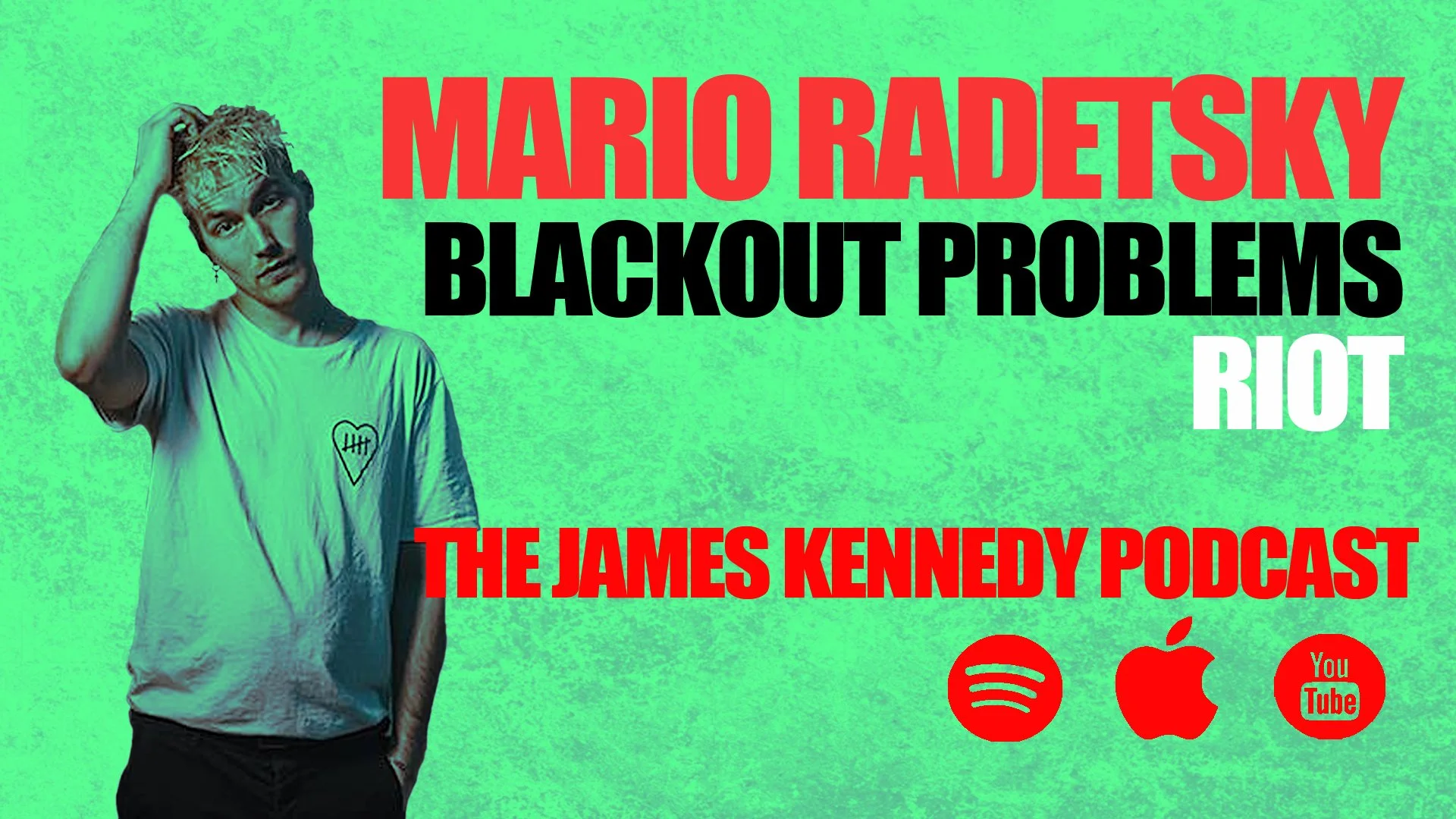
MARIO RADETZKY - BLACKOUT PROBLEMS INTERVIEW
James Kennedy interviews Mario Radetzky, frontman of Blackout Problems, about the band's self-produced fourth album, Riot. They discuss the record's personal and political themes, the headaches of post-Brexit touring, and their upcoming dates with Enter Shikari.
James Kennedy: So, man, give us the lowdown, dude. What's happening? What's going on?
Mario Radetzky: Oh, yeah. So I think for the moment, you know, it feels like there's nothing going on because the tour has not started and the release has not started. But on the other hand, there's so much going on. And yeah, we're really happy to have this fourth record right now. Riot is going to be our fourth one, which is unbelievable. We've been going for a long time now, I think as a band, and recording. I mean, I still remember vividly recording our first record. And now that's the fourth one. But it's a first in some parts, because that's the first one that I've produced myself. And it really feels fresh. We still feel like a newcomer band that's just about to start and about to maybe grow a little fanbase or whatever, you know. So let's see what happens.
James Kennedy: Well, it's interesting you say that, man, because, you know, you guys have been around. You've got four albums deep at this point. You've got a wicked fanbase. You've got a badass tour with Enter Shikari coming up, a new record coming out with Sony. So I mean, you know, you're not a new band getting off the blocks by any means. You're crushing it right now. But I wonder if it feels like that, because on this new record, it's a self-produced album. And I know from my own experience that when you're producing an album yourself and you're aware of all of the moving parts behind the scenes and the build up and the strategies and the tactics, it kind of takes some of the magic out of what is otherwise a roller coaster ride, you know. Is that how it feels for you, or is it the other way around?
Mario Radetzky: Honestly, it's a little bit the other way around, because producing it yourself the first time is so exciting. I feel like there's so much magic in that. And I'm way more excited about releasing the music. I'm a little bit nervous about that as well. And especially with our last single—you know, just a few weeks ago, we released a song called "Funeral." That's the poppiest track that we've ever done. And it's the most positive track as well on a very dark record, I have to say. I think Riot is really dark, and there's a lot of negative shit going on. I get very personal and political at the same time. I talk a lot about stuff that I would probably tell nobody. But, you know, in the music, you can do that. You can open up. I'm a bit like an introvert. But in the music, it's like my spot where I can be honest with myself and to everybody else in a way that I couldn't be in normal life. And so this time, I think we went in really deep. And it feels so magical now, you know. It doesn't really take anything away, especially knowing each and every part about the record. It's very intense. And it's very interesting to record your own stuff. I mean, as you know, probably, but maybe it's just something inside of Blackout Problems that is different than to any other producers, because I do know each and every part of the record, and I did most of them myself. But on the other hand, there's still so much going on that I don't understand. Especially, you know, have you ever written a song and you have no idea how that came about? And you're like, "Wow, where did that come from?" That's something to me that's very interesting, because being a producer for the first time, I really tried to leave my body and take an outside look on the band just to get what it is that I was trying to achieve with this record. And I came up with the idea that the lyrics are very important for our music to get intense. I need intense lyrics, and I really need to feel that. But still, there's so much coming from my subconscious that I sometimes have no idea where that came from, and I start writing, and then there are lines where I think like, "Whoa, I would never say that in a normal conversation, probably."
James Kennedy: So yeah, 100%, I'm with you there, man. As a fellow introvert, yeah, that's one of the rewards that we get as artists, isn't it? That we have an outlet for that side of our personality that we don't often get to show in real life. And also, you know, like talking about some of the things that we talk about in our songs, it's not always appropriate, you know, in normal daily life. So yeah, we're really fortunate that we have that outlet, I suppose, which so many people don't. So with regards to that outlet and this particular record and the things you're talking about, let's jump into that. The album is called Riot. Does the world need a riot right now, and if so, why?
Mario Radetzky: I think it has a lot of riots at the moment. And let me tell you that we thought a lot about this title, Riot, because it has some negative connotations that we didn't really mean, you know. We thought that we have this one line on the record that says, "Let's start a beautiful riot," and we really try to find the positive inside of the negative. For example, in Germany, there's a very big shift to the right at the moment political-wise, but on the other hand, there are millions on the street right now that demonstrate against that. They riot against that; they don't buy it. They demonstrate very peacefully, but they are on the street and they show their support for diversity. They want to live in a country that is not dominated by the right wing, let's just politely call them. And, you know, that's...
James Kennedy: You don't have to be polite. You can call them assholes. Yeah, right-wing assholes. We've got them here too, man.
Mario Radetzky: Yeah, yeah, that's a problem that we have not only in Germany, not only in the UK, we have that problem in the world right now. And I mean, we had that a while ago and it didn't really turn out that good, so we should have learned from history, but turns out we didn't, I think. I don't know, I think we live in very, very, very interesting times now, and if you'd ask me that like 15 years ago when I was just in school and I was thinking about the times that we live in, I thought that our parents or our grandparents lived in interesting times and we don't, because everything's safe, everything's good. But I feel like after leaving school, I just woke up to the world in a way. I thought that racism was something ancient, something from the books, you know, but if you walk around with open eyes and open ears, you find that everywhere. And there's so much that we have to educate ourselves to see these things, and to see how we have been brought up, and what our values are that we have. And what are the... sorry, sometimes I'm a bit lost for words because I'm not a native speaker, but I do my best. Yeah, sometimes you just have to find out where do we stand right now. At the moment, I think there's loads of stuff going on. I mean, there was the pandemic that really shook us, there's now the war in Ukraine, there's Gaza happening right now which is horrible, it's just horrible. And on the other hand, we have so much crisis—we have the climate crisis going on, and you know, there's so much going on. I think that we need some riots, but we should take care that these riots are positive and they really change something, because if you get too negative about things, you're not really affecting the world in a good way, I think. And I really try to stay positive. I may be far from being the most positive guy in the world, but I do my best. And I think that in our music I tend to get pretty negative at times, but there's always a spark somewhere.
James Kennedy: Love it, man. Yeah, I think that's a very important point to make because, you know, the world is changing and the world is bleak enough as it is right now. So, you know, it's really important as us as artists and people with a platform and an outlet to actually highlight these things, but at the same time, you know, people need a break from it as well. So to have that spark and that lightness that you're talking about to add that balance and the entertainment value as well, I think it's very important and it helps to deliver the message as well. Because, you know, a riot like you're talking about can be a positive thing because a riot symbolizes action. It symbolizes getting up and doing something about the ills of the world rather than just being pacified by apathy, which can sometimes happen when things just get too bleak and too heavy. So I think that balance really helps the cause there, you know.
Mario Radetzky: Yeah, let me just add the other side of things, because that was like the political side, but there's also a personal side to that. And the personal riot that I went through in the last two or three years, and that my bandmates went through in the last two or three years, was pretty big as well. We felt like this is a good title because you can not only talk about a riot in a political way, but also in a personal way. We had to master things within ourselves, and I did therapy for the first time ever because I just ran against the wall working too much. I was totally burned out, and I had to get over that, progress a little, change my perspective on things, and really work on myself as a human being and reflect on me to find out who I was and who I want to be. Stuff like that also happened because in 2020 we lost our sense of purpose in a way when we couldn't play any shows anymore. Everything got shook up and it was a pretty intense time for us, and we kind of lost ourselves in that. But writing this record brought us back together. Writing this record was an anchor for me to have something that I was working on, and producing the record was a big goal that I wanted to achieve. So I think that the record not only has like these big worldly themes, it also has a very personal side to it. And if you listen to the record from start to finish, you kind of go through my progress as well as a person. That was important for me because the record starts very aggressive. Have you listened to the record yet?
James Kennedy: Yeah, I was lucky I got a sneak peek from the PR. So, yeah, it's a banger, man. Honestly, it's badass.
Mario Radetzky: Oh, thank you so much, man. So you've heard like the first song starts with, "I want to know more about the tears on your pillow," and that's where I thought, "Let's do the deep dive into personal and let's talk about things from my subconscious or from inside of me that I really need to get out." And when the last song stops, there are these very beautiful nature sounds that I recorded. That was actually one of the first things I recorded for this record. I was in Austria and just spent a few nights in a cabin on a mountain. I just recorded some birds chirping and stuff like that, and cows. That's the thing that ends the record, and it feels like I've talked about and tackled problems, and made some progress hopefully, and now I want to walk away from that. Not walking away without tackling these problems, but I want to talk about them for 11 songs, and then at the end of song 11, I want to get on a horse and ride into the sunset.
James Kennedy: I love it. Yeah, right, man. Hell yeah! Yeah, I love it, man. Brilliantly put as well. I mean, I totally agree. I think like, you know, in terms of my own personal experience over the past few years, and I think the collective personal experience over the past few years, has been a strange and turbulent one, hasn't it, you know? Coming out of a pandemic, which was just weird, and all the political stuff that's been happening since then has been kind of crazy, you know. We're seeing the growth of the right, which you mentioned earlier, make a big comeback as well. I think that's normally a symptom of growing senses of disillusionment and people feeling powerless and not having an outlet for their anger. I think these are all signs that society is feeling increasingly disconnected from any sense of empowerment or purpose, I think. And at that level, you know, like the personal experience that people are going through kind of mirrors the political experience, you know. We look at the nature of our politics around the world right now, and then you see that reflected in the personal struggles that people are going through as well, and the crises that people are going through, you know, these turbulent times, man. So I think the fact that you're highlighting both sides of that coin on this record is going to resonate with people on so many different levels.
Mario Radetzky: Yeah, I love that you say that. I just wanted to add that I was really sick of hearing about the pandemic for a while, and I didn't really want to talk about that or what it's like being a musician stuck in that situation. But right now, like a few years later, and we've overcome that now in parts, I think it's so interesting what a big effect that had on us and how that's now rooted in our systems maybe forever. It really shaped a lot of music and a lot of how do we put out stuff, and it's just shaped our lives in a very, very interesting way. And yeah, I'm very happy that it's over for now.
James Kennedy: Hell yeah. I mean, how has that affected the music industry in Germany? Because we had the double whammy over here with obviously the fallout and the hangover from the pandemic, but we also then got hit with Brexit and all that came with that, which is, by the way, not something that I supported. But bands now in the UK have got to try and navigate this kind of new unknown world of carnets to Europe, the visas, and the 90-in-180-days rule and all this. And that's just compounded the problems that we inherited from the hangover from the pandemic, whereby now you can't get a bus because everyone's touring so the prices are through the roof, and obviously we're limited by what crews and things we can get domestically. So the industry over here has been hit quite hard on several different fronts, you know, unless you're in that one percent kind of unfazed by any of this. But how are you guys feeling things like that over in Germany or on the mainland? I mean, are you still feeling the effects of the pandemic?
Mario Radetzky: Yeah, let's just talk about Brexit just for a second. Because the carnet that you've mentioned, we have the same problem now going to the UK. It is a pain in the ass now, because last time we went to the UK was in October last year, and we supported Noahfinnce for six dates. So we had to photograph every single piece of equipment, each and every cable, the gaffer, everything, you know. And these rules that we have now—filling in the carnet and stuff—that's so hard and it wastes money for us, you know. We needed someone to come to our studio to look at each and everything, and they really checked everything. They checked the numbers on the guitar, and there was one serial number that was wrong on one guitar, so we thought, "Can we take this guitar now?" They make troubles and problems that we really don't need at the moment, so please get back into the EU if you can.
ENJOYING THE CONVERSATION?
GET JAMES KENNEDY'S LATEST INTERVIEWS, WRITING AND LIVE SHOWS STRAIGHT TO YOUR INBOX.
James Kennedy: Oh man, yeah, you know it would make life very much easier for us. Oh, you're telling me! We should, but we can't because half of our population are dickheads, it turns out.
Mario Radetzky: Yeah, that's... You know what's funny? There was the first Brexit date happening somewhere in 2016. I don't recall that fully, but we played in the UK at that moment supporting Royal Republic from Sweden, and everyone was a bit nervous about what's happening now. That was just a night when we went from London to Paris or Amsterdam, so we crossed the border. Everyone was like, "We need to cross the border before 12, because nobody knows what's happening now." And basically nothing happened, I think. But then that was the real Brexit date, and that was in 2020, I think, and we played Manchester again. Wow, so we were in the UK again. There was a Brexit party going on next door where we played, or "Fuck Off Brexit" was the name, right?
James Kennedy: Right, right, that sounds more like it. Yeah, any reason to celebrate, you know, any reason to drink. I think it's more our problem.
Mario Radetzky: Yeah, but every time we're in the UK, it's fascinating. People are so nice to us and we just love going there. That's probably why our next tour starts in October. We will be on tour in October, November, December, I think, and the UK is the country where we play most of the shows. So yeah, we really love playing.
James Kennedy: Why is that? I mean, you've got all of Europe right there on your doorstep, you know—you can play France and Spain. Is there a thing with the UK? Obviously I don't know because I live here, you know, but when I've toured in Europe in the past, I've had the opposite thing. I'm always like, "Oh man, the crowds in France were amazing, we had a great time in Italy," and I come back home and it's like, "Oh, the fucking UK." So is it just because I'm from here, or what's it like for you guys coming over to play here?
Mario Radetzky: Yeah, maybe that has something to do with it. For us as a German band, we've always been influenced big time by English-speaking bands from the US, Canada, Australia, and from the UK obviously. We listen to a lot of UK bands. For us, singing in English being from Germany, and then listening to English-speaking bands all our lives and playing some shows there, is mental. It's very nerve-wracking on the one hand, because I have a big respect for any crowd, but in the UK everyone understands each and every word. So my lyrics are exposed. It's different playing in France; in France, you always have some people in the crowd that do not understand each and every word that you sing, but in the UK, it's like singing in German in Germany. To me, that's very interesting and very inspiring. I tend to get nervous a bit, but I really love that, and the feedback that we get in the UK is pretty good. It's better than we thought it would be, so we love coming back. I'm really looking forward to playing our own shows there—we did a couple of support gigs, and it's just great. I feel like people really—and that's interesting because you maybe have a different point of view there—I feel like people really love music over there.
James Kennedy: 100%. Yeah, it's the one thing we do well. We don't do much well: our food sucks, our weather sucks, our politicians suck, but we do music really, really well.
Mario Radetzky: Yeah, you know, about the weather and about the food, I probably disagree a little bit because I've had amazing food and amazing weather in the UK. I won't argue with the politician, but yeah, I love it there. I just love it there. I could live in Brighton, I could live in... wow, yeah, there's so many cities that I'd love to spend time in. And going from one city to the other, you have something in the UK that we really love: sometimes the navigation system sends us over these weird routes where we see these little towns and stuff like that. I love that, it's so beautiful. And on the other hand, the service stations—they're like a big mall each and every time, with different food options. Have you ever been to a service station in Germany?
James Kennedy: Yeah, I had the exact experience you're describing. We'd just come out of Italy, which was carnage, and the first service station we came to in Germany was like an airport. It was fucking ginormous. They had every type of food there, they had showers, big bathrooms for like five euros for as long as you like. It was amazing, it was civilized, it was huge, and I was like, "Oh man, this is what touring in Germany must be like—it must be like this everywhere." That's what I thought all of Germany was like.
Mario Radetzky: No, that's just not the case! To me, it's totally different. Maybe that's just the different perspective that we have, and maybe it's just more exciting for us to be over there, and for you it's more exciting to be over here. Each and every time I'm in Italy, I love the stations as well because there's the best coffee. That's the best coffee, and I love the Italian espresso, of course—who doesn't?
James Kennedy: Oh yeah, isn't that the coolest thing about being in a band, though? I mean, there's so many struggles in this game, you know. Like, there's financial instability, there's a mental health problem, there's a lot of hardships and struggles that come with this industry, especially now when people aren't buying music the same as they used to. But that's the real reward, I think, is the fact that we get to see the world, we get to meet people from all over the place, have these adventures, have these stories. I mean, you can't put a price on that.
Mario Radetzky: Yeah, and I totally forgot about the negative side of things now talking about stations with you. I really love doing what we do, and I really have great respect for the crowds. I really love playing music with the guys, and especially with our crew, because we're not professionals; we're just friends who do that, and we grew up together and we progress together. Maybe we turn into professionals a little bit more here and there, but if you break us down, we're just a bunch of guys who really love each other and that go on tour together. We try to do our best, and we really put a lot of effort into the things that we do, but it's never been about having a master plan. It's never been about anything else than just expressing yourself, expressing your feelings. It's always been about making music, making art, making some visuals, artistic things. With all the music videos, the photo shoots, and stuff like that, we always tend to love the creative part of things and stay creative, and not change in any way that we don't want to change. We've changed over the last few years, but I look at that more as we've progressed a bit. We don't try to fit into anything at the moment; we just try to make the best version of Blackout Problems that we can make. That has nothing to do with mainstream or being a big hit on TikTok, obviously, or anything like that. That's not what our band is about; our band is about emotions and about expressing feelings, expressing things, and saying things on stage that we feel like saying. We've never had a master plan, and that's maybe why it still feels like just starting out after being in this band for more than 10 years now and having released four records. Every time we did a record and started a new one, we wanted to break with everything that we've done before. First record was called Holy; after Holy, we did a record called Chaos. When we released the first single of Chaos, we tried to release the biggest shocking song that was so different from everything that was on Holy, just to show that there's another side to us that you probably haven't seen yet. We just want to do what we want to do. And with this record, for the first time I could look upon these old records—Holy, Chaos, and Dark—and really be a bit proud. Proud is probably the wrong word, but yeah, I was a bit proud of these records, and I could accept that that's a part of us. Now we don't have to break with that; we can pick and choose songs, styles, sounds, and expressions that we did in the past and just implement it into our 2024 version of our band, because we are all these things. All these songs belong to us and that's our story, so we don't have to break with that. But of course, the new record sounds nothing like any other record in a way, but on the other hand, if you listen to all our records, you end up here and this journey makes sense. Let's see where it takes us next.
James Kennedy: I love that. Yeah, that's the cool thing when you get to look back over your back catalog: you can see your own personal journey. I can look back at albums I did years ago and be like, "I can remember where I was at that time, I can see I'm not that person anymore." There's that growth, you know. Yeah, it's really interesting. Again, it's one of the jewels that comes with what we do, I think, isn't it? We get to have that journal of our own personal journey through music, so I think it's a beautiful thing, man. Well, we've got to talk about the record because that's what we're here to do, and I've got to let you go soon. I feel like I could talk to you for ages about service stations and politics and stuff like that, because I think we're on the same wavelength there, but we've got to talk about the record, man. So when you say it was a self-produced album, do you mean the whole band or was it literally just you doing the whole thing?
Mario Radetzky: That was me doing it, but I had help. We have a co-producer and engineer who's called Moritz Enders—he's been helping us for a while now, and he's been with us on this record. And I had Geister; they do the programming and synth stuff, so that's the thing that I got help with. And we had a great mixing engineer, obviously—I didn't do that myself. Moritz Enders, yeah, that was the team.
James Kennedy: Awesome. Yeah, I think that's a great way of doing things; that's the way I do my records as well. At some point, if you're producing and you're aware of all the finer details of every song, I think it's really healthy to pass it over to somebody else who can do the mixing and mastering and get a second set of ears on it. Because otherwise you can just tie yourself up into never-ending rabbit holes of perfectionism, or you can oftentimes make things worse. Sometimes just having that outside perspective really makes a difference. So it sounds like you've got a great team there, and the quality of the album certainly demonstrates that. But did you like that process? Is that something you think you'll do again, or was it just more work than you needed?
Mario Radetzky: I really loved doing that. Having the mixing engineer that we have, Moritz Enders, he's amazing at what he does and he's like the last quality check station for me. It was a goal to record everything so good that I could pass it over to him. He's been mixing a lot of great records and a lot of really big records, so I knew that at the end of the day it's going to sound good. But on the other hand, he's not the kind of mixer who goes into detail and changes all your guitar sounds, or takes the DIs and re-amps that or anything. He just takes what you give him. I don't want to go too far into detail, but I think it's a really good mix. I didn't give him any DI tracks for the guitars at the end of the day because he could take the DI tracks and re-amp the guitars and make a whole different sound, but I just bounced stereo files and passed these over to him because I knew that he's going to mix the record analog. So he's going to have something like 24 tracks at the end of the day. These projects of mine were really big—I had more than 120 tracks in the songs, which is pretty common at the end of the day if you record a band and do some stuff and record a lot of guitars. I bet that other bands have like two to three hundred tracks...
James Kennedy: That's crazy, man. Yeah, which is crazy, of course.
Mario Radetzky: Yeah, I really loved having him as a mixing engineer, and I really loved that he respected my rough mixes. At the end of the recording and producing process, I did a rough mix inside of my DAW, sent it over to him along with all the tracks, and the end result really sounded like the rough mixes I did, just better—sometimes pretty much better. But he really respected the vision that I had for the record, and that was something that I was eager to do. I had a vision for the record, and I had a vision for our band, and I wanted us to sound very unique—that's what I want to say.
James Kennedy: Right, well you got that, you definitely got that, man.
Mario Radetzky: Thank you! And with unique, I mean that I don't want us to sound like the perfect band. I really want to record tracks and record guitars that sound different and not sound like the perfect AC/DC guitar or anything like that. We don't need that.
James Kennedy: Yeah, the rawness, realness, yeah.
Mario Radetzky: Yeah, I've recorded most of the guitars just into my interface, without any amps or big microphones. I just put on some reverb and that's it. We have this one single called "Gloves" that is a pretty important song for us, because we have Rou Reynolds of Enter Shikari on that track, which is like a life goal for us as a band. And all the guitars are just DI tracks where I've put some reverbs on them.
James Kennedy: Well, it sounds amazing, man, and that's the way I prefer to do things. That's the way I think makes sense: you just shove it into the side of a fuzz pedal, get the sound right at source, get it right once, and then you have to live with it, you know? That is the sound. No scrolling through menus for days on end, or a thousand possibilities for changing it afterwards. Just get it right and then live with it; that's the personality of the track, warts and all. And to have something like a bassline like that, and then to have Rou on top, that's a real magic formula right there, I think.
Mario Radetzky: Yeah, that made me nervous big time, but his part is just crazy. He sent me over this part, and the first take that he sent us is the one that's on the record, because we were blown away by that. He has so much energy in his voice.
James Kennedy: Yeah, he's such a dude, man. And that segues perfectly into the next question I want to ask you, because you're actually going out on tour with the mighty Enter Shikari in February, is that right?
Mario Radetzky: Yeah, that's right, in about four weeks or something like that.
James Kennedy: Wow man, are you stoked? Are you ready?
Mario Radetzky: Yeah, I don't know if I'm ready, but I'm so stoked! Because we've been on tour with Shikari in the UK and in Germany before, and these shows were pretty small, and now the shows are massive. I think that the production Enter Shikari do is always amazing. I've been a fan for a long time, and I actually once traveled to the UK to see them in London at Alexandra Palace. I think it was in 2017. We were four guys, just being the biggest Shikari fans, and we thought, "Let's do this trip, let's see them in their hometown." And it was mind-blowing. Their production was so much bigger than the production they used to have in Germany, which was just great to see. But the shows in Germany are getting bigger and bigger now. They've sold out the Palladium in Cologne, which holds a capacity of 4,500 people or something like that, which is massive.
James Kennedy: So they're crushing it.
Mario Radetzky: Yeah, I think the production is going to be really, really good on this one. The last records that they did were perfect, so yeah, I love them. And the best thing about meeting them was that they were so nice to us. They really respected us and made it possible for us to have the best time ever. Being the opening band, they were really respectful, and I'm going to take that away from these tours.
James Kennedy: Yeah, and they know how to do it, man. Rou was on the podcast before their new album came out, A Kiss for the Whole World, so he was on the podcast just before that came out, and they were talking about their tours and everything. So it's interesting—it's like a full circle moment that I'm now talking to yourself just before your record comes out, before you go out with them touring that album. But Rou actually told me something that you said earlier about how they don't plan to be the biggest band, they're not worried about climbing to be a stadium band—they're just focusing on doing their thing, doing the best job they can to give a kick-ass show to their fans, and doing the best they can to express their music. That's all they think about, and it's doing them great because they're crushing it. So I see a very similar journey happening for you guys.
Mario Radetzky: That's so funny that you say that, because looking upon Enter Shikari, they really seem like a band that have everything under control and planned out, like they had some master plan. But maybe it's sometimes good to have no master plan at all, because then you can be surprised each and every day and see where you end up. Sometimes that's maybe even better than anything you've ever expected, because we've never expected to be on a lineup like that. We also have Fever 333 as the second support band, which is amazing as well. We feel like just starting out now, going on this tour and then releasing our own tour after that. We'll be releasing new tour dates in a few weeks now, and there's going to be a lot of UK on that, as I mentioned, so hopefully we'll see you in person there.
James Kennedy: Yeah, come to Wales! Have you played in Wales before?
Mario Radetzky: We've played Cardiff.
James Kennedy: Cardiff, right, yeah! That's my hometown!
Mario Radetzky: Nice one! We played at... the Globe, yeah, sorry, the Globe!
James Kennedy: The Globe is a good one, man! Yeah, come back, dude, you know you're always welcome in Cardiff!
Mario Radetzky: All right, it was so good to play Cardiff. We'd never been there obviously, and like you mentioned earlier, it's great to see new places and meet new people, and we enjoy that every time.
James Kennedy: But you've got a whole year of that coming up, man, because you guys are playing with a new record to celebrate and play the hell out of new songs, talking about issues that are going to resonate with people on the personal level and the political level. The album kicks absolute ass. Riot is out on February the 23rd through Sony Records. People can check you out wherever—you're on Instagram, Twitter, Facebook, you're all over the place. It's simply @blackoutproblems, I think, is the handle. They can go to blackoutproblems.com where they can pre-order the new record. It's available in gorgeous, stunning red vinyl with an awesome hardcover book as well, full of lyrics, artwork, photos, and all that good stuff, man. You've got a great year ahead of you, dude, and much deserved as well, because you've got a kick-ass record. It sounds amazing, the music rocks, the lyrics are really relevant and timely, and I just wish you nothing but the best for the year ahead, man. What a fucking year you’ve got coming up!
Mario Radetzky: Thank you so much again for taking your time to listen to our record. It's really an honor being on the podcast, and anytime you're in Germany, please let us know!
Key Points:
Host James Kennedy interviews Mario Radetzky of German band Blackout Problems about their fourth album Riot, released February 23 via Sony Records.
Riot is the band's first self-produced record, with Radetzky handling production and Moritz Anders mixing, and it explores both political and deeply personal themes.
The album title reflects a "beautiful riot" concept
Radetzky describes personal struggles including burnout and therapy, and the pandemic causing the band to lose their sense of purpose, with the record serving as an anchor.
The track "Gloves" features Rou Reynolds of Enter Shikari, fulfilling a long-held goal, and the band is currently touring with Enter Shikari across Europe.
Brexit has created major logistical burdens for EU bands touring the UK, including carnet paperwork, equipment checks, and added costs.
Radetzky praises UK audiences for understanding every English lyric, which makes performing there both nerve-wracking and rewarding.
The band has no master plan and values creative freedom, friendship, and authenticity over chasing mainstream success or TikTok hits.
Summary:
This episode of the James Kennedy podcast features a conversation with Mario Radetzky, frontman of the German band Blackout Problems, recorded before the release of their fourth album, Riot, which came out on February 23 through Sony Records. Radetzky discusses the making of the self-produced record, explaining that handling production himself for the first time made the process feel magical rather than removing its excitement. He describes Riot as both political and deeply personal, addressing the rise of right-wing politics in Germany alongside his own experiences of burnout, therapy, and the band's loss of purpose during the pandemic.
The title refers to a "beautiful riot," emphasizing positive action and change over negativity. The conversation covers the band's upcoming tour with Enter Shikari, a collaboration with Rou Reynolds on the track "Gloves," and the challenges Brexit has created for European bands touring the UK, including carnet paperwork and equipment inspections. Radetzky also reflects on the band's journey across four albums, their refusal to follow a master plan, and the value of creative authenticity, friendship, and seeing the world through touring.
The James Kennedy Podcast is a Society and Culture podcast hosted by musician and author, James Kennedy. Exploring the big questions around health, social issues, the arts, politics, mental health, the human condition and how to navigate this thing called life through casual conversations with scientists, activists, rock stars, philosophers and academics. Please subscribe, leave a rating and support the show.