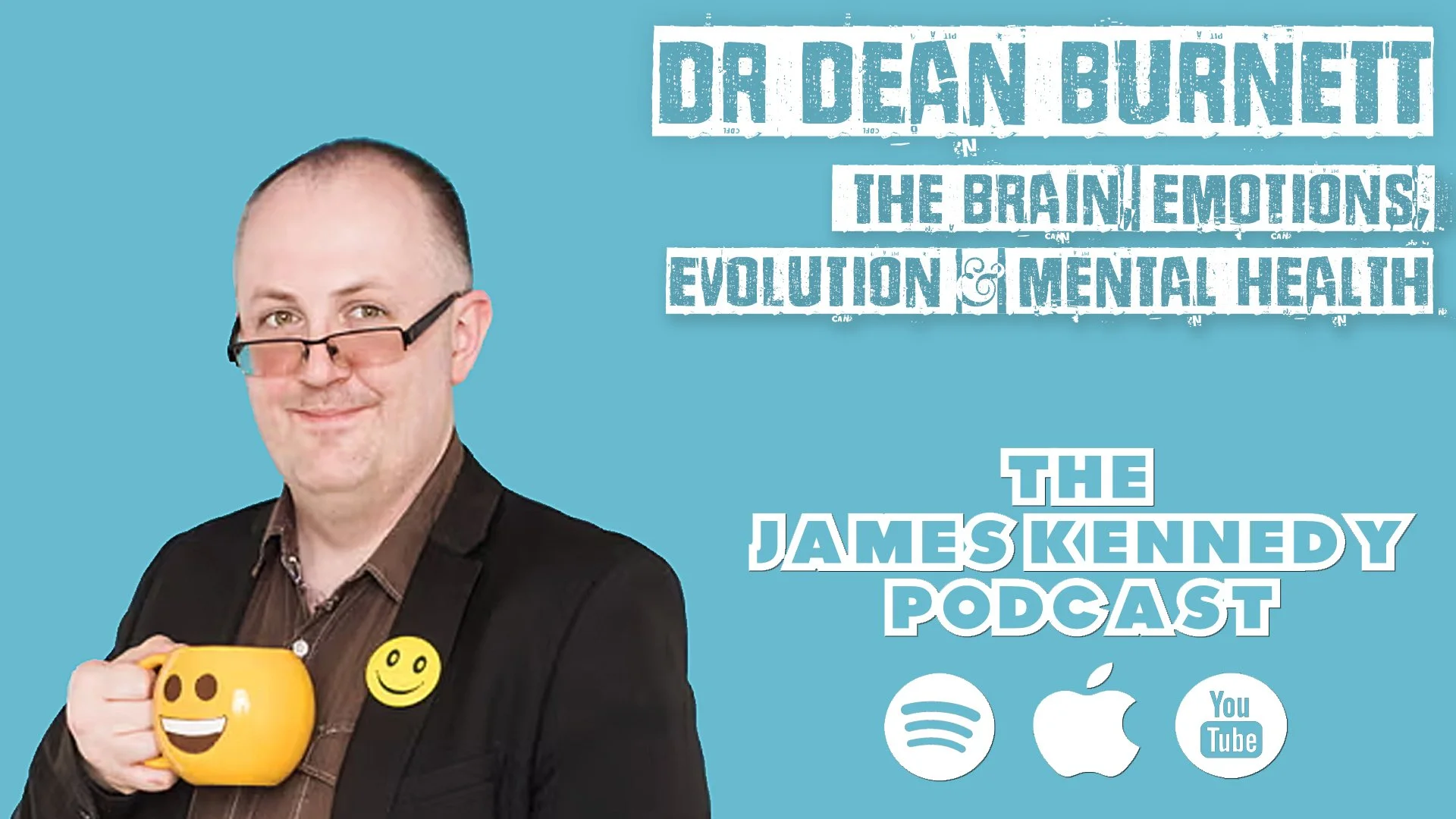
DR DEAN BURNETT - THE BRAIN, EMOTIONS AND MENTAL HEALTH
Host James Kennedy interviews neuroscientist Dean Burnett, who explores how human emotions, modern mental health challenges, and brain adaptability intersect. Burnett discusses how primitive stress responses mismatch our digital world, how neuroplasticity and psychedelics aid mental health, and why embracing negative emotions is vital for well-being.
James Kennedy: Today we are going to be doing a deep dive into all things brain related. We're going to be discussing the brain, the mind, your thoughts, some of the bizarre ways in which your mind and your brain kind of play tricks on themselves, and whatever else happens along the way. But it's a subject that I'm super fascinated in, and I can't wait to pick our guest's brains, for want of a better phrase. He's a fellow Welshman calling in live from just down the road in Cardiff, and he's going to be talking about brain-related stuff. So I'm going to be talking to him today, and he's here today to blow all of our minds on all things brain related. I'm talking, of course, about the awesome Dean Burnett: neuroscientist, lecturer, best-selling author, podcaster, and all-round clever, funny, and brilliant dude. Dean, it's great to have you with us today, man. Thank you so much for doing this. How the hell are you doing?
Dean Burnett: I mean, I can't promise any mind-blowing. If anything, as a neuroscientist, we're taught not to do that. That's like counterproductive. Do not blow, destroy, dismantle, or obliterate brains or minds in any way. That's like Neuroscience 101, that is. Yeah, but other than that, yes, I'm looking forward to it.
James Kennedy: Okay, okay. Just to clarify then: Dean is not going to blow any brains, but he is going to fascinate you with his insight and wisdom on all things brain and mind related to keep the integrity of the brain completely intact. Absolutely no blowing. He will not be destroying your brains, he will not be providing any subliminal messaging, none of that business. It's all good, above-board stuff. Keep expectations...
Dean Burnett: Keep expectations low, everyone's happy then, no one leaves disappointed.
James Kennedy: Well, I want to come on to your new book, Emotional Ignorance, but I'd like to save that till later. I'd like to do a little bit of groundwork before that, just discuss and explore the brain. But I would like to start with emotions, if that's cool, because that's not something that we tend to necessarily associate with a direct brain function. So it's a big question, which I'm sure it's probably going to lead into other areas: What are emotions, where are emotions, and why are emotions?
Dean Burnett: Well, that's something I've come a cropper with, this exact question myself, very recently. Because I agreed to write a book about emotions. I've done other books, and I think because I did a book called The Happy Brain, which is about happiness specifically, but in a more scientific way. It wasn't so much like "what is happiness?", it was "well, why do these particular things make us happy?" Why does our brain like this stuff and not that stuff, you know? And because sometimes it's confusing, like people like horror films, which are meant to scare and frighten and terrify you, but they make people happy. Or sad music, you position yourself, a lot of sad and angry songs, people like that. But logically, you'd think that they wouldn't like that, because those are quote-unquote negative emotions. So that was intriguing to me. So I sort of looked into that, went on this whole big journey about it, the book came out, and it went well. Everyone's happy, ironically. But you do the book tours and people kept saying to me, "Why did you write about happiness? Why not another emotion?" Which, I feel like they meant well, but it was like saying, "Why did you write this book, why not a different book?" Thanks very much, glad you enjoyed. But so then, obviously, that kept happening, so there is obviously a lot of interest in emotions as a thing, as a concept. So I sort of mentioned to my publisher, because they asked about my next book, and I thought, "Well, how about I do a book about emotions?" And they said, "Yeah, that sounds great." We shook hands and signed contracts, and the problem was that I was led to believe, at least, that the science of emotions, the understanding of it, was well established. Because even in the neuroscience world, elected people just mentioned emotions as like, "And then, of course, an emotional reaction occurs..." As if it was like, "Well, we've done all that, let me move this, now we're talking about the good stuff." You know, that was like the basics that had been covered. But as I sat down and wrote this book, I realized that, oh actually, it's more of a conspiracy of silence thing. Like the entire neuroscience world is going, "Well, we don't really know what they are, so let's just not talk about them." You know, like an embarrassing cousin, you don't know what they do, you're just energetic and hope for the best. And yeah, so I realized, well, I don't think people know about this. This is actually really, really complex stuff. And to this day, it remains that there is no widely agreed-on definition of emotions. It's not something any particular people or scientists have, like, "Right, this emotion is... We all agree, yes, let's move on." And that's obviously an issue, because if nobody agrees what something is, how do you study it? You know, someone says, "I'm studying emotions," and someone else says, "No, I'm studying it, I'm studying this, but that's what I think emotion is, what I think is this, I think you're wrong," and XYZ and stuff. So, yeah, if you can't just define, describe, or pin it down within certain parameters—like "they are this, they do this, they act like this"—or isolate them in the brain, these things you can't really do. And although we can see the effects they have and the basic principles of them, they seem to be everywhere in the brain. Like they spread throughout like the veins in marble, and all of this is involved too. So yeah, to say which bit of the brain does emotions, it's not how anything works. Right, I mean, it was a lot easier for me, I had to write the book four times and keep changing it. So, yes, that's a far more complex question than most realize, I think.
James Kennedy: Yeah, because I feel like the way I phrased the question—where I said that I personally don't consider emotions to be a brain function—is that we tend to feel them in our body, don't we? You know, we tend to feel anger in tense muscles, we tend to feel love in our stomach, in our gut, we tend to feel fear or anxiety as pain. So I guess we tend to think of emotions in a physical sense, but I guess is that just the way that they manifest themselves? So they're born of the brain, but expressed through the whole physiological system that they're kind of woven into. And if so, what is the purpose of that? Is it evolutionary, is it a survival mechanism, and if so, why do we get random malfunctions of that system, like panic attacks or irrational love?
Dean Burnett: Yeah, no, I think that's a valid point, actually. That was one of the first-ever aesthetic theories of emotions in history, back in Ancient Greece. There were the Stoics, the school of thought, where they basically thought nothing that can't be tangibly measured or recognized as an actual thing is technically real. You know, like you shouldn't pay attention to things which are purely fantastical or purely hypothetical. But they thought, "Well, emotions are real because they have these physical reactions." When we're sad, we cry, liquid comes out of our eyes, and that's not what normally happens. So let's say when you feel nervous or scared, you feel it in your stomach, or you have butterflies in your stomach, your heart beats faster, and your skin goes white when you're afraid and scared. And this is obviously a big part of the expression of emotions.
And there is one school of thought which does argue that emotions actually start in the body, like we experience something and your body has all these physical reactions, and your brain says, "Oh, look at all these physical reactions, that means anger, that means fear." So they say it's the brain actually, it's like the builder taking delivery of plans from the architect, "So that's what we're going to do." That's not the main theory about emotions. That does have a lot of limits to it. For example, you can experience emotions without any physical things happening to you. I think everyone's experienced this: you walk down the road and suddenly you're hit by a really embarrassing memory, and you go, "Oh god," and you just sort of cringe into yourself on the pavement, and people are just stepping over you because you just realized a horrifically embarrassing thing that happened when you were a teenager. But there was no physical thing that happened to make you think of that, you just did, because brains be brainy like that.
So obviously there's more to it, but a big part of it is actually we don't just feel emotions or experience them, we actually broadcast them, we share them. Because we're a social species. So when we have these emotional reactions and we display them to others, that, in the evolutionary sense, is a really effective and efficient way of communicating with those around you. Like, if your eyes go wide and you're scared, they go, "Oh look, that person's scared, oh god, they must be scared of something, I'll be scared too." Because obviously that way everyone's in a sort of poised state.
There are lots of different things about why we cry, like the chemical differences in emotional tears, which make other people feel certain ways and stuff. And it's also a big signaling thing. Like we think about laughter: laughter is a weird one, because we can experience being amused, we experience lots of emotions, but they don't often involve this massive involuntary spasm. The whole point of laughter is a social thing, it bonds us together, because when someone laughs, we want to laugh too. Studies suggest that if you're part of a group, you're like 30 times more likely to laugh than if you're by yourself, which is why watching stand-up videos by yourself is always a less rewarding experience. It's like, "Haha, yeah, that's funny." But when you're part of a big crowd, it's like, "Ahhh!" Which often isn't that funny, it's just someone coming up and saying, "Hey, who's from Newport?" "Okay, where are you from?" "Newport." "Alright, calm down, calm down, what's wrong with you?" You know, we have different emotional experiences in different contexts.
James Kennedy: Maybe that's just people from Newport.
Dean Burnett: That's okay, I mean, Newport's a lovely place to drive through.
James Kennedy: So it's a social thing then, you think? Is that where things are leaning at the moment, that it's primarily a social thing, a communicative thing, which is why it expresses itself physically?
Dean Burnett: Yeah, yeah, I mean, human emotions especially, because we are the most social species. We're classed as ultra-social. I know people might think, "Well, humans aren't very social, we're awful to each other." Look at any Twitter thread or comments under an article, there's always going to be fire and brimstone and horrible people doing horrible stuff. But in terms of sheer raw numbers, there are close to 8 billion humans on this planet, and we are incredibly tolerant of each other generally, you know? Human cities can have like 25, 30 million people in them and people just go about their day. No other species can do that. If you've done a gig, like you've got a thousand people watching you, sitting there enjoying, sitting side-by-side, technically really cramped in, and they're having a good time, enjoying it—if somebody replaced those people with chimps, it would be an absolute bloodbath within minutes. Because there'd be blood and fur and feces everywhere. I mean, I've done some tough gigs...
James Kennedy: It sounds like some gigs I've done in the past.
Dean Burnett: Yeah, there are some festivals which could have a similar vibe to them. But yeah, that's just other social species, those are our closest relatives emotionally, and they can't handle being in that sort of closed group thing which we can. But you've got to think about how many emotions only exist because of the context of other people, right? Like guilt: guilt doesn't make any sense unless other people are involved. Or embarrassment: one of the examples I've used before is that if you're in your home, in the bathroom, just want to go for a shower, and all your clothes fall off... Well, that's weird, I have to speak to my tailor, you know? But you just get in the shower then. But if you're in a hotel lobby, queuing for a train ticket, and then all your clothes fall off, that's horrific, that's mortifying and embarrassing, right? Because other people are there, and you're sort of like, "Oh my god!" Embarrassment only makes sense if other people are part of the process. So yeah, a lot of human emotions are very social just in terms of their origins.
James Kennedy: Yeah, that's interesting. Well, what about anger then? Because anger is something that can be—well, certainly for me anyway—I can be perfectly angry by myself. And anger can also kind of just be held within oneself as well, can't it? It doesn't necessarily have to be communicated, you can just be pissed off at nothing all day. Or maybe I'm just talking about me.
Dean Burnett: Anger is a strong response to problems and issues. One thing that makes us angry is threats to our autonomy. Because we want to think we're in control, because our brain finds it a lot more relaxing if you're in control. Something bad happens, you have the option to fix it. So anything which makes us lose control makes us angrier. It's a problem called reactance, that's what describes that process where you didn't want to do something until someone told you you couldn't, and now you absolutely do want to do it because you were told you can't, right? It happens all the time. People complain like, "Oh, I can't believe that shop's closing down!" "Did you ever go?" "No, too expensive." But now you can't, so you want to.
And that is seen in unfairness and injustice, these things provoke anger. But yeah, these are things which don't need other people, although they often do involve other people. And if anything, when they don't involve other people, it makes it worse. If you drop your phone and the screen cracks and stops working, or printers are obviously a real common cause of anger because they just don't do what you want them to do...
James Kennedy: Yes, useless!
Dean Burnett: Yeah, that makes it worse, because if you're angry at someone else, you can at least have it out with them. "I'm angry at you because XYZ." Whereas a printer, you're angry because they sit there not printing and just beeping at you, and that's just more infuriating because you have no control, you have no autonomy, you have no option to vent. So negative emotions build up. They're just as important as the positive ones, because they're how we process the world, our experiences, our memories, our knowledge—they're a big part of who we are. But because of the way the brain works, the processing of emotions is handled by the same parts which allow you to feel them, which generate them. So that's why they say bottling things up is only ever a short-term solution. Obviously, you don't just fly off the handle if someone says something in passing which you don't like, that's not how social norms work. But if you just keep it bottled up forever and ever, eventually it'll blow, because your brain can't keep all this in forever, because these emotions need to go somewhere.
And anger's a particularly strong one for that, because one of the things it does is trigger the motivation centers of our brain. At the very most fundamental level, we have two types of emotion: approach and avoid. Here's a thing, an issue, or a situation: I can either approach it, do something about it, or avoid it, leave it alone. Fear obviously very actively triggers the avoid motivation, like, "Right, that scares me, don't do that, leave that alone." Anger does the opposite, it triggers the approach motivation, but often to the point where it's unreasonable. So that's where you get people who are extremely angry taking on... You know, little guys who are furious taking on guys like five times their size.
James Kennedy: Exactly, it's not even that uncommon, is it?
Dean Burnett: But when you are angry enough, like proper Joe Pesci style...
James Kennedy: Yes, the Joe Pesci style!
Dean Burnett: You know, just going out, stabbing someone to death with a pen because you're furious at them. These are the things that happen because anger overrules the avoid system. And actually, I think it was subtly hinted at in Inside Out. Did you ever see that?
James Kennedy: No.
Dean Burnett: There's a Pixar film with all the different emotions. The one character, Anger, whenever he does something controlling the head machine, Fear tries to stop him and he just slams his head or punches him. So that's actually a good indicator of what happens when you're angry, right? It overrules the fear reaction. So it makes you want to do something, that's why catharsis is important. People do contact sports, play angry video games, or write video games—it gives you an outlet for these frustrations, often at inanimate objects just being inconvenient. You're right to be angry at that, but you have nothing to be angry at because it's just pure misfortune or inanimate objects not doing their job, and there's no one to blame for that, it's just bad luck. But you still feel the emotion, it's got to go somewhere.
James Kennedy: Right, so that's where I'm going wrong. I need to have an outlet, I need to start boxing and kicking the shit out of stuff.
Dean Burnett: Yeah, I've taken that up, it does help to be honest, it really does. I've got a bag in my office now as well for when...
James Kennedy: MS Office! How dare you again! Yeah, that's me, man. And I know that it's stupid, because there's nothing we can do about that stuff. Like traffic is a big one for me; I spend a lot of time on the road, as I'm sure you do, and it just drives me crazy, man. You just end up screaming at the windshield about stuff, winding yourself up, and no one else is aware that it's going on. I know that it's really stupid. I'm trying to remind myself that there are things you can do stuff about and things you can't, and if you can't do anything about it, then you just try and let it go. But there's a lot of things that we should rightfully be angry about. You know what I mean? We're right to be angry about the injustices of the world, like what's happening in the Middle East right now or the homeless situation. We're right to be angry about those things, but there is something we can do about those things at some level—you can get involved in something or put your energy behind something. Whereas screaming at the traffic is just pointless for everybody involved. So do you think that is the purpose then of anger, that it's a motivating force that can actually fire us into action about doing something about the things that are frustrating us or that we find unjust?
Dean Burnett: Well, absolutely. I think that's the evolutionary origin of why anger is like this, because it makes us do things, the old approach-the-problem thing means you want to deal with it. Now obviously, there'll be plenty of examples where someone tries to deal with it and fails, which is obviously not ideal. But because we have advanced to a certain point and built such a complex world around us, anger does cloud your thinking a bit. It makes you want to do something, sort this problem out. The risk assessment, the caution part of your brain—which is important, which says, "Okay, if you do this, this could happen, that's not a good outcome, do you want to risk that or not?"—anger sort of blurs that, it weighs too heavily in one direction.
When you're a teenager, this is particularly pointed, because obviously teenagers are known to be hot-headed or temperamental and passionate about stuff. But that's almost like an evolved trait, like they're meant to be like that because that means they get stuff done. You've got to sort of think of humans evolving in the wild and the savannah, just being tried stuff. If you have this cozy little community, everyone's happy, and you're like, "We've got our resources, we've got our people, we've got our little cozy hut, great to stay here forever, what's the big deal?" That quickly leads to stagnation. One drought, one bad season, one migration, and suddenly everything's wiped out. So you get these younger people in their physical prime who are suddenly like, "I don't want to follow authority, I want to go and do stuff," and they get angry easily. It makes them expand, branch out, say, "I'm going to go over there and find some other people." And then humans become more diverse, more mixed, we seek things out. These are things to address, to tackle problems, it's clearly a strongly evolved trait, so we needed it to get to this point, right?
It's just that now, it's almost like our brain is a victim of its own success. Especially now with technology, phones, and the internet, there are plenty of things in the whole world to be angry about which we could do something about, but we're not going to see the results of anytime soon. And one thing our brain doesn't like is effort with no obvious result. The good feeling you get from donating money to something is nice, yeah, that's helpful. But if you think, "I want to tackle climate change, for example: I'm going to do my recycling, drive an electric car, not take flights, live sustainably..." Your life is different, but you don't see the obvious outcome of that, because it'll be 10, 20, 30, 40, 60, 70 years before improvements or changes happen because of the way this works.
And I think that's also a problem which people don't realize with modern politics. Politicians make a claim now with the election, say, "Oh, I'll do this," and then okay, I'll vote for that. By the time the next election comes around, all the stuff they've done wrong, or the fallout from their bad decisions, is too far removed from it. Like austerity over the last few years kicking our ass, whereas at the time people said this is a bad idea, but no one noticed the effects because it's such a big turnaround time. The whole cause-and-effect thing, when this happens, there's so much time between those two when it comes to political or major global issues that we don't connect them instinctively, we have to look into it deeply. So yeah, that's an ongoing problem. The emotion part of our brain is powerful, but it wants quick results, it wants instant response actions, and the world as we've built it doesn't give that, so we can be frustrated about things for longer than we should be.
James Kennedy: That makes a lot of sense, and it kind of leads to something that I wanted to explore with you, which is the big issue of mental health. We seem to be going through a mental health epidemic right now, and my analysis of it was because our brains are wired and our bodies are evolved to basically survive in a certain set of circumstances. We've been hunter-gatherers for hundreds of thousands of years, longer than we've been living in a digital dystopia of a thousand bits of content coming at you every second of the day, bad news from all around the world coming at you, and this high-speed, high-pressure life that never stops. There's no time to think or process anything, and we're just not designed for that, as far as I can tell. So do you think that is why we're seeing this massive surge in mental health problems everywhere we look?
Dean Burnett: Yeah, that will be a big part of it. It's kind of weird to think like, our brains are built for it, the smartest parts of our brain are built for it technically, because they built this world. We are this smart because this only exists because we made it so. But there's an awful big difference between the topmost part, the most human parts of our brain—the neocortex, the one which evolved over the last half a million years or so—and the deeper parts which control all the emotions, instinct, reflexes, and deeper processing. They are still a big part of our mental state, our existence.
I sort of make the analogy that what we've got in our heads currently is like trying to install the latest operating system—like a Windows 25 or iOS whatever—onto an old laptop. You know, it's okay, it can handle it, but it's not built for this. Something slows down a bit, so you can do it, but it wasn't expected or built to do this, because our brains are also fast. We have all these complex modern insights and intellectual abilities on almost a steam-driven instinct and emotion system, and that's where the problem lies a lot of the time.
So yeah, you can become aware of a drought in Africa leading to starvation, or wars going on left, right, and center, localized in these particular regions which don't ever really affect you, unless you count the economical fallout to that right now, which is felt in many. But you're aware of it, so you can see horrific things happening to these people and think, "Oh, that's terrible, I'm going to send some money to that." But emotionally, you're just seeing that happen and feeling the emotions from it, and you can't really stop it unless you shut yourself out of it, but you still know it's there because you've seen it now, and these things are ongoing.
We can also be stressed out by things which happen or could happen in our world which are so hypothetical. We can be scared of climate change, for example, or economic downturn. People panic like, "Oh my god, I might lose my job if I don't make rent this month," or "if I don't save up enough money to buy a new house." These are all long-term issues. The idea that you could lose your job, for example, is something which might never happen. You just keep working away, your employer isn't that fastidious about what you do, but it's always going to be a back-of-your-head thing and it never really goes away. So the stress it causes is triggering the same part of your brain which would cause stress over a tiger or a predator, or being in the middle of the woods and starving.
It's all the same process, so it triggers the same fear response that our ancestors had when they had a wolf nearby. But when you're in the wild, this stress response is almost always quite short-term. Either I beat the wolf, the wolf goes away, or I'm dead. Either way, problem solved, I can stop being scared now. But now we've got this ability to think, "Oh, what if? What if I lose my job? What if the economy doesn't go so well? What if my investments don't pan out?" There's no end to that. It's always a case of "I might lose my job." How do you know you're not going to? There's no way to rule that out. Or climate change, or all these expectations we have: "What if I'm not married by 35?" "What if I don't have kids by 40 and all my lifelong goals are out the window?" These are all hypothetical situations which stress you out based on social expectations and norms.
And the brain is so adept at finding things to worry about, something called counterfactual thinking, where we worry about things that not only didn't happen, they cannot happen, and we worry about them anyway. Like if you went across the road and there was a car coming, you didn't see it and it just misses you—you'll be stressed about that for days because, "What if it hit me?" Yeah, but it didn't! That did not happen. The past is the past, you can't go back and run in front of the car slower and have it hit you. But your brain's going, "Oh, that was a close call, we need to dwell on this so you never do it again. Remember this, learn from this, I'm not going to let it go until you promise me you'll be right." So it weighs on you.
There's something called the threat detection network, where anything we sense which could potentially be a hazard or danger to us is sort of latched onto our internal system: "Right, keep an eye on that, have a low-level stress response, just make sure you don't forget it." And chronic stress is like the Achilles' heel of the brain. That seems to be the independent cause of a lot of mental health issues, particularly the main ones like depression and anxiety. This constant low-level stress, which our brains didn't evolve to deal with, because we thought stress is the first part of the fight-or-flight response, but that's meant to be fight or flight—something happens, you deal with it to make it go away. Low-level, constant stress isn't something our brains are meant to be dealing with, and that's the trigger for a lot of mental health problems. Obviously it's more complex than that, but that's the general running theme of a lot of it.
ENJOYING THE CONVERSATION?
GET JAMES KENNEDY'S LATEST INTERVIEWS, WRITING AND LIVE SHOWS STRAIGHT TO YOUR INBOX.
James Kennedy: Yeah, that makes a lot of sense. It's funny, isn't it? It's like we've got the best computer in the world inside our heads, but there are these surprising blind spots within it. Like the fact that it can't understand the difference between there being a wolf in front of you and something you just imagined in your head. You'd think a computer as powerful as the human brain would be able to understand the difference in that, and the fact that it can't, and that the stress response is the same for both the hypothetical and the very real threat, I find that fascinating. It feels like quite a shocking design flaw, doesn't it?
Dean Burnett: It does, yeah. That was the focus of my first book, Idiot Brain. The reason I got into writing about it was because... I don't know how many years it's been, 20 years or so... But I was interested in the brain generally because I'm from the South Wales valleys, and there were not a lot of scientists there. And again, this isn't insulting the intelligence of my peers or my folk, it just wasn't the done thing. But I was so different from my friends and family, and I was wondering why. Why am I this oddity in a world which is mostly focused on rugby and other things? So I became interested in my own quirks, thinking, "What's something about my brain which is different?" And then I thought, "You know what, it's about brains," and it sort of snowballed from there.
When you start doing neuroscience, if you're a big fan of the brain, you slowly but surely realize: alright, it's not perfect. The mainstream portrayal of the brain I've always had an issue with—not that it's necessarily wrong, but it's very overly positive, almost a hagiography. People say, "The human brain is the most amazing thing you've ever encountered, the most complex object in the known universe, you can do this and that, wow, whiz bang!" But the flaws are always ignored or overlooked, and I think that's unhealthy. Because if you keep getting told your brain is brilliant and magic and amazing, and then it starts going wrong—you have a mental health problem—that feels like something even more deeply flawed with you. Whereas it's actually a huge hodgepodge of countless different evolved systems over millions of years which don't get on, work against each other, or do things in a roundabout way.
I think that's more impressive: the fact that it is this big, glorious mess that we've ended up with, and we've achieved so much with it. It's got all these flaws, but we soldiered on anyway, and I think that's a more inspiring, healthier outlook. My first book was about that: yeah, I think the brain is great, here's why, but it's great that we've got all this and we still soldier on and push ahead. That's a more upbeat, healthy message, so I try to push that where I can.
James Kennedy: I love that, I love that. And it's true, I guess, there's nothing wrong with that. It's a bit like loving someone despite their flaws, isn't it? When you look at the wonders of the world that we've created with this thing, it's insane when you think about it.
Dean Burnett: Yeah, that's like the analogy I use. When you start studying neuroscience as a fan of the brain, it's like moving in with someone you love, you know? You still love them, obviously, you think, "This is great, we spend all our time together." And then slowly but surely you start to realize, okay, they're not perfect. They have issues in the bathroom for 45 minutes in the morning... That's a long time. Fine. Then it's like, "Oh, look, the toilet seat's up again, they keep doing that snort..." It's charming, it's charming. You get to the point of thinking, "I'm not going to kill them, but I think about it often." It's one of those relationships. The affection is still there, but the reality is also becoming more manifest, and that's far more healthy. If you keep deluding yourself that it's all fine and perfect, then when it's not—because it won't be, because that's not how life works—you're far more ready for it.
James Kennedy: Well, from what I understand—and correct me if I've got this completely ass-backwards—brains have this amazing ability to constantly evolve and upgrade themselves, to lay new pathways within the brain and get rid of old ones, this thing called neuroplasticity. Is that a thing, or is that something which I've either completely misunderstood or is being oversold to us by the happiness industry? Because there is such a thing, I think, the idea that you can change your thinking patterns, and the old negative thought patterns will kind of fade away because your brain no longer needs them, and you can relay new positive pathways by changing your thinking process. Is neuroplasticity a thing, or have I either got it wrong or is it not what they're saying that it is?
Dean Burnett: No, I wouldn't say neuroplasticity is a thing, it's probably the thing. It is what the brain essentially is for, what it does. That's why it is what it is and can do what it can do. I think there was this idea for a long time that once you're an adult, your brain's set, it's in place, you're running off installed programs and that's your life then, enjoy yourself. But it's more plastic when you're younger, when you're still developing.
The analogy I have is like when you're young, especially a child, all the materials are being delivered. If you look at the brain as being like a house, all the materials are being delivered, plans are being thrown up, people saying "this should go here, this should go there." Later childhood to teenage years, that's like construction has started: scaffolding is up, foundations are going in, last-minute changes are happening. When you hit adulthood, the house is built. So you've got the walls, the foundation, the allocated space—that's sort of what you've got. You can't really expand beyond that, but... Furniture's in...
James Kennedy: That's what it looks like.
Dean Burnett: Yeah, that's you. But you can remodel: you can take a wall out, put a wall in, add an extension, take windows out, put things here and there, install solar panels. So you've still got a lot of flexibility, just not as much as you did, right?
We still have that sort of plasticity, it just takes a while. I think that's what people don't appreciate. We constantly have changing brain stuff, new memories are formed, connections being formed between neurons through synapses, which is great. That's a fundamental part of our brain; the brain is always changing. The only unchanging brain is a dead one, and that's no good to anyone. A static brain is not a brain at all really.
So neuroplasticity is a huge part of it. And yes, we can rewire, change, and adapt our modes of thinking. That's the whole point of therapy, Cognitive Behavioral Therapy. It's essentially saying, "You think this way, this is the pathway that your thoughts take: A to B to C to D. That's what you've built up over time, that's what your brain's learned to do. It's not a healthy route, it's through a bad neighborhood, a bad road which is wrecking your car. What we need to do is work out a different path. Rather than go A to B to C to D, we go A to E to J to L, loop back round to E." It might take longer, it might take a while to figure it out, but it's a safer, healthier one to go down; it's not doing the damage of the other route. So it works it out, like trying to find a map: "Okay, if I keep thinking like this, what if I think like this instead?"
Sometimes that can become the dominant way of thinking. Therapy doesn't finish, you never use the word 'cured' for mental health stuff; you can cope now, you've managed it, you've adapted. Whereas sometimes it can be a lot more persistent. Addiction is obviously one which is very hard to get rid of, because it happens at such a fundamental level. The deep-buried reward pathways in your brain have changed, they've reached out to connect to your thinking centers, and those very rarely just go away. They can become less powerful, but they're still there, easily reactivated. That's why addiction often requires constant vigilance; you don't just ignore it thinking, "I'm fine, I'm cured, I can just have a drink again." That part of your brain which led to addiction is still there, it's just dormant, it would be very easy to trigger.
When people have depressive spells, those depressive links in the brain are not being used right now, but stress can happen and they can become more forceful, then you fall back into it. That's why mental health is a journey rather than a full stop. Right now we're going this way, let's take this route, use this car, use these supplies.
Psychiatric medication is usually a way of making the brain a bit more flexible, changing the balances and levels which mean this particular sequence of thoughts keeping us in a negative state now has a bit more flexibility, a bit more adaptability. That's why there's a lot of work in psychedelics recently. I went to a big conference, and they look like the next big thing in mental health medication, because they almost have a snow globe effect in your brain. That's why you have these weird trips, because all the barriers in your brain are temporarily shut down, making your brain more flexible, with a lot more plasticity in it. If you can combine that with therapy, you can form these new pathways quicker and easier than you would with pure therapy alone.
James Kennedy: Sounds more fun as well.
Dean Burnett: Yeah, I did partake in some...
James Kennedy: I was going to say! So you did!
Dean Burnett: Yeah, it was very effective. Well, I say it was effective... The problem I had was I didn't know what ketamine therapy is like, and I didn't know, so that's a problem solved, I guess. I don't want to fix anyone's proper problems, but that was my whole point, so that was an easy one to fix.
James Kennedy: That's really interesting, and that makes a lot of sense as well. I have noticed that there does seem to be a growing interest from the scientific community in psychedelics. I'm seeing a lot more studies with very positive results showing the positive effects that psychedelics can have. And it's great, because for far too long, psychedelics have been kind of in the stewardship of the hippie cliché, haven't they? "Acid trip, expand your mind, bro," and all that sort of stuff. But it seems as if there is actually now a growing scientific interest in the efficacy of psychedelics, and there does seem to be some truth to what the hippies were saying, as much as I hate to admit that.
Dean Burnett: Yeah, I mean, the scientific community technically wasn't the ones who were opposed to them; they've been kind of keen to keep researching these things for many years. It was more political pressure which stopped them doing it, because of really bad timing. Associating psychedelics with the counterculture and the hippie movement put it at very deep odds with the Nixon administration, who brought in the War on Drugs, and the Reagan stuff. That was a big blow for psychedelic progress and research. There were people who were treating them with disrespect over time as well, like some Stanford professors just giving them out to students going, "Yay!" Okay, maybe don't do that, that's not ideal. I'm sure they got good reviews in their student feedback, but that gave a bit of a sour taste in the mouth.
Obviously, South Wales was the world's biggest producer of LSD for quite a while, wasn't it?
James Kennedy: Really?
Dean Burnett: Yeah, Operation Julie! There's a musical about it, I think. Mid Wales was just churning out half the world's LSD, because it's so remote. It's a really fun story: they wanted to do this big bust, so a lot of undercover cops moved into the area. You had the dealers and producers in this local community, and the cops, and all the local people going, "Well, they're clearly the drug ones." It's Mid Wales, everyone knows everyone else! "So, are you a cop or what?" "Shut up!" It's a very well-known story, apparently.
James Kennedy: Wow, that's fascinating. We're always going to dig ourselves up sometimes. All the world's coal, then the LSD... What a strange track record for a nation! I know that's bloody amazing, bloody hell. Well, I did a fair amount of that when I was in my early twenties, thanks to the aforementioned Welsh countryside. I used to pick my own and had a great time, but that was many years ago, and I haven't really had the guts to open up that Pandora's box again. I don't know what would come out now at this age with everything I've been through since. But at the time, wonderful experiences on psychedelics.
Dean Burnett: They're a lot more friendly than people realize. This whole deep genius powers thing is more of a political, ideological image generated to deter people. But there is actually a bit of friction right now, because I was in America, and so many people are invested in making psychedelics the next legalized cannabis, because it'll be worth trillions if it takes off. Lots of financial, economic, and capitalist interests in making these psychedelics available, but they've brushed up against the scientific community, who are going, "Whoa, guys! These things could be great, but they're not toys, they're not chewy sweets. These are incredibly powerful substances, you don't just give them out like vitamins. You need real supervision."
Matthew Perry passed away, and it was said to be because of ketamine. He was taking ketamine therapy because he struggled with mental health and addiction issues, but I think the news cynically conflated the two, as in he was taking ketamine therapy and passed away from ketamine-related misadventure. His last therapy was like two weeks earlier, and he clearly obtained some ketamine himself—he knows that world, middle of Hollywood, plenty of people have it—and took it by himself in his hot tub, which is one of the most common causes of death when it comes to ketamine use. It's a dissociative, it completely shuts down your body, and if you're in water, that's it.
When it's just a recreational drug, these are things people don't take into account. It'd be great if these psychedelics were available to people who needed them as effective treatments, but just giving them out to all and sundry is asking for a lot of trouble, because they're not toys, they have a hell of a powerful punch to them.
James Kennedy: Oh yeah, I could make you do some very unwise stuff! I can imagine, I mean they are very, very powerful. I remember just lying on my friend's couch looking at the ceiling, looking at the Artex, just laughing my ass off at the clouds moving, the walls changing color. What I found fascinating about it was that it's not like a trippy, synthetic reality; it's a real reality. I could be talking to you as I am now, and the wall behind you could change from red to yellow, and it would look yellow. It was almost as if my senses and my brain believed that to be reality. It made complete sense.
At that young age, it made me realize the fiction of what we perceive as reality. If that reality can completely change within the space of an hour or two, and I'm seeing colors that weren't there and things moving that aren't moving, what does that say about the reliability of our senses? We've just bought into one version of reality, which in actual fact is just a projection from inside our mind.
Dean Burnett: Yeah, because ultimately the whole existence boils down to tiny impulses being transmitted along our brain cells. That's actually our whole reality, there's nothing else, that's our absolute baseline. Everything that happens to us is on some level neural impulses, because that's how our brain works.
Which leads to a lot of interesting things, like schizophrenic audio hallucinations where people hear voices. What that's believed to be is... We often think to ourselves and have an internal monologue, and our brains recognize, "Okay, this is internal, so I don't hear that as external." It's all being processed in the language area. In schizophrenia, that ability to tell between the two breaks down. The brain doesn't recognize that this activity is from an internal source rather than external, so you start hearing it. It goes, "Okay, there's language there, I guess there must be someone talking." Then you hear this internal monologue coupled with negative emotions, because of all the internal turmoil, so it becomes quite negative. You have this constant hallucination that someone's telling you bad things, because your brain's lost the ability to keep the dividers between internal and external stuff.
A lot of things can be explained like that. I do a lot of work on parasocial relationships, where you become deeply emotionally invested in someone and they don't know you exist. You've got a podcast, you've got fans; these people are invested in you, you have nothing against them, you just haven't met them, you don't know who they are. It's a totally one-way relationship, but they are all in. Especially with someone like Taylor Swift, huge names who have these massive fan bases where people worship them.
When you think about it, your real-life relationships with actual friends are mostly based on your internal representation of that person. You don't spend all day every day with your friends. You've met them, you know them: "They say this, they think this, they talk like this, these are my memories of them." They're your friend because your brain has this representational friend in your head. Now we've created a world where you can learn all about someone to create that representation without ever meeting them. You can follow their YouTube channels, TikToks, read about them in magazines: "I know where they were born, who they're married to, what they like, what they sound like, where they were last week." So I can create this representation just like a regular friend, and I'm deeply invested, even though they've never met me. It's a parasocial relationship, totally one way, but we have that power now, which is odd.
James Kennedy: It's crazy! I suppose it's just one of the other ways in which we're living in an environment which is completely at odds with the one that our brain spent so long developing to survive in. Social media is a crazy one. I think it's amazing in many ways, and the gifts of the internet are wonderful, but as with everything—and you've alluded to this—we need to manage it a little bit. It's not just like taking a lot of psychedelic drugs, these things need to be managed in a very specific way. I think it's the same with social media: you need a cutoff time, and also an understanding of the fact that it's not fucking real as well, you know what I mean? There's a real world out there. Just because your friends are all crushing it on Instagram doesn't mean you're the only loser who hasn't got their life in order.
Dean Burnett: That's actually a really valid point. I've raised it a few times. We've heard of doomscrolling, but I try to call this 'glamscrolling'. You've got a beautiful person, beautiful life, wonderful person, successful... It gives you the idea that this is how other people's lives are. We know an influencer's Instagram is polished nine ways from Sunday, completely stylized and artificial in that respect. All these images are completely tailor-made to look like that. You don't see their flaws, but you do see your own.
So in your head, your brain's going, "Okay, so that's how people are, they have these wonderful lives, wonderful existences. Here's mine: the pants on the side, the dusty carpet I haven't vacuumed yet, the dishes in the sink." On reflection, you see your bad side, your blemishes: "Everyone else is beautiful, I'm not, I guess I'm awful." And then that impacts your mental health.
With social media like Facebook or Twitter, one of the biggest dangers is the fact that now, whatever ridiculous idea you have, you will find someone who agrees with you. And that isn't healthy. In the past, people always had wild theories and ideas, and it was social feedback which allowed these ideas to flourish or not, because we are a social species. Other people have always been our main source of information, even today. We can have reams of peer-reviewed expert analysis saying, "This is the thing that is happening, this is how it works," and one person goes, "Ah yes, but a friend of mine works for the FBI and he said no." Suddenly, because that's a person, we are built to connect to people. That's why influencers and TikTokers have such a big impact: they are relaying an emotional impact and a message to you, as opposed to dry text.
Imagine in the 80s, you're at the pub with your mates and you say, "You know what, I think the world's actually flat." You used to be mocked for the next two years! "All right, Trev, here comes your bloody boy!" You don't want to say that again, so you learn that's clearly not an accepted theory. But now: "I think it's flat." "Me too!" "See! Exactly!" These people agree with me, and when I say this outside, people mock me, so your brain goes, "Well, these ones make me feel good, those make me feel bad, so these are the ones I should stick to." It becomes a self-sustaining worldview, and people end up with wild ideas of how the world works based on their own interactions, because nobody knows what's going on. Saying "Are you sure you're not an idiot? Are you sure you're not talking out your ass?" is a healthy thing to have someone tell you. But people don't like that, they say, "It was my opinion!" Yes, it's your opinion, and it's wrong, clearly.
James Kennedy: That's a great point. We live in strange times, man, and it's only going to get stranger. AI is coming, we've got a content tsunami coming our way that I just don't know if we're prepared to handle. If our brain is struggling now to make sense of these things, then Jesus, I don't know what it's going to be like in 10 or 20 years.
Dean Burnett: Totally, but it's part of the familiar cycle. New technology is on the way and there's a lot of doomsaying. When airplanes came around, people thought, "Oh, everyone's going to have planes in their backyard, it's going to be awful." There's always some middle ground. The AI thing is worrying people when it comes to replacing people with music, stories, and art creations, but I don't think that's as big a risk as people think. The general mass-produced stuff, yeah, you don't need quality for that. But good stories, good music, emotionally relevant stuff—I think that's still something machines are not going to get.
AI art has a similar glossiness to it, an artifice where you look at it and go, "That looks wrong, it looks off." Machines are very reductive: "These are the features of art, therefore I'm going to replicate these." But if someone makes a photorealistic painting with just a pencil or ballpoint pen, it looks glorious, and it doesn't bother us in the same way, because the human brain is so adept at recognizing faces, nuance, and emotionally relevant stuff. Machines struggle with that.
The example I like to use is on a train station platform when it's delayed. You get the recorded voice: "Passengers on platform four, sorry to report that the 17:45 train to London Paddington is delayed approximately 17 minutes. I am very sorry for the delay to this train." But I know you're not sorry, you're a recorded voice! You have no investment in me or my situation, so you're lying to me, and people really don't like that. People don't like having to interact with machines when they're trying to be emotional, and that's a bigger deal than a lot of companies realize.
James Kennedy: That's interesting. I am one of those doomsayers, obviously, because my industry is one that I'm precious about, and we can see the grubby tentacles of AI working their way into our world as we speak.
I wanted to ask you about music, actually, because music has an interesting effect on the brain, doesn't it? Listening to it, and also performing it, especially for younger children learning an instrument. I think it's because it exercises certain parts of the brain simultaneously that they don't get elsewhere. Is there any merit to that? What effect does music have on the brain as a listener, and what's behind playing an instrument?
Dean Burnett: Playing an instrument is a good skill to have, especially if you're adept at it, because back to neuroplasticity, it's a mechanical skill. You have to play something which you wouldn't otherwise do. In an expert piano player, the motor cortex—the part of the brain responsible for fine finger movements—is usually much bigger than the average person's, because they do that a lot. I type a lot, but it's a set keyboard, I'm just doing words; whereas to play music, keep my hands round, and press keys in the right zone with such precision and dexterity, your brain goes, "Okay, that's something I need to do, so I better build up resources for that." It makes finger movement areas bigger. If you're a singer, your vocal skills become more adept because your brain says, "Voice is important, let's shunt more resources to the voice and take away from less important stuff." Your perception of sound, harmony, and rhythm becomes advanced.
Listening to music affects you in multiple ways, from basic to complex. At a basic level, rhythm and beats inspire us. They have a resonant connection to a basic part of us—some argue it might be a heartbeat thing. If you're listening to something fast, you feel like adrenaline is required, so you become more motivated.
The emotional content of music impacts your emotional senses. If you listen to angry music, like heavy metal, you experience that anger in a safe setting: "I'm feeling the anger because this music is pumping it out to me." There's a lot of evidence that people who are into heavy metal are the least angry people overall, because their brains have had a lot more exercise when it comes to being angry. So when anger happens to them, they know how to deal with it and process it. Their brains are adept at it, like a workout.
Sad music is very therapeutic because it helps you process sadness. That's why when people are sad, they listen to sad music and feel better; the brain channels these emotions. To process emotions, you need to feel them, so music allows you to feel these things in safe, controlled ways.
Above that, we recognize the complexity of music: the nuance, details, intricate structure, rhythms, and patterns. Humans love finding patterns, and the more complex, the better. If you are a music aficionado, you can appreciate the skill and sophistication of advanced music, like free jazz or complex concertos. Other people prefer pop, which is simple and straightforward. Both are valid, but the more aware of music you are, the more you appreciate the nuances of the richer stuff.
James Kennedy: Well, I'm glad to hear it, man. That's another brownie point for us musicians before the robots come and stamp us out of existence!
I'm conscious of time because I promised we wouldn't keep you too long, but there's an element I wanted to ask you about: the unconscious brain. I find it fascinating that I can drive to Cardiff and not remember how the hell I got there. My organs, my heart beating, these are all managed by the unconscious brain. How the hell does that work? How is the brain able to drive me to Cardiff while I'm listening to a podcast or talking on the phone, completely unaware that I'm actually doing it?
Dean Burnett: A lot of the time you are aware of it, you just don't remember it, because what we consciously remember is usually the more emotionally stimulating stuff. Ideally, we wouldn't have more say in what we remember, because then you wouldn't have to revise for exams so much. Boring information, you have to read it again and again so it beds in by force; whereas embarrassing memories stick with you forever because they were emotionally powerful. If you've been to Cardiff 20 times in a month, it's the same thing over and over, so your brain goes, "Nothing to worry about here, I'm going to shunt this into the buffer and focus on more important stuff." Routines become hard to remember because they're routine. Your brain doesn't dedicate resources to it.
People have this idea that the brain is half conscious and half unconscious, but it's more like the conscious brain is the pilot and the unconscious is the plane: one bright spark steering a massive, powerful vehicle. Conscious thinking is really impressive, but demanding for the brain. The frontal lobes take up a lot of energy. Emotional reactions are fast because they're simple. When you touch a hot pan on the stove, you flinch. You don't think, "Hmm, I am experiencing a noxious stimulation, perhaps I should remove my hand..." By which point your hand's on fire.
The more you do something, the more your brain feels safe shunting it into the unconscious. When you first learn to drive, that first time by yourself is terrifying, you're hyper-aware of everything around you. You drive to the shops a nervous wreck. But over time, it becomes second nature. You'll drive two hours and not even think about it, because once the conscious mind goes, "I know how to do this," it tells the guys in the back to deal with it. Consciousness focuses on unexpected, novel stuff, so we don't tend to remember well-established routines.
James Kennedy: What happened with me when I had my PTSD was that automatic things, like driving, suddenly became things I was consciously aware of. I had driving anxiety for a few months because I was hyper-aware of everything: the light coming through the trees, that guy over there, someone on the bridge, am I too close to the car in front, am I going too slow? Jesus, I don't know how to drive! Did I lean slightly to the left? Does that mean my balance is wrong? It was almost like my conscious mind had gotten in the way of what was normally an automatic activity.
Dean Burnett: When you have PTSD, you've experienced something so powerful that your brain can't process it. It has so much negative emotion attached to it—fear, anger, whatever the experience was—that the normal process of filing it away in your memory is too much. Your brain can't do it. It's like putting a hot coal in a filing cabinet full of papers: it smolders and makes everything around it charred. It puts your fight-or-flight system on high alert. The amygdala is firing on all cylinders, constantly on, like driving with the high beams on. It drains your battery and blinds people.
That part of your brain is looking for threats, jumping at shadows. Things that were neutral before now aren't, because everything is happening through the lens of this trauma. It's a background noise of trauma, so everything becomes scarier. The same thing happens in Generalized Anxiety Disorder. That part of your brain is overactive, so everything's stressful and your brain tries to find an answer: "Something must be causing it! It's that guy! No, it's that bush! No, it's the eagle! Blue skies!" It's trying to find an answer to the stress and not getting one, because there isn't one—it's all in the past.
James Kennedy: That resonates perfectly with my experience, man, that makes a lot of sense. As we come towards the end, what can we do to maintain a healthy, well-functioning brain? Are there exercises, things we can take, or things we should avoid? What is the best way to look after this amazing computer in our noggin?
Dean Burnett: Generally, exercise in and of itself is always a good idea, because your brain is still an organ at the end of the day. If you can, it's a good idea to do it, because the biological system sustains your brain, and if it's tippy-top, your brain gets more resources. Plus, that sense of achievement makes you feel like you've made progress.
Dealing with emotions, it's important not to bottle things up. There's this modern idea that you have to always be happy, otherwise something's wrong, and that isn't right. It's the whole toxic positivity movement, which I have expressed my dislike for many times: the idea of "Live, Laugh, Love," always be happy. That's not how we work. Negative emotions are vital for a healthy brain. If something bad happens, it's okay to feel sad, angry, or afraid. Nothing is wrong with you if you're having a negative reaction to a negative experience; that's what should be happening.
This idea to always look on the bright side, tell yourself it's a learning experience... Don't use it as a means to shut down any negative experience, like "the only disability is a bad attitude." That's not how it works. A lot of that is quite cynical and mendacious, because it puts the onus on the person. If you're going through a hard time and someone says, "Why don't you try not being sad? Why don't you try cheering up?", it puts all the responsibility on you, and that's not true. People need support and help.
A better society would be better for everyone. Mental health, poverty, and destitution are heavily intertwined. This whole movement of "let's not focus on money, let's focus on well-being"—where NHS workers are given resilience workshops to make them more resilient to stress—people take that as, "Now you're resilient, so we can heap any massive workload on your shoulders." It's like a blank check for more work, and that's not how any of us operate.
So don't deny your negative feelings. They are valid, they are right, and you should be expressing them. Shutting them down is one of the less healthy options people are encouraged to do these days.
James Kennedy: Brilliant. Well, I guess that's a perfect place to lift off and let you get on with the rest of your day. Before we do that, can we let people know what you've got coming up? You've got a massive body of work now. I'll put links to your website and socials in the show notes so people can delve into everything you've done so far. Obviously we need to plug the latest book as well, Emotional Ignorance, but what have you got coming up? What are you working on currently?
Dean Burnett: I'm trying to finish my next book, which should be out in September, I think. I tend to churn them out when I can, because people still care what I think about stuff. I'll be popping around left, right, and centre to plug this book. I'm looking to segue into more video-based stuff...
James Kennedy: You're going to do visual stuff? All right, fine!
Dean Burnett: Yeah, so just keep an eye on the website, I'll be putting more stuff up there as and when I can, and we'll go from there. I'll be around!
Key Points:
The guest is Dean Burnett, a Welsh neuroscientist, lecturer, and best-selling author, who joins to discuss brain and mind-related topics.
Burnett explains that emotions remain poorly defined in neuroscience, are spread throughout the brain rather than localized, and are heavily social and communicative in function.
Anger is described as an approach-motivating emotion that triggers action, can override fear, and requires healthy outlets to avoid harmful buildup.
Modern life creates chronic low-level stress that the brain did not evolve to handle, contributing to rising mental health problems such as anxiety and depression.
Neuroplasticity allows the brain to rewire itself through new pathways, which is the basis for therapies like CBT and emerging psychedelic-assisted treatments.
Social media and parasocial relationships exploit the brain's social wiring, worsening comparison, echo chambers, and unrealistic perceptions of others' lives.
Burnett advises exercise, expressing rather than bottling up negative emotions, and rejecting toxic positivity as ways to maintain a healthy brain.
Summary:
In this episode of the James Kennedy Podcast, host James Kennedy returns from a week in London supporting the Free Assange campaign outside the Royal Courts of Justice. He describes the strong turnout, the international media presence, and the absence of major UK outlets, before introducing his guest, neuroscientist and author Dean Burnett. The conversation explores the science of emotions, beginning with the difficulty of defining emotions in neuroscience and the fact that they are distributed throughout the brain rather than localized.
Burnett explains that emotions are deeply social and communicative, shaped by evolutionary needs to signal and bond with others. The discussion covers anger as a motivating force that drives action, often overriding fear and caution, and the importance of finding healthy outlets. They then examine why modern life, with its constant digital input, global news, and chronic low-level stress, overwhelms a brain evolved for short-term threats, contributing to mental health problems.
Burnett discusses neuroplasticity, therapy, psychedelics, and the dangers of social media, parasocial relationships, and toxic positivity. The episode closes with practical advice on exercise, emotional expression, and maintaining brain health.
The James Kennedy Podcast is a Society and Culture podcast hosted by musician and author, James Kennedy. Exploring the big questions around health, social issues, the arts, politics, mental health, the human condition and how to navigate this thing called life through casual conversations with scientists, activists, rock stars, philosophers and academics. Please subscribe, leave a rating and support the show.