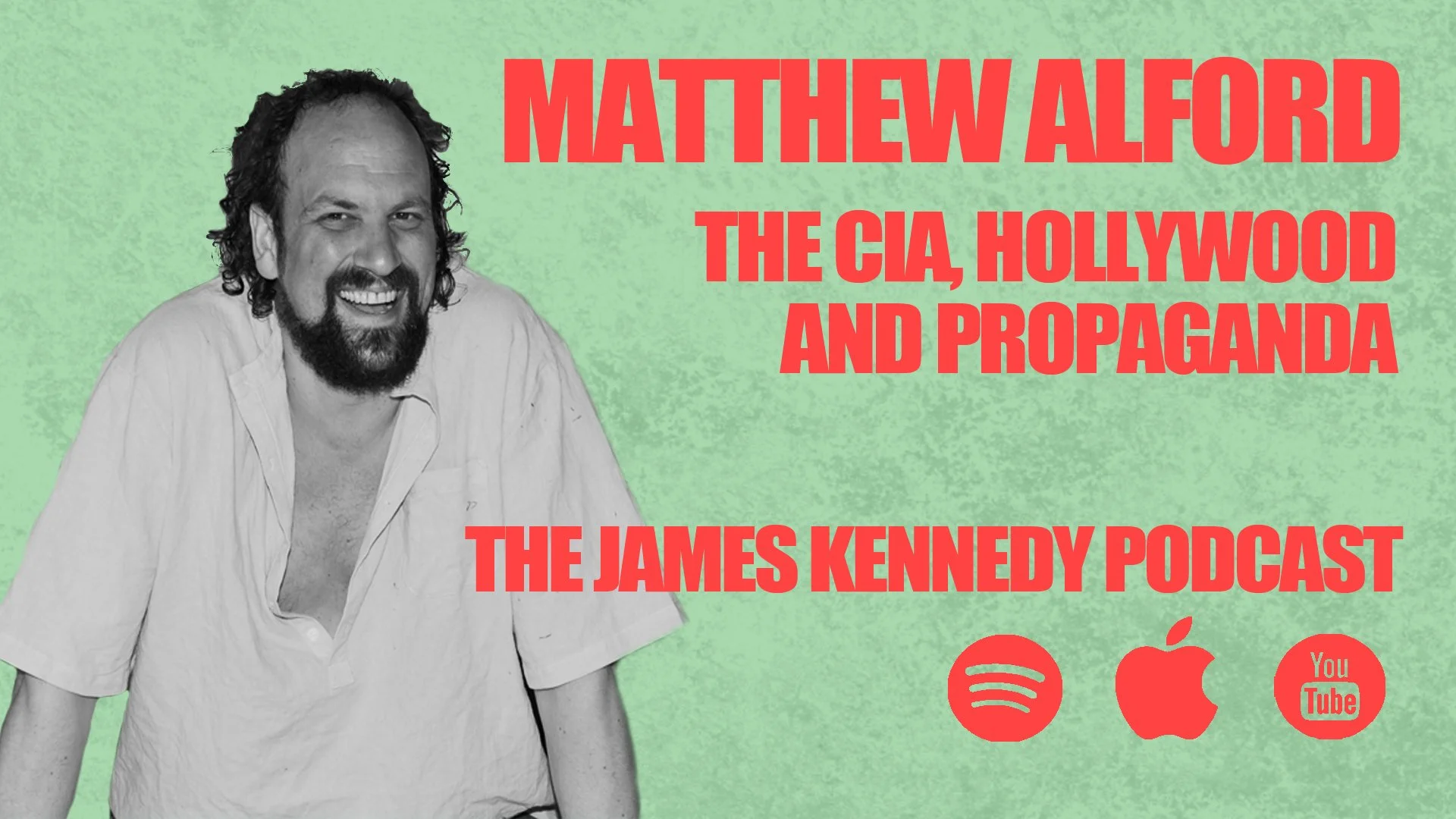
MATTHEW ALFORD - THE CIA AND HOLLYWOOD
Host James Kennedy interviews Dr. Matthew Alford on how the Department of Defense, the CIA, and broader systemic pressures censor and reshape thousands of Hollywood scripts to promote U.S. government interests.
James Kennedy Please join me in welcoming to the show, Dr. Matthew Alford. He's a lecturer at the University of Bath, an author, a filmmaker, and a leading authority on the collusion between the CIA and Hollywood, which is what we're going to be talking all about today. Matt, thank you so much for doing this, man. I can't wait to jump into this. How are you doing?
Matthew Alford I'm doing very well. Thanks for having me, James.
James Kennedy Oh, man, it's a pleasure. I can't wait to jump into this because you were involved in a line of research that is super, super fascinating. And it's something that I know loads of people listening to this are not going to know anything about. And their mind is going to be blown wide open to hear all the stuff that is going on that you've been uncovering and proving and documenting for quite a while now. So to throw us into this, what would you say is the main premise of the work that you've been doing for many years now?
Matthew Alford The premise kind of came from that exact sentiment that you just expressed, which is not having a clue that this kind of thing is happening. When we first started looking into this, 15 or so years ago, it looked like a complete conspiracy theory. The idea that the U.S. government was rewriting Hollywood film scripts and TV shows was just a really peculiar idea. I remember a song by the band James—I don't know if you remember the band James—and they did a really good song, must have been the late '90s, called something like "My TV staring at me saying all our money goes into the military". I remember thinking, oh, that's a curious little lyric to use, but it always seemed like a mysterious, abstract, almost poetic thing to say based on nothing.
But what I found, particularly circa 2015, was this huge tranche of documents from the Department of Defense showing that they rewrite several thousand movies and TV shows. And that was the first major chunk taken out of this wall of secrecy as we saw it. So, yeah, that's what we've been doing. We were dabbling in this work at the beginning of the 21st century when there was almost a complete blanket of secrecy around it, but the big avalanche of material came around 2015. We started off in 2015 with about 3,000 pages of documents, and then that's when we realized that the government has affected maybe 10,000+ products. But now we're up to about 60,000 pages of documentation with a lot more details filled in about the extent to which these changes are political. So basically, the government does control a lot. And it's not just the government; it's the militarized, securitized aspects of the government—the CIA and Department of Defense.
James Kennedy Jesus Christ, that is mental, man. 60,000 pages of documents supporting this. I kind of had a feeling, really, like on some films when you see them and they're so overly, sickly patriotic, where the lone, bedraggled hero claws his way to the top of the mountain to place down the U.S. flag and all is good in the world. You kind of think, oh Jesus Christ, but you could never tell if that's just the cultural indoctrination of the filmmaker—that that was their actual vision—or whether it's a result of direct editorial influence on behalf of the government. Is that a factor or is it always the latter?
Matthew Alford Both of those things you say are completely accurate. It really is the case that there are a lot of movies that are extremely nationalistic and militaristic without any involvement by the Department of Defense. So all of these things are going on.
To try to think of the best examples, take a very violent, xenophobic movie like American Sniper—that Clint Eastwood film from 2013 glorifying someone who could well have been a psychopath who went around murdering people in Iraq as a sniper. That film was so extreme in what it was advocating—basically taking out civilians in Iraq to protect "the herd of sheep from the wolves," very self-congratulatory—and so violent and pro-military that the Department of Defense didn't want anything to do with it. They knew it would be a bad PR look for them. It would just be insane.
Or go back a little bit to George Clooney's first film when he came off TV in 1997, The Peacemaker. That film did not have Department of Defense support, but that film with Nicole Kidman was basically justifying the idea of Team America: World Police, but without the jokes. It was them going around into Russian airspace, bombing, saying all of the Muslims are baddies and have all got nuclear weapons. And, of course, The Peacemaker was actually the securitized United States.
There are a lot of films—my research gives the impression that everything is about this one office or set of offices in Los Angeles and Washington, D.C., which are controlling and manipulating events, but it is more complicated than that. In fact, the final chapter of our book from 2017 points out the extent to which this is a cultural problem and not just a government problem. But that's not to understate the level of the institutional problem here as well. The fact is, if you've got 10,000+ products that are being directly affected at script level by the government, you do have a problem. It's not just cultural; it's both.
James Kennedy Wow, that's interesting. So, I suppose there are some films, then, where the Department of Defense would look at it and be like, well, no further work needed, that's fine, put it out.
Matthew Alford Yeah, either no work needed because it's kind of fine—though they usually offer some kind of courtesy support anyway because there's usually something they can do to help—or they say, "Look, this is just too rich for our blood. Politically, this is just awkward, and even though it's promoting America, it's making us look as insane as we are." So that kind of thing does happen. There are all sorts of different permutations.
James Kennedy So, how does this play out, then, in the day-by-day nature of the thing? Let me take a hypothetical just to illustrate the point. You've got a script that's been written by somebody independently of the government—it's just their passion project. They've written it, they've got a producer, there's a whole team together, and they're making the film. The government has no involvement in it whatsoever; they're just doing their thing and making a movie. At what point does the government get involved? How do they get involved, and what is the nature of their involvement?
Matthew Alford It varies a bit, but the standard process would be that the producers themselves approach the Department of Defense and ask for support, whether they ask for helicopters, extras, an aircraft carrier, or just advice and generic support. So almost always it comes from the producers themselves. For reasons of democracy, it can't be the government going around tapping on a filmmaker's shoulders and saying, "Hey, we want to control your film." There's not a great deal of that.
That said, the relationships between them are so close that it might as well be that. In a democracy, you can't really have that heavy-handed approach, so it is voluntary in theory. The producers will approach the Department of Defense, write in, and send in a form. Executive producer Roger Stahl and I have both written in forms at one time or another to ask for Department of Defense support on our bogus projects to see what they say. In our film Theaters of War, Roger records his application on tape, and you see that they get very uncomfortable because he asks, "Will you support my documentary about your processes?" It was quite a funny bit of our documentary.
So the producer will approach them, and then they will get back to them and say, "Give us your whole script." They'll read the whole context of that script to make sure there's nothing in it that bothers them. If there is, they'll send back an extensive list of changes required.
James Kennedy Wow. And that's very much conditional. If you want to use our airplanes or our airstrip or whatever, this has to change or go fuck yourself—is it?
Matthew Alford Yeah, it's completely conditional. I would describe the Department of Defense and the CIA, but particularly the Department of Defense, as being a very heavy-handed executive producer. That's basically what they're doing. They will make no compromise about the content of the film; even one line would be enough to be what they call a showstopper.
So anything that indicates that there is or was racism in the ranks, or high levels of assault among the troops. Anything that indicates that nuclear weapons aren't safe or under control. Anything that indicates war crimes, or that the U.S. is involved in assassinations. Anything that indicates that the troops might frag their officers—meaning murder their officers. Anything involving drug taking. It's as wide as you could possibly imagine. Anything that will bring not just the military or the CIA into disrepute, but anything that will bring American government policy into disrepute.
Obviously, that's one of those aspects of this arrangement that they play down a bit because they don't want to make it look like they're covering for American policy, but that's exactly what they are doing. There was a film in the mid-'90s where this was put in writing really clearly—they sign the producers into a contract, and part of that is to say, "Don't go against the interests of the U.S. government." There's a similar arrangement from what we can see with new information coming out in the U.K., where the U.K. says, "Do not contradict the interests of the Ministry of Defence." We're working on that documentation now.
So there was a case in the mid-'90s, a film called Countermeasures, which was due to star Sigourney Weaver. That film was about corruption on an aircraft carrier. It had been greenlit, written, and everything, but the Department of Defense got back to them in writing and said, "We're not going to give you this. We have no reason to denigrate the White House or remind the public of the Iran-Contra affair from the 1980s." So they're really clear and explicit; they know exactly what they're doing.
It's the same as what any PR agency would be doing. If you or I were running a PR agency, we would probably be as thorough. Is it flattering to our client? If you're selling shampoo on TV, you're going to be ruthlessly supportive of the soap industry and not say anything about where it comes from or how bad it is for the environment. But the big difference here, and the reason it's so politically important, is that you're talking about the most murderous, powerful, and unstable organization on Earth: the U.S. national security apparatus. The danger created by these people is huge. I'm sure a lot of the people who work for it are thinking, "Well, we're just a cog in a machine putting a good spin on things here," but at an institutional level, it's absolute control.
James Kennedy So if there was a film that was politically oriented in a critical or satirical way—say something like Team America as a good example—that didn't require any favors from the government or the security services, didn't need tech or insight, and they just wanted to make a film. Would there be any influence there? Because if there was no contact between the production team and the security services, but it came on their radar that this might be a little bit subversive, what would happen then?
Matthew Alford Usually nothing would happen then. You're getting more into the conspiracy realm if you assume they would reach out. That's largely because the Hollywood system as it stands already has disincentives to actually produce radical material that promotes the idea of a peace economy.
Take the Oliver Stone movie Snowden from 2016. Edward Snowden was responsible for the biggest leak at that time, which revealed that the United States had been illegally surveilling people through online systems and had unprecedented access to private data. Edward Snowden ended up having to live in Moscow and is still wanted by the U.S. government, though most people consider him to be a hero. Oliver Stone made a really well-done film that was very sympathetic to Snowden, but economically, as with almost all of Stone's films, he had to get all the money from Europe. He couldn't get any U.S. studio behind it.
Bear in mind, Oliver Stone is one of the most successful filmmakers of all time—a millionaire and a celebrated figure artistically and commercially—but he only had 30 days to film the whole movie. During that time—and I don't mean this to sound insensitive, but as an illustration—his mum died, and he had to decide whether to fly back to the U.S. for the funeral or continue filming. For financial reasons, they had to continue filming. Those are the kinds of pressures that are on Hollywood filmmakers. Politically, there are additional pressures on people like that.
So is it the case that the government will involve itself in a film it doesn't have formal levers over? Well, there are concerted campaigns against movies sometimes—Oliver Stone's JFK is a good example. Thousands of articles were written about it because he promoted the assassination conspiracy, leading to a gigantic, coordinated backlash from members of the government and the media. But the formal Department of Defense PR office can't really do anything about a movie they haven't been contracted into.
Another good example is Vice from 2018, about Vice President Dick Cheney. That was an unusually combative and critical film, and they didn't ask for any help from the government. They did a really good job of criticizing that upper echelon of defense contractors and politicians. So things can get through the system, and we shouldn't be hopeless about these things—this isn't just a great government conspiracy that controls everything. The levers of government control are remarkable and were completely unknown until our group got involved with this research, but there are still opportunities for pushback.
For the listeners, I'm pointing to a library of DVDs. You can make a lovely wall of DVDs that are critical of the government and promote alternative histories. It's just that on the other wall, if you put the blockbuster movies, the pro-militaristic movies, the pro-CIA movies, and the movies that show American benevolence, that wall would be about ten times bigger and ten times better funded.
ENJOYING THE CONVERSATION?
GET JAMES KENNEDY'S LATEST INTERVIEWS, WRITING AND LIVE SHOWS STRAIGHT TO YOUR INBOX.
James Kennedy Very impressive collection behind him—he's pointing. Right, that makes a ton of sense. As you were speaking, it popped into my mind that this sounds eerily similar to Chomsky's propaganda model. I recall reading when researching your work that some of your analysis is based upon Chomsky's propaganda model, wherein there are so many fixed structural limitations you have to operate within—whether financial constraints like Oliver Stone making a movie without a studio budget, logistical constraints, commercial constraints, or fear of political backlash. By the time your product filters through all these levels, the outcome is likely to be fairly homogeneous regardless of the initial intention, without the need for any direct conspiracy-style influence from the government. Is that kind of what you're talking about?
Matthew Alford That's 100% accurate. You've explained the Chomsky propaganda model beautifully. That's where all of my theoretical work has come from. At the beginning of my academic career as a PhD researcher, I was literally applying Chomsky's model to cinema. I published articles about the propaganda model for a few years after that, and then I was going to give up everything to do with it because I felt I'd said everything—we know why this material is homogenized and why there is an underlying meta-narrative of U.S. benevolence where imperialism isn't even questioned.
It was only at that point that another researcher, Tom Secker, and I got together and started putting in Freedom of Information Act requests. Suddenly, there was this deluge of material that changed my research career, because it meant I was actually looking at archival data rather than just reading films as texts. We were really shocked to find the extent to which there was direct government involvement.
James Kennedy Man, can you remind the listeners again of the sheer scale of this? You mentioned some figures at the start that I've completely forgotten because there's so much to unpack here. Can you give the listeners and myself a reminder of what we're talking about in terms of how often this happens within movies?
Matthew Alford Let me put it like this in terms of what we knew as a society. At the turn of the 21st century, the only literature out there indicated that maybe a few hundred—perhaps 300—films had been affected by or had contact with the Department of Defense. No one had looked at the CIA role at all. There was nothing written to quantify the role of the FBI, police forces like the NYPD and LAPD, or anything in other countries like the U.K. Nothing was written about TV.
What we found out over the past couple of decades is that at least 10,000 products—television episodes and movies—have been affected by the national security state. Three-quarters of those involve the Department of Defense. The CIA has been involved in around 100, the NYPD and LAPD account for a couple thousand episodes, and the FBI plays a marginal but important role historically.
Government involvement has become more significant over the past couple of decades, particularly around 2004–2005, when they started expanding beyond cinema into network television—quiz shows, cookery shows, anything that might involve a member of the military. For example, if a cheesy TV show involves a bomb dog reuniting with its owner from Iraq, or reuniting couples where one has served overseas—all that feel-good stuff. There was a show where they made dinner for different famous people, and they made dinner for the head of the CIA. In that episode, the CIA chief had to skip dessert to take an extremely important call. They are all ways of associating those government organizations with friendly things, benevolence, cake, and hard work.
James Kennedy Good, wholesome dudes working hard to do the right thing for the people.
Matthew Alford Sometimes that might be the case, but it's part of a PR system. We've known that a PR system has operated systematically for just over 100 years—the industry arose with the idea Chomsky talks about: manufacturing consent, providing necessary illusions, and controlling the "bewildered herd" so democracy doesn't run rampant.
We all know PR and advertising exist, but what's been criminally under-investigated is the role of the state and military apparatus in PR. People generally aren't as aware of the prevalence and insidiousness of military and national promotion as they are of annoying adverts for Wish or whatever.
James Kennedy Now that you've made that comparison, it seems obvious. They have an interest to preserve, and propaganda is a powerful tool. It's hidden in plain sight—a more insidious form of propaganda where you're not living under a direct dictatorship, but information is filtered through that propaganda model into a watered-down narrative.
Are we talking about actual editing of scripts? Do they have someone who will suggest changes, like ending with a shot of the American flag? Is it at that level?
Matthew Alford They usually aren't as clunky as saying, "We really want an American flag right here." When they wrote that they had no reason to denigrate the White House or remind the public of Iran-Contra, that was really on the nose, but that was from the mid-1990s. Personnel involved now tend to be a bit more circumspect with their language because they know their emails could come out. But they do ask for line-by-line rewrites.
Take the film The Hulk. In the script, there was an operation to capture the Hulk called "Operation Ranch Hand." The military said, "You can't call it Operation Ranch Hand because that was the name of the chemical weapons program we used to defoliate Vietnam." The filmmakers had coincidentally used the same name, so they had to change it to "Operation Angry Man." In that case, the military emailed the filmmakers in a very apologetic tone saying, "There are so many changes required that we're sorry, but either you do it or this doesn't go ahead."
A lot of the time, they just want to disassociate themselves from scandal. Since The Hulk is about something going wrong at a military lab, they wanted everyone out of uniform. Or take Independence Day: in the original script, they blew up the Pentagon as well as the White House, but the Pentagon said, "No, you can't do that because we need to be seen to protect. We don't ever want to show that."
As for injections or new material, they do that as well. The CIA operates slightly differently because they don't have black helicopters to offer, so they get in really early with the scriptwriting process, often collaborating with writers before the film is even publicly known. In a way, the CIA is more insidious and conspiratorial than the Department of Defense. They are very circumspect about writing things down, making script changes much harder to identify.
We know the CIA worked on the Tom Hanks movie Charlie Wilson's War, about U.S. foreign policy in Afghanistan and the arming of the Osama bin Laden terrorist network. We also know they worked on the Al Pacino movie The Recruit, about CIA recruitment. No one knew the CIA worked on The Recruit—there were no credits—but it came out during a separate commercial court case. Documents were leaked showing the CIA had basically written the first draft and controlled the entire ideological direction of that movie.
Even in a comedy like Meet the Parents, starring Ben Stiller and Robert De Niro, a tiny change altered the whole vibe. Ben Stiller walks into his prospective father-in-law's office, scared because he wants to marry his daughter and finds out De Niro's character was in the CIA. In the original script, he looks around the office and sees it plastered with real CIA torture manuals from the 1980s School of the Americas. The CIA spoke to the producers and said, "Please don't do that. Why don't you replace the torture manuals with pictures of Robert De Niro hanging out with world leaders?" The producers agreed. That tiny change creates historical amnesia about the CIA sponsoring death squads in Nicaragua, removing what would have been a real image threat in a massive blockbuster comedy.
In Iron Man, the character was originally represented as a genuine anti-war figure fighting the military-industrial complex. By the time they made the movie, Robert Downey Jr.'s character was channeling the military-industrial complex to kill terrorists. Even then, the Department of Defense required changes. Downey Jr.'s character made a casual joke along the lines of "I'd die to be in the military," and they had a stand-up row on set because the Department of Defense said that alluded to high rates of military suicide. They forced them to change the line.
You asked about other ways ideas are inserted. In the late 1990s, under the Clinton administration, there was a separate $40 million military program to promote the drug war through daytime TV shows like Beverly Hills, 90210 and Chicago Hope. They secretly ensured anti-drug storylines were inserted. In an episode of Chicago Hope, someone takes a toke of a joint, gets into a massive car accident, and the doctor implies they won't get a blood transfusion unless they give up drugs. It was so over-the-top that when Salon.com exposed the program, the military had to scrap it.
It happens all the time across the Marvel series. I always think the most disappointing series is Terminator. Terminator 1 and 2 had no military involvement and were subversive films against institutional authority. Terminator 3 only had courtesy support. But by Terminator 4, which had full Department of Defense cooperation, the final scene features the military flying off into the sunset saying, "We will defend democracy wherever it is." It completely betrays the story—you're in a post-nuclear world, and someone has open-heart surgery at the end. It's an absolute mess, but it's as close as you get to actual flag-waving.
A classic historical example from 1968 is John Wayne writing to President Johnson at the height of the Vietnam War's unpopularity, offering to make a propaganda film. Johnson gave him whatever he needed. The film, The Green Berets, ends with John Wayne and a young Vietnamese kid walking off into the sunset, with Wayne saying, "Hey kid, this is what this war is all about." The Department of Defense and Wayne explicitly agreed not to credit the Pentagon so the public wouldn't realize it was propaganda.
James Kennedy That's fascinating. It seems far more insidious than just looking out for helicopters and military paraphernalia on screen.
Matthew Alford There is a secondary concern here. My primary concern is that this is a propaganda issue that promotes U.S.-imposed violence and domination. But a second, creative reason I oppose this is that these organizations are wrecking movies. They make movies and TV shows banal, boring, and uninteresting, creating a chilling effect. It also gives the false impression that the American public is entirely bloodthirsty and pro-military.
Take sports flyovers, which my colleague Trisha Jenkins has researched. When players come onto the field in baseball or football, the audience stands to applaud. At that exact moment, military jets fly over, making it look like tens of thousands of people are rising to applaud the military when they're actually applauding the players.
With films like Top Gun: Maverick, everyone involved admits they couldn't have made it without the military. The 30-year gap between the original and the sequel was partly due to a widely reported U.S. Navy sex scandal in the early '90s. The original Top Gun created a "machoified" culture in the ranks—like the scene where Tom Cruise follows a woman into the bathroom. When they finally made the sequel, the relationship was completely symbiotic. Director Ridley Scott said the same about Black Hawk Down—he could have made it without the Department of Defense, but he would have had to call it "Huey Down."
James Kennedy Yeah, those films would be impossible to make without the military on site. Whenever you see planes or helicopters, nine times out of ten there's military involvement.
Given that Chomsky's propaganda model originally focused on news and information, you've applied it effectively to the movie industry. Do you think it applies to other entertainment industries, like the music industry?
Matthew Alford I wrote an article about music. The role of the military is much less significant there, but there are examples of government interference. A classic case was in 1977 when "God Save the Queen" by the Sex Pistols was artificially kept off the number-one spot by sales manipulation. When Margaret Thatcher died, there was a similar issue when "Ding-Dong! The Witch is Dead" charted.
The military occasionally gets involved in large-scale video shoots on air force bases for major stars, but overall the pop industry is already so diluted, controlled, and contrived. It's also difficult to convey complex analysis of international conflict within a set of lyrics.
A rock star who pursued a peace line and was marginalized by society and his bandmates is Roger Waters from Pink Floyd. He re-released his song about Reagan, "The Bravery of Being Out of Range," supported Julian Assange, and faced round criticism from powerful organizations. If you sustain activism as a rock star, it leads to marginalization, though whether the military directly interferes with individual songs is another question.
James Kennedy I had a situation myself. I released an album during lockdown called Make Anger Great Again, a month before Trump was running. It was a flip on his slogan, full of protest songs about rising up against tyranny. Within one day of posting my first video, which used protest footage including the Colston statue coming down (sourced from YouTube itself), Google and YouTube took it offline for "shocking content."
Facebook wouldn't let me run paid ads because they said it was politically insightful, and I was immediately shadowbanned across all platforms. I went from having 350,000 engaged Twitter followers to being practically invisible within weeks. They revoked my advertising rights and demonetized everything. It didn't come from the military, but from big tech—another layer of that same propaganda model using commercial constraints that lead many to self-censor.
Matthew Alford Having that broader focus on what social media giants do is vital. The real control utilized by social media giants is unaccountable. We see audience figures drop precipitously and artificially when someone releases political content. Owen Jones from The Guardian showed his figures online dropping off after releasing information about Gaza, and artists face the exact same thing.
It's a disturbing twist, and researchers shouldn't put all the emphasis on the military and CIA when we're talking about whole structural systems. That's why my current YouTube series focuses on media representation, censorship, and broader global issues like Russia-Ukraine, Israel-Gaza, and China-Taiwan—specifically the U.S. and U.K.'s role in them.
James Kennedy U.K. foreign policy acts like a little lapdog. What is the U.K. equivalent like in the movie industry?
Matthew Alford I'm working with a PhD student, Tarik, on this. He quickly found about 300 examples of U.K. films and TV shows impacted by the Ministry of Defence and civil service. The James Bond films have all been messed around with, and the Kingsman series contains pointed international political changes. In Kingsman: The Secret Service, the villain Rasputin is vilified for taking Russia out of World War I—ideologically making the person who stopped engaging in a horrific war the bad guy.
The British system is even more secret and less accountable than the U.S. A historical example is a biopic about Prime Minister David Lloyd George from 100 years ago. He watched the finished film, didn't like it, put the single copy in a safe, and suppressed it. It wasn't found until 1999.
Other countries are catching up, too. China and India produce nationalistic movies.
James Kennedy I watch thousands of Bollywood films, and some of it is so sickly patriotic—the lone, bloodied soldier saving a child, kissing the flag, and every bad guy is from Pakistan.
Matthew Alford Nationalism in cinema is a universal problem. Given the potential for conflict between India and Pakistan, that propaganda is particularly dangerous. We need to resist propaganda everywhere and create a stable world through open communication.
James Kennedy What started in my mind as eight guys in a dark room smoking cigars is actually a subtle, all-pervasive system of commercial, financial, and logistical pressures.
Where can people go to check out your books, documentaries, and ongoing work?
Matthew Alford People can check out my YouTube channel, Dr. Matthew Alford, where I'm running the series Worst Year Ever, analyzing international relations, Israel, Iran, and Ukraine. I also publish on Substack.
My two main film projects are The Writer with No Hands (also available as a book) and the documentary Theaters of War (available on Vimeo), which covers everything we've discussed today.
James Kennedy Awesome. I'll put links in the show notes so people can check out your work. Matt, thank you so much for your time today, man. Best wishes moving forward.
Matthew Alford Thanks very much, James. It was a pleasure to be on, and have a great day.
Key Points:
Dr. Matthew Alford's research shows the U.S. Department of Defense and CIA have directly influenced over 10,000 film and TV products, with documentation now exceeding 60,000 pages.
Government involvement typically begins when producers voluntarily request military support, after which the DoD demands full scripts and issues mandatory line-by-line changes.
The Department of Defense functions like a heavy-handed executive producer, blocking content on racism, war crimes, assassination, drug use, or anything damaging to U.S. government policy.
The CIA operates more covertly than the DoD, engaging early in script development and often leaving no trace or credit, as seen in films like The Recruit and Meet the Parents.
Noam Chomsky's propaganda model explains how structural pressures—financial, commercial, and political—naturally homogenize Hollywood output even without direct government interference.
The U.K. Ministry of Defence and other nations like India and China employ similar entertainment influence, making this a global rather than purely American phenomenon.
Big Tech platforms like Google, YouTube, and Facebook now enforce censorship through shadow banning and demonetization, affecting artists and journalists beyond traditional military influence.
Alford argues this propaganda system damages both democracy and creativity, producing banal, conformist entertainment while manufacturing public consent for U.S. militarism and imperialism.
Summary:
This podcast episode features host James Kennedy interviewing Dr. Matthew Alford, a University of Bath lecturer and leading authority on CIA and Pentagon collusion with Hollywood. S.
national security state. Producers typically initiate contact by requesting military assets like helicopters or aircraft carriers, after which the Department of Defense demands full scripts and imposes binding changes. S.
policy is removed. The CIA operates more covertly, often shaping scripts before production even begins, as with The Recruit and Meet the Parents. Alford grounds this in Chomsky's propaganda model, noting that structural pressures—commercial, financial, and political—already homogenize Hollywood output, making direct censorship often unnecessary.
, India, and China, showing this is a global phenomenon. Kennedy shares his own experience of YouTube removing his protest music and Facebook blocking his ads, illustrating how Big Tech now enforces similar censorship through shadow banning and demonetization. Alford concludes that this system damages both democracy and creativity, producing conformist entertainment that manufactures consent for militarism and imperialism.
The James Kennedy Podcast is a Society and Culture podcast hosted by musician and author, James Kennedy. Exploring the big questions around health, social issues, the arts, politics, mental health, the human condition and how to navigate this thing called life through casual conversations with scientists, activists, rock stars, philosophers and academics. Please subscribe, leave a rating and support the show.