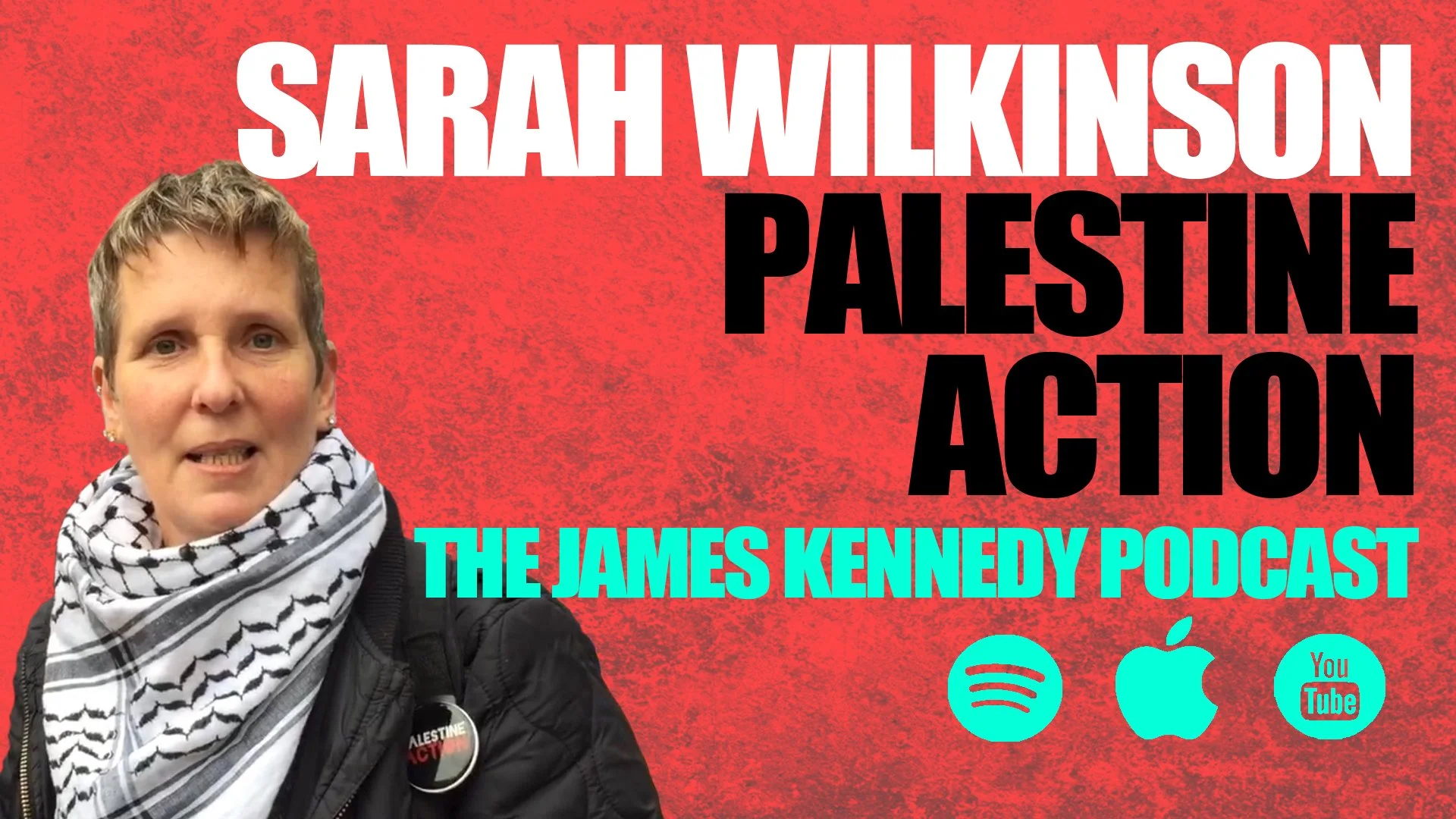
SARAH WILKINSON - PALESTINE ACTION INTERVIEW
Host James Kennedy speaks with Sarah Wilkinson about Palestine Action's direct-action campaigns against Elbit Systems arms factories in the UK. They discuss site occupations, legal outcomes, the broader situation in Gaza, and the personal impact of human rights advocacy.
James Kennedy: Without further ado, strap yourselves in as we welcome onto today's episode of the podcast, the brilliant, the brave, and the wonderful Sarah Wilkinson from Palestine Action. Sarah, thanks so much for joining us, man. How are you doing?
Sarah Wilkinson: Good, thank you. Thank you for inviting me.
James Kennedy: No, thank you for being here. Before we jump into the broader issues, of which there are many surrounding this subject, for those who don't know, can you tell the listeners what is Palestine Action?
Sarah Wilkinson: Okay, so Palestine Action was first established because what was needed—people would protest, people would picket, there'd be vigils, and then everybody would go home for tea. Technically, what was needed three years ago was an action group that didn't go home, that was basically prepared to use their bodies as a way of protesting. To shut down an Israeli arms factory, standing outside with a placard raises public awareness and there is an importance to doing it, but it didn't actually have any results.
So in order to shut down the Israeli factories, of which at the time we had 10, what was needed was really to occupy the factories. It was to get people on board who were prepared to put their bodies on the line, take risks, and get the Israeli arms factory Elbit—which is the largest private arms manufacturer owned by the Israelis—into court. Elbit never wanted to go into court because it didn't want to disclose what it was doing behind the scenes. It's making weaponry, munitions, drone parts, drone engines, parts for Merkava tanks—a whole array of munitions which were being used experimentally to annihilate Palestinians in Gaza and use them as lab rats, if you'll excuse the insensitive term.
Palestine Action was initiated originally to properly shut down these Israeli arms factories—not just protest, not just sit outside and go home afterwards, but to actually shut these places down for three or four days at a time, to go up on the roofs, and to disrupt and destroy the company operations so that it could no longer continue to make weapons. In doing that, you're also raising awareness, you're getting public support, and you're recruiting more people. Effectively, you are shutting the factory down. Even if you're not closing it permanently, you are causing it millions in reparations. Every court case costs Elbit money to take you to court. They have spies that follow you around that cost 200 pounds an hour. All of this comes out of the profits that Elbit are using to manufacture weapons.
So it's a really effective way if people are prepared to make the sacrifice and do some prison time or get arrested to put Elbit in the dock. That's effectively what Palestine Action does. It gets Elbit into court, and the judges normally find that no matter how much damage has been caused, it is proportionate because these Israeli arms factories are destroying lives. They're exporting the weapons back into Haifa, in Israeli-occupied land, and they're using them to murder, maim, torture, kill, and annihilate the Palestinian people.
It's a really effective organization. In three years, this organization has done what no other organization has done, and that is to actually permanently shut three Israeli arms factories down—three Elbits. The first one was Oldham, which was a massive factory making all sorts of munitions and helicopter parts. Then Tamworth was closed; recently, they pulled out of Tamworth. The London HQ, which is a very important one, shut down last year. So three Israeli arms factories are out of England. It doesn't stop the Israelis from manufacturing weapons on their own soil, but it does stop the British from being complicit. No other organization has been able to do this. So in three years, that's three Israeli arms factories; we've got seven more to shut down. The job has not been finished yet, but it's a very important organization, and Palestine Action will continue until every single arms factory is shut.
James Kennedy: Love it. Love it. Yeah, and that's an amazing track record for an organization that's only been going since 2020. You've mentioned some of the things that you guys do in order to achieve those results already, but let's dive deeper into that. What are some of the strategies and tactics that you guys employ in order to achieve the results that you have?
Sarah Wilkinson: Right. It's everything from literally the smallest operations, I suppose, which are locking on—attaching yourself to fairly impenetrable tubes that block the gates and stop the workers from getting in. That's the smaller actions, if you like, but you still get arrested from those and there's still a court case impending afterwards.
Then there's occupying the rooftops, actually smashing through the roof, getting into the factory, and spraying it red. The red obviously is symbolic of the blood spilt by these factories. So it's everything from just disabling the gates to smashing your way into the car park—just basically anything that will shut down the factory and stop operations, even if it's only for a day.
The rooftop operations—I believe in Oldham one of them went on for six days. Then the day before yesterday, there was an action on Teledyne, which is an American firm—it's not an Elbit, but it's an American weapons factory supplying fighter jet components straight to the Israeli regime—and they managed to close that down for an entire day.
Ideas are always different; people come along with their own ideas. "How about if we drive a vehicle through here, or smash this, or hit the wall?" There's always new ideas, and the more people that come on board, the more creative people can be. But the main function is to use direct action to shut down the factory and disable it from being able to work. That costs an awful lot of money. The workers turn up, they can't get in, they've got to go home. Then you've got the insurance costs, and you've got the security costs. Elbit have had to employ numerous security firms and dogs. These all cost money. The more you're costing it, the more you're disabling it from working, and the more you're creating a situation where police forces have to converge and shut the road down so that traffic can't even pass through. You're creating an expense that has to be covered by the company, and the more you do that—
James Kennedy: —the less it can use its profits. I'm guessing that this comes at some significant personal cost to the people doing this as well, though. I'm sure there are some consequences and punishments for people engaging in these activities, is that right?
Sarah Wilkinson: I think it depends how you are in court, and it also depends what judge you have. But the point is, some people have literally sacrificed their liberty, some people have been bailed, and some people have been acquitted. It all depends on the amount of damage that you cause and also how you present yourself in court, as well as how Elbit present themselves in court.
Every court case is different, but every single court case that happens has a huge amount of supporters outside the court raising awareness for passers-by. The court cases get a lot of press coverage, and Elbit are struggling to justify why. They try lying that they haven't got export licenses or that they're not feeding the Israeli military with weaponry, but all of this can be disclosed in court as being a lie. So Elbit end up not looking great in court. They hide behind screens; they won't let their faces be shown. But the information that they give is often proved to be false.
The Crown Prosecutor struggles to say, "Well, why didn't you try protesting ordinarily?" Well, we did; we've done it for years. "Why didn't you write a letter to King Charles?" We've done it. "Why don't you write to your MP?" We've done it. We've leafleted; we've done all of that. There comes a point where you can't just walk up and down a road with a placard anymore. We've done that for about 20 years, so we're now forced into a situation where we have to shut these factories down. We have to, because lives are at stake.
Any judge hearing that in court is fairly sympathetic to the idea, "Well, yeah, you are saving tens of thousands of lives by doing this," so it becomes proportionate no matter how much damage they cause. The idea is to create a situation where that building is no longer under health and safety regulations—they're not able to continue working without a roof, or without a water tank, or without air conditioning. You actually make it impossible for them to go back to work for maybe two or three weeks. Not only that, the red paint is an indication to anyone who drives or walks past that something bad is going on here. People in these sleepy villages need to know that they're living next door to an arms factory that has murdered and maimed hundreds of thousands of adults and children in Palestine, and that it's being used to facilitate a genocide.
James Kennedy: 100%. It's interesting what you said about the sentiments within the courtroom as well, because I would have assumed that an instrument of the state, such as the courts, would just naturally side with big business by default rather than this ragtag group of troublesome protesters causing criminal damage in their eyes. So that's super interesting that that's not actually always the case. By engaging in these activities which get you guys in the courtroom, Elbit have an opportunity to embarrass and expose themselves in that arena as well. It's kind of like a double-whammy effect. I'm actually quite surprised by that, because I would have thought it would have gone the other way.
Sarah Wilkinson: Yeah, but I think the thing about activists is that they're on the right side of history, and a judge can recognize that. We're not there to hurt an individual or hurt anybody. Even when they had dogs, we made sure that when we were smashing glass on the car park, we were not doing it in an area that could hurt the dog. There are elements of humanitarianism about activism. We're trying to save lives. We have colleagues, friends, and family in Palestine, so there's a personal issue, and I think the judge can see that we're not hideous criminals that are a danger to society. What we're trying to do is stop the killing of Palestinian people, to stop the killing in Gaza.
When you're talking about that in court, it's very difficult. I have personal experiences; I've lost people in Palestine, and it's hard for the judge to dispute that. I have a reason for direct action. I have a reason to stop this Israeli arms factory operating, because one of the drones that this particular factory made actually slaughtered my pen friend, who I'd had for years, even before the days of digital social media. I had been writing to my Palestinian friend for years, and this drone—which was made in Britain by the factory I was doing my direct action outside of—was responsible for the killing of an entire family, including a six-month-old baby. She lost all six children.
When you're talking about that in court, the judge can kind of see why you're doing what you're doing. If I'm locked on outside a gate, I'm really not causing any harm to anybody, but what I am doing is trying to stop this factory from making more weapons that will kill another family of six children. It's hard for the judge not to sympathize with that, whereas Elbit are all about making weapons to kill. They can't deny that their weapons are being used to kill people, so how do you go into court and say, "Yeah, we make weapons, we kill people, but it's justified"? You can't really justify it, so they're on the back foot the minute they're in court.
It's easier for the judge to understand the activists, who are always a really nice bunch of people—they're very eloquent, they do well in court, they're likable, and they have a lot of supporters in the gallery. Elbit have no supporters; they come in quite aggressive, trying to justify killing. How do you justify killing? You can't. This is why they've never wanted to be in court, and nobody got them into court until Palestine Action came along and forced them into a situation where they had to take these activists to court because they had destroyed the building. It's a really effective way of putting them in the dock and forcing them to answer questions that they're very uncomfortable about.
James Kennedy: Beautiful, man, yeah. It's really heartening to hear that there is that capacity within the establishment, such as the courts, to have that discourse. You mentioned already some of the more mainstream or socially and politically acceptable forms of protest and resistance, such as marching, placards, petitioning, and awareness raising. It'd be interesting to know what your thoughts are on those forms of protest—whether you think they have a place in change and progress, or whether you think direct action is ultimately the only way to get shit done?
ENJOYING THE CONVERSATION?
GET JAMES KENNEDY'S LATEST INTERVIEWS, WRITING AND LIVE SHOWS STRAIGHT TO YOUR INBOX.
Sarah Wilkinson: Both, really. I'm very tempted to say direct action gets the job done—and it does—but there are some people who can't do direct action, not just for disability reasons, but also because they may have family and don't want to spend time in custody, or they may lose their job if they do so.
There's room for every form of protest. If you have a massive placard protest going on outside a direct action as well, that is just as useful. When you have three-quarters of a million people marching through London taking over the streets, that is still effective. When you have petitions that work—not all of them do—that's still effective. The fact that the pro-Palestinian network has become so huge means there is a job for everyone, no matter what your background, experience, or age group is. There's even young children going out and protesting, coming out of schools and causing day strikes. It doesn't matter; everybody has to protest somehow.
Then there are some brave individuals who put their body on the line and go the whole way, but not everyone can do that. Everybody protests in every form of manner, whether it's direct action, a placard protest, a vigil, or even just leafleting door-to-door—these are all important. Writing to your MP, lobbying parliament—there's a place for everyone.
If they're all done at the same time—like we had a direct action last year where there was also a protest and a vigil going on at the same time—it becomes extraordinarily powerful. We had a protest on a bridge about a kilometer away, a protest outside the factory, and a direct action going on which shut the factory down at the same time, alongside people writing to their MPs on that day and local councillors turning up to watch. When you have everyone out no matter what they're doing, it's empowering.
A direct action can work on its own—it probably doesn't need anything else outside of it—but when you've got a whole host of people doing all sorts of different types of protests at the same time, the government has to sit up and listen. Other people learn what's going on, passers-by get involved and recruited, and listen to the argument. Everything is successful; I don't think we should say one thing is better than the other.
Direct action does actually work, and we can see that in the fact that it's shut down three hideous, toxic Israeli arms factories that were being used to destroy lives in their tens of thousands. These factories had been operating for years and years unbeknownst to the public, but now everyone knows where they are. So you get little sporadic protests that people set up on their own. With seven factories to go, everyone should get on board and join Palestine Action, because there are jobs for everyone inside that organization. You don't have to do direct action—there's media, PR work, organizing, writing articles, and publishing. If you don't have the ability to lie on cold tarmac for 24 hours or climb onto a roof, there are other jobs. Palestine Action is open to everyone, it doesn't discriminate, so I advise everyone to get on board. You can even just donate if you choose. Everyone should get involved, definitely.
James Kennedy: Well, I'm going to put all the links in the show notes so that people can click and go straight there, and I'll give them a plug at the end of this episode as well. Now, you mentioned people lobbying their MPs. I was going to ask, as an intentionally naive question, why is it that our wonderful and conscientious elected representatives are doing literally nothing on this issue?
Sarah Wilkinson: They're so invested in the Israeli regime. They've been invested for absolutely years, even in the weapons industry. They get paid junkets to go on trips to occupied Palestine. The Israeli lobby is very powerful; it pays out to keep people quiet. Some of it is political cowardice, but people in power are scared to lose their careers if they speak out against the Israeli regime.
I think the tide is changing because the genocide is getting so bad—32,000 people slaughtered already—and the UN and the ICJ (International Court of Justice) are talking about genocide. Genocide is now being put onto the table, and people are starting to recognize it. Eventually, the UK government may not be able to continue defying the will of the people or delivering arms export licenses while the Israelis are murdering British people as well, like with the World Central Kitchen massacre. I'm not going to use that so people aren't focusing on the Al-Shifa massacre, which is hugely worse, but the point is that now the Israelis have expanded their operations to killing just about anyone who happens to be on their soil, including aid workers. It is starting to turn the tide, and politicians eventually might have to swap sides and get on the right side of history. Looking at elections, people don't want anybody in power that supports a genocide.
On the popularity side, David Cameron's come in on the back of this, thinking, "How can I become popular again? I'll tell you what, I'll start to sound as if I'm supporting Palestine," because that's where the will of the people is. The pro-Palestinian movement is so big now that politicians are struggling to continue their pro-Israeli stance, because that means they'll never be voted in ever again; people are saying, "No ceasefire, no vote." It's getting hard for politicians, and obviously the Israeli lobby is having to apply a huge amount of pressure to keep them on side. But eventually, as this genocide accelerates—and Gaza is in dire trouble at the moment—whether or not they will continue their pro-Israeli stance for much longer is now debatable. I think a lot of it has backfired on the Israelis.
James Kennedy: 100%. Yeah, and I think another thing that is backfiring on the Israelis as well is this shameful, see-through, and completely ineffective labeling of anyone who supports Palestine, opposes genocide, or even vaguely disagrees with or criticizes the actions of the Israeli government as an anti-Semite. I think that is a disgrace, and I think it's a blag that has long run its course now.
Sarah Wilkinson: That one's got a bit worn out. I'm not like other people that sort of see it as a medal, because let's lose the word "anti-Semite"—really, you're talking about racism, and I wouldn't want to say I'm proud to be racist. So when people say, "I'm proud to be an anti-Semite," I think they actually have to unstitch those words, because that's what the word means: it's just racism and hatred towards Jews. I don't think I want to be proud to be an anti-Semite or proud to be racist, but using it as a get-out-of-jail-free card has unfortunately just been used too often.
They've accused Francesca Albanese, the UN Special Rapporteur, of being an anti-Semite. They accused António Guterres, the United Nations Chief, of being anti-Semitic. They've accused Al Jazeera of covering the Palestinian cause on the ground as being anti-Semitic. They accused UNRWA of being anti-Semitic. There has to be a point where you say, "Oh my god, you need to stop using this as a way of attack because it's no longer working." What the Israelis always do is just resort to that instead of saying, "Yeah, okay, we have killed 32,000 people." Going, "Well, they were all Hamas and they're all anti-Semitic" is kind of not rubbing off on people any longer, especially with the younger generation.
Unfortunately, what's happened is the word anti-Semite has almost been nullified—it's washed it away. We don't want to see a rise of racism, anti-Semitism, or Islamophobia anywhere, but if you keep using it as a slur to silence officials and people like David Miller—who worked at Bristol University and won his case—eventually what you do is nullify it. If you nullify it, then when you cry anti-Semitism, nobody listens. That's the danger of it: unfortunately, it's an overused term because the Israelis have not been held accountable, they're acting with impunity, and they've just shouted "anti-Semite!" at anybody who says, "Yeah, but this is a war crime, this is an atrocity, what you've just committed is a massacre." It's just not holding its own any longer, so there is a danger that by nullifying the term, you increase anti-Semitism by mistake because people start to ignore it, and I think maybe that's what's happening.
Everything the Israelis do backfires on them—everything. Even this genocide, which has cost the lives of 32,000 so far, including 14,000 children. It may be a little insensitive to say that that is backfiring on them, but it will, because the popularity war has been lost. I can't find anybody that would openly support the Israeli regime at the moment; even those that do are remaining silent, and those that used to have come over to the Palestinian cause.
James Kennedy: Yeah, they're losing the propaganda war on all fronts. What is happening is just so extreme, so obscene, and so horrific on a daily basis that even those people who were staunch supporters of Israel's right to exist and defend itself are like, "Wow man, this is fucking way, way, way too much. This is a literal genocide happening on our doorstep and in our times."
I don't think anybody needs me or anyone to remind them of exactly what's at stake here or what's happening, because it is literally in our face all day, every day—just the sheer scale of the horror that is happening in Gaza right now. But for anyone listening who needs a reminder as to why what you guys are doing is so necessary and so important, could you tell them why it is that you do what you do, why it is necessary, and what you think lies ahead in this particular struggle?
Sarah Wilkinson: Actually, even people on our side aren't really waking up to what's happening in Gaza. There are multiple campaigns, and they're all having an effect and are equally important. However, what's happening at the moment is the Israelis have cut North Gaza from South Gaza. Instead of there being a Central Gaza, it's only South and North now.
The Gaza pier—or what we've been calling the Gaza death port—has nothing to do with humanitarian aid. It will allow Israeli ships to come in with not just munitions for the Israeli regime to continue its genocide, but also building materials for the Israelis to start building their waterfront posh properties on Palestinian land. The Netzarim corridor effectively cuts off the north of Gaza entirely. No humanitarian aid trucks can get across; the people in the north are already in a state of an Israeli-engineered famine. Somebody keeps telling me to always remember to say this is a man-made famine.
Now we are reliant on airdrops in North Gaza. There is no route through to feed the people, and there's 750,000—or 600,000 as the official figures state—that are still in North Gaza, completely segregated from South Gaza. What's happening in Rafah is we think that eventually they are going to close the Rafah crossing. All of the campaigns talking about trying to get food in and out of Rafah will be finished, so the people in Rafah will be pushed towards Deir al-Balah, which they're already bombing, and then forced towards this port that will be the only access in and out of Gaza.
What people aren't waking up to is that North Gaza is probably already lost. I don't mean to be pessimistic, but there's no way to get anyone in or out of North Gaza, and these people have been eating grass, dead rodents, weeds that aren't palatable, and animal fodder that is literally poisoning babies and children. People ask why the children always die first—the children always die first in a famine because adults can eat things that children can't. We've got no baby formula going into North Gaza, we've got no food, and they're eating grass. The only thing they have is the airdrops, which have not always been successful as we know. We're now reliant on the Jordanian Royal Air Force to keep doing them, and the Israelis are starting to ban other countries from taking part in the airdrops. We have over 600,000 people in North Gaza that actually are going to starve to death, and there is no way of reaching them because of this Netzarim corridor.
I really want people to keep an eye on this. Obviously the beach is gone; the beach will be a military barracks. The fishing industry is gone, finished. The harbor is in the north; Al-Shifa Hospital, where all the massacres took place, is in the north—they're all past this tank belt. Gaza is in severe trouble at the moment, and people really need to focus on how we get rid of this humanitarian aid port, which isn't a humanitarian aid port. It could be used to forcibly exile Palestinians permanently into other foreign countries who may or may not take them. I can imagine hundreds of thousands of Palestinians floating around in the ocean, many of them drowning because no one's going to take them in—that could be the next situation. Or they will use it for a huge massacre where everybody is forced at gunpoint out of Rafah into the beach area where this port is, and then they will be killed because they will be seen running towards the Israeli troops and they'll massacre them all.
The dangers of the Netzarim corridor preventing Palestinians from reaching family and getting food into the waterways are huge, and we really want people to take note. We are hoping that the massacres that the Israelis have committed—59 people were killed last night alone, and I think there was 117 the day before, so every day it's between 70 and 100 people on average. We need the government to put in an arms embargo and a ceasefire with a complete withdrawal of Israeli troops, because if a ceasefire happens without the withdrawal of Israeli troops, you've still got the Netzarim corridor blocking humanitarian aid getting to the Palestinians in the north. We're still going to have 600,000 people die of starvation and we won't be able to do anything about it.
So yeah, there's multiple dangers. Rafah we think is closing permanently, which means Egypt is no longer in play—the Rafah border makes no difference. The Israelis are going to probably detonate or dismantle it. The Rafah border's closing, and the tanks are going to come and take over the Philadelphi corridor which separates Gaza and Egypt, which means the North Sinai is also in danger. Gaza is in trouble. What we need is a ceasefire, a two-way arms embargo, sanctions, and we need the ceasefire to have the conditions that the Israeli troops withdraw. If we don't have that, then Gaza is finished.
James Kennedy: Oh man, I mean I don't even have any words at this point, you know what I mean? There's nothing anyone can say that hasn't been said, and there's nothing that can be said that could truly express the scale of horror that is happening in Gaza as we speak right now. It truly is the stuff of nightmares, and it could all be stopped if there was any spine in any of our politicians that could put any kind of pressure—political, financial, militaristic—on Israel. It could end tomorrow.
This shit keeps me up at night, man, honestly. I can't fucking believe I'm witnessing this in my lifetime. For anyone who's incensed by what they've heard today or is incensed by this cause generally who wants to get involved and support Palestine Action, please—the first port of call should be to go to palestineaction.org, where you can join and sign up, or you can donate and help the guys that way, or you can get assets to share and resources to learn from as well. For up-to-the-minute updates as they happen daily, please go and follow the guys at @pal_action on Twitter, and it's the same address on Instagram and TikTok as well. Please give them a follow and support them there and help to amplify everything that they're sharing on their pages. As I said, there'll be a link in the show notes as well so that you can go straight there and click.
Is there anywhere else you would like people to go and check out, follow, and support?
Sarah Wilkinson: Not wanting to plug myself, but I'm at @swilkinsonbc. As a social media influencer, it's my job to tweet every single day, so there's a wide range of news covering every aspect. I try and do about 30 to 40 posts per day. It's horrific, actually—I'm sorry my account is doom and gloom, because I'm reporting on the deaths, the massacres, Palestinian prisoners, the torture, and the Palestinian Women 2 movement, which is about the rape of Palestinian women not just in custody, but those abducted. Sorry my account is doom and gloom, but it's news, and I try and cover everything with a press release. Occasionally I might drop in an opinionated tweet, but I do try and keep it to the press releases that are coming out. It will cover what Biden is doing and saying, and what Netanyahu is doing and saying.
Literally every single day—I think I did 50 posts yesterday. That is a daily thing; I don't get a day off, it's 24/7. Then also there's the Twitter Spaces. We run Twitter Spaces to give Palestinians in Gaza a chance to speak and a chance to say from their perspective what's happening. You hear tales of starvation; one man buried 39 members of his family. These are not easy spaces to listen to, but you get it from a Palestinian on the ground. It's not just us white people talking about the Palestinian cause—we're in contact with several people who have become amateur journalists because the journalists are gone, killed, or banned. We're listening to actual Palestinians who are trying to survive, knowing that the next day they've got to survive that survival, so you hear it directly from them.
Another account to follow would be Leila Hatoum, which is @leilah1. NY Plaid is doing research on the Netzarim corridor, and he's @nyplaid. My colleague Shamim Suleiman is @shamimsuleiman. All these people on Twitter are trying to cover what's going on in Palestine.
Oh, and there's one other thing—there's the No Thanks boycott. A man called Ahmed Bashbash, who's also Palestinian, has created an app which you download for free. Take it into the shop, scan everything you buy, and it either goes yes or it displays a big red screen and says, "No, it's an Israeli product, don't buy this." So the No Thanks app—literally just search "No Thanks boycott" and it will come up. It's available for both Android and Apple phones, and it's absolutely a brilliant app. Honestly, it changes your diet, because I've been buying a product thinking, "Yeah, guilt-free, this isn't an Israeli product," only to find that all these years I've been buying an Israeli product. So I've had to change—and I only have a little shop, so I've actually had to change my diet to fit in with this app. It's brilliant, and everybody should get it. It's free, you don't have to pay for it. So the No Thanks app—you can't miss it. That's another thing to get on board with, because then we're boycotting the Israeli regime in our thousands and millions as well. So yeah, a whole multitude of people to follow there, and sorry about that!
James Kennedy: Amazing, no—plug away! I'm going to put a link to the app as well, because I have heard of the app, and then I got so much content coming at me that I forgot to check it out. So I've made a note, I'll put the link in the show notes for that as well.
Sarah, thank you so much. Before we go, I'll ask you a personal question, because you did mention there that you're putting out a lot of very horrific content at such a mass scale because of what you're doing for a living, and what you're involved in personally as well. How do you check your own mental health and keep yourself okay during all of this?
Sarah Wilkinson: I'm not doing very well at the moment. I've lost some quite close friends recently. It's very hard to grieve, because if you're grieving, you're taking away the pain that belongs to the Palestinians, and so I feel that I can't talk to another Palestinian about it because they're burying their children; they're not going to want to hear about me losing a friend. I've actually found it very difficult. I've even been on a retreat to try and get to a place where I could move on. It's hard, so I am struggling a little bit.
I'm losing Gaza, I'm losing the people that I have worked with for years, and I'm watching it. I'm watching my government do nothing—watching my government abstain from ceasefire resolutions or vote against them—and the anger and the fury is kind of hard. You have to have a very strong network, which I do, and you have to be able to ring people and say, "Right, I'm not doing okay today. I've just lost another journalist and I can't move on." I have to keep tweeting while I'm doing that; I have to keep posting as if it hasn't happened.
There are bad days and there are good days, but I still have to do it 24/7 because that's how I see I'm working for Palestine—that is my job, and it's become a full-time job. But dealing with the grief and bereavement, you have to kind of keep it quiet when you're around Palestinians because it's their grief. Look, they've been occupied, they've had everything stolen from them, they've had their food and their culture stolen—I'm not going to steal their grief. But at the same time, I have to find someone who's prepared to listen.
We're all in the same boat; whoever you speak to, they've also lost somebody the day before, or they've lost the same person because we're all connected. It's really difficult and getting harder, and I know that there's a lot of people with secondary PTSD from the genocide. A lot of people have actually closed their accounts just to have a proper week's break. How I see it is we don't have time to have a week's break. Really I should take some time out, but I can't, because every day there's another massacre and it has to be reported—that's just my job. If the Palestinians can face bullets and bombs every single day, live on a diet of grass, and bury their children in the middle of the road because there's no land left, then I can deal with a little bit of PTSD.
James Kennedy: Sarah, you're a hero for what you're doing. We appreciate you, we respect you, and we hope that you look after yourself as well, because if you break, that's one less hero on the front lines, isn't it? This cause needs you, so thank you for everything you're doing, thank you for being with us today, stay safe, stay strong, and free Palestine.
Sarah Wilkinson: Thank you, free Palestine.
Key Points:
Palestine Action is a direct action group founded in 2020 that occupies and shuts down Israeli arms factories in Britain, particularly those owned by Elbit Systems, rather than relying on traditional protest methods.
The group has permanently shut down three Israeli arms factories in Oldham, Tamworth, and London, with seven more remaining as targets.
Tactics range from locking onto gates to occupying rooftops and spraying factories red to symbolize bloodshed, with the goal of causing financial damage and disrupting weapons production.
Sarah Wilkinson argues that conventional protests, vigils, and lobbying have failed for decades, making direct action necessary to stop weapons used against Palestinians.
Court cases often favor activists, as judges recognize the proportionality of their actions given the humanitarian crisis, while Elbit struggles to justify its weapons production.
Sarah describes the catastrophic situation in Gaza, including the Netzarim corridor cutting off northern Gaza, a man-made famine affecting 600,000 people, and the threat of permanent displacement through the planned "humanitarian" port.
Politicians are accused of cowardice and complicity due to Israeli lobby influence, though public opinion is shifting as the genocide becomes undeniable.
The overuse of the "anti-semite" label to silence critics is backfiring and risks nullifying the term's meaning, potentially increasing real anti-semitism.
Summary:
This podcast episode features host James Kennedy interviewing Sarah Wilkinson of Palestine Action about the organization's direct action strategies against Israeli arms factories in Britain and the humanitarian catastrophe in Gaza. Sarah explains that Palestine Action was founded because traditional protests and vigils failed to produce results. The group occupies and shuts down factories owned by Elbit Systems, the largest private Israeli arms manufacturer, using tactics like locking onto gates, occupying rooftops, and spraying buildings red.
Over three years, they have permanently closed three factories in Oldham, Tamworth, and London, with seven more targeted. Sarah describes court cases where judges often sympathize with activists because their actions are proportionate to the lives being saved, while Elbit refuses to disclose its weapons production for the Israeli military. She details the dire situation in Gaza, including the Netzarim corridor cutting off northern Gaza, a man-made famine affecting 600,000 people, and the threat of the planned port being used for forced displacement rather than aid.
Sarah criticizes politicians for cowardice and Israeli lobby influence, and argues the overuse of the "anti-semite" label is backfiring and nullifying its meaning. She urges listeners to support Palestine Action through donations, following their social media, and using the "No Thanks" boycott app.
The James Kennedy Podcast is a Society and Culture podcast hosted by musician and author, James Kennedy. Exploring the big questions around health, social issues, the arts, politics, mental health, the human condition and how to navigate this thing called life through casual conversations with scientists, activists, rock stars, philosophers and academics. Please subscribe, leave a rating and support the show.