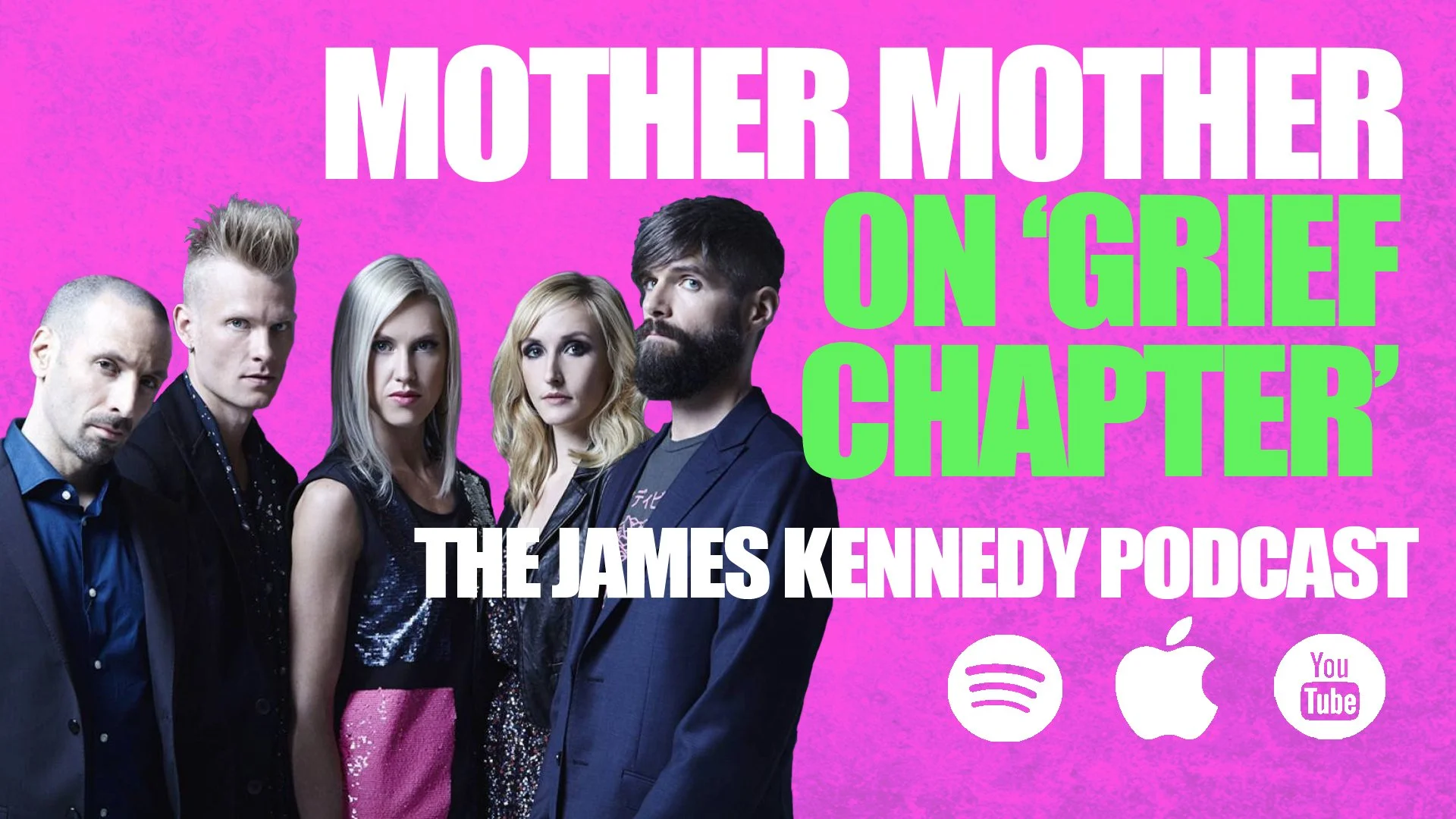
RYAN GULDEMOND - MOTHER MOTHER INTERVIEW
James Kennedy speaks with Mother Mother lead vocalist Ryan Guldemond about the band’s album Grief Chapter and their creative process. They explore the origins of the record's themes of mortality and gratitude, the band's viral surge on TikTok and the changing landscape of the modern music industry.
James Kennedy: How are the shows going, man? This is a big one.
Ryan Guldemond: It's the first tour of this album cycle, so it always takes a minute to get to your sea legs. But we're in the groove now, and wherever we've fallen short on any of these gigs, the audience has more than made up for it. They're just incredible. The crowds that are coming out, like so much life in these venues, so much passion and emotion.
James Kennedy: It's wonderful. Well, I can't imagine you guys falling short because you guys are seasoned professionals at this now and your live show is badass. But I mean, I knowLy what you're talking about, man. It takes a few shows to get the new tracks bedded in. And the new tracks you're talking about are songs off the brand new album Grief Chapter which is out now. I'm sure many of you fans are already loving it as much as I do. So I'd love to get a lowdown on the record, man. You know, what are the songs about? How did it come together? What were the inspirations? What were the obstacles? What was the recording process? Give us a lowdown on Grief Chapter.
Ryan Guldemond: A lot of the writing for the album happened over the last couple of years while we were touring, which is kind of nice. It was a very exciting time seeing so much of the world that we'd never seen, kind of acquainting with this new sport of touring. And so a lot of inspiration, a lot of high energy, and taking that into the writing process in green rooms and hotel rooms, trying to fit it in, right? Because there wasn't a lot of time at home, which I found I always like writing like that. It's just a little bit more charged with curiosity because you're out of your element. And so I just found that part of the process really gratifying, just the writing of the song. Sometimes you have to put your teeth in and you really have to pry these songs out of existence, and they can be very stubborn and resistant. But this time it was very fluid. And as a songwriter, just so grateful for that when the channel opens. Then it was time to bring it to the studio. We were very fortunate to camp out at the Warehouse Studios in Vancouver in Gastown, which is Bryan Adams' revered studio. It's a beautiful brick, industrial building with lots of natural light spilling through and just a great live room, all the vintage mics and preamps and there's a tape machine. We were there for a hundred days. So we really got to, we kept saying like, let's make our Pet Sounds, just symbolizing like, let's just not leave any stone unturned and be obsessive, be indulgent and make the record that we want to make. In terms of themes, death, I think, is at the center of this album, and mortality and grief, obviously. But they're used more as a reference point or signpost to live and to kind of wake up to the miracle of the day and carpe diem, that kind of thing. So it might be ostensibly morose, this album, thematically, but it's not in fact. I think underneath the surface, it's quite hopefully empowering.
James Kennedy: 100%. It is an incredible album. I mean, I got so many questions to ask. As a musician and album maker myself, I've done about seven albums now, produced myself and everything. So I've got questions coming at you from that angle as well that I'm super interested in because your stuff is dense, man. But before we get into the techie stuff, where did the name come from? What's behind the name?
Ryan Guldemond: Grief Chapter? Yeah. So there's a song called "Grief Chapter" and it closes the album. I wrote that song after texting with a friend who was going through the loss of his father and some other friends in his life. So all these people in his life were dying. I said to him in his text thread, "Sounds like you're in a grief chapter." He, being a songwriter, said, "Yeah, I am. But more importantly, that's a great title for an unborn song and should be written." So I put the phone down and started writing the song. It just kind of poured out of the guitar. A lot of the lyrics I just took from our text conversation. In verse two, I'm talking about feeding your mother and she looks like an angel, and those are his words. He said, everything looks different now, that once you cross that line after losing someone, the world changes color. So it was cool. I like it when songs are written like that, as a byproduct of life, as opposed to premeditation in songwriting. I much prefer that when the songs come out of the lived experience. So yeah, it's just a great, beautiful, intimate, personal song. Touches on life and death. Perfect way to close the album and just encapsulates the themes more broadly very well, I think.
James Kennedy: Yeah, it's a great track, that one in particular, actually, man. It's interesting with songs, as soon as you put them out there, regardless of what the intention was behind the writing of it or how it came together, as soon as you put it out there, it kind of takes on a life of its own in the hearts and ears of everyone else that listens to it. Like it can mean different things to different people at different times in their life, can't it? I definitely got the strong existential themes coming through a lot of the lyrics on this record. And that resonates strongly with me because I'm well into all that stuff myself. But in terms of the music as well, I mean, you guys are so eclectic. You're a fascinating band because you never know what's going to come next with you guys, even within the same song, you know what I mean? As I was listening to the record, I was just thinking, who do these guys listen to? Who are their influences? Because there's so much stuff in there. But it's all kind of put together in a way that is distinctly you guys. You sound like nobody else, you know what I mean? So this is probably too basic a question, but yeah, who were the influences on this record? And who are you guys listening to?
Ryan Guldemond: Well, I think the band, the sound, and my songwriting sensibilities could probably be boiled down to like three pillars: that being the Beatles, then the traditional musics of jazz and classical, and then the Pixies, right? I think those three energies kind of come together and define a lot of what we go for. We like the harmonic and the melodic complexities, and that's kind of born from the jazz modality. We like the bent, strange, eccentric, androgynous vocal stylings of the Pixies. And then the Beatles are just masters at unconventional song arrangements and just making the most out of a three-minute song, making it feel like such an epic journey when it's in fact just so brief. So yeah, those are, I think—
James Kennedy: Incredible. Yeah, well, I can definitely hear all of that in your music, and a gazillion other things as well. But you mentioned that the album was written on the road as well. You know, I'd be interested to know what influence that had, as an indirect influence, being at a different place all the time, different hotel room, different time zone, different headspace. What effect did that have, if any, on the making of this record?
Ryan Guldemond: Yeah, I think whatever you're going through at the time of writing songs influences how you write songs. It's just like the order of the universe, I think. I kind of have a thought about life having been so good for us over the past few years, espousing ruminations of impermanence and finality and the fragility of life. Like when shit gets good, I think it's easy to start thinking existentially because it reminds you that good things eventually end. And so I could look back and see how those themes organically came out of a high moment in life.
James Kennedy: Yeah, that's an interesting way of looking at it, man. And like, this is your ninth album now as well, and in quite a short period of time. You guys have been very creatively fertile to put out nine records of the nature of music that you do that is so creatively charged, so eclectic, and so dense. That's a lot of creative output in a short space of time. So how do you guys manage to stay so creatively charged and so creatively productive whilst touring and doing all the other things that one must do these days? Do you guys ever get writer's block? Is it a struggle or have you got a process? I mean, how do you guys manage to stay so creatively productive?
Ryan Guldemond: I've kind of disavowed writer's block. I don't really believe in it; I think it's more a fear of being bad, and so the pressure of that paralyzes someone. It's deeper than that: it's dismantling the fear of not meeting an external expectation and getting back to the root of why you're creative in the first place, which is a really pure, innocent, joyous occasion. It shouldn't be for anything but the sheer joy of that alchemy. And when you are connected to that in an authentic way, I think that's when the good songs just come out anyway. So it's sort of a bit of a Jedi mind trick: you have to not care about writing good songs in order to write good songs. So that's how I deal with writer's block. In terms of the prolificness, if you stop writing songs, they travel somewhere else and inhabit themselves in a different writer. So it's really wise just to always stay greased and acquainted with your muse, whatever that may be. And also, it's just funner. Life is better when I'm writing songs by a huge margin; it's almost like life is pale when I'm not and when I am, it's technicolor. So it's almost just like a self-preservation mechanism for good mental health.
James Kennedy: Oh yeah, well, I totally hear that one, man. I mean, I tried to get out of the game for a bit. In my last band, we were hitting it pretty hard: we did like five albums in five years plus a bunch of touring and stuff like that, and it was really hard, the toll it took on us at that level, with no backing, doing everything independently and the grind of it all, the constant disappointment, rejection, and battles at every step. It took its toll and I got to the point where I was just burned out, depressed, and totally disillusioned. I was like, right, that's it, I need to step back from this because this is just taking everything else from my life that's good and I need to reassess what I'm doing this for. I actually was intending on stepping right out of music and reassessing my life and possibly never coming back to it. It was at that exact point that this album just flooded out of me, the most personal and cathartic, therapeutic album I've ever done, almost like a journal, and it really helped me to get out of it. I think that's what helped me through that process, and it was very ironic that the thing that I was trying to avoid or get away from was the thing that actually saved me and helped me make sense of that whole existential crisis point of my life. So it's kind of like a blessing and a curse, isn't it? It's like the thing that brings us the most joy can also bring us the most pain, but it's ultimately the thing that saves us as well at our lowest points, you know?
Ryan Guldemond: Yeah, and that's when it's the best, when it's raw and real and private and something like a diary. Yeah, I totally agree.
James Kennedy: Well, what I love about you guys as well is the fact that these days, with the industry being what it is, all of us have to be very market-savvy now with the way that we present ourselves online because we're all our own branding agencies now as we exist pretty much through the medium of social media. I think the pressure now to know who you are, to know who you speak to, and to just stay within that lane and within that niche is very much more prevalent now than perhaps it used to be. But even back in the days when the industry was the only way to do it, artists would get told really early on in their career like, "You need to know who you are. Are you heavy metal? Are you hip-hop? What are you? Are you pop? Are you pop punk? You can't keep bouncing all over the map; you got to pick a lane and stick to it because it's confusing people. We need to know who we're marketing you to, we need to know who you're speaking for. Stop being so damn experimental, stop being so adventurous and changing genre from one album or one song to the next. If you want to succeed in the marketplace, you got to play the game." But you guys are a gorgeous, glorious rebuttal to that because you are the opposite of all of that. You guys will flip genres many times within the same song. Every album or every song with you guys is a beautiful box of surprises; you never know what you're gonna get. And yet you've got a wonderfully loyal and global fanbase, you've had great commercial success. So you kind of prove that that actually is bullshit, that whole idea that you can't be too eclectic. If you look at some of the biggest artists that have changed the game over the years—David Bowie, Prince, and many others—these are the guys that flipped whatever genres they wanted to, they did their own thing. So what are your thoughts on that? Do you think that attitude is bullshit, or are you guys just doing your thing and it just worked out?
ENJOYING THE CONVERSATION?
GET JAMES KENNEDY'S LATEST INTERVIEWS, WRITING AND LIVE SHOWS STRAIGHT TO YOUR INBOX.
Ryan Guldemond: I don't know if it's bullshit. I mean, if what feels good to you is sticking in one lane, then I think you should. I just think you shouldn't be formulaic because you think that's going to make you successful, and conversely, I don't think you should be unconventional because that makes you successful. I think you should just try to figure out what turns you on and what stirs your own soul and do your best to act as an ambassador of that, whether that's online, in an interview, or wherever you are representing this magic that you possess and are trying to share with the world. I really don't know how to do social media well. I think we, like so many artists, are confounded by how fast it's moving and how demanding it is. But again, you just have to let go, do your best, and try to present your art form as honestly and consistently as possible. Consistency is the trick in this game: keep writing, keep posting, keep getting out there, and just don't stop. Eventually you'll have really positive punctuations along that journey. For us, it took 15 years before we had our break, and there were so many opportunities to quit up until that point, so many iffy moments. But we just kept going and kept putting records out every two years like clockwork, kept posting whether or not it was clumsy or graceful. Because of that, we were able to meet our miracle in 2020 via TikTok. Looking ahead over the next 40 years, I'm just going to keep doing it if I get 40 years, and I just trust that things like that will happen. It could be 10 years apart, it could be two years apart. It doesn't really matter when; I just know that it will happen if you just keep going.
James Kennedy: Yeah, I love it, beautifully put, man. It's interesting that you say that you don't really know how to do social media because you guys are crushing it on social media and you've also been a recipient of that coveted holy grail that all artists and everybody online in the world wants to get, which is to go viral on TikTok. So I really want to get into that if you don't mind: I want to find out what it's like when that happens. Is it a game changer or is it an overhyped thing? Does it not make a lot of difference, or is it awesome for a day or two and then it's gone again and it's back to life as normal? What's it like when that happens to an artist, man? What goes down?
Ryan Guldemond: That was a total game changer, yeah, absolutely transformative, and we thank our lucky stars. It is so inexplicable, so organic. We weren't even on TikTok; we barely knew what it was. I remember being in the studio and getting word that something was happening on this strange app, and I was gonna just download the app, make an account, and snoop around. Everyone in the studio was like, "Don't do it, it's like Chinese spyware." I was like, "Really? Well, I think I have to because there's some activity." So I made an account, made a really deep TikTok, and went looking around. There's thousands of teenagers all around the world vibing out to Mother Mother music in their bedrooms, hanging with their friends, just in cosplay. This whole different young Gen Z community: gender-fluid, goth, cosplay, alt culture. It was just like looking into a parallel universe. At first, we didn't really know what that would equate to. Is this kind of like a flash or a phase? Does this actually mean real fans who want to buy real tickets and have a real experience with the band in the venue? So it was all just kind of unknown and very mysterious and a big experiment. So we started to engage and try to connect. That connection felt authentic, and it seemed as though something special was forming between these people and the band and the music that wasn't just a viral cat video that would be forgotten imminently. But the true test was getting out on the road. When we finally did, it was just like wherever we went, whether it was Helsinki, America, or South America, one to three thousand folks would show up in this young demographic, this very individual, unconventional, creative, beautiful culture. It just blew us away. It's been like that ever since. Tonight in Paris, we'll play—what is this venue called? The Olympia. That's about three thousand people, and it's just about sold out. I think we sold twenty-five hundred tickets. The last time we played Paris, it was probably two hundred fifty people pre-pandemic.
James Kennedy: Man, that is nuts. So this is no joke. This is the big deal that people make it out to be.
Ryan Guldemond: It's changed our lives and reinvigorated our career. It gave us a new lease on life musically, as a band, interpersonally, creatively, everything. Whatever the success or financial gain or just being out there in the world as a working band, that's not the thing that is exciting. It's just how beautiful the connection with this audience is and how the music feels like a real force for good. There's a real positive advocacy for mental health, accepting yourself, and individuality as an aura to these songs and this fanbase, which has just made us better people and made us more sensitive, smart, compassionate, and heart-space driven. Yeah, we're more heart-led as a byproduct of all this. So it's funny: the success has actually reduced our thirst for success and centered us more in human, heart-based triumph, which is just the connection and I guess love, for lack of a better word.
James Kennedy: Man, what a great story, and it couldn't have happened to a better band as well. That's kind of like the icing on the cake, isn't it? If it happens to some kind of major-label, bubblegum-manufactured pop band, then it doesn't have the same underdog sense to it, you know? But you guys do such great music and you do it for the right reasons, and the fact that it's happened to you guys is just a beautiful bit of universal justice. It actually happened to a friend of mine as well, a friend of mine who was on the metal scene. They've been going for about 25 years over here, a band called Skindred. Awesome band, man. Completely unbeknownst to themselves, they went viral on TikTok. They had a dance that someone had put together and it just took off on TikTok. They didn't even know, same as yourself. But fast-forward a few months later, they're number two in the album charts, and then they headlined Wembley Arena for the first time. So it really does make a difference, man. This TikTok stuff people talk about ain't no joke, you know.
Ryan Guldemond: Yeah, it's special, too, when it's so organic. This industry is just so full of strategizing success, and when it comes from a mystical, inexplicable force, I think it makes it much sweeter.
James Kennedy: Yeah, 100%. And the fact that it's actually turned into tangible, boots-on-the-ground people turning up to the shows and stuff, rather than it just being a strictly online thing, really does show the very real power of it. I think it's testament to just how much the music industry has changed, hasn't it? I mean, what a bizarre state of affairs that something like that can happen without any budget, no marketing team behind it. It wasn't planned, it wasn't strategized. It just happened, as you said, organically and completely unbeknownst to yourselves. What a bizarre world we're now living in, you know what I mean? I'd love to get your thoughts on the music industry, because it has changed so much in the time that we've both been doing our thing. Gone are the days now of having to come up through a label if you're an artist. You can now make your own record, put it out yourselves, and promote yourselves online. What are your thoughts on that? Do you think we've lost something through not having the industry that we used to have? Do you think it's harder for artists now, easier, or just a different set of problems? What are your thoughts?
Ryan Guldemond: It's probably just the way it's supposed to be. I kind of have that evolutionary way of thinking. But yeah, we've seen lots of shifts. It was CDs when we were coming up—CDs and Napster. So we really were there for the segue into streaming platforms, which I think toppled the industry in a certain way, but I think in kind of a good way because it humbled the whole beast and made it more of a trade. I don't think anybody should be making squillions of dollars for doing anything, really, to be honest. I think the financial ceiling should lower. The fact that bands needed to get out and play more live in order to earn their salt and earn their keep, I think, was a good thing. It keeps you honest and keeps you in check with what you're capable of. Now it's just crazy with social media, TikTok, and virality. I think it's too bad that A&R people are on their phones looking for kids in bedrooms who have a moment online and signing them, instead of going out to shows and having that transcendental experience in a venue. There's so many pros and so many cons. All I know is it's just going to keep changing for better and for worse, but that's just the nature of technology and art. Art is chaotic, it does evolve, and it's an uncomfortable process a lot of the time. I think that's sort of the beauty of it.
James Kennedy: Yeah, well, I've been a big ambassador for the new model for a long time now. It was kind of a central tenet to what I wrote about in my book, Noise Damage, about how the pitfalls that I talk about as an artist coming up in the old model no longer have to exist now for an artist thriving in the new model, where you can make your own records and put them out yourself without having to be beholden to anybody at all. Which is a wonderful, empowering, and very important thing that we shouldn't take for granted. But the problem that we've got now—and I've mentioned this on the podcast many times before because it is the big problem—is in this new digital utopia, how the hell do you get heard above the noise of everybody else on Earth who's also now got the same platform and the same tools?
Ryan Guldemond: I think it's probably always been hard to get heard. In the '70s, it was hard to get heard because there wasn't enough noise, because you had to have a deal to make a record. So just the people that had the luxury of making noise got heard and typically got signed. They might not have done well, but they typically got signed. Now there's too much noise, so I think it's just always been near impossible to make it. That doesn't mean you shouldn't try, but it's probably good to have a peripheral plan B. I never expected it to go this way. I wasn't pessimistic, but I wasn't so cocky as to not have a day job until I didn't have to have one. I was cooking eggs and cooking breakfast for people, and luckily I had an employer that would let me take time off and go on tour. I just kept doing that until the scales tipped and I didn't have to have that day job anymore. But yeah, I don't know: would you recommend someone getting into the music industry and trying to become a star right now?
James Kennedy: I would probably echo a lot of what you said. I would say definitely do it, because if it's in your blood and you have to do it, you're going to do it anyway. I didn't make a penny out of anything for like 10 years, but I still did it anyway, which is the right reason to do it. Everyone that gets into this because they think it's going to be a good career choice is doing it for the wrong reason, and they're probably going to be very naive and set themselves up for a lot of pain. But I think definitely be realistic and consider that this is a very volatile, difficult industry that's very unfair a lot of the time. I know so many great, talented songwriters who work their ass off who just can't catch a break, so I think having a fallback is probably a sensible thing to do. But those of us that have got to do it have got to do it regardless.
Ryan Guldemond: Yeah, and I think it's good to frame what it is: it's not a means to be successful, it is a means to have more joy in life. This relationship with creativity, with writing, with your muse, whatever it is, keep it in the space of a hobby, because we love our hobbies, we cherish them, they're sacred places. When the hobby mutates into a vocation, then the magic starts to dissipate. That is the tragedy: it doesn't matter if you're successful or not, when you lose that spark with your muse, then it's over anyway. So always keeping your relationship with your writing, with your art, fresh and magical is the key. Whether or not you're successful, it doesn't really matter, because at least you'll have that, and that will always be the key to your success.
James Kennedy: Amazing. Yeah, music is supposed to be the beauty and the joy in a very otherwise difficult and challenging life, isn't it? The second it becomes something else, it's a sad day. It's supposed to be there to save you. It certainly always saved me at my lowest points, like when I was in school and I was the outcast kid getting bullied. I had my guitar to come back to, I had my music to listen to, I had my band to jam with on the weekend, and that stayed with me ever since, man. At my lowest points, I've journaled an album out of it, sitting back listening to a record or losing yourself in the meditation of a guitar practice or expressing whatever you got to express in the form of a song and then setting it free into the world. I think that's a beautiful thing. The second that turns into something else, it's a sad thing.
Ryan Guldemond: Yeah, I think where the angst and the frustration come from is because everything you just described is so special. When you achieve that, the yearning to share it is so strong. For me, when I write a new song that I know came from the right place, is good, has healing powers, and is a force of good, and I myself am obsessed with, I just want to share it so bad. I want as many people to hear it as possible. When a song that you know is great and you really believe in just falls under the radar, it's heartbreaking. So I think that is much in part why people get so torn up about making it or not, because they believe in what they do and they just want other people to experience it, and the idea of them not feels like a great tragedy.
James Kennedy: Oh, 100%. I've seen that tragedy so many times and it really is a tragedy when that happens. You see so much talent and great art just fall under the radar, it really is a travesty, man. What are your thoughts, speaking about the music industry, on AI? Because that is going to be, whether we like it or not, the next big seismic change. Do you think that's going to be the death blow that everyone's making out it's going to be, or what do you think?
Ryan Guldemond: I don't have a lot of well-formulated thoughts. I don't think about it very much, if I'm being honest. But I think about asking AI to edit all my drums, or lining up all the consonants between a stack of gang vocals, that kind of thing. But I don't get at all excited about AI writing my song. To me, I'm always gonna need that practice. Whether or not AI at large could write better songs than me, I kind of don't care; I'll always have this sacred practice which turns my world technicolor. So I would never hand that over to a robot, but I would certainly use the robot to do some of that more laborious work.
James Kennedy: 100%, that would be great, dude. To have a robot, if I could have Terminator do my drums for me, that would be so good. Make sure all the bass is in time while I go and get a coffee, that'd be amazing. My worry, I guess, is that the industry is gonna much prefer to have a robot churning out a thousand songs that never gets tired or never gives you an attitude problem, rather than paying an actual songwriter to do it that's got needs and needs to be paid. But I think we're probably far off from that. Sync music and library music might be the first one to go because it's quite generic and you can't tell anyway. Actual songwriting, I think, is probably a fantasy at this point; I don't think we've got anything to worry about. But as you said earlier on in the conversation, change is the only constant, so who knows what's right around the corner, man. Hey, as long as we keep doing our thing, it shouldn't matter too much anyway.
Ryan Guldemond: Yeah, I think most people listen to fairly artificial music as it is anyway. It's pop music for a reason. So even if most humans, just like most humans eat fast food, do the thing that everybody does, and even if AI ends up writing Top 40 that most people play on playlists distractedly, that's okay, because there's always going to be a niche of people that love music more deeply than that and want to connect to the human spirit. So maybe that audience and those artists will be empowered even more so because they're up against this great widespread opposition. It could make for a really potent, small experience, which could be really cool.
James Kennedy: I think you've tapped on something there. I'm a firm believer that the greatest musical movements have always come out of struggle and resistance, like the blues, hip-hop, or punk rock. Maybe it might not be the threat that we think it is, but the spark that causes the next new beautiful musical movement. So maybe that's what will happen. Well, I'm so glad that we've managed to get through all these subjects, man, whilst I've got you here, because I don't just want this to be another promo thing for plugging the album. I'm sure you guys have got tons of that and you don't need to do that at this point. But I'm aware that I can't keep you for too much longer, so we have got to bring it back to what you guys are doing before we wrap up. You're sort of just at the start now of this massive leg: you're getting everywhere all around Europe and then you're doing the US and Canada. What can people expect from the new live show? What have you guys got up your sleeve?
Ryan Guldemond: We put a lot of pride into constructing a setlist that is pretty epic and weaves together like one long song that honors every epoch of the band. So we pulled from all the different albums, and there's really beautiful talk moments and connecting to the crowd. The light show is really incredible; we tried to level up there. Honestly, for people that come to the show, I think one of the things that they'll like the most is the spirit of the audience, the spirit of their own community. That's really important. It feels like the audience steals the show in the best way, in a way that we are okay with, just because it's really more about human connection than a positive frequency at a gig. So if someone's coming, they should be most excited about that, I think.
James Kennedy: That's beautiful. And how has it been, your experience as a band? Like I said, last time you came to Paris, it was 150 people, and now it's like two and a half thousand. I'm guessing it's been like that in the previous few shows and it's probably going to be like that on all of them. What's that like for you guys as an experience, coming over and playing some of the older songs to this completely new audience of people that are loving it? What does that feel like for you?
Ryan Guldemond: It's a dream come true, absolutely. It's a really reasonable jump. We feel like we're ready to play for that many people. We've been rehearsing for this for the past 20 years in a sense, and back in Canada we were playing rooms that big for well over a decade. So we're a seasoned live band and we know what we're doing in rooms this size. But we never thought that we would be on these stages in Paris or Oslo or wherever. We thought we'd kind of just be a Canadian band that did well. So to be given the world like that is just such a gift that it's hard to articulate gratitude in the right way.
James Kennedy: Well, I think the gratitude takes the form of the beautiful music that you guys pump into people's hearts night after night from the stage all over the place. So I think you got that one covered. What is next for Mother Mother? What's happening? I know you guys got this massive, sprawling tour for the rest of the year, but what's happening beyond that? Are there any plans, or are you just riding the wave and seeing what happens?
Ryan Guldemond: Definitely a robust touring year, and more music is coming for sure. There's a lot of new songs on the table right now, so I feel like we're just not going to slow down. In speaking of what we can do to give back for this gift, I feel like it's just making more music, not taking a break, and putting all the love and all the richness of this experience into these new unborn songs. I can't wait to hear them, I can't wait to share them, whatever they are, because I know they're going to come from a great place. That feels like the most potent way to give back: just more music for the fans.
James Kennedy: Oh, well, I'm personally glad to hear, and I know that everyone listening to this is going to be super glad to hear that as well, man. So, Grief Chapter, if you haven't heard it, it is out now and it is absolutely exceptional. Do not even doubt me on it: just go out and play it, download it, buy it, and whatever you got to do to get it in your ears, embrace it in your heart and your dancing feet, and you can thank me later. It is available in all usual places right now, and the band can be found on Instagram @mothermothermusic. Give them a follow, follow them on TikTok, get involved, buy a ticket. They're probably coming to your town because they're playing absolutely bloody everywhere. Go along; you will not see a better live show this year, I promise you. Ryan, thank you so, so much for your time, man. This has been a fascinating chat, it's great to meet you in person, and I really appreciate you taking an hour out to speak with me today. Best wishes with everything ahead, man, long may you reign and prosper.
Ryan Guldemond: Thank you so much, I totally loved this. Thanks for having me and all the best to you too.
Key Points:
Ryan Guldemond, singer-songwriter-guitarist of Mother Mother, joins the podcast from Paris during the band's international tour.
The band's new album Grief Chapter centers on death, mortality, and grief as reference points for living fully and seizing the day.
The album title came from a text conversation with a grieving friend and closes the record with an intimate, personal song.
Mother Mother's sound draws on three pillars
Guldemond rejects writer's block as fear of being bad, arguing that songs flow when artists reconnect with the pure joy of creation.
The band's career was transformed by an organic TikTok viral moment in 2020, turning small club shows into sold-out venues of thousands worldwide.
Guldemond advises aspiring artists to treat music as a sacred hobby first, keep a practical fallback plan, and remain consistent over years without quitting.
Summary:
In this episode of the James Kennedy Podcast, the host welcomes Ryan Guldemond, singer, songwriter, and guitarist of Mother Mother, calling in from Paris during the band's international tour across Europe, the US, and Canada.
The conversation explores the band's new album Grief Chapter, written largely on the road in green rooms and hotel rooms over the past two years. Guldemond explains that death, mortality, and grief serve as reference points for a record that is ultimately hopeful and empowering rather than morose. The title track came from a text exchange with a friend losing people in his life, and Guldemond says he prefers songs born from lived experience over forced meditation. He names the Beatles, jazz and classical traditions, and the Pixies as the band's three core pillars, and credits their eclectic, genre-blurring style for keeping the music exciting.
Guldemond also discusses creativity, rejecting writer's block as a fear of being bad, and describes how Mother Mother's organic TikTok virality in 2020 transformed their career, growing audiences from a few hundred to thousands per night. He reflects on the changing music industry, praising streaming's humbling effect and warning against formulaic approaches, while remaining optimistic about AI as a tool rather than a threat to human songwriting. He advises aspiring artists to keep music as a sacred hobby with a practical fallback, stay consistent, and never quit. The episode closes with promotion of Grief Chapter and the band's ongoing global tour.
The James Kennedy Podcast is a Society and Culture podcast hosted by musician and author, James Kennedy. Exploring the big questions around health, social issues, the arts, politics, mental health, the human condition and how to navigate this thing called life through casual conversations with scientists, activists, rock stars, philosophers and academics. Please subscribe, leave a rating and support the show.