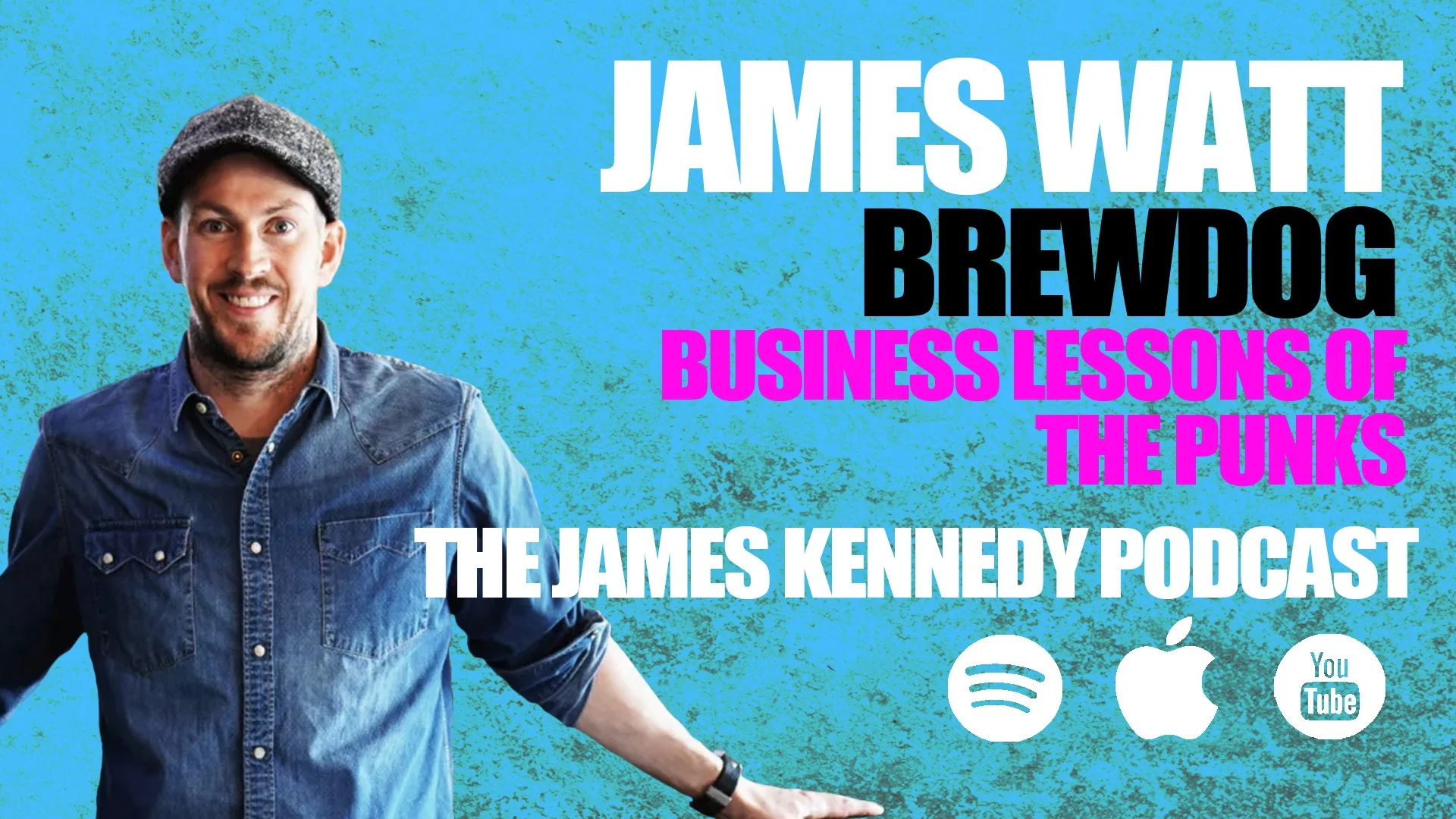
James Kennedy interviews BrewDog co-founder James Watt about building a disruptive punk-rock brand, navigating market shifts and climate sustainability, and balancing an intense workload with downtime and cold water therapy.
James Kennedy: Mr. James Watt, I know you've got way more important shit to be doing right now than talking to me. So I really appreciate you taking the time out to stop in, man.
James Watt: No, good to catch up and excited to do it.
James Kennedy: Me too, man. How you been doing?
James Watt: Yeah, I'm doing awesome. I'm excited to be the second James in a two-James podcast.
James Kennedy: Yes, and two Celts as well. A Welshman and a Scotsman. So what could go wrong? I was going to crack open a Blackheart, which is absolutely fucking delicious, by the way. But 11 am is too early, even for myself. So I'm going with black coffee instead. I hope that's ok.
James Watt: I've got coffee as well, but I'm sure it's 5 pm somewhere. So I don't think it's ever too early for a Blackheart.
James Kennedy: Oh, yeah, you've twisted my elbow already. What's going on at Brewdog HQ right now, man? You're a busy dude. What's happening?
James Watt: Yeah, super busy. So we've just installed a new canning line. So I've just been watching the speed it fills cans. So it fills 60,000 cans an hour, 1,000 cans a minute. And going back to the early days of the company, to fill 1,000 cans used to take us kind of 24 hours. So we can now fill the amount of cans in one minute that took us 24 hours to do back in the early days.
James Kennedy: That is awesome, man. I can imagine that that would have been a very, very cool nerd fest to be a part of. And hey, more beer for us as well. So everyone's a winner, right? It's insane how far you guys have come in such a relatively short space of time. And long before I was a fan of the beer, which I'm 100% a massive fan of, I was a massive fan of the branding and the marketing. Because your marketing is genius. And I know that you get asked about this all the time. So we don't want to dwell on it too much. But we've got to talk about it, man. Because obviously, I'm a musician. I'm from a punk rock, aesthetical, ethical background myself. So your messaging and your imagery and your marketing has always really resonated with me. Because the Brewdog brand is undeniably steeped in punk rock, isn't it? So where does that come from? Is that your background? Or is it just an extension of who you are as a person?
James Watt: I think it's a bit of an extension. But the thing that we were massively inspired by from the whole punk movement was that to smash the system, you need to be able to exist outside of the system. So you need to learn the skills that you need to succeed yourself. So it was that kind of DIY, hands-on kind of ethic that we just fell in love with. And that's what we've built our business on. So we always like to learn what we need to do ourselves, not dependent on the system, not dependent on anything that's outside of us, and being happy to live or die on the merits of what we do ourselves. And that was the attitude that we've tried to build this thing with. And I think it's been good so far. And it's kind of made for a super fun journey as well.
James Kennedy: Oh, 100% man, it's been a fun journey for the rest of us to watch as well. I mean, your marketing, like I said, is just genius. It's bang on. And that whole giving the finger to the establishment figures and just doing things your own way and not giving a fuck. You know, I love all that, man. And it clearly is an authentic extension of who you are as a person, because it would just be impossible to maintain this convincingly for this long. But in order to take what's clearly quite a natural voice for you into the model of packaging a product and a business and strategies and all that sort of shit, did you study and learn any of the things that you've learned in the past? Or do you just have a natural talent for this shit?
James Watt: Yeah, I think we've come up with a much better way of building our business in terms of community ownership, in terms of beers that we make, and in terms of what we do. So that naivety, that lack of knowledge, that lack of experience, I think is actually one of our strongest assets. And I now do a bit of investing in smaller businesses. And I'm always excited to back someone that's not got much experience, not much knowledge, because I think that's how you figure out a way how to circumnavigate a whole market and come up with a new way of doing things.
James Kennedy: That is a great point, man. And already you're dropping some pearls of wisdom here, man, that I think people can learn from regardless of the industry that they're in. And speaking of that, I wanted to flip things on their head. Whilst we're on the subject of punk rock and business, I wanted to ask you how you might approach the sort of change that we had in the music industry if it was in the beer industry. What would happen if all of a sudden, overnight, the product that you sell, the physical, tangible product that you sell, became a free commodity that literally streamed out of the internet for free? Which, as I'm sure you know, is exactly what's happened in the music industry. And some artists and some labels have been able to navigate that and others have just sunk. So I'd be really interested to hear what somebody from a completely different industry outside of the music industry would potentially manage that problem, should you wake up tomorrow and the product that you sell is the center of your business. Suddenly became free?
James Watt: That's a fantastic question. And there's a quote that I often share with the team, and the quote comes from Darwinism and evolution: it's not the biggest or the strongest or the fastest that will prosper, it's the most adaptable. So that adaptability is hardwired into our DNA as a company. And I'll give you a great example. When Covid hit, I spent one day in the depths of despair thinking the company wasn't going to make it. The next day I kicked into action mode. We completely pivoted our distillation business, and within four weeks we were making hand sanitizer for the NHS when there was a shortage of sanitizer. All of the bars were closed, but we used our bars as kind of fulfillment centers for e-com and delivery business, and we 10x'd our e-com business within the space of two months. So if landscapes and markets today change so quickly, everything is changing. You can't cling to the past, and you've got to change and you've got to adapt. And I think the companies that do well long-term are the companies that adapt to inevitable changes. Every market is going to get disrupted, every industry is going to change, and the companies that die and go the way of the dinosaurs are the ones that are reluctant to that change and they don't embrace it and they're trying to fight. You've got to interface change and you've just got to be quick, adaptable, and nimble in the face of that change.
James Kennedy: Brilliant answer. Yeah, that's such a great point. And it was echoed by—I had a guy called Brian Slagel from a record company called Metal Blade Records, and they were the label that first discovered Metallica and Slayer, one of the world's largest independent record labels and still going strong forty years later. And that's exactly what he said. I said, "What do you see in common with all of the main bands and labels that have stayed afloat this time?" And he said, "Adaptability." He said, "Shit's always going to hit the fan. And it's those ones that can adapt and change that are going to be the ones that stick around." So yeah, I love that, man. Beautiful quote as well, because the Darwin quote often gets misrepresented. People say the strongest, survival of the strongest and the fittest. That's not actually what he said. It's exactly what you said. So thank you for clarifying that. So as a thought experiment then, if you weren't—say you got jacked off with BrewDog and you wanted to actually go into the punk rock business and you were managing a punk rock band from scratch, what would you do in the—I don't know if you know anything at all about the music business, but I mean, it's damn hard out there at the moment. We could use some great minds like yours. When in a world where the product is free and every douche in the world has got access to the platforms, so the platform is saturated with every man and his dog and a demo tape, how do us dumb-ass musicians navigate that world? What would the evil genius of James Watt do if he was managing a punk rock band starting today?
James Watt: So I'm going to caveat this heavily by saying I know very, very little about the music industry. But if I was managing a punk rock band, if I was managing a coffee shop, if I was managing a car wash business, if I was managing a fintech business, whatever, I would always go at it with the same kind of underlying principles. So three principles, very simply:
Firstly, you've got to try and be a force for good in terms of what you're doing. Everything is so saturated with people doing similar things. People want something to believe in. The market for something to believe in is infinite. So you've got to try and do some good in terms of what you're doing.
Secondly, and this one for me is massively important, you've got to find a way to disrupt. You've got to find a way to do something different. If I was managing a punk rock band and I was just doing exactly the same as every other punk rock band manager out there, I would be a stone-cold failure and it would go nowhere. And the success would be limited; I could only ever be a percentage as good as the other people in this race, which wouldn't interest me at all. So find a way to do things differently. And that often involves taking a risk, but unless you take a risk and are willing to take a substantial risk, you're never going to open yourself up to the possibility of real success. And the biggest risk is not taking a risk at all. So be a force for good, do things differently, take a risk.
And thirdly, I think the best businesses today and in the future are going to be so deeply rooted and embedded in community. That connection of community—we don't feel like our band is ours, we feel it's our fans. BrewDog belongs to our fans, a community of 220,000 equity punks. They help us design new beers, they help us find new locations, they're the heart and soul of our business. So I would focus on being a force for good, I would try to do something disruptive, and I would put community and community ownership at the heart and soul of whatever I did. And that would be the same as if I was managing a punk rock band or any other new business that I might try and give a go.
James Kennedy: That's awesome. That was actually the next question I was going to ask you. So we ticked two off in one go there, you're fucking flying through it. And what do people do? Because this is the question I've asked a lot of music industry people. So it'd be interesting to get somebody who's had success in business in a totally different industry and also quite a saturated market with some heavy players that dominate most of the market. What do people do to get heard above the noise of everybody else doing it? Because there's a lot of talent out there. There's a lot of hardworking motherfuckers out there, but again, they might not be talented in business or marketing. You guys have been very, very good at blasting yourself into the public consciousness and staying there as well. What can people do sticking in the music business? I know you said it's not something you know a lot about, but in a predominantly digital world that is very, very saturated, what can people do to get heard above the noise of everybody else?
James Watt: Good question. So first and foremost, let's just assume that the base product—be it albums, be it coffee, be it beer, be it software—let's assume the base product is of outstanding, best-in-class, elevate-the-category quality. For us, we set out in an industry dominated by global behemoths thousands and thousands of times our size. We were two humans and a dog with a big mission to make other people as passionate about fantastic beer as we are. And all odds are on us getting completely lost in the industry, but we haven't done that. And we've now built the 14th most valuable beer brand on the planet. And our strategy was very, very intentional. It's okay, so the companies we're competing against spend tens of millions, hundreds of millions every year in advertising trying to convince people that cheap mass-market, lowest-common-denominator beer is a quality product. If we try and spend a tiny amount in advertising, we're going to get absolutely lost. We've got to find a way to cut through that noise. We've got to find a way to get our message out there. And we've got to find a way to do that while showcasing what we are passionate about.
And for us, that time and time again came back to: let's take massive risks. Let's put everything on the line for what we believe in. Let's try and move the narrative forward. Let's try and make sure it's underpinned with the passion that we have. And sometimes it can come across quite stunty, but the intention wasn't for it to be stunty. The intention was, let's do something that gets people thinking and speaking about beer in a different way. We made the strongest beer on the planet because we want to challenge people's perceptions of what beer is, how it can be enjoyed, how it can be savored, how it can be made. And that leads to a very different discussion when we're talking about beer. We drove a tank through the streets of London to announce the opening of our Camden location because with no advertising budget, a little beer company opening a bar in London is going to get no media coverage at all. Us driving a tank through London celebrating the opening of our bar there made headline news. We hired a helicopter and flew the helicopter—and we did this twice, over London and New York, over the Bank of England and Wall Street in America—and we had little stuffed cats and we threw them out of the helicopter with little parachutes. This was "Death to the Fat Cats" because we were rejecting corporate finance and building a completely, completely new finance model for small businesses. So not taking ourselves too seriously, wearing our heart on our sleeve, and being willing to take a stand. We took a huge stand against the World Cup in Qatar because we felt that was the right thing to do. Not many companies have the guts to do that. And if you look at most companies, they're so bland, they're so corporate. You don't know who they are, you don't know what they stand for, you don't know what they're about as a business. We wanted to make sure that people knew who we were, what we stand for, how we do things. So take risks, take gambles, do things that can cut through the noise, which is difficult on a low budget, focus on community, and be very clear about who we are and what we stand for. And by doing that, we've been able to grow in an industry dominated by mega-bucks advertising and cut through. And we're now one of the best-known beer brands in the UK, despite the fact that our competitors over the last 20 years have spent cumulatively probably in excess of 2 billion on advertising, and we've spent next to nothing.
James Kennedy: That's so cool, man. Yeah, and it's certainly worked, dude, as well. I mean, everybody loves the brand. Even my mother, when I said that you were coming on, she said, "Oh, I love BrewDog." And then my 96-year-old grandmother, who was also there, said, "Oh, I love BrewDog as well." So you're clearly reaching the whole demographic there.
James Watt: 96, that's a good age.
James Kennedy: Oh, dude, you've got to invent a new drink called a "Little Treble." My nan swears that the key to her longevity is whiskey. And she calls it a "Little Treble," which is basically half a glass of fucking whiskey. It's like half a pint, but by calling it "little" it implies that it's innocent, you know? Little Treble.
James Watt: I think somebody should tell the Scottish whiskey industry about her. I think they've found her next marketing campaign or something. It's like, if you want to get to 96, this is the way to do it.
James Kennedy: Oh, she would love that, dude. She would be more than happy to cash in on that one. But yeah, you're totally right though, man. The tank thing was absolutely fucking genius. I love that idea. And I think another thing is that you've got to be prepared to make some enemies, because I know you guys can be quite divisive at times and you've gotten quite a lot of flak over the years. But if we're going to use cool quotes to follow on from the Darwin quote, I mean, I love the quote: a man with no enemies is no man at all. If you're trying to do some shit, you're trying to break into a very monopolized market and you're trying to take on some longstanding behemoths, you're going to make some enemies and you're going to piss some people off. And I know that you guys have probably made some mistakes and errors of judgment or whatever over the years, but coming from where you started from with the resources you didn't have, in a system that has been very well established for such a long time with main players that were very powerful and very deep-rooted, I suppose it's impossible for that not to happen. Do you think that's fair?
James Watt: Yeah, absolutely. And we've always been quite divisive as a brand. We've got some people who absolutely love us and some people who don't. And for us, that's fine, because any brand that sets out trying to keep everyone happy is going to be so vanilla, so beige, so indifferent that you're never going to get people passionate about it. And unless you have some haters, you're never going to build the army of love, which is the flip side of the coin. And some people don't like people being successful doing what they love because it makes them feel inadequate and insecure, the fact that they're maybe not that successful and not doing something they love. So the natural response is to kind of hate on that. So we've always taken flak, some of it justified. We have made mistakes along the journey. We're two guys that set up a company when we were 24. We've been so high growth, and in companies that are that high growth, it's difficult to keep all the plates spinning the way you want, and sometimes you can't do everything super well. So we've made mistakes along the way, we've held our hands up when we have made mistakes, but I think the amount of flak we sometimes take is definitely disproportionate to the amount of mistakes that we've made as a company. It's what it is. We know who we are, we know what we do, we know who our fans are, and we just keep building our business in the UK and internationally and keep going. And it's something that just sometimes happens, especially in the UK with success.
James Kennedy: Yeah, well, you've got some powerful enemies as well. People don't like it when a new dog turns up on the block, you know what I mean? I think that's probably where a lot of the disproportion of that comes from. You've got some pretty pissed-off powerful enemies that had a pretty comfy position at the top of the table and you guys have come and kicked the legs of the table away, you know? Speaking of those guys and the behemoths—not necessarily in your industry, but I know your life has probably changed significantly now from when you started the business and I'm sure that you mingle in some corporate circles, probably against your will oftentimes. I know that sustainability is a big part of what you guys do and it harks back to one of the key principles you mentioned about doing good as a company or a band or whatever it may be. So many companies don't—I would hazard a guess that most don't now. You've rubbed shoulders with some of these guys, I'm sure. What's your feeling on why they don't? I mean, they've got grandkids too, right? It can't just be greed. What's the reason?
ENJOYING THE CONVERSATION?
GET JAMES KENNEDY'S LATEST INTERVIEWS, WRITING AND LIVE SHOWS STRAIGHT TO YOUR INBOX
James Watt: Sadly—and I'm going to speak about our sustainability journey then I'll speak about why they don't care—we thought we were doing our bit for the planet, we thought we were doing our bit to help against climate change. And that assumption just came crashing down after I had dinner with Sir David just before Covid hit. And after that dinner, I was hit with a blindingly stark realization that we weren't doing nearly enough and we were part of the problem that our planet is currently facing. We are sleepwalking as humans off the edge of a cliff. We're facing an existential climate crisis and we're not doing enough to help against climate change, and we need to wake up. Huge, huge, huge changes are needed across the board—not in 2050, and not in 2040, not in 2030, huge changes are needed today. Sometimes scientists think it might already be too late. I don't subscribe to that view, I don't think it's too late, but we need to make cataclysmic change across the spectrum of what we do as humans on this planet to be able to survive here.
So on the back of that meeting, and despite our business going through the teeth of Covid, we decided to completely pivot everything we do. So we work with Professor Mike Berners-Lee; he's our lead independent scientific advisor and one of the world-leading experts on climate change, carbon footprinting, and sustainability. And we became the world's first fully certified carbon-negative beer business. That means we take twice the carbon out of the air every single year that we emit. So anytime someone has one of our beers, our planet has less carbon. But sitting underneath that, our first focus is on reducing our emissions. So it's good that we're removing carbon, but we also need to reduce our emissions. We've made huge investments across the business. So we've now got an on-site bio-energy facility that turns our wastewater into biomethane green gas, which then comes back and powers our system. We're working hard on the electrification of our vehicle fleet. We've got an advanced heat recovery system in our brewhouse that takes the heat that escapes and uses that to heat the next batches of beer. We're now fully wind-powered in the UK. So huge investments to reduce our footprint. And also when we count carbon, we count all of the carbon, including the carbon in our supply chain.
Right at the moment, we work with high-class, high-quality removals and offsets. There's so much noise, so much nonsense, so much disingenuity in the offset market. So Mike Berners-Lee and his team vet that. We usually do most of our work for the Nature Conservancy of Canada, which is very sensitive to all those key factors with the removals that we're doing. We also bought 10,000 acres in the heart of the Scottish Highlands—so 10,000 acres, it's huge, it's bigger than 17 actual countries. In the Lost Forest, we've started planting well over a million trees to take carbon out of the air. So our carbon is our problem, and we are determined to fix it ourselves, and we'll have 300,000 trees planted by summer. And we're not just planting trees, we're creating a native biodiverse broadleaf woodland habitat and rewilding a key part of Scotland.
So that's where we are on our sustainability journey. And I fully believe that to drive the change that we need as a society, as humans on this planet, the change has got to come from the best progressive businesses working hand-in-hand with leading scientists. I don't think politicians are able to help us here because the time scales they work on—four- or five-year reelection cycles—are incompatible with the pain that we're going to have to take as a society to make the changes we need. So it's got to be business that drives the change here, and business has got a huge responsibility to do it.
As to why other companies are not doing enough, the answer is sad, and the answer is simple. And the sad, simple answer is: at the moment, consumers simply don't care enough about climate change. A small pocket of consumers do—maybe 10 or 20 percent of consumers make their purchasing decisions based on sustainability. The vast majority of consumers at this moment in time don't care enough. Which is going to change at some point in the next five to 10 years, and the sooner that changes, the better. Members of the public need to realize they can have way more of an impact when it comes to fighting climate change with how they spend their money every single day than how they vote every four or five years. So consumers need to—and it's a sad thing to say, but ultimately consumers need to care more. And as soon as consumers care more and demand that of companies, the companies will change. But until there's that huge demand from consumers, there's not enough incentive for the big companies, who are mostly public and want to make money for their shareholders, to make less money if they have to invest in sustainability. So at the moment they're focused on making money for their shareholders, and the vast majority of consumers don't care enough yet about sustainability to force big companies to change.
James Kennedy: All right, that's a very interesting answer, very well put as well. I didn't see that one coming—I thought you were just going to say they're a bunch of greedy bastards that don't care because they've got their underground dungeons with their maids and their robots and they don't care.
James Watt: No, so they care about one thing: they care about their sales. The consumer has so much power, but also so much responsibility here. Because as soon as the consumer demands that, and as soon as consumers start buying the most sustainable products, everything will have to aspire to that bar. So it's a bizarre thing to say, but how consumers spend their money is one of the key factors if we're able to successfully fight climate change on this planet.
James Kennedy: 100%, that's a great answer. And do you think then—I mean, you guys answered this question for me—do you think it is possible for all businesses to survive and have longevity and make profit and do all the things that a business needs to do while still being ethical, sustainable, and not having an army of eight-year-olds in a sweatshop somewhere? Is it possible? Because a lot of them say that we wouldn't make any money if we did that.
James Watt: It's absolutely possible. But coming back to that adaptability point, it's going to require adaptability. If they keep doing the same thing, not possible. If they're willing to change, if they're willing to evolve, then absolutely possible. But it's that flexibility, it's that nimbleness, it's that willingness to be able to change things that may have been done that way for 10, 20, 30, 40, 50 years. However we have to make change as a society, as individuals, as companies to fight this crisis that we're facing.
James Kennedy: Beautiful, love it. I'm keeping an eager eye on the clock here and I'm trying to rattle through as many questions as I can whilst I've got you here in front of me. So I hope you don't mind the speed that I'm throwing these at you.
James Watt: I like the speed. We've actually got an internal saying in our company that we like to count time in dog years. So I think any company likes speed, especially any small company. Speed is your superpower. So many big companies, so many industries are so slow, so bureaucratic. If a normal company usually does something in seven days, we want to do it in a day. If a normal company does something in seven weeks, we want to do it in a week. If a normal company does something in seven months, we want to do it in a month. So we love to count time in dog years, and that speed has enabled us to go from two humans and a dog to the 14th most valuable beer brand on the planet in just under 15 years.
James Kennedy: Amen! But you're clearly very comfortable with the speed, so you're keeping me on my toes—on my paws, excuse the pun, that was bad, that was bad. Well, I want to move away from this sort of marketing and the corporate and the punk rock and down to the personal level. Because your life, I'm guessing, has changed immeasurably. For people on the outside who are starting up a business or a band, whatever it might be, you've done it, you know? You've started out, you put the whole new disruptive model in place, you've taken on the mainstream, and now you've got all the success to show for it and you're still true to your values, you've got a great product that's very well respected and loved on the streets. Has it changed you as a person at all? How has it changed your life? Is it like we all imagine, that once you get to the top of that mountain it's all fucking awesome and life is great and you're bathing in your millions? Or are you the same guy, but now you've just got less time and more shit to do and more pressure and more stress? Is it what we imagine, or is it something else?
James Watt: It's a good question. For me, it's never been about the money at all. If it was about the money, I would have sold the business completely three or four years ago and be sitting on a beach somewhere drinking a cocktail and never have to do anything ever again. That's not who I am, that's not what I want. For me, it's always been about building something enduring, something that we're proud of. Myself and my team are giving our energy, time, commitment, passion—we want to build something where we can look back in 5, 10 years' time and know we tried to be part of a company that did something differently, that fought climate change, that changed the beer industry.
It's nice to be successful, and I still live in the same place that I lived in before I was successful. I still do the same things. My best friends to this day are the people that I used to work with on the fishing boat. So I think my life and who I am has changed very, very little. I'm still so focused on every single day waking up just like I did in the first week. It's like, this is what I love, this is my hobby, I get to do this as a job, I get to work with people I love, I get to make something that brings people joy, that brings people together, that they can find enjoyment and relaxation in, and I get to elevate the status of beer, which is something I'm insanely passionate about. So I wouldn't want to stop for a second. Hopefully I'm doing this in 5, 10, 15, 20 years' time because it's something I absolutely adore. The success has been good, but I'm still very much the same person in the same place trying to do the same thing, just I guess with a bit more personal comfort, which is nice.
And I often get asked by journalists and people interviewing me what I think of what we've done, what we've achieved, what we've built in the first 15 years, and I wouldn't say I'm callously indifferent to it, but I'm reasonably indifferent to it. For me, what is exciting is: what can we do from here? We've built ourselves an amazing platform. We now make beer in high-tech, beautiful facilities in Scotland, in Columbus, Ohio, in Berlin, in Australia, in China, in Japan, in Ireland. We've now got distribution in 65 countries. We've got an equity punk community of 220,000. So what can we do from here? How can we turn our business into the world's leading beer company at the same time showing business can be a force for good, flying the flag for sustainability, and elevating the status of beer in as many people's lives as possible? And that's what I'm excited about, that's what gets me out of bed every morning, and that's what I'm determined to put everything on the line to try and achieve over the next decade.
James Kennedy: Love it, long may you continue, man. How do you—I've got one more personal question—how do you manage the practicalities of your insane workload then? I mean, do you get downtime? Do you get rest time? Do you get to exercise? Because I'm not flying anywhere near the level you are, man. I spend most of my time in the house in my pajamas like I am now, you know, doing a podcast, supposed to be writing my second book which I've been working on for fucking months, and recording a new record. I get to do all my favorite things in the house, but even I struggle to find time to meditate, to exercise, to eat well, to visit my mum, to have some downtime and see the missus. I can't imagine how hard that must be for you. Do you manage to do any of those things, or is your life just fucking high speed?
James Watt: No, I have to. And I think it's so, so important. What I find is if I don't make time to do those things, I don't take the best version of me to work. So if I don't take time to exercise, if I don't take time to spend quality time with my daughters, if I don't ensure that I sleep well—I'm also huge into cold water immersion at the moment, so if I don't make time to go in my ice bath, if I don't do those things, if I don't get enough outside time—I'm maybe like 70% of the ability and work ethic and focus that I need to take to work.
So it's almost like, if I'm building up the blocks of my time, obviously I work a hell of a lot and I want every hour that I work to be as efficient as I can and as effective as it possibly can be, but I know that over the course of a week if I don't make time to do those other things, those hours that I work are not going to be as effective. So I don't feel guilty about doing those things because I know that the work that I do is going to be better because I do those things that I enjoy, because I do those things that keep me healthy, keep me focused, keep me connected.
Regardless of how successful people are, regardless of how much money they have, everyone gets 24 hours in the day. And for me, what determines to a large extent how successful someone is, is how effectively they use their time over the course of a day. So I do loads of things: I batch my meetings, I only reply to emails at certain times. Too many people have no structure to how they use their time, so they'll send an email, they'll do a point of the hop—every time you switch tasks it costs you focus, it costs you energy, it increases the likelihood to get distracted, and you throw a bit of social media scrolling in at the same time.
So I monitor how many minutes I use my phone a day, I monitor how many minutes I'm on social media a day. I track that, I record that, I try and keep that low so I can focus on other things. I spend a lot of time doing what I would call deep focused work. So my favorite way to work is with a "Do Not Disturb" sign on my door, with noise-canceling headphones on, I give my phone to my assistant, and I turn the internet off. You need to create that space to focus, because otherwise you're trying to do deep work, but at the same time you peck away at an inbox, you jump onto social media, you do a phone call. You need to create the space for that.
And then I also like to block out significant amounts of time to spend with my team, but I like to do that back-to-back-to-back so I'm in that mode where I need to be engaging, where I need to be a leader, where I need to connect with people. So thinking very consciously about how I use my time, how I structure that time, and how I minimize the opportunity cost of working with people and wasted time by switching between tasks and how I maximize the focus I have, really helps me. The difference between a productive week and a less productive week is absolutely massive. If you times that by 52, if you times that by 520 over the course of a decade, I truly believe these little things add up if you do them again and again and again. So I'm really disciplined and structured in terms of how I use my time and how I allocate the focus that I have.
James Kennedy: That is some great advice. Yeah, I mean, I'm guilty of a lot of those errors myself, man. I'm trying to write a book and then I'll take—oh, I'm going to take a break, I'll go on Facebook, and then half an hour later it's like, what am I doing? So yeah, or I'll see my uncle's got a new dog, oh that's really interesting, I'm going to spend half an hour talking about that. So I'm guilty of that myself, so I'm gonna take that away for sure, because I got a lot of shit that I gotta get done.
James Watt: The best work that I always do is when I'm completely undistracted. So you've got to carve out a few hours at a time—no internet, no phone calls, no connection, nothing. And you need to almost decouple your head from where things are. Something I often say to the team and say to myself as well: you can't build the future if you're so concerned with what's happening at the moment. So you've got to create that space to be able to look ahead and build something. I think I've got some good qualities as a CEO, I've probably got some things I need to work on as well, but my strongest asset is that ability to build something, create something. But you've got to give your head the space and time to be able to do that.
James Kennedy: That is great advice, yeah, I will definitely be taking that on board myself. What do you get from the cold water therapy?
James Watt: Oh, I love it. So I started doing it about two years ago. I've actually—one of the investments that I've made recently is in a company called Monk, which is designing a beautiful ice bath to go in people's homes. And I originally started doing it to help recover from workouts, from exercise. But what I'm really into now is the mental health benefit. Every time you do it, regardless of how many times you've done it, it is still very difficult. But I've now got an ice bath in my home, so every morning I would go in for two and a half, three minutes. The sense of accomplishment that you've done something that difficult first thing in the morning—it's impossible not to feel good afterwards. You get flooded with endorphins, you feel more alive than after you've had two or three coffees. But it's also so beneficial for your heart, for your muscles, for your recovery. But that buzz, that high, that focus, that sense of accomplishment—it's always a very difficult two minutes.
And what I love about it as well is you've got to be exactly there. You've got to be so focused and so present. If your head's somewhere else, you need to jump out after 10 seconds. You need to be calm, you need to slow your breathing down. I always find it difficult to meditate because my head's quite noisy. You can't have a noisy head when you're in cold water; you've got to be so calm, so focused, so relaxed, so in that moment. So I think there are so many benefits. I think it's going to be the next big mainstream health thing that more and more people do. It's just got so, so many benefits—benefits in terms of weight loss, it eats up fat off your body as well; benefits in terms of reducing inflammation, reducing aches and pains in your body. If you exercise, if you work out, it massively speeds up recovery as well. A huge amount of mental health benefits too. So I would encourage everyone to do it.
And you don't need to have an ice bath. I started by just doing 15 seconds every day at the end of the shower on cold. And after a few weeks you build it up to 30 seconds, 45 seconds, then a minute. And if I'm traveling, if I'm in a hotel, if I don't have access to the ice bath itself, it's just two minutes full cold at the end of the shower, and you get exactly the same benefits. You don't even need to invest anything, and anyone can get the benefit. It's tough, but doing something tough builds up mental resilience, and everyone needs a good amount of mental resilience, I think. So for me it's a fantastic thing, and it's one of the things that I've become most reluctant to not do as part of my day.
James Kennedy: Well, you've convinced me to give it a go, because a few people have mentioned it on the podcast and it does sound like something I definitely need to do. But man, oh god, the idea of that just fills me with terror. So I'm gonna give it a try, I'll give it a try and I'll tweet about how I got on.
James Watt: Okay, let me know, I'm excited to hear how you get on. And maybe if we do the podcast again we can do it whilst we're up to the neck in ice water.
James Kennedy: Yes, and we'll have the aforementioned pint of Blackheart as well.
James Watt: Sounds good, we'll see how many minutes the podcast is—maybe one or two.
James Kennedy: I think you'll win that, I'll be like, "Fuck this, I'm out of here, man," I'm more than happy for you to win. Well, James, I've got one last question before I let you go because I'm going to try and let you get away early since I know you've got shit to do. We've got quite a few related themes in common. As I said, I'm in a band, my band is called James Kennedy and the Underdogs, which was taken from my book that came out in lockdown, My Life as a Rock and Roll Underdog. I'm a political punk rock band, my album is called Make Anger Great Again. I know you've got a thing called Make Earth Great Again. And also I've got a thing called the Dog House, which is fans with floors, basically. So when we're touring out and about because we're a DIY punk band, we've got a database of fans that put us up on their sofas and their floors—it's called the Dog House. So we've got quite a few dog-related themes there that come from my band name. I just wanted to double-check, am I not going to get chewed up by the BrewDog mafioso at any point, am I? Or has the head dog given me a green light and said it's okay?
James Watt: You are all good. Some of those things that you just mentioned, I can see so much resonance with what we do, and I love some of those initiatives you're doing. So I will definitely check out the band and check out the book.
Key Points:
Guest James Watt, co-founder of BrewDog, discusses building a global beer brand with a punk rock, DIY ethic.
Watt explains three core principles for business
BrewDog's marketing stunts, such as driving a tank through London and dropping stuffed cats from a helicopter, cut through noise with minimal advertising spend.
BrewDog became the world's first fully certified carbon negative beer business, investing in renewable energy, tree planting, and carbon removal.
Watt argues that most companies lack sustainability efforts because consumers do not yet demand it strongly enough with their spending.
Watt shares personal productivity habits including time-blocking, cold water immersion, and deep focused work to maintain effectiveness.
Summary:
The main guest is James Watt, co-founder of BrewDog, the global craft beer phenomenon. Watt discusses how BrewDog built its brand on a punk rock, DIY ethic, focusing on disrupting the market, taking risks, and building community ownership. He explains how the company used bold marketing stunts to compete against industry giants with massive advertising budgets, growing into the 14th most valuable beer brand in the world.
Watt also details BrewDog's sustainability journey, including becoming the world's first fully certified carbon negative beer business, investing in renewable energy, tree planting in the Scottish Highlands, and carbon removal. He argues that consumer demand is the key driver for corporate sustainability, and that businesses must adapt to survive.
The conversation covers personal topics too, including Watt's productivity habits, the importance of cold water immersion for mental health, and how he structures his time for deep focused work. The episode ends with mutual appreciation and plans to stay in touch.
The James Kennedy Podcast is a Society and Culture podcast hosted by musician and author, James Kennedy. Exploring the big questions around health, social issues, the arts, politics, mental health, the human condition and how to navigate this thing called life through casual conversations with scientists, activists, rock stars, philosophers and academics. Please subscribe, leave a rating and support the show.