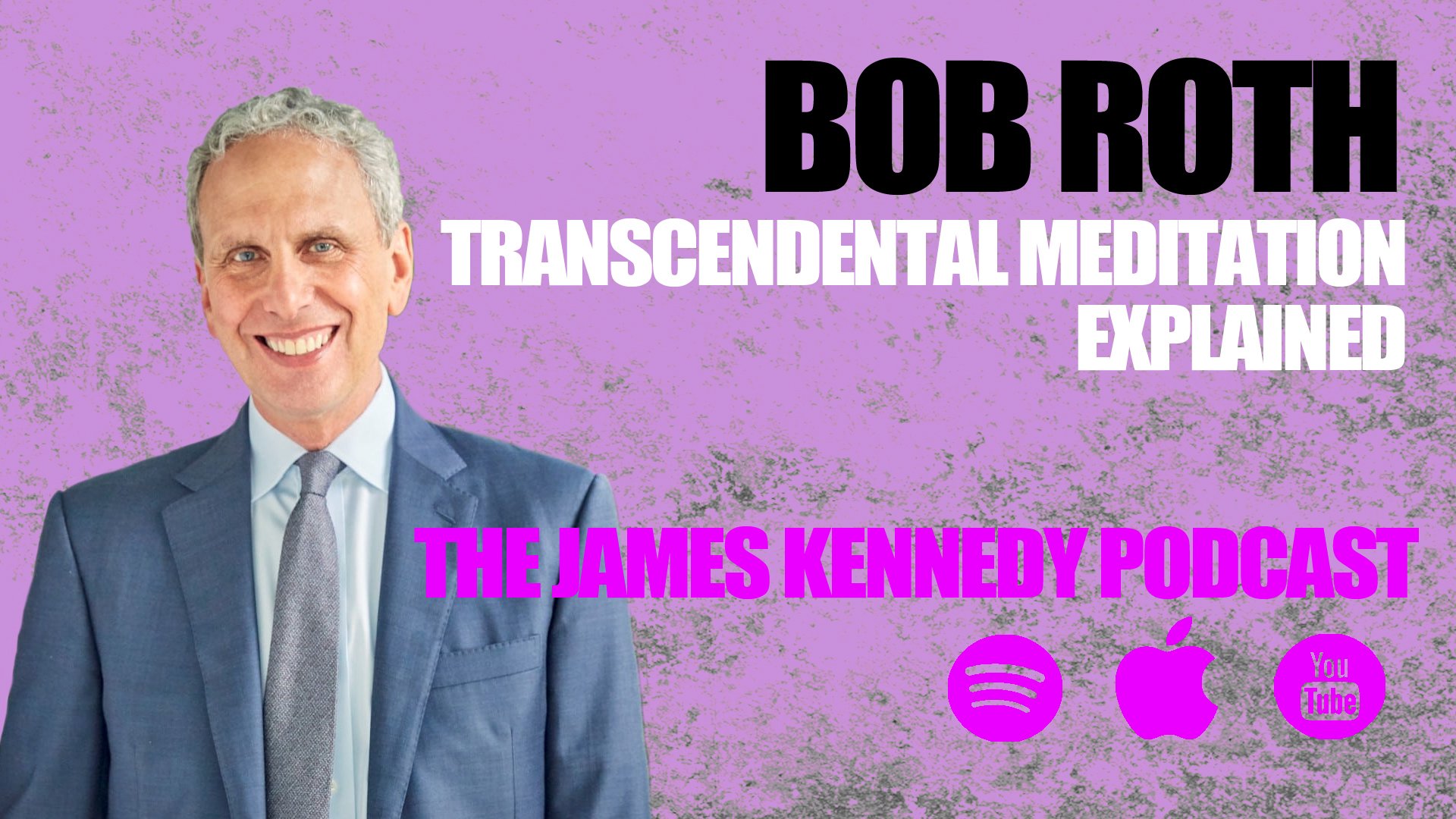
James Kennedy interviews meditation expert Bob Roth about Transcendental Meditation (TM). Bob explains how this simple practice brings deep physical rest and mental calm, contrasting it with other techniques like mindfulness. They explore TM's science-backed benefits, including reducing cortisol, lowering blood pressure, healing PTSD, and tackling the modern stress epidemic.
James Kennedy: Thanks so much for doing this, man. How are you doing?
Bob Roth: I'm good. Thanks for having me.
James Kennedy: You're too kind. And welcome anytime, of course, Bob. Well, I know I don't have you for as long as I would like to today, so I'm just going to straight in and get down to business, if that's okay with yourself. Let's go for it. Awesome. Well, I suppose we should establish at the start that you specialize in a form of meditation called Transcendental Meditation. So I think it would be good to set the stage here at the start of the conversation to establish for the listener who doesn't know anything about this at all, what is Transcendental Meditation? And what are the benefits that it brings to the people who practice it?
Bob Roth: Well, it's a simple, natural, effortless technique. This is just nuts and bolts here. Practice for about 15 to 20 minutes twice a day, sitting comfortably in a chair with your eyes closed. And during that 20-minute period, according to science, your active thinking mind, noisy active thinking mind, has a chance to settle down inward to a state of inner calm, and equanimity. At the same time, your body, because they're so connected, gets a state of rest deeper than the deepest part of deep sleep. And that deep rest, according to science, is miraculous. It reduces stress, anxiety, depression, burnout. It promotes resilience, better health, focus, creativity. That's why all the people that you were mentioning and the 10 million others practice TM for its very real benefits.
James Kennedy: Well, I can vouch for that personally, from my own experience, 100%. And it's good to know that I think it's becoming more popular now. I think more people are open to the concept of meditation. It's not seen as such a kind of taboo or esoteric kind of concept anymore, thanks to the popularization of meditation apps and things like that. But how does the ancient form of Transcendental Meditation that you specialize in differ from some of these more increasingly popular types of meditations, such as breathwork and guided meditations?
Bob Roth: Or mindfulness or Vipassana or any of the ones that are out there. Right. Well, it's a wonderful question. And I want to step back for a second and just sort of give a model or an example of the mind and what the different meditations do. So I like to think of you're on a little boat, you're in the middle of the North Atlantic Ocean. And all of a sudden, you get huge waves, 20-foot waves, you're a little boat, you could look up and see these giant waves. And you could think, Oh, my God, the whole ocean is in upheaval. But it's not really true, because if you did a cross-section of the ocean out there, you'd realize, okay, the waves are 20 feet high, the ocean is miles deep, and at the depth of the ocean, it's pretty darn calm. So, use that as analogy to the mind, the surface of the mind, the waves, the torrential waves. Some people call it the monkey mind. I like to call it the gotta, gotta, gotta, gotta mind. So, I gotta do this, and I gotta do that, and I gotta call him, and I gotta call her, and I gotta make a list, and I gotta find the list, and I gotta make a new list, and I gotta get to sleep, and I gotta get. It's all the gotta's, and everybody's got that. And so, it's a natural desire. I am going to answer your question about meditation in a minute. I just want to put this in perspective, because it'll do a better job of answering. So, enter the field of meditation. Everybody wants inner calm. Everybody wants inner equanimity, inner power, inner creativity. But so, there's different meditations, and there's tons of different meditations. But according to science, research on all the different meditations, it comes down to basically three, James. Okay. Are you still with me, or is this too long of an answer?
James Kennedy: No, 100%. I'm loving it.
Bob Roth: Okay. So, three basic meditations, and they look at it by measuring brainwave patterns, what's going on in the brain through MRI scans and EEG. And the first of the three is something called focused attention. And that's where, okay, you got a monkey mind, your mind is filled with thoughts, so you focus. You focus your attention on your breath. You focus your attention on some part of your body. You focus your attention on a mantra, a sound. The idea is just focus. And when we do that, to try and clear the mind of thoughts, it's actually a very difficult thing to do. But what the research shows is it creates something called gamma brainwaves. And gamma is 20 to 50 cycles per second. Working really hard, fast, hard, hard. Second type is called open monitoring. Many mindfulness techniques are like this. Many breathwork techniques are like this. Open monitoring teaches us to dispassionately observe our thoughts and our moods and our feelings. We're not trying to push them out, just dispassionately observe them. Don't be in the past when, if you know a guy named Joe, and 10 years ago, Joe done you wrong, and now he's coming to town. Well, that's not a good thing. That's not 10 years ago. Be in the present moment. And in the present moment is an equanimity. There's no equanimity in the past, and it's just worry in the future, in the present moment. And so that is open monitoring, and that's another group of meditation techniques. Those are both called, I'm giving you a mini masterclass here. Those are both called cognitive approaches to meditation. Cognitive means pertaining to your thoughts, your moods, your feelings, pertaining to the waves. Stop the waves. The third is transcendental meditation. Now James gets an answer to his question. In transcendental meditation, the word transcend means go beyond. And in transcendental meditation, we recognize that you, all of us, have a vertical dimension to our mind. We feel things deeply. We love deeply. We get hurt deeply. We also have an intuition. Somebody says, James, I got a great idea where you should put your money into this. And it sounds great, and then you're with yourself quietly, and you go, I don't think so, Jack. And he asks why. He says, it doesn't feel right. So that's a deeper level of the mind. In transcendental meditation, far beyond, far deeper than that, there's a level of our mind that's already perfectly calm, expanded, unbounded, the source of our creativity, the source of our energy. This is what they say in the books. So transcendental meditation doesn't care about the waves. It doesn't try to stop thoughts. It goes to the source of thoughts. And when that happens, we have something called alpha-1 brainwaves, completely different to what you see from others. And as I said, your body gains a state of rest deeper than sleep, according to research at Harvard. And then a whole galaxy of benefits that are wonderful for not just surviving life, but thriving in life, more than you see with any of the other meditations. I'm not putting them down. They all have their purpose, and people love them, but the research stands pretty strong.
James Kennedy: Awesome. I appreciate that wonderful explanation. And a tour of all the different types of meditations there, Bob. I really appreciate that. And that makes a lot of sense. You mentioned the galaxy of benefits as well, that TM, short for transcendental meditation, brings to the person practicing it. Could we list some of that galaxy and jump into that ocean of consciousness that you mentioned there and explain what exactly does it bring to people's lives as a result of even short-term practice?
Bob Roth: Well, so you have on the phone a guy who loves science. I love everything, art, music, and everything. But because I'm by nature a fairly skeptical person, I don't want to just—because some branding agency came along and said something is great—show me the evidence before I do it. And the research on transcendental meditation showed one thing that's very important: if your listeners or any of us have degrees of anxiety in our life about things—we all do—anxiety is driven by a hormone called cortisol. And cortisol is secreted in the adrenal glands that sit on top of the kidneys whenever we're under pressure. Anxiety and cortisol has a very bad effect; it shuts down the immune system. That's why if a person's stressed, they're more likely to get sick. So if you get a good night's sleep, cortisol drops 10 percent. In 20 minutes of TM, cortisol levels drop 30 to 40 percent. And that is huge because nothing else does that. Other research shows—we're doing research right now with veterans who have PTSD, and there's a huge amount of research showing that TM is an excellent antidote for veterans and first responders and actually anybody, all of your listeners who have ever had traumatic experiences in their past and that traumatic experience continues to haunt them. TM is incredibly effective for reducing and healing trauma. On the other side of the coin, there's studies that show increased creativity. The creative process isn't just having good ideas, as you know, it's the ability to take those ideas and make them happen. A lot of people could say, I'm going to start a podcast. But look what you're doing, James, you started a podcast. A lot of work to do it. But that's the creative process: both the innovative idea and the ability to focus to make it happen. And so there's a lot of research on TM for enhancing creativity, intelligence, and the ability to focus. And there's a hundred million Americans in America with high blood pressure. The numbers are probably just as high in the UK. High blood pressure. And you can take medicines and it saves lives, but it doesn't get to the root cause. So the National Institutes of Health in the US has given 26 million dollars to study the effects of TM on high blood pressure, and the results are amazing. And I think in a couple of years, our national health insurance is going to cover TM and reimburse for it for all these different benefits.
James Kennedy: That's incredible. You mentioned cortisol there. Cortisol is a killer because cortisol is the catalyst to so many other illnesses and problems and stresses within the body and the mind, which can lead to a whole range of physical illnesses and cancers and all sorts of things. So that reduction in cortisol is massive across the whole health spectrum, isn't it?
Bob Roth: Oh, yeah, absolutely. I really think there's such a change going on in the health care system right now. They have to move away, and insurance companies—in the US we have a lot of private insurers and also Medicare, which is a national insurance—they're going through a huge change because modern medicine doesn't understand the cause of so many mental health issues. So many people suffering from anxiety, depression, insomnia, burnout. And then it goes further: bipolar disorder, the eating disorders. They don't know the cause. It's called pathology; they don't understand the cause. If you don't understand the cause foundationally, then you can't have a solution. We know that if I cut my arm and it gets infected, they know what that is: germs and bacteria, and I got an infection and I get antibiotics. Well, if a person is depressed, they don't really know the cause. And so they throw a lot of money at different pills, and it helps some people, but not everybody. So here comes along Transcendental Meditation: a simple technique, non-pharmacological, non-invasive, anyone can do it, a few minutes in the morning and a few minutes in the afternoon. And it has a galaxy of benefits; it doesn't just reduce high blood pressure, it reduces high blood pressure, burnout, anxiety all in one shot. So it's a new time that's coming, and it's not long before TM and other evidence-based non-integrative practices are part of the health care system because the current one is bankrupting everybody.
James Kennedy: Oh, 100%. Could you imagine if they had this in schools? I've often thought that so many societal and personal problems could probably be dealt with better in school. For many kids, unfortunately, school is the safest place that they've got; there may be trauma at home. So I think to be taught this tool at such a developmental age could probably nip in the bud so many psychological and as a result physical problems that, whether we like it or not, affect all of us in society.
Bob Roth: There's a lot of schools in the US and I imagine also in the UK that are incorporating some forms of meditation or breathing or something, because if a person is 26 or 27 and they start showing signs of bipolar disorder, it started when they were five or six. It didn't just bang. And so those ages, those developmental ages, are crucial to give them something to manage and deal with the 24/7 they feel it too: social media, bullying online. I'll tell you something that's pretty shocking: the fastest rise of people going to emergency rooms with suicide, suicidality, threats of suicide, the fastest growth rate is children 5 to 11. Children 5 to 11. I could not believe it. When I was a little kid, I'm going to go out and play kickball or basketball, whatever, spend the night at Joey's house. Now it's a different world. And girls in particular, the high levels of stress in their early teens, it's frightening. We're in danger of losing a generation to stress. And meditation—I think they're starting to recognize you can't ignore it. We're not going to give every child Valium. It's not sustainable, it's not scalable, it's not humane. So it's not long before you're going to see TM and other techniques being made available in the schools to save the children.
James Kennedy: Wow, that is staggering, man. I had no idea that that was the situation. And it's fascinating to me that one of the more effective tools that we have in the fight against some of the things you just mentioned is this practice that has been around for thousands of years. Is that right?
Bob Roth: Over 6,000 years old, yeah. Predates Buddhism, predates Judaism, predates Hinduism, predates everything. As is yoga. Yoga also predates it. It's not like you had to be a Buddhist or a Hindu to do yoga; it was long before that. Stretching, transcending, it was just accessible. And then religions come along and they may incorporate it into their practice, into their religious belief. It's something useful, just like a religion could say that you need to do jumping jacks. Doesn't make jumping jacks religious or Catholic, it's just a technique. So that's what happened with meditation: it got adopted around a religion, but in and of itself has nothing to do with religion. It's just a tool.
James Kennedy: That's a great point to point out as well, because I approached Transcendental Meditation when I did my training in it with the same level of skepticism that you alluded to earlier. I'm from a scientific interest background. I consider myself to be an atheist, and I was a little bit put off by what I consider to be some of the religious aspects surrounding it. But that was just down to my own misinformation. As soon as I got into it, I realized exactly what you said: that this is a powerful tool that is not aligned with any kind of belief system or anything like that. So for people listening to this who may have fallen into the same misinterpretation as myself, this is, as you just said, not connected to any kind of faith or belief system. This is just a practical tool that, as you said, can bring you that galaxy of benefits.
Bob Roth: Yeah, and 10 million people of all religions have learned it, all educational backgrounds, all cultures. And what I love is the work that we're doing right now to get insurance companies to reimburse for TM so that a single mom on welfare, she goes to her doctor, she's got two kids, stressed out of her mind, the doctor can say, well, I can give you this anti-anxiety medication, and I can also give you a prescription for you to learn TM. Right, that would be so great, because some people don't want to live their life on drugs. I think one of the interesting things is I've received calls from some of the top pharmaceutical firms in the US wanting to offer TM to their employees for the stress, because it's so all-pervasive right now. It's just all-pervasive and it's not going away. I also tell people, maybe 20 years ago the idea of taking 20 minutes out to do TM to meditate was a luxury for rich people or something. It's not a luxury anymore, it's an essential tool in your toolbox to not just survive, but actually thrive. And it's not long before it's widely available. It's not long. I call it the democratization of meditation. Everybody should have equal access to these tools. This is not just for somebody who can do this or that. Everybody should have equal access. It'll make a huge difference.
ENJOYING THE CONVERSATION?
GET JAMES KENNEDY'S LATEST INTERVIEWS, WRITING AND LIVE SHOWS STRAIGHT TO YOUR INBOX
James Kennedy: Well, I think it's exactly what you said. We're living through a growing stress epidemic at the moment, which causes a whole spiral of other physical and mental illnesses and ills in society at large. And it all comes down to the growing stress that we're feeling. Times are hard at the moment and getting harder. So to have this tool that's so powerful available to us, I think, is a real gift. And it's ironic that we're coming back to a practice that has been around for thousands of years in the modern age, isn't it? You mentioned yoga as well. I find that quite interesting.
Bob Roth: They knew a lot way back when.
James Kennedy: Well, Chinese medicine still falls into the camp that I described earlier, where I treat it with some skepticism. Am I wrong in that as well?
Bob Roth: Oh, no, you should be. That's fine. I'm just talking about there's research now on aspects of Chinese medicine. There's research on aspects of Ayurveda, which goes back to the Vedas with yoga. Just research. I don't adopt or believe just everything wholesale altogether, but there's elements of something that they knew. And the same with Chinese medicine. There's some research showing that some of the herbal compounds can work more effectively than our high-tech medicines. Because ultimately, the human body is the same human body for thousands and thousands of years. And thousands of years ago, maybe they're growing their foods without pesticides and all that stuff, and we grow with so much of that now, and our human body can't metabolize it, can't just process it. So I think some of the diseases can be due to just the body not knowing how to handle these chemicals. And so we can look back to Ayurveda or Chinese medicine or yoga to see if they have some wisdom, then they could be relevant today. But I see there's a difference between skepticism and cynicism. I always tell people I'm a skeptic. If I was a cynic, I'd never get out of bed. But a skeptic is not disbelieving; just show me the evidence. And that's why I love TM. There's just an enormous body of research and more coming out all the time. In New York City, where I'm calling you from, we're offering TM for free in 50 hospitals to doctors and nurses and health care providers who were on the front lines during COVID and now the front lines with the violence that's happening in our cities. And we'll be in 1,000 hospitals in a year or two because the demand is so great.
James Kennedy: That is absolutely incredible. And what great work you're doing as well. I mean, you've been doing this for decades now to thousands and thousands of people. When you look back at the lives you've changed and the lives you've saved, do you feel a sense of reward? Or are you still looking at the mountain ahead of you?
Bob Roth: No, there's two things. That's a wonderful question. By the way, you're an excellent interviewer. Really good. You ask really good questions.
James Kennedy: Thanks, man. Not bad for a dumbass rock musician, huh?
Bob Roth: Yeah, really good. Ask me the question again.
James Kennedy: I was just saying, on a personal level, do you feel a sense of reward?
Bob Roth: Oh, yes! I'll tell you. When I was a kid, I always wanted to change the world. I worked for Bobby Kennedy, Senator Bobby Kennedy, when he was trying—yeah, talk about ancient—when he was running, wanting to get the Democratic nomination for president. And I saw him speak in San Francisco with 2,000 people in June. And I thought, we're going to change this blanky blank world. We're all together. And then five days later, four days later, he was assassinated. And it was very devastating to me. And I decided I was going to go to college, went to University of California at Berkeley, I would study law, and I would become a US Senator like Bobby Kennedy, change the world. Well, it didn't take me long, even then going to school at Berkeley, to realize that politics was not going to heal the soul of the nation. Look what's going on. And I thought, maybe education. My mom was a school teacher. Maybe I'd write an educational curriculum and change kids one at a time. And then I learned to meditate. I started skeptically, but I learned it. And one of my first thoughts after I learned, it was so relaxing. I thought, maybe this is a tool I'll bring to those kids in South San Francisco and in Oakland, California, where there's a lot of crime. And now, when you ask that question—you know, that was June 28, 1969—all these years later, now I run a foundation that's brought TM for Free to a million kids all over the world. And we're working with veterans and police and firefighters and emergency technicians who drive ambulances, and school teachers, and inner-city school kids, and frontline health care workers, and women who are survivors of domestic violence and sexual assault. And it's growing. Our main centers are New York, Los Angeles, and Washington, D.C. But that's just because we're pouring all of our resources to demonstrate how effective this can be, and then we'll make it available all over the country and all over the world. So, yes, it's very satisfying on the one hand. But on the other hand, I still see the mountaintop. And there's still more work to do. So I don't stop. I don't stop ever. People are always saying, well, just bask in your achievement. And I say, no, it's more fun. I love challenges, and it's more fun to go for the top. And the top is medical insurance companies covering TM so everyone has equal access.
James Kennedy: That would be amazing. Well, for people listening in the UK, obviously, that's a strange concept to us. But in America, I can appreciate just how powerful that is.
Bob Roth: Well, it's going to happen. I'll tell you, in the UK, your health care system is getting riddled and beat up by the same stress, drug abuse, violence. It's the same. And when it's demonstrated here, it won't be long before the UK does it because they're losing money and, more importantly, they're losing lives.
James Kennedy: Great point. Well made. And when people talk about you, they often focus on the fact that you've taught Oprah Winfrey and Russell Brand and Hugh Jackman and all these celebrities. You're the guy that's taught the celebs. But what doesn't normally get mentioned in that same conversation is the fact that you've taught thousands upon thousands of people personally from a very different walk of life, from military vets to survivors of domestic abuse, trauma victims, people with PTSD. And I'd be really interested to know what you've seen personally happen to those people as a result of beginning this practice of Transcendental Meditation. What improvements or changes did you see in these people personally, and how long did it take before those changes became known as a result of doing this practice?
Bob Roth: Really good question. So when we're talking about, like, veterans or police, I'll give you an example in the US. A person in the US will experience or see, on average, three to four traumatic events in their lifetime. Car crash, something in their family. Three to four. A first responder, a firefighter or a police officer, 180. 180 traumatic experiences. Imagine what that does to your brain and your nervous system, and obviously your emotions. So what they find with TM, because it's so easy to learn and the veterans love it—and we tell them it's actually a warrior's meditation, it was practiced by the warriors early on, not a bunch of hippy-dippies—within a few days of having learned it, what we find is veterans who hadn't slept more than an hour or two because of nightmares and flash-backs, now they're sleeping for 16, 18 hours. And then after a week, they're just back to normal. But the body gets such a degree of rest and relaxation that now they can sleep. There's such a sleep debt. So the Veterans Administration is very interested in the benefits of TM because it shows, like within a few weeks, research shows a reduction in PTSD, which is post-traumatic stress disorder, a reduction in anxiety, a reduction in insomnia. They start sleeping better. And there's a transformation. And again, we don't teach them a philosophy. We don't teach them, oh, you should have a positive outlook on life, you should be happy you're alive. No. We just give them the tool, the technique. It takes about an hour a day over four consecutive days to learn from a certified teacher. You don't want a bogus teacher, a certified teacher. And that teacher will teach you how to meditate, and that teacher will be available to support you for the rest of your life. And so now I'm going to answer your question: about a 30% to 40% reduction in symptoms of PTSD, about a 50% to 60% reduction in sleep disorders. Very significant. And right now there's a phase three trial that we're doing at Stanford University Medical School, University of Southern California Medical School, Columbia University Medical School, Mount Sinai Hospital on TM and veterans with PTSD. And the results of that study will be used to get coverage by the insurance carriers for veterans to cover TM for free as part of their healthcare system. So all my talk about this, we're not far away. It's not just talk. It's very, very close.
James Kennedy: That is incredible. And when that happens, what an achievement that will be for you personally to have been part of the movement that made that happen.
Bob Roth: It really will be great. The need is so great that people are stepping forward saying, let me help. We've launched something in New York City called Meditate New York. And in a couple of months, there's going to be new billboards all over the city just telling people, look into meditation, not just TM, look into meditation, educate yourself. And the mayor, Eric Adams of New York City, I taught TM 12 years ago, so he's a co-chair of Meditate New York. It's really going well.
James Kennedy: That's amazing, man. Well, I think with all this information and science and galaxy of benefits and stats and everything that we're talking about, I think it's important at this point to remind people that essentially the practice itself is very, very simple. Essentially, it's just sitting still with your eyes closed for 20 minutes once or twice a day. It doesn't require any equipment.
Bob Roth: Yeah, no apps. You have a sound, a simple one-, two-, or three-syllable sound that you think quietly, and a teacher teaches you how to think it so you're not making effort, you're not straining. So the whole process is profoundly relaxing. And that, again, comes about from that deep relaxation in the body. And also the brain—the brain is bathed in this very calming, soothing, coherent wave called alpha-1. So afterwards, that deep rest doesn't make you exhausted, it's energizing. You have more energy, more focus, more resilience, you're more yourself. That's it. You're not your stressed self, you're more yourself.
James Kennedy: Well, God knows I need a lot more of that in my life, because I've recently been diagnosed with PTSD and a little bit of nervous system dysfunction due to some recent trauma that I had. So I need to be getting back on the saddle.
Bob Roth: James, my buddy, when we're done here, we're going to connect and we'll set up some times for a follow-up, and I'll help you with that.
James Kennedy: Oh, thank you so much, Bob. You're very kind. And that segues into the next section of the conversation that I'm going to try and squeeze in here before I take up too much of your time, which is: somebody in my situation that does have training in TM and does understand what it's all about and what it entails, but is still struggling to actually make it a habit in their life, what tips could you give us now as someone who has worked with thousands of different types of personalities in different situations from all sections of society? What general habit-forming tips could you give to someone like myself who's making a lot of excuses? I get up in the morning, there's coffee, I want to exercise before I get up, I don't have kids, but if I did that would be my distraction. There's work, there's the commute. How do people, when they're juggling so many things in an ever more stressful and ever more time-constrained life, find time for this?
Bob Roth: Well, first thing I say is, James, there's 1,440 minutes in your day, and if you can't find 20 out of that, or 40 out of it, some priorities here, buddy. Because the trajectory that we're all on—and if you have PTSD and complex PTSD, where you just gather just living—it's not getting any better on its own. So number one, there is time available; you can just get up 20 minutes earlier. And the 20 minutes, here's another point, it doesn't take away from the sleep because the rest during TM is deeper than sleep. So you're not losing 20 minutes of sleep, you're getting up 20 minutes earlier to get a state of rest deeper than sleep that's going to allow you to sleep better the next day. And for the brain to establish new neural pathways, new habits, it takes anywhere between three and six or seven weeks for that to happen. When I learned TM, I decided I didn't know any of this stuff, I decided, okay, I'm just going to do the meditation as my teacher said, do it twice a day for 20 minutes, I'm going to do it for a month. And then after a month, then I'll decide if I want to do it, but I have to give it a chance. If someone says, oh, here's a beautiful plant, a beautiful orchid, and you water it like this, you're going to have beautiful orchids, but you water it half as much and you say, ah, the flower wasn't any good, the orchid wasn't pretty—well, you didn't give it a chance, you didn't water it properly. And also, I hear from people saying, well, I meditate when I get really stressed. And I said, that's like watering your vegetable garden when the lettuce is about to die. It's not going to do any good. Take care of yourself. So to you and to others, I'd say, all right, I'm going to do this for a week, twice a day. All right, I'm going to re-up it for another week. But you've got to do it. And if you don't, then you've got nobody to blame but yourself.
James Kennedy: Love that answer. I feel like I've been told, and I shall do as I'm told. So thank you, Bob. Well, for people that have a bit more discipline than myself and are really putting in the time and effort here to make this work, what general tips have you discovered over the years of doing this on such an extensive level that help people along the way to form this habit or to maintain this habit or to make it a little bit easier along the way? Because it is difficult. The practice itself is very simple, but it can also be very difficult because it's so at odds with the nature of our internal world, isn't it? Our internal world is so noisy. We've got that internal dialogue, which never shuts the hell up for two minutes. So just calming all that and silencing all of that can be quite difficult to fall into a groove with. So what general things have you discovered over the years that help people to stick with it and to make it a bit easier?
Bob Roth: Well, it's a good question. And the fact is, when I told you about those three different types of meditation—focused attention, very hard to do because you're basically trying to stop the waves on the surface, you're trying to stop thoughts, which is very hard because the mind naturally thinks about a zillion different things; open monitoring, a little easier, you don't have to stop thoughts, it's just living in the present; and then TM, no effort. And that's why I want to refresh your practice, because if you're making effort, it's not TM. So I would tell everyone, just be sure you're doing it right. If you're doing focused attention and that's your choice and you like that difficult sort of thing, then connect with your teacher or find someone and just be sure you're doing it right. And so that's what I'm saying to you, James: you want to be sure you're doing it right. And you're going to find that it's not difficult. I promise you, you're going to find that it's comfortable and easy and relaxing. And if you're not happy with one meditation, try another, because they're not all the same.
James Kennedy: Great advice. Well, Bob, as we come towards the end, because I know unfortunately I've got to let you go, even though I'd like to keep talking to you for the next two hours, everyone that's been listening that wants to get involved and start their meditation journey—how do they start? Where do they go? What do they do? And how does it all work?
Bob Roth: Well, two things. In the US, you can go to tm.org and find out where a teacher is, or you can just go online and Google Transcendental Meditation UK. I'm also going to give out my actual email address. This doesn't go to someone else, it goes to me. And if you have any questions about the meditation or you want help in finding a teacher, you can email me at Bob@DavidLynchFoundation.org. That is my personal email address. And I'm doing it because James is such a good guy.
James Kennedy: I'm not going to take any of the credit for that! That's very, very kind of you, Bob. I hope you're not going to get inundated.
Bob Roth: But if I am, that's fine. If people genuinely want to know, then I'm happy to answer.
James Kennedy: You're a true gent. That's really kind of you. Thank you, Bob. And I can assure you that none of my listeners will be contacting you with anything dubious or irritating because they're all of a supreme intellect level, hence why they listen to my podcast, of course. Bob can also be stalked on Instagram and Twitter @MeditationBob. And as I mentioned in the intro, he is also the executive director of the David Lynch Foundation, which can be found at www.DavidLynchFoundation.org.uk, so check that out. And if you're interested in hearing more from Bob, Bob has done thousands of interviews which you can hear in podcast form or on YouTube as well talking more on this subject, so definitely go and check that out and get yourself started.
Bob Roth: Wonderful. And you're great, and next time I'm going to interview you about your rock music and how you got interested in all of this and what you're doing, but that'll be another call.
James Kennedy: Oh, anytime. Yeah, I look forward to that. I tell you what could be interesting is maybe if I get back on the meditation saddle and we could have a catch-up conversation maybe six months down the line or something to see how my life has changed, what I did differently to make me stick with it this time with more success, and what benefits I'm feeling as a result.
Bob Roth: Perfect, sounds great to me. Thank you very much for having me on your show, it's an honoUr and I really enjoyed it a lot.
Key Points:
Guest Bob Roth, executive director of the David Lynch Foundation, explains Transcendental Meditation as a simple, effortless technique practiced 15 to 20 minutes twice daily with eyes closed.
Roth categorizes meditation into three scientific types
Research shows TM reduces cortisol by 30 to 40 percent, easing anxiety, depression, insomnia, burnout, and PTSD symptoms.
TM is a 6,000-year-old secular tool, not tied to any religion, and is used by 10 million people including veterans, students, and celebrities.
The David Lynch Foundation offers TM free to frontline workers, veterans, and inner-city youth, and is pushing for insurance reimbursement.
Roth advises skeptics to try TM for a month before judging, emphasizing that consistency, proper instruction, and treating it as essential rather than optional are key.
Kennedy, recently diagnosed with PTSD, plans to restart TM with Roth's personal guidance and document his progress in a future follow-up episode.
Summary:
James Kennedy begins this episode by confessing his long struggle to maintain a consistent meditation practice, despite knowing how profoundly it improves his mental health, sleep, mood, and focus. He admits he is a high-stress person who constantly neglects self-care, and he invites Bob Roth, a world-renowned Transcendental Meditation teacher and executive director of the David Lynch Foundation, to explain the practice.
Roth describes TM as a simple, natural, effortless technique: sitting comfortably with eyes closed for 15 to 20 minutes twice a day. He compares the mind to an ocean with turbulent surface waves, explaining that TM transcends those waves to reach a calm, unbounded inner source. He outlines three scientific categories of meditation, noting that TM uniquely produces alpha-1 brainwaves and rest deeper than sleep.
Roth cites research showing TM reduces cortisol by 30 to 40 percent, lowers blood pressure, eases anxiety and depression, and significantly reduces PTSD symptoms in veterans. He stresses that TM is secular and evidence-based, not religious. The David Lynch Foundation provides free TM to at-risk populations, and Roth is pushing for insurance coverage. He advises Kennedy and listeners to commit for a month, practice twice daily, and ensure proper instruction. Kennedy, recently diagnosed with PTSD, plans to restart TM with Roth's help and share his progress in a future episode.
The James Kennedy Podcast is a Society and Culture podcast hosted by musician and author, James Kennedy. Exploring the big questions around health, social issues, the arts, politics, mental health, the human condition and how to navigate this thing called life through casual conversations with scientists, activists, rock stars, philosophers and academics. Please subscribe, leave a rating and support the show.