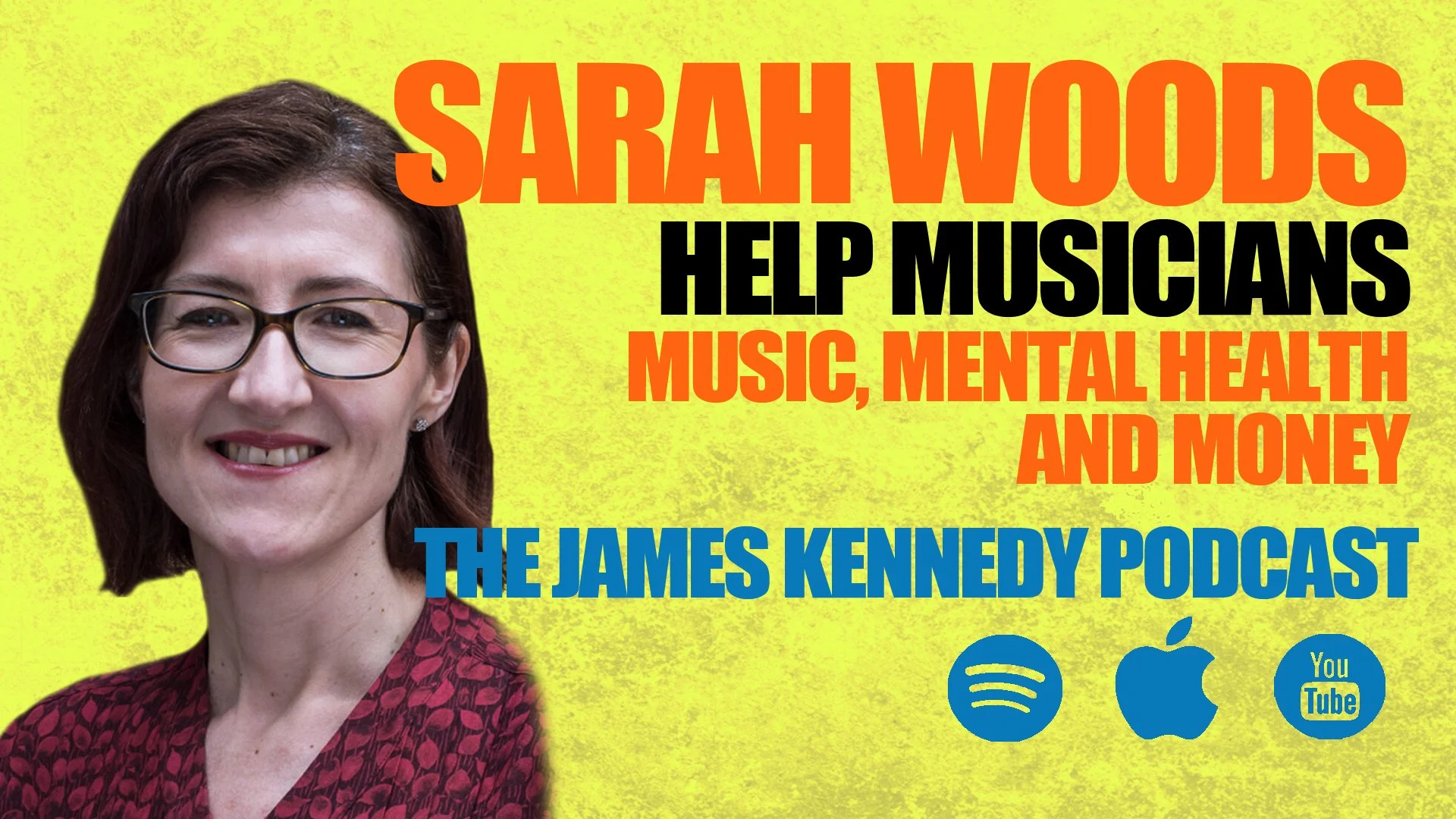
James Kennedy interviews Sarah Woods from the charity Help Musicians. They discuss the unique financial, physical, and mental health challenges facing musicians today, how these struggles compare throughout the industry's history, and the vital support services—including grants, helplines, and Music Minds Matter—available to artists.
James Kennedy: Sarah, thanks so much for joining us today. How are you doing?
Sarah Woods: I'm good. And James, thank you for your very generous introduction to the charity.
James Kennedy: No, not at all. As I said, I'm a big fan of what you guys do. So thank you so much for doing it. We have done a few things in the past. I think you guys may have published a few articles I've written on mental health and stuff in the past in the music business. So thank you for that. But I'm looking forward to finding out more today and sharing that with the listeners. So for those people who don't know anything at all about Help Musicians, can you give us a download on who you are and some of the things that you guys do?
Sarah Woods: Sure. So Help Musicians is an independent charity for professional musicians across the UK. We also run a mental health charity called Music Minds Matter, and that is available for everyone within the music industry. So we offer a very broad range of support focusing on health and well-being, mental health, but also career development. So we offer funding for times of crisis, particularly financial crisis. We offer grants in terms of career development and business skills. We run a series of helplines, so whether that's the mental health helpline, we run a bullying and harassment helpline, and we introduced a new helpline last year to support musicians with inquiries around touring, since that's become more challenging following Brexit. So hopefully, if you visit Help Musicians' website, there's something relevant for every musician at every stage of their career.
James Kennedy: Absolutely amazing. And it's interesting. If you step outside of it and look at it objectively, it's kind of interesting how an entire industry of people needs a charity to help it with those issues. I mean, before we get into why that is, what are some of the main issues that affect this particular community? Because you don't see any charities that represent mental health interests of factory workers or something like that. So it's very interesting that this community has the need for this. So what are some of the main issues that affect the musical industry?
Sarah Woods: So we've been going for 100 years. So we say a musician's life is precarious, with ups and downs throughout a career. And I think a majority of musicians in the UK are freelancers, and developing a sustainable career as a musician can be tough. So the kind of issues that we're trying to design support around are times of financial crisis, recognising that, particularly after the pandemic, musicians are taking on quite a lot of debt. But also that kind of unpredictability and volatility of sustaining that income can take its toll. And that can take its toll mentally, but also physically. So if you're a musician with a career injury, we will support you with funding or medical support to recover and get back to work. So I think it's just a precarious career, and one which has many unique challenges, which from time to time, unfortunately, mean musicians either need a helping hand or actually some sort of career support to get their career back on track.
James Kennedy: 100%. Yeah, I can totally relate to a lot of the things you've described there, unfortunately. And you mentioned that the charity has been around for 100 years. So I'd be really fascinated to ask, I don't know if this is possible to answer, or if there's any data that supports this either way. But we know that the music industry has changed significantly and permanently in the past 20 to 30 years. But do we have data on what the mental health and the financial stability and security of the artistic community was like before that seismic shift, before the internet, back in the bad days of gatekeepers and major labels and record deals and things like that? Because my theory is that it's possibly worse now that we don't have any set structure or any safety net of any kind really, and we're all kind of out there on our own, competing not just with the five bands in our hometown, but now every band on the planet for space on the internet or whatever. So my gut feeling would be that it's possibly worse now in that regard. Better in many ways, and it is more democratized and we all have more opportunities and more control and more freedom, but the toll that that takes on us emotionally and financially and in terms of our feelings of security, I imagine that those things are worse. But I might be wrong. Do we have any insight or data on that either way?
Sarah Woods: It's a really good question. We had our centenary in 2021, and one of the projects around our centenary was to try and delve into the charity's archive to look at what those issues have been over 100 years. And we have a wealth of information. In the olden days, the way the charity used to record its support for musicians was through the development of these little case cards, which were little typed up summaries of the needs of the musician and the support that was given. And having looked through those, that precarity of career is throughout actually. So whether that be the 30s or the 50s, mental health is a theme. Musicians who have either mental health or addiction issues is also sadly a theme. But that sense of debt again is always there. I think that unsustainable income which unfortunately from time to time musicians need some additional financial support with just to get themselves into a position where they can start to grow their career again. So I think terminology has changed around it, so in the sort of 30s and 40s there's language around nervous disorders and those kind of things, but I think it's been consistent sadly.
James Kennedy: That is both disheartening to hear and also fascinating as well to know that despite the shifts that we've had in the industry since, you know, you mentioned the 30s, that this has been quite a consistent theme in our industry. That doesn't bode well, I don't think. And I suppose there could be an argument to be made for the fact that oftentimes substance abuse and things like depression and mental health problems often do come with both the blessing and the curse of having that creative gift within you. It does seem to be a common theme, but I think it's exacerbated by the way that this industry is set up in such a bizarre way that's very unique. Yeah, and as I said, my gut instinct would be that it is worse now because there is literally no structure or support system or gatekeepers of any kind at all now. Social media has a massive impact on everybody's mental health across the board, but I think when you're a creative freelancer as most of us are now in this community, you're constantly measuring yourself in comparison to what you think other people are doing on social media, which for the most part is bullshit across the board because we all project a version of ourselves which is way more glamorous and successful than the reality behind the scenes. But the fact that this has been fairly consistent as far back as records can show is both fascinating and depressing. But I suppose on the flip side of that, there could be an argument for the fact that it's actually better now in the sense that we have these conversations now, whereas back in the day it was so much more taboo, especially for men, to talk about mental health struggles and financial instability and insecurity and things like that. So the data might not have been as honest back then or as truly representative of the actual situation, whereas now thankfully we're a lot more enlightened and a lot more open about speaking about these things and doing something about it. So I suppose it's possible that it may have actually been worse before. Do you think?
Sarah Woods: And maybe people didn't reach out for help or feel they could reach out for help, right? I think just your question in terms of has it got worse recently, so our Music Minds Matter charity over the last two years, we have seen a significant increase in calls to that. So that's up 200%. Actually, requests for therapy are up 35 percent. Whether that is a backlash from the pandemic, so we know that from some of our surveys that we've done from musicians that they're feeling less hopeful about sustaining a career in music, and whether obviously trying to get yourself out of a position of debt into an earning position again, we know that musicians tend to supplement a lot of them tend to supplement their musical income with other forms of work. I was reading the other day a report from UK Music that said they estimate that up to a third of freelancers left the industry during the pandemic. If that's true, that's really going to bear out in a bad way in future years. So we will see. I think over the next couple of years we are seeing an increase in support for our business skills development, our touring and live funding, which suggests to me that we've got musicians who are still in the industry and they're still struggling to get out of the tail of the pandemic, and there are others who are now trying to move forward their careers and take advantage of the opportunities in front of them, but need some financial support to do that.
James Kennedy: Yes, interesting isn't it? It's almost as if the aftermath effects of the pandemic are stronger now than they were immediately afterwards. There was a sense of optimism I felt when we came out of the pandemic and the lockdowns and everyone was like right we can play again and every man and his dog was on tour and stuff, but the ripple effect of that I think is really taking root now bizarrely enough, you know, two years after it. And it is heartbreaking to see some of the best musicians and creators and artists I know smashing their hands up on building sites. I've mentioned that before, but we all just got in so much debt because essentially our livelihood was just frozen for an unknown amount of time. And I think it's interesting what that tells me, is that this industry is structured in such a way that it's not able to absorb any kind of shocks like that. I mean, I know it was a very particular time and a very specific set of unprecedented circumstances, but I think it takes extreme and extraordinary times to really highlight and expose the true nature of something, and I think what it showed us is that we are just not prepared for any disturbance to the normal way of doing things. And that's why all of these things that you've mentioned, the mental health, the financial insecurity, the pessimism, the lack of hope, having to take day jobs to supplement our incomes and things, and the debt, that's why we have all these things. And it's just insane that the main foot soldiers of the industry, the creators, the artists, the people that write the songs and play the songs, the main cogs of this entire industry, are just not being looked after in any way shape or form by the structure of the industry. So is this a structural thing? Is it something just to do with the way the industry has been traditionally developed, or is it something else? Why is it so prevalent in this business in particular?
Sarah Woods: Well, I mean, I think the life of a freelancer in particular is significantly influenced by change, and over the last few years we've seen COVID, we've seen Brexit, we've seen increased costs in terms of your ability to make a profit, we've seen changes in your income. So I think at the moment there is definitely a myriad of issues that are all a perfect storm of creating some major challenges. So I feel in particular that issues around mental health and career stability are more acute at the moment because of those changes which are influencing the predictability of being able to sustain a career, right? Whether the industry itself, if you step back from that, is part of that, I don't know. I think in every industry where you have complexity and lack of structures, even trying to get into this industry, one of the things that we're seeing is if you're a musician who's sort of at the early part of your career, what does a sustainable career in music look like? It's hard to map out, so that visibility and connectivity we're seeing as a key issue for musicians. Freelancing can be quite a lonely life often, and actually when you're able to bring people together and say actually you know what, there are a number of you experiencing the same challenges, so one of the things Help Musicians has done more of over the last couple of years is bring musicians together in peer-to-peer support sessions to focus on mental health and well-being, to try and share an issue and get some connectivity going forward, and mentoring hopefully might support in the right way.
James Kennedy: That makes a lot of sense. Another thing I've noticed is it seems to me from a personal experience, and just the conversations I've had with artists and performers over the years at all levels of the industry, that these issues that you've described are actually universal. And they don't necessarily go away with success, which is what I always imagined would happen in my sordid career, that once we get to the top of that mountain, it's all going to be a lot easier and we'll have support behind us and we'll have less burnout and it'll be awesome. And it seems to me from the conversations I've had—some on the podcast and some privately—that that is not the case. It seems to be that these are universal themes throughout the entire food chain of this industry from top to bottom. And this was brilliantly and brutally portrayed in the book that I've spoken about many a time on the podcast, the book Bodies by Ian Winwood, where just the sheer level of lack of care and concern for artists, well-known artists on major labels, was just absolutely flabbergasting. But I do feel that this is slowly changing for the better as a result of work by groups such as Help Musicians and the general opening up of the narrative around mental health and the value of art and the people that make it. I do see some signs of change in the right direction and a general shift in values happening in the industry for the better. Would you agree with that?
Sarah Woods: Yeah, I do agree with that. And the reason I say that, we ran our first mental health summit which we invited lots of people across the music industry to last year, and a number of the major labels came and actually shared some of the things that they're doing now within their organizations to promote better mental health and well-being. So I do agree with what you've just said, that there is now more of an engagement in the issue and a recognition that touring in particular is emotionally and physically taxing. There's someone called Tamsin Embleton—and actually, who's just written a great book on touring and mental health, so if you're interested in that, it's a really great resource for how to support musicians and some of the insights around those challenges—and I saw her tweet the other day that Live Nation had bought 3,000 copies of the book, which again is a really positive sign to show that those who can make a difference, particularly around touring, are engaging in how they might do so. So I think that's a really positive step.
ENJOYING THE CONVERSATION?
GET JAMES KENNEDY'S LATEST INTERVIEWS, WRITING AND LIVE SHOWS STRAIGHT TO YOUR INBOX
James Kennedy: 100%. Yeah. And I've always been quite critical of the mainstream industry machinery. I've always been a big proponent of the independent model, because that's the one that I've always operated within. And obviously that wasn't available to us not so long ago. So it is kind of like this new democratization, this new empowerment that artists have got, whereby if you can't get a deal or if you don't want to get a deal, you want to cut your own path or you want to do things yourself, the tools and the opportunities are now available, which is amazing. But what comes with that is all the burden and the pressure. It is on you to understand business, to understand marketing, to understand distribution, to manage your social media. And also, you are now in direct competition with the rest of the world. It's like, how do you get heard above the noise of everybody else doing that? That is a question that I've asked many times on this podcast to all sorts of people from different industries. And it is the question, isn't it? It's like we are all battling against the absolute monsoon of content that is saturating and inundating all of us 24/7. So it is a brave new world and it's great to have the empowerment and the tools and the opportunities that we've got. But also there is a whole host of new pressures and new stresses that come with that.
Sarah Woods: I think that's a really good point. And you see more and more independent musicians carving their own career, which is brilliant in terms of control and mapping out your own path in a way that is right for you. But with that comes that responsibility of decision making, and you're trying to do different things, you're trying to promote yourself, you're trying to market yourself, you're trying to create, you're managing your own business. So there's a lot to juggle, and I think that's partly why we see some of the challenges that we see, that that juggling can take its toll unfortunately if it's not something that people keep the right balance on. In particular, you talk about social media, you're building your brand, there's so much to juggle as an independent artist. So we at Help Musicians hopefully can support you with some elements of that at the right time. So do feel free to ring anybody in our musician engagement team at any time and talk about where you are in your career and what we might do to help you.
James Kennedy: Yeah, it's absolutely indispensable, because more and more artists these days are doing all of the things you just mentioned. And it's a 24-hour job, and most of those things we don't know what we're doing. We can do the music stuff just fine, that's our natural habitat. But the social media, the marketing, the financial management, you're doing all of your own heavy lifting and everything as well and driving and band management, and it's 24/7. And that combined with the pressure of social media and the comparison thing that I mentioned earlier as well, it's a lot. To have you guys as an ally is absolutely indispensable. So I hope that more musicians will reach out and check out the amazing resources on the site, because the website is brilliant as well. A lot of the funding opportunities and information and mental health platforms and stuff that you've got there as well for help is absolutely an indispensable tool, particularly at this time now when more and more musicians are essentially sole traders, freelancers doing this by themselves. We need what you guys do.
Sarah Woods: Treat us like a friend.
James Kennedy: Love it. Love it. And what a friend to have. So thank you. And the other friends that bands and artists have as well, of course, are their fans. One of the other beautiful benefits that we have now of this new model I described earlier is that direct relationship that artists can now have directly with their fans, which is another source of great reciprocal support. So what are your thoughts on some ways that fans listening to this can directly support the bands and artists that they love? Because I think more and more people are becoming more aware and more enlightened now as to the actual harsh realities that go on behind the smoke and mirrors, behind the curtain, bands essentially living out of a van and showering in car parks and all that sort of stuff, and living on pot noodles and making negative money if any. I think more and more people are becoming attuned to that reality now, and of course people want to help and everybody loves music. They want to help particularly the bands and the artists that they love. So what can people do, in your opinion, to directly support and help the artists that they love?
Sarah Woods: Now is more important than ever to buy their music, buy the merchandise. Go on social media and encourage them to continue going. And one piece of research Help Musicians did last year was around the value of music to the public, and it was so positive to see how much the public appreciate music. Almost half of the population cite music and their taste in music as being part of their DNA. And I know at the moment that people have to make difficult decisions around how they spend their time, how they spend their money, but if you love that artist, do make it your special night out. Go and see them, because it will both give them the encouragement to keep on going, but also financially, it's really needed now more than ever.
James Kennedy: 100% agree with that. Yeah. And you've made me just remember a conversation I had with Mark Davyd from the Music Venue Trust as well. Because I think a part of this is the smaller venues as well, the grassroots venues, isn't it? Because without them, these are the venues that most musicians are playing in. They're not playing in arenas. I think more and more artists, like 99% I would say, are probably playing in the sort of venues that are also being affected by this. Because, as you said earlier, the live circuit has taken a massive shock as well since COVID. So I think another thing people can do is start going to local shows. It's cheaper for a start, and heaven knows we all need that right now. And you're directly supporting the breeding ground that is enabling many musicians to get out and actually do their thing. So get out to a show, buy some merch, shout about it on social media, just basically get involved. And it's a lot more fun that way to be directly involved in the artists rather than watching them from row 153 at the arena, I think. Maybe I'm biased.
Sarah Woods: There's nothing, nothing beats a live performance. And MVT do a great job of championing grassroots venues, and with the costs at the moment, it is tough. So support your local venue. I remember when I grew up in Liverpool and one of my most greatest memories of my teenage years was going out to gigs in the center of the city, and nothing can beat it. So if you can, do go out and support your favorite artists.
James Kennedy: 100%. And before I come on to the amazing work—I mean, you've mentioned some of the great things that you guys do already, but I want to round up by just giving it to everybody in one go so they know what it is you guys do and that there is hope out there and there is help out there. Before we do that, I want to ask you, are you hopeful that the future is going to get better? Are you still seeing major obstacles and resistance or roadblocks ahead, or are you hopeful that this is going to get better?
Sarah Woods: I am hopeful, and I'm hopeful because, as I was just saying, music is hugely valuable in our society. I wish the government would do more to support it. I think particularly issues around Brexit might start to have some sort of resolution. But music has been part of our society and part of our DNA as a country for so many years that I am hopeful. I think it's going to continue to be tough for a year or so at least, but I do think it will hopefully get better over the coming years. And one of the things I've seen actually in terms of the music industry following the pandemic is organizations collaborate more and come together. And I think that's been one of the positive steps from the pandemic, that more organizations that have voices or can do things to influence change are coming together to pool their voices and influence to make a difference.
James Kennedy: Yeah, I totally agree with that. I definitely think that the conversation is a lot less taboo now. It's a lot more commonplace to have these types of conversations, and I think that is exactly what you just described. And I think Help Musicians are a massive part of that. I mean, you guys have been at the game a long time. You have a very broad range of interests and services that you guys cover. I get a lot of hope from that as well. I mean, just to know that all those years that I struggled when I was unaware of you guys—struggled financially and emotionally and went through some really dark times carrying the weight of the world on my shoulders, or so I thought—I could have just reached out to you guys. And it's so great now to know that the bands that are starting out now in this very unpredictable and volatile environment that they're coming into have got such a great friend in Help Musicians. So I'd like to shine a light now on some of the things, just to remind people, because you've mentioned some of it already, but just to sort of encapsulate what it is you guys do and what people can get when they come to you guys for help. What are some of the areas and the main sort of services that you guys operate within?
Sarah Woods: So we offer a number of different things depending on where you are with your career. So from a health side of things, we offer a hearing health service, which gives custom fitted attenuators to musicians at significantly discounted costs. So if you haven't sorted out decent hearing protection, do look that up and do something around that. On the career development side, we offer record and release funding. We offer skills and professional development support with up to 1.5 thousand pounds there to enhance skills or artistic practice. We also offer support in terms of touring and live. And on the well-being side, there are lots of resources to support musicians to look after their mental health through our Music Minds Matter website. So there's a huge range there of things, whether you're wanting to invest in your career, look after your well-being, or invest in better mental health.
James Kennedy: Well, can you tell us a bit more about Music Minds Matter in particular? Because obviously mental health is a significant part of your career. It's a serious problem in our industry right now. So it'd be good to let people know more about that. It's a 24/7 helpline, is that right?
Sarah Woods: That's right. So for anyone working in the music industry, we have a 24/7 helpline where you get to speak to a trained counsellor. And we also offer a website called Music Minds Matter Explore with lots of videos on it around particular issues that you can learn more about, whether that's stress, anxiety, or well-being. So that's worth a look as well in terms of learning more about both how to protect your mental health, but if you're feeling a certain way and you want to learn more about how others have dealt with that, then that's a great resource also.
James Kennedy: That's so cool, man. Yeah, it's so invaluable and so important that we've got this ally on our side and this friend on our side as we navigate these new uncertain and uncharted terrains. And I notice as well that you do release funding for certain things. What's the situation with that? Is that an ongoing thing or is that sort of like a seasonal thing? How does that work?
Sarah Woods: So we opened a winter support fund last year for musicians that we knew were going to really struggle due to the rising costs, and through that scheme we've paid out about £400,000 now. So for musicians who are really struggling financially, that support is available. So ring our Musician Engagement Team and they can talk you through what might be available to you given your financial situation. But also if you're somebody that's nursing a career injury or worried about something like RSI, do give us a ring and we can talk about how we might help you look after your physical well-being as well. So there's both financial support in terms of crisis, but also financial support for career development too.
James Kennedy: Yeah, that's absolutely brilliant, man. I mean, do you feel the warm sense of reward in the work that you do as well, or are you like many other people that I've asked that question to in this podcast who do similar great work in other fields where they're just more focused on what's yet to be done?
Sarah Woods: I think, look, when we hear from musicians that we've made a difference, that boosts the whole team. It really does. We employ people that care passionately about music and are working for the charity because they want to make a difference. And so of course we're pleased when we feel that we've made a positive impact to somebody. We're also a team that's always thinking though, right, what do we need to do next? So we have a vision to create a world where musicians thrive. So it's not just about supporting musicians in times of crisis, it's about ensuring musicians across the UK can really have a successful and sustainable career. And given what we've talked about earlier, there's definitely a lot more to do on that. So we are thinking about what we can do in the next five years to make more of a difference.
James Kennedy: Brilliant. Well, thank God we've got you. It's so reassuring and so important that we've got you on our side. And it's one of the cliches of our industry, unfortunately, that it's only ever the artists who get all the applause and appreciation, whilst the poor roadies are lugging all the equipment behind the scenes. So on behalf of all of us musicians and the wonderful dysfunctional community that I'm a part of, I'd like to extend those thanks and that applause to yourself and everyone involved at Help Musicians for being there for us and for everything that you guys do. So thank you.
Sarah Woods: Thanks, James. That's really appreciated. Can I also say thank you to you, because talking about those challenges, talking about some of the issues that are challenges is really important too and it encourages others to keep going. So thanks to you also for shining a spotlight on those issues. It really does help, I think.
James Kennedy: Oh, yeah, 100%. No, I totally agree with you. I think it's healthy, especially, unfortunately, for men still. There's still kind of an outdated idea that men aren't allowed to talk about these things. I think it's just put it out there, man, because it's good to talk and it's good for everyone involved. And little by little, the more people talk openly about these things, the better we can make things change. And especially for people in positions of success to be open and honest about their struggles and their journey, I think it's helpful because it helps those artists coming up behind them to know that it's not just them and they can learn then from the mistakes of those that went before them. We are a community and we've got to help each other out, man.
Sarah Woods: Exactly. Completely agree. Couldn't have said it better.
James Kennedy: So how can we help you guys then? Because you said that you are a charity. So I'm assuming then that you stay afloat on public donations. How can people actually help and support you guys?
Sarah Woods: We are a charity and we do rely on public donations. Music Minds Matter this year will cost 1.3 million. That's a record spend. And that's something at that level we can't continue to spend indefinitely. So if you are in a position to support the charity, we'd love to hear from you, whether that's in terms of money or advocacy for what we do or helping spread the word. Do look at our website and see how you can potentially support in terms of time or advocacy or in any way. That's hugely appreciated.
James Kennedy: Brilliant. Well, I'm sure you're going to get a lot of love, because one thing that we can I think always rely upon in our industry, no matter how hard it gets, is everybody loves music. That's not going to go away. So if you want to keep musicians afloat, then you've got to not just help and support them directly in the ways that Sarah mentioned earlier, but also you've got to help and support Help Musicians. We need those guys more than ever right now. So if you can spare a few shekels—I know everybody's struggling right now—then please do donate and help these guys who are doing such great work to support my community. So please go on the website and check that out. I'm assuming they can donate there. And speaking of the website and links, where can people find you?
Sarah Woods: So we are Help Musicians. Type that into Google and we'll come up. And everything that we offer in terms of our range of support and the ability to donate is all through that website. So do go and have a look. And if you've got some questions when you've looked at the website, do ring our Musician Engagement Team. That team is available throughout the day, ready to talk to people about where they are within their career and what we can offer to support. So do pick up the phone. Often it's difficult with a website to get a clear sense of whether in terms of eligibility or what's the right fit for you. So do give the team a call and they're there to help.
James Kennedy: 100%. And the website is helpmusicians.org.uk. You're all over social media as well. It's Help Musicians UK on Facebook and Help Musicians on Twitter and Instagram. So there's no excuse, they're everywhere. Get in touch. Do check them out. The website is amazing, there's so much stuff on there. If you're a musician and you feel like you're overwhelmed or you're in a corner, you're not on your own, these guys are there to help and support you. So please check out the website at helpmusicians.org.uk, and if you're in any position at all to support these guys directly, then please also go to the website and make a small donation if you can afford to do so to help them continue with their amazing work. Sarah, thanks so much for joining us today, I really appreciate you taking time away from your busy and awesome work to speak today, it's been fascinating.
Sarah Woods: Thanks, James, it's been a pleasure and a privilege, it's been lovely to talk to you and thanks so much.
Key Points:
Guest Sarah Woods of the charity Help Musicians describes its century of work supporting professional musicians across the UK.
Help Musicians runs the Music Minds Matter mental health service, offering a 24/7 helpline and online resources for anyone in the industry.
The charity provides crisis funding, career development grants, hearing health support, and a bullying and harassment helpline.
Demand for mental health support has risen sharply, with calls up 200 percent and therapy requests up 35 percent in two years.
Musicians' struggles with precarity, debt, and mental health date back a century, though the language and openness around them have changed.
Fans can help by buying music and merchandise, attending gigs including grassroots venues, and donating to or advocating for the charity.
Summary:
James Kennedy welcomes Sarah Woods from Help Musicians, a UK charity that has supported professional musicians for 100 years and also runs the Music Minds Matter mental health service.
Woods outlines the charity's wide range of help, including crisis funding, career development grants, hearing protection, touring support, and a 24/7 counselling helpline. She notes that musicians' financial precarity, debt, and mental health struggles have been consistent themes throughout the charity's history, though demand for support has risen sharply since the pandemic. Both discuss how the loss of industry gatekeepers has empowered independent artists but also loaded them with business, marketing, and social media pressures, while Brexit, rising costs, and the pandemic have worsened instability.
They agree that the conversation around mental health is becoming less taboo and that the industry is slowly improving. Fans are urged to buy music and merchandise, attend local gigs, and donate to or advocate for the charity so musicians can sustain their careers.
The James Kennedy Podcast is a Society and Culture podcast hosted by musician and author, James Kennedy. Exploring the big questions around health, social issues, the arts, politics, mental health, the human condition and how to navigate this thing called life through casual conversations with scientists, activists, rock stars, philosophers and academics. Please subscribe, leave a rating and support the show.