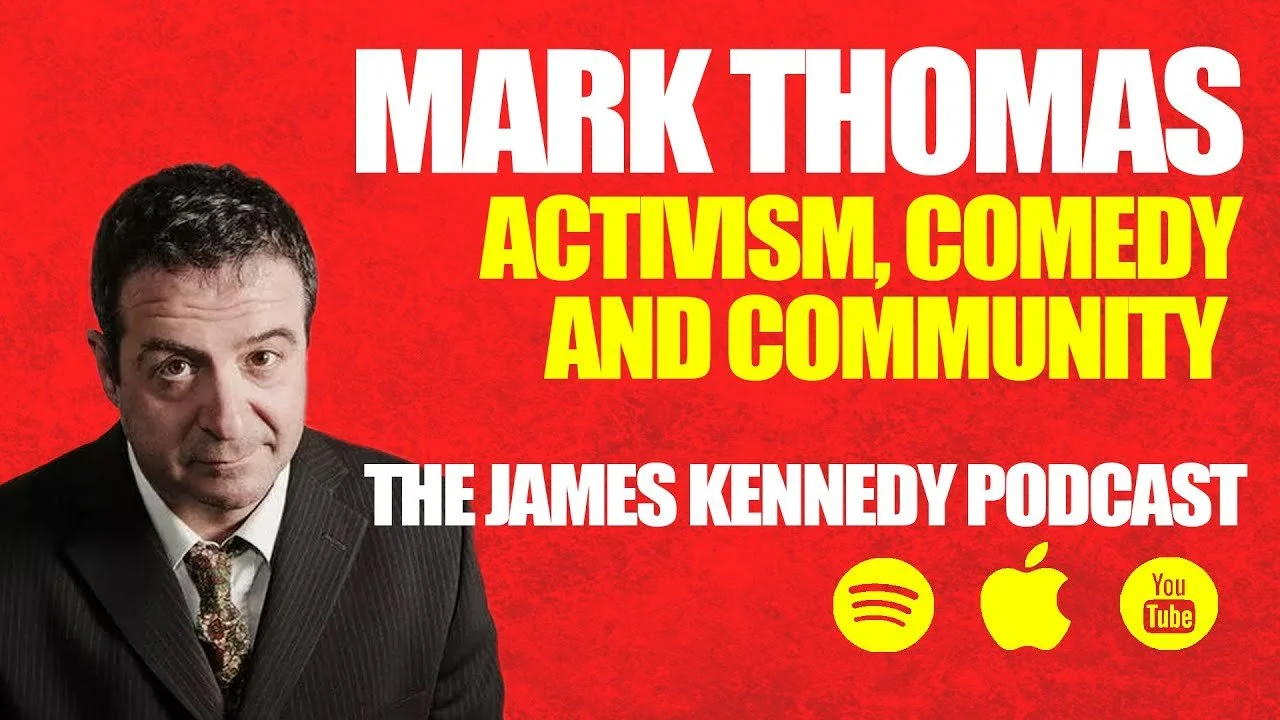
MARK THOMAS - ACTIVISM THROUGH COMEDY AND COMMUNITY
James Kennedy interviews activist-comedian Mark Thomas to discuss political populism, grassroots community activism, fan-owned football, the power of comedy and Thomas's new play, Ordinary Decent Criminal.
James Kennedy: Ladies and gentlemen, please rattle the roof for Mr. Mark Thomas. Mark, how you doing, brother?
Mark Thomas: Heidi hi! How are you doing, brother? It's great to see you. What's up? I'm all right, man. I've just got out of the bath, so you've joined me at a very relaxed moment.
James Kennedy: I love it! Perfect. And also, I should point out that today we are recording this on October the 13th, which as it turns out would have been the 100th birthday of the late, great Mrs. Thatcher, who I'm sure you're a fan of as much as I am. Any thoughts on Mrs. Thatcher, Mark, and will you be doing anything to celebrate what would have been her 100th birthday?
Mark Thomas: Well, the thing about her, it's an interesting thing that Thatcher's legacy has now been picked up by Reform. They're the true inheritors of Thatcher's legacy, which is total privatization. It amazes me, because you know what, a lot of Reform supporters—the anger that Reform supporters feel is a very real anger, you know? We should all feel angry. We're paying over the odds, we're paying masses of money to a bunch of billionaires for crapping in the water, you know? We're paying over the odds for gas and electricity, we're not looking at green renewables, all these things are happening, you know? The piecemeal approach that Labour take to it all; the idea we should be fighting for council houses, we should be fighting for a massive rebuild that is a council house rebuild, the privatization of the Health Service, the continual privatization of everything, the financialization of our lives—Nigel Farage is the inheritor of that mantle. I'm not sure I made any sense in that rant there.
James Kennedy: No, totally, man, totally. I mean, it's an interesting one, isn't it? Because yeah, we're seeing the rapid rise again of populism in figures like Trump and Farage; the far right is back with an ugly vengeance. But do you feel the left should share some of the blame for that, and that the left has helped to enable this situation given that our track record the past 10 or more years has been shambolic? We've offered no effective opposition or alternative ideas, and we've just left the gates wide open for the far right to stick its jackboots back in. What are your thoughts, man? I mean, has the left been letting us down?
Mark Thomas: Well, it's interesting if you look at Labour at the moment, who are—with Starmer's "island of strangers" speech, your reference to legitimate concerns, to criticizing people's behavior as being un-British, he's focusing on migration—you just think all that he's doing is he's rolling out the red carpet for Farage. He's legitimizing his viewpoint. What Labour essentially is saying is Nigel Farage is right, but we'll manage his racism better. And that has legitimized it. There's no way that Reform supporters are going to vote Labour; they absolutely hate them. I mean, we'll see, but my feeling is that the Labour Party have laid out the red carpet in response to populism, in response to the far right.
And I think we have to be very clear about this: when you start talking about rounding up people on the basis of their skin color and deporting them, that is fascism, and I think you have to be very clear that what Farage is putting forward is a type of fascism. He is kind of like a superversion of the 1970s National Front.
When you say, "Has the left played any part of this?"—I think certainly, be clear on this, anti-Semitism exists. It's not a fictional thing; it exists. Anti-Semitism exists everywhere, and it exists in the Labour Party, but the way it was weaponized and used against Corbyn supporters and Corbyn was quite remarkable, and I think it shows that the right wing of the Labour Party would rather destroy the Labour Party. So certainly that's happened.
I think there are parts—and you have to sort of go, there are bits of the sort of movement to support Palestine, the solidarity movements, there are bits, not massive, but there are bits that have anti-Semitism in it. I mean, it's our duty to call that out. It's not as big as people make out, but it is there, and we have to call it out when we see it. When two Jews were killed in Manchester, it's very, very simple: that's wrong, that's racism, that's anti-Semitism, we condemn it. You don't have to add anything else onto it, you don't have to go, "But what about...?" No, that's it. It's racism and it's wrong and it's evil and we condemn it. That's it.
I think the left's tendency, the "what-about-ery," really just does my head in. Just as Netanyahu, when he said that this was an example of anti-Semitism equating to anti-Israeli policy; just as Starmer equated anti-Semitism with opposition to the genocide, those—that's racism, that's conflating Judaism and Jewishness with Israeli action in Israeli government and Israeli military campaign. The left shouldn't have any truck with that, but when we see it, we have to call it out.
James Kennedy: Beautifully put, man. Yeah, no, I totally agree, and we're living in strange times. It's like everything has become so binary now, you know? You either totally agree with this or you totally agree with that, and you don't agree on anything in the middle. And I feel like this is something that started creeping in during the first Trump era, and it's just not realistic as to how things work in the world, you know? And I certainly don't think it's true of how most people think either, but it's made the nature of discourse now so extreme, you know? You're either in complete agreement or complete disagreement, and everyone's screaming and shouting at each other, and I think that social media has played a role in that as well. What do you think? Are you seeing this as well?
Mark Thomas: Social media has played a role in it because the platforms are owned by billionaires, you know? The billionaires own the platform.
There's a show that I've been doing with a mate of mine called Vic Melody. She's a performance artist and an anthropologist, and I've been working with her. It's a great show. What she does is she embeds herself with hobbyists and then goes and does shows about it, and she'll be in there for years. So she did a show about pigeon fancying and about Northern Soul dancing. Anyway, we've sort of known each other for years, we've talked about working together for years, and she said, "What should I do?" and I said, "Reenactments."
And the reason why I make this jump is because the English Civil War saw this explosion of radical thought and ideology, right? If you look at the Levellers, the Ranters, the Diggers, you know, the Fifth Monarchists, you have all these radical ideas. Diggers, proto-anarcho-communists from 1649 squatting land that they could feed themselves and plant and grow vegetables and creating communities. That's Gerrard Winstanley, who is the person who sort of pamphleteered and was the leading figure within the Diggers. His pamphlets were kind of 200 years before Marx wrote the Communist Manifesto in English, and it was printed and available. It was no longer in Latin, it was no longer the possession of the clergy; it was open to everyone. And people began to read it and say, "Oh, this bit: 'Love thy neighbor,' or whatever. 'The earth is a common treasury.'" That's when you see this explosion, which is why suddenly the press starts to emerge, the control of the press, the control of the media starts to emerge.
And it's the owners of the platforms that have their own self-interests at heart, whether it's Musk promoting all his sort of debating 13-year-old apartheid-apologist wank, or whether it is Zuckerberg complying with Trump's demands. They're all working for their own agenda, for their own money, for their own enrichment. So there is a degree that social media has polarized things, but that's at the behest of the owners of it.
One of the interesting things—and this goes back to the thing I was working with Vic—one of the things we did was we worked a lot in a council estate in Brighton, in East Brighton. Now, Whitehawk has got a life expectancy that's 10 years less than the rest of Brighton. Half the kids there live in poverty. It's the end of the bus stop. There's no pub, there's no post office, there's no church, there's no school; there's a Premier shop, that's roughly it.
Right, during lockdown, or just as lockdown was starting, there's a guy there called Brian. And if you're listening, Brian, salute! He started the East Brighton Food Court, and he offered people meals on wheels. Right, he's got nothing. He's got nothing, but he asked people, "Are you a bit more worried because you have to go into town, and how can you get into town when you haven't got money?" They're worried about how they're going to feed themselves. So Brian found where there was a disused community kitchen, borrowed the key from the caretaker, cut a copy, and squatted the kitchen. He was blagging food from supermarkets, from restaurants, from cruise ships, and he got all these volunteers to come and help, whether it was pensioners, trade unions, people who lived in the flats nearby. 400 people a day—free food, right?
Because it is a market—fruit and veg—he's obsessed with people getting their fruit and veg. His mission is to smuggle in 33 portions a week, right? He's absolutely brilliant, and he's a remarkable man, right? And so he makes things happen, and in communities, that's really important. Working-class communities, it's really important that people come together in that way to fight for each other. And I just want to say, because he was blagging off cruise ships, while the rest of the country went into lockdown, the people on a council estate in Brighton ate lobster.
James Kennedy: This is brilliant, this is brilliant, you know what I mean? It's so exciting. Love it, love it, love it!
Mark Thomas: It's fan-owned. It's fan-owned, right? They're anti-homophobic, they're anti-sexist, anti-racist, anti-imperialism, very pro-beer, right? And they sing about that on the terraces; it's really exciting. You've got a community hub there that was set up independently. They've got cookery clubs, they've got a boxing club there, they've got a mum and toddlers club there, they had a vet who popped in. All of this stuff that's happening independently because people haven't got a choice. People haven't got a choice: you either come together and fight for your community and build grassroots structures, or you will die alone. And that's that.
James Kennedy: 100%. Yeah, and that kind of segues perfectly into the next question I was going to ask you, because I wanted to ask how you feel we most effectively affect change. Because you've been involved in causes and activism for a long, long time, and you've done a lot of work on a lot of different issues. So I wanted to ask, from your experience, what have you seen as being one of the best ways to affect change? And I feel like from what you just said, that the answer is possibly going to lie within direct action within the community, starting on your doorstep, making things better in real, tangible ways today. Is that about right?
Mark Thomas: I think it is. AFC Wimbledon, as you may or may not know, we had the ground sold. 35 years ago, it was sold to property developers—the owner of the club sold the football ground. And so activists, football fans, trade unionists, local community people came together to form AFC Wimbledon. And in 23 years—we were put at the bottom of the English football pyramid—in 23 years, we've gone through seven tiers of the English football pyramid, right? We're now in League One. So we've gone through all that, and we've got our own ground, right, owned by fans, built by fans, right, 250 yards from the site of the original stadium.
And that's a beautiful, beautiful story. It speaks of the love and importance of football within a community, and what it means for a community, and how it's not just about the community coming to the club, but the club being the community. The club also has an action trust. We did something like 1,500 times on our food delivery, okay? And we work with GPs, right, so local doctors in the area can refer you to Wimbledon's food bank, and you'll get a package every week. You don't get assessed, you don't get marked down, you don't get, "Well, you had one three weeks ago." You get a package every week. We've got computers for schools, we've got a furniture bank, all this kind of stuff.
I was doing some stuff with a mate of mine over at the club, and one of the officials who was helping us says, "I've got to hurry up." I said, "Why is that?" He said, "I'm off to teach." I said, "I thought you worked as a coach and stuff." He said, "I go in to teach local schools for kids who are hard to reach in English and maths, because I wear the badge and because the club means something. And it gives me a bit more entry into respect into kids' minds to actually be receptive to learning."
That is a community club: we look after the community that we're part of. But it also means if you're a football fan, your club's got more chance of surviving with roots in the community. You look at clubs which are just sold up, moved off, parceled off, used by Saudi Arabia, used by UAE to whitewash a dreadful human rights and democratic deficit. So when you look at change, you can look at it on those very small levels of actually making sure your community is all right, of looking after and working with your community.
And I think in places like Italy, they're in the community, they're part of the community, they're involved in the football and they're involved in the local scene to make sure people are fed. It's all about all the political aspects as well as clubbing and all of those things that go together with it, and that actually is really inspiring. And you can see it over in Clapton CFC, which is the community—the football club is, again, another fan-owned football club. They've just bought this place right next door to the football ground, and they're using the ground floor for new changing rooms, for community work, for people involved in the community, for working to bring the community together to facilitate those needs. It's really exciting when you see these things; these are the bedrock. We need to be doing the most basic terms of political work.
Of course it's important to pick up the mantle for Palestine. You know, it's absolutely appalling that we have seen Starmer arming a genocidal regime; it's appalling that he has then gone to outlaw people opposing it nonviolently and proscribing Palestine actions. We need to fight on that, but we also need to do the bread and butter.
ENJOYING THE CONVERSATION?
GET JAMES KENNEDY'S LATEST INTERVIEWS, WRITING AND LIVE SHOWS STRAIGHT TO YOUR INBOX.
James Kennedy: Bang on, man. Yeah, beautiful stories, man. Beautiful people doing beautiful things in the community that actually affect people's lives for the better in the here and now in ways that all of us can get involved in, you know what I mean?
Mark Thomas: The thing about that is it cuts across bringing the community together, and once you've got them together, you can start to preach.
James Kennedy: Love it, love it! Well, I mean, what about the political system, though? Because yeah, it's essential for all of us to do as much as we can on our doorstep and address the issues that actually affect people's lives in the here and now, but we also have to fight fascism, you know? And we also have to maintain our democracy, certainly at times like now more than ever, you know? We're living in such hot times right now that it's very easy and tempting to just tap out of it sometimes. It's certainly how I feel; I feel so fucking bedraggled by it all sometimes that I just want to tap out, you know what I mean? But I know that that's what they rely on, and that's what they want, and that's why they do it, so it's important that we fight the bigger battles and on the bigger battlefields as well, right?
Mark Thomas: People do whatever they can in their own little way, do you know what I mean? Sometimes—I used to know a guy who was Irish and came to this country in the '50s, and he was just like, "You keep your head down, you go to work, you don't cause any fuss, right? That's it, you go to church." But every time he got some money out the bank, when he put his wallet in his back pocket, to quote: "The Queen would always kiss my ass." And I always thought, you do whatever little bit you've got to do, do you know? And if it's as small as that, at least celebrate that.
You're right, though, that in a way it's purposefully overwhelming, you know? Throw everything in the air, break everything up, move quickly—the neoliberal mantra, if you like. It does become overwhelming. Follow the money, that's what you do, you know? Trump gets a plane—"Thank you very much, you've given me a new massive great one"—and then suddenly, "Oh, what's that? We're opening up an airbase for you in Idaho." Watch where he's going, watch the fact that this is a president who just enriches himself. He's an old-fashioned mafia thug, he's a fascist, you know, that's what he is. He's a klepto-dictator as well. Dictators, they steal things.
It is sometimes overwhelming, but I think it's our job to just kind of find what we can do, find what we think is useful, find what we think is productive, find other people to work with who support us. People used to say to me, "What advice do you have for me if I want to be an activist?" and I would always say, "Right, this is what you do: you find something you're interested in, find something you're passionate about, research it, really read up about it, understand the subject, understand the arguments that are thrown at you and understand how you can defeat them. And then you start to organize meetings, and you start to find other people who work with you. You get the leaflets printed, you hand them out, you set out the chairs, you watch no one arrive, you fail. You do it again, you watch a few people arrive, you fail again, then you build it and you get more people, and you start groups that can protest together and put petitions together and write letters and lobby and campaign. And when you've done all of that, then you get to hang off an abseiling rope outside Big Ben and look really cool."
James Kennedy: Indeed, indeed! Well, I mean, you've always made activism seem really fun and really cool. I mean, I watched every episode of The Mark Thomas Comedy Product, I watched it every week, and I want to show you something before we move on, because I'm so old that I've actually got every episode on VHS—look at this! And that show was so important in my political development, because you just made politics accessible and you made activism seem really fun and really cool, you know, and the pranks, like flying over Menwith Hill in an air balloon...
Mark Thomas: Thank you. I'm just delighted that you did, thank you.
James Kennedy: No, well, thank you, man, sincerely. I mean, you've inspired me and so many people from my age and my generation to become politically active and engaged, you know, whether it was in your writing or your TV work or the live comedy shows, of which I've been to many. And you've always managed to find the fun and the humor and the human and the heart, you know, in all of these issues through all of these times we've been through—and man, there's been some tough ones over the years.
But I wanted to ask how you maintain that, you know? You've never lost your fire and your passion and your energy, and I feel at the moment that we're living in possibly the worst times that I have ever experienced in my entire life, and it's affecting my energy and my sense of hope for a better day. How do you maintain that? How do you keep your hope and your fight alive through all of these fucking tough times, man?
Mark Thomas: I think it's this idea that I was born in 1960, and so I was kind of brought up with this idea that things would get progressively better, that somehow each generation would materially improve upon the last one, that I would do better than my parents and that my kids would do better than me, and that somehow we would all move forward and we would all benefit. That idea is gone, that idea is shot to pieces—the idea that we will gradually get better, that things will improve, that's out the window.
What I think is interesting: I don't have a huge amount of hope. You get the old Marxist-Leninists always go, "The victory of the proletariat is inevitable," and it's not. It's not inevitable. What's inevitable is conflict. Rosa Luxemburg famously said, "We face barbarism or socialism." Right, that's what it is, that's the choice we've got.
When I first started going to the West Bank in Palestine like in 2009, I always remember talking to someone. He said, "The thing that I'm proudest of is that we're still here." And I remember saying, "Do you have much hope?" and he said, "No, not at all, but I always know there'll be resistance." And that's the important thing to remember: when the hope arrives, it's fucking great, and sometimes it does, and when it does, it's just wonderful. You can feel those moments of change, you can feel those moments of community where you're moving forward and you're actually winning; it feels alive, it courses through you like crack.
What lasts is opposing wrong. What lasts is trying to create a better way of fighting, of resisting—that's what lasts. People just go, "Fuck this, I'm putting on a Palestine action T-shirt." Does that mean we're going to win? No, but it certainly cheers us up, and it shows the law for what it is, you know? That kind of resistance, the ability to laugh and to mock, is a really important one. Our ability to keep going is an important one.
James Kennedy: Love it, love it, man! Yeah, and comedy as well is a very important weapon in our arsenal, you know, a weapon that you've been using successfully against the evildoers for a long time now. How powerful a weapon do you feel that comedy can be in affecting change, even if it's just giving us all a laugh in times of hardship?
Mark Thomas: Let me put it this way round: a bloke in Hong Kong got a hooky video from a market, a dodgy video of a film, and halfway through the film he realized that it had been taped over a news report, and he realized that his government had been lying to him. And he started this path of anti-government cartoons, and what he used to do is do these cartoons, spray them on the walls, photograph them, and try to get them through the Great Firewall of China. And they'd get through.
One of the cartoons he did was of President Xi and Obama, and Obama was Tigger and President Xi was Winnie the Pooh. That was the cartoon that he did. President Xi was so, so, so enraged by it that he banned Winnie the Pooh in China! What?! So when you say, "What can comedy do?"—well, if all that we do is fuck off dictators, then that's a job, yeah, you know?
Comedy does all sorts of things. This is why Erdogan in Turkey was jailing cartoonists; this is why cartoonists get banned and jailed in Saudi, because they don't like it. There's a great quote, which is, "The truth is written on the toilet wall," you know, that actually that'll be the last place that you find the truth. I suppose that's where comedy takes its root.
Martin Rowson did a cartoon—he's a cartoonist, and he did this cartoon after the Finsbury Park mosque attack, where a racist drove a white van into a bus stop at Finsbury Park mosque. Martin drew a van at a bus stop, and on the side of the van it said, "Read the Daily Mail, read the Sun." That cartoon—the editor of the Daily Mail, Paul Dacre, went into a fucking meltdown! He did a front page furious at these liberals mocking him, mocking his readers, you know, from a cartoon! Yeah, that's fucking great, and I love it! I've got that picture, and it's a reminder of what we can do, of what we can achieve with what we think are small things, you know?
We're part of a culture of resistance. I mean, you can also look at it the other way: you look at Israeli comics that were doing jokes about famine and jokes about Palestinians starving, or you can look at it from the '70s and see the vicious thuggery that went on within some of the club circuits where, especially in the north of Ireland, famine gags were told. These are the taunts of bullies, so it's not one thing or the other. It's just a thing that's there that really fucking upsets people in power. What more reason do we need than that, you know? I love the Portland Frogs. Oh God, you're a genius—there's a war zone, and you've got all these inflatable frogs standing off against ICE agents.
James Kennedy: Yeah, and these guys are so megalomaniacal and narcissistic and psychopathic as well, they just can't handle anyone taking the piss out of their delicate little fucking ego. And that in and of itself, just to know that something someone said as a joke, an innocent fucking joke, has got them pounding around their fucking mansion with a vein popping out of their head, you know, it's a beautiful thing.
Mark Thomas: Yeah, absolutely. To know that we have the power to elicit that response from the rich and powerful is a wonderful thing.
James Kennedy: Amen to that, brother! Amen! And that segues perfectly into your new show, Ordinary Decent Criminal, a play written by Ed Edwards and performed by your fine self. You're performing it all over the country as we speak. Can you tell us a bit about it? What's the backstory, what's it about, and how's it going?
Mark Thomas: Okay. Over the years, my shows have moved away from straight stand-up into big old theatrical pieces. I did a show about the Red Shed, which is a Labour club in Wakefield, and about the miners' strike, and about a memory of it. It involved all my friends from that time, meeting up and finding them and trying to find this story, so it becomes a very theatrical thing. And what I love is all forms of performance.
So I've been building up shows that have verged into political situationist theatre for years. I came out of a show called The Political History of Smack and Crack, which is about the flooding of Liverpool with heroin in the early '80s. I came out of seeing it and said, "That's the best show I've seen in years." And this voice behind me went, "I wrote that." And that's how I met Ed Edwards, the playwright. We just started chatting, and we got on like a house on fire. So we would hook up; if I was touring, he'd come and see me, if I was up in Manchester, I'd go and stay with him, and we got on really, really well. I really like working with him.
So we developed a show together called England & Son two years ago, and that was great. I mean, we picked up six awards and toured it in Australia—it was really brilliant. And so we wanted to do another one, which is this Ordinary Decent Criminal. It's based upon the fact that Ed had been a half year in jail for importing cannabis, and he was an old communist who ends up as a drug dealer and then refinds his communism. It's a funny old story, because you get lots of people, like innocent people go to jail and fight for their freedom, you know? This one is: guilty bloke goes to jail, discovers activism. It's quite a wonderful story, and Ed's writing is fantastic.
Everything's packed fast. So if you were saying, "A thin-looking man appears at the side of the door and walks into the jail," right, he doesn't do that. He goes, "A gaunt man enters." Bang, you're done! Like it, you know what I mean? Everything is really alive, and it's a great story, and he writes it such that it's like an emotional rollercoaster. We were doing it down in Plymouth, and it was just alive. The people coming up after us, I was saying to them, "I'm glad you feel like that. I don't want you to feel like you've been to theatre. I don't want you to think, 'That was marvelous, darling. Where should we go for dinner?'" You don't want people doing that; you want people coming out and going, "Bloody hell, what was that?" That's what you want, and I love that feeling.
I performed it in a jail last week to a group of prisoners, and it was electric. People might not like the idea of going to do stuff in jails, but whether you like it or not, people in jail are in your community. They might not be on your doorstep, but they're in your community, so what do you want to do? Do you want to punish them more like the Daily Mail, or do you want to try and engage with people as adults and human beings? I'm not going, "Well, we should give everyone jacuzzis," quite clearly, but what you want is people using their time to create.
It's really exciting looking at people's jail writings. One lad I met a few years ago when we were doing stuff in jail, he had started writing and had been on the education course, and he showed me the pile of A4 notebook books he'd filled up with his writings—whether it was raps, poems, diary pieces, or short stories. I swear to you, it was nearly a foot high, this pile of books that he had filled in three months. For me, that's really exciting, that's really, really thrilling. And the play has all sorts of stuff in it about jail, about capitalism, about how it works, about how we survive and what we do to find meaning for ourselves, if you like. It's just a great, great show—go and have a look at the reviews, they're really great reviews.
James Kennedy: It sounds incredible, man, it really does. I've got to get out to a show. You're playing all over the place, sometimes several shows a day. In fact, you're actually playing tonight, is that right?
Mark Thomas: Yeah, I'm going down to Hove tonight. We've got three nights in Hove, which is all very nice, really great to do. And then I'm working on a new stand-up show, and we're looking at ideas for another theatre show, a little bit of activism and naughtiness, and then we're looking at some stuff with football and the idea that you can pressurize the football regulator to make it look like clubs can't spend more than they earn. You change it all around. So for me, there's all sorts of things going on, and it's all very exciting. And I'm 62 now, so I should really be getting ready for my pension, but here's the secret: I haven't got one, so I'm just going to have to keep going.
James Kennedy: Yeah, I hear that, I hear that! I'm in exactly the same predicament myself. Yeah, I'm going to be singing and playing the fucking guitar until the day they put me in a box. Well, thankfully, it doesn't sound as if you're going to be running out of ideas or fire or energy anytime soon, so that's great for your purposes and amazing for the rest of us, because we get to continue to enjoy the wonderful gifts of Mark Thomas for many years to come.
Well, speaking of that, where do people keep up with what you're doing? Because you are a busy guy, you're always putting out good shit, but you seem to be off all social media now apart from BlueSky and your website, which is obviously excellent and has got everything on it. Is there anything else where people can follow you?
Mark Thomas: That's it: you can follow me on BlueSky or on my website. That's it.
James Kennedy: Top man! Yeah, I like that.
Mark Thomas: It's just another fucking thing I've got to learn, you know? I don't want to do that.
James Kennedy: You're not missing anything, man.
Mark Thomas: I've been performing for 40 years. You either like it or you don't; come or don't, that's it.
James Kennedy: Love it, love it, man! Yeah, well as a fan, I'm thrilled to hear that there's going to be more stand-up coming, because I'm going to show you one more VHS—look at this: Brighton Arts Centre, 2001, man!
Mark Thomas: Oh man, that was a great one. Was that the Dambusters tour? Yeah, that was Dambusters when we were doing the Ilisu Dam.
James Kennedy: Bruv, one of the best gigs I've ever been to, I'm not lying, man!
Mark Thomas: Man, I became involved in a campaign—I started a campaign by accident, working with Kurdish activists, green activists, crusties, all sorts of people, and we ran this really amazing campaign. And what was great was, right at the beginning, we went to the Kurdish area where this project that Britain was supporting was going to take place, and they all said to us, "Just go and attack the finance. Go and attack the finance." And that's what we did, and we won! Unfortunately, we beat the British government, seven European consortiums, and a torturing state, but we didn't win in the end. The Chinese government built the scheme, but we held it off; we did our bit. Was it enough?
James Kennedy: Well, no, but I have a feeling it never is. 100%, yeah, man. Like, people ask me as a musician all the time, "What's the best gig you've ever been to?" and they always expect me to say a band, you know? And I say Mark Thomas' Dambusters, because I went with my father, who was a fan as well—he's no longer with us, sadly—but we both came out of that gig fucking shell-shocked. It was just you on stage telling the story, and it was so fucking powerful and so intense. We were just shell-shocked when we came out; we didn't speak, we were kind of like, "Wow, that was a fucking ride."
Mark Thomas: You want people to be involved, you want people to be moved, you want people to be excited and full of thoughts and feelings, you know? The idea that you should posture around the stage in fucking tennis whites going, "Does anyone fancy a game?" just fills me with fucking dread. The idea that you go and see some theatre sometime—I've had the nicest sleeps in the National Theatre, yeah! It's essentially the most expensive, comfortable chair you can ever rent, and sometimes you leave the theatre and you just go, "I hate every one of the audience."
James Kennedy: Yeah, I can relate, yeah.
Mark Thomas: I want to see working-class theatre, I want to see exciting theatre. I love doing the show wherever we get a chance to do it. I've performed all over the place, whether it's been in working men's clubs, socialist clubs, on fucking squats, car park roofs, or in the street—I'm happy to do a gig. Theatre is kind of my least favorite venue, but I'll put up with it.
James Kennedy: Sure. Well, on that note, speaking of theatres, I've got to let you head off and prepare for tonight, so I've kept you long enough. Mark, thank you so, so much for taking time out to speak with me today. As a long-time fanboy from Wales, you've made me very happy, and it's very kind of you to do this. I appreciate it.
Mark Thomas: Oh man, I'm really enjoying it.
James Kennedy: Oh, I'm glad to hear that, man. Well, thank you again for doing it, and thanks for everything you've done generally to inspire, inform, fire us up, and keep us laughing throughout the years. You are a true legend, sir; we salute you. Best of luck with the shows, and please, please keep doing your wonderful thing.
Mark Thomas: Absolute delight. Take good care, my love.
Key Points:
Guest Mark Thomas discusses the rise of populism, the far right, and criticizes Labour's approach to migration and the legacy of Thatcherism.
Mark Thomas argues that social media polarization is driven by billionaire platform owners with self-interests.
Mark Thomas highlights community activism examples including AFC Wimbledon, East Brighton food projects, and fan-owned football clubs as effective grassroots change.
Mark Thomas explains his philosophy of sustained resistance over hope, quoting Rosa Luxemburg's "barbarism or socialism" and emphasizing that opposing wrong is what lasts.
Comedy is discussed as a powerful weapon against authoritarianism, with examples including the Winnie the Pooh cartoon that enraged Xi Jinping.
Mark Thomas tours his play "Ordinary Decent Criminal," based on co-writer Ed Edwards' experience in jail, and performs it in prisons.
Summary:
James Kennedy opens the podcast celebrating the release of his new book "Loud Medicine" and discussing progress on a third book and a new album with his band, The Underdogs. He then welcomes Mark Thomas, a veteran comedian, activist, and author, for a wide-ranging conversation. Thomas discusses the rise of populism and the far right, arguing that Reform UK inherits Thatcher's privatization legacy and criticizing Labour for legitimizing far-right viewpoints on migration.
He addresses how social media polarization is driven by billionaire platform owners pursuing their own agendas. Thomas emphasizes that effective change happens through grassroots community activism, citing AFC Wimbledon's fan-owned model, East Brighton food projects, and fan-owned football clubs as examples. He explains his philosophy of sustained resistance over hope, quoting Rosa Luxemburg and stressing that opposing wrong is what endures.
Comedy is highlighted as a powerful tool against authoritarianism. Thomas also discusses his touring play "Ordinary Decent Criminal," based on co-writer Ed Edwards' prison experience, and his performances in jails. Kennedy closes by praising Thomas as a legendary figure and encouraging listeners to support his work.
The James Kennedy Podcast is a Society and Culture podcast hosted by musician and author, James Kennedy. Exploring the big questions around health, social issues, the arts, politics, mental health, the human condition and how to navigate this thing called life through casual conversations with scientists, activists, rock stars, philosophers and academics. Please subscribe, leave a rating and support the show.