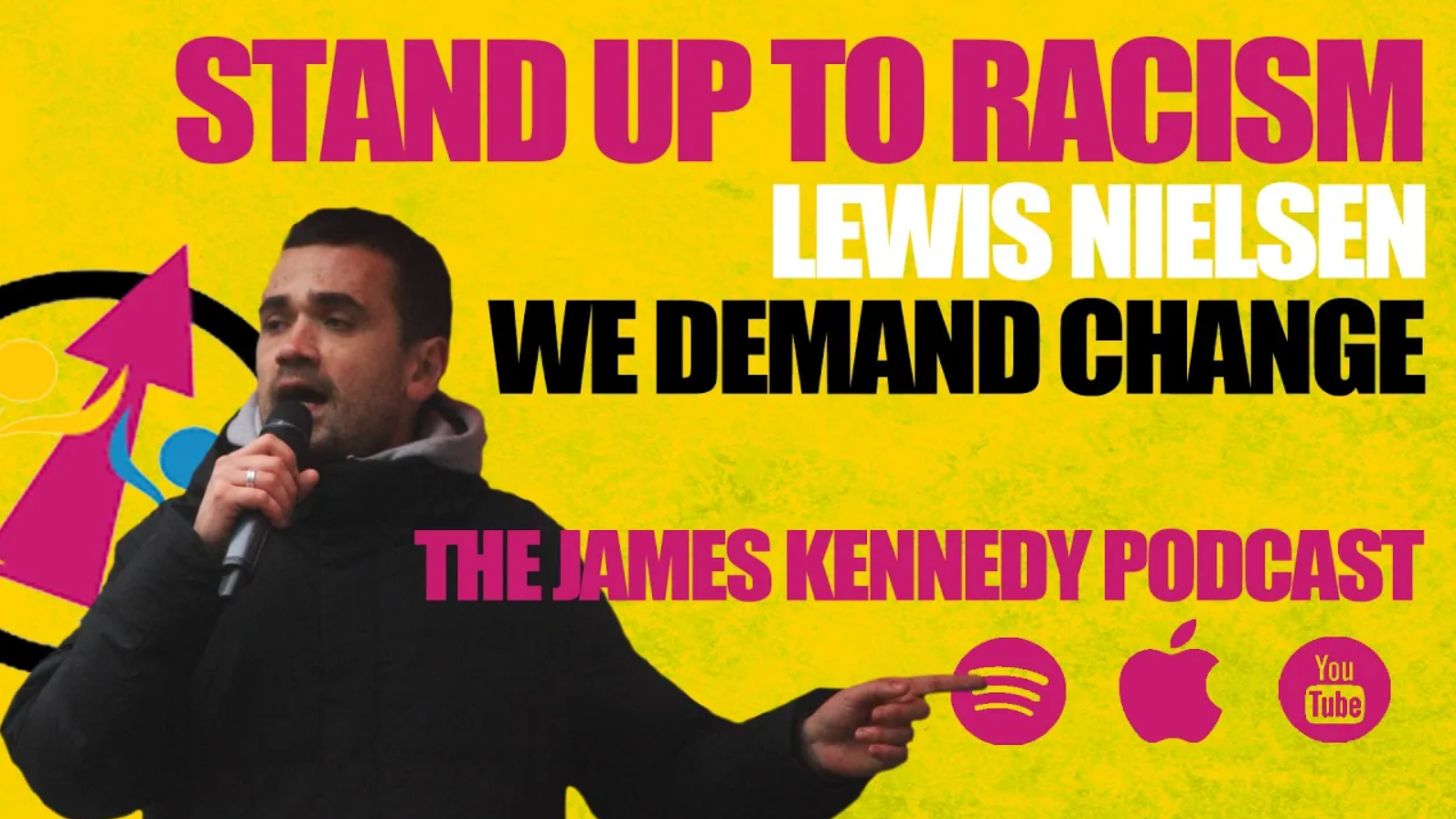
LEWIS NIELSEN - STAND UP TO RACISM
James Kennedy speaks with Stand Up To Racism Anti-Fascist Officer Lewis Nielsen about the March 2025 "We Demand Change" summit in London. They discuss the rise of far-right politics, systemic inequality, and how grassroots organizing and collective action can drive meaningful change.
James Kennedy: Lewis, thank you so much for joining us, brother. How you doing, man?
Lewis Nielsen: I'm good, James. How are you?
James Kennedy: I'm very well, thank you, man. Thank you for asking, and all the better for seeing your fine self. We got loads of stuff to delve into today, but before we do that, I wanted to ask if you could share a little bit about yourself and the campaign group that you are involved with, Stand Up To Racism. What is it that you guys do, and what is it you campaign for?
Lewis Nielsen: Great. Well, it is a real pleasure to be here, James, and to be talking to you. Look, my name is Lewis. I'm the Anti-Fascist Officer with Stand Up To Racism. We are a broad coalition based in Britain that campaigns against racism, fascism, Islamophobia, and antisemitism. To be honest, most of our time, unfortunately, in the last year or so has been taken with racism and anti-fascism, campaigning against the far right. We were one of the organizations that did a lot around the response to the far-right riots we've seen in August—sorry, last August—and we spend a lot of our time pissing off Tommy Robinson and his supporters by organizing counter-protests and making sure they're not marching unopposed.
So that's what we're about. Then the event we got on the 29th of March, the We Demand Change summit, is really about all the people supporting it coming together and saying something's got to happen. We've got to try and change the way things are heading in Britain. So we're really excited about it, and it's only 10 days away I think now, which is exciting, but there's a lot of stuff to do to put it all together.
James Kennedy: I can imagine, yeah, I can imagine. Not the only event that you guys are involved in as well, but we'll mention that as we get towards the end just to loop backwards. So tell us about what is happening at the event in London on March the 29th, if you can.
Lewis Nielsen: Well, look, the event came about because a few of us from the different campaigns—Stop the War, the Peace & Justice Project, Jeremy Corbyn, trade unionists, and others—have, just to state the obvious, looked at what's happening in Britain, looked at the direction Keir Starmer is going in, and said that we need to do something to try and stop this, that it's possible for us to come together to debate, to discuss, but also to be honest, to fight back. To say that the racist rhetoric he's using around immigration, the stuff today announced about the attacks on disability benefit, the support for an Israeli genocide in Gaza—it's about saying that if we work together, if we join the dots, the anti-racist movement, the Palestine movement, the trade union movement, if we come together, then we can offer a politics of hope. Because I think—I don't know about you, James, but myself, my friends, my family—a lot of people feel despair at the moment, I think. The 29th was about trying to say that if we come together and organize, we can offer a politics of hope.
James Kennedy: Love it. Well, God knows we need that more now than ever before, because it is hard to maintain hope at the moment, man. You know, the sheer scale of injustice and unfairness that we're witnessing right now across the world, not even to mention the horrors of the genocide in Gaza that we're all witnessing on a daily basis that just seem to go completely unopposed by the world's powers. It is hard to keep one's hope and one's fight at a time like this, you know, but I'm sure that that's exactly what the powers that be want.
That's why I love events like this and activism more generally, because it always makes you realize that you're not alone, that there are way more of us than there are of them, that there are way more good people in opposition to the bad guys than you might be led to believe if you look at Twitter or the mainstream media for five minutes. So I always feel better and more hopeful when I come away from one of these things. So far the numbers are looking good, right? You've got thousands prospective to turn up to this one?
Lewis Nielsen: Yeah, I mean, look, we're confident that at this point people will be booked in advance, more will turn up on the door, some will join online. Like you just said, James, this is about building collective power from below. It's not about saying we have to hope that someone in the Labour Party drags it a bit leftwards, or wait until there's some electoral project. I'm for challenging Starmer, but it's really about saying that our power lies when we mobilize, when we organize, when we get out on the streets, when we organize in workplaces, communities, and that kind of thing. We think that kind of thing can turn the tide.
I think it's understandable why people feel despair, but to be honest, fear-mongering etc. is going to get us nowhere, do you know what I mean? We have to have a sober analysis about what we face, which is a big threat, but we have to say, "Right, we're going to crack on with trying to change things," and if we do that, we think we can have an impact in Britain. Maybe I'm an optimist, but I honestly believe that there are more anti-racists in Britain than racists. I think there's more people in support of Palestine than there is in support of what Israel is doing. I think there's more people who want to spend money on supporting people on benefits than they do want to on giving the rich tax cuts. I think that the question is we've just got to organize those people, isn't it?
James Kennedy: 100%. 100%. Thank you to yourself and everybody involved in this for making that happen as well. It's so important.
You've already alluded to some of the pressing social issues that face us right now. I'd like to do a bit more of a deeper dive into that. I mean, we can talk about this either from your personal perspective or obviously as a representative of the event and the campaign group that you're a part of, but I'd like to ask you—and you can answer it from whichever angle you want to do so—what do you feel are the most pressing issues for us as a country right now, and as part of a global community as well?
Lewis Nielsen: Well, I do think that if you look around Europe, I think the rise of the far right is, well, to put it mildly, one of the biggest challenges we're going to face. I mean, if you look now, the picture around Europe is that far-right or even fascist parties are getting 20% of the vote or are getting elected. I mean, the German election result that came through, what was it, a month ago now, you know, there's a fascist party in Germany getting 20%. And these guys don't really hide it, to be honest. They openly embrace the controversy of Holocaust denial, of calling for mass deportations, and so on.
My biggest worry is that Britain is not far behind. If you look at Farage and Reform, I do think it's a unique threat that we've never actually faced in Britain. This is a far-right party which now has four MPs, because thankfully they're falling out with each other a bit. But it's going to win a lot of councillors in May. I think it could win something like 200, 300. They're probably going to win the by-election in Runcorn; there's a chance of that. And they've got 200,000 members.
We feel I think that it's time to sound the alarm about that. We also think that Starmer is playing into their hands, to be honest. When I see Yvette Cooper bragging about deporting migrants, when I see Starmer essentially trying to copy Reform's rhetoric on migration etc., and then cozying up to people like Donald Trump and the fascist Giorgia Meloni, who's Prime Minister of Italy, you just think, "Look, this isn't going to stop Nigel Farage; it's going to give him more confidence, because he's setting the agenda, you know what I mean?"
If you look around you, it's never worked—social democratic or conservative parties using the language of the far right, if anything, gives them more confidence. But we're saying that it's possible if you organize that we can push back against that. Last August showed that, I think. You'll remember it as much as me, James, and I'm sure the listeners will, that it was really scary for a week, wasn't it? To be honest, it really felt like they were on the rampage. People were understandably, especially people of color and people of Muslim background etc., worried about going out.
What turned that was not the police and it wasn't Starmer. It was that we came out, wasn't it? From Walthamstow right up to Hull, to Plymouth, to all over the country, people said, "We're not standing for that." And we think we need a bit of that now. I do honestly think Reform are a danger, but I don't think they're unstoppable. They've got their own problems, their own contradictions. If we get that anti-racist message out there, we can stop them. So for me, that's the biggest thing at the moment where Trump has a vision of him in the White House, of Farage in Number 10, of Le Pen in France, of Meloni in Italy, and all the rest of it. We've got to say we're not letting them take us back to the 1930s.
James Kennedy: Amen to that, man! Yeah, hell no. What do you think is behind this disturbing growth of the right again then? We've been here before; we've learned these lessons, man. Why is this happening? What do you personally think is behind this rampant growth of the far right again?
ENJOYING THE CONVERSATION?
GET JAMES KENNEDY'S LATEST INTERVIEWS, WRITING AND LIVE SHOWS STRAIGHT TO YOUR INBOX.
Lewis Nielsen: Well, look, I think that's the biggest question, isn't it, in the sense that it does feel like the far right are at their strongest level since the 1930s. I think there's two things to understand about it.
One is that the way in which mainstream parties, including parties like Labour, have driven through austerity has created real bitterness in society. People are poorer, standards have been cut, wages have stagnated, inflation's higher, so people's lives are harder, and people are right to be angry.
The second thing is that mainstream parties have also embraced racism that has emboldened the far right. So it's now common, whether it's in Germany, France, Britain, or Spain. Pretty much every social democratic party, as well, of course, as conservative parties like the Tories, have embraced Islamophobia. They've accepted the idea that migrants are a problem, when actually when you look at it, migrants build our societies, like the NHS, etc. They go along with the idea that asylum seekers on small boats or whatever are the biggest problem.
I think the combination of those two things—creating bitterness in society and then pandering to the racism—means that the far right can pose as outsiders. It's ridiculous, isn't it, that millionaires like Trump and Farage are able to pose as outsiders? But two, they're using arguments which are being used by the mainstream. Their kind of racist rhetoric is being used by the mainstream.
What we argue, James, is that that's why we need principled anti-racism, but we do need an alternative, and that's what the summit on the 29th is about, really. It's not about saying no to Reform and we're just going to prop up the Labour government. It's about saying, actually, we can build an alternative. You can say to people that pensions don't have to freeze, that we don't have to cut disability benefit while the rich get richer and there's more billionaires than ever. It's about saying you have to offer a politics of hope. That means anti-racism is key, but we have to say that the world can be a different place as well where people don't have to be bitter about their lives getting harder.
James Kennedy: 100%. Beautifully put, man. So what does a better, different, alternative future look like for you?
Lewis Nielsen: Well, that's a good question. That's a good question. Look, for me, if you look at what capitalism offers—and we look relatively the same age, James, but for my generation, I just think my future (I'm 31) is going to be one where the climate catastrophe is going to get worse. Climate change is going to be very real—well, it is already real. Look at what happened in LA over Christmas. I look at the rise of the far right. I look at the fact that, to be honest, for my whole adult life there's been economic crisis since 2008 where the economy has meant that ordinary people have faced cuts while the rich have got richer, and all the other things going on, the rise of transphobia, etc.
That's what capitalism offers, right? What kind of alternative do we need? I do think it's possible for us to build a world where profit isn't king, where the destruction of the environment so Shell and BP can make record profits isn't just a given, where we don't have to accept the idea that they're going to play migrant workers off against indigenous workers so that they're not uniting together. I think it's possible that we can build a more just and sustainable world, and that for me, to be honest, is a different kind of society. Maybe I'm going to shock you, James, but I'm an anti-capitalist. I think the problem in society is the way that the system is run, and I honestly think there's a potential—and you see it all the time in the movements for Gaza, or when people go on strike, or the solidarity people show with people who are under attack—that that kind of feeling and spirit is something which I think we can channel into a much better kind of world.
James Kennedy: You madman! You mean you want a more equal society where capital doesn't trash the planet and everybody's lives, and we don't have to live as stressed-out cogs in a machine in order to make billionaires richer? But are you crazy? It sounds terrible, doesn't it?
It sounds amazing! I don't know why it's so bloody difficult for us to get that over the line. All the things you just mentioned are all the things that we all want. It all seems so obvious, doesn't it? Everybody wants equality and security and a life of dignity and freedom and human rights, and there's not really any reason why we shouldn't all be able to live that life.
It seems to me that after the honeymoon period after the Second World War ended—where we had the birth of the NHS, free education, workers' rights, the welfare state, and the rebuild, building up the country in a much more equal and socially aware way—ever since then we've just been slipping back into the old oligarchic ways of the past. Why is that? How have we let that happen? How has it happened? Why has it happened, and how do we get from 1947 to where we're at now in 2025? What's going on?
Lewis Nielsen: Well, if I could also answer that, James, I'm not sure we'd be here; we'd be living in a kind of egalitarian paradise. But I guess, look, the biggest question for me is: do the majority of people in Britain and the world—I think there's big numbers of people who want to see change, who recognize the world is a fucked-up place, to be honest. Partly that's because of the big stuff happening—climate change, the rise of the far right, etc.—but also because people's own experience is hard, isn't it?
I think I'm the first generation who has it harder than my parents did. I speak to my mum about this, right? My mum was the first in her family to go to university ever. She got paid a grant to do that that she never had to pay back, by the way. It was a grant. She came out of university, could get a good job, and could buy a house at the age of 30 or whatever. That was actually quite normal. I'm not saying that capitalism in the '70s or whenever that was was amazing—there were lots of problems—but there was an expectation you could do that. None of that's now there for me, right? None of that's there for my generation, and therefore I think people recognize it and want to see change.
You see that manifest itself in the support for people like Jeremy Corbyn or Bernie Sanders, in the Palestine movement, in BLM, in the climate movement, and so on. What I think is the challenge is that we haven't yet found a way to break the power of the people you were talking about. We've shaken the system, haven't we? BLM did, the climate movement, Palestine has, etc.—shaken the system, but the power structure still remains mind intact. The big corporations, the way in which the politicians and the media support them, the way in which the police protect them—how we build movements, therefore, that can break that power is the biggest question.
I don't have all the answers for that. The summit on the 29th, we're not saying we have all the answers, right? It's not going to be a top-down thing where you come on and in the first session we're going to give you "what is to be done" and follow the leader. We want to discuss. We think there's got to be a discussion about this, and there's lots of different views, etc.
My biggest thing is how the magnificent movement for Palestine we've seen, the anti-fascist mobilizations—how do we build them into something more? My personal view—and I'm not really speaking on behalf of any organization here—my personal view is I think we do need an electoral challenge. I think it will be good in Britain if the left got its act together and put Starmer under pressure this May '26 and beyond. But to be honest, I think you have to go further than that as well.
If I think about the Palestine movement, the biggest power of that has been what we've done in the streets: the mass demonstrations, the student encampments, the stuff people have been at work. I think we need more of that because you look throughout history, that's how real change has come about. That's the thing we should take inspiration from: whether it's the civil rights movement in America, the big worker struggles we've seen, or the struggle for women's rights at the beginning of the 20th century, all of that came from below, and those changes were won from below. If we're going to change things today, it will be through that kind of mass movement and mass collective power that will do that.
James Kennedy: 100%. Great examples as well there, man. It's important for us to remind ourselves that there have been many times in the not-so-distant past as well where things have seemed pretty insurmountable and futile, but people power did indeed prevail. It's never easy, and it's never an easy win, but it is possible. Many would argue, including myself and I'm sure yourself as well, that it's the only thing that ever achieved any form of effective change: grassroots collective organizing and pressure from below.
So we can find hope in those examples that you just mentioned there, and as we said at the start, hope is something that we could all do with a hefty injection of right now, because it's pretty tough right now. I share your view of parliamentary politics as well.
I wanted to ask you, speaking of hope, what hope do you feel that there is in the electoral parliamentary system given our recent experience of it? I mean, we've got Keir Starmer as the leader of the Labour Party now, so it doesn't get more surreal than that, yeah? Should we fight this battle on that battlefield as well within parliament, or should we just forget about those guys and focus all on the streets and unifying together? What are your thoughts on the parliamentary system as we have it today? Is there any hope in that institution, and if so, where is it?
Lewis Nielsen: Well, staying with the theme of hope, James, the hope I have is that I've been politically active for about 10–12 years since I was at university. In that time, there's been the Corbyn stuff which was massive—everyone my age gravitated towards Corbyn, which was fantastic. There's been a climate movement which was massive—the school strikes, the BLM stuff (huge), Palestine. So there's been these big things. If you put all of those together, you're talking about a critical mass of people in Britain who have organized, who have been politicized, and know that things have to change.
So my question is: how do we cohere that? How do we get those people together, and how do we crystallize that into something that can win real change? My personal opinion on the experience of Corbynism is that, as fantastic a development as it was and what a big impact it had, I think the fact that it was pushed into the Labour Party and pushed into parliamentary politics meant that we fought it on a terrain which wasn't even—to be honest, parliamentary politics is rigged in favor of those in power. What is that Audre Lorde quote? "The master's tools will never burn down the master's house." If voting changed anything, they'd make it illegal.
That terrain is harder. I think we need to operate on it, but if we just focus on that, I think it will sap our energy and we'll have to end up making concessions and compromises. I'm therefore of the opinion that that big number of people I've talked about from across the different movements—if those people are encouraged to lead, to become organizers, leaders in communities, in school, in their university, in their workplaces—then we've got a bigger chance of changing things. I don't think that's easy, and I'm not saying it's simple, and I don't think I've got all the answers for it, but I think that kind of politics is what we need.
I think there's an opportunity right now around Gaza, to be honest. I mean, the stuff last night is horrific, right? It looks like Israel is now resuming its genocidal assault. What are we going to do about that? I'm for voting for left-wing candidates in May '25 in a month's time, and I'm for doing it in May '26, but it can't wait, can it?
I actually think we've got to think—the magnificent stuff that we've seen on the streets from Stop the War to PSC etc., I think we've got to make the country ungovernable and say while the support is being pumped into what Israel is doing, we're not going to let them do it. We're not going to pretend this is normal; we're not going to accept that this is happening. If you think about it that way, then you think about how mass mobilization can lead to disruption and can also begin to say that our real power comes from below.
James Kennedy: Man, you're getting me fired up just listening to you, mate, honestly! I love it, and I agree with you 100%. Brilliantly put, man. There's nothing I can add to that, man. I think that is the perfect way to do it, because you've gotten some fire in my belly.
I think that's the perfect way for us to wrap up. Let's just remind everybody who's going to be on the same page now after listening to your brilliant words: what is happening on March the 29th, and how can they get involved?
Lewis Nielsen: Saturday the 29th of March, it's the We Demand Change summit of resistance. There's going to be thousands of people there. There's going to be big speakers: Jeremy Corbyn, Omar Barghouti, and so on. But to be honest, it's a day for action planning and mobilizing. There's going to be workshops, sessions, live music, and it's about the left coming together and saying, "Look, we can turn the tide on despair." It's in East London at The Cause, which is a fantastic music venue that you might know. It's going to be a fantastic event, and I'd really urge everyone listening to get there on the day and be part of the debate and discussion to say, "Look, this could be a line in the sand; we're not going to accept the way things are going, we can change it, and we can do that if we come together and we organize."
James Kennedy: Brilliant! Just to reiterate, that is the We Demand Change summit happening on March the 29th at The Cause in London. There will be a link in the show notes, and we really, really hope that you can all make it. As I mentioned at the start, if you can't make it, fear not. There are loads of other things that you'll be able to get involved in through whatever means you can, happening all across the country all of the time. The best way to find out about what's happening in your local area and how you can be involved is to head to standuptoracism.org.uk. It's a brilliant website full of resources and links and things you can get involved with. There's also a contacts page in there where you can get in touch with your local groups, and if you follow them on their socials as well, you'll get in-the-minute updates on things that are happening as they happen.
With that said, Lewis, we have to bid you farewell, my friend, because I know you've got to rush off and do another one of these, but thank you so much for giving us your time, man. We really, really do appreciate it, and thank you for everything you're doing for the cause as well, mate. Best wishes with the event, best wishes with everything moving forward, and peace, strength, and solidarity, man.
Lewis Nielsen: Amazing. Thank you, James, and thanks everyone for listening.
Key Points:
The "We Demand Change" summit is scheduled for March 29th in London, organized by a coalition including Stand Up To Racism, to unite campaigners, trade unionists, and activists.
The event features speakers like Jeremy Corbyn, Owen Jones, and Grace Blakeley, focusing on issues such as the Gaza genocide, the economy, far-right threats, climate change, and workers' rights.
Lewis Nielsen of Stand Up To Racism warns that the far right is at its strongest since the 1930s, with Reform UK posing a significant electoral threat in Britain.
Mainstream parties like Labour have embraced austerity and racist rhetoric, emboldening the far right and creating societal bitterness.
Grassroots collective action, as seen in the response to last August's riots and the Palestine movement, is crucial to countering far-right politics.
The summit aims to offer a politics of hope and build an alternative to capitalism, focusing on unity and mobilization from below.
Listeners are encouraged to get involved locally via Stand Up To Racism's website and to subscribe to the podcast for updates.
Summary:
In this episode of the James Kennedy Podcast, host James Kennedy speaks with Lewis Nielsen, the anti-fascist officer at Stand Up To Racism, about the urgent "We Demand Change" summit taking place on March 29th in London. The event is a day of panels, workshops, and discussions aimed at uniting campaigners, trade unionists, and activists to build a movement for a just future. Key issues include the genocide in Gaza, economic inequality, the rise of the far right, climate change, and workers' rights.
Nielsen highlights that the far right is at its strongest since the 1930s, with Reform UK gaining traction, and criticizes mainstream parties like Labour for adopting racist rhetoric and austerity policies that fuel division. He argues that grassroots collective action, as demonstrated by the response to last August's riots and the Palestine movement, is essential to counter this threat. The summit seeks to offer a politics of hope and build an alternative to capitalism.
Listeners are urged to attend the summit or get involved locally through Stand Up To Racism, emphasizing unity and mobilization from below to achieve real change.
The James Kennedy Podcast is a Society and Culture podcast hosted by musician and author, James Kennedy. Exploring the big questions around health, social issues, the arts, politics, mental health, the human condition and how to navigate this thing called life through casual conversations with scientists, activists, rock stars, philosophers and academics. Please subscribe, leave a rating and support the show.