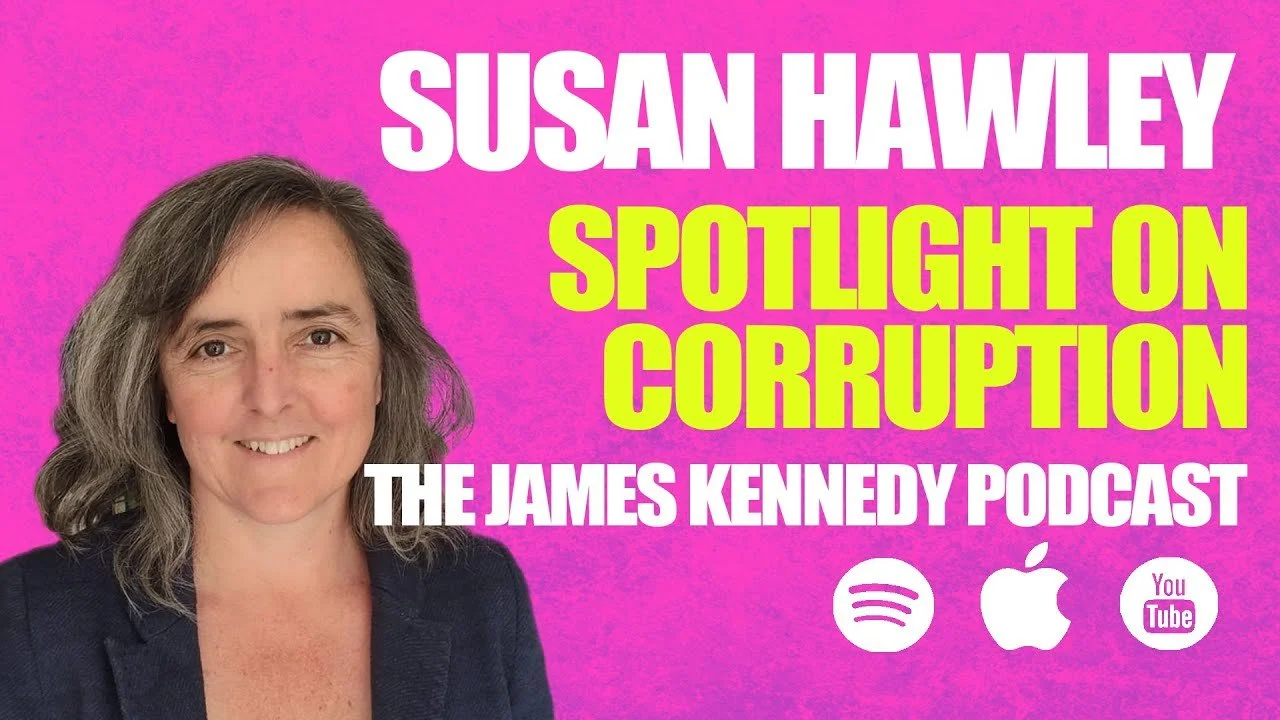
DR SUSAN HAWLEY - EXPOSING THE UK’S CORRUPTION PROBLEM
James Kennedy interviews anti-corruption expert Dr. Susan Hawley about government corruption and corporate lobbying in the UK. They discuss local spending failures, political gifts, money laundering, and practical solutions like lobbying transparency and holding MPs to account to protect democracy.
James Kennedy Susan, thanks so much for being here. How are you doing?
Susan Hawley All right. Thanks. Thank you so much, James, for inviting me on. Looking forward to discussing corruption with you.
James Kennedy Oh, man, me too. Well, maybe to start off with then, we should give the listeners an overview of the nature of the work you do at Spotlight on Corruption and what exactly the organisation is about.
Susan Hawley Yeah, so we're a pretty small charity, and really our purpose is to make sure the UK government takes fighting corruption seriously. So we monitor enforcing the anti-corruption laws. Is it living up to its commitments? So we work across a range of areas. A lot of it is, is the government itself in the UK actually behaving in an ethical way and upholding standards of integrity? Is the UK actually taking steps to prevent it being a magnet for dirty money from other countries? You know, we all know about Russian oligarchs parading around the streets of London in limos. You know, we are a complete honeypot for corrupt actors all across the world wanting to buy property or buy luxury goods here or use our private schools. So we work across a range of issues on the assumption that we should never be complacent, that we don't have actually quite a serious corruption problem at home. And that we should play a role as a good global citizen and not be causing harm abroad by facilitating and enabling corrupt people to come to the UK and launder their money.
James Kennedy Wow. Okay. Well, there's some explosive truth bombs delivered there already in your opening segments. So we're off to a good start. Where does the UK stand then on the global stage in terms of our measurable level of corruption? You know, are we squeaky clean? You know, I highly doubt that, but are we as bad as the UK is?
Susan Hawley The reasons Musk gave for dismantling all the aid that was going to the U.S. was given to us, well, it was because it was all corrupt. And you see a growing narrative among people in Reform politicians talking about how all local government spending, it's all corrupt, aid is corrupt, we need to get rid of it. And I think we need to be really wary of that and find ways to challenge it because public spending is really crucial for not just at home, but also to play our role in tackling poverty abroad. And so we need to find ways to counter that narrative that public spending is just somehow inherently corrupt. But I think it's a good example about how when the weakness around the rules of politics is that creates this sense that it's very easy to fuel that all politicians and therefore all government and all political spending is corrupt.
James Kennedy How accurate is that then? Because you said that the public perception of our politicians is not particularly great. Through your work over the past 20 years of delving into this, how accurate is that perception really in the inner workings and the behind the scenes of how our government acts and actually operates on a day-by-day look?
Susan Hawley I think the bottom line is there are a lot of really, really good people, and there are some rogue actors. The trouble is that it's about the systems around them and what those systems incentivize. So I'll give you a really good example. I just saw it on social media actually that a Labour MP was saying just since becoming a new Labour MP, just being bombarded with gifts and hospitality with people lobbying them, and they were really shocked because they come from a sector where none of this would be allowed. And I think the trouble is it's a little bit like the frog who gets slowly boiled in boiling water, is that if you're in that system and everyone is just doing that, that's what you do, right? So it's not that they're bad people, but they're just living in the culture which just does not have enough boundaries and accountability around it. So I think in terms of actual corruption day to day, we're not at the level where if you walk down the street the policeman's going to stop you and ask you for a bribe. Very, very rare. There are areas like planning law where everyone feels it's very corrupt, but that's often because it's very opaque. But there are also real problems like there aren't proper rules around gifts and hospitality for local government officials and planning officers, for instance. So the risks of corruption are there even if there isn't loads of corruption going on. So what we really focus on is, and it's good because it means we can do something about it, we need to change it and make it more robust so that politicians pay better and people can have more trust in them.
James Kennedy Yeah, man, it's so important. Well, when we finish the conversation, I would like to end on a hopeful note and end with a sense of mission and purpose by discussing some of the ways in which we can mitigate this problem, and you mentioned that other countries such as the Nordic countries are already doing this very successfully. So I'd like to tap into that as well if possible. But before we get there, I'd like to further explore the murky underbelly and the dark back rooms of corruption in governments to get a feel for exactly what we're talking about here. Because is it literally just hospitality and concert tickets and football tickets and stuff like that, or is this much more insidious? Because I imagine a gigantic oil company or a massive global financial conglomerate doesn't have to rely on handing out concert tickets. I'm sure that their influence weaves through governments in much more nuanced and hidden ways. Is that accurate, or am I just getting close to the realms of conspiracy theories now?
Susan Hawley No, it's not conspiracy. We've just done a major report about lobbying, and we really looked at this, like who is meeting the main officials in the Treasury and in the Business Department, in the Energy Department, in the Science and Technology departments. And time and again, the ratio of business groups to public interest groups is just shocking. It's like 23 to 1. Wow. So just in the business departments, like 1.8 percent of their stakeholders were from public interest groups, and then the Treasury 2.3, you know. So the rest is just them hearing from the business community. And that's particularly at a ministerial level. You see that ministers, as civil society organizations, we wrote to various ministers saying, can we have a meeting after the change in government, as we always do. We tried it with the last government, and they write back saying, I'm afraid my diary is full. And you're thinking, well, your diary is not full for certain people, right? And so what we found is that actually the companies in each of these departments that got the most meetings were often the companies that also gave the most hospitality. And so there's a kind of level of influence which goes very deep. It's like they're the people that, arguably, if you're receiving hospitality from people, you feel a connection to a bit of potential obligation to. That's the concern. Our ethics bodies have flagged that. The National Audit Office has flagged that. So hospitality is a really big issue actually. Like, should we have stronger rules like they have even in the EU or in the UN, that you have a presumption against accepting hospitality? And I think we saw that with as soon as the new Labour government came in, this whole freebie row is very distasteful to people because they know they couldn't do that in most professions, like a teacher or even a business person, they can't just take free luxury gifts or a free holiday because it sends absolute alarm bells about conflicts of interest. So I think there are two groups of people that have real influence: it's business, but often it's particular businesses, like Barclays and HSBC in the Treasury, some of the big audit firms in DBT, big energy companies in the Energy Department, who both have the most meetings and give the most hospitality, and they also get secondments. They get their people in to help develop policy in government departments, but there's no transparency about that. And a lot of this data that we were looking at is just the tip of the iceberg, because only a fraction of the kind of lobbying that happens is actually sometimes represented here. If it's informal like WhatsApp texts or meeting meetings outside of formal settings, these are not covered by the data. And we've definitely found, in working with journalists, that you think, this looks quite interesting, I wonder if this minister's met so-and-so, and it's nowhere in the public data that they've met so-and-so. Like we were looking at crypto firms; sure enough, you do a Freedom of Information request and, lo and behold, there were meetings, there were policy discussions. And so there's a really big problem around too much secrecy in lobbying, there's a really big problem with dominance of certain things. What we were saying in our report is you need to start thinking about ways of making sure that the public feel genuinely involved in decision making, and that's absolutely key to restoring trust. So we did some focus group work ourselves actually in the Red Wall, this was under three or four years ago, and the women in the Red Wall were like, we just never get asked what we think should happen, we've got so many good ideas. And actually time and again, when people have used citizens' assemblies, for instance on climate change, actually they're very different from doing focus groups. They're like a process where the public really thinks about things and then they come to a consensus. We just need a lot more citizen participation in decision making in this country. And you can see it, other countries are way ahead on this, it really does build trust.
James Kennedy Well, I guess it's inspiring to know that solutions do exist in other places that are actually combating this scourge successfully already. An example popped in my mind. Well, there's a place in Brazil, I can't think of the name of the city now off the top of my head, but they actually were running the entire town through citizens' assemblies, right down to the financing of things and the implementation of certain laws, and as it turns out with much better results for everybody. The citizens were actually doing a much better job than the government. I just wish I could remember—I don't remember the name of the place.
Susan Hawley Was that Porto Alegre participatory, that's what I'm thinking of. Yeah, yeah, yeah. And since then, I think, and actually there's a whole group of civil servants now looking at that, but they need political backing. You need like the ministers to say, because they're quite time-consuming, so you can't use them for everything. There are more participatory techniques that I think are used in Porto Alegre on day-to-day spending. But on big issues, if you look at Ireland, for instance, they do quite a lot of citizens' assemblies when they have very contentious issues like what to do about abortion. So they use them quite frequently. In Switzerland, they do referendums on everything, but they have to be designed really carefully. But I think they're really powerful. So if we had, I mean, the big issues of the day, if you were going to choose what are the key things that the public really need a say on, you had one on climate change that was brilliant. If you watched it on BBC, you saw people really thinking about it, coming up with really creative ideas, but none of their recommendations were listened to. So that's where the politics come in. If you're going to have them, you need a commitment from very high up that these are going to lead to something and that the people involved are actually going to be listened to.
James Kennedy Damn right, yeah. There's another aspect of this as well which you alluded to earlier. It's not necessarily a direct form of corruption, but it is just the sheer amount of power that a lot of these corporations have to influence governments. They often make threats like, if you bring in this labor law or this health and safety law, we'll just shut shop, move our factories elsewhere, and you'll have an unemployment problem to deal with in your town. And that's technically bribery. So does that come under the fold of corruption, or is that something else?
ENJOYING THE CONVERSATION?
GET JAMES KENNEDY'S LATEST INTERVIEWS, WRITING AND LIVE SHOWS STRAIGHT TO YOUR INBOX.
Susan Hawley It is something that is destroying trust, absolutely. This sense of big business, and if you think a lot of our problems, for instance with austerity, stem from the financial crisis, the financial crisis itself stemmed from a weakening of financial sector regulation, which was the result of extensive lobbying by finance firms. And what you've got now is again huge lobbying and the government weakening financial regulation and listening to particular voices in the business community. So I'll give you an example: recently someone who's in one of the business groups who works more with small enterprises was saying they were really shocked and upset about the National Insurance increase. And what they were most annoyed about on top of it was the tax break, and they were quite open, the private refunds, about really this is a huge success for our lobbying. So the point is I think that we're also making in our report is who represents the public interest when you have a policy? So the government is looking at taxation, who are they listening to? Like you can't just listen to the one voice that says, as you say, well we'll pull out of the country if you make this tax, if you close this tax loophole, which it was a tax loophole, right? Actually then you need other people saying, well on the other side we need that money for this, this, and this, and it will be unfair. So the real concern is you get actually bad policies as a result because you're only listening to one argument all the time, a very biased argument.
James Kennedy An interested, yes, yeah. What about then at the more local level? I mean, have you seen similar things happening within local governments, or is this just for the boys at the top?
Susan Hawley No, I mean local government at the moment is a complete disaster zone. It's been called a kind of crisis of public administration, and it all goes back to Lord Pickles, if you remember him. He was Local Government Minister and he abolished this thing called the Audit Commission in 2015, which oversaw the audits of all local government. Just last year, the National Audit Office refused to sign off the UK's public sector accounts because it said it couldn't get accurate information about local government spending. So just one in 10 local government authorities had submitted accurate spending information. I mean, it's really mad. You've got 129 councils hadn't submitted accounts for over two years, and what you've got is a series of councils going bust now. You've had Thurrock, Woking, problems in Birmingham. It's emerging these crazy stories where they went on wild borrowing sprees and made really dodgy investments. And I think this is like, and these were people running the council. So we've got a real problem with local government, and whether it's corruption or whether it's just absolutely inexcusable incompetence or disdain for the system. And, yeah, it was kind of mad exuberance with public money.
James Kennedy Right, right, right.
Susan Hawley I mean, there's some super poor decision making, which is leaving councils literally bust. And these are councils that are meant to deliver the social safety net, right, at a local level. So this is an area that we've also been campaigning for the government to have a new proper domestic corruption offence. We have a criminal offence of misconduct in public office, but it basically can't be used against anyone who's in a high position. It's only ever been used against very junior prison officers and police officers. I mean, we did research: it was like 98% of prosecutions were junior or mid-level employees. And we found out of prosecutions, there's four cases where they successfully managed to get someone who held a senior position. So we need a new domestic corruption, a corruption in public office offence. And we need to look at how this can also apply to people in very senior positions of local government. But we desperately need to restore some kind of oversight mechanisms in local government spending.
James Kennedy Wow. That is mind blowing. Jesus Christ. Yeah. So this is quite all-pervasive then throughout all levels and branches of government. And you said that it's gotten worse over the past five years. I think that's what you said. Why is that exactly? I mean, I could probably guess when you look at some of the characters involved.
Susan Hawley Yeah, I mean, it's a really good question. I do think that in the UK, we've always been a bit, had a "don't look, don't find" approach to corruption. So we don't really have—we've only very recently set up a police unit that looks at corruption in the UK. And it's not even a permanent thing yet. That was literally earlier this year. So we're in a situation where there's nowhere you can report corruption. So if you want to report corruption in the UK, you have to find an obscure bit of your local police force's website and you submit an online complaint, and you never hear back, basically. Wow. And so this "if you don't look, you don't see it" kind of approach has worked for a while, right? A very good country, we don't have any corruption, we don't have to pay bribes to see a doctor, we don't get past a policeman in the street. But I think that actually the Boris Johnson era did really change that, because I think you saw a level of really open flouting of rules and this sense of, his support for Owen Paterson, despite the fact that he had really breached the rules, it was a sense that they really were above the rules.
James Kennedy Yeah, kind of arrogant macho boys club, it felt like, and that coincided with Trump as well, bringing in this kind of lone leader, this strong man arrogance, I suppose, and complete disdain for the broader structure of government that they were a part of.
Susan Hawley Yeah, and it's interesting because charismatic politicians, none of it sticks. At the end of the day, there were enough decent people in the Conservative Party to say, no, this is no good, and they did get rid of Boris Johnson. So for a lot of people, they're like, oh, the system works. We don't think that's a sign of the system working, because you could have had a different composition of the Conservative Party that, like we've seen with the Republicans in the US, don't think that's a problem. So we need stronger checks and balances. The Labour government made, when they were in opposition, Boris was an absolutely easy target: wallpapergate, you had the holidays, crazy stuff going on, and they promised in their manifesto to create an Ethics and Integrity Commission and to strengthen the rules. We were really hopeful that this is stuff that is quite cheap to do, sends a really big political statement early on, and we're still waiting for any sense of what the new government is actually going to do on this. So the revolving door between business and government ministers and big business, it's got no teeth, it's absolutely hopeless. It's like the regulator can send a letter saying, this doesn't look good, and that's it. There's no fining powers, there's no enforcement, no punishment or anything. And then the conflicts of interest in government, like the National Audit Office again just last year found they are just in crisis, they're not really being enforced, most departments aren't doing it properly. So we really desperately need this Ethics and Integrity Commission, and we need ordinary people to feel they can do something about this and show they care about it, because I think the trouble is what we've seen again and again is that doing anything about this is not seen as a vote winner. So people think, we'll fix the NHS, or we'll fix the cost of living, we'll do these things. But what they're ignoring is that actually how people feel about their politicians is really fundamental, and people need to feel good about the people representing them. So taking steps to actually show that politicians are going to have stronger rules and are going to be policed properly for keeping those rules actually would be a really popular, really good step. A lot of people are really fed up with feeling that politicians just don't seem to play by the same rules as the rest of us, as I mentioned earlier.
James Kennedy Why wouldn't a political party take this on as one of their main key issues then? Because there is such mass disillusionment and distrust in government, and for good reason, that anyone seeming to be taking this seriously would really be onto a vote winner surely. So why wouldn't a party get behind this? Is it because pretty much everybody across the political spectrum are beneficiaries of the system as it stands, or are there actually voices within parliament who are advocating for this?
Susan Hawley I think there's some. Actually it was like a really key platform in the Labour manifesto, restoring trust. I think the issue is, how do you restore trust? Is it by making sure people can see their GP, or is it by people feeling that the politicians are good people? But it's kind of both; you can't do one without the other, right? But the second bit about feeling like your politicians are good people, any reaction on that has been missing. So in a way, Labour and the Lib Dems actually have said we need these reforms, but look, we're in very turbulent times. I can understand why it drops down the priority list. It's that kind of nice to have. But we think that's a mistake, because actually this is stuff that is pretty quick, pretty easy, and will make people feel better about politicians.
James Kennedy Right, well, that's amazing to know that it's quick, cheap, and easy. And you mentioned, because I want to move on to some of the solutions now, ways that we can make this happen and ways that people can actually get behind the cause and support you guys and support the issue generally. You mentioned as an example at the start, the Nordic countries are doing this way better than most, and it doesn't go amiss on me that they're also the countries that sort of come up highest in happiness and equality. They have a lot less of the social ills that come as a result of inequality, and I think that's a really good point. So they seem to be doing something right over there. What are they doing, how are they doing it, and can it work over here?
Susan Hawley Yeah, so this is actually a complicated one, because they don't actually have better rules. They have a culture, a culture of how politicians behave. And I think there are probably some specific things about that. So the question is, in the UK could we just presume that we could create a culture? It's obviously working in the Nordic countries, but I think the problem is, I'm just not sure at the moment. The culture is not right at the moment in Westminster, and you need a culture shift. So how do you get that culture shift? Do you go around saying to people, "oh, you've got to behave better," or do you have some hard-edged rules say, "when you don't behave well, this is going to happen to you"? It's a perennial debate. I think if you look at certainly in our focus groups, most of the public want stronger penalties on politicians to make them behave. So I had exactly that thought: let's look at what the Nordic countries are doing, but they're doing a lot of stuff very differently to us, and we can't just jump from where we are to where they are. We're going to need some help with stronger rules, I'm afraid, or some rules.
James Kennedy Let's talk about that then. So what can we action sort of immediately that would work for where we're at, where we're starting from, that would significantly help this cause?
Susan Hawley Yeah, so there are various things, and I think no one should underestimate, when they feel rage about something, write your MP. Don't forget to harass your MP, write to the PM. Actually, that is—I think people feel, oh, it's not going to do anything, but actually the more letters that MPs have in their inboxes saying, "why isn't the government actually having proper rules to stop big business donating to politicians, for instance? Why are they letting foreign billionaires fund our parties? Let's get serious, let me have some really tough rules around elections." So I think no one should underestimate that just doing that is really important. Obviously there are quite a lot of petitions out there, like 38 Degrees. I think we all need to—certainly we're thinking more about what kind of things we can offer for people to do, to feel like they can do something about this, because I think the worst thing is if people feel really angry about it, but they feel really powerless. And actually, there are some really easy and important steps that we can do, and I think make the government do at the end of the day, because we do need the government to take this seriously. And the more people flag it to them and say, "you promised us an Ethics and Integrity Commission, why haven't you done it? What are you doing to clean up politics?", the more they will have to think, actually, we better do something about it.
James Kennedy Yeah, so in terms of how that is enforced then, are we talking about things like transparency, some kind of register for members receiving gifts or offers or opportunities from private interests? Are we talking about some kind of penalty or punishment or even removal from the post for those who breach those rules? And then who enforces that? Do we have a model for that at the moment?
Susan Hawley On the criminal level, we need this new corruption in public office offense. That's a really clear thing that's not really even on the government's agenda. Like when we raise it, they're like, "oh, what's that?", even though it was recommended by our Law Commission, the country's Law Commission, and they spent a lot of public money coming up with these nice proposals. I think actually knowing who is influencing government, asking who they've been meeting with, so lobbying transparency: we actually need them, very simple, they need to create a central register where you can immediately see who's meeting with ministers, what they're talking about, and that done on a monthly basis. That would also focus their minds on who they're not meeting with and how they can make sure that actually they do have more public interest groups that they meet with, and they think more creatively about how they get more public participation. And on the Ethics and Integrity Commission, I mean that is about—we've got some regulators in that space, and they need more teeth. So like I mentioned the revolving door, you need sanctions when ministers breach rules. You need independent oversight. At the moment all these regulators, some of them could just be abolished tomorrow by the Prime Minister. So actually they need to be in the law so they can actually do their job, and they need stronger powers. So these are all recommendations that have been made for probably 15 years or more by some of the top ethics experts in the country, and they just consistently get shelved and shelved again. We were quite excited that the government was finally going to do something about it with this Ethics and Integrity Commission, so if you've got any listeners, go and ask your MP what are they doing to make sure that the government is going to bring in an Ethics and Integrity Commission.
James Kennedy 100%, yeah. That shouldn't be underestimated, the power of that. I mean, I've had members of parliament on this podcast, and I've had investigative journalists and campaigners and activists from all different fields of interest, and that is the one thing that they've all had in common, as they say, do not underestimate the power of writing to your MP. That's what they're there for. And I suppose we find ourselves in this kind of catch-22 at the moment, because there is this distrust of the system generally, this kind of feeling of, what's the point, they're all corrupt, they don't listen to us, they're all the same, it doesn't make any difference anyway. But to a certain degree, it is on us to enforce the democratic process and to let our representatives know that we care about this issue and ask them what they're doing about it, and nag them and keep on their back about it. And if enough of us do that with enough members of parliament, that's got to make a difference. So as tough as it is, and I do get it, the level of trust is at an all-time low in government, and for very good reason, but I think the gravity of this issue certainly warrants a second wave of energy on our part to start making these guys listen to us.
Susan Hawley I think the fact that people are seriously thinking about "we need a strong man as a leader" should wake people up. Like, we don't have long, we've got to really get on with this. And I just have to tell you a funny story: I remember walking past Victoria Station, I'd actually just been to something in the Houses of Parliament, and there was a guy in the street who was drunk, and he was going, "Roll up, roll up! I could be your next MP! I take bribes, I commit sex offenses!" Actually, there are a lot of really brilliant MPs who work so hard. That job is so hard, it's like all your life, 7:00 a.m. to 1:00 a.m. kind of job.
James Kennedy A thankless job as well, oftentimes, isn't it?
Susan Hawley Yeah, and we've worked with some brilliant MPs, and they really, really care about this stuff and getting it right. And so I think they need to also be supported and know that.
James Kennedy Yeah, that's a great point. Where can people actually arm themselves then with accurate information on this issue? Where can they get up-to-date, accurate, reliable figures and statistics and information? Because that's something that's so hard these days as well with all the information we've got access to. Finding reliable information that isn't spin, or hasn't been manipulated in some way, or isn't just flat-out AI or fabrication, where are some good places that people can go to actually get some good intel on this?
Susan Hawley Yeah, I mean look, Spotlight on Corruption, our website is www.spotlightcorruption.org. We've got fantastic colleagues who work with Transparency International UK, who do a lot of research. UK Anti-Corruption Coalition is another kind of coalition of over 10 organizations working on various aspects of corruption. Yeah, so there are organizations out there, and we'd love more support from the public. We're certainly looking at ways to expand how the public could engage and campaign more on this, because it's such an important issue.
James Kennedy 100%. And how can people support your work at Spotlight on Corruption then? I know that they can obviously donate, but can they get involved as well and amplify the message and share things? Does that help?
Susan Hawley Yeah, always sharing stuff. Even on social media, no point doing it on X because whatever you post is just going to get buried amongst the blizzard of Elon Musk self-love and propaganda, I'm afraid. We had to come off X because we weren't getting any engagement.
James Kennedy Same, same, yeah. I built a massive platform on X, and then, yeah, I just had to leave because it became absolutely pointless being on there anymore.
Susan Hawley Bluesky is great, LinkedIn, and yeah, you can donate, you can look at our stuff, share our stuff. We are actively looking at how we could provide more actions people who care about this stuff could do, so always reach out and ask.
James Kennedy Fantastic. Well, I'll put a bunch of your links in the show notes to this as well so people can click and go and follow you on socials, or put a link to the website as well because there's tons of stuff on there for people to look at as well and get a feel for the issue. Lastly before I let you go, I'm going to squeeze one more in if that's okay. Could we just finish up with trying to rally the troops here? Why is this so important?
Susan Hawley It is ultimately about whether we're going to have democracy in this country or not at the end of the day, and whether we get proper public spending spent in the right places, whether the UK is a fair place to live, and whether we feel like we've got the people who are governing us who are doing the right thing in the public interest. So I think we've got to tackle these things to make sure that people do believe in democracy, and they do believe that they can have a say in government. It's about our own mental health as well, right? And having hope and feeling like day to day we're living in the kind of country we want to live in.
James Kennedy And a system that we can believe in as well, where we feel genuinely represented and respected as a part of an active, actual democracy that represents our interests, rather than the interests of a tiny, tiny less than one percent of the population.
Susan Hawley And can I just say that because we do work with colleagues, for instance in Georgia, where you see your country suddenly see massive democratic backsliding, and suddenly journalists and civil society groups just being disappeared off the streets in white vans. People don't know what they've got until they lose it, and we can't afford to lose it because it's so precious, what we have: our democracy, our ability to speak freely, and we really need to protect that.
James Kennedy Amen, amen. Well, on that note, I think that's a beautiful way to round off. Susan, thank you so much for giving us your time today. We really appreciate you taking time out to chat with us. It's been a fascinating conversation, and long may you continue to shine light on the bad guys. Spotlight on Corruption, and I will get all the links in the show notes, and I hope that everyone gets involved in this and amplifies what you guys are doing and hope for a day when things can be different.
Susan Hawley Brilliant. Thanks, James. Thank you so much. See you soon. Bye-bye.
Key Points:
Guest Dr. Susan Hawley, Executive Director of Spotlight on Corruption, has over 20 years of experience researching and campaigning against the UK's role in facilitating global corruption.
The UK is described as a "honeypot" for corrupt actors worldwide who use it to launder money, buy property, and access private schools.
While the UK lacks widespread petty corruption, systemic issues persist through opaque planning laws, inadequate gift and hospitality rules, and weak oversight of local government spending.
A major lobbying report revealed a shocking 23-to-1 ratio of business groups to public interest groups meeting with government departments, with companies giving the most hospitality often receiving the most meetings.
Local government is in crisis, with 129 councils failing to submit accounts for over two years, several councils going bust, and the National Audit Office unable to sign off on public sector accounts.
The Boris Johnson era marked a shift toward open flouting of rules, and while he was eventually removed, the system's checks and balances remain weak.
Proposed solutions include a new domestic corruption offence, a central lobbying register, an ethics and integrity commission, stronger sanctions for rule-breakers, and greater citizen participation in decision-making.
Summary:
In this episode of the James Kennedy podcast, host James Kennedy speaks with Dr. Susan Hawley, Executive Director of Spotlight on Corruption, about the pervasive issue of corruption in UK government. Hawley explains that while the UK doesn't experience petty bribery, it faces serious systemic problems: it serves as a global hub for dirty money, has inadequate rules around gifts and hospitality, and suffers from a lobbying landscape heavily dominated by corporate interests over public ones. A recent report revealed a 23-to-1 ratio of business groups to public interest groups meeting with key government departments, with companies providing the most hospitality often gaining the most access.
The conversation also highlights the crisis in local government, where poor oversight, reckless borrowing, and failed investments have left multiple councils bankrupt. Hawley notes that the UK's "don't look, don't find" approach to corruption has been exacerbated by recent political scandals, though the system did eventually remove Boris Johnson. She emphasizes that solutions exist and are already working in countries like those in the Nordic region, which rely on cultural norms rather than stricter rules.
Hawley calls for a new domestic corruption offence, a central lobbying register, an ethics and integrity commission with real enforcement powers, and stronger sanctions for politicians who breach rules. She urges citizens to contact their MPs, support organizations like Spotlight on Corruption, and engage with the issue, stressing that protecting democracy from corruption is essential for a fair and functional society.
The James Kennedy Podcast is a Society and Culture podcast hosted by musician and author, James Kennedy. Exploring the big questions around health, social issues, the arts, politics, mental health, the human condition and how to navigate this thing called life through casual conversations with scientists, activists, rock stars, philosophers and academics. Please subscribe, leave a rating and support the show.