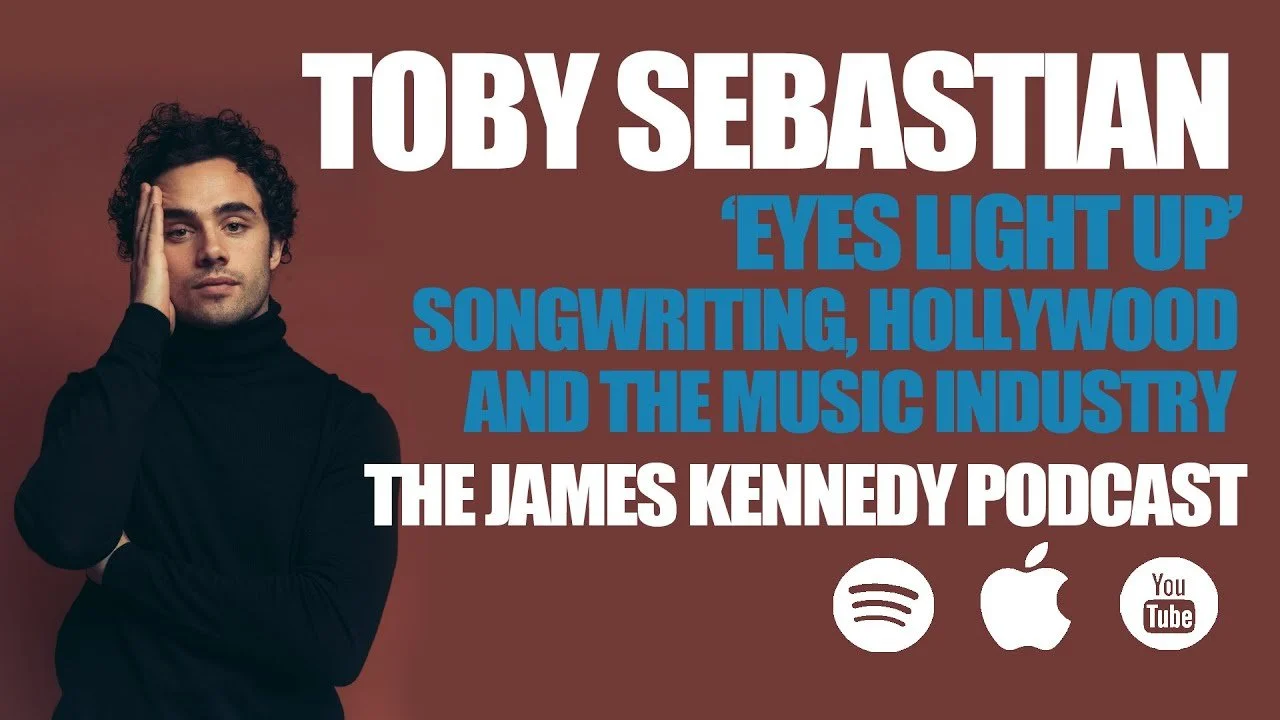
TOBY SEBASTIAN - MAKING ‘EYES LIGHT UP’
Host James Kennedy interviews Game of Thrones actor and musician Toby Sebastian about his new independent album, Eyes Light Up, balancing music with acting, and prioritizing routine for mental health.
James Kennedy: Toby, thanks so much for joining us, brother. How are you doing, man?
Toby Sebastian: I'm good. I'm good, man. Thank you so much for having me.
James Kennedy: The pleasure's all mine, man. I am loving the new record. You must be so proud of it, man.
Toby Sebastian: I'm so happy to hear that. There aren't many people that have heard it. And yeah, it's been a real kind of labor of love. It's been like, I'd like to say two years in total of making it. But really, I think it's a lot longer than that, because I released an album when I was like 19, and this kind of has been an album that I've been dreaming of making kind of since I started writing songs, really. I'd say that this album really represents my style of music more than any other kind of songs or material that I've released. And it's taken a long time to do and I work with some amazing people. But as I said, no one's really heard it. I think there are literally probably five people that have heard this album, so yeah, very happy.
James Kennedy: Oh, man, well, I feel privileged to be one of the five. I mean, we should say straight out the gate this bad boy is coming out on April the 4th. So it's right around the corner, available to preorder right now. But we'll get into all that stuff in a bit. But yeah, no, I love the record, man. I've thoroughly enjoyed it. And I don't think it could drop at a more perfect time. I mean, you know, the sun is just starting to come out after what's been a long winter for a lot of people, you know, both literally and figuratively. And this album is chilled, it's soothing, it's mellow, it's positive, it's sunny, and it's got some deep existential stuff in there as well. But the vibe, it's just got a great vibe, man. And I really genuinely enjoyed listening to it. And I know a lot of other people are going to love this record as well.
Toby Sebastian: Well, I hope so. I really am chuffed to hear you talk about it like that. Yeah, I'm so proud of it. There are moments where, as I'm sure you know being a musician yourself, you sometimes feel like you're not over a kind of a collection of songs, but you can spend so much time overthinking things, you can go over things, you can read things, you can rewrite things. And every time I've kind of put something out, it's been a very different experience in terms of my ability to let go of things or sometimes holding on too tight. And in the end with this one, it was just like, let's just get the thing out. I don't want to overthink things. If I wait another six months, I'm going to rerecord something that at the moment sounds really cool and I wouldn't change a thing, but I guarantee if I wait another year, I will change a thing. And so it feels very freeing knowing not only that it's coming up, but also there not being kind of like one melody or one second of the record that I regret, where I regret a decision or lyrically. And I haven't experienced that before on that level. So, yeah, I'm pumped for people to hear it.
James Kennedy: Yeah. Well, that's interesting that you say that because I got regrets on every record. I'm on my eighth record now and I still listen to things now like I cringe. I'm like, why didn't I just fucking change the bass line? I knew it at the time. Why didn't I do it, you know? So that's like amazing to hear that you're at peace with the whole record, man.
Toby Sebastian: Well, maybe talk to me in a year again. We'll see how I'm feeling about it then. No, it's a funny one. I think a lot of the songs, as I'm sure you've noticed, there are lots of different styles that are on this record. But I think maybe that's why I feel particularly fulfilled by it. It's because it kind of ticks off all the boxes of the types of music that I like listening to.
James Kennedy: Yeah, it is a very eclectic record and there's a lot of different sounds and styles welded together in there that I can hear, but it works perfectly. I can hear a little bit like T-Rex, if I'm not wrong, you know, some of the rhythmic stuff and the backing vocals. But then there's also like slide guitar and some kind of Americana vibes. There's some folk influences there, a bit of soul. I mean, is that reflective of your influences whilst you're making the record or your influences as a musician generally? Or, obviously, you know, we need to mention you do have an adjacent career as an actor as well. Is some of that musical eclecticism a product of the fact that you do so much traveling with your job and you spend a lot of time in America? Do you think that that influences the sort of styles that you delve into as a writer or have these influences been in your blood, you know, since day dot?
Toby Sebastian: I guess I'd start with absolutely the music I was kind of brought up on, what kind of filled, you know, the rooms of our family home. You know, I grew up listening to Crowded House and Tracy Chapman and John Martyn. You know, there's elements of my playing, whether it be finger picking or sometimes the way I like to try and use my voice, I can hear a very distinct kind of connection between something like a John Martyn and, you know, my dad loved rock. He was Bowie, he was the Stones, and my mum particularly loved soul. So you kind of merge those two together. And then outside of that, I've always loved kind of, I'd say like warm, sonically warm sounding music. So stuff, I go back to John Martyn or Nick Drake. And I suppose that would be the first thing that springs to mind as to how all those sounds have ended up on that record. But you're also right in the sense that in acting and actually before acting when I left school, I think a year or two earlier than that, I was meant to, so I left at like 17 or so, and I spent three years in Nashville, Tennessee recording with a really, really wonderful producer and writer who was mainly a country writer. And he worked with kind of Faith Hill and Tim McGraw and all these, you know, brilliant country artists. But we weren't making country music. And I think that's the beautiful thing about music. And what I realised then was that like this person from this musical background and meeting me at 17, having just grown up on what my parents played or what I then kind of found myself, there could be like a connection and it could work and it didn't mean that I had to be writing country music for that album to work. But all those experiences, they've all obviously led to this. So one of the songs, Heaven is the Backseat of a Rental Car, I wrote that like, you know, several years ago. And I actually wrote it in England with a couple British writers. But now in hindsight, you know, I hadn't actually thought about it until you just asked me that question. That for sure, I can hear it now, thinking about it and knowing where I had been before I wrote that song, I'd just been in LA on and off for a year. But like, that's so LA, that's so Americana. And I hadn't even put two and two together until you just asked me now. So I'm sure I'm going to be finding out a lot more about these songs the more I talk about it.
James Kennedy: Yeah, yeah, I find that stuff fascinating because I have a similar thing, you know, with my music. Like people say, oh, you're clearly influenced by this band or that band. I think I've never heard that band before. So other people hear things in your music that perhaps you don't know. That's the beautiful thing about it. It's like once you've, and I suppose you're at that stage now where the album is actually leaving your nest as such and going out into the world, it becomes other people's songs then and other people read things into it or hear things into it that you may not have even known about. And I think that's the beautiful thing about this art form, isn't it? You know, it's so personal to everyone.
Toby Sebastian: Of course, yeah, yeah, it's completely personal. And also like people hear different things about songs, from songs. A couple songs on the album that I've played live, someone said, "Oh god, you know, that must be really tough for you," or "That person, you know, I didn't realize," or "Did that person die or did someone die?" Or like, "Was there a big traumatic..." And more often than not actually, it's not that people are wrong, it's just they've taken it completely as I've sung it, whereas as much as I like to write things about real experiences, I also love to write songs imagining a scenario or imagining someone going through something. You know, there's a song on the album called Daddy Daddy and I was actually watching, I can't remember what it was I was watching, I was watching an episode of a TV show with my girlfriend when we were living in London a couple years ago. Something had started playing in this episode of this show, I can't remember what it was, but it started playing and there was like a note, I don't even think it was the key, it was just like the smallest sound. I basically was like, "Stop, stop the TV!" And I kind of ran to the piano, ran to the guitar, and I just out of nowhere started singing that line that you've heard, "Daddy Daddy," and in my mind it was like, I think I missed the train again. But straight away my mind was like, it wasn't talking about my dad or talking about a father being a bad person. My train of thought to write that song was I want to write a song about someone longing to be home. I want to write a song about someone who maybe has screwed something up or done something wrong, or maybe just is filled with regret or feels like crap and they miss home comforts, and they miss their mom and their dad and their families and their close friends. And it was just that I like the Daddy Daddy thing because I thought that saying Daddy Daddy sounded more like a cry for help. And I also like that people could read into multiple things. Of course, I spent five minutes on it then, I recorded it, and then I said to my girlfriend, I was like, "Right, turn the TV on again." And then the next morning I wrote the song in an hour and we recorded it in two, and I sent it to my parents. And I said to my dad, I was like, "Look, just FYI, this is not about you and it's not a bad thing. Also I haven't actually said anything in the song that makes it sound like I'm talking about a bad father, whether it be mine or someone else's. It's not meant to be about that; it's about someone being far away from home, like a call for help." So of course I sent the song and then I spoke to them half an hour later. My mom was like, "That song's brilliant," and my dad was like, "Yeah, you know, I really, really love it, but you know, I'd like to think that people won't think that about me." And I'm like, "No, it's not about you." And you know, I've played it at shows, played it at gigs, and there'll always be someone... It's a sad song and then I've had a couple people who are like slightly teary-eyed, either because of a relationship they've had with their dad or maybe they're just imagining it. But that's kind of what I love about writing music. You know, it's also escapism, deeply personal to the artist.
James Kennedy: Well, how does that compare then with acting? I don't want to focus on that side of your career too much because we're here to talk about the record and the music, but do the two things that you do fulfill different creative holes or creative needs that you have, because they're very different crafts, aren't they?
Toby Sebastian: Yeah, I mean, I'm about to contradict something I've, the way I've normally spoken about it, but I would say yeah, they offer, for me anyway, they offer completely different things. I love them both equally. I love with acting like playing dress up for the day or for a few weeks, and it's like escaping myself and being someone completely different to me and finding kind of realness in that person or a truth. But then at the same time with music, you know, wherever I've gone around the world, even if I've gone and done an acting job having my guitar playing, I've done an acting job with my guitar with me, whether I was sitting in a hotel room or going to like the local park or whatever and having a song, having a sing, and writing something that's deeply personal, even if I'm writing something that's not personal to me, that experience is deeply personal because I'm in control of everything and it's a wonderful way of like just letting stuff out. So yeah, they both offer completely different things. What I have found is that I've had a lot of people who have been... I've been writing a TV show for the last couple years and I found that writing that TV show has offered a very similar kind of creative flow as writing music because I'm in control of it, it's my world. But obviously with an acting piece, when you come onto someone else's project, it's their baby essentially, and you can be slightly set in your way as to how you think a character should be, but ultimately it's not yours.
James Kennedy: Yes, that makes a lot of sense. And you were active as a musician before you became an actor. I'm interested, was becoming a Hollywood actor kind of like your version of the struggling musician getting a coffee shop job? Is that what happened?
Toby Sebastian: No, so what happened... I left school for a music opportunity for a record deal. Originally I wanted to go to drama school; I didn't want to study music theory or go to college and study music, I wanted to keep on writing songs, I wanted to hone that craft, but I didn't want to go and study it in a school or a college or university. I wanted to go to drama school because that's what a lot of my peers or people that I respected did, and I wanted to keep my songwriting going and be in a band, release music or whatever. And I basically got the music opportunity first. I just got very lucky that I was playing a school performance and one of the pupils, he was a couple years younger than me, his father was a big A&R guy. So basically, fast forward like three years or so, I've been on this kind of whirlwind of making this album, and I kind of made it very clear to the people that were helping, like my manager at the time, that I'm working on this album and I wanted to get into doing my acting as well or at least meet a couple people. He had helped me meet a couple people, I'd also gone to a couple like open castings, and kind of one thing led to another and 100 auditions later I got my first five-line role in something, and that kind of then just rolled on for the next 10 years or so. And then it was only until about 2019 that I started releasing music independently.
James Kennedy: Right, independently. So you started with a deal...
ENJOYING THE CONVERSATION?
GET JAMES KENNEDY'S LATEST INTERVIEWS, WRITING AND LIVE SHOWS STRAIGHT TO YOUR INBOX.
Toby Sebastian: I started with a deal, did the whole major label deal thing. The album actually never came out. You know, it was like many major label stories, a lot of love from every single person went into it, but it just felt, for multiple reasons which we don't need to go into, it didn't in the end. And so I was kind of left with this album. And I think I got really lucky. I felt incredibly sad when I kind of got dropped. I mean, I didn't in a sense get dropped, there was like a whole rejigging of the label and I was basically told like, "This isn't going to go on, we can't basically have you anymore." And so I was like 20, and luckily I'd kind of started a bit of some acting connections over the couple years prior to that, or a year prior to that. And I remember calling up this fantastic woman who was my acting agent for a few years, and I said like, "This has happened and I don't want to stand still, I need to keep moving for my mental health. Can I come to LA?" And she was like, "Of course you can come to LA." So she was like, "Come to LA and come for pilot season." So I kind of did, and so I went and basically spent all my money over a month that I had and stayed in a roadway inn on Beverly Boulevard, which kind of ironically was the really, really crappy kind of roadway inn, and it was opposite Erewhon, which Erewhon is like Whole Foods on steroids. Like you go and buy something and it's like five, ten times the price of what it should really be. So I basically spent all my money... In my mind I was like, "This is just where people go in LA to go and eat food." But basically I was just very lucky that I've always had really lovely, supportive, brilliant champions around me who, when something hasn't gone to plan or you feel a bit wobbly and you're like, "Oh my god, what am I going to do?" I've had the energy from someone. And so I went to LA and that kind of started this period of a few years. And so by the time in 2019 I had just done a couple films and it was like, "Let's just release some music." How have I not released music in years, you know? How is that even a thing? I think it was just like a survival thing, it was like focus on something next because that last thing didn't go to plan, and it was actually really sad, so move on and you can be brilliant in something else. But it was always in the back of my mind, it was like, okay, and the music...
James Kennedy: That's fascinating, I didn't realize that. So the record that's coming out in April then, is that independent or is that with somebody?
Toby Sebastian: That's independent as well.
James Kennedy: Wow, bro, that's fucking amazing, man. Because, well, I mean, I run my own independent label and now a music publishing house as well, so I know how much work goes into that, man. So, you know...
Toby Sebastian: It's one of those things that's like, it's incredibly exciting, but I kind of got to a point where we've been talking to some labels over the last two or three years and some of the deals just weren't right. And they were kind of like, not wrong in the sense of amounts or whatever, it was more like a lot of the places didn't feel like the right place for me, if that makes sense.
James Kennedy: Totally.
Toby Sebastian: So in the end I was like, let's just get the album out. We've been working on this for two and a half years. It's finished, it's finished, it's finished, it's finished, it's finished! So let me print some vinyls and let's get cracking, and let me make some noise. And so I think as soon as we made that decision, it was my girlfriend, but also my producer Matty Benbrook, brilliant writer-producer who worked with Paolo Nutini a lot and Dido, and he's drummed with Faithless for several years. Both those two people were just like, let's just get cracking, let's go. And I think the moment I made that decision, it was like, okay, we're on. What are we waiting for?
James Kennedy: I... That definitely resonates with me. I mean, I've had a lot of major label artists, like chance hopping artists on the podcast, and we have that exact conversation about the pros and cons, because a lot of them started out doing their first record independently. They did it kind of the other way around, and now they're doing the major thing, and they all say, "Man, it was so much better when we were independent, we could make the record and put it out whilst we're still enjoying it and we can't wait to play it live." Whereas when you do it through a major, they put you in the pecking order of all the other releases, you could be waiting a year and a half before it comes out, and then by the time you're touring it, you're fucking bored of it.
Toby Sebastian: Yeah, I mean to be honest with you, my, despite having been signed by a major label, my experience with it is pretty limited. I mean, I hear stories. You hear success stories, you hear the opposite. I think they can be absolutely brilliant when they work, you know, if you're an artist and it works and things go to plan. And also it's like anything in life, it's so dependent on who you've got at the label looking after you. You know, I've heard not just stories through people, but also like from friends who got the dream album deal, and it's like a five-album deal if it went the length, and come record two, when there's good hype, the first record has had a good response from kind of journalists or whatever and the fans, come record two it's like, "Oh, we're going to half the funding for your second record" or something because your first A&R guy got fired and now there's a new one or something like that. That happens so often. People in the music business are always forever moving and connecting for another company. So I don't know, I always say like when people say to me, "So does that mean you're going to be independent forever?" And I'm like, no, not at all, not at all. But I have done the major thing before, I would happily do it again, but it's also just about finding the right people.
James Kennedy: Right, 100%. Well, it sounds like you've got a pretty solid team of people around you that have got a good value set and have your best interests at heart as well. Seems to be working.
Toby Sebastian: Well, so far for sure, yeah, yeah. I mean, I've got a handful of people that are wonderful and I can trust on every level, including creatively. So, you know, I've also really enjoyed the last since 2019, putting singles out, putting an EP out, and seeing the audience grow and seeing more and more people coming to shows. And it's really exciting because it really feels like you're putting what you, me, and the handful of people that have put in tons of energy, it feels really kind of like rootsy, you know? You've started from the bottom and you're putting just time and love and belief, and when things start to happen, it's like, holy shit, this is really cool.
James Kennedy: And it's so rewarding as well. And it's amazing that we can do that these days as well. I mean, we are living in a kind of a new golden age really for artists, despite all of the very real problems with streaming and artists aren't getting paid any money anymore and venues are closing down. Back in the bad old days when it was just major labels making all the money and had all of the industry in their pocket, distribution, recording, the whole nine yards, we couldn't make our own music without a record deal. At least these days, as challenging as it is, we're able to still make our music with or without a label, put it out ourselves, and do our thing. So as much as I complain about it, it is an amazing time to be an artist right now. Do you feel more excited than fearful, or is there an equal balance? What, the time has come? That's a great question. I think it's a mix. I do think that the only constant really, if you look at anything, is change, like we're constantly changing and I think that adaptation is important. I think those who are able to adapt can see the opportunities and the possibilities in change. But there's always going to be the horseshoe makers that fall by the wayside when somebody invents the car, you know? So yeah, I think as long as you're able to adapt... And somebody like yourself who's obviously multi-talented as well, I think that you've probably got that in your tool bag already.
Toby Sebastian: Yeah, it's a funny one. It's like the amount of times people say to me, "Spotify is so awful, how little they pay their artists" or whatever, it's also, I suppose what I'm saying is like always highlighting the downsides to it, which there are. At the same time, I always say to people, "Yeah, but without the likes of a Spotify or an Apple Music or all the others, like Deezer and Tidal and all of the streaming platforms, getting heard in a hundred countries would be virtually impossible unless you had very, very thick pockets of cash." Like, that's where you would have to have a major label. There would be no room really. I mean, you could tour and you could gig locally, of course you could do it within England for example, or for me I could do it in England, but it would kind of stop there unless I was able to afford to go and travel to other places. And then even then, unless someone bought the album, because gig tickets are, for a lot of people, a lot of people can't afford to buy a gig ticket and come and buy your merch or a CD or a vinyl or anything. And so then you'd have to be able to be reliant on the fact that not only were people going to buy your ticket for your show, they'd also have to buy a CD as well, because if they didn't, they'd forget your music and how would you ever kind of make a profit on anything? So I think that these streaming services are brilliant in that sense, in terms of growth.
James Kennedy: Yeah, 100%. I mean, I slagged them off a hell of a lot, but I mean, in the interest of balance, I think it is like you say, it's important to highlight the massive impact that they've had on empowering artists such as ourselves to keep doing our thing independently. And I'm glad you mentioned that, dude, because I did not know this was an independent release, so hats off to you, man.
Toby Sebastian: Yeah, it is an independent release. I think that it comes with a lot of fear in releasing stuff independently, because you think to yourself, "Oh wow, it's not like most musicians in the world are funding their music on some level." More when I say that, I more mean like if you don't get the reaction, the fear if you release it and something doesn't pop or the dial doesn't go up at all, that kind of fear, and that's it, right? And that's a lot of independent artists, after weeks or months or years of making something, and then you're doing it and you're not a label, you're putting it out. And I have that fear myself. I mean, I firmly believe in my bones that this album will resonate with a lot of people, I think I have to feel that as well. But of course there's always that little voice in the back of your head like, "Yeah, but what if...?"
James Kennedy: Now, I think it's going to do really well, mate, honestly, like straight out the gates I loved it. It really set a vibe, and I think like I said, it's the perfect time for this album to land as well, sun's coming. It's a great summery, feel-good, chilled record. It's soothing, it's warm, it's soulful, it's deep words. Maybe you should do the voiceover, we have a TV ad. Oh god, what am I in my townie Newportian South Wales accent? What are you... As we come towards the end now, because I've got to keep an eye on the clock here, I don't want to keep you too much longer, we're going to loop it back to talking about the record. I'm glad that we managed to digress into those other areas, because I think it's interesting to get your perspective on that, because people see you as a successful actor as well and think that everything must be easy for you, you know, and have everything handed to you on a plate. But no, to know that you've got the same fears and obstacles that all the rest of us independent artists have is fascinating. Riddled with them, such is the blessing and the curse of the artistic spark, I suppose, isn't it? Sure, so what... You mentioned touring, are there going to be tour dates? I did look, I haven't seen any announcement yet, are there some coming?
Toby Sebastian: So there's two shows coming up. The first show I've got is a record store signing, which is going to be Truck Records in Oxford. I'm from Oxford so it's my hometown. Truck Records is a very small little record store and it's got a great history of fantastic acts doing their first signings in there. And so on the 4th, that is the actual date of its release, so that'll be fun. The 26th I'm headlining at...
James Kennedy: Oh, nice!
Toby Sebastian: And so I'll be headlining that, which is always a super fun show. And then the 30th I'm playing The 100 Club in London, another venue with mega history. And then there will be a tour in autumn as well after the summer festivals.
James Kennedy: Nice! Are we talking UK or are you going further afield as well?
Toby Sebastian: It'll be UK and a few more shows in Europe as well.
James Kennedy: Fantastic! Right, well, I'm going to plug all the links in the show notes and at the end as well when we round up. What about what lies ahead for yourself more broadly, you know, what's happening with the acting? Is there anything in the pipeline there you can talk about?
Toby Sebastian: So I've got a film that I'm going to be shooting in a few weeks' time, which unfortunately I can't talk about, but what I can say is that it's a relatively new thing for me, it's kind of come quite recently and there's a lot of wonderful people that are involved. As ever with the acting stuff for me, it's like there's a lot of stuff that's going on and either there's a lot of time in between before you either find the next job or lots of auditions and all that jazz. But I am writing the script which is kind of my main focus outside of music at the moment.
James Kennedy: That's awesome!
Toby Sebastian: And we'll be looking for kind of putting a little development team around that.
James Kennedy: Is there anything you could tell us about it?
Toby Sebastian: I would just say it's very much about me and the acting part of my life, it's a comedy.
James Kennedy: How do you find the time, man? I mean, you're juggling a lot of pretty big projects there at the same time.
Toby Sebastian: Normally, the truth is that I juggle it very badly and I realize that I haven't gone back to someone. I will kind of ask, let's say like maybe I'm talking to my manager, I'll inquire about something and he will answer straight away, and then like two weeks later I'll be like, "Oh crap, not only did I reach out to him myself, I got an answer in a minute and I didn't do the thing that the person advised me to do." Right, right, right. So I basically juggle as best as I can. I'm awful at keeping a calendar... It's amazing that... No, I'm not that bad, but I juggle as best as I can.
James Kennedy: Well, I want to ask you then one final question before I let you run off. It's common with people who do what you do and who juggle so many different disciplines in this kind of very uncertain industry as well, obviously people have burnouts, they don't look after themselves, they don't make time for self-care. I've been guilty of that myself many a time. Do you make time for self-care and well-being? Is that something you factor into your life or does it get neglected amongst the carnage of juggling?
Toby Sebastian: No, no, no. So I think one big thing apart from the experience that I had, the wonderful experiences that I had when I was signed quite young and went to America and was very much on my own little mission, one of the things that I'm really grateful that I kind of got from that, and even before I left school, was routine. Routine has always been so important for my mental health. Physically obviously I like to be fit. Look, I love a party, just as much as anyone else I love to party, but being physically fit on some level and also just exercising for my brain is so important, otherwise I would just sink and I would experience extreme burnout. But kind of the year before I left school and then the four years that I was, or three years that I was with the label, going to London or going to Nashville or going to LA, I always had routine. So even when I didn't need to wake up at seven o'clock in the morning, I naturally had done that. And yeah, I'm not always like that now, but I've always had some level of routine, and even if that's meant waking up early, having coffee, and going for a 20-minute run, I'd say I do it more for my mental state as opposed to my body, if that makes sense. So yeah, that's kind of like a non-negotiable priority in my life, not just exercising, but like mindfulness and just trying to look after myself.
James Kennedy: That's brilliant to hear, man, yeah. It's brilliant to hear, not enough people do that. I don't think, speaking from my own experience as well, it's easy to get caught up in the race, isn't it, you know?
Toby Sebastian: Yeah, especially in our industry as well, yes.
James Kennedy: So I think for people to look at somebody like yourself, upcoming actor and musician, to know that that's something that you say is a non-negotiable, I think will be a good example for them to follow, and so I'm glad to hear that. Well, on that note I'm going to let you go because I know you've probably got either more of these to do or you're going to lap up some of the Gibraltar sun. So before I let you go, we've got to plug the record. Eyes Light Up is available to pre-order right now at tobysebastian.co.uk on gorgeous orange and black vinyl. It is coming out on April the 4th, so go get it, go get two, get three, give them to your friends, lay back and lap up the soothing sounds of this delicious album as the sun starts to fall upon us once more. You can also follow all of the updates and tour announcements and news and everything else to do with Toby's amazing career, or careers I should say, on Instagram at tobysebastian1, and keep an eye out for those live shows because you will not want to miss those bad boys. Toby, thank you so much for giving us your time today. It's been a fascinating chat and I wish you all the best with the record and everything that lies ahead for you, man.
Toby Sebastian: Thank you. Oh, thank you so much for having me. It's been lovely chatting music.
Key Points:
Guest Toby Sebastian, an actor known for Game of Thrones, is releasing his new album "Eyes Light Up" independently on April 4th.
Toby describes the album as a two-year labor of love that represents his true musical style, blending rock, soul, folk, and Americana influences.
Toby previously had a major label deal at age 19 that never resulted in a released album, leading him to pursue acting before returning to independent music in 2019.
Both host and guest discuss the pros and cons of major labels versus independence, agreeing that creative control and finding the right team matter most.
Toby emphasizes routine, exercise, and mindfulness as non-negotiable priorities for maintaining his mental health while juggling acting, music, and screenwriting.
Toby has upcoming record store signings, a headline show at the Hundred Club in London, and a UK and European tour planned for autumn.
Summary:
In this podcast episode, host James Kennedy speaks with actor and musician Toby Sebastian about his forthcoming album "Eyes Light Up," releasing independently on April 4th.
Sebastian explains that the album took roughly two years to complete and represents his most authentic musical style to date, drawing on childhood influences like Crowded House, Tracy Chapman, and John Martyn, alongside soul and rock from his parents. He reflects on his early major label deal at 19, which fell apart without releasing an album, prompting him to pivot toward acting before returning to music independently in 2019.
The conversation covers the creative differences between acting and music, the value of independence versus major label support, and the role of streaming platforms in empowering artists. Sebastian also discusses writing his own TV show, an upcoming film he cannot yet discuss, and his commitment to routine and exercise for mental wellbeing. The episode closes with details on pre-ordering the album and upcoming live shows.
The James Kennedy Podcast is a Society and Culture podcast hosted by musician and author, James Kennedy. Exploring the big questions around health, social issues, the arts, politics, mental health, the human condition and how to navigate this thing called life through casual conversations with scientists, activists, rock stars, philosophers and academics. Please subscribe, leave a rating and support the show.