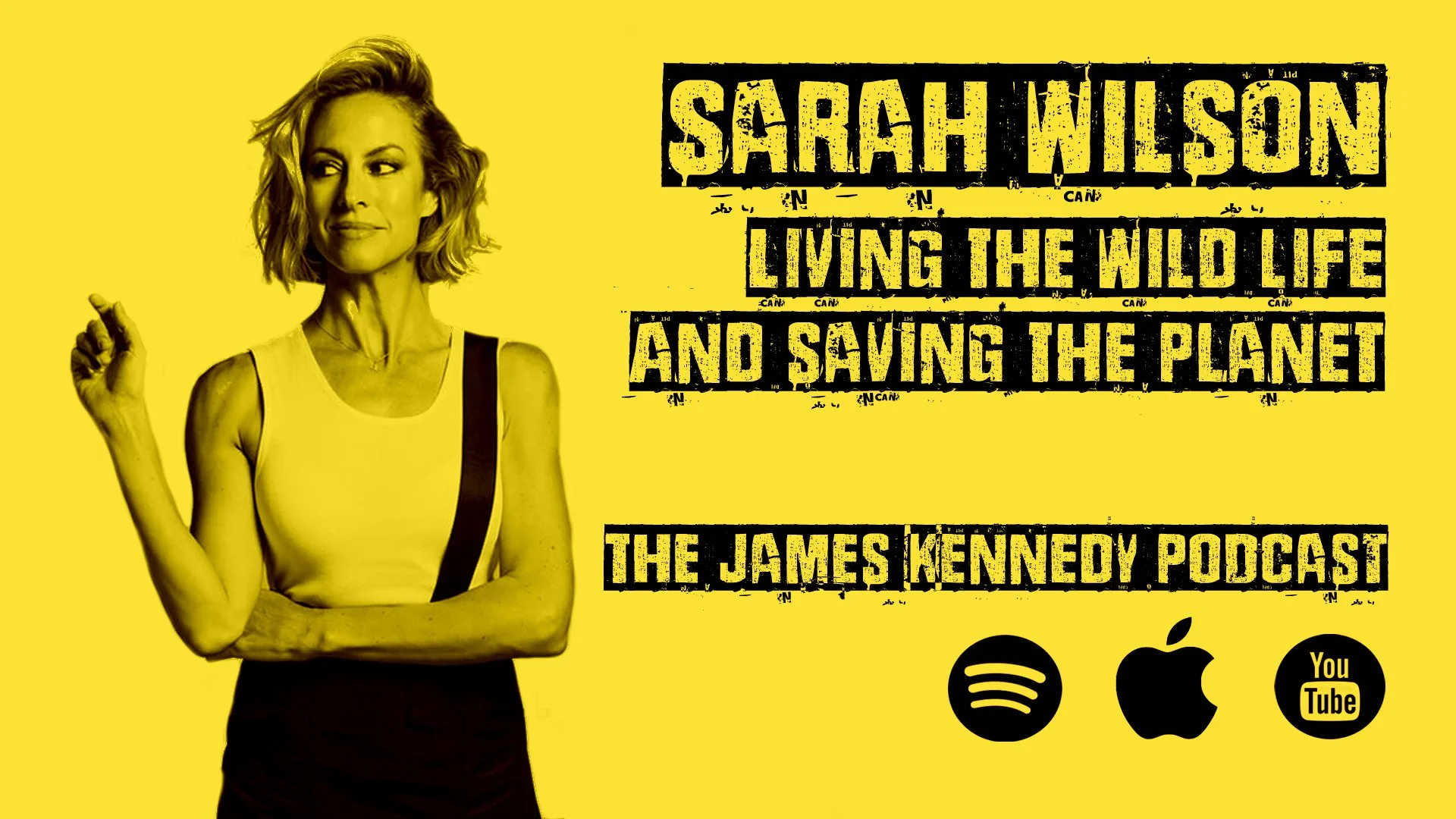
SARAH WILSON - HOW TO LIVE THIS ONE WILD AND PRECIOUS LIFE
James Kennedy interviews multi-time New York Times best-selling author and activist, Sarah Wilson. They discuss the state of humanity, the pitfalls of capitalism, food waste, overconsumption and how things like meditation, hiking in nature and living a minimalist lifestyle can help us to live This One Wild and Precious Life in a way that is better for us and better for the planet.
James Kennedy Sarah, thanks so much for doing this, man. How you doing?
Sarah Wilson Thank you for that kind intro, James. I'm great. I always feel really old when people do my intro because I just realize, "God, that's a fair bit of stuff, right?" It's simply because I've been around a while.
James Kennedy I don't think it's because you've been around a while. We've all been around a while. I'm not that many years behind you; I'm hot on your heels, and I'm nowhere near that level, dude. So you're clearly made of different stuff, and you've had a hell of a life, man. When you hear all of that, do you feel a sense of achievement, or are you like me—that no matter what you do, as soon as it's done, you're immediately looking at the top of the next mountain?
Sarah Wilson Oh, totally the latter. I'm very much like that. I actually get it pointed out to me every now and then, like, "Oh wow, did you celebrate whatever it is that you might have done?" And I'm like, "No, no, no, I can't be bothered." As soon as I've finished something, I'm really on to the next thing, right? So it's always been—I mean, I don't know that I am overly ambitious; it's just that I've got lots that I need to attend to in this lifetime, you know? And the achievements or the awards or whatever that you get along, they don't really matter to me. I very rarely pause on them; I very rarely turn up to the award nights or whatever it might be, because it's the doing of the things that I enjoy doing, if that makes sense, rather than the getting there.
James Kennedy 100%, yeah! Yeah, I'm exactly the same. I just follow my curiosity—that's all I've ever done when I look back, really, you know? With the music, writing the books, and now the podcast. The podcast makes me no money and takes a lot of time, as I'm sure you're aware, but just by following my curiosity, I get to have fucking awesome conversations with people like Sarah Wilson on a Wednesday morning. What else am I going to be doing on a Wednesday morning? So that makes a lot of sense to me. I guess I've always kind of done the same: follow my interest or my curiosity, and it's led me down some interesting roads, you know?
Sarah Wilson Yeah, I'm sure you're the same, James. You get asked, "So how did you plan your career?" And I've never planned a single thing. I've never used a resume. I've just sort of started on the thing and then it becomes the thing, you know? A lot of my early journalism jobs were because I just happened to be the annoying work experience kid that was there at the time saying, "I'll do it." That's literally how my first gig in journalism started, and that's kind of how it just continued. I just happened to be there doing something as an extra gig on the side, and then they went, "Oh well, we might as well get you to do it."
I think it's not a bad way to live, really. I've actually looked into this a little bit—the theory on it and the science on it. I interviewed this dude called Marcus Buckingham—I don't know if you've heard of him; he's an American psychologist and demographer—and he talks about this idea of "tilting." It actually started off with him looking at what it was that made the happiest women in the world happy, because there'd been this big study that came out that showed that the unhappiest people in the world were women in their early 40s who are lawyers. I'm sorry to anyone listening who fits that profile! But he went, "Well, you know, what are the happy women doing? What are they getting right?" What he found was that they tilt, which is to say they just move in the direction of the thing that makes the most urgent and, I guess you could say, joyous sense in any given moment, rather than trying to go, "Well, I should be doing this, and I should be spending this amount of time on my own personal time, this amount of time with my kids, and this amount of time on my career," because we've all got this kind of weird sense that we've got it all wrong, we've got the ratios all wrong. He's like, "Quit that. Just basically tilt towards the thing that matters that's most important, that is calling you because you are the person that's best to do it." I try to live that way.
James Kennedy That's really interesting, man. You see, you're already dropping pearls of wisdom, which is exactly why I invited you on today, because I know you've done a hell of a lot, you've lived a lot, you've learned a lot, you've traveled a lot, and you've shared a lot. You've condensed a lot of that stuff into your book, which we're going to come on to and talk about in just a bit, because it's been out about two years now, I think, but it was recently published just this year by the awesome and lovely folks at I Books, who also published that seminal work Noise Damage—gotta get a plug in!
We are going to talk about the book, but first I want to tap into some of those other pearls of knowledge that you've got a whole catalog of. I figured a good place to start would be: where are we at right now, and then work our way backwards towards what we can do about it? So where do you see humanity being right now as we head towards a new year in 2024? Where is humanity, where is the world that we live in right now, and what are our main problems? How did we get there?
Sarah Wilson Oh, bloody hell, that's a big one! Okay, but I'm very happy to answer it because it's sort of what I'm working on at the moment. I think where we are at is in a space of profound polarization, uncertainty, and confusion. I think we're in a time of environmental or ecological collapse that's happening all around us. We can't deny that that is happening; we are in it now. The thing that we were always talking about, that we were trying to prevent, that we were working towards—it's happening now. I just saw a news report today saying that we've hit two degrees above pre-industrial temperatures now. We're sort of seeing the implications of it. Back in Australia, the fires started way earlier; it's going to be a hellish summer, I suspect.
We're also seeing this disintegration of the old world happening with the Middle East crisis, with Ukraine, and also you've got an election coming up in the US next year. I think we're seeing some real shifts happening in the world, but what I think is the more important thing, or probably just the closer-to-home thing that we can all be focusing on as humans living a human experience, is our reaction to it—the overwhelm, the fear that we're all feeling. What we're seeing is that we're not handling it really well, right? Everyone listening to this, anyone old enough to understand the language that we're speaking and to have an iPhone or whatever, we've all grown up in a time of growth and opulence, right? There's been ups and downs, but in the main, it has been a time of growth and improvement, and that's all we've known. We assume that that's how life goes, but it doesn't. Throughout history, every civilization has gone through a growth period, a brief period of stabilization, before some sort of collapse, and we're just not used to it.
The challenge that I think we're all in at the moment, wherever we are in the world, is finding ways to cope with it. The shit fight on social media is very indicative of how we're not coping, right? We polarize when we face threat and uncertainty; we go into a tribal mindset where there's us and then an enemy out there. That's why people like Trump do so well, right? Because they create an enemy where the enemy is us, the enemy is the system, the enemy is our overconsumption and our ridiculous belief that infinite growth and consumption on a finite planet could somehow stack up, right? That's all really sad, but we don't need to be creating extra enemies, so we've got to keep a watch on that and get way better at it because this isn't going to go away. We're not going to suddenly go back to normal—that ain't going to happen. We've just got to get better at how we do life. So that's the state of the planet through my eyes.
James Kennedy Agreed, yeah. That was a big question, and you fucking nailed it in one fell swoop! Brilliantly put, man. I totally agree with you, because I do feel myself that when we look at the state of the world, what we're seeing on the outside—environmental degradation, waste, inequality, a health crisis, the climate crisis—it's almost like a reflection of what we're feeling on the inside, isn't it? A sense of disconnect, of isolation and individualism, a hopelessness almost. The growth period that you mentioned has almost polluted our values. We've now got this kind of value system of every man for himself, reliance on quick fixes and quick relief. As you say in your new book, when you start pulling apart all of these issues—the inner and the outer—layer by layer, ultimately all roads end up leading back to capitalism. I absolutely agree with that, but could you elaborate on what you mean by that?
Sarah Wilson Yeah, it's funny. When I first wrote that part of the book, it was actually just before COVID started, so this book is a COVID baby. I started writing it and was very tentative about putting these ideas forth, and then COVID happened. I think we all kind of had a moment to sit back; we kind of were sent to our bedroom to go and have a good hard look at ourselves. That's how I see COVID in many ways. It was a time to kind of go, "Oh shit, have we got this right?" As a result of it, I actually felt a little bit bolshie, and I felt like I could go pretty hard on this capitalism piece in the book. It proved to be a really popular chapter in the book; people went, "Oh my god, I had never seen it that way!"
Capitalism as a system is a system that did serve humanity for quite some time, you know? It did lead to progress, it enhanced democracies around the world for quite some time, and I think in its original form it kind of worked. Then we got this next chapter in the 1980s: neoliberalism. That was sort of Thatcher and Reagan coming in and going, "Let me add this up a bit, and what we're going to do is we're going to get rid of the structures that keep an eye on the market 100%. We're going to actually downgrade government intervention, community groups, social groups, trade unions, all of this kind of thing. We're going to dial them down so that the market reigns." That's where things started to get really, really wobbly.
It's really hard for people who've only known capitalism, who haven't seen it in any other framing, to see that it's actually just a construct, and it's not a construct that worked throughout. It's not something we've had as part of the human experience from the beginning. Constructs can be great, and then they no longer serve us and we've got to move on. That's something that I think a lot of people do find really hard to fathom, because, "Oh gosh, without growth, what are we? And without the market system that corrects itself, what are you talking about—a communist system, Sarah? You're talking socialism." Of course I'm not, although I think both communism and socialism have benefits to them, you know—
James Kennedy They're both completely different systems as well, aren't they!
Sarah Wilson Correct. Correct.
James Kennedy I mean, there's this linguistic dissonance, I think, in America where they think socialism is communism, and they're very, very, very different things.
Sarah Wilson Yeah, that's right. There's elements of socialism that can be very, very well incorporated into capitalism, and in fact, they were in the original days. But look, in the book, I line up the definition of a cult as per Wikipedia. I run down the official definition of a cult and I basically line up capitalism next to each entry, and honestly, it is a match for match! The mindset of a cult is really very similar to the mindset of capitalism, where we think that there's no other system beyond it, we think that any other framing must be problematic, and so on, you know? Once you actually see it through that lens, you can then start to be critical of it in a way that's productive, where you can actually go, "Well, which parts of this can serve me?"
I remember somebody once said—it's a quote from a metamodernist thinker who said, "Look, all systems and theories are wrong, as in not completely true; we've got problems. However, some of them can be useful, right?" And that's what capitalism should be: we should be basically using the bits that are useful. Now, the thing is, I mentioned this before, this equation that capitalism works to: infinite growth on a finite planet. That is insanity; it doesn't stack up, and we now know this. We have entered overshoot, which is basically where we are using the resources faster than they can be reproduced by nature, and that's been happening since the 1970s. We are now in massive overshoot. We have hit planetary boundaries—there are nine planetary boundaries. Earlier this year, it was announced by the Stockholm Resilience Institute that we have hit or surpassed the sixth of the nine planetary boundaries, and another two are about to go.
We've also hit the Limits to Growth, which was a report done in 1972, and they predicted that it would happen right about now, the early 2020s, and sure enough, we have. So everything that was predicted about this ridiculous equation has come to light, and that's where we are today. Capitalism no longer serves us is the conclusion that I draw.
James Kennedy Love it! Yeah, I totally agree. I mean, your assessment of capitalism and its journey is one that I share. I had a guy on the podcast called Professor Richard Wilkinson, who wrote an amazing book called The Spirit Level. He and his partner studied countries from all around the world and their relative levels of inequality and equality, and how that then correlates with the social ills that they have, such as drug addiction, unemployment, homelessness, crime, violence. In every single case and in every single country, countries that have higher rates of inequality have higher rates of all of those negative metrics, whereas the opposite is also true: more equal countries have none of those negative metrics.
So it's kind of indisputable that an equal society is better for everybody, and that's why we need things like socialism—as dirty a word as that is—in order to contain some of the excesses of unrestrained capitalism. Because until the '80s, we had things like powerful unionism, power struggle, unions, and nationalized core industries like transport, education, and health. It was only when Thatcherism and Reaganism came along that that was over, and now we've just got complete, unrestrained, cancerous capitalism which is just eating everything on the planet, and it's just completely unsustainable, you know?
Sarah Wilson Yeah, I think sports metaphors are always really useful, and I refer to those trade unions and so on as the moral umpires on the footy field of life, right? Football is a boring game if there are no rules and no umpires. If it's just a free-for-all, there's not the same fun, right? We go and watch it for the mechanics of the boundaries. Humans need to be bound. We developed religions for a good reason: because we don't have the capacity to go into life and have to make the moral decisions for every single move that we make in a day. We've got to put food on the table, a roof over our head, and go about being able to know how to morally deal with things. So we create boundaries and rules and things like that so it can guide us, and they remain open to discussion until they don't, and that's when religions become problematic.
But that is the point of rules and moral umpires and community groups that keep these checks and balances going. I think it's actually created a world where, yeah, it is a free-for-all, where you have OpenAI being able to determine what information that we're going to have access to. You have these cowboys out there like Elon Musk just making up rules that suit them, you know? And you've got social media, where it is an absolute free-for-all. The upshot is incredible amounts of despair and suicides and a younger generation that are really suffering. That's what you get when you remove the moral umpires from the footy field.
ENJOYING THE CONVERSATION?
GET JAMES KENNEDY'S LATEST INTERVIEWS, WRITING AND LIVE SHOWS STRAIGHT TO YOUR INBOX
James Kennedy I love that analogy. Yeah, it works so well. It's so simple and just sums it up perfectly. Do you feel, then, that even though all of us can make changes in our personal lives—and we should, of course, with regards to waste, our consumption habits, and our lifestyles—do you feel, though, that real change, the kind of change that we need urgently, is not actually going to be possible without global systems? Do you feel that it's going to be a systemic change? Do you think that's possible? If so, how do we get there? Because it does feel at the moment like it's a little bit unattainable, doesn't it?
Sarah Wilson It does. Look, I have to be honest: I am not sure we're going to attain it. We're not going to be able to orchestrate an entire systemic overhaul. However, that is not to say that it won't happen. It may be thrust upon us, and I suspect that's how things are starting to go. I think there are institutions that are being disintegrated and called into question without our real input; it's just that they're crumbling, you know? Democracy is having a complete reset and reshuffle, and it's not necessarily for the good, but there are other reshufflings that I think are happening.
So you're right. For a long time in the climate movement, there was this idea of the carbon footprint—that each individual could make a difference by recycling, switching to renewables, turning off their light switches, and blah, blah, blah. There is certainly a lot of worth to that. However, it should be pointed out that that whole notion of the carbon footprint was invented by British Petroleum, one of the major fossil fuel companies, to basically put the blame onto consumers.
I came across this with my I Quit Sugar work 10 years ago. I realized that what the sugar companies—and in this case, it was Coca-Cola—did this particular campaign when I was still running the business, where they came out with this "calories in, calories out" kind of concept, right? So you can go and drink as much Coke as you want, eat as much sugar as you like; you've just got to burn it off, right? So it put the onus back onto the individual, right?
James Kennedy Got it, yeah.
Sarah Wilson The problem isn't sugar; it's the fact that you're not burning it off.
James Kennedy It's you—you're having too much of it.
Sarah Wilson Yeah, you're not exercising. So they brought out all these doctors, and we all bought into that slogan, right? It's a completely made-up slogan with no science behind it, but I bought into it for a long time. We all did. This is what these major companies do: when they want to avoid responsibility, they turn it onto the individual. My God, do we lap it up, because we do guilt and shame so wonderfully as humans. Then we go, "Oh my God, we're bound to fix this, and I'm just going to do it, and I've got to get all my neighbors to do it, and I'm going to yell at them and get angry with them." Of course, that creates more polarization and, dot dot dot, the world that we live in now.
So on the one hand, yes, it's a problem that this carbon footprint theory is out there, but on the other hand—yes, systemic change at a government level and at a corporate level is what needs to happen. It puts us in a bit of a bind, though, because what can we do? Well, we can shift our money to better banks, we can divest, we can put pressure on governments, we can vote for governments that will put in climate policies, which is what we did in Australia. I worked on that campaign for a year and a half, and we got in a left-leaning government—a bit of an anomaly in the world today—and they came in with a bunch of climate policies and climate promises. Unfortunately, they haven't fully lived up to it. They're better than the other option, but yeah, there's been a couple of fossil fuel projects that have been approved under this new government, so it's imperfect. It's slow, and it's not going to happen in time.
However, we've still got to do the recycling. We've still got to be engaged, because that is what the human spirit is about, James. Like, if we don't have that, then who are we? This has come up recently with the Middle East stuff. There's a lot of debate whether the ceasefire is what we need to be doing. Well, my argument is we need to call for a ceasefire, even if it's naive, even if it's not perfectly achievable. We, as everyday citizens, must call for it, and then it's up to our governments to then tell us why they're having to make compromises and backwards-and-forwards treaties and discussions with Israel. But we, as humans, need to call for these fundamental, morally important things, which is exactly why we should also fight for the climate, and we should be living in congruence.
That's the really important bit. I talk about that in the book: this notion of being in attunement with life. So much of what we're doing is out of attunement with the flow and the rhythms of life, and what that does is it creates this horrible dissonance in our being. We are not living in the patterns of life, and so we feel this incredible disconnect and loneliness. The loneliness piece is massive. The UK, I think, is one of the loneliest places—well, when the UK was part of the European Union—and I think there's a loneliness minister in Britain that's trying to attend to this issue. Our loneliness is not just our loneliness from other people; our loneliness is from our relationship with life, with the rhythms of life. If we want to be in the rhythm of life, we want to be saving it, not wasting it and exploiting it and abusing it.
James Kennedy Amen! Yeah, 100% agree with you, man. Beautifully put as well.
Sarah Wilson I don't know if I answered the question there. I can't remember what the question was; I kind of got a bit carried away.
James Kennedy It doesn't matter! It doesn't matter. The answer was brilliant—fuck the question!
Well, you've kind of segued nicely there into the next portion of the conversation, where I wanted to talk to you about: what can we do about all of this? What can we do to reclaim our sense of humanity and our sense of self, and live this one wild and precious life to its full potential? Because through your personal journey, both literal and figurative—I mean, you've traveled the world and you've spoken with many of the world's heavy hitters in the world of science, philosophy, and spirituality in pursuit of answers to these existential questions.
I'd like to ask you: through all of that, everything that you've learned, everything that you've experienced and overcome yourself, and the conversations you've had, do you feel that there are universal and eternal truths to the human experience? Because I feel like since the dawn of time, we've been trying to answer these questions, whether it's through religion or spirituality or paganism or now through science. I think it's much the same thing. We're looking out at nature, we're looking inwards to ourselves, and we're trying to answer the questions about meaning: What do I mean? What does it all mean? Life and death, happiness, good health, how to live the best life, is there a right way to live, morality? I feel like humanity has been searching for an answer to these questions since the dawn of time. I'd just love to ask—I know it's a big question—do you feel through everything that you've experienced, all the conversations you've had, and all of your personal journey and exploration, that there are universal, eternal human truths? And if so, what are they?
Sarah Wilson That's an awesome question. I mean, I could answer it from all different angles, but maybe I should answer it with a way that I almost answer it in the book. As you know, I hike around the world with this 15-kilo backpack in the footsteps of different philosophers, etc., to almost answer that very question: What is it we're here to do?
What I find myself asking—and I quote a wonderful poet, an English-Irish poet called David Whyte, who says there's always more beautiful questions to be asked—one of the more beautiful questions that I ask in the book is from a wonderful philosopher called Erich Fromm. He once asked—it's buried in one of his books and I pulled it out and now use it all the time in my podcasts—"What is left if we lose it all?" It's amazing how many people don't quite get the question, and then other people know it straight away. But basically, if we are stripped of all the things that we have got attached to in this life—our identity, our things, our attachment to our job, our career, our reputation, and so on—if we were to lose all those things, as well as maybe losing the security of a stable planet, what is left at the end of the day? What is it that will sustain us?
I answer it actually with Erich Fromm's answer, which is that he boiled it down to making his life a study in work and love. He gives wonderful reasons as to why those two things are what matter, and I tend to agree. I sort of say in the book that for me, attending to my work—that vigilant going down deeper and deeper into what I can do to be of service in this lifetime—is something that I've really enjoyed doing, and I've had the wonderful privilege of being able to do it as a day-to-day thing. Some people do it on the side of their day job, doing their service work. Then I'm honest about it: for me, I struggle with the idea of love. That will always be the thing that I have to study, you know?
So I think those two elements are really fundamental, and I do come across it in all different ways in different traditions. We have to contribute; to be of service is 100% important. I start off actually in my other book, First We Make the Beast Beautiful, which is about my journey with anxiety and a reframing of it into more of a philosophical and spiritual framing, with a quote—a question I put to His Holiness the Dalai Lama. I basically said, "How do we stop our minds from chattering?" He says, "Don't bother. Don't bother." And I'm like, "What the hell? The Dalai Lama is going 'don't bother'?" He's like, "There's more important things to do." He basically says altruism—being of service to others—is a better use of your time.
It's that parable, James, of the monk who goes up in the mountain in a cave and meditates for two years, gets all Zen and everything, and then wakes up one day and goes, "Oh my God, I've got to go back down the mountain to the village and actually impart this wisdom, this stillness, and this peace." There's no point being up in the mountain doing all this meditative stuff; we have to be of service. So, yeah, that's something I think that's really core. At the end of the day, it's love and being of service—that's what defines our humanity.
James Kennedy Wow, love it! Man, that was amazing. Yeah, I mean, you got answers for everything, man, I love it!
Sarah Wilson They're kind of not my answers. I mean, I've made a career, I suppose, out of going around the world and meeting up with people way wiser and smarter and older than me and going, "So, what's the answer to this?" and then I curate it. I mean, that's what I do: I'm a conduit. I can take complex information and try to break it down into a way that everyday people who are bogged down with kids and the whole thing can go, "Oh, I get it." That's my mission in life, anyway.
James Kennedy Love it! Well, that's exactly why I got you on the podcast. I was like, "Well, who's going to be able to clear up all my existential turmoil, clear up my angst for me?" I know just the person!
Well, look, we've talked about the problems. You've explained very articulately where we're at, what we're dealing with, and where we're headed. So, what can we do? I know you've done a lot of work on this with regards to health, happiness, mental health, spirituality, meaning, and all that good stuff. So let's dive both feet into that. What can we do to turn this around, to live our one wild and precious life to its full potential and save the planet and our future in the process? Tell us.
Sarah Wilson Well, there's some fundamentals, and I like fundamentals that I can tick off about five different goals at the same time. They're the ones that keep me really satisfied and make my Type-A personality go, "Yep, this is good, this is the right answer."
Look, one of them is meditation. Meditation is non-negotiable. Do as I say, not as I do, because I go through slabs of time where I just can't face it, and that's cool, right? You do it as you can. The best idea is just to give it a go, and there's all different ways to go about that, but it really does work, and you can be terribly bad at it, as I am—it still does its job.
In a similar vein: walking in nature. I call it hiking, whatever you want to call it—it just works. There are about 42,000 studies that have been done around the world on the benefits of walking in nature, so much so that in Japan and South Korea, the health programs and health policies incorporate what's called "forest bathing." It's also been incorporated in different parts of Scandinavia and in California because the science is so conclusive. There's all different studies that show that the chemicals that trees release have a big part to play in rebalancing our anxiety.
I've got a bunch of different favorite studies. One of them is the observation that we became humans on two feet. We emerged from being on all fours onto two feet, and as we learned to walk, the part of the brain that controls discerning thought and creative thought is the part of the brain that grew. So our brains got bigger because we stood on two feet; we were able to reach more nutritious food, and our hands were freed up to do different things. That's how we became top-of-the-food-chain species. What that means is that when we walk, we actually best access discerning thought. Walking at a moderate pace through nature is what actually brings about our best thinking. That's why there was that big phase—and I think it continues—of walking meetings. Psychiatrists I know in New York took to doing their sessions with patients walking through Central Park. We can actually access incredibly awesome thinking by walking in nature.
The other thing, just to bring it back to that congruence and attunement that we were talking about earlier: there's fractals in our arms and in nature. Fractals are repeated patterns. If you think of the petals of a flower, the rings of a tree trunk, or tidal pools, they're patterns that repeat out. Our retinas in our eyes are also made up of fractals, and when our eyes connect with these patternings in nature, there's this kind of sucking-in connection point. Anyone who's got—sorry, this is not an ad for Apple Mac computers—but you know their old power cords where they had a magnetizing thing and it would sort of just suck itself in? It was just a nice, snug fit. I always think of that when I think of attunement: we kind of click in in this beautiful, snug way into the flow of life when we walk in nature, because these fractal patternings bring us back to a sense of belonging and like this idea that, "Ah, this makes sense. We're meant to be part of this."
Countless other studies show that this process of walking in nature just does its job. A lot of people go, "Well, how do I do it?" I'm like, "Don't worry about it; 20 minutes will generally work, but longer is better, and you can even just walk in suburban parks—it will also do its job." Studies have shown that that's the case, so just start walking. You don't have to do anything else, and you'll get home and the job will be done on you.
To that end, the other thing that you can do to make one of the biggest differences to the planet is to get rid of your car. Get rid of a car in your life. It forces you to walk, you then connect more with your community, you then have the benefits of all those walking studies, and like I say in the book, walking or riding a bike sticks up two fingers to the whole capitalist concept of cars and moving fast from one place to another. Like I say, it ticks off a bunch of boxes.
If you're really wanting to cut down on carbon emissions at an individual level, one of the best things you can do—and it's a surprising one to many—comes from Project Drawdown, which has been following this for many years. It was a massive bestseller around the world, and I actually just interviewed Paul Hawken, who put that together. He's one of the OG climate activists; I think he's in his 70s, potentially 80s now, and he's still an absolute legend, one of the heroes for the global climate movement. The number one thing you can do is to cut food waste. It was ranked as number three; it's number two or number one now in terms of, out of a hundred different ways that you can cut carbon emissions. This is something that people can't quite believe, but if food waste were a nation, it would be the third biggest carbon emitter after the US and China. The biggest food wasters are us, consumers—not the supermarkets, not restaurants, not the farmers: us. So if we were to even halve the amount of food that we throw out—and this is not just food that is going off in the fridge, it's also unnecessarily peeling things, cutting off fat that we should be eating from foods, all that kind of thing—there'd be enough food on the planet to feed the world. That just gives an indication of just how much food we're wasting. So, yeah, there's some practical things you can all do, and do them now.
Oh, and the other thing is: don't go to the shops. Just stop buying—it's as simple as that. Recycling does not work; it burns more carbon than many people are prepared to accept. Only 7 to 9% of plastic, which is one of the more readily available recyclable items, is in fact recycled. All those clothes that you think you're taking to thrift stores and charity stores—only 5% of it gets sold; the rest goes into landfill. Don't kid yourself: recycling does not work. Not consuming is the only thing that works, and so I just encourage people to not go to the shops, because buying begets buying. You go to a shopping mall to buy a vegetable peeler and you come home with towel sets and a whole heap of shit you just don't need. As you might know, James, I can go for a year or 18 months at a time buying nothing other than groceries, absolute staples. There was a Times magazine article just last weekend, and it was all about the fact that I own three pairs of knickers. I don't know why, but it seems to fascinate people that I have lived between one carry-on backpack and two suitcases of things for the last 15 years.
James Kennedy I love it, man! I love your whole vibe and the fact you're doing it as well, and all of these things make total sense. That is a real bombshell about recycling—I mean, that's actually the first I'd heard of that. I feel like it's a real bombshell. I thought I was doing my bit, and it kind of absolved my guilt to put my recycling out thoroughly. That's something I'll definitely be taking a deep dive into, because that's mental, man.
Sarah Wilson Yeah, and again, the plastics industry is going to be dialing up the recycling message, and you'll probably notice on supermarket products they're all putting big "made out of recyclable" messaging. It's recyclable, but it's not being recycled, and the cost of breaking down the polymers and putting them back up again... Look, that doesn't even bring into play the transport costs of things, right? If you buy a bottle of water, especially one that's come from some South Pacific nation where, by the way, they are suffering from lack of fresh water—and I'm talking about Fiji Water here—that water costs a bomb to cart around the world, right? Leaving aside the plastic, there's all those considerations as well.
James Kennedy Fucking insanity, man! Well, I'll be doing a deep dive on that on an episode of the podcast coming shortly, so stay tuned for that, listeners.
Right, well, we've got to talk about the amazing new book, This One Wild and Precious Life by Sarah Wilson. Give us the lowdown on the book; tell us all about it.
Sarah Wilson Yeah, well, it was my noble attempt to get people engaged in the climate issue. My specialty, James, is making things people don't want to do sexy, you know? It's my years at Cosmo adding pink sparkle dust to everything that equips me for this. People didn't want to quit sugar, so I tried to make it as fun and cool and sparkly with lots of fun foods as I could.
With this topic, I hiked around the world, like I mentioned before, for three years with a 15-kilo bag. I followed in the footsteps of Wordsworth in the Lake District, and I actually hiked with the poet David Whyte. I went on the hunt for the world expert on forest bathing in Japan and hiked for four days up along this pilgrimage trail to meet up with this famous monk. It's hilarious: I got there and I mentioned the word to him in Japanese, and he was like, "What's that?" I'm not joking: four days I hiked to get to him, and we just burst out laughing. I said, "You realize you're the world expert on this? You are quoted everywhere." And he's like, "Oh, am I?"
I hiked through the Jordanian desert with a Bedouin shepherd. I do a bunch of things, and I basically am trying to find a path through the climate crisis that's actually got a spiritual, philosophical element that makes sense. At the same time, I parallel the journey with my journey with motherhood. I was told that I could never have children a number of times, and there's this journey through losing babies and that kind of thing that parallels the journey.
I come out the other end with a very, very calm happiness. I basically come out the happiest I've ever been in my life, and one of the conclusions that I make is that the best antidote for despair and fear is action. Becoming engaged—an activist, if you want to call it that—in saving this one wild and precious life that we have is actually the thing. That's what it's all about; that's what we're here to do. I live it, I breathe it. I don't do it because I'm wanting to self-flagellate; I actually do it because it's more fun than the status quo. This is a better way to live, even if it wasn't about saving the planet. This is a better way to live—it's simple, you know? Coming back to people saying, "Why are you a minimalist?" I often have to reply, "Because I'm lazy." I've worked out that shopping and storing the shit and then having buyer's regret and all that kind of thing makes me miserable, and I've just eliminated it from the equation of my life. So, yeah, that's the book.
James Kennedy Oh man, if that doesn't sell a few copies of the damn thing, I don't know what will! Absolutely, absolutely amazing. This One Wild and Precious Life by Sarah Wilson is out now on paperback, eBook, and audiobook, available everywhere, published in the UK by our friends over at I Books. Christmas is coming—get yourself a copy! It's going to change your life; it's going to set you up for 2024. Also buy a shitload of copies for Christmas presents. That takes care of that—knowledge, health, and happiness is the best gift you can give anybody, so get a copy to give to people for their Christmas stocking.
Sarah Wilson—you gotta go and follow her on all of her socials, so let me give a shout-out: it's @_sarahwilson_ on Instagram, she's also at sarahwilson.com, she's got an awesome Substack you should go and subscribe to and check out, and her amazing podcast Wild is also available everywhere.
Sarah, thank you so much for taking the time to speak with me today and share all of your incredible insight and wisdom with us all. I hope you know what great work you're doing, and long may you continue to do it. I'm off out now to go and polish and dust off my pushbike and hit the road, so thanks for inspiring me, and I'll see you next time. You're an example to us all. I wish you nothing but success, health, and happiness, my friend, and I look forward to whatever you do next.
Sarah Wilson Oh, James, you are very generous, and I really, really appreciate the care you put into chatting with me. Thank you. Thank you very much.
Key Points:
The guest is Sarah Wilson, a multi-New York Times best-selling author, founder of the I Quit Sugar movement, and host of the Wild podcast.
Wilson discusses the current global state of polarization, ecological collapse, and how capitalism has become a cult-like system that no longer serves humanity.
She argues that individual actions like recycling are often distractions promoted by corporations, while systemic change and reduced consumption are essential.
Wilson emphasizes that walking in nature, meditation, and being of service to others are key practices for well-being and living in tune with life's rhythms.
She explains that the best antidote to despair is action, and that activism can lead to a calm happiness and a more fulfilling life.
Her book, This One Wild and Precious Life, combines a global hiking journey with personal memoir to explore how to face the climate crisis with spiritual and philosophical grounding.
Summary:
The main guest is Sarah Wilson, a best-selling author, founder of the I Quit Sugar movement, and host of the Wild podcast.
Wilson offers a sweeping analysis of the world's crises, describing a time of profound polarization, ecological overshoot, and the failure of neoliberal capitalism. She argues that capitalism has become a cult-like system that promotes infinite growth on a finite planet, leading to environmental and social breakdown. She critiques the concept of the individual carbon footprint as a corporate distraction and stresses that systemic change is necessary, though she remains uncertain it will happen in time.
Wilson also shares practical steps for personal and planetary health, including meditation, walking in nature, reducing consumption, and cutting food waste. She emphasizes that the best antidote to despair is action, and that being of service to others and living in tune with life's rhythms are fundamental to human fulfillment. Her book, This One Wild and Precious Life, chronicles her global hiking journey and personal struggles, offering a philosophical and spiritual path through the climate crisis.
The James Kennedy Podcast is a Society and Culture podcast hosted by musician and author, James Kennedy. Exploring the big questions around health, social issues, the arts, politics, mental health, the human condition and how to navigate this thing called life through casual conversations with scientists, activists, rock stars, philosophers and academics. Please subscribe, leave a rating and support the show.