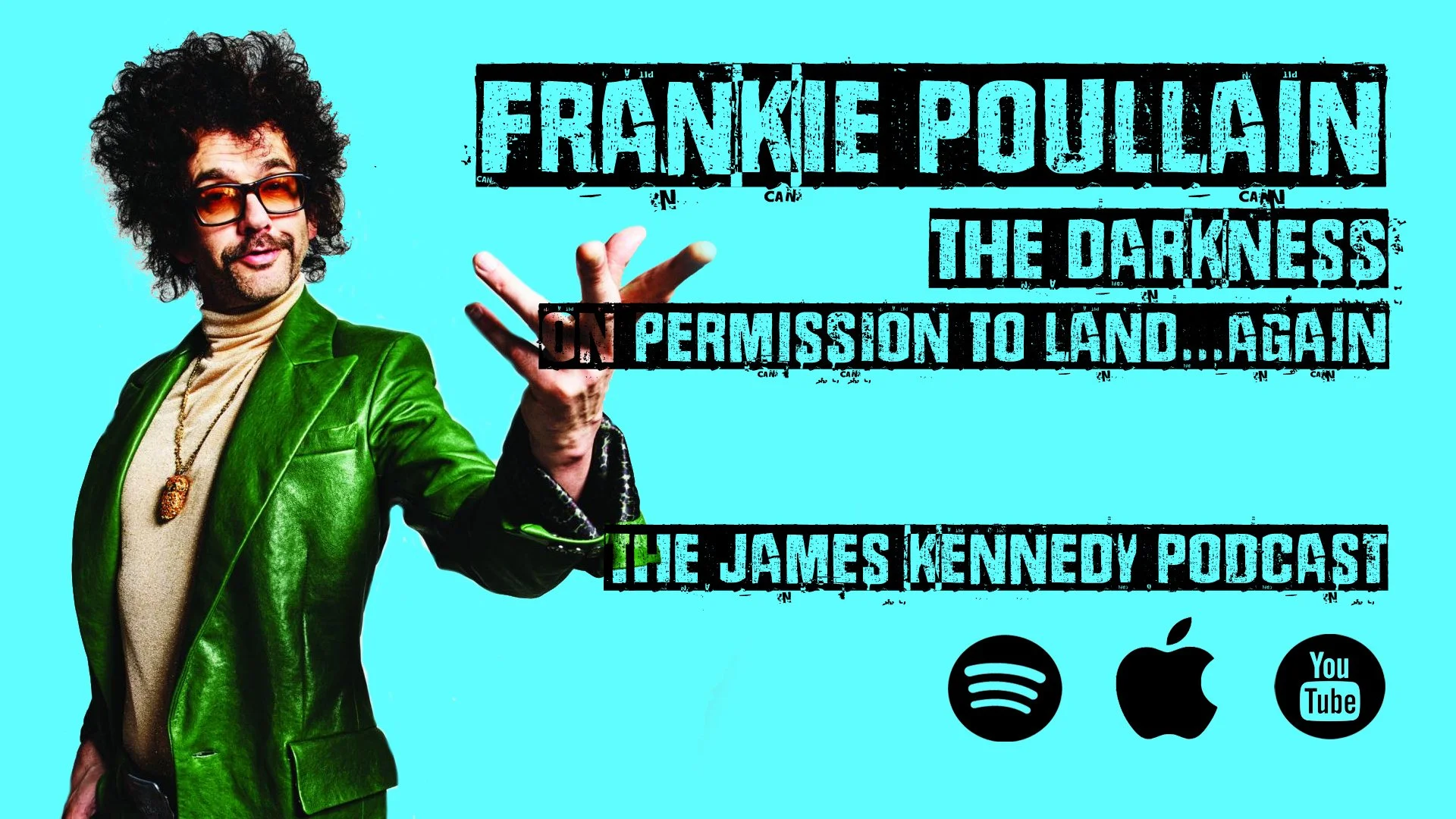
FRANKIE POULLAIN / THE DARKNESS - ROCK, STRUGGLE AND SURVIVAL
James Kennedy interviews Frankie Poullain, bassist of rock band The Darkness. They discuss the band's 20th anniversary reissue of their album Permission to Land, their upcoming world tour and documentary showing their career struggles and band dynamics. They also talk about the realities of life on tour, mental health in the music industry, music streaming models, political apathy, and the enduring ethos of punk rock.
James Kennedy
Mr. Frankie Poullain. How are you, sir? Thank you for joining us.
Frankie Poullain
Very good. And even better, hearing my name pronounced correctly for the first time in 28 years.
James Kennedy
Well, I will admit, it was a bit of a risk. It was a bit of a gamble, but I am learning French and I thought that the spelling seemed to make sense to me. So I'm glad I got it right.
Frankie Poullain
It was an impeccable pronunciation.
James Kennedy
What did you get? Poulin? Is that the standard?
Frankie Poullain
Yeah, everyone says Poulin, you know. Even the guys in the band once, you know, we did this song once all about. It was called Second Fiddle. It was Dan talking about how he's always second fiddled his brother. It was a song for the fans, you know, all about the band and everything. And Justin even managed to do a false rhyme where he managed to rhyme Eddie Graham with Frankie Poulin. Yeah. That was the biggest stretch.
James Kennedy
Well, what's happening, man? What's going on? You guys have got a load of things happening right now. So fill us in.
Frankie Poullain
Well, at the moment, I'm in Cornwall. We're on a songwriting trip for our, would it be, eighth album? And we're also about to undertake rehearsals in a couple of weeks for the 20-year anniversary world tour, which is going to be in the States, first of all, and then we're going to hit Europe, UK, then Australia, Japan.
James Kennedy
And this is the 20th anniversary of Permission to Land, right? Which is called Permission to Land Again.
Frankie Poullain
Yeah, so here we are again. But, you know, we'll be doing a lot of rare B-sides and there'll be a few surprises in the set too. We've just been working on the set design and it's going to be—yeah, we're putting a lot into it because this is possibly our last tour before we're back in arenas for the next album. We've really done really well in the UK and Australia and we've gone from, you know, the theatres into the arenas. So it's really good times for us at the moment. And we've got a documentary coming out later in the year as well.
James Kennedy
Oh, nice. Dude, the package for the reissue that's coming out is absolutely incredible, man. There is so much stuff on it. There's so much stuff on it. It's on offer there. It's available for pre-order right now and there's like, there's a four-disc edition. It's coming out on multi-vinyl options as well with, you know, loads of info on the album and stuff like that. Tell us about the package, man. It's available to pre-order right now, yeah?
Frankie Poullain
Yeah, there is and there's lots of commentary from the guys, a little bit from me as well, and all kinds of rare photographs and rare recordings as well, live recordings from back in the day and bonus tracks and all that kind of stuff. So, yeah, it's wonderful for the fans.
James Kennedy
Oh, man. Yeah, it looks absolutely gorgeous. And like I said, you are playing absolutely everywhere as well. So, yeah, you've got a busy year coming up and good to know that, you know, you're songwriting as well at the moment and with plans to do some arena tours and new stuff coming up as well. I mean, are you guys, have you guys got a forecast now for like the next two years or so or are you just focusing on now or what's happening?
Frankie Poullain
We're taking our time with this album. Goodness, we've worked really hard the last few years. It got everything back on an even keel after COVID. We put a lot of work and we did like a seven week tour of the States and we were the first band actually for a lot of people in the States, the first band after COVID so that was an experience.
James Kennedy
Oh man, I can imagine. Yeah, and like you guys are so good live as well, such a fucking killer live show. So I can imagine that after all that time off people were just fucking blowing their minds. I mean, dude, I'm so jealous. I mean I'm in a band myself and they're like, you know, obviously at a much different level to you guys and I just imagine that like it's so hard, you know, for most bands and when we look at guys who are like flying and soaring the heights that you guys are, we imagine that like it's all trouble free and that you have no problems at all and everything's taken care of and it's all sex, drugs, and rock and roll and glitz and glamour and decadence and ease. I'm just fascinated to know the true reality behind the scenes. I mean is that where it's at for you guys now or do you still have challenges and struggles even at the level that you guys are at?
Frankie Poullain
It's all about companionship, brotherhood, you know, chemistry, because you know, you go through the—because the struggle is really where it's at, you know. That might sound wanky for me to say, but the struggle is what bonds you together and that can be a really enjoyable thing, you know, if you've got that chemistry and you've got to be able to have a laugh, you know. And we've got a lead singer, you know, we're really lucky to have a guy like him who doesn't take anything seriously. He doesn't take himself seriously anymore, that's so rare in a lead singer. He hasn't got any of those annoying traits almost all lead singers have, you know, so that's great, you know. And we've got also a pair of brothers who don't have like a kind of passive-aggressive or a kind of unhealthy relationship in any ways. It's really inspirational. They've got great parents, then Justin, you know, really good people who sacrificed a lot for them. That's really where it comes from, you know. Their father built them like a garage where they could record and play and really supported them as well, you know, and their mom was really big into the 70s and 80s kind of scene back in the day, you know. That's, you know, we talk about that, we've touched on that, it's touched in this in the documentary, almost like the Friday Friday link with Justin's mom coming back from a club in Carnaby Street and how she saw Brian Jones in a pink catsuit, yeah, you know. That's kind of almost the thing that kind of set it off, so that's the nature of the documentary.
James Kennedy
Man, that sounds super interesting. Is it kind of like a traditional rock and roll behind the scenes following you guys around doing your thing sort of thing or is it more to do with the human and the relationship side of things?
Frankie Poullain
Well, it's not what people are going to expect. There are silly bits and there's definitely surreal bits. I would say it's more surreal than silly. But the director Simon Emmett, who funny enough comes from a fashion background, but he also has a bit of history in making these documentaries. He did one about Barnet Football Club and about the link between Barnet and the community up there and the link between these eccentric fans who just had this obsessive passion for Barnet. And he's done the same with The Darkness fans, he's focused on that. He's also focused on our kind of passion, kind of love for a music form which is kind of dying out really, you know. It's not quite archaic, but people call it heritage, don't they, you know, the kind of rock scene, you know, of the old kind of classic rock bands. We're still kind of carrying that on in spite of everything. And there's been times when we've been like the laughing stock, sometimes people laughing at us, sometimes people laughing with us. I guess that's the big differentiation. So the documentary explores all these things and also touches on some quite emotional things that would be kind of maybe hardcore and quite depressing in other bands, but the way that we've managed to kind of laugh at things that happened—some quite dark moments, health issues, and of course, you know, the breakup of the band as well. So, yeah, it's all there and it's a lot more emotional than people will think and it was uncomfortable for us, but that's a good thing. To make a good one you have to be uncomfortable and it has to really be about the human struggle because, you know, back in the day we tried to do a documentary covering all the success in 2003, 2004, but that's not good to watch. Human documentaries are almost always invariably about the human struggle and that's what makes them resonate.
James Kennedy
Well yeah, already that sounds right up my street, man. That sounds fascinating because, yeah, it's that sort of stuff that I'm interested in because as you said, yeah, we all love to watch a band sailing the fucking highest heights like you guys have, but after a while it gets a little bit like, okay cool, we know about that, you know what I mean? Like we know all the stories about Ozzy and private planes and, you know, fucking strippers and cocaine and whiskey and all that sort of stuff. We've kind of—we know that story because it's been told, but it is still—we still love to see it because it is the dream that all of the rest of us kind of like hope to attain one day, but never do. But as you—as I think I totally agree with you when you say that it's actually the deeper connection, the deeper resonance is that human struggle, those universal themes that we can see like, oh wow, guys like The Darkness, they still struggle too, they still have their interpersonal conflicts or their mental health struggles or their substance issues or whatever it might be, you know, this—that there's baggage that comes with that lifestyle that we hadn't really considered because we haven't experienced that life. So I think getting an insight into that stuff is so much more interesting, I think, and resonates more emotionally, I think, as well.
Frankie Poullain
Exactly. And you got to put your vulnerability out there, you know, and we did, and it wasn't necessarily enjoyable, but it's uncomfortable for us, that's a good thing, I think. You have to put yourself in an uncomfortable situation, maybe not quite as uncomfortable situation as Bros did or Metallica in Some Kind of Monster.
James Kennedy
Yeah, that was pretty cringe in places.
Frankie Poullain
Yeah, the cringe factor is good though. I think it should be cringe because it is ridiculous the way that we lead our lives. So I think you almost have a duty to do that, to put yourself out in the cringe factor, because I guess ever since things—the history of western civilization, you know, the metal years once that's come out, you know, you just have to own it and just say, yeah, yeah, yeah, this is ridiculous what we do, you know, and we are dicks most of the time, and we're ridiculously fortunate, and it's such a strange way to lead your life. So you have to just, yeah, expose it all really as much as you can anyway. Yeah, I totally agree, man. So I was just remembering something that Justin said once we were talking all about something ridiculous again, you know, some stage thing and then I mentioned, you know, there's a dignity kind of aspect and everything, and then Justin said, "And you can't lose something of which you haven't got any left," you know. Yes, you just own it.
James Kennedy
I love that, man. I love it because you're in an interesting space as a band musically, visually, you know, in terms of the genre that you're associated with and everything. But I mean the fact that you have fun with it and there's a tongue in cheek to it as well, as well as the great musicianship and the great show and the fucking amazing songs and everything like that, you can tell that like you don't take yourself too seriously as a band, that totally comes through. There's a fun factor to it and it's almost kind of like a little nod there to the—yeah, we know that like this is mental, but you know, we're fucking doing it anyway, you know. Yeah, yeah, do you have pockets of normality in this lifestyle then? I mean is it rock stardom all the time or do you have insanity for like six months and then like complete normality for the rest of the year?
Frankie Poullain
No, there's too much normality, but you know really if you're talking about what we do for a living we're actually travelers because 90-95% of our existence is taken up with just traveling, just hanging around airports, sitting on tour buses in our bunks or in the back lounge of the kitchen area. I mean, you know, it's a decent tour bus, but still traveling and a lot of it is drudgery. So I kind of wind down and conserve your energy and then you just wait and then you push all your energy out, you know, for that gig or whatever it is that you're doing or the video shoot, but really it's like we're mainly travelers and killing time.
James Kennedy
Yeah, well I guess at your level you're more like space travelers because, you know, the level that you guys operate as a band is kind of mostly unattainable and it's for most artists and beyond the comprehension of most people outside of this world as well, because you know most people don't get to live or experience that life or soar the kind of heights that you guys do as a band, you know. So I can only imagine what kind of roller coaster that must be because it's intense enough, you know, at the transit van level, you know, where most bands operate, where you're bored out of your mind for most of the fucking day and then you launch face first into the mad rush of a live show before being hurled back onto a dark empty motorway again, it's just fucking weird. So I can only imagine how that must be when you're doing it at the sort of level that you guys are.
Frankie Poullain
Yeah, for sure. If anything, when you go on stage you have to suppress some of your kind of excitement and kind of collect yourself and compose yourself. But then the other side of things, where it's the 95% you're not doing exciting things, you have to almost generate excitement, so you're doing the opposite things both times because both things are so extreme.
James Kennedy
Yeah, that's a really interesting point actually. I mean, I talked a lot about my experience of falling apart as a human being as a result of this lifestyle in my book Noise Damage. And I know that you're a published author as well, you've written a book called Dancing in the Darkness where you chart your journey into this world, which I haven't yet read, but I'd be fascinated to do so. But I'd also be interested to know, how did you find the writing process and, you know, was it quick and easy for you or did you find it long-winded and tedious?
Frankie Poullain
Yeah, I find it a bit long-winded and tedious, and I wouldn't do the same thing like that again. I try to make it a bit tongue-in-cheek and silly, but I would do something completely different next time. I wouldn't write from first-person perspective, you know, create like an alter ego or do something like that, you know. That'd be more interesting, I think.
James Kennedy
Yeah, nice. Well, I'm currently—I've actually made the same mistake twice. I'm actually coming towards finishing my second book now. I got a deal for my second book. My first book did really well, it went to number one on Amazon in three categories, which was awesome, for about a day it was the second best-selling rock biography after Roger Daltrey, which was amazing considering it's about a band who didn't make it, didn't get signed, no one ever fucking heard of. And I think it's—the resonance of the book is very much what you were describing about the documentary, because I'm talking mostly about the struggle and there's no happy end and it didn't work out, you know. I think it resonated with the 99% of bands who also have that journey and don't make it to The Darkness level, you know. But the reason I mentioned that is because the second book I'm writing at the moment, I've just finished writing a chapter on mental health in the music industry and how it's such a universal crisis there. And I would love to ask you, as a band that's been around a while now and you've seen some pretty big highs and you've seen some pretty big lows, and you kind of alluded to it a little bit in the previous answer, but what are some of the things that you guys do to manage your mental health, to keep yourself all in good health, to look after each other, to keep a balance? What are some of the things that you guys do to keep the show on the road, but keep yourselves happy and healthy in the meantime?
ENJOYING THE CONVERSATION?
GET JAMES KENNEDY'S LATEST INTERVIEWS, WRITING AND LIVE SHOWS STRAIGHT TO YOUR INBOX
Frankie Poullain
Just don't take yourself seriously, you know. Try to practice self-awareness and just learn to laugh at ourselves and just accept that the human condition is a human condition. Everyone's got kind of blind spots, and I guess, you know, we have a good chemistry in terms of the different—what we each represent. I mean, I said there's a bit in the documentary where I say that if we're a family, you know, then Dan is the father, Justin's a trophy wife, the drummer is the adolescent teenager, and I'm the weird uncle. We each inhabit kind of different spaces and adopt different roles, even if some of it's subconscious. But in terms of mental health, yeah, just trying to be self-aware and trying to challenge ourselves and just not to take ourselves seriously and kind of laugh at the mistakes. We don't reprimand each other, in fact, we actually encourage the mistakes in each other and we'll highlight and draw attention to them and then laugh at them rather than incriminations. And really, we don't really like—the ego thing never really comes in, you know, or if it does then it's—I just never really notice any kind of ego issues at all in the band, no, none whatsoever, which is quite rare.
James Kennedy
Yeah, it is really rare, especially when you get to the sort of level that you guys are, when you've got the crew and the support and the entourage and the funding and the fans, and you're living in that kind of bubble world that you're living a lot of the time. It must be very hard, so to have the internal weather healthy—
Frankie Poullain
I think that makes a big difference, yeah, you have to. And also it's all the people around you, as you mentioned, the crew, the wardrobe, and the merch. Really there's no room for anyone that has an attitude problem, so you have to really use your instinct there, and gradually you find yourself weeding people out unfortunately, and you have to, and it's really for the best, you know. If you smell a rat—or maybe that's slight exaggeration—but if you just—if someone's not kind of blending or not combining with other people, you really have to nip it in the bud, because these days it has to function like a well-oiled machine, you know. There can't be any kinks or anything, you know, because you have to make money from touring.
James Kennedy
That makes a lot of sense, and I think that's essential at every level of the ladder. I mean, we had to lose a drummer in our band who's probably the best musician I've ever fucking played with because he wanted to fight his way out of every club with a steel bar, and after a while that just grinds everybody's gears, you know what I mean? So, yeah, you have to keep the—you have to keep like, like you said, that well-oiled machine, there's no space for douchery.
Frankie Poullain
Yeah, exactly, yeah. Really, the attitude, the mentality is almost more important than having like the best technical kind of musician or—it's all about the combination and the blend, the chemistry.
James Kennedy
Well, I'm so glad to hear that that same rule applies at the higher rungs of the ladder as well. That's great, yeah, that's some great advice there for bands who are out there because it is tough right now. I mean, have you found it's gotten tougher with you guys with things like Brexit and coming out of COVID and stuff like that? I know like the cost of touring is a lot higher now, I know ticket sales have been up and down as well. Have you guys found any effect, good or bad, as a result of any of those things coming out of COVID with Brexit, or is everything pretty much as it was?
Frankie Poullain
Yeah, all those things are a major pain in the arse, you know, COVID and Brexit. Obviously, you know, nothing good could come out of that, but—well, actually, I'll tell you what, something good can come out of it, because we're all in this together, and what it does is it makes you dig deeper and compensate, you know. So it takes away any complacency. But it's obviously like a pain in the arse, but something we've been insulated from most of the bad effects by having great management who almost never put a foot wrong and they've navigated our way out of these tricky situations. And now we're actually in a better place than we have been for 18 years, really.
James Kennedy
Well, that's good to hear, man. How do you feel about the music industry generally then? Because, you know, you guys have come up during a time when we've seen the historic transition between the old model of, you know, CDs and vinyl into the digital and the streaming model. And obviously there's been a lot of readjustment, a lot of labels kind of fell by the wayside and it took a while for everybody to figure—get their heads around how things work now. You guys have been a band through that transition, you've seen both sides. Have you got any thoughts about, you know, the state of the industry right now? Do you think it's in an interesting place or is it any better or worse? What are your feelings?
Frankie Poullain
Well, there's less arseholes, because you can't really afford arseholes anymore. The whole Kill Your Friends generation then—if you read that book by John Niven—yeah, that kind of indulgence and complacency of the late 90s, early noughties has kind of died away, and now it's a reality now. And that is a shame in a way, because there's less characters in the industry and it's more kind of functional. It's lost a—obviously, if you're looking for a little kind of indulgence and decadence, you'd probably find more of it Canary Wharf than you do in their record industry. Oh yeah, it's different.
James Kennedy
Yeah, I totally agree with you there, man. That's a great point as well. What are your thoughts on music streaming then? This is a contentious issue, I know there's arguments for and against on both sides. What do you think, a force for good, a force for evil, or something in between?
Frankie Poullain
Well, it was the wild west out there when these—I think corporations kind of created them, these platforms, and made up the rules as they went along really. There's an argument to say that they're gangsters really, and yeah, obviously we're not paying enough, everyone knows that. Because the idea is that, oh, people are going to such and such because the platform is so great and they just happened to see music on it, you know, it's not that they're going there, "Oh, I'll listen to this band, so I'm going to listen to this band," you know. Somehow the idea is that you're going to the platform first, you know, because it's so great, which is obviously nonsense, you know. So it is a bit unfair, but at the same time, you are getting a lot of exposure and their argument is that, you know, they're listening to there and then they buy a concert ticket. It's unfair, but that's the way it is, I'm not complaining about it. Well, actually, probably is an argument, but if people like Bob Geldof and the high ploy can't change things currently then I'm not sure who can. If the politicians are powerless against the corporations then fans are even more powerless.
James Kennedy
Well, I guess, you know, there's always the argument that you hit them where it hurts, you hit them in their pocket, and if enough people stop buying the fucking product and stop using the service then, you know, they're either forced to change or shut shop, I suppose, you know. But whether that's going to happen I seriously, seriously doubt it. I think streaming is here to stay and we just need to try and improve it, and I think it's going to be a really good thing to do, and I think it's going to improve, you know, the model as it exists, which is going to take a long time, and it's going to be a lot of fucking collateral damage in that process. But for me personally, you know, I don't—I see it as a bit more nuanced I think than this argument is often presented. It's presented as "Spotify is evil, they don't pay enough, fuck Spotify," but I think that there's an argument for perhaps, you know, how—let's unfuck Spotify, you know, the model is clearly one that people like, it's here to stay, it can be a great leader for discovery to lead people then towards your, you know, your merchandise and your concert tickets and your t-shirts and things like that. It's a great place as a music listener to discover new music. So, you know, there are a lot of positives, but yeah, the remuneration rate sucks, it is terrible. But I think when people complain about that, they're sidestepping the issue that for most major artists that are actually using the platform, most of the people that are complaining about this with the loudest voice are people who are signed to legacy record deals, and they're not going to be able to do that, so it's not that Spotify pay sucks, which it does, but also that 80% of what they get paid then gets given to their label and then 20% gets divvied up amongst their fucking managers and producers and all the other middlemen that have been locked into their contract. So it's a bit more nuanced than that. Whereas for someone like myself, who's an independent artist who does everything DIY and does everything himself, I get all of the publishing, I get all of the label side, I get all of the production and artists and performance and songwriting side, I get fucking everything. So I might not be shifting the kind of numbers that a major label artist would because I don't have that exposure or that added clout behind me, but what I do make is 100% mine. So for me, Spotify pays a few bills every month, you know what I mean? Which is more than I had before. So I think it's a bit more nuanced and layered, but generally, yes, I mean, they need to pay a lot fucking more and they need to also drop this pro-artist system that they've got whereby they divvy up all the money against the highest streamed artists rather than divvying up the money depending on which paying listeners are. The money that I pay every month should be going to Bloodywood because that's all I fucking listen to. It shouldn't be going to Ed Sheeran, which I never listen to. So that system is mental. There's a lot of structural things that need to change. But I think you're right. I mean, it's David and Goliath, isn't it? I mean, how that's going to happen, I don't know.
Frankie Poullain
Yeah, exactly. I couldn't agree with you more. You know, the point is it all comes down to the government. There's hardly any area of life where there's regulation, you know, over the beast, the free market kind of capitalism. So you can't—you know, the problem is you can't just have regulation in one sector, not regulation in another. I happen to believe there should be regulation because we all know that the beast of free market capitalism has become like monstrous and out of control, and it's basically causing the end of our existence. And I think that's the problem. I think that's the problem, you could argue. And we have all these countries behind us that are going to go through the same thing that we're going through: India, China, Brazil. So it's a much, much larger question than just musicians, unfortunately. But yeah, of course, it's unfair. And many things are unfair, you know, with the 1% of the population controlling 50% of the world's wealth, et cetera, et cetera, you know. That's just a very brief summary and everything, I know I'm not dealing with any issues specifically. But the principle is that there should be more regulation across all sectors of life, you know. There should be—like, transport should be regulated, you know, you can't have the shareholders in rail companies just fucking with people's lives like they do. You know, people can't get to work and strikes and there's delayed planes and trains because it suits the shareholders to do that. There's all kinds of shit going on. In the words of Roger Taylor, gangsters are running the world. You know, I'm not talking about drug dealers and mafia, you know, we're talking about the corporations who are gangsters dressed up as businessmen.
James Kennedy
Oh, 100%. No, I totally agree with that. And I think, you know, the drug dealers and the mafia are all part of the same class. It's just business, you know, the oligarchs and government and, you know, people with fucking billions stashed away in tax havens and the oil barons and the financiers, you know, they're all rubbing shoulders in the same places and mixed in that are the literal criminals, like, you know, the drug barons and the mafiosos and things like that. They're all part of the same class and they all exist to serve their own, the interests of their own economic class. So, yeah, I see them as literal criminals, you know what I mean? And if you look at how the rest of us fit into that picture, you know, we have to pay taxation, which is essentially extortion money, you know, like if you don't pay this money, then, you know, we're going to cut your fucking services off and send the fucking boys around, you know, aka the police. It's—I think it's worse now than it has been for a long, long time, because for the reasons you said, we've just got this kind of free reign, reckless, unregulated, capitalistic behemoth, which is just destroying the planet and everything on it, apart from the 1% who benefit from it.
Frankie Poullain
Yeah, exactly. Well, well put. I'm glad that we both understand that, but it doesn't change the fact that one can't help feeling helpless. It's incredible how little the British protest. I mean, at least the French, you know, the French protest, and they do win some small victories through protesting, but nothing makes people in this fucking country protest. It's just—it's incredible, isn't it? I mean, it's pretty obvious to see that that comes from the nanny state, which comes from the monarchy. I think psychologically it all comes from that. And that part of it makes me sick. I felt even worse than sick, I felt nauseous when the coronation was ten days shut down when the Queen died. I felt it was just obscene and just an insult. I always think back to the First World War, you know, for king and country, all these millions of working class men just massacred for king and country so the royal families of Germany and Britain could have their little squabble over having their places in the sun, you know, their colonies. Just obscene, you know. But coming back to my original point, the French don't have a royal family and that's why they protest, because they don't have that culture of obedience and servile, kind of begging bowl, kind of servitude. Is that the word? Yeah. Anyway, I'm glad I'm speaking to a Welshman, so I'm sure you can relate to that to a certain degree. English people don't seem to be—you know, you seem to offend English people so easily. I mean, of course, but I'm talking about, you know, the Southern—you know, I've lived in the South of England for a long time, and unfortunately, I've been faced with this awful kind of complacency and this kind of casual kind of—you know, they're so casual about it all, and just, you know, just this adherence to the hierarchy. And I guess they're happy, you know, the English middle classes is something I think about, isn't it?
James Kennedy
Man, you are talking my language now, dude. Honestly, I feel like we should have gone on to politics earlier on in the conference. We have opened up the Pandora's box now, man. I totally agree with you about the French. I mean, look at what's been happening over there recently. Those guys know how to fucking make a noise, man. I mean, you know, they literally chopped off the heads of their aristocracy and their royal family. I mean, that's fucking awesome. You will never, ever, ever see anything like that in Britain. It's not going to happen. And like you, I blame this kind of apathetic, subservient, kissing the ass of those above you mentality that we seem to have over here, where it's like, royal family, they're so much better than us. And if only—if I kiss the ass of the guy above me, then maybe I can be like him, rather than doing what the French do and taking to the streets en masse and say, "No, fuck the people above us. We're going to fucking burn it down." That's more my vibe, but it's never, ever, ever going to happen in Britain. And you know what? I blame not only that subservient attitude that you're talking about, where it's like, oh, you know, doffing the cap to those above you and not making a noise and not making a fuss and just being a good little fucking servant, a good little peasant doing as you're told and standing in line—I blame the pubs. You know, I think it's too easy to just go to the pub and have a fucking moan about it, but then don't do anything, than to actually fucking rise up and get off your ass and change things for the better. I think, you know, if they closed the pubs down, you'd see a revolution by Tuesday. But it's almost as if we like this shit. We almost like having it bad. You know, it's weird.
Frankie Poullain
Yeah, I think there's something masochistic about a large proportion of the English population.
James Kennedy
Man, it's the only explanation I can think of as to why we've had the Tories in power for like nearly 13 years now. We've got to actually enjoy the pain. It's the only explanation I can think of.
Frankie Poullain
I just noticed your Ramones t-shirt. Do you know this from Rockaway Beach? Yeah, I was on Rockaway Beach just 10 days ago. It's a great beach. Just like you catch a ferry from Wall Street Pier and it's about an hour ferry ride. I was really impressed. I had that kind of experience. It was really nice water, you know, and surf. You know, there's people surfing and everything, boogie boarding.
James Kennedy
Nice, nice. Yeah, I think punk rock, the spirit of punk rock is always going to have a place in society, a necessary place in society, I think, like that. Not necessarily—it doesn't have to be connected to the musical genre. You know, things need to evolve and change. But I think the ethos and the attitude of punk rock, I think, is necessary, certainly more now than ever before.
Frankie Poullain
Yeah, the legacy is just amazing. For a really small group of people, what they did and how they changed culture for the best, it's just—you know, if it hadn't happened, what a huge loss. Things would be even worse. It was a huge thing, it really was. I met Chrissie Hynde backstage. I know people don't say shit about punk rock, but in terms of her role in teaching Steve Jones to play guitar, for one, and just the way in which she—because that's really what it's all about, is the attitude. It's not what you do, it's the way that you do it. It's the way of doing things unapologetically. Anyway, yeah, I met her backstage at the Guns N' Roses support gig at Hyde Park, and that was a real privilege to meet her.
James Kennedy
Oh, I bet, man. That's one of the many perks, I guess, of what we do for a living is not necessarily always about the financial pay. For most of us, that's fucking non-existent. But it is the travel, it's the stories, it's the people you meet along the way, it's the memories that you get. I mean, what else are you going to do? Spend your life fucking, you know, sitting in a cubicle, you know what I mean? Punch numbers for some douche, you know? Like, oh, you're going to be out there, yeah, okay, you're broke, but hey, you just met your fucking hero at a festival or something, you know what I mean, backstage and got to do a song with them or something. Or just, you know, being stuck in the ass end of Italy living in a transit van, you know, and fucking wanting to strangle your manager, but that's still more exciting than being stuck in the office.
Frankie Poullain
Surely, couldn't agree with you more. Some of our best memories are in Italy, you know. We do really well there, apart from obviously having gear stolen there, you know. There is a bit of crime there and actually it's difficult to sell merch there too because of the bootleg culture, you know. But apart from that, that's kind of what I like about it, because it's kind of scuzzy and unpredictable, but the warmth of the fans and the way they respond to our music is just really heartwarming.
James Kennedy
Oh yeah, I love the place, man. I love the people, I love the culture, I love the history. It's one of my favorite places on earth, man. I had great times visiting there and playing there as well. Some of my most fun memories are playing places in Italy. But sticking with punk rock just for a second, because you mentioned of course The Ramones there in Rockaway Beach and what an important genre punk rock has been and the spirit of punk rock, and I totally agree with that. I've got a theory that I think struggle is a major engine for great music and great social change, and oftentimes the two go hand in hand. If you look at things like punk rock, hip-hop, the blues, these are all game-changing musical genres and social movements that were all born out of social struggle and personal struggle. And you mentioned earlier on in the conversation how struggle has been an important part of your guys' journey, and I think the struggle is an often overlooked element in the creative process and the creative journey of artists. I mean, we live in a culture where everybody is obsessed with the winners and the wins and the glory, but really I think if we look back at the moments that spawned our greatest developments in life and our greatest achievements, they all came from moments of struggle where we had to dig deep, make really difficult decisions and changes, and we had to channel our inner strength and resilience and put aside our bullshit, you know, for something that's more important than giving up, you know. So I think the failure and struggle gets really overlooked in the obsession that we have with success and achievement and winners. So on that theme, instead of asking you now about, "Hey, what's the biggest fucking gig you've ever done?" and all that sort of bullshit stuff you've answered a thousand times, I'd like to ask you more about the failure and the struggle that you guys have encountered along the way that has contributed to your staying power and where you are as a band now. Have there been any catastrophic struggles or failures or moments when it was all looking so good and then it looked like it could all fucking fall through your fingertips at any point, but somehow you pulled it back and came back bigger, stronger, and better than before?
Frankie Poullain
Well, everyone knows about obviously 2003 and 2004, and I wouldn't necessarily call that—you know, we all know about the struggle, the conventional struggle you had between 2000 to 2003, you know, in the hard yards and playing the pub circuit and then making it and then being in the band and then being in the right place at the right time and then having the right song, I believe in a thing called love, so I don't really need to talk about that. But what's interesting, more interesting when you say struggle, is actually the comeback in 2011. So the comeback with the original lineup, we hadn't seen each other for a few years, even the brothers hadn't spoken for a while, and we got back together with Ed on drums, Graham on drums, and then we had—the management just wasn't right, so we didn't come back well at all. Even though we had a lot of eyes on us, we had a big comeback gig at Download on the main stage in 2011, the management wasn't right, the organization wasn't right, the label wasn't right, so there was a struggle after that. But also, unfortunately, Ed realized that he couldn't deal with some of his issues, shall we say, his health issues and his refueling habits, so unfortunately, you know, we lost him and that was a struggle. So I would say the album after the comeback album—the comeback album was Hot Cakes, not our best album, but it has its moments, but there were struggles with management and then we lost Ed, and then we were left with the second comeback album with a new drummer. And I would—when I think back to that period, it's the Last of Our Kind album, I think back there was a real atmosphere of struggle. Myself, Dan, and Justin, just the three of us on an Irish island off the coast of Kerry, and I remembered that as being the album that really epitomized the struggle, because we'd been given this opportunity to come back and we—I wouldn't say we blew it, but we didn't capitalize on it, and then there was just three of us left and we had to work up again. And that album, Last of Our Kind, I think it has a couple of big songs on it, "Barbarian" and "Open Fire", and we really dug deep, you know. Dan dug—Dan always digs deep, but he dug really deep musically to come up with some amazing riffs and guitar work, and then Justin kind of was more emotive, I think, on the album. So best answer to your question, when you want to think of The Darkness and struggle, I think back to that album. And we did have Emily Dolan Davies, a female session drummer who was great on the album and recording the album, and I think that's a really good album with us. It was nice to have her with us, but then she didn't really want to tour with us, that didn't feel right, I guess. Women touring with a cock-rock band didn't quite—not that we are a cock-rock band, but there was something about it that didn't quite work touring. But in terms of the album, she did help us.
James Kennedy
Well, amen to that, man. And yeah, you are a band that has had more than your fair share of struggles and ups and downs and challenges over the years. So, you know, that is testament to the fact that you're still here now, kicking it bigger and better and louder and flashier than ever before. It's testament to that exact spirit that I'm talking about. And speaking of bigger, louder, flashier, faster, more, we got to loop it back to what we came here to talk about in the first place. We are talking about Permission to Land Again, the 20th anniversary reissue of that classic iconic album where it all started. It is coming out on October the 6th and it is available for pre-order right now. It is in a special 4-CD DVD release, including the original album, rare B-sides, bonus unreleased demos, as well as live albums from their iconic shows at London Astoria, Knebworth, and the Wembley Arena, as well as a 2-CD edition as well. There's a 5-LP version, there is a reprint of the original 1-LP vinyl which has long been out of print since 2003, it's now coming back, man! There is fucking loads and loads of options here. This thing looks absolutely gorgeous, I can't wait to get my hands on a copy. There's a booklet as well with loads of info and backstory on the album that is available for pre-order right now and it's coming out on October the 6th. The band are also going on a colossal tour, they're playing all over in North America as well as a bunch of sold out dates in the UK with a whole bunch of new dates announced for Edinburgh, Newcastle, Leeds, Nottingham Rock City—my favorite venue—Brighton, and London, as well as dates across Europe and everywhere else. So all you Darkness fans out there, you are in luck. The boys are going to be playing here, there, and everywhere with a brand new record coming soon as well, new material, there's going to be a documentary, and talk of a book as well, Frankie said. So it's a great time for Darkness fans and a great time for the band, I'm sure. I mean, dude, busy times, busy times indeed for you guys. Busy times, good times.
Frankie Poullain
We're looking forward to it, and we've got this stage show that we're just working on now which we're really excited about, yeah.
James Kennedy
Oh man, well I'm excited as well. I know that everybody listening to this is going to be excited because you guys are so fucking good live, so I can't wait to see what the new live show is going to be and I can't wait for everything ahead, man. I mean, what a great few years you guys have got ahead of you, and long may you guys continue to do your thing and bring so much joy and fucking awesome tunes and good times to so many people around the world who love you so much for it. We thank you for what you do, brother. Long may you continue to do so, and thank you so much for stopping by today and chatting with us. It's been a really, really interesting chat, so I really appreciate you stopping by and, yeah, I'll see you at a show soon, man.
Frankie Poullain
Thanks, James. Really appreciate it, all the best.
Key Points:
The guest is Frankie Poullain, bassist of The Darkness, who discussed the band's 20th anniversary reissue of Permission to Land, a documentary, and an upcoming world tour.
Frankie explained that The Darkness maintains mental health through self-awareness, humor, avoiding ego, and prioritizing chemistry over technical skill when working with crew and band members.
Frankie described the music industry as having fewer characters and more functional operations since the decline of 1990s indulgence, and he criticized streaming platforms for unfair pay while acknowledging their exposure benefits.
James and Frankie agreed that free-market capitalism is out of control, that regulation is needed across all sectors, and that British apathy contrasts with French protest culture.
Summary:
The interview with Frankie Poullain covered The Darkness's 20th anniversary reissue of Permission to Land, titled Permission to Land Again, which includes rare B-sides, demos, live recordings, and a documentary. Frankie discussed the band's upcoming world tour, new album songwriting, and the importance of chemistry and humor in maintaining mental health. He reflected on the music industry's transition to streaming, calling it unfair but acknowledging its exposure value. Both James and Frankie criticized unregulated capitalism, corporate power, and British apathy, praising French protest culture. James also promoted his band's mailing list and upcoming projects, noting that season two of the podcast will return after summer.
The James Kennedy Podcast is a Society and Culture podcast hosted by musician and author, James Kennedy. Exploring the big questions around health, social issues, the arts, politics, mental health, the human condition and how to navigate this thing called life through casual conversations with scientists, activists, rock stars, philosophers and academics. Please subscribe, leave a rating and support the show.