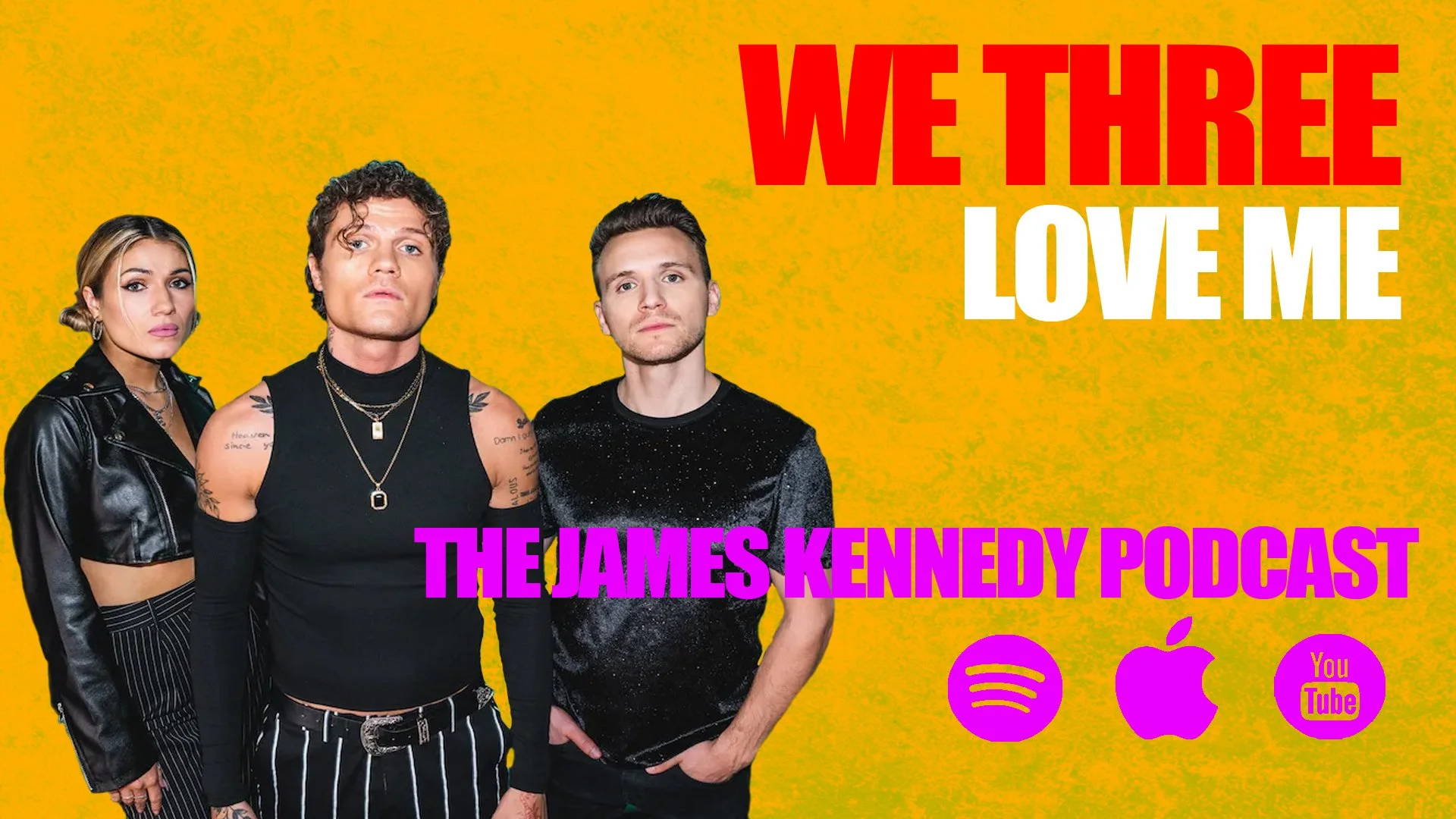
WE THREE INTERVIEW - ART AND HONESTY ON ‘LOVE ME’
James Kennedy interviews the band We Three to discuss their journey since gaining a national following on America's Got Talent. They dive into the raw, honest songwriting behind their fifth project (Love Me), the production process with producer Bill Zimmerman, navigating sibling dynamics, and how they connect with fans while adapting to the modern music industry and social media landscape.
We Three: James, hi, how are you?
James Kennedy: There we go, got you. How are you doing, guys? Good to see you. Well, guys, you've been busy, man. I mean, there's so much stuff I want to get into, so many questions, and you've got a load of stuff coming up as well. We're going to get into all that. So I don't want to delve too much into the backstory, because you guys have been over that so many times in interviews. But the problem is that your backstory is so damn interesting. So we're not going to park up on it, but if we could just do the one-minute kind of, for those people that don't know you guys yet, if you could just give us the one-minute bio of who are We Three and so many interesting stuff that's happened along your journey so far.
We Three: Yeah, I mean, for those of you who don't know us, I would say one thing that's very interesting is we are three siblings, and we have been in a band for 10-plus years. We forget the number. We've been siblings for 10-plus years! The last five years, it's always been 10 years. Yeah, that's why I'm just saying 12 now. We've been in a band for a while, like when we actually started this, but we had the opportunity to go on America's Got Talent back in 2018. Super, super cool. We never thought that would be something that we would do at all, but the opportunity just kind of presented itself. We went on the show, they seemed to like it, and we made it to the semifinals. We gained a huge following and just kind of continued to push from there. So we really do owe a lot to America's Got Talent. It really propelled us into our career today. After that, we've been able to work with some great team members. We're on our fifth project now, our fourth album, and a bunch of singles. Yeah, just getting to live the dream. We pinch ourselves almost every day. It's like, this is pretty rad.
James Kennedy: It's insane, man. I mean, your fan base and the love you guys get on your socials and online and everything is completely justified, but it is of a different level, isn't it? What do you guys attribute to that connection that you've got with your fans? I mean, there's loads of people that have been on TV reality shows and stuff like that—we've got our versions of it over here as well—but most people, you don't hear of them after that. You guys have just been propelled into a different level. Like I said, the level of love that you've got with your fan base is very special and unique, isn't it? What do you attribute that to?
We Three: So sweet to say. No, I mean, I think we didn't want to disappear after the show. Nobody wants to disappear after the show. And that's all we had seen. We were definitely aware of that, and so we saw the show as more of just a tool—not trying to downplay it, but that wasn't our main goal. We weren't even very starstruck when we were on there; it was just kind of like, "No, this is to get us to the next phase."
That's what Simon said, actually. He said, "This is a platform."
So there was a lot of hard work. There were ups and downs, and there are still ups and downs and there are going to be in the future. But with the fans, we really didn't realize what kind of a fan base we had for the longest time, because this is our first fan base. We just really didn't know. But the more we got to know each other, the more we traveled and the more shows we played—you know, we go across the pond, play shows in spots we'd never been, and the fans were so consistent everywhere we went. The energy was the same. Then we would have people at the venues start to talk about our fans. That's really when I started to realize: they would come up and just be like, "You have some of the most energetic and passionate fans, but so respectful and kind, and they are ready to have a good time. I don't really see this very often."
I don't know why we have brought them to us, but we're not going to stop because we really do love them. That's the best answer I can give you, because they inspire us to keep working on this. They're lovely. We put out music that makes us nervous on the regular, and from the beginning, the first couple songs that we did that with, their response kind of just showed us, "Oh, that's all they want from us." We can do this and they're going to receive it, so it's very symbiotic.
Yeah, the honesty means a lot and it goes a long way. I think that we just realized, "Wow, a lot of us feel the same way." We relate in a lot of things, we have the same struggles no matter what side of the pond you're on. It's pretty astounding. They check in on us frequently too—just, if they haven't heard from us on socials for a while, we get messages saying, "Hey, just checking in, are you okay?" It's so sweet. I think it's just that similar energy that is going back and forth. We're giving it to them, they're giving it back to us, and that naturally just expands. If you have that good supportive energy, our concerts feel a lot like that.
James Kennedy: Yeah, that's a beautiful thing, man. It's pretty difficult, I think, when you're in the middle of the tsunami to appreciate it because you're in it. But I would say that looking in as a spectator, not only does the music kick ass and the band is awesome, but I think—like Josh said—bravery, openness, and honesty are a massive part of it. Your lyrics are so raw and open and honest, and they touch on themes that everyone goes through in some form or other. You do it without any sugar-coating, laying yourselves bare. When you do that and let yourself be vulnerable, as Bethany said, it's so much more relatable and real, isn't it? That makes people stick to that and gravitate toward it, because they know that you're not lying to them. They know that you're speaking their truth as well as your own. I think your lyrics are awesome, guys, as well as the music, of course. You deal with some pretty heavy-going subjects without messing around.
We Three: You know, it's unintentional, but life's kind of heavy, isn't it? So we're going to talk about those things. But like you said, it's scary every single time. I made a rule a while back where if I show people a new song, it has to make me uncomfortable to share it with them, to have them listen to the lyrics that I'm saying. If it doesn't, it usually means I'm not being honest enough, not being real enough. I need to get past 50%.
James Kennedy: Love it! And are the lyrics 100% from direct personal experience, or is there some fiction in there as well?
We Three: Yeah, I would say 99%. You know, there might be a song that was on our record that was storytelling, but no, 99% of it is all true story stuff that we're going through.
James Kennedy: Wow, that's incredible. I mean, I love the lyrics personally. They really stand out to me, and there's a ton of stuff on the new record that I want to talk about in terms of the lyrical content, but we'll come to that in a minute. First, I want to talk about the making of the new album. You guys are at an interesting juncture in your journey now—you're at a point in your career where you are fully yourselves, doing your own thing on your own terms. What was the process like of making this record? Did you enjoy it? Was it arduous, or was it quick and easy? Tell us about the background to making this new record.
We Three: One thing that was cool is there's a producer that we started working with two records ago. With this one, I feel like we started working with him early, and that's one thing that changed that added a new depth, a new level, and a lot more fun. He actually got to fly out here; he was in the studio and everything. So yeah, we made the whole thing right over there in my little studio.
This one was slightly unique for me because we weren't planning on making a record. As a songwriter, you have a back catalog of just hundreds and hundreds of songs—songs you forgot about—and that's kind of where I was. I wasn't at the point of putting a record together, and then all of a sudden our management was like, "I need a record right now!" I got freaked out and started writing a bunch, and I remember both of you were like, "No, you have songs! Let me go through the catalog." So yes, there were songs written after that are on there, but it's largely a lot of that catalog stuff, which was kind of ironic.
So I got to finish it, and like you were saying, having a producer come out... he finished the entire record in two weeks! He came out—I mean, I had a lot of it recorded and stuff—and we both sat down for two weeks straight and just banged out 18 songs.
James Kennedy: That's insanity! Two weeks! My god, you're putting us all to shame, guys!
We Three: That's Bill Zimmerman. He is so fast, he's a ninja on the computer. Some of the stuff that he does is wild. I think I'm fast on Logic, and then I see him go, so it was a very cool experience, very different. But then it still came together conceptually. I just ended up... there were so many songs that didn't end up making it, and then the ones that did, we just keep finding reasons why they're supposed to be on a project together.
In my opinion, it didn't necessarily feel amazing making this record. I'm not going to lie; it was really stressful. We weren't in the best space to put it together, so it was a hard one to feel good during. But we just kind of trusted the songs and trusted the timing of everything and why it's supposed to be there. But now, just looking at the project in and of itself and how people are responding just to the teasers... well, because we've been sitting with these songs—for some of them, almost two years, like a chorus or something like that—you get numb to it. You don't really know, and so it's hard to decide, "Is this good, or is this bad?" We kind of had to just let go and let the process happen, trust the vetting process of which songs make the record. Usually, when we do that and just let go, it turns out organic. So starting to tease these songs, it's feeling like that process worked and we made the right decisions. But it's always a gamble. You flip a coin every single time.
James Kennedy: Yeah. Well, I've heard the record! I'm lucky enough to have been sent a private link to hear it, and I can say it is absolutely killer, guys. Straight out the gates, the first track, my jaw was on the fucking floor!
We Three: Yeah, that first one takes you to church a little bit!
James Kennedy: Oh, that's one way of putting it! It grabs you by the fucking throat up against the wall and says, "You are going to listen to this fucking record whether you like it or not!" But the whole record is a ride, man. I mean, the whole range of human emotion is on that record—the good, the bad, the fun, and the ugly. Before you know it, you're at the end and you want to do the whole ride over again. It's a real roller coaster.
How did you find the process? I recorded my last album in this very room, just like you guys were describing—I do all my stuff at home as well. How do you find that process? Do you prefer doing it that way, or do you prefer being able to go somewhere neutral where someone else takes care of a lot of the legwork, so when you're home, you're home? Personally, I prefer doing it at home because I don't have to watch the clock. If I want to go upstairs halfway through to tinker with something, I can do that. Do you find that, or do you prefer the separation?
We Three: When we're making the songs themselves and actually coming up with the ideas and demos, I have to be in a home space where I can run and go do whatever, not on someone else's timeline. But then that started to give me anxiety as well, because once you get to the end of the process, it feels so good to hand it over—to know that you're not the last hands touching it, and to have someone else who's better than you come in and tweak things, correct things, and get other creative input. You're just so close to it!
Just like you said, when you're in the middle of the tsunami, how do you know what's going on? Having those outside ears is really helpful. It's hard to find people that you trust with your art, so it's trial and error sometimes finding them. But Bill is an amazing guy, and he really gets the vision. It's so much fun bringing in songs, and he's still able to take them somehow and make them so much better. You see them as finished, and he's such a calming presence too, super calm while he's doing all this amazing stuff.
James Kennedy: How does it work with the sibling dynamic? I'm super interested in that, because my brother was in my band for about two weeks and we just wanted to fucking destroy each other. It didn't work at all! How does it work with you guys? Is that the key to your success and still kicking it 10 or 5 years later, whatever it is? Does it add a certain friction that you guys need, or is it the sibling bond and sibling love that makes it all work?
We Three: We don't have any friction! We get along all the time! (Sarcasm) No, it can be pretty shit. It can be pretty shit! But—
James Kennedy: Okay, next question, next question! Ha ha!
We Three: No, it's good! We found a process. It used to be really horrible—really, really horrible—and just hard because we are all our own artists, and it's difficult to figure out a way to make it work when we all know how to push each other's buttons. But now, it's less that we write songs all together; we try to have our own jobs within We Three. I do a lot of the songwriting, Joshua does a lot of the live stuff, and Bethany does a lot of the social media. It doesn't mean that we're not involved in everything, but once it gets to the end, that's when it gets kind of crazy. We all start throwing in our two cents at the end, like, "No, I don't like that, I don't like that!" And I'm like, "Well, I started this at the beginning!" Then the fights break out, but we're still here though! We are still here.
I feel like it should be a lot worse, but it actually gets better and better over time. We respect what each of us brings, and I think it's starting to become more fun to collaborate because we've gotten through a lot of it. It's been a lot of years that we've been doing this, so it's wild how in a lot of the collaboration processes, we're just understanding each other more. If one person needs to take a break, a massive process now—rather than being in the same room—is Facetimes every 10 minutes. Like, "Okay, how do you think this next thing sounds?"
The processes keep changing. The other day I Facetimed her while I was writing a song, and her husband was sitting in the room. I don't know what line it was, but he heard it and called me like 20 times that night. I was like, "We gotta pause the show, he's writing a really good song!" I just hear out of the back corner of the room, he's like, "What if you just did a big choir in the back?" I was like, "Let me try it!" So I recorded it on Facetime and it sounded awesome. So it changes!
ENJOYING THE CONVERSATION?
GET JAMES KENNEDY'S LATEST INTERVIEWS, WRITING AND LIVE SHOWS STRAIGHT TO YOUR INBOX
James Kennedy: That was an awesome recovery, guys!
We Three: Took a little bit there, we stumbled, but—
James Kennedy: Well, whatever you're doing, it's clearly working for you, so keep doing it! If you've got that little bit of friction that you need to light the furnace, then I'm sorry guys, you're going to have to keep doing it for the rest of us, because like I said, the new record kicks ass!
Given the title of the record, Love Me, I wanted to ask you guys: is there a thread or a theme that runs through the record, and what are some of the issues that you guys are tackling on this album?
We Three: The thread that goes... I mean, it's the obvious one, but the idea of loving yourself a bit. Also, just the phrase "love me" is a thread that goes through this quite a bit in a bunch of different scenarios. It was a very interesting phrase because it can be kind of cocky, it can be desperate, it can be in love, or it can be questioning. There's so much to it, and I feel like you get that throughout the record.
Some of my favorite topics... our song "In Therapy" is one of my favorites because it really is so honest and raw. Every time I listen to it, I get uncomfortable because I almost wish I would have sugar-coated it more so everybody wouldn't know all my business and shit. But that's just kind of the idea of dealing with your demons in relationships, and then getting out of those relationships and realizing that the demons you were struggling with in the relationship were still there before.
I think the concepts transition from past to current, like we talked about with some of these catalog songs that found their way here. It touches on childhood stuff growing up, religious experiences, and then how that manifests in you up to current day. Now the thread is "love me," which is so wild that it literally appears in so many places on the record that I didn't necessarily realize at first. The concept is fluid.
The other thing that I found was with the love songs: there's not a stereotypical love song on it. Unintentionally, it's like a question mark. It's like, "I adore you, but this is really hard. This is toxic, and I still love you, but this is really difficult." So there's almost a lot of questioning and unsettling themes on this record. There isn't just a song where you sit down and talk about how beautiful and perfect everything is. That wasn't intended at all.
You asked for a clear answer, but all the different things make it like a question mark, and I think that's exactly what's going on. We don't really know, and the more that we talk about it in interviews, the more we process it as we're talking. There's a lot in this record that we don't know how to explain necessarily; it's very much happening almost in real time for us, I feel.
James Kennedy: Yeah, no, that makes a lot of sense. I think the way you conceptualize that was great, because it is a mixed bag. There's a lot of self-discovery, self-reflection, and self-empowerment on there, which I think a lot of people are going to connect with. I know that's quite a common thread in a lot of the previous stuff you've done as well, because you talk very openly about tough subjects. On this record in particular, you touch on church abuse—a tough one, but brave as hell that you guys did that, and much respect to you for doing it the way you did it. It must be tough to sing that every night, but props to you for doing it. You cover sexuality, gender identity, mental health, suicide... some really tough subjects. I know you have a lot of resonance with the LGBTQ+ community. What is the situation with that in the States at the moment?
We Three: In the U.S. it's not that great over here right now. The wild thing about these songs—which again proves to us not to overthink what we put out and to trust the songs—is how crazy the timing has been. People might look at our project right now and think, "Well, that was very intended and planned," and it wildly wasn't.
Some songs on this record are really hard, and they're going to be hard to sing and hard to put out. I lose a little bit of sleep at times hoping that it's going to be helpful, not going to lie. But we've been validated over and over, even just in conversations with my friends recently talking about what's happening in America right now. Conversations about child abuse, and conversations about how people are being excommunicated from communities because of their sexual orientation and identity. Minority groups right now are being blamed for things that they should not be blamed for.
We hope to do what we know how to do, which is put music out that's honest. Like we said, it's very organic how this is happening, but we are happy to help in any way and just lift up people that need a lot of extra love right now. It's a tough time over here in that realm, but with this record, we hope to give people a place to go to feel a little bit less alone, as cliché as that sounds.
James Kennedy: 100%. Like I said, you don't leave any stone unturned on this record. There's a lot of personal introspection, social reflection, and tackling some pretty taboo subjects without any sugar-coating. But I don't want to misrepresent the record either—it's important to point out that this is a fucking fun record as well! It's a full range of the human experience, a great fun listen, and everything you'd expect from the band.
Moving away from the record for a second, I want to backtrack a little and ask what your experience was like in the music industry when you went out into it face-first after being semifinalists on America's Got Talent. Gaining all that huge exposure, pressure, and platform... I can imagine you were probably swamped by every cigar-chomping, money-rinsing shark in the game, but I might be wrong! What was your experience of the industry? Was it positive, or was it the old cliché?
We Three: I feel like our experience was pretty good in one sense. The team we had around us was really helpful, and we felt free to be able to do what we wanted to do. I think where it got difficult is that the show can only tell so much of your story in such a short time. They really focused on one particular part of our story, so that's what the world knew us as—this one angle. Trying to share more of who we are and more of our story... that's where it kind of got difficult. We had to do some rebranding. So it wasn't so much the music industry itself, but more of the social side of it.
We definitely had a team around us right when we got off the show. We had massive attention and were given a massive tour immediately afterwards. A lot of it was just scrapping, getting it together, and saying, "We're going to do what we've got to do to keep propelling after the show." But the biggest hurdle was the rebranding of how we were portrayed. When people came to our shows, they thought they were going to get a very specific version, and then they realized, "Oh, they talk about this stuff in their songs, okay." It was pretty hard to disappoint people, but I think it was so worth it, because having to constantly try to sound pretty... I don't think we would still be here. It took a lot of hard work. We went through some huge bouts of depression in those times because followings went down, and we had to work hard to keep it going. But then slowly you find that niche, you find that new fan base, and you just keep working and staying true to what your music is.
James Kennedy: Yeah, I find that so interesting, man, because I've never done anything like that. I can't imagine what it must be like, because I've always been an independent artist, raising the flag for independent artists and doing things that way. I can't imagine being on such a huge platform and then going out into the industry. When you're on my side of the fence, you cynically imagine that every door must be open for those guys, and that all the success that follows is easy or unearned somehow. But I know that's not the case. Hearing you talk about the depression you faced, the pressure, the struggles, and the social dynamic changes... not only is that quite universal among people who go through it, but it's so contrary to the projection of TV shows where they make it look like pure glamour and living the dream. Behind the scenes, the struggle, the work ethic, and the personal toll it takes are kept from public view.
We Three: That's true. I think there was a huge distance back when we were on the show—TikTok wasn't what it is now, and there was a big veil between the two worlds. Now, if someone goes on a show like AGT, I'll watch it, but I'll immediately go to their social media and see, "What's their experience? How are they doing?" It gives you so much more insight into the experience, and that's changed in the last three years. It's a constantly changing world, which I keep hoping gives artists more control. Not necessarily saying it's easier, but at least they have more say in who they are and what they're doing on social media.
It's hard because while there's that opportunity to have more control, it's a responsibility as well. It can be such a pain if you don't have that skill set to produce that sort of content. That's why we've really been grateful that there are three of us, because we get to each take the lead on certain things. Manuel and I hate doing a lot of social media stuff—we just don't like posting on our own very much—but Bethany is really good at it, and she's like, "Boom, okay, you guys are going to do this!"
James Kennedy: In that case, we've got to give a massive shoutout to Bethany as the evil genius behind your social media gear! You guys are crushing it on social media.
We Three: Well, it starts with the songs! I can't do that unless the songs are there. Very diplomatic answer! No, she crushes it most days, and I'm always like, "Oh god, I gotta get in the mindset." I always tell you to come after drinking a pack of coffee so you can be on my level, or else I just can't match your energy level! "I gotta get these TikToks!" and I'm just like, "Yes..."
The other day, she wanted to go do something else because she was distracted, and Manuel kept bringing her back like four times to finish this video. She was like, "Wow, that was really great!" Afterwards he was like, "Actually, it's just because I wanted to get this over with so I could get back in my pajamas!"
James Kennedy: It would be remiss of me if I didn't take advantage of this opportunity to ask: what tips would you give as someone who has been so goddamn successful on social media? What would you give to all the fledgling artists who are out there, exactly like Josh described, thinking, "I don't know what to do, I can't be bothered, I'd rather be playing my guitar. How the fuck do I squeeze this in, and how do you get heard above the noise of everybody else on the planet who is also on Instagram and Facebook?" What pearls of wisdom can you throw down to help the rest of us out a bit?
We Three: It sounds dumb, but it works: copy whatever works! If you see someone do something with a song in a certain way and it works, just do that! Try to find someone who's close to your style. You're not going to be copying completely, it's just a framework.
Mentally, social media can be the most defeating thing because it's so important now. So I always tell myself to start from a great place of creativity. If you are drained as fuck and not able to think of concepts, then don't force it. Take time. You have to start from a place where you feel excited and inspired by what you want to create, because people are going to see through it if you're faking it or really tired. Find ways that you can enjoy it. That might mean coming up with a new concept that nobody else is doing, but that you would enjoy making. You have to find a way to make it an art form so it comes from a place of creativity, and then just be consistent.
The "evil genius" thing is that anytime a song comes around, I'm thinking, "Oh my god, that would be so good on TikTok!" We're always thinking about how a song will immediately transfer visually, even before the song is finished yet! Before it's even finished or considered a good song, we're like, "That would do so well!"
James Kennedy: We just got a podcast exclusive! Some great tips there that a lot of listening artists will really appreciate. I'll try and incorporate some of it myself as someone who detests social media and having to relentlessly make videos and pictures of myself. I will try and find the fun in it, so thank you for that!
We Three: What both of them said is great: finding people who are doing it in a way that interests you, emulating that, and finding a way to do it organically. That's something that's helped me a little bit. I'm still terrible at doing it by myself, but finding content on social that you like and that resonates makes it so you can see it as an art form rather than just a job. It's going to change your life.
James Kennedy: How do you guys feel about social media and the new model of doing things in the music business? Did you have any experience with the old model—the pre-MySpace days when it was all CDs, jiffy bags, phone calls, and flyers on the street corner?
We Three: We were kind of on the tail end of it, back when we registered everything. We had a brief moment with it, but it was very small, and our scale wasn't selling back then. Social media became massive, so it's mainly streaming that we've been involved in.
James Kennedy: Do you think it's better now for artists than it was back in the good old days?
We Three: I feel like there's more opportunity for artists to be in control, but with that opportunity comes a lot of work. There's also more opportunity for people to be taken advantage of, so what was already there has just expanded.
There's a balance to it. In one sense, every artist—even ones no one would have ever heard of—has an opportunity now, and that's amazing. But on the other hand, over 40,000 songs are released on Spotify every single day. To cut through now, you have to write the perfect song; you don't have a choice. So it's a tough one. I like both eras for different reasons.
I try to take a step back sometimes and look from above, like: "This is so weird, what we have to do to get songs out there now!" But how can we accept that this is where we're at with the music industry, play the game, and still find our consistent, authentic core line? Because it's going to change again. My favorite bands will play the game to a point, but they are still themselves through all the changes, and their art always shines through in the end. It's going to change again, and we're going to find a way to go with it while staying true.
It goes back to finding people who are doing what you like and emulating that. That goes back to when we first started playing music—that's what we do as musicians, right? You emulate what they do, and then you put your own spin on it. It's exactly the same thing.
James Kennedy: That's a great point. You've reminded me of a guest I had on the show last year, Brian Slagel, the CEO of Metal Blade Records. They're a heavy metal label that's been around for over 40 years—they discovered Metallica and Slayer. He's been around the block, knows the game, and kicked it in both the old model and the new model. I asked him what the key to success was, and he said: "You've got to have the ability to adapt. You never know when the rug is going to get pulled out from under you. You might think you're flying now, but next week it's all going to change, so you've got to have the constant ability to adapt and roll with the tide."
We Three: Don't waste your precious energy hating where we're at. Put it into figuring out how to adapt, stay authentic, and not sell out.
James Kennedy: Love it, love it! That's the clip we're going to use, guys!
Well, I can't keep you guys all day. It must be like 9:00 in the morning over there, so I need to let you go drink some coffee. Before we wrap up, let's remind people about the record: Love Me is coming out on July 21st on Palawan Productions. The record kicks ass, honestly. Your fans are going to love it, and people who haven't heard of you yet are going to love it too. Thank you for doing this—a hell of a roller coaster!
I can't wait to come see you when you come to the UK on tour. You're touring Europe as of August—Germany, Switzerland, Spain—and then coming to the UK in October: Newcastle, Glasgow, Edinburgh, Manchester, Birmingham, Brighton, London, and Dublin. Are you excited? Are you pumped?
We Three: Oh my god, yeah! This has been one of the longer breaks we've had from traveling, so we're getting a little stir-crazy. I'm very, very excited! We're prepping for this tour now—we're literally going to rehearse right after this. It's a brand new show, putting it all together with the production and everything. It's really exciting.
James Kennedy: Ah, I'm so jealous, man! I haven't been on tour in a while. I'm definitely going to come see you guys—I'll try to get to Manchester or London!
We Three: Just let us know!
James Kennedy: Thank you so much, appreciate that guys! Is there anything you want to say to people before we go? You can catch up with the band @wethreemusic on TikTok and Instagram, but is there anything else you want to say before you go?
We Three: We love you, thanks so much for your support, and we hope you love the record!
Key Points:
Host James Kennedy released a bonus podcast episode during his book-writing hiatus to interview the alt-pop sibling trio We Three
We Three consists of three siblings—Manny, Bethany, and Joshua—who have been a band for over a decade and gained major exposure on America's Got Talent in 2018.
The band credits their loyal fanbase to honesty, vulnerability, and raw lyrics that address heavy subjects like mental health, sexuality, and child abuse.
Their new album "Love Me" releases on July 21st and explores the many meanings of the phrase "love me" across themes of self-love, toxic relationships, and personal growth.
The album was produced largely from their home studio with producer Bill Zimmerman, who finished the record in just two weeks.
We Three discussed the challenges of rebranding after their TV appearance and navigating the modern music industry's social media demands.
The band shared advice for independent artists on social media
We Three will tour Europe and the UK starting in August and October, with dates in Newcastle, Glasgow, Edinburgh, Manchester, Birmingham, Brighton, London, and Dublin.
Summary:
This bonus episode of the James Kennedy podcast features an in-depth conversation with We Three, an alt-pop trio of three siblings—Manny, Bethany, and Joshua—who have been making music together for over a decade. They first gained widespread attention as semifinalists on America's Got Talent in 2018, which launched their career but also created challenges around public perception and rebranding. The band discusses their loyal and passionate fanbase, which they attribute to their willingness to be vulnerable and honest in their lyrics, tackling difficult subjects such as mental health, sexuality, religious trauma, and toxic relationships without sugarcoating.
Their new album "Love Me," releasing July 21st, explores the multifaceted phrase "love me" across themes of self-love, desperation, and personal growth. Recorded largely at home with producer Bill Zimmerman, the album came together under time pressure but resulted in a cohesive, emotionally charged body of work. The trio also opens up about their sibling dynamic, acknowledging both the friction and the deep bond that fuels their creativity. They share practical advice for independent artists navigating social media, emphasizing authenticity, consistency, and finding enjoyment in the creative process. The episode concludes with details about their upcoming international tour, including UK and European dates, and James's enthusiastic endorsement of the new record.
The James Kennedy Podcast is a Society and Culture podcast hosted by musician and author, James Kennedy. Exploring the big questions around health, social issues, the arts, politics, mental health, the human condition and how to navigate this thing called life through casual conversations with scientists, activists, rock stars, philosophers and academics. Please subscribe, leave a rating and support the show.