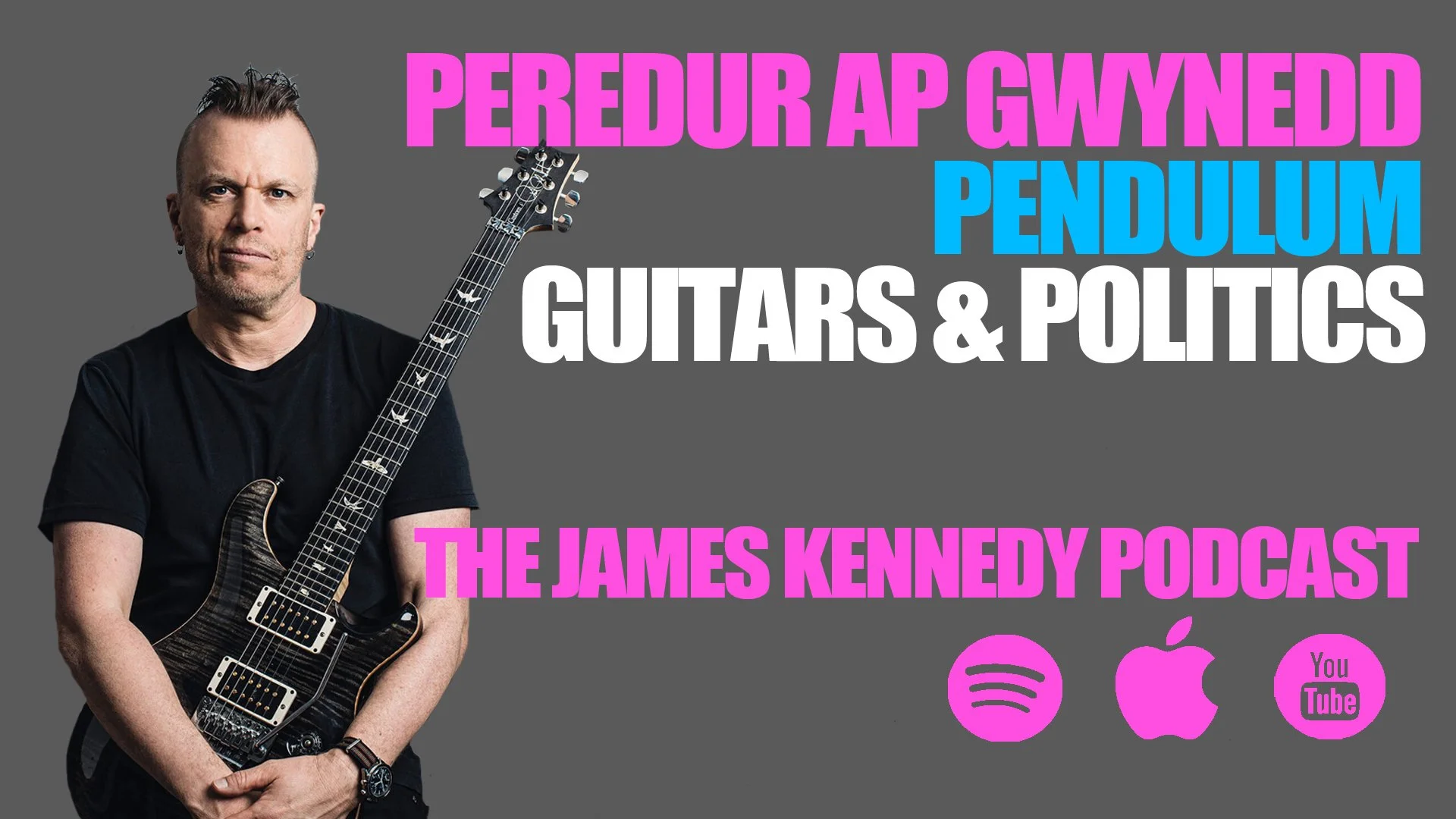
James Kennedy interviews Pendulum guitarist and session musician Peredur Ap Gwynedd about his musical upbringing in Wales to playing arenas worldwide with artists like Natalie Imbruglia and Anastacia, composing for TV, navigating the post-Brexit touring crisis, Welsh Independence and his return to the stage with Pendulum
James Kennedy: I'm joined today by the brilliant Peredur Ap Gwynedd. Perry, thanks so much for joining us, man. How you doing?
Peredur Ap Gwynedd: Very good, thank you very much. Thank you for asking me on the pod. I'm honored.
James Kennedy: Well, it's an honor to have you, man. I'm looking forward to picking your brains. We've got loads of stuff I want to get into, but first, I just want to double-check: you are a Pontypool boy, is that right?
Peredur Ap Gwynedd: That's right, yeah. I was born in Pontypool, and then I lived in Pontllanfraith for a little bit, so yeah, so I'm a Gwent boy or Monmouthshire boy. Is it Monmouthshire, or is it still Gwent? It's Monmouthshire now?
James Kennedy: I think it's Monmouthshire. The Monmouthshire Massive.
Peredur Ap Gwynedd: Yeah, it's so confusing. Every time they change the names of the counties, I'm like, where am I from again?
James Kennedy: Were you born there?
Peredur Ap Gwynedd: In the hospital in Griffithstown, yeah.
James Kennedy: Did you live in Griffithstown as well?
Peredur Ap Gwynedd: No, I lived in Pontllanfraith.
James Kennedy: So you were raised in Pontllanfraith, right?
Peredur Ap Gwynedd: Yes, for a little bit, then we moved further west. That's Blackwood more or less.
James Kennedy: So you're more of a Blackwood boy then, I'd say.
Peredur Ap Gwynedd: Well, it's like the Blackwood / Pontllanfraith metropolis, isn't it?
James Kennedy: Yes, right. Because the reason I'm inquiring so intensely is because I was raised in a place called Little Mill, which is just outside of Pontypool, so I wondered if you might have known of it, because it's like a tiny little village, doesn't have a shop or a post office, and that's it.
Peredur Ap Gwynedd: No, we moved from there when I was about three, so we moved then to Carmarthen and then Pembrokeshire, and then I moved to London, but I am a Monmouthshire boy, and not a lot of people know that actually; they think I'm from West Wales from Crymych, but I'm not.
James Kennedy: You're a southy.
Peredur Ap Gwynedd: Yes, southeast, that's where I'm from, and I'm quite proud of it actually.
James Kennedy: Are you a Welsh speaker?
Peredur Ap Gwynedd: I am, yes, it's my first language. I grew up speaking Welsh at home, so it's obviously totally natural to me.
James Kennedy: Well, I was gonna say, dude, you've probably got the best name we've ever had on the podcast so far. Son of Gwynedd, that's fucking awesome.
Peredur Ap Gwynedd: Yeah, it's kind of quite metal really, isn't it!
James Kennedy: Yeah, man, the name sounds like you're going on a fucking conquest.
Peredur Ap Gwynedd: Yeah, but Peredur was a knight of the Round Table; he was one of Arthur's knights, and the English speakers would know him as Percival, Sir Percival, so it's Peredur or Sir Percival, or in German, Parsifal. So if anybody knows any Wagner operas, there's a famous opera from the Ring Cycle called Parsifal, and I think it's from the Ring Cycle, anyway. I did a music degree, I should know this shit.
James Kennedy: This is already fucking really interesting. We're already on Wagner and ancient etymology, I love it. Well, I suppose we should start at the start, because you've had like an insane career. I think most people would think of you now, I suppose, as the guitar player in Pendulum, but you've got this whole other career before that with acts like Natalie Imbruglia and Anastacia and tons of others. So I suppose, should we give people the backstory as to what you've done, how you got started, and what led you to where you are now?
Peredur Ap Gwynedd: Well, growing up in Wales, as you probably know, it's very musical, there's music everywhere, and if you go to a pub, it's usually four-part harmonies after a couple of pints. But yeah, so I left, I moved further west, and I ended up in Crymych in Pembrokeshire, and in Crymych there was a rock school there in the further education wing in our secondary school. And I was playing guitar anyway; we had guitars at home, my parents both played acoustic guitars, folk stuff, then, and I picked that up probably when I was about nine years old. And then about 13, there was a rock school, and everybody who had an interest in guitars or drums or bass, keyboards, or singing all went to this rock school, and I started playing in my first band. So it's from then really.
And then I went on then and did music A-level. A friend of mine was a guitarist called Myf Isaac, he used to play in Budgie, he now composes music for TV mainly in Wales, but Myf told me, "You could do this professionally," and I was like, "Really?" because I hadn't really thought about it, and I was 16 years old not knowing what I should do, and for somebody to say that I could do this as a profession was like a bit mind-blowing. And there's him, Myf, and then my guitar teacher in school called John Rodge, he's amazing, he's an amazing folk guitar player, he's a jazz player, ridiculous country chicken-picking stuff, so good, so good. And he also told me that I could do it, and he said then maybe I should think of doing music A-level, so that's what I did.
So I did music A-level and then applied for some universities, and I ended up in London in Goldsmiths College and University of London. And the reason I chose that was they have a music studio and an electronic music element to the course as well—not electronic as we know it as dance music, but electronic as in Stockhausen and classical, electronics, experimental stuff, yeah. So it's all that really. So yeah, I went to London, stayed here—well, I've lived in other places on and off, I went to Paris for a bit, I've lived in Sydney for a little bit, and LA as well for a little bit. But I always come back to London. Usually when I come off tour, when I used to come off tour, if there was a gap, I'd get a flat and just soak up the atmosphere somewhere else, and I'll then do some work with various artists over there or songwriters. And after I finished uni, I started doing sessions then, and then my first main big session would have been Natalie Imbruglia.
James Kennedy: So how does something like that come about? I mean, so you're like a student on a course with, I'm guessing, tons of other musicians who are all awesome. So how does that penny drop there?
Peredur Ap Gwynedd: I got into a band with a drummer called Chuck Sabo. Chuck, he's a session guy, American drummer, he's lived in London for years and he's a session guy. He worked with Elton John, Take That, God, what else did he do? Just a load of big names, and he had his own band with him and his wife. So I met somebody who knew him, and Chuck was looking for a guitarist, so I joined his band. And then Chuck got asked to put together a band for Natalie, and so he just said, "Do you fancy playing for Natalie?" I went, "Yeah, right."
James Kennedy: So what age were you at that point?
Peredur Ap Gwynedd: Early twenties. So a few years after college. And so we got together, it was a bunch of us. It was myself, my brother was on bass—my brother moved to London by that time, he went to uni in another place, but he moved in with me in Camden. And so it was myself, my brother, and a guy called Chester came on the other guitar. Chester played with Bryan Ferry, and he was also the guitarist on "Like a Prayer" by Madonna. So yeah, Chester is a top session player; he plays with David Gilmour now, Jesus, and has played with Roger Waters as well, he's done both Pink Floyds.
So that was back in '97. I joined, I got an advanced copy of "Torn"—so for all the young kids out there who don't know what "Torn" is, "Torn" is Natalie's first hit, and it was a massive, massive banger. Huge. Worldwide. So I got an advanced copy of the CD, and I listened to it, and I went, "Yeah, I'll get three months work out of this." Eventually, I had nine years of work in total. So yeah, that first couple of years was all quite bonkers, because I'm getting treated like royalty all over the world. And it never got to number one in the UK; it was number two for weeks because the number one at the time was Aqua, "Barbie Girl".
James Kennedy: Hey, no touching "Barbie Girl"!
Peredur Ap Gwynedd: So "Torn" is one of those singles that never, ever got to number one in the UK. Wow. Then it got number one various places in Europe, got massive in Europe. So the first thing we did, we went out to Italy, went out to Netherlands, went to Belgium, we just did this massive promo tour, both playing a lot of it live and doing acoustic stuff. And she was the biggest thing on the planet at that time, and then it got released in America and it just got huge. It was number one in the Billboard charts for 10 weeks, one of the most heavily rotated songs on radio that year.
And we first went out to the States then in March '98, I think it was, and the first thing that we did was the David Letterman show. I was like, "Yeah, I'm a boy from South Wales going into the deep end." David Letterman was great, "Oh my God, what am I doing?" And two days after that, we did Saturday Night Live. So I've just recently found the episode of Saturday Night Live that we did; it was the one that Scott Wolf presented, he was an actor from, I think the show was called Party of Five. So he was a presenter of the guest garden, and at the very end where he says his goodbyes and everybody's on stage together and he's there banging the middle and Natalie's just to the side of him, and I am in between the two of them like, "Hello, I'm on telly!" And it pans out, and then I start dancing with this comedian called Tracy Morgan—he's one of my favorite American comedians—and I'm dancing with him, and then the thing pans out and Will Ferrell walks towards me and starts talking to me. Oh my God, this is before he was famous, and I'm obviously just dancing with some tall bloke! So a few years later I went, "Oh my God," and I've just recently found it again online.
James Kennedy: So I can't imagine—you're in your twenties, you're a few years out of university, and you're fucking on the David Letterman show, you know what I mean? That's insane.
Peredur Ap Gwynedd: Yeah, it's nuts. It was a lot of fun, and then that carried on basically. We did Jay Leno a few times, Letterman a couple of times, Jay Leno three or four times. And it just kept on happening then for nine years.
James Kennedy: I had no idea, because I mean, for people who can't remember, that was a fucking iconic, massive, massive song, wasn't it? I mean, it wasn't really my kind of thing—for me, I was like into Frank Zappa at that time.
Peredur Ap Gwynedd: I was listening to Gregory Peckery as well, on personal stereo.
James Kennedy: Anything that was on the radio was like, "Oh, that's pop." I was probably playing "Torn" in covers bands for college money, but I wasn't really familiar with anything that she did after that. So that gig kept you going for nine years?
Peredur Ap Gwynedd: Yeah. So she did another album after that called White Lilies Island, and then after that it was Counting Down the Days, and the album went to number one, the third album in the UK. And I was with her until 2006. We're still mates, we're still in touch with each other, we still talk.
James Kennedy: That's amazing, Jesus. Well, what an introduction to the music industry, because I'm guessing you were right in at the pro end, you know, the private planes, the fucking arenas?
Peredur Ap Gwynedd: There was a private small propeller plane—there was never a private jet, but there was one small one, but it's usually just normal, you know, we never got the private jet treatment. But it was always jumbos apart from one journey that we did from Biggin Hill airport to Newquay down in Cornwall for a Radio 1 Roadshow thing back—that's the only private thing that we ever had.
James Kennedy: I'm sure there's been opportunity since then with everything that's happened since, because you've also gone on—like, I mean, that's already a fucking hell of a story, but that's not where it ends, because you bounced in from there to doing working with, or were you doing the other stuff as well as that, or did it come separately?
Peredur Ap Gwynedd: During Natalie, I did a year with Sophie Ellis-Bextor during Natalie's first album, and then I did a year with Kim Wilde as well, so Kim Wilde overlapped Natalie for a little bit. And then back in 2004, I'd been working with—there's a producer called DJ Fresh, an artist called DJ Fresh, and he's done all types of things. He used to be in a drum and bass band called Digital Nation, and I used to do a load of stuff for them, and then he had a label called Breakbeat Chaos. And he brought these producers over from Australia called Pendulum, and they wanted some guitar on the first album. So Fresh went, "Oh, it's my mate Perry, he can play guitar," so I just went up to their flat in Barnet in North London and just put some guitar down on the first album, right.
And then I'd forgotten about it, and then two years later I was actually in Paris working with a French artist called Mylène Farmer—she's like Madonna in France, the French version of Madonna, you know. The band was nuts, you know, we had Abe Laboriel Jr. on drums, you know, Paul McCartney's drummer, and Shakira's bass player, and Milton McDonald from Take That on the other guitar, the proper big fuck-off arena tour thing, right.
And then during that tour, I was just chatting to a mate of mine who also knew Fresh and used to tell me about Pendulum, and I said, "Oh yeah, you know, they're really big," and I was like, "What? Oh yeah, they sold 400,000 copies of the album." I was like, "What?" because it was totally underground new drum and bass, you know. And then they got in touch again, they wanted to do it live and did a gig in Fabric, which was the first live gig that we did, that was in October 2006. And then the next year I got asked to join full-time.
James Kennedy: That's amazing. There's so much in there we could unpack, but we don't have—you know, I can't keep you all day, so we're gonna have to do the kind of Hollywood edited version. But that sounds like such a fucking constant streak. I mean, make the rest of us poor bastards feel better: were there low points when it all went to shit, or has it been like just a crazy streak?
Peredur Ap Gwynedd: I've been really lucky. It's been a kind of constant line of gigs really, because when Pendulum went on hiatus in 2012, we went on a four-year hiatus, and then during that point I started work—I did a couple of years with Anastacia, and then after Anastacia I went on the road with Faithless for two years. And then in 2016 Pendulum got back together again after the hiatus and started gigging again and started releasing new stuff.
James Kennedy: And before we come on to pendulum then, because you're actually in the band with Pendulum, I know you're not like a session guy or something like that, so what is the difference then? Because I've heard—I've got a few friends who are session players who've played, you know, big—I won't mention any names, you know, but big stadium tours and stuff—who've given me a lot of horror stories and bad news about treatments and disposability feelings and things like that. What was your—I mean, I know the industry and climate is very different now to what it was back in the '90s and early noughties, but what was the life like as a session musician on these tours?
Peredur Ap Gwynedd: Obviously you're not the boss, you're a hired hand, but I've been really lucky with the people that I've been working with over the years; they've been bloody lovely, you know. I've heard horror stories, and certain people I wouldn't want to go on stage with, I definitely wouldn't want to be on a tour bus with them, but I've been so lucky, everybody that I've worked with has been great, really nice people. It's like one of my philosophies in life, especially to do with work: don't be an asshole. If you're an asshole, people won't hire you.
I've been really lucky that the people I worked for, they've all been great and they've become good mates and we had a lot of fun, and that's what it's all about at the end of the day. If you can't enjoy what you're doing, what's the point of doing it? And if you're on tour with an absolute nightmare of an artist or whoever, or somebody in the band that you don't get on with, then I know it gets difficult because that's happened to some friends of mine. But I've been so lucky that that's never happened to me.
Well, I think you have to be really unlucky to work with an asshole in the music industry, because the way it's set up, as I said earlier, if you are an asshole, people won't hire you. And the same goes with artists: if you're an asshole to people who work with you—the record company, or management, or radio people, TV people, whatever—then they won't work for you. So you have to be nice. If you're not nice, people won't want to work with you, so you have to be very, very, very unlucky to work with a nightmarish person, I think.
James Kennedy: Yeah, that makes a lot of sense, like to see how it would fall down that way as well, you know, and you would know because you've been out in that world for a long time now.
Peredur Ap Gwynedd: Well, of course, because when you're a touring musician especially, you're with the tour bus—everyone calls it a touring family—and you're all on a tour bus together or you're flying together, and that could be for 18 months or even more, you know. And you have to get along, and people hire people who they know can get along with other people, you know. It's just—I've been really lucky that way.
James Kennedy: Well, you've mentioned being lucky a few times, and clearly you've had some awesome opportunities and stuff, but at the same time, taking into account everything else that you've described—you're easy to get along with, you're fucking kick-ass on the guitar, you're professional—I mean, that's the thing that people get twisted, I think, well, on the subject of luck. Because yeah, of course there's lots of good musicians out there who are hardworking and very nice and they just can't catch a break, we've all got friends like that. So of course you do need to have the element of luck, but that's not where the story ends; it's what you bring to the table from that point onwards then which determines whether you're able to stay afloat for longer than two weeks.
Peredur Ap Gwynedd: Yeah, luck is a big element of it, but you have to be in the right place at the right time. And I think if I would have stayed in Wales back in Pembrokeshire, I don't think I would have had these opportunities. 100%, I've had these opportunities because I've lived in London. For example, Chuck Sabo said, "Do you want to come over and jam?" That was 45 minutes on a tube for me. If I lived five hours away in Wales, that would never have happened, can't do it, can't do it.
And everybody who I speak to, young musicians who I speak to who want to do what I did, I always tell them—well, it's a cliché, but you have to be in it to win it. If you're not in one of the main musical centers, it's probably not going to happen to you. You have to be there. It's like with any job really; if you want to work in the financial district in any city, you know, it's pointless if you live up in the countryside 400 miles away. It's the same thing with any job really. So I tell all the young musicians who want some advice: move somewhere. It could be London, or Brighton is pretty good, or Bristol, or Liverpool now.
James Kennedy: Anywhere where there's something happening.
Peredur Ap Gwynedd: Yeah, Manchester, you know, because there's always chances for a session in a big city, you know. And obviously London is one of the main centers on the planet, not just in the UK, so you've got more of a chance in London than you would do in any of the other cities in the UK. And that's what I decided to do, because I knew that's where the industry was and that's where nearly all the record companies are, so all most of the acts are based in London. So that's why I moved there.
James Kennedy: It makes a lot of sense, and that's great advice to musicians listening, because we do have a lot of music industry specials on this giving advice to musicians and stuff. Listen, I think you were the first session—I know you're not exclusively a session musician, but you're the first session musician that we've had on, so it's great to have that insight as well from that side of the industry, and everything you say makes a lot of sense.
Peredur Ap Gwynedd: I mean, for me, I wanted to work in music, be it in a band or be it a session or wherever, and I just fell into the session thing. It's nothing that I—well, I kind of studied to do that a bit, jazz, read some music. I've got a degree, I should be able to read bloody music, you know! So I was kind of veering towards that way, but it was just total luck that I got that first gig, you know.
James Kennedy: So amazing, amazing. Well, what a story, man, what a story. I mean, it sounds as if you've been working and gigging pretty much relentlessly since that time until—if my research serves me correctly—until 2018? Was that the last tour you did with Pendulum prior to that?
Peredur Ap Gwynedd: To the lockdown, yeah. My last gig pre-lockdown was New Year's Eve, Perth, 2018. Perth, Australia, because we play a lot in Oz obviously, because a couple of guys are Australians and they're from Perth originally. So yeah, that was the last gig pre-lockdown. But that's what I do: when I'm producing music for television, right, it's something I've always done since the '90s. I'd rather not be twiddling my thumbs or practicing my guitar really—that's the most boring thing in the world.
James Kennedy: That's really interesting, because I'm always fascinated by what musicians do, because diversification is something that comes up all the time. Especially these days, you've got to be versatile and have a few strings to your bow. So I always wonder what people do when they're not touring. I had no idea that you had that element as well, that's fascinating, man.
Peredur Ap Gwynedd: Yeah, I've always produced music, so I'm sat here where you can't see it at the minute, but behind that is my studio, my studio setup. And I've always done that really—started working on TV in the '90s for S4C, the Welsh language channel, and started doing music for them. And you know, I do stuff for BBC, ITV, well, stuff worldwide really, do adverts and music for adverts as well.
James Kennedy: That's amazing, a lot of sync stuff then. So is it like library stuff? Do you prepare a bunch of stuff in advance, or do you do stuff to brief?
Peredur Ap Gwynedd: I've done both. I've done library music, and what I've done a lot is, you know those singing competitions you have on TV, you know the backing tracks? Whether they're all bespoke because obviously they have to be in a different key or done with different arrangements, I've done those for different programs since Fame Academy—that's the first time I did that. So me and a friend of mine, Kenny Dickinson—he's a keyboard player, but Kenny played for Natalie as well and KT Tunstall and people—we have this production thing together that we do these backing tracks for singing competitions for TV shows all over the world.
James Kennedy: That's fucking amazing, man. Dude, you're crushing it, man, I had no idea. Yeah, so in the lockdown then, like when you weren't gigging—because I was going to ask you, what the fuck did you do, did you go out of your mind in the lockdown? But it sounds as if you kept yourself pretty busy.
Peredur Ap Gwynedd: Well, no, because obviously television shut down as well, and we were in the middle of one as lockdown started, and then it kind of ground to a halt really. So the problem with shows like that, any type of show really, was the costs doubled just to keep everybody safe. So if you've got a brand new singing competition coming out on TV, they actually pulled it—the one that I was about to do on ITV, they pulled it just before it started, because they'd have to get all the crew and everybody involved in the show to stay in one hotel totally isolated from the outside world for two months.
And so basically all the testing and all the precautions they had to do, you know, basically doubled. If a TV production cost two million quid normally, with COVID precautions involved and the way you have to deal with that, it was four million quid. And this one show in particular, ITV went, "You know what, nah, sod it, we'll pull it." But if it's a show like Strictly say, you know, the guys on Strictly... but for a brand new show like the one that I can't even remember what it's called to tell you the truth, COVID costs put the kibosh on that. But I started doing sessions again, so I was just doing recording sessions, guitars, and started producing other artists as well.
James Kennedy: Wicked. So you kept yourself pretty sane then off the stage. Because I was going to ask—my last tour was also in 2018, and then in 2019 I kind of hunkered down, I wrote my book and made my new album that was coming out and everything like that. So I did a lot of like production stuff and getting shit ready for 2020, which was going to be the big one, you know, and then it just fucking killed all of that.
So for me, I haven't—because of the two years of the lockdown and then my father passed away last year, he was ill, terminal cancer for most of last year, so I had a European tour with the band and a UK tour that was like the first coming out of lockdown, coming out of the gate swinging, you know, and then we had to cancel all that. So for me it's been three years now, and if I'm right, was it the same for you as well with Pendulum?
Peredur Ap Gwynedd: We did our first gigs—not as a full band, I might say—it was 2021. We did a bunch of hybrid DJ-live things, because we still couldn't get KJ, our drummer, he couldn't come over from the state he lives in, in Las Vegas, so he couldn't come over from the States because of restrictions. So it was myself, Rob, and Gareth—they were on decks, and I was on live guitar, Rob's doing live vocals—just the three of us went out and did like six mini festivals over that summer. And then last year, 2022, we did a bunch of sporadic festivals across the world; first one was in Miami in March, and then just a bunch of European festivals then.
James Kennedy: And what was that like coming back then after—you know, because I still haven't done it yet—I bet it's weird, right?
ENJOYING THE CONVERSATION?
GET JAMES KENNEDY'S LATEST INTERVIEWS, WRITING AND LIVE SHOWS STRAIGHT TO YOUR INBOX
Peredur Ap Gwynedd: Really weird. Because going on stage for the first time after that, you kind of walk on stage, you go, "Right then, what do I do now? Do I stand, do I move over there, or do I move back a bit, spread legs or what?" "Do I bang my head right now, or what? I don't know." Because it's being on stage and I have to—you know, basically living on stage for years—being back on stage then, it's just like, "Oh my God, it is really, really..."
James Kennedy: Did you miss it then, like emotionally? Was it kind of like, did you have that surge of "Oh, this is—yes, I missed this," or was it kind of like, "Oh, this is weird"?
Peredur Ap Gwynedd: No, it was just weird the first few shows. Because it is a weird thing to do anyway, but you get used to it. But then for me, it was just going and doing this weird thing and I'm not used to it anymore, it's just like, "God, that's just really fucking weird man, it's just like what the fuck is this?" And it took me a few gigs to get into it again, just to feel at home on stage, you know. It's very strange.
James Kennedy: But you're back now, you're settled in, you know, you're back to the old natural habitat.
Peredur Ap Gwynedd: Yeah, it's been great. So the festivals we did over the summer were fantastic, you know, and we've got more gigs coming up this year. The first one we announced was Brixton Academy, and that went on sale sometime in November I think, and tickets sold out in 15 minutes. And then we put another one on in Brixton, and that kind of sold out—well, it was a little bit slower because the Queen died, so that sold out with a bit of competition, right! So we've got two gigs in Brixton, which is amazing. We love Brixton, favorite place to play in the world. It's got two shows in Brixton in March, and then festivals and tours and stuff after that as well.
James Kennedy: Yeah, summer season, man, yeah, perfect. How is—because we both spoke at the House of Lords select committee hearing, didn't we, about the effects of Brexit on touring, UK artists touring in Europe post-Brexit? Has that affected you guys or your crew in any way?
Peredur Ap Gwynedd: Not really, no, because we didn't do that many shows last year. If we did, then it would have. Because another thing that I do as well apart from music is I work as a cycling commentator on the Tour de France, so I was out in the EU for the first weekend of the Tour de France and for the final week, so that added to my dates. But if we were touring a little bit more, then it would have affected me. But luckily it didn't, but I know loads of people that it has affected, same, they lost their jobs because of it.
And you know, the fact that UK musicians are now losing jobs to musicians with EU passports because it's easier for them to tour the EU. Giving an example, pre-Brexit, 80 percent of my income was from gigging in the EU, right. So that's when touring was normal, and touring is coming back into normal. So yeah, so it was 80 percent of it. That's how big a chunk of my income came from working in the EU. And yeah, so it's a bit scary when you think about it really.
James Kennedy: Well, yeah, I mean, it's similar to what you mentioned earlier about when you were talking about, yes, you have to have the ability, you have to have the talent, but you also have to be—people have to be able to work with you. And I think when productions on the mainland or they're touring through the mainland are considering crews, they're going to consider, "Well, you know, can this lighting crew or this sound tech or roadie or whatever it is, can they do the whole tour or can they only do 90 days and then they've got to go back again?" That's going to be a consideration people are going to make, which is outside of their ability or talent as crew members. It's just fucking terminal for many people's careers, you know.
Peredur Ap Gwynedd: Absolutely. It's easy for me, because I'm part of a band. If I was just doing sessions—imagine if the Pendulum hiatus was now, then I would be in trouble, because we were touring Europe a lot. And one of the artists I was working with was Anastacia, with Steve Barney. Steve Barney, good mate of mine, right. So Steve lost his job. Have you spoken about this before on this pod?
James Kennedy: Not in a while. Well, not Steve specifically, because you used his as a case study, didn't you, in your tour? Yeah, it was brilliant.
Peredur Ap Gwynedd: If people don't know, then Steve has played with Anastacia since 2009; it's been his main gig for that long. And he, obviously like every other musician, he lost his gigs over COVID. And then beginning of last year, he got offered a gig with an Italian artist called Gianna Nannini, this huge Italian artist in March, and then he went, "Yep, I'll have that." So he went on tour. And then halfway through that tour, he got a call from Anastacia's management asking about his availability for an upcoming tour in September—it was a European tour going through September, October, and November, I think.
And then they found out about this whole 90 days in 183. So as a UK passport holder, you can only be in the EU or in Schengen area, sorry—certain countries within the EU for 90 days within every 180 days. So from this date, you count back 180 and you're only allowed to be in the Schengen area for 90 days. And he found out that he only had 12 days left by the time Anastacia's tour would have started.
And so they tried all sorts of things. The government say, "Oh yeah, you can get visas, you can have working visas." You can't, it's impossible, you can't get working visas. So what the government is saying is a lie; you can get some working visas, but nothing that covers the whole of Schengen. So basically, if you're touring the EU, you're touring Schengen mainly. And he found out that he couldn't do it. And then there's nothing that Anastacia's management could do—they had to find another drummer. So they got another drummer in—a great drummer from Finland, so she's got an EU passport, so there's no hassle then touring with her anymore. So Steve's basically lost a job. And there was a UK tour, a two-and-a-half-week UK tour involved within that European tour, and he lost that as well. So a British musician has lost a British job just because of Brexit.
James Kennedy: It's an awful story. And Steve, he went big with it, didn't he? He posted it on social media and he went viral and really helped to kind of highlight this issue. And he's still a victim of it, as are so many other people, you know, and people who aren't, I suppose, on that side. They're not under the spotlight, literally speaking, you know—it's the backstage crews and the drivers.
Peredur Ap Gwynedd: Yeah, I think it's worse for the crew even, because the crew, more than a session musician, they will jump off one tour and join another one. And because that's what those guys do—if you're a rigger or a caterer, there's no rehearsals involved, you just go bang and you start the next gig. If you're a musician, then you have to go into rehearsals. But if you're a crew guy or girl, then you're more likely to jump off from one tour to the other, and that's how people make their livings. But no British crew politicians can't do that anymore because of this stupid rule. And the Tories—it's an absolute fucking... I hate the Tories. You don't? I didn't get that vibe about you, dude, to be honest.
James Kennedy: Actually, no, no, that's wrong, I don't hate all Tories. No, I've actually got some Tories friends who... ouch... they're actually, yeah, yeah, but they're actually all right. But they're so disgusted with the Tories, they don't vote Tory anymore—they're like closet Tories, right! But yeah, they're disgusted by them as well, you know. But we can talk about the Tories if you want: I hate Brexiteers.
James Kennedy: Yeah, and there's still a few people who were kind of desperately clinging on to the idea that it was a good idea despite all of the evidence that it was an absolute fucking disgrace and shambles.
Peredur Ap Gwynedd: Assholes, they're dumb assholes in this country. Yeah, it's literally gone to the dogs, it's terrible. You know, the whole—God, what is it? I saw the exports are down, was it 47% or something? And we'll never get that back, because the people in the EU, they're buying from somewhere else now, their products they were buying from the UK. You know, it costs so much money to export and import to the EU.
James Kennedy: On the flip side, we've got our freedom back, you know what I mean? We're free from the clutches of those EU bureaucrats that were holding us down.
Peredur Ap Gwynedd: Man, you know what, it's not just the far right, it's the far left as well. It's like—I saw a great quote the other day, it was like the far right wanted to leave the EU because they thought the EU was like the Soviet Union, and the far left want to leave the EU because the EU wasn't enough like the Soviet Union. And it's just like—and the thing just recently, you know, with the whole train strike, I support the train strikes 100%, and it's right what they do, but the whole Mick Lynch thing being a Brexiteer... I'm like going, "Mate, did he..." He got his ass handed to him on a plate on the James O'Brien show the other day, you know, because the TUC came up with the fact that due to Brexit, all workers' rights are being eroded away now, and only due to Brexit. And Mick Lynch, ardent Brexiteer, you know, it's partly his fault, he told his union—the RMT told all their members to vote leave. And I look at him and I see Nigel Farage.
James Kennedy: Well, self-interest. You know, he was thinking about the interest of his own community of people and their employment prospects, but that's the fucking point, you know what I mean?
Peredur Ap Gwynedd: Well, with Mick Lynch, he wanted us to leave the EU so it'd be easier for us to nationalize the rail companies. Every single country in the EU has a nationalized rail company, every single one!
James Kennedy: And we used to have a nationalized rail industry! What's—we used to be in the EU, it wasn't the EU that made it privatized, it was the fucking Tories!
Peredur Ap Gwynedd: Yeah, so the far left and far right for me are just as bad as each other, you know. And I think Mick Lynch is worse than Farage, because he's all for the workers and he made his workers poorer. You know, it's just—he's such a hypocrite. But I do 100% support the strikes.
James Kennedy: We all do, man. And I agree with a lot of what Mick Lynch says, I think he's right on the way he kicks their fucking ass in the media and stuff like that. The problem is for me is that the Tories have just fucked everything, they brought us to this situation. Because just look at the state of our society, has it ever been this fucking bad, man? I mean, you know, everybody's on strike, major infrastructural backbones of the whole country are all on strike, you know, they're shipping people to fucking Rwanda, you know, it's the Brexit, the state of the economy, the cost of living crisis, the energy crisis. I mean, is there anything that they haven't fucked up? Yet we continue to elect them, I just can't make any sense of it.
Peredur Ap Gwynedd: Well, the UK isn't a left-wing country—well, sorry, no, no, England isn't a left-wing country. Wales is a left-wing country, Scotland is a left-wing country. England isn't, and England is way bigger than Wales and Scotland, right? So it's always been a right-wing country, you know. And the furthest left I think this country's ever voted was Harold Wilson, I think, off the top of my head, you know. But mainly they vote for the right-wingers, that's what England does, it's always done it. You know, back 200 years ago there wasn't such a thing as the left wing, you know, it was the Whigs and the Conservatives. It's a very strange thing, but that's England for you, you know.
James Kennedy: It's almost like we've got this kind of addiction to self-abuse or something like that, because we can clearly see that none of these decisions actually make our life any better, in fact they make them worse, and they're like, "Yeah, we'll go, yeah, we'll do that, yeah, cool, you know, we won't complain as long as the pubs stay open, we're okay."
Peredur Ap Gwynedd: Yeah, you know, it's a funny thing. I heard somebody complaining about the strikes last week, and she was saying, "I've got a low-paid job and you don't see me going on strike." It's like, oh, come on, come on, use your brain! It's like, God, England isn't a left-wing country, and you know, people can moan about it as much as they want, but it's still going to be—it's not a left-wing country, but Wales is. If Wales went independent, they'd have had Labour Party leadership for the last 100 years, since Labour started back in the '20s or whatever. But it's England, so... and England's got this monopoly. Well, it's not a nation of equals, really, is it?
James Kennedy: So do I take from that then that you are pro-Welsh independence?
Peredur Ap Gwynedd: Fucking hell, yeah! Even though I've lived in England for a long time, I've lived in London all my adult life. There's nothing wrong with England, you know, it's a fucking great place. No, no, I love England, I'm married to an English person and I love living in England, England is a really nice place to live, in London is anyway—I've never lived outside of London—and I've got a lot of friends down here who are English. Got nothing against England whatsoever. But I do have an issue with how the political system is set up here, right, because as you know, Wales is totally different from England, and Scotland is totally different to England. It'd be nice to have some sort of political—not economic union, but not a political one, you know, like the economic union you've got between the UK and Ireland, that's great, you know, we can work there, they can work here.
James Kennedy: And we could rejoin the EU, you know.
Peredur Ap Gwynedd: Yeah, but exporting and importing from Ireland is a little bit more difficult now because of that, yeah right. But yeah, I'm all for independence for Wales, I love it. I've got no say in Scotland, but I do hope they get it as well, you know, because the way that our culture, the Welsh culture, has been eroded for centuries now by the English Parliament, you know, it's really bad.
James Kennedy: 100%. Well, anytime you can bring democracy and the machinery of democracy closer to the people making the votes, I think that's a good thing. It's further away—you were saying, I know that was a left-wing argument against the EU, was because, "Oh, these are unelected EU bureaucrats," but I mean, they are elected.
Peredur Ap Gwynedd: That's the weird thing, that they are elected. I voted in the European elections, you know, like a lot of other people did, but some people didn't, and they didn't realize they could do that. But you know, it's... I think Mark Drakeford saying just for Christmas about how bad the NHS is in Wales at the minute and he doesn't have enough money from Westminster to invest in the NHS in Wales—yeah, come on, come on! He's nearly there, you know, it's like he's saying something and what he's saying is there's an obvious answer to this. There's an obvious answer to it: how do you get more money from Westminster? Or maybe just scrap Westminster altogether and you're in charge of your own taxation?
And you know, it's highly possible that Labour will get in in the next election, and they've promised more devolution and all that, but then you know that's only going to last for a certain amount of years and they are going to get voted out again because it's the Labour Party, they always do something, always messes up with them.
James Kennedy: Well, if they can't win the next one, dude, they might as well just fucking throw the towel in, you know what I mean? Because I mean, it can't get any worse! If you can't win an election now against the Tories, it's fucking over.
Peredur Ap Gwynedd: I think that they're going to win the election in spite of Keir Starmer being leader, not because of him. Because his advisors, his speechwriters, they're rubbish, they're so bad. At his speech a couple of days ago, last week, he just—it's just so corny, he comes up with terrible one-liners. You know, he was there in his shirt and tie with his sleeves rolled up, you know, classic, and he comes out with, "The Labour Party are going to roll up their sleeves and sort out the economy" or something. I mean, come on, stop it! Who writes that? It's just terrible.
James Kennedy: But it's laughable, you know, it's for real, like that's the speech.
Peredur Ap Gwynedd: And then his whole thing about the freedom of movement—was it on the Sophie Ridge program or was it on Kuenssberg? Sophie Ridge, I think, yesterday on Sunday, saying that he in 2020 said he wanted freedom, and basically now he says he doesn't want freedom, you know, three years later. It's like, come on mate, absolutely useless. Every time he opens his mouth on that subject he just makes a fool of himself. And he's trying to—what is he trying to pander to? The far right, you know, because he knows that what he's saying, what he's saying is bullshit, utter bullshit. He knows this, because he doesn't believe what he says. Brexit is a shit idea, right, and we've seen that, and we've seen how the economy has gone because of it. Brexit is a really shit idea. How many shit ideas has anybody seen turn out good? I can't think of any.
And him trying to say that, "Oh no, we're going to make Brexit work"—you can't make it work, it's shit! You can't polish a turd! Literally, polishing a turd—that's a cliché thing, you know, it's a cliché saying, but seriously, get a turd in your hand and try to polish it, you can't do it, you're just smearing shit over your hand! And Starmer coming up with this crap all the time, and if he backtracks like that then he's going to look even more of an idiot, you know.
James Kennedy: And it's like they're not an effective opposition. And because of our voting system—I left Labour to join the Greens because I'm going to vote with my conscience from now on, I'm going to vote with my conscience from now on—but I've learned the error of my ways, you can't, because the only actual opposition we do actually have that has a fighting chance of ever getting in is Labour. So you have to... and you know, it's such a fucking shame, because they are not an effective opposition, they're not a united party at all, and the only way that they can make themselves remotely palatable to enough of the voting public is to water down their left-wing aspects and move more into—and basically appease the same sort of people that the Tories basically do.
Peredur Ap Gwynedd: Absolutely. Because if you want to be Prime Minister, you have to win over Tory voters, yeah. That's the simple thing, that's the basic thing with politics in the UK: you have to get Tory voters. Corbyn's not going to get Tory voters, no bloody way. Ed Miliband obviously didn't do it. David Miliband is more likely to do it—well, would have been more likely to do it. But you know, you have to win over Tory voters, and I'm lucky, I live in a constituency in London that happens to be the 19th safest Labour seat in the UK, so I can vote for whoever I want. Harriet Harman's my MP and she's great anyway. But yeah, that's the problem—if it was PR, it would be totally different, wouldn't it?
James Kennedy: 100%. We did an episode on PR a few months ago, we had Make Votes Matter on to talk about how explain how all that works and stuff, and it just makes so much more sense. If we have PR, this would be a no-brainer. But I mean, it sounds as if we share the same disappointment in our party. I mean, ever since Tony Blair—Tony Blair ruined it for me, you know, because he just fucking killed for me, like I said, there was that old romantic feeling that I have about traditional Labour values. And you know, when Margaret Thatcher says you're her greatest achievement, then you know you're the devil.
Peredur Ap Gwynedd: With Tony Blair, that's when I realized, "Oh my God"—it was the whole Iraq War thing. It's just like, stop it! And all our troubles now can be kind of, if you look back, it all started from there—the whole war in the Middle East and the whole refugee problem, and then Syria coming out of that as well.
James Kennedy: And the financialization of everything, schmoozing to the City, all that stuff, you know.
Peredur Ap Gwynedd: Yeah, it could all be traced back to that Iraq War basically. And if we would have said no, I think we'd be in a way better position than we are now. And you know, the whole refugee crisis, that's what set a lot of right-wingers off and a lot of racists off.
James Kennedy: And it doesn't look like things are going to get better anytime soon, I don't think. I think we're in quite a hole now, and I think it's going to take us a long, slow journey to get out of it. My guess is—I mean, I don't know, I've lost a lot of faith in humanity—my guess is that Labour probably will win the next one.
Peredur Ap Gwynedd: Yeah, they will, but I don't know how long they keep a hold of power, because it wouldn't surprise me if the Conservative party do another shift to the right, further to the right than they are now. And that's what the really scary stuff is, you know. If that happens, God knows what happens if the Reform party and the Tories kind of merge, then there's a lot of racism in the UK.
James Kennedy: Yeah, and that's just easy to fire up when people feel angry and disillusioned and disenfranchised and insecure, you know. That's the old classic go-to, and I've said a couple of times on the podcast before that I just see this pattern that the reason the Tories are so good at staying in power is because they pander to the primal emotions in people: fear and tribalism and that sort of stuff. And that's a lot easier to tap into than abstract notions like democracy and justice and equality, you know—they are more complex things to talk about rather than "immigrants are gonna steal your job, here we go." It's as simple as that. And that's what we need to have, exactly what you said: we need to have an opposition that are willing to play the popularity contest, because it isn't just about policy, it's about personality, it's about passion, it's about emotion, you know.
Peredur Ap Gwynedd: Yeah, I mean if you look at Trump, you know, when you got Trump and Boris Johnson, you know, "Go, yay, look at us, whoa!" And then on the other side you go, "All right, yeah, yeah..." The funniest, loudest one is going to win.
James Kennedy: The funny strong man, we're in the era of the strong man, you know. Hopefully it's going to die out soon, you know, but yeah, we are in a hole, it's gonna take a while to get out.
Peredur Ap Gwynedd: I'm not sure if it ever will, if we ever will survive that. I think it'll always be like that now, you know, because with the internet and all that, it's all about media and the media perception, unfortunately. So you could have the best policies in the world, but if you can't convey those policies in a decent way or in a good way to the public, then they're not going to listen to you. I should be in PR really, shouldn't I?
James Kennedy: No, don't do it, dude, stay exactly as you are, honestly, stay exactly as you are.
Peredur Ap Gwynedd: Political PR—well, I'd be really good at that for Welsh independence!
James Kennedy: Yeah, absolutely man, set us free!
Peredur Ap Gwynedd: Yeah, well, I'm a card-carrying member of Plaid Cymru, by the way.
James Kennedy: Top man, good for you, man. Right, well, I'm aware of the time and I feel like we could probably bitch about the politics of the Tories all day long, and God knows I would love to, but I can't keep you all day. I'm racking my brains for a way to segue this into the next question which I've got to ask you because it was sent in by one of our listeners who was dying to ask you this question... and it's just absolutely impossible for me to segue the Tories to this, so I'm just gonna have to figure it out! If I can just jump in and say it: as we approach the end of the chat, what is the one guitar pedal that you cannot do without?
Peredur Ap Gwynedd: Yeah, it's the Line 6 Helix. Without that I'll be a very, very quiet guitarist. For those of you who don't know what the Helix is, it's an amp modeling and effect modeling multi-effect unit, yeah. So I feel like that's a boring answer, but I haven't used—that gig in Perth in 2018, that's the last time I've switched on an amp. Every gig I've done since has been just the Line 6, okay, straight out to the desk. So basically I plug my guitar into the pedal and then there's a lead then that goes from the pedal into the mixing desk, and that makes—that sounds like a guitar amp, with loads of different effects in it as well, for the lazy people out there. So basically the Line 6 Helix has...
James Kennedy: Well, that's always a good thing, you know. Gone are the days of lugging fucking amps up stairways and stuff, you...
Peredur Ap Gwynedd: Yeah, so the Helix is like 12 and a half kilos, it's a piece of kit. But every single recording I've done since, for six years now, has been with the Helix, and I haven't recorded with an amp for a long, long while.
James Kennedy: That's amazing. I love Line 6 stuff, man. I had a Line 6 amp for years, but I've recently gone down—I've got the BluGuitar amp. Ever seen those?
Peredur Ap Gwynedd: Oh yeah, Thomas Blug, I actually know Thomas very well, yeah. Because I'm also endorsed by an amplifier company called Hughes & Kettner, Thomas used to work for Hughes & Kettner. So yeah, when I do use an amplifier I usually use Hughes & Kettner because it sounds great and it's got lovely shiny blue lights.
James Kennedy: Well, I love the BluGuitar, man, it's fucking a monster, you know. It's about the size—you know, it's about the size of an A4 piece of paper.
Peredur Ap Gwynedd: Because with my Helix, there's no compromise with sound at all. It sounds great, and because it's DI'd straight into the mixing desk, for me it sounds better because there's no inconsistencies in the sound. If there's a microphone in front of a speaker cabinet, the problem with amps was because there's so much bass and vibration on stage, because the music is so heavy, the amp or the microphone would move even though—it would vibrate and then bounce around, the microphone. If I'm—because we're all on in-ears as well, so we're on in-ear monitoring, so when the microphone just moves like millimeters to one side, you can hear it and you can kind of lose the guitar in the mix or whatever. So with the Helix I don't get that problem at all whatsoever, it's great, and I have carried it as carry-on luggage as well.
James Kennedy: I was going to say, the Helix—because they've got so many now—and it's also about the size of an A4 piece of paper as well, isn't it?
Peredur Ap Gwynedd: No, it's bigger, it's what, about 18 inches by 12. I'm looking down on it and I was like, it's at my feet, so yes, it's about 18 inches by 12, so it's a—there's they do a smaller version, but I've got the proper full fat version.
James Kennedy: Right, because I'm thinking of getting a Line 6 pedal—there was, I can't remember which one it was I was looking at, because in my last band my pedal board was about—unfortunately this is an audio-only podcast so people can't see the shapes we're making—my last pedal board was about like three meters by three meters in my last band because I was the only guitar player. But now I'm just singing in my new band, so my pedal board is basically—for the few guitars I play rhythm on—it's just like a fuzz pedal, a tuner, and a lead boost, fucking nothing! So I'm thinking, yeah, for a fly-on rig I'm probably going to get one of the small Line 6 multi-effects.
Peredur Ap Gwynedd: Yeah, the HX Stomp, I think that's the one that's got amp simulators in it as well. It's a smaller version of that, it's got less memory or DSP in it, but if you just want basic stuff like that it's perfect, and it's about six inches by four.
James Kennedy: That suits me! Basically, I just don't want to carry anything ever again. You can put it in your pocket, perfect, that's good for me, man. Well, dude, thanks so much for this man. Like I said, I'm trying to be wary of your time because you're a busy dude, and I really appreciate you coming on and talking to us about your amazing career and giving us some insight and advice for other people, you know, the musicians listening as well, and showing what a fervent left-wing fucking red socialist you are as well, you know.
Peredur Ap Gwynedd: Did I tell you I'm apolitical?
James Kennedy: Oh, dear. You get two Welshies in a room talking politics, and it's always going to go one way, you know what I mean?
Peredur Ap Gwynedd: Exactly, it is. It's difficult to be anything other than kind of left or left-of-centre if you are Welsh.
James Kennedy: I think we're on the right side of the divide, dude. I'd rather be punching up than punching down any time. You know, you're pulling up and punching up. That's the way I see it, you know?
Peredur Ap Gwynedd: Absolutely.
James Kennedy: So before I do let you go, what can people look forward to with the band? What's happening with the band? What's coming up?
Peredur Ap Gwynedd: Well, we've got these two gigs coming up in Brixton in March, and then there'll be more shows after that. There will be more announcements happening soon, there's going to be new music coming out as well. Sweet. So yeah, I think we're going to be busy most of this year and into next year as well. Amazing. There will be lots of—well, quite a lot of chances for people to see us live. So we're doing Download, we're doing the 20th anniversary of Download.
James Kennedy: Oh, nice. And various other festivals, so...
Peredur Ap Gwynedd: Oh, you've got a good year ahead of you then, man. Hopefully. Nice. Well, you fucking deserve it, man. It's been a crazy few years, so I'm glad that you guys are back in full force kicking fucking asses and taking names. You deserve it.
Peredur Ap Gwynedd: Thanks, James. Hopefully we'll cross paths again at some point later on in the year.
Key Points:
Guest Peredur ap Gwynedd, guitarist of Pendulum, was born in Pontypool and raised in Crymych, Pembrokeshire, with Welsh as his first language.
He began playing guitar around age nine and joined a rock school at thirteen, later studying music at Goldsmiths in London.
His first major session was with Natalie Imbruglia in 1997, lasting nine years and including performances on David Letterman and Saturday Night Live.
He has worked with Sophie Ellis-Bextor, Kim Wilde, Anastacia, and Faithless, and joined Pendulum full-time in 2007.
He advises young musicians to move to major music cities like London, emphasizing that luck requires being in the right place.
He discusses post-Brexit touring difficulties, citing drummer Steve Barney losing work due to the Schengen 90/180-day rule.
Both host and guest criticize the Conservative Party, Brexit, and Keir Starmer, while expressing support for Welsh independence and the Green Party.
Summary:
In this episode of the James Kennedy Podcast, host James Kennedy welcomes Peredur ap Gwynedd, guitarist for the band Pendulum, highlighting their shared Welsh roots—both were born in Pontypool, though ap Gwynedd was raised in Crymych, Pembrokeshire.
Ap Gwynedd discusses growing up in a musical Welsh household, learning guitar at age nine, attending a rock school at thirteen, and later studying music at Goldsmiths in London. He details his extensive session career, starting with Natalie Imbruglia in 1997, which lasted nine years and included appearances on David Letterman and Saturday Night Live. He also worked with Sophie Ellis-Bextor, Kim Wilde, Anastasia, and Faithless before joining Pendulum full-time in 2007.
The conversation covers the challenges of post-Brexit touring, with ap Gwynedd citing drummer Steve Barney's lost work due to the Schengen 90/180-day rule. Both share left-wing political views, criticizing the Conservative Party, Brexit, and Keir Starmer, while supporting Welsh independence and the Green Party. Ap Gwynedd also discusses his work as a cycling commentator and TV music producer.
The episode ends with details about Pendulum's upcoming Brixton shows and Download Festival appearance.
The James Kennedy Podcast is a Society and Culture podcast hosted by musician and author, James Kennedy. Exploring the big questions around health, social issues, the arts, politics, mental health, the human condition and how to navigate this thing called life through casual conversations with scientists, activists, rock stars, philosophers and academics. Please subscribe, leave a rating and support the show.