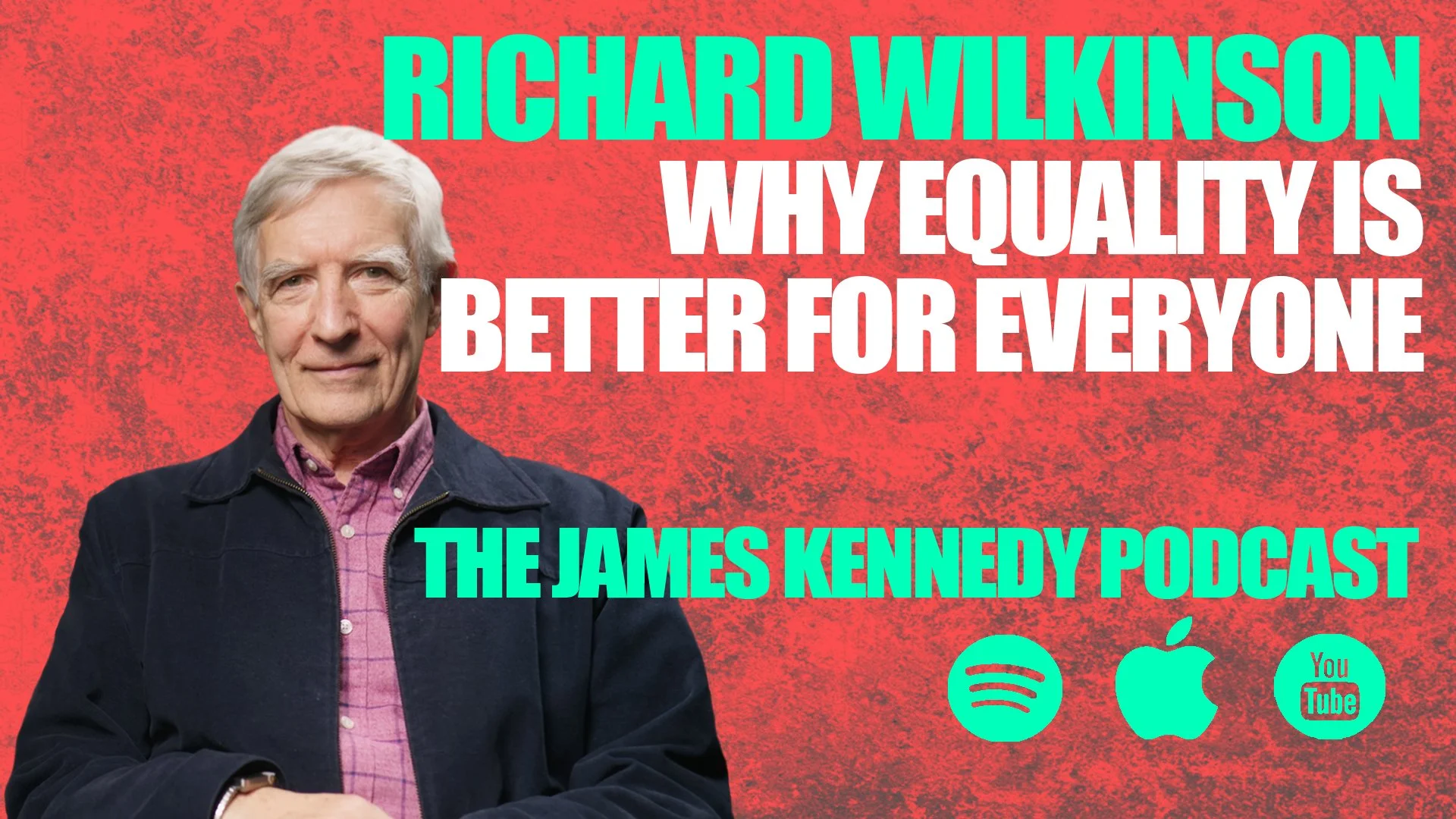
James Kennedy interviews epidemiologist and co-author of the book ‘The Spirit Level’, Professor Richard Wilkinson who explains how decades of scientific data prove that economic inequality is the root cause of modern society's biggest ills—from poor health and crime to anxiety and broken communities.
James Kennedy: Richard, I've been really looking forward to speaking with you, so thanks so much for stopping by. How are you doing, sir?
Richard Wilkinson: Thanks for having me. It's nice to be doing this. I always think there's no point in doing research unless people get to know about it.
James Kennedy: Yeah, I hear you there, mate. Well, I'm grateful to you. A lot of people do know about the book; it's done very, very well, and rightly so. I absolutely love the book. It's mind-blowing stuff, and I can't imagine the level of research that must have gone into creating the book. So, kudos to you and Professor Kate Pickett as well for bringing us this amazing book. For those who haven't yet read the book or don't know anything about it, would it be possible to give us a bit of a summary as to what the book is about and what the central theme of it is?
Richard Wilkinson: Well, in a way it comes out of a very old intuition that inequality is socially damaging, socially corrosive, damages the social fabric in a society. But now you can get figures on the scale of income inequality in different countries and actually start to look and see whether there are differences in various outcomes related to how unequal a society is. And in the rich developed world, countries like the USA and Britain are much more unequal than some of the Scandinavian countries. And it looks as if, as a result of that, they suffer more violence, more imprisonment, worse health—including mental health—a whole range of problems get worse.
So for instance, as I said, the US is one of the most unequal of the rich developed countries. It has the highest obesity rates, it has more homicide, it has more people in prison, it has worse drug problems, its life expectancy is actually going down at the moment. And that contrasts, for instance, with countries like Norway or Denmark, where you find exactly the opposite: they're doing well on all of those things, and they have much smaller income differences between rich and poor. And basically, we just did that sort of analysis.
James Kennedy: It's uncanny when you look at it. One of the things that stood out to me—the book is very fresh for me at the moment because I'm only just finished reading it—is to reiterate some of the issues that you just mentioned there and in the book as well, such as physical ill health, drug abuse, lower life expectancy, educational performance, high rates of violence and imprisonment and crime, obesity, social mobility, teenage pregnancies. All of these things you mentioned in the book, and they all get a chapter.
And what I found really uncanny, as I mentioned in the intro, is that when you assess all of these issues and then superimpose them over that country's level of inequality, the graphs that come out from that are all exactly the same. So it proves indisputably, visually on the page, that a country's level of inequality is directly related to its level of poor performance on any and all of these issues. And I just found that really uncanny, because it's airtight, you know? You would have thought there would have been a little bit of exception to the rule, but there's not, you know? It's iron-clad, and I just found that very uncanny. For me, it's case closed: inequality is the cause of these things.
Richard Wilkinson: Yeah. What's actually really uncanny is you find exactly the same pattern if you look at the 50 American states. Some states do better than others, and the ones that do the best are the ones with the smallest income differences between rich and poor. And so in a way it confirms that intuition that's been around since I guess before the French Revolution, that inequality is divisive and socially corrosive.
Now, that is a common intuition, and in a sense all we do is show this in hard statistical terms. What is surprising is that it's not just amongst the poor that inequality does the damage. Even better-off people would have happier lives if they were in more equal countries, right? They'd be—their children would be less likely to get seriously involved in drugs, they might live a little bit longer, and they do better educationally, they'd be less likely to be victims of violence. In that sense, even better-off people would do better if they lived in a more equal country.
So we're all affected, and the problems which inequality has its greatest impact on are the ones with what we call social gradients: problems that are more common amongst the poorest areas in inner cities. And we all know, in many of our big cities, the areas that have the worst health, or the most violence, or where kids do worst at school. So it's telling us that that pattern gets worse in more unequal societies, which makes a lot of sense.
James Kennedy: Well, it is an intuition. I think for many of us it will be common sense, but to have it there visually proven, it's indisputable. You can see it with your own two eyes, you know? It's indisputable that this is a pattern that happens all around the world, everywhere that it's tested, whether it be in various states within a country or in countries around the world. It's just an indisputable fact, I think.
How did we get here then? Because what's quite distressing to read as a British citizen is that we are pretty much always in the top form of the worst cases—whether it's mental health, or drug abuse, or violence, or imprisonment, or social mobility, we are always pretty much at the top of the league there along with the United States. How is it that some countries like us are so unequal, and then other countries like Japan or the Scandinavian countries are literally always right at the extreme other end of that graph?
Richard Wilkinson: Well, we used to be one of the more equal countries. In the 1960s and 70s, we were as equal as the Scandinavian countries are now, and we did better on all these things. If you compare us over time with other countries, you can see standards slipping as income differences widen. Looking at things like infant mortality, seeing that pattern there—that you know, we used to be one of the best countries in terms of infant mortality, and you see year by year our position in the sort of international league table of infant mortality slipping all the time until now we do pretty poorly.
You asked why. There's a clear pattern in most rich countries that income differences were very large in the 1920s and started to decline in the 1930s and went on declining, so we were becoming more and more equal until the late 1970s. And then from about 1980 onwards we get a huge rise in inequality again, and so we're now back to levels of inequality last seen in the 1920s. All the social progress has been reversed effectively. Class and status are now much more important than they were, and with that, declines in social mobility and so on. The whole social structure has become more ossified; status, as I say, matters much more.
I think that long-term pattern of changes in inequality is the result of really political changes or ideological changes. In the early part, in the 1930s onwards, there's a growing importance of the labor movement, social democratic parties, a belief that people have that there is a better way, our societies can work better for all of us, that life can be qualitatively better. And so you'll get voices on radio and television representing that sort of other view—what I call the sort of countervailing voice, if you like—whether that's trade union leaders or Labour Party figures or whatever.
But from about 1980 that all starts to crumble, disappear, and you get a rise of neoliberal free market fundamentalist ideology under Thatcher and Reagan. And it's not just in one country; it's an international change in thinking. And that right-wing ideology wins out, and the left loses any confidence in what it's about, where it's going, and so on. So I think that's what happens.
And of course, the Thatcher government and other governments around the world, they privatized the utilities—electricity, gas, water, phones, post offices, and so on. They lowered top tax rates. In the 60s and 70s, top tax rates for the richest people went up to 80 or even 90 percent; now they're back to 40 or 45 percent. So the richer are getting much, much more than they used to. But it's not just that the tax burden has declined, it's that the income differences before tax have increased dramatically.
Another of our research papers looked at income differences within big companies, and you find CEOs were earning—well, I sometimes think I shouldn't say earning, they were getting 20 or 30 times as much as the average production worker in the 60s and 70s up to around 1980. But by the first decade of this century, they were getting not 20 or 30 times as much—they were getting 200 or 300 times as much. Suddenly a huge escalation in the differences within large multinational companies.
And there are also research papers which look and see whether the performance differs according to how well-paid the CEO is. And if you take the top 500 companies in the US, for instance, you find the companies doing best are the ones with the less well-paid CEOs. You know, so they're not actually earning it; it's not justified at all by performance, which is of course how they justify the outlandish salaries.
James Kennedy: That's really interesting. So I was going to mention, you said that it all started to go south in the late 70s, and I thought, "Oh, what happened in the late 70s? Oh yeah, thatcherism, reaganism." So you could see a direct correlation there between the undoing of socially oriented politics more towards completely unregulated free-trade capitalism, and you could see that how the corrosive social effect that that has had is demonstrated clearly in your graphs.
Richard Wilkinson: Yes. Although it's hard to sort of graph changes in ideology, what people have graphed is changes in the proportion of the labor force in trade unions. And you see as the proportion in trade unions goes up, inequality comes down. And then when the proportion in trade unions starts to fall, inequality goes up again. And I think that's not because trade unions transform your wages—I'm sure they help—it's that trade union membership is a sign of the health, if you like, of the whole labor movement, of the social democratic parties, and so on—that alternative ideology in society.
James Kennedy: Well, there has definitely been a global ideology shift, hasn't there, since the 80s? And certainly here in the UK, we've followed the American model of just unregulated everything, free-trade capitalism, dog-eat-dog mentality, and we've got the demonstrable social scars to show for that, which seem to be very similar to the sort of social issues that they have. And much like America, our politics has now become completely dominated by the interests of the rich elite one percent business class, who I'm assuming are the main barriers to progress on the issue of inequality because they, of course, are the main beneficiaries of it.
Richard Wilkinson: Well, I think the influence of the rich on politics has increased enormously with rises of income differences. You know, they buy their influence; the money spent by large corporations and the super-rich on lobbying in most countries has increased enormously, and they manage to get the legislation they want. A lot of people have remarked how inequality is fundamentally destructive of democracy, and I do think our democracies have become more and more meaningless in a way.
I don't know, I think there's a solution to that. I think one of the ways of reducing pay differences is forms of economic democracy: employee representation on company boards, employee ownership, things like that. So gaining more equality by extending democracy into the economic sphere. And the evaluations suggest that more democratic companies work better than the usual forms of management.
James Kennedy: I guess it's difficult though, isn't it? Because the people that truly hold the reins of power these days, the people you just mentioned—the super-rich—I suppose they're not really affected by this, though, are they? I mean, they live in gated communities and yachts and private planes, and their kids go to private universities. So I suppose they are essentially insulated from the damage that this inequality—that they are the causes of—reeks on the rest of society.
Richard Wilkinson: Well, I think we're not completely insulated. We don't have data on the super-rich, so we can't see the levels of mental illness or violence or whatever. But we can talk about the top five or ten percent, and we see even they would do a bit better in a more equal society. The difference is smaller at the top—differences in what inequality does to people compared to the impact on the bottom of society—but it looks as though—and we all know that their children get mental health problems and become drug addicts and commit suicide and so on—they're not really insulated from what goes on in the rest of society.
James Kennedy: Yeah. And regardless anyway, I mean, you know, a 95 to 5 ratio is not a good split for the people that have got everything and then the rest of us that are scrambling amongst ourselves. So regardless of whether the top one, five, ten, twenty percent or whatever like it or not, it's still not cool. A democratic society ought to be able to deal with this, yes, whatever the top one percent are doing or thinking.
Richard Wilkinson: Right. But actually it's they who control what happens, and it's not only the lobbying, it's also the control they have over the media and the major newspapers, television, and so on. And actually it was clear in the States, you could see the right setting up right-wing radio stations and so on, which became more influential and helped this change in popular ideology.
James Kennedy: Well, I suppose it comes down to our values, doesn't it? I mean, we, as you mentioned, do have an instinctive set of values, and most of us know kind of instinctively that inequality is wrong. We don't need it explained to us why that is so, you know. We do have those values, but we've been locked into a system now whereby we are living out of alignment with our quite primal and natural human and communal values. So essentially, I feel that we need a shift back now. We need to reclaim the ground that we've lost and get back to a sense of living in alignment with the values that are better for everybody.
ENJOYING THE CONVERSATION?
GET JAMES KENNEDY'S LATEST INTERVIEWS, WRITING AND LIVE SHOWS STRAIGHT TO YOUR INBOX
Richard Wilkinson: Well, I think the more immediate effect—and one of the things when I give talks, I show that community life weakens, and people feel they can't trust each other. There are various questions in national surveys, like, "Do you feel people would take advantage of you if they got the chance, or do you feel most people can be trusted?" And that plummets with greater inequality. And of course that goes with people not feeling safe walking home late at night in our towns—and you know, it's a major issue particularly for women, and an infringement of their freedoms, very important fundamental infringement.
But you also get this rise in homicide rates, which has been shown all over the world. So those unequal societies are not only less friendly, less community-oriented, less trusting of each other, but they're more dangerous. And if you look at really the most unequal societies—places like Mexico and South Africa—you see it's gone a stage further: people are actually afraid of each other. They've got bars on their windows and doors and razor wire around the top of their gardens and so on, and other people are to be feared, kept out, dangerous. And that is really so tragic, because studies of happiness and well-being show that the quality of social relations is absolutely crucial. You know, having lots of friends, being involved in community life, are fundamentals to happiness, and it's there that inequality is doing its greatest damage. And that's not just the poor; it's what all of us suffer.
James Kennedy: 100%, yeah. And that ties in with something else I wanted to ask you about. I haven't yet read The Inner Level, which is the other book that you co-authored with Kate Pickett. The tagline to that is "How more equal societies reduce stress, restore sanity, and improve everyone's well-being." Now, I'll be fascinated to read that because we have seen—and it's quite well known now—that there's a global increase, certainly in the Western world, of anxiety and stress and depression and all of these things. And I think it's a direct result of this ideology shift that we've been talking about, this kind of dog-eat-dog, "you're on your own, there's no community, it's just the individual." Living out of alignment with our natural sense of community and tribalism is going to be detrimental to people's mental health. And certainly now at a time of the cost-of-living crisis and war and all the bad news, and our national assets are getting sold out from under us and stuff like that, more and more increasingly are we becoming stressed and tense and pressured and anxious and despairing because of the ever-tightening grip of this right-wing conservative capitalistic worldview. So am I right in thinking that that's where you're going in the other book, The Inner Level?
Richard Wilkinson: Yes. I think after writing The Spirit Level we felt that people still didn't see that they were personally affected by income inequality. It was something that was out there in society, but you know, most of us, we only think about our friends and family and so on. We have an idea of the personal life that really matters to us, and the big outside things in society are somewhere else. And so we wanted to show that actually the mechanisms come right into our most personal experience.
Actually, what inequality does—I said it makes class and status more important—that means it raises issues of your feelings about self-worth. And it's clear that we feel that we're more worried by other people's judgments: how they see us, and you know, do they think that we're stupid, incompetent failures, or do they think we're very successful and clever, and all the rest of it? And there is a response to that. If you're worried about how you're seen and judged by other people—and we all are to some extent, you know, you're worried about the impression you give to people and what you look like and whether you've got the right sort of a decent car or whether you've got the latest phone or your clothes, whether they've got the designer labels—what you find is people buying more status goods. They're spending more money on things that look good, from clothes to cars.
But the psychological response is twofold. You can either feel a lack of confidence, insecurity that you're no good, you find social life too stressful, you withdraw from—you don't go to parties and even things like that because you're worried about all this stuff. Social contact becomes more stressful and anxiety-provoking; you withdraw from social life, you get depressed, and so on. Or the other response to feeling worried about how people see and judge you is to big yourself up, so you go in for what psychologists call self-aggrandizement, right? Self-enhancement.
And part of it, as I said, through consumerism. But you can see it in—there's a nice research paper which looked at what they called status anxiety, and they show that in more unequal countries the whole population, all income groups from the rich to the poor, have more status anxiety than people in a more equal society. So we all get more twitchy about how people see and judge us. And those issues of confidence are very personal, and I think we all feel that, you know, we have this little psychological weakness: "Well, I'm a bit worried about what other people think of us." And that lack of confidence is seen—I think we mostly see it as a sort of personal psychological weakness that we hide away. In fact, we should share it with others and say, "Look, I know and I feel like this, and so do you," and we must put our guard down and share these things a bit.
But I think part of the decline in community life is that we are more worried about these social connections. We're more worried about—you're more hesitant to start chatting to people who you don't know, because you just feel more inhibited, socially inhibited, I suppose.
James Kennedy: Yeah, yeah. That I think you're right. That's something that we all carry, even—even people in the top 5% I'm sure are going to have that kind of, I suppose you could describe it as a kind of relative status. You know, it's like we're all constantly made to feel inadequate compared to what's happening, what we think is happening in the rest of society. And because of this value shift that's now happened, you know, since the late 70s, is we now tend to measure things based on our personal level of success or personal riches or personal possessions or personal power or strength in whatever form that might be. And we tend to identify very much now in that way. And of course we get it rammed down our throats as well, you know, the examples of people who are richer and better looking and more successful than we are. And we do have this feeling that it's on us, you know, to make it on our own and to fight our way to the top of the pile rather than being part of a functional, healthy, equal society which would be a lot more attainable and a lot better for everybody.
Richard Wilkinson: Yes, it's a very fundamental damage to the social fabric. And I think people, you know, they feel it now, but they don't see the pattern of change. Perhaps it's harder for younger people to see it, but you know, I'm getting on now in terms of age, and I remember when society was different. And the changes since free-market fundamentalism, neoliberalism, Thatcher, and Reagan came in around 1980, in my own experience I can feel that they have made our society more antisocial. It used to be a warmer, more friendly, cooperative place than it is now.
James Kennedy: Well, I'm an 80s baby, so I don't have any other point of reference. You know, it's crazy, but I don't have a personal point of reference of what life could be like that would be different to this.
Richard Wilkinson: Bad luck! Yeah, yeah. You're right, we have to be campaigning, struggling to make a better society that has those characteristics that we know are important to our well-being and happiness.
James Kennedy: Well, speaking of solutions then, and moving us into a better direction—just to kick off, I asked ChatGPT, you know, the artificial intelligence computer, how we can solve inequality before I came on the podcast today, and I want to share with you what it said:
Tax the rich higher.
Increase wages.
Strengthen the unions.
Provide free education and free healthcare for all.
Tightly regulate the financial and real estate industries.
Now, I was quite impressed with that. I thought that sounded quite lefty for a robot. Would you agree?
Richard Wilkinson: Yes, I would. I've tried it out on a number of things—not that particular question—and I've been rather impressed by its answers. I suppose it's going through vast quantities of research and discussion and literature and so on, and just pulling out the stuff that comes up repeatedly.
Yeah, but I mean there's no doubt we've got to tax the rich more, given that our services, public services, are falling to bits. You know, whether it's school buildings with ceilings falling down, or lack of teachers in all sorts of subjects, or whether it's the NHS. The idea that you should allow the super-rich to be pulling in millions each year, and giving rise to—and families, I can't remember the word I want, but who will not have to work for generations because their great-great-grandfather was paid millions and they stashed it away and so on. We don't want a society like that, and nobody can really believe that allowing people to have those huge incomes is more important than funding the Health Service properly.
Yeah, but it's not just a matter of taxes and benefits. It's, as I was saying earlier, a matter of extending democracy into the workplace. And if there were some measure of democracy in the workplace, you might think your boss should get a bit more than you—you might think maybe you would vote for twice as much—but you probably wouldn't let them have 300 times. I'm saying "him" all the time, but of course there are, and there are a few women CEOs, but we say "him" because that is generally the way it is unfortunately, the way it is.
James Kennedy: Yes.
Richard Wilkinson: People actually often ask me how other forms of inequality fit into this: ethnic inequality, gender inequality. And actually they're all related, because in societies where you've got bigger overall income differences, there is more discrimination by ethnicity and gender. So women's pay disadvantage is bigger in those societies, and the differences between Black and White are bigger. So you know, it's part of—where I said that class and status becomes more important, with that goes a process of thinking the people at the top are brilliant and the ones at the bottom are hopeless. And the prejudiced feel that the poor are poor because they're—I don't know—lazy and stupid, yeah, all those prejudiced ideas.
But actually, as soon as anything becomes a marker of low social status—whether it's skin color, or in some countries your linguistic group, you know, in the States Spanish speakers, or in Belgium the different linguistic groups that go and have some status relevance, or in Northern Ireland what religion—where any of those things become markers of status, they are stigmatized.
And actually you can see in some of these things, like obesity, it changes. It used to be the fat and the rich who are fat, and the poor who are thin. In the 20th century that reversed, and so suddenly obesity starts to be stigmatized. And actually you see the same with suntan: when the poor worked in the fields and were very suntanned, the upper classes tried to keep as white as they could, carrying parasols to shade themselves from there because it showed they didn't work in the fields.
James Kennedy: I get it, yeah.
Richard Wilkinson: And as soon as the poor are living in cities, in basements, working in factories without seeing the sun at all, they became white, and it became fashionable to have a nice suntan. It's awful how the importance of class and status work out.
James Kennedy: I know, it really is, man. It's such a shameful, needless destruction to so many people's lives in so many different ways when it could so easily be the other way. And when you look at the world now, from your experience of the transition that society has made, do you see a hope? Are we moving—there's signs that we're moving in the right direction, that things are turning a corner—or are we just freewheeling our way to the end of the cliff?
Richard Wilkinson: Well, I think there's a big, big fight going on. But actually, even fueling the far right is, I think, that sense of loss of status, and, you know, "Make America Great Again"—people wanting, even if they've been diminished and looked down on, they want to be part of something that is seen as great, partly as a response to... But I know, I think the prejudices increase with the more you have your own status, self-worth taken away from you, the more you try and regain it by saying, "At least I'm better than those bastards." And so it generates prejudice downward, prejudice divisions.
But I'm in a way hopeful because I think that the amount of inequality is intimately linked to whether or not we can move towards sustainability. The environmental footprint of the rich is so much bigger than the poor. And if you start to try—if you have environmental taxes, carbon taxes, and so on—the poor will feel they're unfair unless there are much higher rates on the rich. And you saw this in France when President Macron proposed raising taxes on fuel, which he thought was a green measure, and the response was the gilets jaunes, and there was this huge movement lasting months and months in endless different French cities saying that that was unfair to be taxing the fuel that the poor used. And so Macron had to drop it.
And you know, there are lots of reasons for thinking that to make any environmental policies acceptable, they have to be accompanied by measures to increase equality. But as I say, particularly because, you know, the private planes and the endless months of flying done by the rich, and lifestyles and huge houses and so on, the environmental footprint is really so much worse. And actually to move towards sustainability, environmental sustainability, we just have to lower consumption, and it's the consumption of the rich which is the main offender.
James Kennedy: 100%. Well, as we come towards the end then—because I'm conscious to not take up more of the time that I promised you I would—what can people listening to this do? What can we do? What can the 95% of us actually do to regain control and steer us back to sanity?
Richard Wilkinson: Well, we started the Equality Trust, which you'll find on the web if you look up equalitytrust.org.uk. That's a small registered charity that campaigns for greater equality. But I think what people do in their workplaces—membership of trade unions and so on—is important. Students in some universities have taken up the issue of the pay differences within the universities between the vice-chancellor at the top and the cleaners at the bottom, and that has led to some changes. Many of the Labour-controlled local governments in Britain—I think 15 or 20 of the big cities in Britain controlled by Labour authorities—have set up what they call fairness commissions to recommend how to reduce income inequalities locally, and they have led to almost all those cities paying at least the living wage rather than the minimum wage. And some of them are insisting that their suppliers, the people they buy from, the companies also pay the living wage. And there's now a big living wage movement.
So campaigning on these issues is really important in all sorts of situations—not only at work and students and so on, but also through the sort of things that the Equality Trust is doing: talking about it. But joining trade unions is important too.
James Kennedy: 100%, yeah. I mean, essentially coming together as a community again, regaining that community attachment and that communal identity rather than the individualistic identity that we've all been sold into now, and coming up together stronger together, and regaining control of our shared resources and shared identity and shared power.
So Richard, thank you so much for doing everything that you've done along with Professor Kate Pickett as well to highlight and amplify this issue and to lay out the case so plainly and so clearly, demonstrated with the data as to why this issue now is case closed and indisputable. So we know what the problems are, we know why we have these problems, and we know what we've got to do about it. So it's an invaluable gift that you've given us, so thank you so much for all the hard work. As you said there, check out equalitytrust.org.uk if you want to get involved. And also I would 100% encourage everybody listening to this to rush out right now and buy the book, The Spirit Level, the book that we've been talking about today where all of this stuff is laid out with all of the information and all of the background. And also check out The Inner Level, which I have yet to read, but you can mark my words, I will soon be doing so.
Richard, thanks so much for giving us your time today. It's been a fascinating chat, and we thank you again for everything you're doing.
Richard Wilkinson: Well, thank you for spreading the word. Essential work.
Key Points:
The podcast argues that income inequality is the root cause of most social problems, including poor health, crime, violence, drug abuse, and declining trust.
Professor Richard Wilkinson and Professor Kate Pickett documented these correlations across hundreds of studies in their book The Spirit Level.
In rich developed countries, more unequal societies such as the US and UK suffer worse outcomes than more equal societies such as Norway and Denmark.
Inequality in countries like the UK fell until the late 1970s, then rose sharply after 1980 with the rise of neoliberal free-market ideology under Thatcher and Reagan.
Rising CEO pay, weaker unions, lower top tax rates, and increased political lobbying by the rich have deepened inequality and damaged democracy.
Inequality raises status anxiety and self-doubt across all income groups, damaging mental health and weakening community life, as explored in the follow-up book The Inner Level.
Ethnic and gender discrimination worsen in more unequal societies because class and status become more important markers.
Solutions include higher taxes on the rich, stronger unions, workplace democracy, living wage campaigns, and local fairness commissions.
Summary:
This podcast episode features host James Kennedy interviewing Professor Richard Wilkinson, an epidemiologist and co-author, with Professor Kate Pickett, of The Spirit Level. The central argument is that income inequality is the root cause of most social problems in rich developed countries, including mental and physical illness, violence, crime, imprisonment, drug abuse, obesity, and declining trust. Using data from hundreds of studies, the authors show that countries with wider income gaps, such as the US and UK, consistently perform worse on these measures than more equal societies like Norway and Denmark.
Wilkinson explains that inequality fell through much of the twentieth century but rose sharply after 1980 due to neoliberal ideology under Thatcher and Reagan, alongside weakened unions, lower top tax rates, and soaring executive pay. He notes that inequality fuels status anxiety, damages self-worth, and erodes community life, affecting everyone, not just the poor. Discrimination by ethnicity and gender also worsens in more unequal societies.
On solutions, Wilkinson endorses taxing the rich more, strengthening unions, extending democracy into the workplace, and supporting campaigns like the Living Wage and local fairness commissions through the Equality Trust. He also links equality to environmental sustainability, arguing that green policies must be paired with measures to reduce inequality to be accepted. The episode closes with a call for listeners to subscribe, read the books, and come together to demand a fairer society.
The James Kennedy Podcast is a Society and Culture podcast hosted by musician and author, James Kennedy. Exploring the big questions around health, social issues, the arts, politics, mental health, the human condition and how to navigate this thing called life through casual conversations with scientists, activists, rock stars, philosophers and academics. Please subscribe, leave a rating and support the show.